Available Online at www.ijpret.com
110
INTERNATIONAL JOURNAL OF PURE AND
APPLIED RESEARCH IN ENGINEERING AND
TECHNOLOGY
A PATH FOR HORIZING YOUR INNOVATIVE WORK
IMPLEMENTATION OF STABLE ETHERNET COMMUNICATION LINK FOR
EMBEDDED APLLICATIONS
VOLVOIKAR PRAMILA PRAKASH1, HASSANALI VIRANI2, RAJEEV JOSE3
1. M.E in Electronic Communication & Instrumentation, ETC dept., Goa College of Engineering, Goa University, India.
2. Professor, ETC dept., Goa College of Engineering, Goa University India. 3. Senior Project Manager, R&D, Siemens Ltd. Goa.
Accepted Date: 27/02/2014 ; Published Date: 01/05/2014
\
Abstract: This paper deals with the implementation of the Stable Ethernet communication
link for embedded applications. It basically applies the International Electro-technical Commission standards developed for data communication to manufacturing control networks. Recent enhancement of the industrial communications and networking are possible to apply in Ethernet networks system at all levels of industrial automation, especially in the controller level whereby the data exchanges in real-time communication is mandatory. In this paper an Embedded web server application with TCP/IP support and Ethernet interface is implemented to demonstrate Stable Ethernet link using ARM Cortex A8 core. The web server reference design includes complete source code written in C-language.
Keywords: ARM, Embedded Web Server, Ethernet, SYSBIOS RTOS, Lwip TCP/IP Stack.
Corresponding Author:MR. VOLVOIKAR PRAMILA PRAKASH
Access Online On:
www.ijpret.com
How to Cite This Article:
Available Online at www.ijpret.com
111
INTRODUCTION
Communication between any devices are required to be stable in order to have reliable data transfer as long as the complete data transfer takes place. Designing a Robust and Reliable Industrial Communications Infrastructure with Ethernet has traditionally been used to network enterprise workstations and to transfer non-real-time data. Ethernet has several properties that make it ideal for distributed embedded systems Communication software can be developed and tested on workstations and should be portable to a Real-Time Operating System (RTOS) without modification. By using TCP/IP on top of Ethernet, embedded systems can become globally accessible from enterprise networks. This connectivity and interoperability is possible, and affordable using commodity off the shelf (COTS) hardware and software, which has led to a recent surge in interest in embedded Ethernet [1]. In comparison with PC, the embedded system is greatly improved in stability, reliability and safety etc.
In this paper embedded systems and Internet technology are combined to form a new technology the Embedded Internet Technology, which developed with the popularization of computer network technology in recent years. It can be utilized to serve the embedded web documents, including static and dynamic information about industry machineries/systems. This technology could function in the hardware and software as long as they are connected. Only by using web browser through the Ethernet and TCP/IP protocol users can get access information of remote devices [2].
Available Online at www.ijpret.com
112
Figure1: Embedded web server
module. It has requirements, such as low resource usage, high reliability, security, portability and controllability for which general web server technologies are unsuitable [1].
II EXPERIMENTAL PLATFORM
The approach in this paper uses TMDSICEAM3359 (Industrial Communication Engine Version 2 ) ICE V2 Development board from Texas having 32-bit RISC CPU ,ARM AM3359 Cortex A8 microprocessor with 720 MHz core frequency as a platform for implementation of the required application.
2.1. HARDWARE
2.1.1. ARM
ICE V2 is based on AM3359 with fast ROM and RAM memories and a wide range of peripherals. Such as Clock, USB, SDRAM, UART, NOR Flash, SPI, TWI, Timer Counters, ADC and Micro SD Card Interface, LCD, RS232 Interface, Ethernet Interface, JTAG, Power, etc. The ICE V2 embeds two Ethernet ports with jumper for CPSW & ICSS mode selection.
2.1.2. Ethernet MAC (EMAC)
Communication over Ethernet and IP is based on the concept of network layers as delineated by the Open Systems Interconnection (OSI Model). Ethernet is Layer-2 and IP is Layer-3. This segregation of communications is one of the primary reasons Ethernet and IP have been so widely adopted. Segregation into layers allows each layer to be modified independently. It also allows mixing and matching of layers to implement specific data transmission and communication.
Available Online at www.ijpret.com
113
includes an internal memory that holds information about the Ethernet packets that are received or transmitted [1].
2.2. SOFTWARE
2.2.1. TCP/IP Protocol Suite
The TCP/IP protocol suite allows computers of all sizes, running different operating systems, to communicate with each other. It forms the basis for what is called the worldwide Internet; a Wide Area Network (WAN) of several million computers .The TCP/IP protocol suite is a combination of different protocols at various layers. An Ethernet controller driver controls the Ethernet interface. The applications can communicate with the transport layer through buffers with data and variables with control information [1].
LwIP is an implementation of the TCP/IP protocol stack. In order to reduce processing and memory demands, lwIP uses a tailor made API that does not require any data copying. Communication between the TCP/IP stack and the application programs are done either by function calls for the case where the application program shares a process with lwIP, or by the means of a more abstract API. The API functions in the part of the API that runs in the application process will pass a message using a simple communication protocol to the API implementation in the TCP/IP process. The operation is carried out by the API implementation in the TCP/IP process and the return value is sent to the application process by message passing [5].
2.2.2. SYS/BIOS
SYS/BIOS is an advanced RTOS from Texas Instruments for use in a wide range of DSPs, ARMs, and microcontrollers. It is designed for use in embedded applications that need real-time scheduling, synchronization, and instrumentation.
SYS/BIOS provides the following benefits:
• To minimize memory size, the APIs are modularized so that only those APIs that are used, be bound into the executable program.
• System calls provide deterministic performance to meet real-time deadlines.
Available Online at www.ijpret.com
114
• Structures such as semaphores, mailboxes, events, gates, and variable-length messaging are provided to support communication and synchronization [6].
2.2.3 HTTP Protocol
The Hypertext Transfer Protocol (HTTP) is an application protocol for distributed, collaborative, hypermedia information systems. HTML Hypertext Markup Language is the simplest encoding of a webpage to be served
III EXPERIMENTAL SETUP
A. Experimental Setup of the Embedded Web Server for Stable Ethernet link.
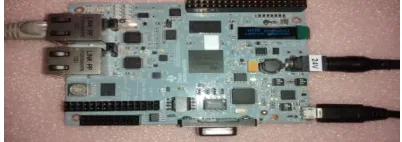
The experimental setup of the embedded web server is shown in Figure 2. The target is connected to the Ethernet port 1 of the network, the power is made available through the power cable. USB is used as the debugger while programming.
Figure 2. Experimental setup on ICE V2
B. Integrating RTOS and Embedded Web Server
The main part of the server is the RTOS handling the web server application. Whenever, a connection is established, a new task is created using Sysbios. And application is executed for that user running in a task.
C. Porting the Web Server
The Embedded web server application and the RTOS are ready and are to be ported on the target. The porting is done using Code Composer Studio 5.5 compiler. The target is configured over the network, to work as an embedded web server.
D. Testing the Embedded Web Server
Available Online at www.ijpret.com
115
settings: bits/s 115200, Data bits 8. Figure4 shows the result of the ping command made by the client. Here its noted that communications is stable.
Now request is made to the server, by typing the IP address‘198.162.1.2’ of the server in the client’s browser. This request is taken by the operating system of the client and given to the LAN controller of the client system. If the IP address entered is correct and matches to that of the server, a request is sent to the LAN controller of the server
Figure3. Result seen on HyperTerminal
Figure4. Ping statistics.
Available Online at www.ijpret.com
116
Figure5. Webpage Implementation.
The live capture of the packets sent/ received is analyzed by using Wire shark. When there is request from client for a webpage, it is uploaded using TCP/IP and a stable Ethernet link. Figure 6 shows the I/O graph obtained for a Http request, and dependencies of OSI model layers.
Figure6. I/O Graph
E. Issues
It is necessary that the Ethernet physical link gets detected and EMAC has its MDIO registers set accordingly. Once the link becomes alive, application can run over Ethernet easily ,hence stable Ethernet communication link is a must.
IV CONCLUSION
In this paper webpage application on ICE V2 is implemented with the required stable Ethernet TCP/IP communication link.
Available Online at www.ijpret.com
117
the data acquisition and control system such as the function, reliability, cost, size, power consumption, and remote access and so on.
REFERENCES:
1. Pramila P. Volvoikar, “Stable Ethernet TCP/IP Real Time Communication In Industrial Embedded Applications”, IJRES, Jan 2014.
2. Nakul Padhye, “Arm Embedded Web Server for DACS”,VSRD-IJEECE, Vol. 2(8),2012, 663-668
3. S. A. N. Sandeep, “Embedded Web Server Based on DAC System Using ARM” ,IJERA, Vol. 2,
Issue 4, July-August 2012.
4. Ms. Divya Agrawal, “A Novel Approach of Light Weighted Web Server Based on Arm-9” , IJSER ,Vol 3, Issue 12, Dec-2012.
5. http://citeseerx.ist.psu.edu/viewdoc/download?doi=10.1.1.109.1795&rep=rep1&type=pdf