Available Online at www.ijpret.com
136
INTERNATIONAL JOURNAL OF PURE AND
APPLIED RESEARCH IN ENGINEERING AND
TECHNOLOGY
A PATH FOR HORIZING YOUR INNOVATIVE WORK
ABRASIVE JET MACHIHING
*SURENDRA K MAURYA, SUNIL M YADAV, SUMIT N PATIL, DAWOOD M TOL
SE MECH Engg, GMVIT, Tala, Raigad. Accepted Date: 27/02/2014 ; Published Date: 01/05/2014
\
Abstract:AJM machining is a non-traditional process, wherein material removal is effected by the erosive action of a high velocity jet of a gas, carrying fine grained abrasive particle, impacting the work surface. The process is particularly suitable to cut intricate shape in hard and brittle material which are sensitive to heat and have a tendency to chip easily. Water jet machining (WJM) and Abrasive Water jet machining (AWJM) are two traditional or non-conventional machining processes. They belong to mechanical group of non-non-conventional process like Ultrasonic Machining (USM) and Abrasive Jet Machining (AJM). In this process the mechanical energy of water and abrasive phases are used to achieve material remove or machining. This paper reviews the current status and method of non-conventional machining process and discusses the unique advantage and possible applications. A water jet cutter is a tool capable of slicing of materials using a jet of water at high velocity and pressure, or a mixture of water and abrasive substance.
Keywords: Abrasive jet machining, Erosion Rate, Peening, Fluidized bed, Machining Removal Rate.
Corresponding Author: MR. SURENDRA K MAURYA
Access Online On:
www.ijpret.com
How to Cite This Article:
Surendra Maurya, IJPRET, 2014; Volume 2 (9): 136-141
Available Online at www.ijpret.com
137 INTRODUCTION
A steam of abrasive grains (Al₂O₃ or Sic) is carried by high pressure gas. This gas is impinges on work surface with high velocity through a nozzle of diameter 0.3 to 0.5 mm. Similar to Sand Blasting Process. Material removed by mechanical abrasion action of the high velocity abrasive particles. Generally use for Making holes on super-hard material. Highly use for surface finishing and typically used for cutting, peening and etching of glass, ceramics and other hard materials.
2. WATER JET MACHINING
In water jet machine, the water is pumped at sufficiently high pressure of about 200-400 MPa using intensifier technology. When water at such pressure issued from a relatively small orifice (generally of 0.2 to 0.4 diameters), the potential energy of water is converted into kinetic energy. Thus giving a high velocity jet upto 1000m/s. Such high velocity water jet is used to cut the sheets/foils of aluminium, leather, textile, frozen food etc.
Jet of abrasives particles is carried by carrier gas or air. The high velocity steam of abrasives is generated by converting pressure energy of carrier gas or air to its kinetic energy.
This is a process of removal of material by impact erosion through the action of concentrated high velocity stream o grit abrasives entrained in high velocity gas stream. AJM is different from shot or sand blasting, as in AJM, finer abrasive grits are used and parameters can be controlled or effectively providing better control over product quality. The cutter is commonly connected to a high pressure water pump where the water is then ejected from the nozzle,
Cutting through the material by spraying it with jet of high speed water. In working
The substances used in water jet slurry (Al2O3, Sic) powders are used for heavy cleaning, cutting, and debarring. And in case of soft metals used slurry of Sodium bicarbonate. For working process the nozzle stands off distance is 0.81 mm. In working process relative motion between nozzle and work -piece can be manually. Or automatically controlled using cam drives, tracer mechanisms or using computer controlled according to the cut geometry required. Marks of copper, glass or rubber can be used to concentrate the jet stream of abrasive to a confined area on the work-piece. Intricate and precise shapes can obtained.
Available Online at www.ijpret.com
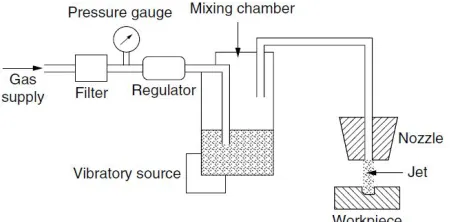
138 Fig 1: Working of Abrasive Jet Machining System
SCHEMATIC LAYOUT OF AJM
ABRASIVE JET MACHINING CONSISTS:-
1. Gas propulsion system
2. Abrasive feeder
3. Machining chamber
4. AJM Nozzle
5. Abrasive
4. TYPES OF ABRASIVE JET MACHINING (AJM):
A) Gas Propulsion System:
Gas propulsion system used for supplies clean and dry air. Air, Nitrogen and carbon dioxide to propel the abrasive particles. Gas can be supplied from cylinder. Gas should be non-toxic, cheap, and easily available. The propellant consumption is of order 0.008 m³/min at a nozzle pressure of 5 bars and abrasive flow rate varies from 2 to 4 gm/min for fine machining and 10 to 20 gm/min for cutting operation.
B) Abrasive Feeder:
Available Online at www.ijpret.com
139 C) Machining chamber:
It is well closed so that concentration of abrasive particles around the working chamber does not reach to the harmful limits. Machining chamber is equipped with vacuum dust collector.
D) AJM Nozzle:
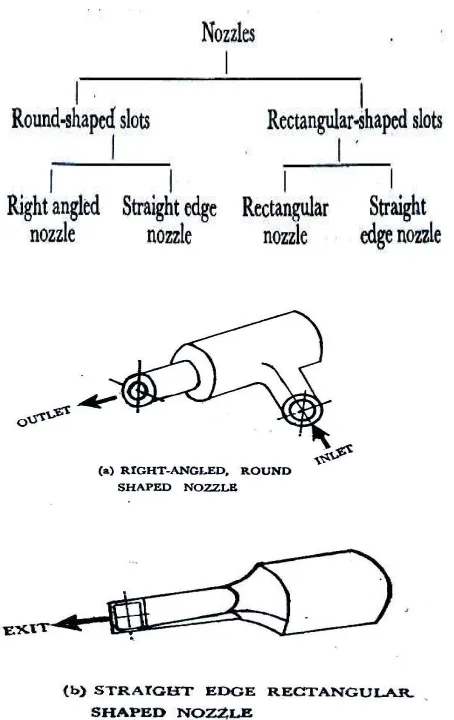
AJM nozzle is usually made of tungsten, carbide or sapphire which has resistance to wear. The nozzle is made of either circular or rectangular cross section and head can be straight, or at a right angle is so designed that loss of pressure due to the bends, friction etc is minimum possible. With increase in wear of a nozzle, the divergence of jet stream increases resulting in more stray cutting and high inaccuracy.
Available Online at www.ijpret.com
140 E) Abrasives:
Aluminium oxide (Al₂O₃) silicon carbide (Sic) Glass beads, crushed glass and sodium bicarbonate are some of abrasives used in AJM; Selection of abrasive depends on MRR, type of work material, machining accuracy.
5. CONCLUSION
1. A new technology which has immerged quickly and has replaced other old methods of manufacturing.
2. Apart from the typical machining, this method can also be used in food and soft-goods industries.
3. As material and pump technology advances faster cutting rates, longer component life and tighter tolerances will be achievable.
6. ADVANTAGES
1. Because of AJM is cool machining process, it is best for machining brittle and heat-sensitive materials like glass, quartz, sapphire, and ceramics.
2. The process is used for machining super alloys and refractory materials.
3. It is not reactive with any work-piece materials.
4. No tool changes are required.
5. Intricate parts of sharp corners can be machined.
6. The machined materials do not experience hardening.
7. Material utilisation is high.
8. It can machine thin materials.
9. There are no heat affected zone's
7. APPLICATIONS
Available Online at www.ijpret.com
141 2. Debarring of cross holes, slots, and threads in small precision parts that require a burr-free
finish, such as hydraulic valves, aircraft fuel systems, and medical appliances.
3. Machining intricate shapes or holes in sensitive, brittle, thin, or difficult-to-machine materials.
4. Insulation stripping and wire cleaning without affecting the conductor.
5. Frosting glass and trimming of circuit boards, hybrid circuit resistors, capacitors, silicon, and gallium.
8. LIMITATIONS
1. The removal rate is slow.
2. The tapering effect may occur especially when drilling in metals.
3. The abrasive may get impeded in the work surface.
4. Stray cutting can't be avoided (low accuracy of ±0.1mm).
5. Soft materials can't be machined by the process.
6. Suitable dust-collecting system should be provided.
9. REFERENCES
1. www.flowcorp.com
2. www.waterjets.org
3. www.aqua-dynamics.co.uk
4. Abrasive Jet Machining by John H. Olsen