4016 FORMULATION AND EVALUATION OF BALOFLOXACIN FLOATING
TABLETS USING PEANUT HUSK POWDER AS NATURAL POLYMER
M. Purushothaman*1, C.Saravanan2
1 Scient Institute of Pharmacy, Ibrahinpatnam, Hyderabad-501506, India 2 Sun Rise University, Alwar, Rajasthan – 301030, India
*Corresponding author E-mail: [email protected]
ARTICLE INFO ABSTRACT
Key Words
Metoprolol Succinate, Floating tablets, Peanut Husk Powder,
Natural Polymer
A sustained release system for Balofloxacin designed to increase its residence time in the stomach without contact with the tablets was achieved through the preparation of floating tablets by the direct compression method. In the present study attempt has been made to develop sustained released drug delivery system by formulating the floating tablets of Balofloxacin using peanut husk powder as a natural polymer (cellulose 35.7%, hemicelluloses 18.7%, lignin 30.2%) which is biodegradable, biocompatible, nontoxic, economically cheap cost, devoid of adverse and side effects and easily availability. Balofloxacin chemically 1 cyclopropyl-6-fluoro-8- methoxy-7- (3-methylamino piperidine -1- yl)-4- oxoquinoline-3- carboxalic acid used as an Antibacterial agent. The 9 batches of floating tablets (BF1 to BF9) were formulated by direct compression method using different ratio of polymers like peanut husk power, HPMC and carbopol. The formulated tablets were evaluated by means of different parameters like shape and density of tablet, hardness, friability, weight variation, drug content uniformity, Invitro buoyancy, swelling Index, Invitro dissolution studies. The formulation BF5 has better sustained release when compared other formulations, it release the drug of about 30.1% at the 1sthr and almost 60% release at the end of 8hrs, hence we conclude that the combination of peanut husk powder, HPMC and carbopol shows better Gastric retention time which sustains the release of the dosage form.
INTRODUCTION:
Balofloxacin chemically 1 cyclopropyl-6-fluoro-8- methoxy-7- (3-methylamino piperidine -1- yl)-4- oxoquinoline-3- carboxalic acid used as an Antibacterial agent. When dose is missing it may causes nocturnal attack, so attention was made to develop the extended release tablets of metoprolol succinate by utilizing hydroxyl propyl methyl cellulose K100M, Carbopol and Peanut Husk Powder.
To reduce the frequency of administration and to improve patient compliance, a sustained-release formulation of Balofloxacin is desirable. The drug is freely soluble in water and hence judicious selection of release retarding excipients is necessary to achieve a constant in vivo input rate of the drug. The most commonly used method of modulating the drug release is to include it in a matrix system [1].
An Elsevier Indexed Journal ISSN-2230-7346
4017 Hydrophilic polymer matrix systems are
widely used in oral controlled drug delivery because of their flexibility to obtain a desirable drug release profile, cost effectiveness, and broad regulatory acceptance. The purpose of controlled release systems is to maintain drug concentration in the blood or in target tissues at a desired value as long as possible. In other words, they are able to exert a control on the drug release rate and duration. In recent years, considerable attention has been focused on hydrophilic polymers in the design of oral controlled drug delivery system because of their flexibility to obtain a desirable drug release profile, cost effectiveness and broad regulatory acceptance [1].
The need for gastroretentive dosage forms (GRDFs) has led to extensive efforts in both academia and industry towards the development of such drug delivery systems. Prolonging the gastric residence of a dosage form may be of therapeutic value. Amongst the methods available to achieve this, floating dosage forms show considerable promise [2]. The basic idea behind the development of such a system is to maintain a constant level of drug in the blood plasma in spite of the fact that the drug does not undergo disintegration. The drug usually keeps floating in the gastric fluid and slowly dissolves at a predetermined rate to release the drug from the dosage form and maintain constant drug levels in the blood [2]. Several approaches are used for the formulation of gastroretentive systems such as mucoadhesion, flotation, sedimentation, expansion and modified shape systems. Both single-unit systems (tablets or capsules) and multiple unit systems (Multiparticulates systems) have been reported in the literature. Among these, FDDS offer the most effective and rational protection against early and random gastric emptying compared to the other methods proposed for prolonging the gastric residence time (GRT) of solid dosage forms. Extended-release dosage forms with prolonged residence time in the stomach are also highly desirable for drugs that are locally active in the stomach and those are unstable in the intestinal or colonic
environment or which have low solubility at higher pH values. FDDS has a lower density than gastric fluid and thus remain buoyant in the stomach without affecting the gastric emptying rate for a prolonged period of time [2]. Prolonged gastric retention improves bioavailability, reduces drug waste, and improves solubility for drugs that are less soluble in a high pH environment. Effervescent floating dosage forms prepared with the help of swellable polymers such as methylcellulose and various effervescent compounds such as sodium bicarbonate, tartaric acid, and citric acid. They are formulated in such a way that when in contact with the acidic gastric contents, CO2 is liberated and gets entrapped in swollen hydrocolloids, which provides buoyancy to the dosage forms [2].
The objective of present work was to develop gastro retentive formulation using peanut husk powder as a natural polymer which releases drug in the stomach and upper gastrointestinal (GI) tract, and form an enhanced opportunity of absorption in the stomach and upper GI tract rather than the lower portions of the GI tract [2].
MATERIALS AND METHODS:
Balofloxacin, HPMC K100 M, Carbopol, Sodium Carbonate, Magnesium stearate and talc were obtained from Madras Pharmaceuticals, Chennai. All reagents and solvents used were of analytical grade satisfying pharmacopeial standards
Preparation of gastro retentive floating tablets
4018 was directly compressed (9mm diameter
punches) using tablet compression machine. Each tablet contained 100mg of Balofloxacin and other pharmaceutical ingredients as listed in table no 1 in each section.
Evaluation of tablets
Compatibility studies:
Compatibility studies were performed using IR spectrophotometer. The IR spectrum of pure drug and physical mixture of drug and polymer were studied. Drug- excipient interactions play a vital role with respect to release of drug from the formulation amongst others. FTIR techniques have been used here to study the physical and chemical interaction between drug and excipients used.
Pre Compression Parameters
Angle of repose, bulk density, tapped density,Carr’s(compressibility) index and hausner’s ratio are determined to find out the flow property of granules during formulation.
A) Angle of repose:
In order to determine the flow property, the Angle of repose was determined. It is the maximum angle that can be obtained between the free standing surface of the powder heap and the horizontal plane.
Ө = tan -1 (h/r)
Where,
h = height, r = radius, Ө = angle of repose
Procedure: An accurately weighed sample was taken. A funnel was fixed in the stand in such a way that the tip of the funnel was at the height of 6 cm from the surface. The sample was passed through the funnel slowly to form a heap. The height and the circumference of the powder heap formed were measured. The radius was measured and the angle of repose was determined using the above formula. This was repeated five times for a sample.
B) Compressibility index (Carr’s indices):
Compressibility index is an important measure that can be obtained from the bulk and tapped densities. In theory, the less compressible a material the more flow able it is. A material having values of less than 20 to 30% is defined as the free flowing material.
CI = 100 (VO – Vf)/V
C) Determination of bulk density and tapped density:
A quantity of 5g of the powder (W) from each formula was introduced into a 25 ml measuring cylinder. After the initial volume was observed, the cylinder was allowed to fall under its own weight onto a hard surface from the height of 2.5 cm at 2 sec intervals. The tapping was continued until no further change in volume was noted. The bulk density, and tapped density were calculated using the following formulas
Bulk density = W / VO
Tapped density = W / Vf
Where,
W = weight of the powder, VO = initial volume, Vf = final volume
Hausner’s ratio: Hausner’s ratio is an indirect index of ease of measuring the powder flow.
Post Compression Parameters
Thickness: The thickness of the tablets was determined by using vernier calipers. Five tablets were used, and average values were calculated.
4019 weighed using a Sartorius electronic balance
and the test was performed according to the official method. Twenty tablets were selected randomly from each batch and weighed individually to check for weight variation.
Friability Test: The friability of tablets was determined using Roche friabilator. It is expressed in percentage (%). Ten tablets were initially weighed (Winitial) and transferred into friabilator. The friabilator was operated at 25rpm for 4 minutes or run up to 100 revolutions. The tablets were weighed again (Wfinal). The % friability was then calculated by –
%F = 100 (1-W0/W) - % Friability of tablets less than 1% are considered acceptable.
Drug Content:
Chromatographic conditions:
Column: 250 mm x 4.6 mm, 5µ , Detector: 293 nm, Flow: 1.2 ml/minute, Injection volume :20 µl, Temperature: Ambient, Diluent:. Mix Methanol:Water in the ratio of 300:700, Mobile phase: Filtered and degassed mixture of Methanol:Water in the ratio of 350:650.
Standard preparation:
Weighed accurately about 0.100g of Balofloxacin working standard into a 100ml volumetric flask, added 70ml of diluent, shaked and sonicated to dissolve the content, made up the volume with diluent. Pipetted out 5ml of resulting solution to 100ml volumetric flask made up with diluent.Filtered through 0.45 micron membrane filter.Collected the filtrate after discarding the few ml of the filtrate.
Assay preparation:
Weighed 20 tablets, triturate to a fine powder. Weighed accurately about 0.300g powdered tablets (equivalent to 0.100g of Balofloxacin) in to a 100ml volumetric flask. Added 70ml of diluent sonicated for 30minutes, and made up the volume with diluent, pipetted out 5ml of filtrate to 100ml
with diluent. Filtered the solution through 0.45micron membrane filter.Collected the filtrate after discarding the first few ml of the filtrate.
Procedure: Separately injected equal volumes (about 20 µl) of the standard preparation and the assay preparation into the chromatograph, recorded the chromatograms, and measured the responses for the Balofloxacin peak.
In Vitro dissolution studies
The release rate of Balofloxacin from floating tablets was determined using TheUnited States Pharmacopoeia (USP) XXIV dissolution testing apparatus II (paddle method). The dissolution test was performed using 900 ml of 0.1 N HCl, at 37
o
±0.5oC and 50 rpm A sample (5 ml) of the solution was withdrawn from the dissolution apparatus hourly for 8 hours, and the samples were replaced with fresh dissolution medium. The samples diluted to a suitable concentration with 0.1N HCl. Absorbance of these solutions was measured at 293 nm using a Shimadzu UV-1601 UV/Vis double beam spectrophotometer. Cumulative percentage of drug release was calculated using the equation obtained from a standard curve.
In vitro buoyancy studies
4020
Table 1. Precompressional Evaluation of Balofloxacin Powder Blend
S.No Formulation Angle of Repose (θ)
Bulk Density
(g/ml)
Tapped Density (g/ml)
Compressibility Index (%)
Hausner’s ratio
1 BF1 25o 87’±0.58 0.364±0.41 0.453±0.47 17.45±0.62 1.19±0.55
2 BF2 24o85’±0.61 0.359±0.39 0.425±0.42 16.32±0.67 1.17±0.56
3 BF3 26 o83’±0.57 0.365±0.43 0.481±0.43 15.55±0.64 1.16±0.51
4 BF4 23 o80’±0.63 0.355±0.38 0.436±0.46 18.39±0.66 1.19±0.53
5 BF5 25 o78’±0.56 0.394±0.42 0.472±0.48 16.63±0.65 1.15±0.54
6 BF6 24 o 86’±0.55 0.375±0.48 0.469±0.44 17.43±0.62 1.18±0.58
7 BF7 26 o83’±0.57 0.346±0.39 0.451±0.41 18.39±0.67 1.20±0.52
8 BF8 25 o85’±0.59 0.381±0.41 0.465±0.48 16.52±0.63 1.23±0.57
9 BF9 26 o88’±0.60 0.348±0.45 0.432±0.45 17.38±0.61 1.25±0.53
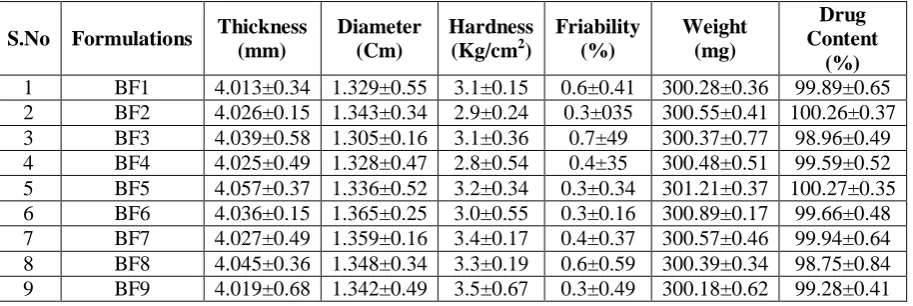
Table 2. Post Compressional Evaluation of Balofloxacin floating tablets
S.No Formulations Thickness (mm)
Diameter (Cm)
Hardness (Kg/cm2)
Friability (%)
Weight (mg)
Drug Content
(%)
1 BF1 4.013±0.34 1.329±0.55 3.1±0.15 0.6±0.41 300.28±0.36 99.89±0.65
2 BF2 4.026±0.15 1.343±0.34 2.9±0.24 0.3±035 300.55±0.41 100.26±0.37
3 BF3 4.039±0.58 1.305±0.16 3.1±0.36 0.7±49 300.37±0.77 98.96±0.49
4 BF4 4.025±0.49 1.328±0.47 2.8±0.54 0.4±35 300.48±0.51 99.59±0.52
5 BF5 4.057±0.37 1.336±0.52 3.2±0.34 0.3±0.34 301.21±0.37 100.27±0.35
6 BF6 4.036±0.15 1.365±0.25 3.0±0.55 0.3±0.16 300.89±0.17 99.66±0.48
7 BF7 4.027±0.49 1.359±0.16 3.4±0.17 0.4±0.37 300.57±0.46 99.94±0.64
8 BF8 4.045±0.36 1.348±0.34 3.3±0.19 0.6±0.59 300.39±0.34 98.75±0.84
9 BF9 4.019±0.68 1.342±0.49 3.5±0.67 0.3±0.49 300.18±0.62 99.28±0.41
Table 3. Composition of Each tablet
INGREDIENTS MF1 MF2 MF3 MF4 MF5 MF6 MF7 MF8 MF9
Balofloxacin 100 100 100 100 100 100 100 100 100
Peanut Husk powder 35 35 - 35 60 60 155 - -
HPMC E50 120 - 120 60 60 35 - 155 -
Carbopol - 120 35 60 35 60 - - 155
Sodium bicarbonate 25 25 25 25 25 25 25 25 25
Magnesium Stearate 10 10 10 10 10 10 10 10 10
Talc 10 10 10 10 10 10 10 10 10
Table 4. Buouancy studies of Balofloxacin Floating tablets
Formulations Floating Lag time Floating time
BF1 9±0.24 15.00±0.58
BF2 15±0.36 14.50±0.49
BF3 16±0.29 17.00±0.24
BF4 8±0.19 16.50±0.75
BF5 11±.41 13.50±0.29
BF6 4±039 16.00±0.37
BF7 16±0.48 15.00±0.22
BF8 12±0.67 17.00±0.78
4021 RESULTS AND DISCUSSION:
Compatability Studies: In the present study, it has been observed that there is no chemical interaction between Metoprolol Succinate and the polymers used.
Hardness test: The measured hardness of tablets of each batch ranged between 2.9 to 3.5kg/cm2 (Table 8).This ensures good handling characteristics of all batches.
Friability Test: The values of friability test were tabulated in Table 7.2.The % friability was less than 1% in all the formulations ensuring that the tablets were mechanically stable.
Weight Variation Test: The percentage weight variations for all formulations were tabulated in Table no 7.2. All the formulated (BF1 to BF8) tablets passed weight variation test as the % weight variation was within the pharmacopoeial limits of 7.5% of the weight. The weights of all the tablets were found to be uniform with low standard deviation values.
Drug Content Uniformity: The percentage of drug content for BF1 to BF8 was found to be between 98.92% and 100.43% of Balofloxacin, it complies with official specifications. The results were shown in Table 7.2.
In vitro Buoyancy Study: On immersion in 0.1N HCl solution pH (1.2) at 370C, the tablets floated, and remained buoyant without disintegration. Table 7.3 shows the results of Buoyancy study shows Buoyancy character of prepared tablet. From the results it can be concluded that the batch containing only HPMC polymer showed good Buoyancy lag time (BLT) and Total floating time (TFT). Formulation containing showed good BLT of 45 sec, while the formulation containing peanut powder, drumstick powder (alone) did not float more than 1.5 hrs. This may be due to the nature of polymer and gas generating agent, which were kept constant in the present study. But the different combination of different natural and synthetic polymers gives the greater floating time more than 24 hrs also. The gas
generated cannot be entrapped inside the gelatinous layer, and it escapes leading to variation in BLT and TFT.
Table 5. Standard calibration curve of Balofloxacin
Concentration(µg/ml) Absorbance
0 0
1 0.019
2 0.041
3 0.062
4 0.084
5 0.105
6 0.123
7 0.141
8 0.163
9 0.180
10 0.201
Slope value(b) = 0.020
R2 Value =
0.999
Figure 1. Standard Calibration Curve of
Balofloxacin
4022
In-vitro Dissolution Study
All the Nine formulation of prepared floating tablets of Balofloxacin were subjected to invitro release studies these studies were carried out using dissolution apparatus, 0.1N HCL (PH 1.2). The release data obtained for formulations BF1 to BF8 were tabulated in table 7.5and fig no 7.2 shows the plot of cumulative % drug released as a function of time for different formulations. The invitro release of all nine batches of floating tablets showed the release with an initial effect. In the first hour % drug released were 22.1, 28.7, 23.2, 23.5, 30.1, 28.6, 40.2, 36.4 and 33.6 For BF1, BF2, BF3, BF4, BF5, BF6, BF7, BF8 and BF9 respectively. From the in-vitro dissolution data it was found that formulation BF1, BF2, BF3, BF4, BF5, BF6, BF7, BF8 and BF9 released more than 60% of drug before 8 hrs of the study indicating that the polymer amount is not sufficient to control the drug release. While BF1, BF4, BF5, BF6 and BF9 containing all polymers released more than 60% of drug within 8 hr. It concludes BF5 had better controlled release than the other formulation.
CONCLUSION:
It was concluded that the Balofloxacin floating tablets can be formulated using Peanut Husk Powder with good release profile for a prolonged period of time up to 12 hours. It could decrease the frequency of dose administration, prevent nocturnal attack and improves patient compliance. Further in vivo studied are required to correlate in vitro release data.
REFERENCES
1. Gothi GD, Porish BN, Patel TD, Prajapati ST, Patel DM, Patel CN. Study of design and development of sustained release tablets of metoprolol succinate. Journal Global Pharma Technol, 2(2), 2010, 69-74. 2. Rao BP, Kottan NA, Snehith VS,
Ramesh C. Development of Gastro retentive drug delivery system of
cephalexin by using factorial design. ARS Pharmaceutical, 50, 2009, 8-24. 3. Srivastava A.K, Wadhwa S, Ridhurkar D, Mishra, B., “Oral sustained delivery of atenolol from floating matrix tablets-formulation and in vitro evaluation”, Drug Dev. Ind. Pharm., 2005, 31(4), 367-74. 4. Sweetman SC. Martindale: The
Complete Drug Reference. 37th ed. London: Pharmaceutical Press; 2011. p. 229.
5. Alksne L. BalofloxacinChoongwae. CurrOpinInvestig Drugs 2003;4:224-9
6. Dave, B.S., Smin, A.F., Patel, M.M., “Gastroretentive drug delivery system of Ranitidine hydrochloride: Formulation and in vitro evaluation”, AAPS Pharm. Sci. Tech., 2004, 5, e34.
7. Streubel, A., Siepmann, J., Bodmeier, R., “Floating matrix tablets based on low density foam powder: effect of formulation and processing parameters on drug release”, Eur. J. Pharm. Sci., 2003, 18(1), 37-45.
8. Li, S., Lin, S., “Effect of formulation variables on the floating properties of gastric floating drug delivery system”, Drug Dev. Ind. Pharm., 2002, 28, 783-793.
9. Wei, Z., Yu, Z, “Design and evaluation of a two-layer floating tablet for gastric retention using cisapride as a model drug”, Drug Dev. Ind. Pharm., 2001, 27(5), 469-74.
10.Li Lin, “Statistical optimization of gastric floating system for oral controlled delivery of calcium”, AAPS Pharm. Sci. Tech., 2001, 2 (1), e1.
4023 13.Ozdemir, N., Ordu, S., Ozkan, Y.,
“Studies of floating dosage forms of furosemide: in vitro and in vivo evaluation of bilayer tablet formulation”, Drug Dev. Ind. Pharm. 2000, 26(8), 57-866.
14.Wu, W., Zhou, Q., Zhang, H.B., Ma, G.D., Fu, C.D., “Studies on Nimodipine sustained release tablet capable of floating on gastric fluids with prolonged gastric resident time”, Yao. Xue. Xue. Bao., 1997, 32 (10), 786-790.
15.Kondivanitha, Mohanvarma, Alluriramesh, “Formulation and in-vitro evaluation of floating tablets of hydralazine hydrochloride”, Int. J. Pharm., 2012, pp 51-58.
16.N arunkumar1*, C Rani , “Formulation and in vitro evaluation of oral floating tablets of atorvastatin calcium”, Int. J. Pharm., 2008, 492-495.
17.C.P.Jain1 and P.S. Naruka ,” Formulation and evaluation of fast dissolving tablets of valsartan”, Int. J. Pharm., 2009., 219-226