Research Article ISSN: 2319-507X Bharati Shete, IJPRET, 2013; Volume 1(8): 356-364 IJPRET
Available Online At www.ijpret.com
INTERNATIONAL JOURNAL OF PURE AND
APPLIED RESEARCH IN ENGINEERING AND
TECHNOLOGY
A PATH FOR HORIZING YOUR INNOVATIVE WORK
LIGHT POLLUTION
BHARATI SUNIL SHETE,
Department of Civil engineering, Dr. Sau. Kamaltai Gawai Institute of Engineering & Technology, Darapur.
Accepted Date:
27/02/2013
Publish Date:
01/04/2013
Keywords
Light pollution,
Light trespass,
Over-illumination,
Glare,
Light clutter,
Sky glow
Corresponding Author Mrs. Bharati Sunil Shete,
Abstract
Available Online At www.ijpret.com INTRODUCTION
Light pollution, also known as photo
pollution or luminous pollution, is excessive
or obtrusive artificial light. Pollution is the
adding-of/added light itself, in analogy to
added sound, carbon dioxide, etc. Scientific
definitions thus include the following:
• Degradation of photic habitat by
artificial light.
• Alteration of natural light levels in the
outdoor environment owing to artificial
light sources.
• Indoor light pollution is such alteration
of light levels in the indoor environment
due to sources of light, which
compromises human health.
• Light pollution is the introduction by
humans, directly or indirectly, of
artificial light into the environment.
Light pollution competes with
starlight in the night sky for urban residents,
interferes with astronomical observatories,
and, like any other form of pollution,
disrupts ecosystems and has adverse health
effects. Light pollution can be divided into
two main types:
• Unpleasant light that intrudes on an
otherwise natural or low-light setting.
• Excessive light (generally indoors) that
leads to discomfort and adverse health
effects
Light pollution is a side effect of industrial
civilization. Its sources include building
exterior and interior lighting, advertising,
commercial properties, offices, factories,
streetlights, and illuminated sporting
venues. It is most severe in highly
industrialized, densely populated areas of
North America, Europe, and Japan and in
major cities in the Middle East and North
Africa like Tehran and Cairo, but even
relatively small amounts of light can be
noticed and create problems. Since the
early 1980s, a global dark-sky movement
has emerged, with concerned people
campaigning to reduce the amount of light
pollution. The International Dark-Sky
Association (IDA) is one non-profit advocacy
Research Article ISSN: 2319-507X Bharati Shete, IJPRET, 2013; Volume 1(8): 356-364 IJPRET
Available Online At www.ijpret.com
A. WHAT IS LIGHT POLLUTION?
Light pollution is probably best described as
artificial light that is allowed to illuminate,
or intrude upon, areas not intended to be
lit. It consists of several elements:
• Intrusive Light
Also termed as Light trespass. It is the
intrusion of over bright or poorly directed
lights onto neighbouring property, which
affect the neighbor’s right to enjoy their
own property. A typical example would be
an inconsiderately directed security light
shining into a bedroom window. It is light
spilling beyond the boundary of the
property on which a light is located,
sometimes shining through windows and
curtains.
Over-illumination is the presence of
lighting intensity (illuminance) beyond that
required for a specified activity. The
concept of over-illumination encompasses
two separate but related concerns:
• Use of more artificial illumination than
required is expensive and
energy-intensive. This includes consideration
both of the appropriate level of
illumination when spaces are in use, and
when they are unoccupied.
• Clinical studies show that excessive
levels of artificial light produce
annoyance and health effects in a large
fraction of the population. These effects
may depend on the spectrum of the
light as well as the overall brightness.
• Glare – Glare is difficulty seeing in the
presence of bright light such as direct or
reflected sunlight or artificial light such as
car headlamps at night. Because of this,
some cars include mirrors with automatic
anti-glare functions. It is the uncomfortable
brightness of a light source when viewed
against a darker background. Glare can be
generally divided into two types, discomfort
glare and disability glare.
Discomfort glare results in an instinctive
desire to look away from a bright light
source or difficulty in seeing a task.
Disability glare impairs the vision of objects
without necessarily causing discomfort. This
could arise for instance when driving
Available Online At www.ijpret.com caused by the inter-reflection of light within
the eyeball, reducing the contrast between
task and glare source to the point where
the task cannot be distinguished. Glare can
reduce visibility by:
• reduction of brightness of the rest of the
scene by constriction of the
• reduction in contrast of the rest of the
scene by scattering of the bright light
within the eye.
• reduction in contrast by scattering
in particles in the air, as when the
headlights of a car illuminate the fog
close to the vehicle, impeding vision at
larger distance.
• reduction in contrast by reflection of
bright areas on the surface of a
transparent medium as glass, plastic or
water; for example when the sky is
reflected in a lake, so that the bottom
below or objects in the water cannot be
seen (veiling glare).
• bloom surrounding objects in front of
glare
1) Light clutter
Available Online At www.ijpret.com reflection of light within
, reducing the contrast between
task and glare source to the point where
the task cannot be distinguished. Glare can
reduction of brightness of the rest of the
scene by constriction of the pupils
of the rest of the
of the bright light
scattering light
in particles in the air, as when the
headlights of a car illuminate the fog
close to the vehicle, impeding vision at
by reflection of
bright areas on the surface of a
transparent medium as glass, plastic or
water; for example when the sky is
reflected in a lake, so that the bottom
below or objects in the water cannot be
surrounding objects in front of
Light clutter refers to excessive groupings of
lights. Groupings of lights may generate
confusion, distract from obstacles (including
those that they may be intended to
illuminate), and potentially cause accidents.
Clutter is particularly noticeable on roads
where the street lights are badly designed,
or where brightly lit advertising surrounds
the roadways. Depending on the motives of
the person or organization that installed the
lights, their placement and design can even
be intended to distract drivers, and can
contribute to accidents.
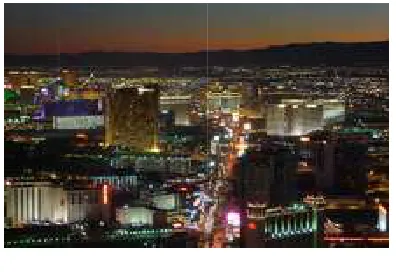
Fig. 1:
One such classic example of light clutter is
shown in fig.1,which displays excessive
groupings of colorful lights in
Clutter may also present a hazard in the
aviation environment if aviation safety
lighting must compete for pilot attention Light clutter refers to excessive groupings of
lights. Groupings of lights may generate
on, distract from obstacles (including
those that they may be intended to
illuminate), and potentially cause accidents.
Clutter is particularly noticeable on roads
where the street lights are badly designed,
or where brightly lit advertising surrounds
roadways. Depending on the motives of
the person or organization that installed the
lights, their placement and design can even
be intended to distract drivers, and can
contribute to accidents.
One such classic example of light clutter is
shown in fig.1,which displays excessive
groupings of colorful lights in Las Vegas.
Clutter may also present a hazard in the
n environment if aviation safety
Research Article ISSN: 2319-507X Bharati Shete, IJPRET, 2013; Volume 1(8): 356-364 IJPRET
Available Online At www.ijpret.com with non-relevant lighting. For instance,
runway lighting may be confused with an
array of suburban commercial lighting and
aircraft collision avoidance lights may be
confused with ground lights.
Skyglow
Skyglow refers to the glow effect that can
be seen over populated areas. It is the
combination of all light reflected from what
it has illuminated escaping up into the sky
and from all of the badly directed light in
that area that also escapes into the sky,
being scattered (redirected) by the
atmosphere back toward the ground. The
pink or orange glow we see for miles
around towns and cities caused by a
scattering of artificial light by airborne dust
and water droplets. This is a serious
problem for astronomers as the artificial
brightness of the sky overpowers distant
stars, especially those low in the night sky.
It is becoming more and more difficult to
find areas where our view of the night sky is
unaffected by illumination. The light from
distant stars can take hundreds, even
thousands, of years to reach our eyes - so it
is a pity to lose it on the last moment of its
journey!
B. Causes (Sources of light pollution)
Sources of
light pollution
as shown in
fig. 2 include,
Fig.2
• security lights that light up buildings
and their surroundings
• floodlights used to illuminate games
pitches, places of entertainment and
buildings
• street lighting
• advertising and display lighting
Lighting unoccupied areas is a significant
waste of energy. Many office buildings are
illuminated overnight and on weekends.
Lighting of unoccupied areas can be
reduced by installation of occupancy
sensors or timers.
Energy can also be wasted by operating
Available Online At www.ijpret.com cases this arises because the lights are
controlled by timers, which must be reset
periodically as the times of sunset and
sunrise vary throughout the year.
Retail stores, especially those with large
windows, are sometimes illuminated
overnight as a measure of crime
prevention. The idea is that, with the lights
on, burglars are visible from the outside and
bypassers can raise an alarm.
C. The impact (Effect) of light pollution
This can:
• Harm people’s quality of life.
• For example, it can disturb sleep when it shines into homes.
• Interfere with our view of the night sky.
• Waste energy and is therefore a waste of resources and money.
• Have an impact on the ecology and wildlife of an area, affecting the
behavioural patterns of mammals, birds,
insects and fish.
• Light pollution refers to annoying, harmful and just plain wasteful lighting.
Unnecessary lighting also contributes to
global warming by making wasteful
demands on energy.
• Health effects of over-illumination or
improper spectral composition of light
include increased headache incidence,
worker fatigue, medically defined stress,
decrease in sexual function and increase
in anxiety.
• Lighting is responsible for one-fourth of
all electricity consumption worldwide
and case studies have shown that
several forms of over-illumination
constitute energy wastage, including
non-beneficial upward direction of
night-time lighting.
• Light pollution poses a serious threat in
particular to nocturnal wildlife, having
negative impacts on plant and animal
physiology. It can confuse animal
navigation, alter competitive
interactions, change predator-prey
Research Article ISSN: 2319-507X Bharati Shete, IJPRET, 2013; Volume 1(8): 356-364 IJPRET
Available Online At www.ijpret.com
II. WAYS TO REDUCE LIGHT POLLUTION
• Reduce the light escaping from your home - Put your exterior lights on
motion detectors so they only come on
when needed. Minimize wattage, and
direct illumination toward the ground,
not upward, where it's of little use but
contributes to sky glow (or goes into
your neighbour's home). If you live in a
multistorey building, use blackout blinds
at night so birds aren't fatally attracted
to your windows, and talk with your
building manager or tenant's association
about turning your high-rise into a
Bird-Friendly Building.
• Cool it with the indoor lighting Put as many household lights as possible
on dimmer switches so you can save
energy while you enjoy mood lighting.
Stick with table and floor lamps, not
harsh overheads.
• Turn the lights off at work Collisions with man-made structures are
the number one cause of death among
migrating birds – many of which are
already facing extinction from habitat
loss. Ask your office building's
management to turn off the lights
during bird migration season in the
spring and fall.
• Harness your spending power
Ecotourism is a booming industry. Stay
at hotels, inns and resorts that tread
lightly on the earth through
energy-conservation measures that enforce
strict lights-out or light-blocking
measures in bird-migration paths, sea
turtle-nesting areas, and other
particularly light-sensitive wildlife areas.
• Get involved in municipal politics Write, e-mail or phone your local
councilor, as well as the mayor's office,
to talk about city lighting. Suggest ways
to reduce lighting consumption in
municipal buildings. And lobby for
high-efficiency, lower-energy, flat-lens
streetlight fixtures. Not only do they
produce less greenhouse gases, but they
also reduce glare, increasing driver,
cyclist and pedestrian safety.
• Lobby for lights-out Start a letter-writing campaign to get
Available Online At www.ijpret.com perhaps on Earth Day/Night. Also, ask
local sports arenas and stadiums to turn
off lights when games aren't playing.
• Lights out in the wilderness When camping and cottaging, keep
exterior lights off as much as possible as
they can interfere with the body clocks
of nocturnal creatures like salamanders,
giving them fewer hours to scavenge for
food. And keep interior light indoors
with blackout curtains.
How to prevent light pollution
If lighting is necessary, a number of
measures can be taken to avoid causing a
nuisance:
• If lighting is the best option then only
the right amount of light for the task
should be installed. Lighting will become
a problem if it is poorly designed or
incorrectly installed.
• For domestic security lights a 150W
lamp is adequate. High power
(300/500W) lamps create too much
glare reducing security. For an all-night
porch light a 9W lamp is more than
adequate in most situations.
• Make sure that lights are correctly
adjusted so that they only illuminate the
surface intended and do not throw light
onto neighbouring property. Security
lights should be correctly adjusted so
that they only pick up the movement of
persons in the area intended and not
beyond.
• To reduce the effects of glare main
beam angles of all lights should be
below 70 degrees.
• Direct light downwards. If uplighting has
to be used then install shields or baffles
above the lamp to reduce the amount
of wasted upward light.
• Do not install equipment which spreads
light above the horizontal.
CONCLUSION
Though not now, Light pollution becomes a
serious issue in few days and we must have
to be aware of that. If we have to protect
the environment, we must have to take
Research Article ISSN: 2319-507X Bharati Shete, IJPRET, 2013; Volume 1(8): 356-364 IJPRET
Available Online At www.ijpret.com increasing awareness among public is also
necessary and strict actions against these
concerning issues are also required.
References:
1. www.njaa.org/light.html
2. en.wikipedia.org/wiki/Light_pollution
3. www.canadianliving.com/life/green_livin