www.biogeosciences.net/13/2689/2016/ doi:10.5194/bg-13-2689-2016
© Author(s) 2016. CC Attribution 3.0 License.
Processes regulating progressive nitrogen limitation under elevated
carbon dioxide: a meta-analysis
Junyi Liang1, Xuan Qi1, Lara Souza1,2, and Yiqi Luo1,3
1Department of Microbiology and Plant Biology, University of Oklahoma, Norman, Oklahoma 73019, USA 2Oklahoma Biological Survey, University of Oklahoma, Norman, Oklahoma 73019, USA
3Center for Earth System Science, Tsinghua University, Beijing 100084, China Correspondence to: Junyi Liang ([email protected]) and Yiqi Luo ([email protected])
Received: 29 June 2015 – Published in Biogeosciences Discuss.: 20 October 2015 Revised: 20 April 2016 – Accepted: 27 April 2016 – Published: 10 May 2016
Abstract. The nitrogen (N) cycle has the potential to regulate climate change through its influence on carbon (C) seques-tration. Although extensive research has explored whether or not progressive N limitation (PNL) occurs under CO2 en-richment, a comprehensive assessment of the processes that regulate PNL is still lacking. Here, we quantitatively syn-thesized the responses of all major processes and pools in the terrestrial N cycle with meta-analysis of CO2 experimen-tal data available in the literature. The results showed that CO2 enrichment significantly increased N sequestration in the plant and litter pools but not in the soil pool, partially sup-porting one of the basic assumptions in the PNL hypothesis that elevated CO2results in more N sequestered in organic pools. However, CO2enrichment significantly increased the N influx via biological N fixation and the loss via N2O emis-sion, but decreased the N efflux via leaching. In addition, no general diminished CO2 fertilization effect on plant growth was observed over time up to the longest experiment of 13 years. Overall, our analyses suggest that the extra N supply by the increased biological N fixation and decreased leaching may potentially alleviate PNL under elevated CO2conditions in spite of the increases in plant N sequestration and N2O emission. Moreover, our syntheses indicate that CO2 enrich-ment increases soil ammonium (NH+4)to nitrate (NO−3) ra-tio. The changed NH+4/NO−3 ratio and subsequent biological processes may result in changes in soil microenvironments, above-belowground community structures and associated in-teractions, which could potentially affect the terrestrial bio-geochemical cycles. In addition, our data synthesis suggests that more long-term studies, especially in regions other than
temperate ones, are needed for comprehensive assessments of the PNL hypothesis.
1 Introduction
Fossil-fuel burning and deforestation have led to substan-tial increase in atmospheric carbon dioxide (CO2) concentra-tions, which could stimulate plant growth (IPCC, 2013). The plant growth stimulated by CO2fertilization and the resulting terrestrial carbon (C) storage could partially mitigate the fur-ther increase in CO2concentrations and associated climate warming (IPCC, 2013). However, this effect may be con-strained by the availability of nitrogen (N), an essential el-ement for molecular compounds of amino acids, proteins, ri-bonucleic acids (RNAs) and deoxyriri-bonucleic acids (DNAs) in organisms (Rastetter et al., 1997; Oren et al., 2001; Luo et al., 2004; Reich et al., 2006; Norby et al., 2010; Reich and Hobbie, 2013). A popular hypothesis of the N constraint to the CO2fertilization effect is progressive N limitation (PNL) (Luo et al., 2004).
de-mand, PNL may not occur. Otherwise, PNL may lead to a di-minished CO2fertilization effect on plant growth over time. Some of the site-level studies support (Reich et al., 2006; Norby et al., 2010), while the others refute the PNL hypothe-sis (Finzi et al., 2006; Moore et al., 2006). To date, no general pattern of PNL across ecosystems has yet been revealed.
Since the key determining PNL occurrence is whether N supply meets N demand (Luo et al., 2004), it is important to understand how N supply changes under elevated CO2. The change in the N supply for plant growth under elevated CO2 is determined by the responses of multiple N cycling processes, including biological N fixation, mineralization, nitrification, denitrification, and leaching (Chapin III et al., 2011). In addition, the responses of these processes to CO2 enrichment may be influenced by external N addition, such as N deposition and fertilization (Reay et al., 2008). Thus, synthesizing the responses of processes that regulate PNL to CO2enrichment may help reveal the general pattern of PNL in terrestrial ecosystems.
In the current study, the main objective was to synthesize data published in the literature on the N limitation to plant growth under enriched CO2 conditions. Our data synthesis was designed to answer two questions: (i) how do the major processes in the terrestrial N cycle respond to CO2 enrich-ment? (ii) Does the CO2fertilization effect on plant growth diminish over time? To answer these questions, two sets of data from the literature were collected (Supplement Table S1, Table 1). With the first data set, we quantitatively examined the effects of CO2enrichment on all the major processes and pools in the N cycle using meta-analysis. These processes and pools included N sequestered in organic components (i.e., plant tissues, litter and soil organic matter (SOM)), bi-ological N fixation, net mineralization, nitrification, denitri-fication, leaching, and total inorganic N (TIN), ammonium (NH+4)and nitrate (NO−3)contents in soils. We separated the first data set according to the experimental durations to ex-plore the responses of the N processes to short- vs. long-term CO2treatments. In addition, the responses of the N processes to CO2enrichment were compared between without and with N addition conditions. The second data set was compiled for the plant growth in decadal free air CO2enrichment (FACE) experiments. With the data set, we explored whether the CO2 fertilization effect on plant growth diminishes or not over time.
2 Materials and methods 2.1 Data collection
For the first data set, a comprehensive literature search with the terms of “CO2 enrichment (or CO2 increase)”, “nitro-gen” and “terrestrial” was conducted using the online search connection Web of Science in Endnote. Then, papers meet-ing the followmeet-ing two criteria were selected to do the
fur-ther analyses: (i) including both control and CO2enrichment treatments, where the ambient and elevated CO2 concentra-tions were around the current and predicted atmospheric CO2 concentrations by the Intergovernmental Panel on Climate Change (IPCC, 2013), respectively (Fig. S1 in the Supple-ment); (ii) including or from which we could calculate at least one of the major N pools or processes: soil TIN content, soil NH+4 content, soil NO−3 content, aboveground plant N pool (APNP), belowground plant N pool (BPNP), total plant N pool (TPNP), litter N pool (LNP), soil N pool (SNP), N fixation, nodule mass and/or number, net mineralization, ni-trification, denini-trification, and inorganic N leaching. Overall, there were 175 papers included in the first data set (Table S1, References S1). For each paper, means, variations (stan-dard deviation (SD), stan(stan-dard error (SE) or confidence inter-val (CI)) and sample sizes of the variables in both control and CO2enrichment treatments were collected.
For those studies that provided SE or CI, SD was com-puted by
SD=SE √
n (1)
or SD=(CIu−CIl) √
n/2uP, (2) wherenis the sample size, CIu and CIl are the upper and lower limits of CI, anduP is the significant level and equal to 1.96 and 1.645 whenα=0.05 and 0.10, respectively. In some studies, if tissue N concentration and biomass were re-ported, we multiplied the two parts as N pools. When both APNP and BPNP were provided (or calculated), the two were added together to represent the TPNP. When data from multi-ple soil layers were provided, they were summed if they were area-based (i.e., m−2land), or averaged if they were weight-based (i.e., g−1soil). In studies where the respective contents of NH+4 and NO−3 were reported, the TIN was calculated by adding the two together. For all the variables, if more than one result were reported during the experiment period, they were averaged by
M=Xj i=1
Mi
j (3)
with standard deviation
SD= v u u u t Pj
i=1SD 2
i(ni−1) ni
Pj
i=1ni−1
Pj
i=1ni
, (4)
wherej is the number of results,Mi, SDi and ni are the mean, SD and sample size of theith sampling data, respec-tively (Liang et al., 2013). If additional treatments applied (e.g., N addition), they were treated as independent studies.
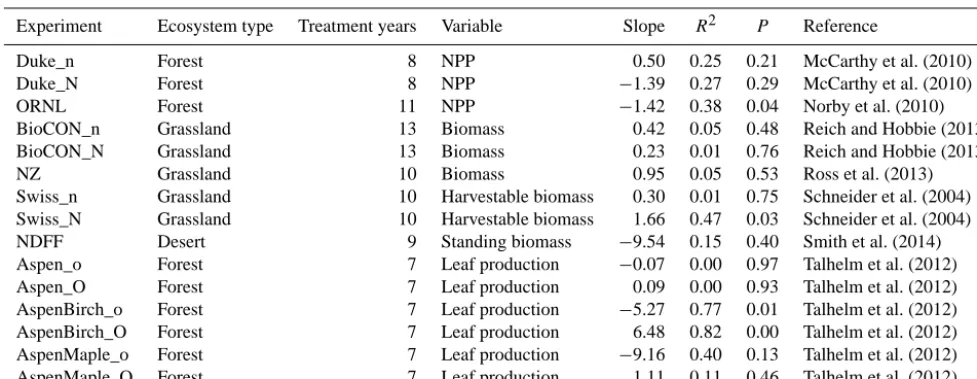
Table 1. Results on the effect of CO2enrichment on ecosystem NPP (or biomass or leaf production) in decadal free air CO2enrichment (FACE) experiments over treatment time. The values of the slope,R2andP in the linear regression in Fig. 4 are shown. The lower and upper n (i.e., n and N) in Refs. Schneider et al. (2004), McCarthy et al. (2010) and Reich and Hobbie (2013) mean without and with N addition, respectively. The lower and upper o (i.e., o and O) in Ref. Talhelm et al. (2012) mean without and with O3treatment, respectively.
Experiment Ecosystem type Treatment years Variable Slope R2 P Reference
Duke_n Forest 8 NPP 0.50 0.25 0.21 McCarthy et al. (2010)
Duke_N Forest 8 NPP −1.39 0.27 0.29 McCarthy et al. (2010)
ORNL Forest 11 NPP −1.42 0.38 0.04 Norby et al. (2010)
BioCON_n Grassland 13 Biomass 0.42 0.05 0.48 Reich and Hobbie (2013)
BioCON_N Grassland 13 Biomass 0.23 0.01 0.76 Reich and Hobbie (2013)
NZ Grassland 10 Biomass 0.95 0.05 0.53 Ross et al. (2013)
Swiss_n Grassland 10 Harvestable biomass 0.30 0.01 0.75 Schneider et al. (2004)
Swiss_N Grassland 10 Harvestable biomass 1.66 0.47 0.03 Schneider et al. (2004)
NDFF Desert 9 Standing biomass −9.54 0.15 0.40 Smith et al. (2014)
Aspen_o Forest 7 Leaf production −0.07 0.00 0.97 Talhelm et al. (2012)
Aspen_O Forest 7 Leaf production 0.09 0.00 0.93 Talhelm et al. (2012)
AspenBirch_o Forest 7 Leaf production −5.27 0.77 0.01 Talhelm et al. (2012)
AspenBirch_O Forest 7 Leaf production 6.48 0.82 0.00 Talhelm et al. (2012)
AspenMaple_o Forest 7 Leaf production −9.16 0.40 0.13 Talhelm et al. (2012)
AspenMaple_O Forest 7 Leaf production 1.11 0.11 0.46 Talhelm et al. (2012)
divided into forest, grassland, and cropland to explore possi-ble differences between ecosystem types.
For the second data set, 15 available time series of plant growth were collected from 7 decadal FACE experiments (Table 1). The ecosystems included nine forests, five grass-lands and one desert. Because of the limited data, we in-cluded variables that can represent plant growth in one way or another, for example, net primary production (NPP), biomass, and leaf production. These data were collected to reveal whether the effect of CO2enrichment on plant growth diminishes over treatment time as proposed by the PNL hy-pothesis (Luo et al., 2004). In the seven studies, the treatment lasted from 7 to 13 years, and at least 6 years’ production measurements were reported. For each data, the percentage change in NPP (or biomass or leaf production) by CO2 en-richment was calculated. Then, a linear regression between the percentage change and the treatment year was conducted. A significantly negative slope indicates that the effect of CO2 enrichment on the plant production diminishes over time. A non-significant slope was treated as 0. After deriving all the slopes, the frequency distribution of the slopes were fitted by a Gaussian function:
y=y0+ae−
(x−µ)2
2σ2 , (5)
wherex is the mean value of each individual interval, andy
is the frequency of each interval.y0 is the base frequency.µ
andσare the mean and SD of the distribution. 2.2 Meta-analysis
With the first data set, the effect of CO2enrichment for each line of data of the N variables was estimated using the
natu-ral logarithm transformed response ratio (RR) (Hedges et al., 1999; Liang et al., 2013):
logeRR=loge(XE/XC) , (6)
whereXEandXCare the variable values under enriched CO2 and control conditions, respectively. The variation of the log RR was
V = SD 2 C
nCX2C + SD
2 E
nEXE2 !
, (7)
where SDCand SDE are the standard deviation of XC and
XE, andnCandnEare the sample sizes ofXCandXE. Then, the random-effects model was used to calculate the weighted mean. In the random-effects model, the weighted mean was calculated as
Mweighted= Pk
j=1Wj∗Mj
Pk j=1W
∗ j
(8)
with the variance as
Vweighted= 1
Pk j=1W
∗ j
, (9)
wherekis the number of studies,Mj is the Ln(RR) in study
j, andWj∗is the weighting factor which consists of between-and within-study variances (Rosenberg et al., 2000; Liang et al., 2013). The 95 % lower and upper limits (LLweightedand ULweighted)for the weighted mean were computed as LLweighted=Mweighted−1.96×
p
and
ULweighted=Mweighted+1.96×pVweighted. (11) The weighted mean and corresponding 95 % bootstrapping CI (999 iterations) for each variable and category were cal-culated in MetaWin 2.1 (details are described in the soft-ware handbook by Rosenberg et al., 2000). The results were back-transformed and represented as percentage change by (RR−1)×100 %. The response was considered significant if the 95 % CI did not overlap with zero.
3 Results
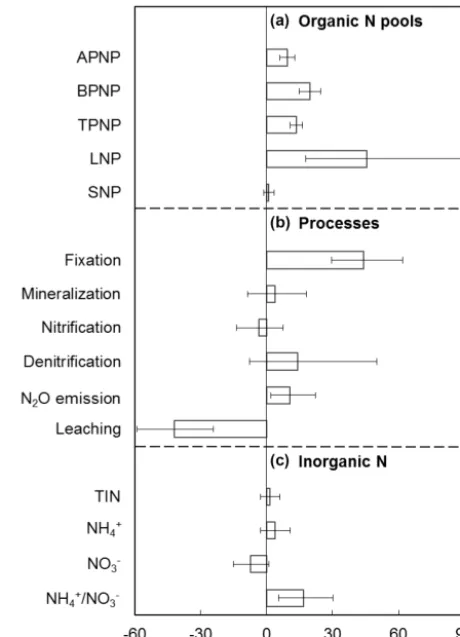
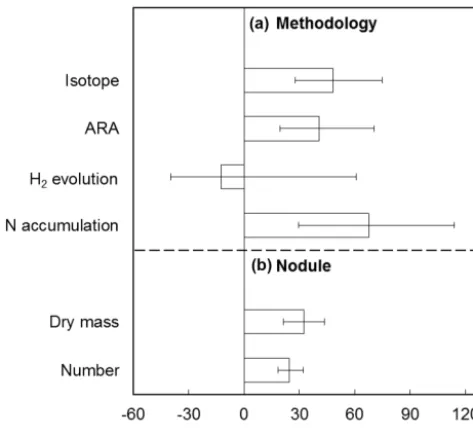
The meta-analysis of the first data set showed that CO2 en-richment significantly increased N sequestered in plants and litter but not in SOM (Figs. 1a, S2). Whereas CO2 enrich-ment had little overall effects on N mineralization, nitrifica-tion and denitrificanitrifica-tion, it significantly increased biological N fixation by 44.3 % (with 95 % CI from 29.5 to 61.8 %). The increased biological N fixation was consistent when us-ing various methods except H2evolution (Fig. 2a). In legume species, CO2enrichment significantly increased nodule mass and number (Fig. 2b). In addition, CO2enrichment increased N2O emission by 10.7 % (with 95 % CI from 2.0 to 22.3 %), but reduced leaching (i.e.,−41.8 with 95 % CI from−58.9 to −24.3 %) (Fig. 1b). Although CO2 enrichment did not change the total inorganic N availability in soils, it increased the soil NH+4 /NO−3 ratio by 16.9 % (with 95 % CI from 5.4 to 30.2 %) (Fig. 1c).
Treatment time had no effect on most of the variables (overlapped 95 % CIs for short- and long-term treatments) except nitrification, which was not changed by short-term treatment, but was significantly reduced (−23.4 with 95 % CI from −30.4 to−12.1 %) by long-term CO2 enrichment (Fig. 3b). In addition, it seemed that the responses of the NH+4 /NO−3 ratio was strengthened over time, representing a neutral response to short-term CO2 enrichment, but sig-nificantly positive and negative responses to long-term CO2 enrichment (Fig. 3c). The effects of CO2 enrichment were influenced by N addition (Fig. 3d–f). For example, nitrifi-cation was significantly reduced by CO2 enrichment with-out N addition by 19.3 % (with 95 % CI from −40.5 to −0.65 %), but was not changed with N addition. Denitrifi-cation and N2O emission responded to CO2enrichment neu-trally without N addition, but significantly positively with N addition (Fig. 3e). Additionally, the responses of some vari-ables to CO2enrichment were dependent on ecosystem type (Fig. 3g–i). APNP responded to CO2 enrichment positively in forests and croplands, but neutrally in grasslands (Fig. 3g). Net mineralization had no response to CO2 enrichment in forests or grasslands, while it was significantly increased in croplands (Fig. 3h). Moreover, the change in the TIN was neutral in forests, grassland, but positive, in croplands,
re-Figure 1. Results of a meta-analysis on the responses of
nitro-gen pools and processes to CO2enrichment. In (a), APNP, BPNP, TPNP, LNP, and SNP are the abbreviations for aboveground plant nitrogen pool, belowground plant nitrogen pool, total plant nitrogen pool, litter nitrogen pool, and soil nitrogen pool, respectively. In (c), TIN, NH+4 and NO−3 are total inorganic nitrogen, ammonium, and nitrate in soils, respectively. The error bars represent 95 % confi-dence intervals.
spectively (Fig. 3i). In addition, a positive response of the NH+4 /NO−3 ratio was only observed in grasslands (Fig. 3i).
[image:4.612.313.543.68.387.2]Figure 2. Responses of biological N fixation measured by different
methods (a) and nodule dry mass and number in legume species (b). ARA: acetylene reduction assay. Mean±95 % confidence interval.
4 Discussion
In this study, we carried out two syntheses on the responses of the terrestrial N cycle and plant growth to CO2enrichment to test whether PNL generally occurs across ecosystems. 4.1 PNL alleviation
According to the PNL hypothesis, a prerequisite for PNL oc-currence is that more N is sequestered in plant, litter and SOM (Luo et al., 2004). Our results showed that elevated CO2significantly increased N retention in plant tissues and litter, which is consistent with previous meta-analyses (de Graaff et al., 2006; Luo et al., 2006). Thus, there seems to be evidence for some basic assumptions of the PNL hypothesis. However, the results from the second data set did not show a general diminished CO2 fertilization effect on plant growth on the decadal scale, which disagrees with the expectation of the PNL hypothesis, suggesting that N supply under elevated CO2 may meet the N demand. In this study, we have iden-tified two processes that increase N supply under elevated CO2, i.e., biological N fixation and leaching.
CO2enrichment significantly enhanced the N influx to ter-restrial ecosystems through biological N fixation, which re-duces dinitrogen (N2)to NH+4 (Fig. 1b). The enhanced bi-ological N fixation may have resulted from the stimulated activities of symbiotic (Fig. 2b) and free-living heterotrophic N-fixing bacteria (Hoque et al., 2001). In addition, the com-petition between N2-fixing and non-N2-fixing species may have contributed to enhancing the biological N fixation at the
ecosystem level (Poorter and Navas, 2003; Batterman et al., 2013).
In addition, the N efflux via leaching was reduced under elevated CO2conditions (Fig. 1b). This could be attributed to the decrease in NO−3, which is the primary N form in leach-ing, (Chapin III et al., 2011), and the increased root growth which may immobilize more inorganic N in soils (Luo et al., 2006; Iversen, 2010). In contrast, gaseous N loss through N2O emission increased under elevated CO2, although this increase was only observed when additional N was applied.
The net effect of the responses of N processes to CO2 en-richment resulted in higher N retention in ecosystems, espe-cially within plant tissues and litter (Fig. S2). Because the product of biological N fixation (i.e., NH+4)and the primary form for N leaching loss (i.e., NO−3)can be directly used by plants, the effects of CO2enrichment on the two processes directly increase the N availability for plant growth, poten-tially alleviating PNL (Fig. 5). The increased N in plant tis-sues can be re-used by plants via resorption (Norby et al., 2000, 2001), and consequently reduce the N demand from soils. This may be another mechanism that alleviates PNL (Walker et al., 2015). Therefore, the increased N availabil-ity from increased N fixation and reduced N leaching could potentially support net accumulation of organic matter in ter-restrial ecosystems (Rastetter et al., 1997; Luo and Reynolds, 1999).
Since biological N fixation provides at least 30 % of the N requirement across natural biomes (Asner et al., 2001; Galloway et al., 2004), our results suggest that the positive response of biological N fixation to CO2 enrichment plays an important role in alleviating PNL. The PNL hypothe-sis was proposed to characterize long-term dynamics of C-N coupling in response to rising atmospheric CO2 concen-tration. Thus, it is critical to understand the long-term re-sponse of biological N fixation to elevated CO2. In this pa-per, we have synthesized 12 studies that lasted 4–7 years and binned them in a long-term category (> 3 years). On aver-age, in those long-term studies, CO2 enrichment increased biological N fixation by 26.2 %. The increased biological N fixation is supported by evidence at gene level from long-term experiments. For example, Tu et al. (2016) found that the abundance of nifH gene amplicons, which is a widely used marker for analysing biological N fixation, was signif-icantly enhanced by 12 years of CO2enrichment in a grass-land (BioCON). However, our synthesis showed a relatively wide 95 % confidence interval from 2.54 to 59.8 %. The wide range can be partially attributed to the relatively small num-ber of studies. In addition, most studies incorporated in the current synthesis were conducted in temperate regions. Thus, longer-term studies, as well as studies in other regions (e.g., boreal and tropical) are critically needed to reveal more gen-eral patterns in the future.
in-Figure 3. Responses of terrestrial nitrogen pools and processes to CO2 enrichment (Mean±95 % confidence interval) as regulated by experimental durations (a–c; short-term:≤3 years vs. long-term: > 3 years), nitrogen addition (d–f), and ecosystem types (g–i). Please see Fig. 1 for abbreviations.
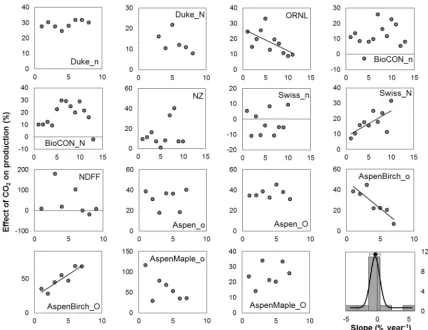
creased soil N supply for plant growth, which in theory could alleviate PNL. However, the PNL alleviation potential may vary across different ecosystems due to asymmetric distri-butions of biological N fixation (Cleveland et al., 1999). In addition, PNL alleviation may also be influenced by other factors. While a diminished CO2fertilization effect on plant growth was not observed in most of the long-term experi-ments, it occurred in two sites (i.e., ORNL and Aspen-Birch) (Fig. 4). Plant growth is usually influenced by multiple en-vironmental factors (e.g., nutrients, water, light, ozone). The undiminished CO2 fertilization effect in most studies indi-cates that resource limitation (including N) was not aggra-vated, suggesting that no PNL occurred in these sites. How-ever, in the ORNL and Aspen-Birch (without O3treatment) experiments, the diminished CO2fertilization effect on plant growth was potentially driven by limitation of N, or other re-sources, or their combined effect. For example, reduced N availability has been identified as one of the primary fac-tors that lead to the diminished CO2 fertilization effect on NPP in the ORNL FACE experiment (Norby et al., 2010). In the Aspen-Birch community, however, the deceleration of leaf area increases due to canopy closure was responsible for the diminished CO2fertilization effect on plant growth with-out O3addition (Talhelm et al., 2012). With O3addition, O3 significantly reduced the canopy development, resulting in a relatively open canopy during the experiment period. In ad-dition, the negative effect of O3addition increased over time,
leading to the apparent increase in the CO2fertilization effect (Fig. 4) (Talhelm et al., 2012).
4.2 Dependence of the responses of N cycling processes upon methodology, treatment duration, N addition and ecosystem types
Experimental methodology may potentially influence find-ings. Cabrerizo et al. (2001) found that CO2enrichment in-creased the nitrogenase activity measured by acetylene re-duction assay (ARA), but not the specific N fixation mea-sured by the H2evolution method. In the studies synthesized here, four methods were used to estimate biological N fixa-tion, including isotope, ARA, H2evolution and N accumula-tion. Among them, ARA and H2evolution measure nitroge-nase activity (Hunt and Layzell, 1993), whereas isotope and N accumulation methods directly measure biological N fixa-tion. All but the H2evolution method showed a significantly positive response to CO2enrichment (Fig. 2a). The insignif-icant response shown by the H2evolution method was likely because of the small study numbers (i.e., 3). In addition, the biological N fixation measured by ARA, isotope and N ac-cumulation showed similar response magnitudes (Fig. 2a), suggesting consistency among the three methods. However, further assessment on the H2evolution method is needed.
[image:6.612.71.524.65.323.2]Figure 4. Time courses of CO2effects on ecosystem NPP (or biomass or leaf production) in decadal-long FACE experiments. Please see Table 1 for details of experiments, references and statistical results. Only statistically significant (P< 0.05) regression lines are shown. The panel at the right-low corner shows the distribution of the slopes (−0.37 % year−1with 95 % CI from−1.84 to 1.09 % year−1).
N mineralization, in addition to biological N fixation, is a major source of available N in soils. Our meta-analysis showed no change in the net N mineralization in response to CO2 enrichment, which is consistent with the results by de Graaff et al. (2006). However, the response of net min-eralization was dependent upon ecosystem types, showing no change in forests and grasslands, but significant increases in croplands (Fig. 3h). There may be two reasons for the stimulated net mineralization in croplands. First, N fertil-ization, which is commonly practiced in croplands, can in-crease the substrate quantity and quality for mineralization (Barrios et al., 1996; Chapin III et al., 2011; Booth et al., 2005; Lu et al., 2011; Reich and Hobbie, 2013). Second, tillage can alter soil conditions (e.g., increasing O2content), which can potentially favour the N mineralization under en-riched CO2 (Wienhold and Halvorson, 1999; Bardgett and Wardle, 2010). These findings suggest that CO2enrichment can stimulate the N transfer from organic to inorganic forms in managed croplands.
Unlike leaching, the response of nitrification was depen-dent upon treatment duration (Fig. 3). Nitrification was not
changed by short-term treatment, but was significantly re-duced by long-term CO2enrichment (Fig. 3). One possible reason for the reduced nitrification with long-term CO2 en-richment is the cumulative effect of hydrological changes. CO2enrichment is assumed to reduce stomatal conductance and, consequently, water loss via plant transpiration, lead-ing to an increase in soil water content (Niklaus et al., 1998; Tricker et al., 2009; van Groenigen et al., 2011; Keenan et al., 2013). A synthesis by van Groenigen et al. (2011) shows that CO2enrichment increases soil water content by 2.6–10.6 %. Increased soil water content may result in less oxygen (O2) concentration in soils, which could potentially constrain ni-trification.
sub-Figure 5. Mechanisms that alleviate PNL. PNL hypothesis posits that the stimulated plant growth by CO2enrichment leads to more N sequestered in long-lived plant tissues, litter and soil organic matter (SOM) so that, the N availability for plant growth progressively declines over time, and plant growth is downregulated (grey symbols). The current synthesis indicates that the basis of PNL occurrence partially exists (i.e., more N sequestered in plant tissues and litter; black symbols). Despite of the increases in plant N sequestration and N2O emission, stimulated biological N fixation and reduced N leaching can replenish the N availability, potentially alleviating PNL (blue boxes and arrows). Upward, downward, and horizontal arrows mean increase, decrease, and no change, respectively.
strate for nitrifying and denitrifying bacteria (Keller et al., 1988; Stehfest and Bouwman, 2006; Russow et al., 2008). The strengthening trends of both nitrification and denitrifica-tion led to a shift of the response of N2O emission to CO2 enrichment from neutral without N addition to significantly positive with N addition (Fig. 3e). Our results indicate that CO2enrichment significantly increases gaseous N loss when additional N is applied. This is consistent with a previous synthesis (van Groenigen et al., 2011). Increased N2O emis-sions can partially offset the mitigation of climate change by the stimulated plant CO2assimilation as the warming poten-tial of N2O is 296 times that of CO2. However, a recent mod-elling study by Zaehle et al. (2011) found an opposite result showing that CO2enrichment reduced emissions of N2O. In their model, elevated CO2 enhanced plant N sequestration and consequently, decreased the N availability for nitrifica-tion and denitrificanitrifica-tion in soils, which led to the reduced N2O emissions. However, our synthesis shows that inorganic N does not decrease. Especially with additional N applica-tion, enhanced denitrification by CO2enrichment results in a greater N2O emission.
4.3 Changes in soil microenvironment, community structures and above-belowground interactions
The meta-analysis showed that the two major forms of soil available N, NH+4 and NO−3, responded to long-term CO2 en-richment in opposing manners (Fig. 3c). While the enhanced
biological N fixation by CO2enrichment tended to increase the NH+4 content in soils, the reduced nitrification decreased the NO−3 content in soils, leading to a significant increase in the NH+4 /NO−3 ratio (Fig. 3c).
[image:8.612.133.469.68.285.2]prefer-ences for plant absorption of different forms of N are differ-ent (Chapin III et al., 2011; Odum and Barrett, 2005), the increased NH+4 /NO−3 ratio may benefit some plant species while depress others, and consequently alter the community structures over time. These diverse changes in soil microen-vironment and microbial and plant community compositions could further affect the terrestrial C cycle on long temporal scales, on which more studies are needed.
5 Summary
This study synthesizes data in the literature on the effects of CO2enrichment on the terrestrial N cycle to improve our understanding of the N limitation to plant growth under el-evated CO2. Our results indicate that elevated CO2 stimu-lates N influx via biological N fixation but reduces N loss via leaching, leading to increased N supply for plant growth. The additional N supply via the enhanced biological N fixation and the reduced leaching may partially meet the increased N demand under elevated CO2, potentially alleviating PNL. In addition, our analysis indicates that increased N2O emis-sions may partially offset the mitigation of climate change by stimulated plant CO2assimilation. Moreover, changes in soil microenvironments, ecosystem communities and above-belowground interactions induced by the different responses of NH+4 and NO−3 to CO2 enrichment may have long-term effects on the terrestrial biogeochemical cycles and climate change.
The Supplement related to this article is available online at doi:10.5194/bg-13-2689-2016-supplement.
Acknowledgements. We thank two anonymous reviewers for their
valuable comments and suggestions, Kevin R. Wilcox for his help with language checking. This study was financially supported by the US Department of Energy, Terrestrial Ecosystem Sciences grant DE SC0008270 and Biological Systems Research on the Role of Microbial Communities in Carbon Cycling Program grants DE-SC0004601 and DE-SC0010715. Authors declare no conflict of interest.
Edited by: A. Rammig
References
Asner, G. P., Townsend, A. R., Riley, W. J., Matson, P. A., Neff, J. C., and Cleveland, C. C.: Physical and biogeochemical controls over terrestrial ecosystem responses to nitrogen deposition, Bio-geochemistry, 54, 1–39, 2001.
Bardgett, R. D. and Wardle, D. A.: Aboveground-belowground linkages: biotic interactions, ecosystem processes, and global change, Oxford University Press, Oxford, UK, 2010.
Barrios, E., Buresh, R. J., and Sprent, J. I.: Nitrogen mineralization in density fractions of soil organic matter from maize and legume cropping systems, Soil Biol. Biochem., 28, 1459–1465, 1996. Batterman, S. A., Hedin, L. O., van Breugel, M., Ransijn, J., Craven,
D. J., and Hall, J. S.: Key role of symbiotic dinitrogen fixation in tropical forest secondary succession, Nature, 502, 224–227, 2013.
Booth, M. S., Stark, J. M., and Rastetter, E.: Controls on nitrogen cycling in terrestrial ecosystems: A synthetic analysis of litera-ture data, Ecol. Monogr., 75, 139–157, 2005.
Cabrerizo, P. M., González, E. M., Aparicio-Tejo, P. M., and Arrese-Igor, C.: Continuous CO2enrichment leads to increased nodule biomass, carbon availability to nodules and activity of carbon-metabolising enzymes but does not enhance specific nitrogen fix-ation in pea, Physiologia Plantarum, 113, 33–40, 2001. Chapin III, F. S., Matson, P. A., and Vitousek, P.: Principles of
ter-restrial ecosystem ecology, Springer, New York, USA, 2011. Cleveland, C. C., Townsend, A. R., Schimel, D. S., Fisher, H.,
Howarth, R. W., Hedin, L. O., Perakis, S. S., Latty, E. F., Von Fischer, J. C., Elseroad, A., and Wasson, M. F.: Global patterns of terrestrial biological nitrogen (N2)fixation in natural ecosys-tems, Global Biogeochem. Cy., 13, 623–645, 1999.
de Graaff, M. A., van Groenigen, K. J., Six, J., Hungate, B., and van Kessel, C.: Interactions between plant growth and soil nutri-ent cycling under elevated CO2: a meta-analysis, Glob. Change Biol., 12, 2077–2091, 2006.
de Vries, F. T., Hoffland, E., van Eekeren, N., Brussaard, L., and Bloem, J.: Fungal/bacterial ratios in grasslands with contrast-ing nitrogen management, Soil Biol. Biochem., 38, 2092–2103, 2006.
Finzi, A. C., Moore, D. J. P., Delucia, E. H., Lichter, J., Hofmockel, K. S., Jackson, R. B., Kim, H., Matamala, R., McCarthy, H. R., Oren, R., Pippen, J. S., and Schlesinger, W. H.: Progressive ni-trogen limitation of ecosystem processes under elevated CO2in a warm-temperate forest, Ecology, 87, 15–25, 2006.
Galloway, J. N., Dentener, F. J., Capone, D. G., Boyer, E. W., Howarth, R. W., Seitzinger, S. P., Asner, G. P., Cleveland, C. C., Green, P. A., Holland, E. A., and Karl, D. M.: Nitrogen cycles: past, present, and future, Biogeochemistry, 70, 53–226, 2004. Hedges, L. V., Gurevitch, J., and Curtis, P. S.: The meta-analysis
of response ratios in experimental ecology, Ecology, 80, 1150– 1156, 1999.
Hoque, M. M., Inubushi, K., Miura, S., Kobayashi, K., Kim, H. Y., Okada, M., and Yabashi, S.: Biological dinitrogen fixation and soil microbial biomass carbon as influenced by free-air carbon dioxide enrichment (FACE) at three levels of nitrogen fertiliza-tion in a paddy field, Biol. Fert. Soils, 34, 453–459, 2001. Hunt, S. and Layzell, D. B.: Gas exchange of legume nodules and
the regulation of nitrogenase activity, Annu. Rev. Plant Phys., 44, 483–511, 1993.
IPCC: Climate Change 2013: The Physical Science Basis. Contri-bution of Working Group I to the Fifth Assessment Report of the Intergovernmental Panel on Climate Change, Cambridge Uni-versity Press, Cambridge, United Kingdom and New York, NY, USA, 2013.
Keenan, T. F., Hollinger, D. Y., Bohrer, G., Dragoni, D., Munger, J. W., Schmid, H. P., and Richardson, A. D.: Increase in forest water-use efficiency as atmospheric carbon dioxide concentra-tions rise, Nature, 499, 324–327, 2013.
Keller, M., Kaplan, W. A., Wofsy, S. C., and Dacosta, J. M.: Emis-sions of N2O from Tropical Forest Soils: Response to Fertiliza-tion with NH+4, NO3−, and PO3−4 , J. Geophys. Res.-Atmos., 93, 1600–1604, 1988.
Lambers, H., Chapin III, F. S., and Pons, T. L.: Plant Physiological Ecology, Springer, New York, 2008.
Liang, J., Xia, J., Liu, L., and Wan, S.: Global patterns of the re-sponses of leaf-level photosynthesis and respiration in terrestrial plants to experimental warming, J. Plant Ecol., 6, 437–447, 2013. Lu, M., Yang, Y. H., Luo, Y. Q., Fang, C. M., Zhou, X. H., Chen, J. K., Yang, X., and Li, B.: Responses of ecosystem nitrogen cycle to nitrogen addition: a meta-analysis, New Phytol., 189, 1040– 1050, 2011.
Luo, Y. and Reynolds, J. F.: Validity of extrapolating field CO2 ex-periments to predict carbon sequestration in natural ecosystems, Ecology, 80, 1568–1583, 1999.
Luo, Y., Su, B., Currie, W. S., Dukes, J. S., Finzi, A. C., Hartwig, U., Hungate, B., McMurtrie, R. E., Oren, R., Parton, W. J., Pataki, D. E., Shaw, M. R., Zak, D. R., and Field, C. B.: Progressive nitrogen limitation of ecosystem responses to rising atmospheric carbon dioxide, Bioscience, 54, 731–739, 2004.
Luo, Y. Q., Hui, D. F., and Zhang, D. Q.: Elevated CO2stimulates net accumulations of carbon and nitrogen in land ecosystems: A meta-analysis, Ecology, 87, 53–63, 2006.
McCarthy, H. R., Oren, R., Johnsen, K. H., Gallet-Budynek, A., Pritchard, S. G., Cook, C. W., LaDeau, S. L., Jackson, R. B., and Finzi, A. C.: Re-assessment of plant carbon dynamics at the Duke free-air CO2enrichment site: interactions of atmospheric [CO2] with nitrogen and water availability over stand develop-ment, New Phytol., 185, 514–528, 2010.
Monsant, A. C., Tang, C., and Baker, A. J. M.: The effect of nitrogen form on rhizosphere soil pH and zinc phytoextraction by Thlaspi caerulescens, Chemosphere, 73, 635–642, 2008.
Moore, D. J. P., Aref, S., Ho, R. M., Pippen, J. S., Hamilton, J. G., de Lucia, E. H.: Annual basal area increment and growth duration of
Pinus taeda in response to eight years of free-air carbon dioxide
enrichment, Glob. Change Biol., 12, 1367–1377, 2006. Niklaus, P. A., Spinnler, D., and Korner, C.: Soil moisture
dynam-ics of calcareous grassland under elevated CO2, Oecologia, 117, 201–208, 1998.
Norby, R. J., Long, T. M., Hartz-Rubin, J. S., and O’Neill, E. G.: Nitrogen resorption in senescing tree leaves in a warmer, CO2 -enriched atmosephere, Plant Soil, 224, 15–29, 2000.
Norby, R. J., Cotrufo, M. F., Ineson, P., O’Neill, E. G., and Canadell, J. G.: Elevated CO2, litter chemistry, and decomposition: a syn-thesis, Oecologia, 127, 153–165, 2001.
Norby, R. J., Warren, J. M., Iversen, C. M., Medlyn, B. E., and McMurtrie, R. E.: CO2enhancement of forest productivity con-strained by limited nitrogen availability, P. Natl. Acad. Sci. USA, 107, 19368–19373, 2010.
Odum, E. P. and Barrett, G. W.: Fundamentals of Ecology, Thomson Brooks/Cole, Belmont, California, USA, 2005.
Oren, R., Ellsworth, D. S., Johnsen, K. H., Phillips, N., Ewers, B. E., Maier, C., Schafer, K. V. R., McCarthy, H., Hendrey, G., Mc-Nulty, S. G., and Katul, G. G.: Soil fertility limits carbon
se-questration by forest ecosystems in a CO2-enriched atmosphere, Nature, 411, 469–472, 2001.
Poorter, H. and Navas, M. L.: Plant growth and competition at ele-vated CO2: on winners, losers and functional groups, New Phy-tol., 157, 175–198, 2003.
Rastetter, E. B., Agren, G. I., and Shaver, G. R.: Responses of N-limited ecosystems to increased CO2: A balanced-nutrition, coupled-element-cycles model, Ecol. Appl., 7, 444–460, 1997. Reay, D. S., Dentener, F., Smith, P., Grace, J., and Feely, R. A.:
Global nitrogen deposition and carbon sinks, Nat. Geosci., 1, 430–437, 2008.
Reich, P. B. and Hobbie, S. E.: Decade-long soil nitrogen con-straint on the CO2fertilization of plant biomass, Nature Climate Change, 3, 278–282, 2013.
Reich, P. B., Hobbie, S. E., Lee, T., Ellsworth, D. S., West, J. B., Tilman, D., Knops, J. M. H., Naeem, S., and Trost, J.: Nitro-gen limitation constrains sustainability of ecosystem response to CO2, Nature, 440, 922–925, 2006.
Rosenberg, M. S., Adams, D. C., and Gurevitch, J.: MetaWin: statis-tical software for meta-analysis, Sinauer Associates Sunderland, Massachusetts, USA, 2000.
Ross, D. J., Newton, P. C. D., Tate, K. R., and Luo, D. W.: Impact of a low level of CO2 enrichment on soil carbon and nitrogen pools and mineralization rates over ten years in a seasonally dry, grazed pasture, Soil Biol. Biochem., 58, 265–274, 2013. Rousk, J. and Bååth, E.: Fungal biomass production and turnover
in soil estimated using the acetate-in-ergosterol technique, Soil Biol. Biochem., 39, 2173–2177, 2007.
Rousk, J., Brookes, P. C., and Baath, E.: Contrasting Soil pH Ef-fects on Fungal and Bacterial Growth Suggest Functional Re-dundancy in Carbon Mineralization, Appl. Environ. Microb., 75, 1589–1596, 2009.
Russow, R., Spott, O., and Stange, C. F.: Evaluation of nitrate and ammonium as sources of NO and N2O emissions from black earth soils (Haplic Chernozem) based on15N field experiments, Soil Biol. Biochem., 40, 380–391, 2008.
Schneider, M. K., Luscher, A., Richter, M., Aeschlimann, U., Hartwig, U. A., Blum, H., Frossard, E., and Nosberger, J.: Ten years of free-air CO2enrichment altered the mobilization of N from soil in Lolium perenne L. swards, Glob. Change Biol., 10, 1377–1388, 2004.
Smith, S. D., Charlet, T. N., Zitzer, S. F., Abella, S. R., Vanier, C. H., and Huxman, T. E.: Long-term response of a Mojave Desert win-ter annual plant community to a whole-ecosystem atmospheric CO2 manipulation (FACE), Glob. Change Biol., 20, 879–892, 2014.
Stehfest, E. and Bouwman, L.: N2O and NO emission from agricul-tural fields and soils under naagricul-tural vegetation: summarizing avail-able measurement data and modeling of global annual emissions, Nutr. Cycl. Agroecosys., 74, 207–228, 2006.
Talhelm, A. F., Pregitzer, K. S., and Giardina, C. P.: Long-Term Leaf Production Response to Elevated Atmospheric Carbon Dioxide and Tropospheric Ozone, Ecosystems, 15, 71–82, 2012. Thomson, C. J., Marschner, H., and Romheld, V.: Effect of
Nitrogen-Fertilizer Form on pH of the Bulk Soil and Rhizo-sphere, and on the Growth, Phosphorus, and Micronutrient Up-take of Bean, J. Plant Nutr., 16, 493–506, 1993.
plan-tation increases in a future high CO2world, Biomass Bioenerg., 33, 200–208, 2009.
Tu, Q., Zhou, X., He, Z., Xue, K., Wu, L., Reich, P., Hobbie, S., and Zhou, J.: The Diversity and Co-occurrence Patterns of N2-Fixing Communities in a CO2-Enriched Grassland Ecosystem, Microb. Ecol., 71, 604–615, doi:10.1007/s00248-015-0659-7, 2016. van Groenigen, K. J., Osenberg, C. W., and Hungate, B. A.:
In-creased soil emissions of potent greenhouse gases under in-creased atmospheric CO2, Nature, 475, 214–216, 2011.
Walker, A. P., Zaehle, S., Medlyn, B. E., De Kauwe, M. G., Asao, S., Hickler, T., Parton, W., Ricciuto, D. M., Wang, Y. P., and Wår-lind, D.: Predicting long-term carbon sequestration in response to CO2enrichment: How and why do current ecosystem models differ?, Global Biogeochem. Cy., 29, 476–495, 2015.
Wienhold, B. J. and Halvorson, A. D.: Nitrogen mineralization re-sponses to cropping, tillage, and nitrogen rate in the Northern Great Plains, Soil Sci. Soc. Am. J., 63, 192–196, 1999.