www.ann-geophys.net/28/1499/2010/ doi:10.5194/angeo-28-1499-2010
© Author(s) 2010. CC Attribution 3.0 License.
Annales
Geophysicae
Intermediate-m ULF waves generated by substorm injection:
a case study
T. K. Yeoman1, D. Yu. Klimushkin2, and P. N. Mager2
1Department of Physics and Astronomy, University of Leicester, Leicester LE1 7RH, UK 2Institute of Solar-Terrestrial Physics, Irkutsk, P.O. Box 291, 664033, Russia
Received: 26 May 2010 – Accepted: 2 August 2010 – Published: 5 August 2010
Abstract. A case study of SuperDARN observations of Pc5 Alfvén ULF wave activity generated in the immediate after-math of a modest-intensity substorm expansion phase onset is presented. Observations from the Hankasalmi radar re-veal that the wave had a period of 580 s and was charac-terized by an intermediate azimuthal wave number (m=13), with an eastwards phase propagation. It had a significant poloidal component and a rapid equatorward phase propa-gation (∼62◦per degree of latitude). The total equatorward phase variation over the wave signatures visible in the radar field-of-view exceeded the 180◦ associated with field line resonances. The wave activity is interpreted as being stim-ulated by recently-injected energetic particles. Specifically the wave is thought to arise from an eastward drifting cloud of energetic electrons in a similar fashion to recent theoreti-cal suggestions (Mager and Klimushkin, 2008; Zolotukhina et al., 2008; Mager et al., 2009). The azimuthal wave num-bermis determined by the wave eigenfrequency and the drift velocity of the source particle population. To create such an intermediate-mwave, the injected particles must have rather high energies for a given L-shell, in comparison to previous observations of wave events with equatorward polarization. The wave period is somewhat longer than previous observa-tions of equatorward-propagating events. This may well be a consequence of the wave occurring very shortly after the substorm expansion, on stretched near-midnight field lines characterised by longer eigenfrequencies than those involved in previous observations.
Keywords. Ionosphere (Wave-particle interactions) – Mag-netospheric physics (Magnetosphere-ionosphere interac-tions; MHD waves and instabilities)
Correspondence to: T. K. Yeoman
1 Introduction
Magnetospheric long-period Ultra Low Frequency (ULF) waves in the Pc 3–5 frequency band (2–100 mHz) in the ter-restrial magnetosphere represent Alfvén waves standing be-tween magnetically conjugate points of the high-conductivity ionosphere. These waves are usually categorized according to their predominant polarization: toroidal waves if the per-turbed magnetic field oscillates in an azimuthal direction, and poloidal waves if the magnetic field oscillates in a ra-dial (meridional) direction. Furthermore, these two kinds of waves are distinguished according to their azimuthal wave numberm: the toroidal modes are generally low-m waves (or equivalently a large scale size in the azimuthal direc-tion) and the poloidal modes are high-mwaves (or equiva-lently a small scale size in the azimuthal direction). The two wave modes are thought to have distinct generation mecha-nisms. The low-mwaves are usually supposed to be reso-nantly generated by an incoming fast mode arriving from the outer boundary of the magnetosphere (field line resonance) (e.g., Agapitov et al., 2009). The high-mwaves generally
havem >15, and are thought to have their energy source
the ion distribution function which is able to feed energy into the wave is that where
∂f∂W >0, (1)
wheref is the ion distribution function andW is the en-ergy. Such non-Maxwellian ion distribution functions, of-ten termed “bump-on-tail" distributions, can be created quite commonly by naturally-occurring processes in the magne-tosphere, such as substorm-associated particle injections or other particle acceleration processes. Subsequent to such an injection the ions are subject to gradient-curvature andE∧B
drifts and move westwards, arriving at a given magnetic lo-cal time at different universal times due to the energy de-pendence of magnetospheric drift paths. Even under steady state conditions particles follow energy-dependent drift paths which can lead to the formation of such bump-on-tail dis-tributions (Cowley and Ashour-Abdallah, 1976; Glassmeier et al., 1999a; Ozeke and Mann, 2001). Subsequent to such an injection and drift process, on occasion particles will match the local drift-bounce resonance condition (Southwood et al., 1969),
ωwave−mwaveωd=N ωb, (2)
where N is either zero (drift resonance) or an integer (usu-ally±1, drift bounce resonance). In either caseωwave,ωb, andωd are the angular frequencies of the wave, the proton bounce, and the proton azimuthal drift, respectively. Such wave-particle interactions are processes of fundamental im-portance in collisionless astrophysical plasmas.
Although this picture seems generally accepted, there are some inconsistencies concerning the generation of the
low-mwaves. Some key features of field line resonances have yet to be observed (Glassmeier et al., 1999b). In addition, due to the very different spatial structure of the Alfvén and fast modes their interaction is rather weak and the genera-tion mechanism may become rather ineffective (Leonovich, 2001). Saka et al. (1992) also observed a Pc5 wave event withm∼1 associated with increased fluxes of energetic elec-trons in the magnetosphere and interpreted it as a wave gener-ated not through coupling between a fast and Alfvén mode, but rather by electron injection. These facts hint that some low- and intermediate-m waves can be generated through mechanisms other than resonant excitation by the fast mode, perhaps by high energy particles, as suggested for the high-m
wave populations.
In previous work the structure and occurrence of ener-getic particle-driven waves have been studied by a num-ber of authors in the magnetosphere with in situ spacecraft data, for both case studies (e.g., Hughes et al., 1979; Taka-hashi et al., 1990; Eriksson et al., 2006; Schäfer et al., 2007, 2008) and statistically (e.g., Kokubun, 1985; Takahashi et al., 1985; Anderson et al., 1990; Woch et al., 1990; Engebretson et al., 1992; Lessard et al., 1999). These studies identified a strong population of particle-driven waves in the dusk sector.
Events were also detected near dawn, however, and a vari-ety of wave-particle interaction modes have been invoked. Ground-based observations have also contributed greatly to our knowledge of particle-driven waves. A number of cate-gories of waves have been identified in such data, which have distinct wave characteristics and occurrence conditions. Gi-ant “Pg" pulsations have been observed on the ground and in situ by orbiting satellites at times when geomagnetic condi-tions are quiet. A statistical study of 34 of these events ob-served on the EISCAT magnetometer cross network in north-ern Scandinavia found a peak in occurrence of these waves in the dawn/prenoon sector; no events were observed in the afternoon (Chisham and Orr, 1991). The average value of the azimuthal wave number was∼ −26 for the 34 events (here negative mis taken to represent westward phase propaga-tion). Pgs have been related to drift-bounce resonance mech-anisms with both symmetric (e.g., Takahashi et al., 1992) and antisymmetric (e.g., Chisham and Orr, 1991) wave modes, and the wave-particle interaction responsible for their gener-ation thus remains controversial.
Storm time Pc5 pulsations have been seen in STARE (the Scandinavian Twin Auroral Radar Experiment; Greenwald et al., 1978) data (Allan et al., 1982, 1983). Storm time Pc5 pulsations are compressional waves of highmnumber (m= −20 to−80) with a frequency in the Pc5 range (1.7– 6.7 mHz) which have been associated with a drift-resonance source mechanism. Drift resonance involves fundamental wave modes, with the electric field symmetric about the equator (i.e. an equatorial electric field antinode). Contrary to the Pg events discussed above, storm-time Pc5s are ob-served in the dusk sector during magnetically disturbed in-tervals.
Some more recent results from a High Frequency (HF) Doppler sounder, DOPE (the DOppler Pulsation Experi-ment; Wright et al., 1997) at Tromsø, northern Norway have demonstrated the existence of populations of high-mwaves in both the morning and afternoon sectors. In this case the morning sector waves were the most populous, and hadm -numbers of order 100, high enough to screen the waves com-pletely from ground magnetometers (Yeoman et al., 2000). In later studies using DOPE, Baddeley et al. (2005a) demon-strated that waves with m-numbers of 100–200 were as-sociated with a source in proton populations with energies
∼10 keV, with a drift-bounce resonance mechanism most likely in the prenoon sector, but with both and drift-bounce resonance mechanisms possible in the postnoon sec-tor. Using a combination of DOPE observations and in situ energetic particle measurements, Baddeley et al. (2005b) were able to demonstrate a statistically significant relation-ship between such high-mwave occurrence and conjugate measurements of non-Maxwellian particle populations in the overlying magnetosphere.
Experiment; Nielsen et al., 1983) coherent radar system in the dusk sector (Waldock et al., 1983; Tian et al., 1991; Yeo-man et al., 1992). Similar observations were seen in the BARS (Bistatic Auroral Radar System; McNamara et al., 1983) coherent radar by Grant et al. (1992). Later, Yeo-man and Wright (2001) presented ULF wave observations close to local noon using the HF radar artificial backscatter technique at Tromsø which demonstrated both wave activ-ity characteristic of drift-bounce resonance and wave activactiv-ity characteristic of drift resonance activity, with the latter waves showing equatorward phase propagation. Recently Yeoman et al. (2008) presented observations of similar populations of equatorward-propagating wave events driven by energetic particle populations in the outer magnetosphere, at an L-shell of 15. These previous observations of equatorward propagat-ing waves are the most similar observations to a newly iden-tified population of ULF wave events, where an equatorward propagating wave which is characterised by an intermediate azimuthal wave number is associated with a newly-injected energetic particle population. An exemplary case study of such a wave is presented here, and its possible source mech-anism is discussed.
2 Instrumentation
The ULF wave data presented here were recorded by the SuperDARN radars at Hankasalmi, Finland and Þykkvibær, Iceland. Full details of SuperDARN are given in Greenwald et al. (1995) and Chisham et al. (2007). Figure 1 presents the fields of view of the radar scan modes used in this study. Channel A of both radars employed a full 16-beam scan of 45 km range gates, starting at a range of 180 km, and is out-lined in black. Channel B was restricted to 1 beam, again with 45 km range gates. Hankasalmi sounded beam 9, ing northwards, whereas Þykkvibær sounded beam 5, point-ing north and east. These beams are outlined in blue in Fig. 1. The integration time of the radars was 3 s, yielding a full radar scan from Channel A every minute, and single beam data with 3 s time resolution on Channel B. Data are also presented from the IMAGE (International Monitor for Auroral Geomagnetic Effects; Lühr, 1994) magnetometer ar-ray, which has a sampling interval of 10 s. The time inter-vals under study were selected from interinter-vals identified us-ing the FUV instrument (Mende et al., 2000a,b) on the IM-AGE spacecraft. Specifically use is made of the list of 2437 substorm events occurring between May 2000 and Decem-ber 2002 identified by Frey et al. (2004). This list was subse-quently extended to 4193 substorm events after considering the 5-year period up to December 2005.
3 Data
The ULF wave event case study presented here occurred on 21 March 2002, and was selected from a dataset derived from
Geographic coordinates
60°N 70°N
70°N
0°E 15°E 30°E 45°E
SOR MAS MUO PEL KEV
OUJ HAN NUR BJN NAL
SOD KIL TRO
HOP HOR LYR
LEK AND ABK IVA
DOB
[image:3.595.306.549.61.269.2]LOZ RVK
Fig. 1. The fields of view of Channel A (black) and Channel B (blue) of the Hankasalmi, Finland and Þykkvibær, Iceland Super-DARN radars during the interval under study.
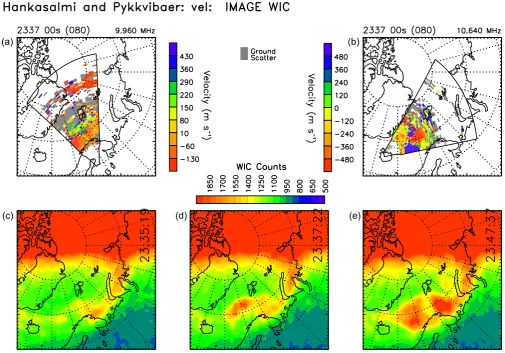
the IMAGE substorm list described in Sect. 2. The list of substorm events was reduced by selecting substorm onset events which occurred within 1 h local time of the location of the Hankasalmi radar. The list was further reduced by se-lecting only those times when a high time resolution beam was available on beam 9 of the Hankasalmi radar, and good quality data coverage was available on both the Hankasalmi and Þykkvibær radars. The data coverage and substorm de-velopment are indicated in Fig. 2. The upper panels of Fig. 2 present the data coverage of the two SuperDARN radars, showing the colour-coded ionospheric flow velocities across the full fields of view at 23:37 UT. The Hankasalmi data are presented in Fig. 2a and the Þykkvibær data in Fig. 2b. Red (negative) velocities are away from the radar and blue (posi-tive) velocities are towards the radar. The data are presented in magnetic latitude-magnetic local time coordinates. The radial dashed lines are separated by 1 h local time, with lo-cal midnight being marked by the vertilo-cal dashed line. The dashed circles indicate magnetic latitude at 10◦separations. Excellent data coverage is seen across a substantial region of both radar fields-of-view. The lower panels Fig. 2c–e present the corresponding IMAGE FUV Wideband Imaging Cam-era (WIC) instrument in the same coordinate system. The substorm onset was identified by Frey et al. (2004) as start-ing at 23:35:19 UT, at a geomagnetic latitude of 66.76◦and
(a) (b)
[image:4.595.45.551.83.436.2](c) (d) (e)
Fig. 2. Fields-of-view and data coverage from Channel A of the SuperDARN radars at (a) Hankasalmi, Finland and (b) Þykkvibær, Iceland in magnetic latitude-magnetic local time coordinates during substorm onset at 23:37 UT. Red (negative) velocities are away from the radar and blue (positive) velocities are towards the radar. The radial dashed lines are separated by 1 h local time, with local midnight being marked by the vertical dashed line. The dashed circles indicate magnetic latitude at 10◦separations. (c–e) present IMAGE WIC auroral data in the same coordinate system for three times during the substorm expansion phase.
equatorward of the observations presented here. Figure 2d and e shows the subsequent development of the auroral emis-sions at 23:37:22 UT and 23:47:37 UT. By 23:37:22 UT the auroral activity had migrated poleward and westward over the westernmost limit of the SuperDARN radar data cover-age, and subsequently by 23:47:37 UT the auroral activity expanded in all directions, essentially filling the area of the SuperDARN radar data.
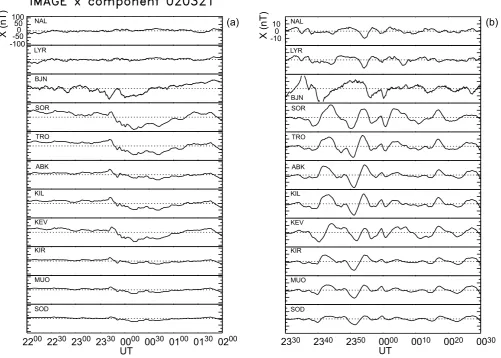
Figure 3 presents IMAGE X-component magnetometer data during the substorm interval. Figure 3a depicts unfil-tered data between 22:00 UT and 02:00 UT for a selection of IMAGE stations covering decreasing latitudes from top to bottom. At the highest and lowest stations there is little mag-netic signature of the substorm activity, but between these stations there is a clear decrease in the X component mag-netic field, starting around 23:30 UT, indicating an enhanced
-500 50 100
X (nT)
2200 2230 2300 2330 0000 0030 0100 0130 0200
UT
-100 -10
0 10
X (nT)
2330 2340 2350 0000 0010 0020 0030
UT
(a) (b)NAL
LYR
BJN SOR
TRO
ABK
KIL
KEV
KIR
MUO
SOD NAL
LYR
BJN
SOR
TRO
ABK
KIL
KEV
KIR
MUO
[image:5.595.49.551.68.426.2]SOD
Fig. 3. IMAGE X-component magnetometer data during the substorm interval. (a) unfiltered data between 22:00 UT and 02:00 UT (b) data bandpass filtered between 1000–20 s for the interval 23:30–00:30 UT.
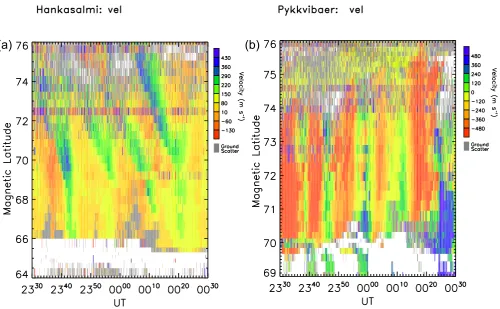
oscillatory flow velocities covering magnetic latitudes of 66◦ to 76◦, with a clear equatorward phase evolution visible in the wave. Fourier analysis (not shown) reveals the wave pe-riod to be 580 s (a frequency of 1.7 mHz). The data from the north-east directed beam of the Þykkvibær radar in Fig. 4b shows wave activity with the same period, but with little de-tectable phase propagation in the direction of the radar beam. The Fourier amplitude and phase behaviour of the wave is now examined in more detail. Figure 5a and b present the Fourier power and phase at the peak frequency of the ULF wave as a function of geomagnetic latitude, as derived from the ionospheric drift velocity measurements along beam 9 of the Hankasalmi SuperDARN radar presented in Fig. 4a. A 3◦
latitude range is chosen, where the wave signatures are clear-est and free from ground scatter contamination. The Fourier analysis confirms the equatorward phase propagation, reveal-ing that the wave exhibits a phase propagation of 151◦over this latitude range (∼62◦per degree of latitude). It is visually clear from Fig. 4a that the total equatorward phase variation over the wave signatures visible in the radar field-of-view
(a) (b)
Fig. 4. SuperDARN radar velocity measurements from (a) Hankasalmi beam 9 and (b) Þykkvibær beam 5. The ionospheric velocities are colour-coded as in Fig. 2, and the location of these two high time resolution beams is illustrated in Fig. 1.
0 500 1000 1500 2000 Power (Arb. Units) 69.5
70.0 70.5 71.0 71.5 72.0 72.5
Magnetic latitude
-100 0 100 Phase (degrees) 69.5
70.0 70.5 71.0 71.5 72.0 72.5
Magnetic latitude
(a) (b)
Fig. 5. Fourier (a) power and (b) phase at the peak frequency of the ULF wave observed in the ionospheric drift velocity measured along beam 9 of the Hankasalmi SuperDARN radar as a function of geomagnetic latitude.
east, although the significance of such small phase variations is unclear. If the longitudinal and latitudinal phase propaga-tions observed in the Hankasalmi data are used to predict the phase evolution expected along Þykkvibær beam 5, which
covers a significant range of both latitude and longitude, then a phase increase of 103◦in latitude and a phase decrease of 80◦ in longitude result. Thus the small phase change ob-served along Þykkvibær beam 5 is essentially consistent with the data from the Hankasalmi radar.
4 Interpretation: Alfvén waves, generated by substorm
injected high-energy particles
[image:6.595.48.290.449.593.2]0 500 1000 1500 2000 Power (Arb. Units) 106
108 110 112 114 116
Magnetic long
itude
-100 0 100
Phase (degrees) 106
108 110 112 114 116
Magnetic long
itude
[image:7.595.309.549.60.196.2](a) (b)
Fig. 6. Fourier (a) power and (b) phase at the peak frequency of the ULF wave observed in the ionospheric drift velocity mea-sured along beams 7–12 of the Hankasalmi SuperDARN radar at 70◦magnetic latitude as a function of geomagnetic longitude.
following substorm injection, with a drift resonance mecha-nism invoked as a source mechamecha-nism.
Following Yeoman and Wright (2001), taking the angular drift frequency of the particles to be
ωd=
ωwave
mwave
= 2π
τwavemwave
, (3)
where τwave is the wave period (i.e. taking N=0 in Eq. 2) yields a proton angular drift frequency of
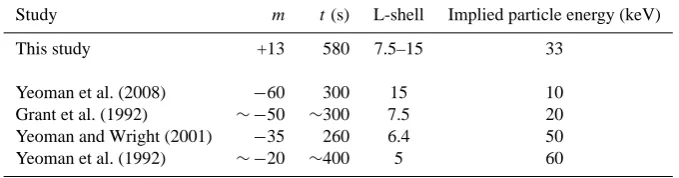
∼8.3×10⁻⁴rads s−1. The wave observations presented here cover L-shells of 7.5–15. Applying the equations for the de-pendence of proton or electron drift on particle energy as in Yeoman and Wright (2001) then implies an energy source in 25–70 keV particles at L=7.5–15. Taking large pitch angles and the central L-shell of the wave observations, then particle energies of 33 keV are predicted. The characteristics of the ULF wave events with equatorward phase propagation ob-served by Grant et al. (1992), Yeoman et al. (1992), Yeoman and Wright (2001), Yeoman et al. (2008) and those presented here are summarised in Table 1, along with the energetic par-ticle populations implicated in their generation by the authors concerned. Table 1 shows that whilst wave events are seen with a variety ofm-numbers and periods, a clear trend exists in previous observations in that the energy of the proposed particle population inversion decreases as the L-shell of the observation increases.
The present observations lie outside this trend, being ob-served with relatively lowm-numbers at relatively high lat-itudes. It is also the only observation with eastwards phase propagation. The present case study was taken from a larger database of such wave observations. The periods and m -numbers of the larger population were in fact very consis-tent. The majority of events identified so far have eastward phase propagation, although westward-propagating events have also been observed. Invoking the drift resonance mech-anism for an eastward-propagating wave event clearly
re-0 1000 2000 3000 4000 5000 Power (Arb. Units) 80
82 84 86 88
Magnetic long
itude
-100 0 100 Phase (degrees) 80
82 84 86 88
Magnetic long
itude
(a) (b)
70.92 71.76 72.02
71.48 72.28
71.21
70.62
Magnetic latit
ude
Fig. 7. Fourier (a) power and (b) phase at the peak frequency of the ULF wave observed in the ionospheric drift velocity measured along beam 5 of the Þykkvibær SuperDARN radar as a function of geomagnetic longitude. The corresponding geomagnetic latitudes of the datapoints are shown on the right for reference.
quires the wave energy source to lie in the population of en-ergetic electrons rather than the population of enen-ergetic pro-tons. Free energy should be available on occasion in the elec-tron populations when the conditions in equations Eq. (1) and Eq. (2) are met for electrons, although in the case of electrons the much more rapid electron bounce period would preclude solutions for conditions other thanN=0 in Eq. (2). Such energy sources in drifting electron clouds have been consid-ered as wave sources by Saka et al. (1992), Saka et al. (1996), Pilipenko et al. (2001a) and Pilipenko et al. (2001b). Such a mechanism involving electron clouds offers no explanation for the observed equatorward phase propagation, however. An alternative approach is considered below.
As is well known, in them∼1 limit two MHD modes, the fast mode and the Alfvén, are coupled. However, when these two modes have a different parallel structure (Leonovich, 2001) this coupling may under some circumstances be ne-glected and the excitation of the Alfvén waves can be stud-ied alone. The theory of the generation of this mode by substorm injected particles has been elaborated by Mager and Klimushkin (2008) and Mager et al. (2009). Although that theory was developed for the proton-driven high-mwave case, its qualitative features can be generalized for a more general situation, with lowerm-numbers and a wave source in the energetic electron population (see Zolotukhina et al., 2008).
The azimuthally drifting inhomogeneity provided by the drifting cloud of injected energetic particles can be consid-ered as a sudden impulse propagating from one location on the azimuthal coordinate to another with the drift angular ve-locityωd(x). Thus, let us consider the Alfvén waves excited by a sudden impulse with an azimuthal structure of the form
[image:7.595.47.290.62.209.2]Fig. 8. Lines of constant modelled wave phase. The dashed line represents the drifting source (energetic particle cloud), positiveφ is in the direction of the drift (westward for protons, eastward for electrons). The bold line corresponds tokx=0 (a purely poloidal polarization of the wave).
the expression (Leonovich and Mazur, 1998; Klimushkin and Mager, 2004)
E= |E|ei9 (4)
with the phase
9= −ω(x)t+mϕ, (5)
whereω is the resonant eigenfrequency andx is the radial coordinate. The azimuthal wave numbermis determined by the exciting impulse.
Following Mager et al. (2009), for a wave source in an azimuthally drifting inhomogeneity, the expression for the wave field must show the fact that the Alfvén waves have negligible energy propagation transverse to field lines. Hence, Eq. (4) is replaced by
E=2(ωdt−ϕ)|E|ei9. (6)
Here2(ωdt−ϕ)is the Heaviside step function. The wave phase is still given by Eq. (5), but themnumber is not arbi-trarily imposed. Instead, as the excitation is due to a moving source, in the source reference system the (Doppler-shifted) phase just behind the source is constant, thus the transformed wave frequencyω0=ω−mωdmust be zero. Hence, we ob-tain an expression for them-number:
m= ω(x)
ωd(x)
, (7)
just as in Eq. (3). This value depends on the radial coordinate (simply through the fact that different azimuthal wavenum-bers will be resonant with the moving source at different L-shells). Finally, we get the following expression for the phase:
9= −ω(x)t+ ω(x)
ωd(x)
ϕ. (8)
The bounce-averaged drift frequency in the inhomogeneous field is proportional to the particle energy and the radial coordinatex:
ωd'8×10⁻³x, (9)
whereωd,x, andare measured in degrees per minute, Earth radii, and keV, respectively (Roederer, 1970). The energy of substorm injected particles also depends on the radial coordi-nate, so in effect the drift frequency happens to depend only on the L-shell. Let us assume that drift frequency increases with the radial coordinate. This case can be realized in the magnetosphere under conditions where there is a consider-able loss of injected protons (e.g. Southwood, 1980). In this case, the lines of constant phase in thex-ϕplane are depicted in Fig. 8 (note that the whole picture is shifting to the right along with the source).
The wavevector radial component is determined as
kx≡90= −
ω
ωd 0
(ωdt−ϕ)−ωt
ω0d
ωd
, (10)
where a prime indicates a radial derivative. Note thatωdt−
ϕ≥0 since the wave appears in some azimuthal location si-multaneously with the particle cloud arrival in the same spot. Thus, provided thatω0d>0, the first right-hand side term is positive, while the second is negative. Just after the moment of the source passing a point with a given azimuthal coordi-nate, the radial component is negative,kx<0. However, it is finite, hence the wave has a polarization between toroidal and poloidal. A negative value of the wavevector radial com-ponent means a negative radial phase velocity of the wave; projected onto the ionosphere along geomagnetic field lines, this implies an equatorward phase propagation.
At the moment
t=ϕ(ω/ωd)
0
ω0 (11)
kx goes to zero the wave becomes poloidal. After that it changes its sign and becomes positive: the polarization of the wave becomes mixed again and, due to the phase mixing, the wave gradually transforms into toroidally-polarized one. The characteristic transformation time is
τ=2m0l
0L
, (12)
[image:8.595.47.290.60.192.2]Table 1. A summary of the characteristics of this case study and previous ULF wave observations showing equatorward phase propagation, and the particle energy of their proposed magnetospheric source (after Yeoman et al., 2008).
Study m t(s) L-shell Implied particle energy (keV) This study +13 580 7.5–15 33
Yeoman et al. (2008) −60 300 15 10 Grant et al. (1992) ∼ −50 ∼300 7.5 20 Yeoman and Wright (2001) −35 260 6.4 50 Yeoman et al. (1992) ∼ −20 ∼400 5 60
5 Conclusion and discussion
The SuperDARN data presented in Sect. 3 showed that in the immediate aftermath of a substorm expansion phase onset, Pc5 Alfvén ULF wave activity was stimulated by the recently-injected energetic particles. Observations from the Hankasalmi radar revealed that the wave generated in the magnetosphere had a period of 580 s (a frequency of 1.7 mHz) and was characterized by an intermediate az-imuthal wave number (m=13), with an eastwards phase propagation. It had a significant poloidal component and a rapid equatorward phase propagation (∼62◦ per degree of latitude). The total equatorward phase variation over the wave signatures visible in the radar field-of-view ex-ceeded the 180◦associated with field line resonances. Data from a north-east directed beam of the Þykkvibær radar was consistent with the period and phase behaviour inferred from Hankasalmi. The wave period observed here was somewhat longer than previous observations of equatorward-propagating events (see Table 1). This may well be a con-sequence of the wave occurring very shortly after the sub-storm expansion, on stretched, near-midnight field lines char-acterised by longer eigenfrequencies than those involved in previous observations.
The data can be interpreted in terms of the theory of the wave generation by substorm injected particles as elaborated by Mager and Klimushkin (2008), Mager et al. (2009) and Zolotukhina et al. (2008), with, in this case an electron cloud of energy∼33 keV acting as the wave source. According to the theory, wave comes into being with mixed polarization. As the wave moves farther and farther away from the source, it becomes poloidally-polarized. Furthermore, the wave fi-nally transforms into a toroidal polarization. If the wave at-tenuation is taken into account (for example, due to the fi-nite conductivity of the ionosphere or wave-particle interac-tion), then the wave does not have enough time to transform into a toroidal polarization, and the maximum wave ampli-tude will correspond to a mixed polarization. The azimuthal wave numbermis determined by the wave eigenfrequencyω
and the drift velocity of the sourceωd: m∼ω/ωd. Thus, to create the intermediate-mwaves, the injected particles must
have rather high energies for a given L-shell, in comparison to previous observations of wave events with equatorward polarization (see Table 1). The high energy and hence rapid azimuthal drift of the particles also explains the small time lag between the substorm onset and the detection of the wave. Low and intermediate-mwaves could also be generated by means of bump on tail instability under the drift reso-nance condition as outlined in Eq. (1) and Eq. (2) (Mager and Klimushkin, 2005). However, in this case there is a problem with the poloidal polarization of the wave, since the wave soon transforms into a toroidal one due to the phase mixing (Klimushkin, 2000, 2007; Klimushkin and Mager, 2004). In addition, this mechanism offers no explanation of the equa-torward propagation of the wave. Besides, it would be more appropriate to regard the instability as a mechanism for wave enhancement rather than as the source. To set this mecha-nism to work requires some germ amplitude, which could be provided by the moving particle cloud source, as suggested in this paper. A statistical investigation into the characteris-tics of the new wave type presented here, and its relationship to the associated substorm activity, will be presented in a fol-lowing paper.
Acknowledgements. This work is supported by INTAS grant
05-1000008-7978. The work by D.K. and P.M. is supported by Pro-gram of the presidium of the Russian Academy of Sciences #4, OFN RAS #15, and program #9 of the Earth’s sciences department of the Russian academy of sciences. The work by T.K.Y. is supported by STFC grant ST/H002480/1. We thank Harald Frey for making the IMAGE substorm list publically available.
Topical Editor I. A. Daglis thanks W. J. Hughes and another anonymous referee for their help in evaluating this paper.
References
Agapitov, O., Glassmeier, K.-H., Plaschke, F., Auster, H.-U., Con-stantinescu, D., Angelopoulos, V., Magnes, W., Nakamura, R., Carlson, C. W., Frey, S., and McFadden, J. P.: Surface waves and field line resonances: A THEMIS case study, J. Geophys. Res., 114, A00C27, doi:10.1029/2008JA013553, 2009.
Allan, W., Poulter, E. M., and Nielsen, E.: Pc5 pulsations associ-ated with ring current proton drifts: STARE radar observations, Planet. Space Sci., 31, 1279–1289, 1983.
Anderson, B. J., Engebretson, M. J., Rounds, S. P., Zanetti, L. J., and Potemra, T. A.: A statistical study of Pc 3-5 pulsations ob-served by the AMPTE/CCE magnetic fields experiment. 1. Oc-currence distributions, J. Geophys. Res., 95, 10495–10523, 1990. Baddeley, L. J., Yeoman, T. K., and Wright, D. M.: HF doppler sounder measurements of the ionospheric signatures of small scale ULF waves, Ann. Geophys., 23, 1807–1820, doi:10.5194/angeo-23-1807-2005, 2005a.
Baddeley, L. J., Yeoman, T. K., Wright, D. M., Trattner, K. J., and Kellet, B. J.: On the coupling between unstable magne-tospheric particle populations and resonant highmULF wave signatures in the ionosphere, Ann. Geophys., 23, 567–577, doi:10.5194/angeo-23-567-2005, 2005b.
Chisham, G. and Orr, D.: Statistical studies of giant pulsations (Pgs): harmonic mode, Planet. Space Sci., 39, 999–1006, 1991. Chisham, G., Lester, M., Milan, S. E., Freeman, M. P., Bristow,
W. A., Grocott, A., McWilliams, K. A., Ruohoniemi, J. M., Yeo-man, T. K., Dyson, P. L., Greenwald, R. A., Kikuchi, T., Pinnock, M., Rash, J. P. S., Sato, N., Sofko, G. J., Villain, J.-P., and Walker, A. D. M.: A decade of the Super Dual Auroral Radar Network (SuperDARN): scientific achievements, new techniques and fu-ture directions, Surv. Geophys., 28, 33–109, 2007.
Cowley, S. W. H. and Ashour-Abdallah, M.: Adiabatic plasma con-vection in a dipole field: Proton forbidden-zone effects for a sim-ple electric field model, Planet. Space Sci., 24, 821–833, 1976. Engebretson, M. J., Murr, D. L., Erickson, K. N., Strangeway, R. J.,
Klumpar, D. M., Fuselier, S. A., Zanetti, L. J., and Potemra, T. A.: The spatial extent of radial magnetic pulsation events ob-served in the dayside near synchronous orbit, J. Geophys. Res., 97, 13741–13758, 1992.
Eriksson, P. T. I., Blomberg, L. G., and Glassmeier, K.-H.: Cluster satellite observations of mHz pulsations in the dayside magneto-sphere, Adv. Space Res., 38, 1730–1737, 2006.
Frey, H. U., Mende, S. B., Angelopoulos, V., and Donovan, E. F.: Substorm onset observations by IMAGE-FUV, J. Geophys. Res., 109, A10304, doi:10.1029/2004JA010607, 2004.
Glassmeier, K.-H., Buchert, S., Motschmann, U., Korth, A., and Pedersen, A.: Concerning the generation of geomagnetic giant pulsations by drift-bounce resonance ring current instabilities, Ann. Geophys., 17, 338–350, doi:10.1007/s00585-999-0338-4, 1999a.
Glassmeier, K.-H., Othmer, C., Cramm, R., Stellmacher, M., and Engebretson, M.: Magnetospheric field line resonance: a com-parative approach, Surv. Geophys., 20, 61–109, 1999b.
Grant, I. F., McDiarmid, D. R., and McNamara, A. G.: A class of high-m pulsations and its auroral radar signature, J. Geophys. Res., 97, 8439–8451, 1992.
Greenwald, R. A., Weiss, W., Nielsen, E., and Thomson, N. P.: STARE: A new radar auroral backscatter experiment in northern Scandinavia, Radio Sci., 13, 1021–1039, 1978.
Greenwald, R. A., Baker, K. B., Dudeney, J. R., Pinnock, M., Jones, T. B., Thomas, E. C., Villain, J.-P., Cerisier, J.-C., Senior, C., Hanuise, C., Hunsucker, R. D., Sofko, G., Koehler, J., Nielsen, E., Pellinen, R., Walker, A. D. M., Sato, N., and Yamagishi, H.: DARN/SUPERDARN A global view of the dynamics of high-latitude convection, Space Sci. Rev., 71, 761–796, 1995.
Hasegawa, A., Tsui, K. N., and Assis, A. S.: A theory of long pe-riod magnetic pulsations. 3. Local field line oscillations, Geo-phys. Res. Lett., 10, 765–767, 1983.
Hughes, W. J., Southwood, D. J., Mauk, B., McPherron, R. L., and Barfield, J. N.: Alfvén waves generated by an inverted plasma energy distribution, Nature, 275, 43–45, 1978.
Hughes, W. J., McPherron, R. L., Barfield, J. N., and Mauk, B. H.: A compressional Pc4 pulsation observed by three satellites in geostationary orbit near local midnight, Planet. Space Sci., 27, 821–840, 1979.
Klimushkin, D. Y.: The propagation of high-mAlfvén waves in the Earth’s magnetosphere and their interaction with high-energy particles, J. Geophys. Res., 105, 23303–23310, 2000.
Klimushkin, D. Y.: How energetic particles construct and destroy poloidal high-m Alfvén waves in the magnetosphere, Planet. Space Sci., 55, 722–730, 2007.
Klimushkin, D. Yu. and Mager, P. N.: The spatio-temporal struc-ture of impulse-generated azimuthalsmall-scale Alfvén waves interacting with high-energy chargedparticles in the magneto-sphere, Ann. Geophys., 22, 1053–1060, doi:10.5194/angeo-22-1053-2004, 2004.
Kokubun, S.: Statistical characteristics of Pc5 waves at geostation-ary orbit, J. Geomag. Geoelectr., 37, 759–779, 1985.
Leonovich, A. S.: A theory of field line resonance in a dipole-like axisymmetric magnetosphere, J. Geophys. Res., 106(A11), 25803–25812, doi:10.1029/2001JA000104, 2001.
Leonovich, A. S. and Mazur, V. A.: Standing Alfvén waves with m 1 in an axisymmetric magnetosphere excited by a non-stationary source, Ann. Geophys., 16, 914–920, doi:10.1007/s00585-998-0914-z, 1998.
Lessard, M. R., Hudson, M. K., and Lühr, H.: A statistical study of Pc 3-Pc 5 magnetic pulsations observed by the AMPTE/Ion Re-lease Module satellite, J. Geophys. Res., 104, 4523–4538, 1999. Lühr, H.: The IMAGE magnetometer network, STEP International
Newsletter, 4, 4–6, 1994.
Mager, P. N. and Klimushkin, D. Yu.: Spatial localization and azimuthal wave numbers of Alfvén waves generated by drift-bounce resonance in the magnetosphere, Ann. Geophys., 23, 3775–3784, doi:10.5194/angeo-23-3775-2005, 2005.
Mager, P. N. and Klimushkin, D. Yu.: Alfvén ship waves: high-mULF pulsations in the magnetosphere generated by a mov-ing plasma inhomogeneity, Ann. Geophys., 26, 1653–1663, doi:10.5194/angeo-26-1653-2008, 2008.
Mager, P. N., Klimushkin, D. Y., and Ivchenko, N.: On the equa-torward phase propagation of high-m ULF pulsations observed by radars, J. Atmos. Solar-Terr. Phys., 71, 1677–1680, doi: 10.1016/j.jastp.2008.09.001, 2009.
McNamara, A. G., McDiarmid, D. R., Sofko, G. J., Koeler, J. A., Forsyth, P. A., and Moorcroft, D. R.: BARS – a dual bistatic au-roral radar system for the study of electric fields in the Canadian sector of the auroral zone, Adv. Space Res., 2, 145–148, 1983. Mende, S. B., Heetderks, H., Frey, H. U., Lampton, M., Geller,
S. P., Abiad, R., Siegmund, O. H. W., Tremsin, A. S., Spann, J., Dougani, H., Fuselier, S. A., Magoncelli, A. L., Bumala, M. B., Murphree, S., and Trondsen, T.: Far ultraviolet imaging from the IMAGE spacecraft. 2. Wideband FUV imaging, Space Sci. Rev., 91, 271–285, 2000a.
Fuselier, S. A., Gerard, J.-C., Gladstone, R., Murphree, S., and Cogger, L.: Far ultraviolet imaging from the IMAGE spacecraft. 1. System design, Space Sci. Rev., 91, 243–270, 2000b. Nielsen, E., Guttler, W., Thomas, E. C., Stewart, C. P., Jones, T. B.,
and Hedburg, A.: SABRE – new radar-auroral backscatter exper-iment, Nature, 304, 712–714, 1983.
Ozeke, L. G. and Mann, I. R.: Modeling the properties of high m Alfvén waves driven by the drift-bounce resonance mechanism, J. Geophys. Res., 106, 15583–15597, 2001.
Pilipenko, V., Kleimenova, N., Kozyreva, O., Engebretson, M., and Rasmussen, O.: Long-period magnetic activity during the May 15, 1997 storm, J. Atmos. Solar-Terr. Phys., 63, 489–501, 2001a. Pilipenko, V. A., Watermann, J., Popov, V. A., and Papitashvili, V. O.: Relationship between auroral electrojet and Pc5 ULF waves, J. Atmos. Sol.-Terr. Phys., 63, 1545–1557, 2001b. Roederer, J. G.: Dynamics of geomagnetically trapped radiation,
Springer-Verlag, Berlin, Heidelberg, New York, 1970.
Saka, O., Iijima, T., Yamagishi, H., Sato, N., and Baker, D. N.: Excitation of Pc 5 pulsations in the morning sector by a local injection of particles in the magnetosphere, J. Geophys. Res., 97, 10693–10701, 1992.
Saka, O., Watanabe, O., and Baker, D. N.: A possible driving source for transient field line oscillations in the postmidnight sector at geosynchronous altitudes, J. Geophys. Res., 101, 24719–24726, 1996.
Schäfer, S., Glassmeier, K. H., Eriksson, P. T. I., Pierrard, V., Fornaçon, K. H., and Blomberg, L. G.: Spatial and tempo-ral characteristics of poloidal waves in the terrestrial plasmas-phere: a CLUSTER case study, Ann. Geophys., 25, 1011–1024, doi:10.5194/angeo-25-1011-2007, 2007.
Schäfer, S., Glassmeier, K. H., Eriksson, P. T. I., Mager, P. N., Pier-rard, V., Fornaçon, K. H., and Blomberg, L. G.: Spatio-temporal structure of a poloidal Alfvén wave detected by Cluster adja-cent to the dayside plasmapause, Ann. Geophys., 26, 1805–1817, doi:10.5194/angeo-26-1805-2008, 2008.
Southwood, D. J.: A general approach to low-frequency instabil-ity in the ring current plasma, J. Geophys. Res., 81, 3340–3348, 1976.
Southwood, D. J.: Low frequency pulsation generation by energetic particles, J. Geomagn. Geoelectr., Suppl. II, 32, 75–88, 1980. Southwood, D. J., Dungey, J. W., and Etherington, R. J.: Bounce
resonant interactions between pulsations and trapped particles, Planet. Space Sci., 17, 349–361, 1969.
Takahashi, K., Higbie, P. R., and Baker, D. N.: Azimuthal propaga-tion and frequency characteristic of compressional Pc5 waves ob-served at geostationary orbit, J. Geophys. Res., 90, 1473–1485, 1985.
Takahashi, K., McEntire, R. W., Lui, A. T. Y., and Potemra, T. A.: Ion flux oscillations associated with a radially polarised trans-verse Pc5 magnetic pulsation, J. Geophys. Res., 95, 3717–3731, 1990.
Takahashi, K., Sato, N., Warnecke, J., Lühr, H., Spence, H. E., and Tonegawa, Y.: On the standing wave mode of giant pulsations, J. Geophys. Res., 97, 10717–10732, 1992.
Tian, M., Yeoman, T. K., Lester, M., and Jones, T. B.: Statistics of Pc5 pulsation events observed by SABRE, Planet. Space Sci., 39, 1239–1247, 1991.
Waldock, J. A., Jones, T. B., and Southwood, D. J.: First results of micropulsation activity observed by SABRE, Planet. Space Sci., 31, 573–578, 1983.
Woch, J., Kremser, G., and Korth, A.: A comprehensive investiga-tion of compressional ULF waves observed in the ring current, J. Geophys. Res., 95, 15113–15132, 1990.
Wright, D. M., Yeoman, T. K., and Chapman, P. J.: High-latitude HF Doppler observations of ULF waves. 1. Waves with large spatial scale sizes, Ann. Geophys., 15, 1548–1556, doi:10.1007/s00585-997-1548-2, 1997.
Yeoman, T. K. and Wright, D. M.: ULF waves with drift reso-nance and drift-bounce resoreso-nance energy sources as observed in artificially-induced HF radar backscatter, Ann. Geophys., 19, 159–170, doi:10.5194/angeo-19-159-2001, 2001.
Yeoman, T. K., Tian, M., Lester, M., and Jones, T. B.: A study of Pc5 hydromagnetic waves with equatorward phase propagation, Planet. Space Sci., 40, 797–810, 1992.
Yeoman, T. K., Wright, D. M., Chapman, P. J., and Stockton-Chalk, A. B.: High-latitude observations of ULF waves with large az-imuthal wavenumbers, J. Geophys. Res., 105, 5453–5462, 2000. Yeoman, T. K., Baddeley, L. J., Dhillon, R. S., Robinson, T. R., and Wright, D. M.: Bistatic observations of large and small scale ULF waves in SPEAR-induced HF coherent backscat-ter, Ann. Geophys., 26, 2253–2263, doi:10.5194/angeo-26-2253-2008, 2008.