The Thirty-Third AAAI Conference on Artificial Intelligence (AAAI-19)
Popularity Prediction on Online Articles with Deep Fusion of Temporal Process
and Content Features
Dongliang Liao,
1Jin Xu,
1∗Gongfu Li,
1Weijie Huang,
1Weiqing Liu,
2Jing Li
2 1WeChat, Tencent Inc.{brightliao, jinxxu, gongfuli,wainhuang}@tencent.com;
2University of Science and Technology of China,
[email protected],[email protected]
Abstract
Predicting the popularity of online article sheds light to many applications such as recommendation, advertising and infor-mation retrieval. However, there are several technical chal-lenges to be addressed for developing the best of predictive capability. (1) The popularity fluctuates under impacts of ex-ternal factors, which are unpredictable and hard to capture. (2) Content and meta-data features, largely determining the online content popularity, are usually multi-modal and non-trivial to model. (3) Besides, it also needs to figure out how to integrate temporal process and content features modeling for popularity prediction in different lifecycle stages of online articles. In this paper, we propose a Deep Fusion of Temporal process and Content features (DFTC) method to tackle them. For modeling the temporal popularity process, we adopt the recurrent neural network and convolutional neural network. For multi-modal content features, we exploit the hierarchical attention network and embedding technique. Finally, a tem-poral attention fusion is employed for dynamically integrat-ing all these parts. Usintegrat-ing datasets collected from WeChat, we show that the proposed model significantly outperforms state-of-the-art approaches on popularity prediction.
Introduction
Online articles, such as news in portal websites and blogs in social networks, have become the most important source of information. The popularity of online article describes how much attention it receives, which could be measured by the amount of total views. Popularity is a measure of content quality for content providers, and a way to fil-ter information for content consumers. Unfortunately, we can only acquire the overall popularity after the lifecyle of the online article. Predicting the overall popularity in early stage sheds light to many applications, such as recommenda-tion, advertising and information retrieval (Gao et al. 2018; Liu et al. 2016). Besides, it is also academic valuable and industrial applicable to properly answer the question like “How to predict the overall popularity of online content at any time?”
Recently, popularity prediction has drawn great atten-tions. Scholars handle this task with two-broad-category
∗
Corresponding author: Jin Xu <[email protected]>; the first two authors contributed equally
Copyright c⃝2019, Association for the Advancement of Artificial Intelligence (www.aaai.org). All rights reserved.
1.0
0.8
0.6
0.4
0.2
0
Time (days)
1 2 3 4 5 6 7 8 9 10
N
ormalized T
ot
al Views
(a) Long term growth trend.
H
ourly
Views
Amount
July 1 July 2 July 3 July 4
Time (date)
External impact
(b) Short term fluctuation.
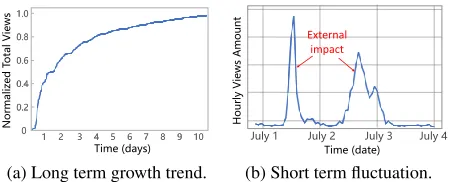
Figure 1: These two sub-figures show temporal dynamic of articles popularity in WeChat1. (a) The normalized total
views accumulative process of all articles. (b) The hourly views amount variation of an example article.
approaches: temporal process modeling and content fea-ture modeling. Temporal process modeling predicts popu-larity based on temporal evolution processes of aggregated view volumes in time slots. The accumulative popularity in-creases over time while shows unexpected outbreaks under impacts of external factors, shown in Fig. 1. Most exist-ing works capture short term fluctuations based on the spe-cific assumption about external impact (Zhao et al. 2015; Cao et al. 2017; Rizoiu et al. 2017). However, many external factors are unpredictable. Specific assumptions restrict these models’ predictive power. Yuet al. tried to extract popular-ity fluctuations from temporal process itself, based on hand-crafted “phases” (Yu et al. 2015). However, influences of external factors may cover different ranges and durations. It is hard to assume the amount and shapes of fluctuations arti-ficially. How to extract short term fluctuations automatically is still a unsolved problem in this branch of methods.
On the other hand, recent works have proved the effective-ness of content features in the popularity prediction, such as short text descriptions, titles and images (Zhang et al. 2018; Piotrkowicz et al. 2017; Sanjo and Katsurai 2017). However, online articles are usually long texts which are non-trivial to model, and diverse forms of meta-data features further com-plicate the content feature modeling. None of existing works has taken fully advantages of the long text and meta-data features for popularity prediction of online articles.
1
Attention CNN
Temporal Attention Fusion
LSTM
Text Features Meta-data
Popularity Level
Content Features Temporal Process
Embeddings & FC layers
Tot
al
view
s
Time
Hourly
view
s
Time
Hierarchical Attention
Growth Trend Fluctuation
Category Tag
Author Fans
Publish time Language
… …
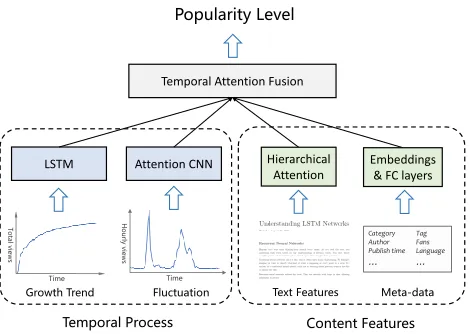
Figure 2: The overall framework of Deep Fusion of Tempo-ral process and Content features model.
Meanwhile, these two categories of methods have their own strength and drawbacks over different lifecycle stages of online article. Temporal process modeling relies on series of history events, and performs better and better over time since the observed popularity gets closer to the overall ularity. However, it is hard to learn the overall trend of pop-ularity at the very beginning after online content have been published. In practical applications, it is valuable to predict the overall popularity in early stage of online article’s life-cycle, so that we can recommend potential “hot” articles and filter arid ones. In contrast, content features will not change over time. Thus content features modeling is more reliable in early stage, while it fails to exploit the temporal evolution of popularity. Therefore, we should integrate the temporal process and content feature modeling to leverage their re-spective power. Nevertheless, different articles show differ-ent increase rates and fluctuations in popularity evolutions. Intuitive fusion methods, such as vector concatenation or lin-ear combination, lack flexibility for handling the diversity of popularity evolution processes.
Motivated by above challenges, we propose a neural net-work method named Deep Fusion of Temporal process and Content features (DFTC). The framework of DFTC is shown in Fig. 2. In our model, we tackle above challenges with following modeling techniques: (1) For modeling the tem-poral process, we adopt Recurrent Neural Network (RNN) to capture the long term growth trend of popularity. As for short-term fluctuations, we adopt attention based Convolu-tional Neural Network (CNN) to extract rising or falling “phases” structures automatically. (2) For modeling content features, we exploit Hierarchical Attention Network (HAN) (Yang et al. 2016) for capturing text features and employ embedding techniques to embed meta-data features into ho-mologous dense vectors. (3) For dynamic fusion, we employ a temporal attention layer. It leverages attention mechanism to learn flexible weights for combining all above modeling techniques, based on their outputs and temporal contexts. Besides, we collect real-world datasets from WeChat, and
conduct extensive experiments for evaluating prediction per-formances in different stages, including a case study for ef-fects of CNN and attention fusion.
Our main contributions are summarized as follows:
• We leverage RNN for long term growth trend and CNN for short term fluctuation of temporal processes automati-cally, rather than specific assumption of external factor or hand-crafted “phases”.
• We adopt HAN for text features, embedding techniques for meta-data features, and temporal attention fusion for integrating temporal process and content feature model-ing dynamically.
• Experimental results show the proposed model signifi-cantly outperforms state-of-the-art methods, demonstrat-ing the validity and superiority of our approach.
Related Work
Popularity prediction has drawn great attentions for decades. Scholars handled this task with two-broad-category ap-proaches: temporal processes modeling and feature-based modeling.
Temporal process modeling. Some researchers regarded
the popularity cumulation of online content as an micro ar-rival point process of view events. They predicted popu-larity by modeling micro point processes of single events based on reinforced possion processes (Shen et al. 2014), hawkes point processes (Zhao et al. 2015) or neural network (Cao et al. 2017; Gou et al. 2018). However, the amount of events can be explode in a short time in large-scale applica-tions, which will cause performance issues of micro tempo-ral process modeling. Thus we argue that predicting popular-ity based on macro accumulation process of event volumes has more practical value, since macro temporal processes are typically a few dozens to a few hundred data points.
A number of models have been proposed to describe the evolution of macro temporal process. Hawkes intensity pro-cesses (Rizoiu et al. 2017) expanded hawkes point process for macro temporal process and adopted it in Youtube video popularity prediction. HIP made specific assumptions about functional forms of temporal processes and influences of ex-ternal factors, which may restrict the expressive power of these models (Du et al. 2016). Mishraet al. proposed a dual RNN model for modeling both micro and macro temporal process (Mishra, Rizoiu, and Xie 2018) and achieved state-of-the-art performance. However, it still needs micro events for modeling the fluctuation caused by external influence. Yu
et al. extracted rising and falling “phases” from macro tem-poral process to capture fluctuations, and proposed a phase-based linear regression approach for popularity prediction (Yu et al. 2015). However, hand-crafted “phases” can not handle the diversity of popularity evolution processes. In our model, we adopt attention CNN for extracting local rising and falling structures automatically and LSTM for captur-ing the long term growth trend of macro temporal processes.
Feature-based modeling. Some other researchers
popularity prediction. Piotrkowiczet al. predicted popularity of news articles using only headline features (Piotrkowicz et al. 2017). Sanjoet al. proposed a visual-semantic fusion model for online recipe popularity prediction, leveraging im-age and short text features in recipes (Sanjo and Katsurai 2017). User-guided hierarchical attention network (Zhang et al. 2018) learned modalities content and user features for social image popularity prediction. Unfortunately, there is none existing work has taken fully advantages of the long text and meta-data features for popularity prediction of on-line articles. Besides, these approaches also ignore popular-ity evolution processes of online content.
Some other methods extracted various hand-crafted fea-tures for popularity prediction, including both temporal pro-cess and content features. Keneshlooet al. extracted meta-data, content and temporal features, and adopted tree re-gression for news popularity prediction (Keneshloo et al. 2016). Shulmanet al. added novel social structure and early adopter features for improving the prediction performance (Shulman, Sharma, and Cosley 2016). Their performances heavily depend on extracted features. However, these fea-tures are hard to design and measure, and are often binded to specific datasets or applications. Inspired the huge suc-cess of deep learning, we leverage neural network for mod-eling both the content features and temporal processes, avoiding laborious feature engineering (Xu et al. 2012; Xu et al. 2017).
Problem Formulation
We regard the popularity prediction task as a classification problem, discretizing the amount of total views tonintervals
{l1, l2,· · ·, ln}to represent popularity levels of online
arti-cles. Our goal is to predict the popularity level at any time af-ter the online article has been published. For the ease of cal-culation, we discretize continuous time to time slots, and ag-gregate user feedback events volumes as macro time series. Here, user feedback events contain not only “view” but also “share”, “comment” or “like” in many applications. We take all the volumes of these events in time slotstas feedback vectorvt. More formally, for a online contentc, given any
time slottand the history feedback series{v1,v2,· · ·,vt},
the objective is to predict the overall popularity level ofc.
Model
In this section, we introduce the proposed Deep Fusion of Temporal process and Content features (DFTC) model. The overall framework is presented in Fig. 2. DFTC consists of three parts: temporal process modeling, content feature modeling and attentive fusion. The temporal process mod-eling takes the history feedback series{v1,v2,· · ·,vt}as
inputs, and adopting recurrent neural network for modeling the long term growth trend and convolutional neural net-work for capturing short term fluctuations. In the content features modeling, we leverage hierarchical attention net-work for learning text features, and embedding technique for extracting meta-data features. At last, we dynamically integrate all these parts through temporal attention fusion.
Fixed Size Window ConvSize 1 ConvSize 2 ··· ConvSize k
···
Attention
··· Filter Concatenation
(a) Attention CNN.
h11 h12 h1n
h21 h22 h2n
s1 s2 sn
h31 h32 h3n
h41 h42 h4n
hh
Attention Attention
w1 w2 wn
Bidirectional GRU layer
Bidirectional GRU layer
Sentence Attention
Sentence Encoder
Word Attention
Word Encoder …
… … …
(b) HAN
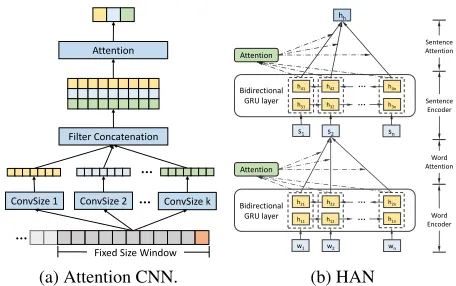
Figure 3: (a) The architecture of attention CNN for capturing short term fluctuations. (b) Hierarchical attention network (HAN) for modeling text content features.
Temporal Process Modeling
In this work, we employ Recurrent Neural Network (RNN) for modeling the temporal evolution process of popularity. Long Short Term Memory (LSTM) is the most widely used RNN structure. We reiterate the formulation of LSTM:
it=σ(Wixt−1+Uict−1+Viht−1+bi) (1)
ft=σ(WfxSt−1+U
fc
t−1+Vfht−1+bf) (2)
ct=ft∗ht−1+it∗tanh(Wcxt−1+Vcht−1+bc) (3)
ot=σ(WoxSt−1+Uoct−1+Voht−1+bo) (4)
ht=ot∗tanh(ct) (5)
The superiority of RNN for temporal modeling is that the hidden statehtinvolves all the history information so that
we need not to make a specific assumption about functional forms of the history trend (Du et al. 2016). What’s more, the memory cellctin LSTM ensures the long term dependency
can also be captured. Thus we adopt LSTM to learn the long term growth trend of popularity. Concretely, we feed the feedback vectorvof each time slot into LSTM, and ob-tain the history growth pattern in the output vectorhr
t.
kernels with different sizes to capture different scale of fluc-tuations, shown in Fig. 3a. After then, we stack outputs of all convolutional kernels vertically.
Note that CNNs usually need fixed size inputs. Thus, we take a clipped series{vt−k+1,vt−k+2,· · ·,vt}with fixed
lengthkbeforet. Then we apply same padding and get an output series{ct−k+1,ct−k+2,· · ·,ct} with lengthk too,
which captures the fluctuation pattern of the recent history. At last, we need to merge output series through temporal dimension into output vector hc
t. There are several widely
used methods for the merging operator, such as vector con-catenation, max/mean pooling and linear combination. Here we adopt the attention mechanism (Vaswani et al. 2017) for merging {ct−k+1,ct−k+2,· · ·,ct}. Attention mechanism
helps the outputhctto focus on such time slots that are
influ-enced by external factors, via multiplying different attentive weightsαcto different vectorsc. The calculation of attentive
weightsαcand the output vectorhc
tis as follows:
aci =Victanh(
k
∑
i=1
Wjcct−k+i+bc) (6)
αci = exp(a
c i)
∑k
j=1exp(a
c j)
(7)
hct= k
∑
i=1
αicct−k+i (8)
Content Features Modeling
Content features of online articles, including text and meta-data features, largely determine their popularity. Online ar-ticles are usually long text documents, such as news arar-ticles and blogs. Inspired by the huge success of neural network in nature language process (Lai et al. 2015; Yang et al. 2016; Huo, Li, and Zhou 2016), we adopt the Hierarchical Atten-tion Network (HAN) (Yang et al. 2016) for modeling the text content feature. The framework of HAN is showed in Fig. 3b. Considering the inherent hierarchical structure of documents (i.e. words form sentences and sentences form a document), HAN encodes a document to a vector with two levels of encoder and attention, applied at the word-level and sentence-level. Both word-level and sentence-level en-coders are bidirectional Gated Recurrent Unit. For more de-tails of HAN, please refer to their research article (Yang et al. 2016). Besides, titles are high-level overviews of articles and show primary impressions. We also learn a title repre-sentation vector as a supplement. Since the title is usually a phrase or a sentence, we encode the short text to a vector with only word-level encoder and attention. Then we con-catenate document vector and title vector together as text featureshh.
Meta-data features consist of both one-hot features, such as category, and numerical features, such as fans number of author. Instead of hand-crafted selection and combination of these features, we exploit embedding techniques for em-bedding these features into homologous dense vectors and apply fully connected layers for the feature combination.
Embedding
Concatenation
FC layers
0 1 ···0
·· · One hot features
·· · 0.5 Numerical features
(a) Embedding.
FC FC FC FC
hmerge
α1 α2 α3 α4
Attention
hr hc hh he
t
(b) Temporal Attention Fusion.
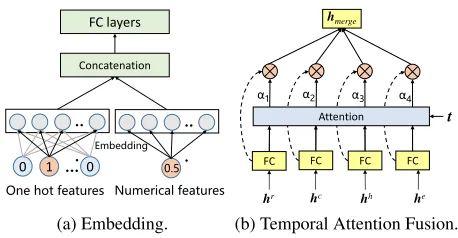
Figure 4: (a) The illustration of embedding techniques for meta-data features. (b) The architecture of the temporal at-tention layer.
As shown in Fig. 4a, we embed one-hot features to vec-tors through embedding matrices. On the other hand, we multiply numerical features by embedding vectors for map-ping them to homologous dense vectors. Then we concate-nate embedding vectors and apply fully connected layers for combining all meta-data features tohe.
Attentive Fusion
For fusing above modeling techniques, a direct way is to concatenate outputs of all these parts and feed the concatenation result into output layers for prediction. Let
hrt,hct,hh,herepresent outputs of RNN, CNN, HAN and
meta-feature embedding. Then we can get prediction attas:
ˆ
yt=f(W[htr,hct,hh,he] +b). In this way,hrt,hct,hh,he
are combined with fixed weightsW. As mentioned in Sec-tion 1, we argue that it lacks flexibility for handling the dy-namic evolution of temporal process. At the very beginning after online articles have been published, it is hard for tem-poral process modeling to learn the overall growth trend of popularity. Thus the prediction should mainly depend on content feature modeling. As time goes on, the observed popularity gets closer to the overall popularity, so tempo-ral modeling should take a major part in prediction. On that basis, we suppose to integratehr
t,hct,hh,he with a
flexi-ble weightα.α should be a function of ofhr
t,hct,hh,he
and temporal contextt, so that it could automatically adapt different outputs and temporal context.
In this work, we adopt an attention mechanism to achieve dynamic integration, shown in Fig. 4b. Attention mechanism is a element-wise combination, thus we feedhr
t,hct,hh,he
into fully connected layers for feature combination and ac-quire element-wise aligned vectorshˆr
t,hˆct,hˆh,hˆe. Then we
use a two-layer neural network to compute the attentive weightsαmas:
ami =Vimtanh( ∑
j∈{r,c,h,e}
Wjmhˆjt+Wtmt+bm) (9)
αmi =
exp(ami )
∑
k∈{r,c,h,e}exp(amk )
(10)
interval of t and the publish time. Here, periodic proper-ties are one hot features and time interval is a numerical feature. We apply the same strategy as embedding meta-data features to embed temporal context into vector. With attentive weightsαm, we combine all subnetworks
dynam-ically as hmerget and get a probability distribution Pt = {pt(l1), pt(l2),· · ·, pt(ln)} of popularity levels after fully
connected layers and softmax output layer. Then we take the popularity level with max probability as prediction resultyˆt.
hmerget = ∑
i∈{r,c,h,e}
αmi hˆi
t (11)
Pt=softmax(f(hmerget )) (12)
ˆ
yt= arg max
l pt(l) (13)
Temporal Decayed Loss
With the proposed model, we get a probability distribution
Ptof popularity levels of online articlecat time slott.
Sup-posing the true level of c islc, the single step loss at t is
defined by the cross entropy asLt=−logpt(lc). Through
the whole time series ofc, we can define the overall loss of our model asJ =∑
tLt.
In practical applications, it is much more valuable to pre-dict overall popularity in early stage. Besides, the inherent relation between the observed popularity and overall popu-larity makes it easier to make predictions in the later period. In order to help our model to invest more efforts to opti-mize the prediction performance in early stage, we multiply a temporal decayed factor to the single step loss:
J =∑
t
D(∆t)Lt=−
∑
t
D(∆t) logpt(lc) (14)
The temporal decayed factor D(∆t) should be a monotonous and non increasing function of the time interval
∆tbetweentand the publish time. In this work, we choose a function as follows:
D(∆t) =⌈logγ(∆t+ 1)⌉−1 (15)
Here,⌈·⌉represents up rounding operator.∆tis number of time slots from the publish time tot, thus∆tand⌈logγ(∆t+ 1)⌉are both positive integers.γ > 1 is a hyper-parameter for controlling the decay rate. We adopt the log function to ensure the decay rate ofD(∆t)will get smaller and smaller with time goes by. The up rounding operator is employed for restricting the initial decay rate of log function.
Experiments
Datasets
We collect an online article dataset from a widely used mo-bile social application WeChat2. Both media organizations
and personal users can set up their official accounts for pub-lishing news and articles. Users can follow official accounts
2
http://www.wechat.com
hot normal cold
>1,000 ≤1,000 >10 ≤10
training
#articles 18,832 9,159 9,243 8,946 8,884 balanced test
#articles 2,093 1,020 989 1,009 1,007 random test
#articles 78 467 2,060 4,308 23,087
Table 1: Datasets Statistics
to subscribe article updates. WeChat provides article recom-mendation and search function for users. When reading ar-ticles, users can also take “share”, “save”, “like” and “tip” actions. Nowadays, there are more than 500,000 new arti-cles and 2 billion “views” per day in WeChat.
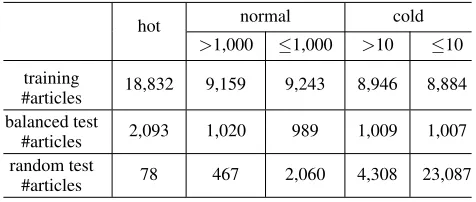
We divide the overall popularity of articles into three cat-egories, “hot” (more than 10,000 views), “cold” (less than 100 views) and “normal” (otherwise). Here, we take the to-tal views of 15 days after articles are published as an ap-proximation of overall popularity. The distribution of article views is a typical power-law distribution. Only 0.08% ar-ticles are “hot”, while more than 93% arar-ticles are “cold”. Thus we collect all “hot” articles from May 25 to July 25 and under sample other two category articles. In order to ensure the diversity of training data, we adopt a piecewise uniform sampling over the logarithmic views amount. We count the amount of “view” ,“share”, “save”, “like” and “tip” actions per 5 minutes of each article as macro time series. Then we clip these time series before the observed popular-ity achieves 80% of overall popularpopular-ity or the 80% of “hot” threshold. The articles whose time series lengths are less than 12 is filtered, because they either become “hot” imme-diately or retain “cold” all the time. Finally, we get 61,178 articles from WeChat. In following experiments, we take 85% of articles for training our model, 5% articles for vali-dation and 10% articles for evaluation, calledbalanced test set. For evaluating our model on the realistic distribution, we randomly sample other 30,000 articles asrandom test set
from July 26 to August 10. The dataset statistics information is shown in Table 1. Besides, meta-data features consist of
“category”, “publish time”, “content length”, “video num-ber”and“fans numbers of publisher”.
Experiment Settings
Baselines We compare the proposed DFTC method with
following baselines:
• Feature-based classifier. We adopt logistic regression (LR) and random forests (RF) as baselines of the popular-ity classification task. These classifiers take both temporal process features and content features as inputs.
• HIP (Rizoiu et al. 2017). Hawkes Intensity Process ex-tents the well known hawkes point process for modeling macro temporal process and is applied for predicting pop-ularity of videos.
Method Results of Balanced Test Set Results of Random Test Set
Accuracy hot F1 normal F1 cold F1 Accuracy hot F1 normal F1 cold F1 LR 0.6441 0.3575 0.6446 0.7088 0.7551 0.4248 0.8272 0.8973 RF 0.6587 0.4246 0.6506 0.7277 0.8086 0.4743 0.8454 0.8909 HIP 0.6502 0.4353 0.6330 0.7182 0.7860 0.4342 0.7742 0.9217 VoRNN-TS 0.6709 0.4447 0.6530 0.7366 0.8569 0.4581 0.8505 0.9540 CACNN 0.6965 0.4018 0.7040 0.7394 0.8498 0.4825 0.8472 0.9493 DFTC-TS 0.7278 0.4858 0.7203 0.7638 0.8863 0.5253 0.8592 0.9698 DFTC-SF 0.6542 0.5343 0.6754 0.6212 0.6879 0.5536 0.6926 0.7869 DFTC-SM 0.7559 0.5554 0.7489 0.7812 0.9301 0.5649 0.8625 0.9759
DFTC 0.8147 0.6110 0.7822 0.8393 0.9653 0.6292 0.8729 0.9916
Table 2: Overall Prediction Performance
RNN achieves the state-of-the-art performance on macro temporal proceses, leveraging the superiority of LSTM.
• CACNN (Gao et al. 2018). Context Attention Convolu-tional Neural Network is proposed for click-through rate forecasting, which models temporal process with atten-tion CNN and incorporate meta-data features.
• DFTC-TS & DFTC-SF. DFTC-TS is the temporal pro-cess modeling part of our model.DFTC-SF is the content feature modeling part of our model.
• DFTC-SM. DFTC-SM merge temporal process and
con-tent feature modeling via vector concatenation.
Metrics We adopt the accuracy and F1-score as metrics for the classification performance. Accuracy is the ratio of accurate predictions to all predictions. In our experiment, we study F1-scores of popularity levels by taking each of them as positive and other two levels as negative respectively.
Parameter settings In temporal process modeling, we
adopt a single LSTM layer with hidden size 512. We em-ploy 4 kinds of kernels with sizes of 1,3,7,11 respectively. The number of each kind of kernels is set as 128. The CNN input window sizekis 3 hours. In content feature modeling, we start with a pre-trained HAN for a relevant classification task and fine-tune parameters with our dataset. Embedding sizes of meta-data features are set as 32. We employ 2 FC layers for meta-data embedding combination, 1 FC layer for aligninghrt,hct,hh,he, and 1 FC layer after attention layer. All of FC layers employ ReLU as active function and have unified hidden size 512. In the decayed loss function, we set γ as 12. At last, we leverage the Xavier initialization and Adam optimizer for parameters learning, and employ dropout on each FC and RNN layers for regularization.
Complexity analysis As for our neural network, the major space consumption is the storage of weight matrix and the major time cost is the flops of linear transformation. Letn
represent the max hidden size in the network, the space and time complexity of our model are bothO(n2). In some other
neural networks such as 2D-CNN for CV tasks, the interme-diate results also consume lots of space. However, the inter-mediate results of our model is 1D-vector with max sizen,
which has no need for major consideration. Concretely, un-der our experiment setting, the total number of parameters is 6.2M. In the online prediction, the HAN and embedding part of our model compute only once for each specific article. The LSTM, attention CNN and attention fusion part of our model will be executed for each time step. For comparing time cost of the proposed model with LSTM and attention CNN, we conduct experiments based on TensorFlow with Tesla P40 GPU. One step forward prediction with batch size 64 consumes 0.29ms for CNN, 0.49ms for RNN and 0.97ms for our proposed DFTC.
Result Analysis
Comparison with Baselines Table 2 shows the
predic-tion performance comparison measured by accuracy and F1-score. We can observe that the proposed method achieves the best result through all metrics on both test sets. Note that all methods get better results on the random test set. Under the realistic distribution, most articles’ view amount are far away from the view amount of articles in other categories. Most “cold” articles have less than 10 views and most “nor-mal” articles have less than 1000 views, as shown in Table 1. In balanced test set, there are much more examples closed to the classification boundary, which is more convincing for performance evaluation.
0.0 0.1 0.2 0.3
Vie
w
s
Pr
oporti
on
20% 40% 60% 80% 100%
(a) Case study ofαm (b) Accuracy of first 5 hours (c) Accuracy of first 50%
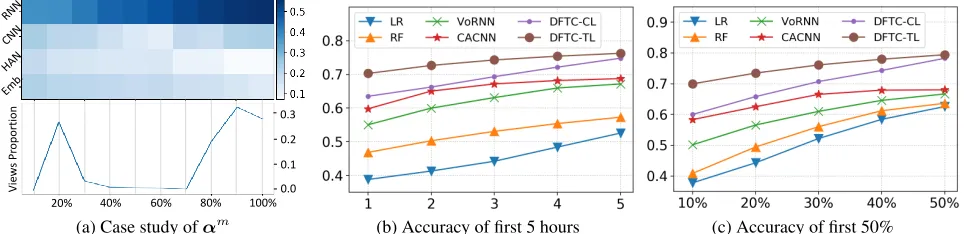
Figure 5: Performance Analysis. (a) The heatmap of average attentive weightsαmand the line chart of short term fluctuations
per 10% of time series. The weight of RNN increases over time and the weight of CNN corresponds to fluctuations. (b) Average accuracies of first 5 hours after articles are published. (c) Average accuracies when the observed popularity runs up to 10%-50% of the overall popularity.
model captures long term trend and short term fluctuation of the temporal process, and integrates text and meta-data features dynamically. Based on these modeling techniques, DFTC method significantly outperforms state-of-the-art methods. In balanced test set, it shows 17.0% increase of accuracy and 37.4%, 12.0%, 13.5% improvement of hot, normal and cold F1-score respectively. Our model have been applied in article recommendation in WeChat now.
Ablation Analysis The proposed model is also superior to its variants, i.e. DFTC-TS, DFTC-SF and DFTC-SM. DFTC-TS and DFTC-SF only leverage temporal processes or content features for prediction. It is no surprising that their performances are not desirable. Note that DFTC-TS out-performs other temporal process methods, i.e. VoRNN-TS and HIP, illustrating that the design of LSTM for long term trend and CNN for short term fluctuation is effective and su-perior. DFTC-SM combines temporal process and content feature modeling through vector concatenation, which lacks flexibility for handling the dynamic growth of time series. In contrast, DFTC method adopts attention mechanism to learn flexible weights for dynamic fusion. Thus it outper-forms DFTC-SM by 7.8% on accuracy in balanced test set.
Case study In order to study effects of attention CNN and temporal attentive fusion, we randomly select a “hot” arti-cle as case study. We average its attentive weightsαmand
aggregate its view amount per 10% of time series, shown in Fig. 5a. The four rows of upper heat map represent attentive weights αm of RNN, CNN, HAN and embedding
respec-tively. The bigger the weight is, the darker the color is. It can be observed that all these parts make similar contribution for prediction at the beginning. As the observed popularity get-ting closer to the overall popularity, RNN can learn the long term growth trend more accurately. Thus RNN model plays a major role in prediction at the later period. The lower line chart shows short term fluctuations of this article. We can observe the view amount shows outbreaks at the beginning and end of time series. Accordingly, attention CNN has high attentive weights at the beginning and the end, which means it effectively captures such local rising and falling structures that are important to the overall popularity prediction.
Performance in Early Stage In practical applications, it is much valuable to predict overall popularity in early stage. Figure 5b shows average accuracies of first 5 hours after ar-ticles are published and Fig. 5c shows average accuracies when the observed popularity runs up to 10%-50% of the overall popularity in balanced test set. We can observe that our model shows an obvious improvement of the early stage prediction performance, from both time and observed popu-larity aspects. Note that the performance of HIP is not shown here, because it needs a long enough temporal process to es-timate parameters well (Rizoiu et al. 2017). Feature-based methods perform very poorly in early stage, since hand-crafted features can hardly capture temporal dynamic pat-terns. CACNN integrates meta-data features for prediction, thus it performs better than VoRNN-TS in early stage.
DFTC-CL is our model with the common sequence loss. Content feature modeling enables our method to make re-liable predictions when the temporal process lacks enough information, and the attentive fusion ensures content feature modeling plays a major role in early stage. Thus DFTC-CL significantly outperforms state-of-the-art methods. The temporal decayed factor of loss function helps our model to invest more efforts to optimize the prediction performance of early stages. When we apply the temporal decayed loss function for optimizing, i.e. DFTC-TL, the early stage per-formance is further improved. Besides, since the observed popularity gets closer to overall popularity over time, it can also get a desirable performance in the latter period, even if we reduce their weights.
Conclusion
Acknowledgment
This work was done when Dongliang Liao was interning at WeChat, Tencent Inc. We would like to thank our WeChat colleague Shen Huang for his great help in experiments and writing of this paper. We would also like to thank our WeChat colleagues Zhe Feng, Yuetang Deng, Zhiping Wang and Yandong Bai for useful discussions and supports of this work. We would also thank Prof. Feiping Nie of Northwest-ern Polytechnical University and Prof. Yudong Chen of Cor-nell University for their valuable suggestion.
References
Cao, Q.; Shen, H.; Cen, K.; Ouyang, W.; and Cheng, X. 2017. Deephawkes: Bridging the gap between prediction and understanding of information cascades. InProceedings of the 2017 ACM on Conference on Information and Knowl-edge Management, 1149–1158. ACM.
Du, N.; Dai, H.; Trivedi, R.; Upadhyay, U.; Gomez-Rodriguez, M.; and Song, L. 2016. Recurrent marked tem-poral point processes: Embedding event history to vector. In
Proceedings of the 22nd ACM SIGKDD International Con-ference on Knowledge Discovery and Data Mining, 1555– 1564. ACM.
Gao, H.; Kong, D.; Lu, M.; Bai, X.; and Yang, J. 2018. Attention convolutional neural network for advertiser-level click-through rate forecasting. 1855–1864.
Gou, C.; Shen, H.; Du, P.; Wu, D.; Liu, Y.; and Cheng, X. 2018. Learning sequential features for cascade outbreak pre-diction. Knowledge and Information Systems1–19. Huo, X.; Li, M.; and Zhou, Z.-H. 2016. Learning unified features from natural and programming languages for locat-ing buggy source code. InIJCAI, 1606–1612.
Keneshloo, Y.; Wang, S.; Han, E.-H.; and Ramakrishnan, N. 2016. Predicting the popularity of news articles. In Proceed-ings of the 2016 SIAM International Conference on Data Mining, 441–449. SIAM.
Lai, S.; Xu, L.; Liu, K.; and Zhao, J. 2015. Recurrent con-volutional neural networks for text classification. InAAAI, volume 333, 2267–2273.
Liu, A.-A.; Nie, W.-Z.; Gao, Y.; and Su, Y.-T. 2016. Multi-modal clique-graph matching for view-based 3d model retrieval. IEEE Transactions on Image Processing
25(5):2103–2116.
Mishra, S.; Rizoiu, M.-A.; and Xie, L. 2018. Modeling pop-ularity in asynchronous social media streams with recurrent neural networks. arXiv preprint arXiv:1804.02101.
Piotrkowicz, A.; Dimitrova, V.; Otterbacher, J.; and Mark-ert, K. 2017. Headlines matter: Using headlines to predict the popularity of news articles on twitter and facebook. In
ICWSM, 656–659.
Rizoiu, M.-A.; Xie, L.; Sanner, S.; Cebrian, M.; Yu, H.; and Van Hentenryck, P. 2017. Expecting to be hip: Hawkes in-tensity processes for social media popularity. In Proceed-ings of the 26th International Conference on World Wide Web, 735–744. International World Wide Web Conferences Steering Committee.
Sanjo, S., and Katsurai, M. 2017. Recipe popularity predic-tion with deep visual-semantic fusion. InProceedings of the 2017 ACM on Conference on Information and Knowledge Management, 2279–2282. ACM.
Shen, H.-W.; Wang, D.; Song, C.; and Barab´asi, A.-L. 2014. Modeling and predicting popularity dynamics via reinforced poisson processes. InAAAI, volume 14, 291–297.
Shulman, B.; Sharma, A.; and Cosley, D. 2016. Predictabil-ity of popularPredictabil-ity: Gaps between prediction and understand-ing. InICWSM, 348–357.
Szegedy, C.; Vanhoucke, V.; Ioffe, S.; Shlens, J.; and Wojna, Z. 2016. Rethinking the inception architecture for computer vision. InProceedings of the IEEE conference on computer vision and pattern recognition, 2818–2826.
Vaswani, A.; Shazeer, N.; Parmar, N.; Uszkoreit, J.; Jones, L.; Gomez, A. N.; Kaiser, Ł.; and Polosukhin, I. 2017. At-tention is all you need. InAdvances in Neural Information Processing Systems, 5998–6008.
Xu, J.; Yin, Y.; Man, H.; and He, H. 2012. Feature selection based on sparse imputation. InNeural Networks (IJCNN), The 2012 International Joint Conference on, 1–7. IEEE. Xu, J.; Tang, B.; He, H.; and Man, H. 2017. Semisupervised feature selection based on relevance and redundancy criteria.
IEEE transactions on neural networks and learning systems
28(9):1974–1984.
Yang, Z.; Yang, D.; Dyer, C.; He, X.; Smola, A.; and Hovy, E. 2016. Hierarchical attention networks for document clas-sification. In Proceedings of the 2016 Conference of the North American Chapter of the Association for Computa-tional Linguistics: Human Language Technologies, 1480– 1489.
Yu, H.; Xie, L.; Sanner, S.; et al. 2015. The lifecyle of a youtube video: Phases, content and popularity. InICWSM, 533–542.
Zhang, W.; Wang, W.; Wang, J.; and Zha, H. 2018. User-guided hierarchical attention network for multi-modal social image popularity prediction. In Proceedings of the 2018 World Wide Web Conference on World Wide Web, 1277– 1286. International World Wide Web Conferences Steering Committee.