www.biogeosciences.net/10/6185/2013/ doi:10.5194/bg-10-6185-2013
© Author(s) 2013. CC Attribution 3.0 License.
Biogeosciences
Effect of ocean acidification on the benthic foraminifera Ammonia
sp. is caused by a decrease in carbonate ion concentration
N. Keul1,*, G. Langer2, L. J. de Nooijer3, and J. Bijma1,4
1Alfred Wegener Institute, Am Handelshafen 12, Bremerhaven, 27570, Germany 2Department of Earth Sciences, Cambridge University, Cambridge, CB2 3EQ, UK
3Department of Marine Geology, Royal Netherlands Institute of Sea Research, Landsdiep 4, 1979 SZ, ’t Horntje, the
Netherlands
4Jacobs University, Earth and Space Sciences, Campus Ring 8, Bremen, 28759, Germany
*now at: Lamont-Doherty Earth Observatory, Geosciences, Columbia University, 61 Rd 9W Palisades, NY 10964, USA
Correspondence to: N. Keul ([email protected])
Received: 27 September 2012 – Published in Biogeosciences Discuss.: 25 January 2013 Revised: 3 July 2013 – Accepted: 16 July 2013 – Published: 1 October 2013
Abstract. About 30 % of the anthropogenically released CO2 is taken up by the oceans; such uptake causes
sur-face ocean pH to decrease and is commonly referred to as ocean acidification (OA). Foraminifera are one of the most abundant groups of marine calcifiers, estimated to precip-itate ca. 50 % of biogenic calcium carbonate in the open oceans. We have compiled the state of the art literature on OA effects on foraminifera, because the majority of OA re-search on this group was published within the last three years. Disparate responses of this important group of ma-rine calcifiers to OA were reported, highlighting the impor-tance of a process-based understanding of OA effects on foraminifera. We cultured the benthic foraminifer Ammonia sp. under a range of carbonate chemistry manipulation treat-ments to identify the parameter of the carbonate system caus-ing the observed effects. This parameter identification is the first step towards a process-based understanding. We argue that [CO23−] is the parameter affecting foraminiferal size-normalized weights (SNWs) and growth rates. Based on the presented data, we can confirm the strong potential of
Am-monia sp. foraminiferal SNW as a [CO23−] proxy.
1 Introduction
During the last 800 000 yr atmospheric CO2concentrations
ranged from ca. 180 to 300 µatm (Petit et al., 1999; Siegen-thaler et al., 2005). Since the start of industrialization,
anthro-pogenic release of CO2has caused atmospheric CO2
concen-trations to increase steadily at a rapidly rising rate (currently ca. 0.5 % yr−1; Fabry et al., 2008). Approximately 30 % of the carbon dioxide emissions are taken up by the oceans (Sabine et al., 2004). As a consequence of this, future surface ocean pH values are predicted to decrease 0.4 units (Caldeira and Wickett, 2005) by the end of this century. This decline is commonly referred to as ocean acidification (OA). Through the associated decrease in the calcium carbonate saturation state (), biogenic calcification of ecologically important or-ganisms such as corals, coccolithophorids and foraminifera is expected to be hampered. It is generally expected that coral calcification decreases under lowera(aragonite saturation
of OA effects on foraminifera from this wide spectrum of re-sponses, it will ultimately be necessary to develop a process-based understanding of OA effects. The first step is the iden-tification of the parameter of the carbonate system that causes the effects. Most carbonate chemistry perturbation experi-ments are characterized by a simultaneous change in several parameters of the carbonate system. This makes it impossi-ble to separate, for example, carbonate ion effects from pH effects and to develop a process-based understanding of OA effects on foraminifera. We have conducted carbonate chem-istry perturbation experiments with the benthic foraminifer
Ammonia molecular type T6, further referred to as Ammonia
sp. (Hayward et al., 2004) (please note that this species is also referred to as Ammonia tepida in other studies, e.g., de Nooi-jer et al., 2007; Dissard et al., 2010; Dueñas-Bohórquez et al., 2011; Raitzsch et al., 2010). We were following both the clas-sical approach (i.e., co-varying [CO23−] and pH) as well as keeping pH constant while varying [CO23−] to overcome this problem. The experimental setup used here allows us to dis-tinguish between [CO23−] and pH effects and potentially to identify a single parameter causing observed effects on
Am-monia sp. (Langer and Bode, 2011).
2 Material and methods
2.1 Sample collection and culturing
Surface sediments were collected in the Wadden Sea near Dorum, Germany, between January and May 2011 and kept at 10◦C as stock cultures after the removal of macrofauna. Living specimens (identified by their brightly colored yel-low cytoplasm and pseudopodial activity) of Ammonia sp. were isolated from the stock cultures (de Nooijer et al., 2007; Raitzsch et al., 2010; Dueñas-Bohórquez et al., 2011) using a 230 µm screen and transferred to well plates at 25◦C. Ap-proximately 10 % of the specimens reproduced asexually af-ter about one week. Juveniles were kept for an additional 2– 3 days until they added another ∼3 chambers before they were transferred to culture experiments. Our culturing ex-perience has shown that foraminifera have a high mortality when transferred into experimental conditions earlier than this ontogenetic stage.
2.2 Seawater preparation
Sterile-filtered (0.2 µm pore size) North Sea seawater was used to prepare culture media for the experiments as de-scribed in Keul et al. (2013). The manipulated seawater was filled headspace-free into borosilicate flasks, sealed gas-tight with Teflon-lined caps and kept at 3◦C until used in the ex-periments. Two different carbonate chemistry perturbations were carried out, with four treatment levels each, leading to a total of eight treatments (Table 1):
1. TA manipulation: seawater with a range of pHs and [CO23−] (4 in total), while total inorganic carbon con-centration remained constant (TA denotes total alka-linity).
2. pH-stable manipulation: 4 treatments where DIC (dis-solved inorganic carbon) and TA were manipulated in a way that pH was kept constant while the accompa-nyingpCO2values matched those of the TA
manipu-lation.
2.3 Experimental setup and culturing
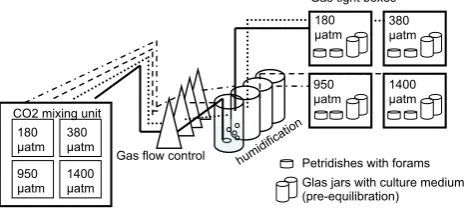
Long-term carbonate chemistry perturbation experiments re-quire a special experimental setup, allowing stable carbon-ate system parameters over a long time period. We have constructed an experimental setup (Fig. 1) to allow for sta-ble carbonate system parameters over long incubation peri-ods and to ensure accessibility of the individuals (for feed-ing, regular water changes, etc). Asexually reproduced juve-niles were placed into petri dishes containing the manipu-lated seawater and placed into one of four gas-tight boxes. A gas mixing system provided a steady gas flow (60 L h−1; see Hoppe et al., 2012 for a description of the gas flow con-troller) into the gas-tight boxes, at four differentpCO2
con-centrations (Table 1). Flow rate was constant and allowed a replacement of air inside the box every 10 minutes. Cul-turing took place in a temperature-controlled room at 26◦C with a natural day/light cycle (12 h/12 h). SuppliedpCO2of
the gas mixtures was checked regularly. Borosilicate bottles containing the manipulated seawater were stored open in the boxes prior to water exchange to allow for pre-equilibration. Pre-equilibrated seawater was used to exchange the water in the petri dishes every 2–3 days. Foraminifera were fed photosynthetically inactive (heat sterilized) algae (Dunaliella
salina) after the water was changed. To minimize potential
effects of bacteria growing on the bottom of the dishes, petri dishes were exchanged every two weeks. The culturing pe-riod lasted for 59–96 days.
2.4 Sample analysis
2.4.1 Carbonate chemistry
Table 1. Upper part: calculated and measured carbonate chemistry parameters of the eight treatments. “Nominal”pCO2refers to thepCO2 supplied by the gas mixing system. A variety of input parameters (here pH and DIC) can be used to calculate the carbonate system and can be found in the supporting online material of Keul et al. (2013). Lower part: mean physiological parameters and 2 SE (standard errors).
Treatments
A1 A2 A3 A4 B1 B2 B3 B4
Seawater parameters
pCO2(µatm) “nominal” 180 380 950 1400 180 380 950 1400
pCO2(µatm) 217 479 850 1301 63 396 829 1252
CO23−(µmol kg-sw−1) 401 224 136 88 21 152 405 563 HCO−3 (µmol kg-sw−1) 1798 1999 2073 2063 223 1499 3536 5131 DIC (µmol kg-sw−1) 2205 2236 2232 2187 246 1662 3965 5729 TA (µmol kg-sw−1) 2747 2535 2400 2277 342 1884 4436 6343 pH (total scale) 8.32 8.02 7.79 7.60 7.95 7.98 8.03 8.01
c 9.8 5.5 3.3 2.2 0.5 3.7 9.9 13.8 [Ca2+](mol kg-sw−1) 0.009 0.009 0.009 0.009 0.009 0.009 0.009 0.008
Physiological parameters
n(number of specimens) 15 14 37 39 36 21 19 24
Final weight (µg) 7.3 6.1 5.1 6.3 3.4 5.3 7.3 5.3
2 SE 2.1 1.4 0.9 1.0 0.5 1.6 1.4 1.5
Final length (µm) 288 255 252 280 247 288 280 229
2 SE 27 29 19 18 26 32 31 28
Growth rate (10−2µg µm−1) 11.20 7.28 7.55 9.71 5.99 9.33 12.75 9.01
2 SE 3.17 2.34 1.17 1.43 0.89 2.72 2.53 2.56
SNW (10−2µg µm−1) 2.41 2.19 1.89 2.14 1.33 1.70 2.48 2.29
2 SE 0.48 0.37 0.23 0.24 0.14 0.33 0.38 0.67
180 µatm
380 µatm
950 µatm 1400 µatm
180
µatm 380 µatm
950
µatm 1400 µatm CO2 mixing unit
Gas flow control
Gas tight boxes
Petridishes with forams Glas jars with culture medium (pre-equilibration)
Fig. 1. Culturing setup: juvenile foraminifera were placed into petri dishes containing the manipulated seawater and placed into one of four gas-tight boxes, which were supplied with air of four different
pCO2concentrations (Table 1) by a gas mixing system. Borosili-cate bottles containing the manipulated seawater were stored open in the boxes prior to water exchange in the culturing petri dishes to allow for pre-equilibration. Please note thatpCO2values given in the figure represent those supplied by the gas mixing system (“nom-inal” values in Table 1). The actualpCO2value in the culturing petri dishes differs from these idealized values (see Table 1).
WTW pH-meter was used to measure pH potentiometrically. Simultaneous measurement of a seawater buffer (Tris/Tris-HCl prepared according to the recipe described in Dickson et al., 2007) allowed conversion of the pH values to the total scale. All pH values reported are on the total scale. Salinity
and temperature were measured with a conductivity meter (WTW Multi 340i), interfaced with a TetraCon 325 sensor. pH and DIC (Hoppe et al., 2012) were used to calculate the carbonate system parameters (CO2SYS program, adapted to
Excel by Pierrot et al., 2006). The equilibrium constants for K1 and K2 of Mehrbach et al. (1973) as reformulated by Dickson and Millero (1987) were used.
2.4.2 Growth rate and size-normalized weight
Foraminiferal tests were soaked in concentrated NaOCl for ca. 20 min until all organic remains were removed (visual verification under the stereomicroscope), washed three times in deionized water and dried at room temperature over night. Sizes were measured under a stereomicroscope (Zeiss Stemi SV 11) using a Pyser bar scale, with a precision of ±7.4 µm under the used magnification of 66×. Individual tests were weighed using an Ultra-Microbalance (Mettler Toledo UMX 2), with a precision of 0.1 µg.
Different terms are used in the literature to describe the rate of growth of foraminifera: growth rate, calcification rate and precipitation rate are among the commonly used terms, which, however, are not formally defined and thusly of-ten confused with each other. We define growth rate as the amount of growth (here calculated as the increase in shell weight) of the whole specimen over time, whereas chamber
[image:3.595.51.285.401.506.2]carbonate during chamber formation. While these two pa-rameters can be measured (e.g., Glas et al., 2012; Ander-son and Faber, 1984), the assessment of the rate of biogenic precipitation of calcium carbonate is complicated, since bio-genic calcium carbonate precipitation is mediated by organic membranes, whose contribution (e.g., surface area) cannot be determined experimentally (see, e.g., Cuif et al., 2011 for an overview). Growth rates were calculated from the incubation period of individual shells and final shell weight and have the unit µg day−1ind−1 (ind = individual). (Please note that we assumed a constant initial weight since foraminifera were inserted to the experiment at the same development stage, al-lowing a comparison of growth rates. From the relationship between weight and size of specimen at the end of the ex-periment, we have calculated that the initial weight was at most ca. 10 % of the final weight on average.) Foraminiferal shell weights increase with increasing shell diameter. The aim of size-normalized weight (SNW) is to remove this ef-fect of shell diameter on the weight, making it possible to ob-serve non-size-related variations in shell weight, for instance in shell thickness. Unfortunately the term size-normalized
weight is used and defined incoherently in the literature;
con-sequently a comparison of SNW between different studies might be hampered. We report SNW throughout this paper as the ratio of weight to diameter calculated for every speci-men (unit µg µm−1).
2.5 Statistics
All statistical tests were carried out using the statistics envi-ronment R (R Core Team, 2012). An ANOVA (analysis of variance) was performed to determine an effect of carbon-ate chemistry parameters on measured variables (diameter, weight, growth rate, SNW). Data were log-transformed to en-sure normally distributed data (Shapiro test,p >0.05). Both Levene and Fligner tests confirmed homogenous variances of the dataset. The null hypothesis of the ANOVA (all group means are equal) was rejected ifp <0.05. Tukey HSD (hon-estly significant difference) post hoc tests were performed to determine which means differed from each other. Lin-ear regressions were performed with the built-in linLin-ear re-gression model. The homogeneity of rere-gression slopes was assessed by means of a hoRS (homogeneity of regression slopes) model. The assumption of homogeneity of regres-sion slopes was rejected if the respectivepvalue was signifi-cant (p <0.05). Average values and 2 SE (standard error) are given throughout the text.
3 Results
3.1 Carbonate chemistry
FourpCO2 levels were maintained in the airtight boxes in
which the petri dishes containing foraminifera were placed during the culturing period (180–1400 µatm, nominalpCO2,
Table 1). Due to in- and outgassing, the respective pCO2
values of the culturing media were not exactly matching, in some treatments more than in others (especially the lowest
pCO2 values). However, in order to analyze the effect of
individual carbonate chemistry parameters on foraminiferal calcification, obtaining similar ranges of selected parame-ters is crucial, which is given in our experimental setup. The variation inpCO2in the culturing seawater was in the same
range as maintained in the boxes (61–1301 µatm). pH was kept constant in the pH-stable manipulation (7.99±0.04), while it varied in the TA manipulation between 7.60 at the highest and 8.32 at the lowest pCO2 level. Carbonate ion
concentration decreased with increasing pCO2 in the TA
manipulation (401–88 µmol kg-sw−1), whereas it increased withpCO2in the pH-stable manipulation (21–563 µmol
kg-sw−1). DIC was kept quasi-constant in the TA manipulation
(2215±23 µmol kg-sw−1), whereas it increased withpCO 2
from 246 to 5729 µmol kg-sw−1in the pH-stable
manipula-tion. TA increased from low to highpCO2by almost a
fac-tor of 20 in the pH-stable manipulation (342–6343 µmol kg-sw−1). The range in the TA manipulation with 470 µmol kg-sw−1was comparably small.c(calcite saturation state) was
in all treatments>1 with a range ofc= 2.2–13.8, despite
treatment B1, where the culturing media were undersaturated with respect to calcite (c= 0.5).
3.2 Physiological responses
Detailed growth characteristics such as calcification rates versus growth rates, carbonate chemistry factors influenc-ing growth and the variability of all these amongst ju-venile foraminifera have not been assessed yet for most foraminiferal species. In general, we observed a high vari-ability in final shell diameter and weight among speci-mens (Table 1). Consequently, linear regression of individual growth characteristics (final diameter and weight, and factors such as SNW and growth rates derived thereof) versus car-bonate chemistry parameters yields relatively lowR2values (Table 2). If the observed high variability in growth charac-teristic was due to the effects of the carbonate chemistry ma-nipulation, the control group A2 should display the lowest variability. Since this was not the case, we can assume that the observed variability has not been induced by our treat-ments and is a natural characteristic among the offspring of
Ammonia sp. Table 2 contains the statistical output of a linear
regression model performed on the average growth charac-teristics (length, weight, growth rate, SNW) versus carbonate chemistry parameters (as listed in Table 1).
3.2.1 Length and weight
Table 2. Results of linear regression model between SNW and individual carbonate system parameters (based on averages of the eight treatments). Statistically significant regressions (atp <0.05) are displayed in bold.
Parameter CO23− pH DIC TA HCO−3 c pCO2
Length
p 0.741 0.740 0.469 0.498 0.445 0.741 0.618
R2 0.02 0.02 0.09 0.08 0.10 0.02 0.04
F 0.12 0.12 0.60 0.52 0.67 0.12 0.28 Weight
p 0.171 0.428 0.311 0.281 0.341 0.171 0.566
R2 0.29 0.11 0.17 0.19 0.15 0.29 0.06
F 2.42 0.72 1.22 1.40 1.07 2.42 0.36 Growth Rate
p 0.133 0.457 0.232 0.208 0.255 0.133 0.530
R2 0.33 0.10 0.23 0.25 0.21 0.33 0.07
F 3.02 0.63 1.77 1.99 1.58 3.02 0.44 SNW
p 0.027 0.463 0.047 0.039 0.060 0.027 0.247
R2 0.59 0.09 0.51 0.54 0.48 0.59 0.22
F 8.49 0.61 6.24 6.93 6.61 8.50 0.25
were performed. The lowest final weight was measured on shells grown in treatment B1 (average: 3.4±0.5 µg), which was undersaturated with respect to calcite. Based on the re-sults of the ANOVA, all carbonate chemistry parameters de-spite pH could have had a positive effect on final shell weight (p <0.05). The linear regression model reveals that the car-bonate ion concentration can explain the highest amount of variability (29 %) in averaged shell weights and pCO2 the
lowest (6 %).
3.2.2 Growth rate
Growth rates are given as µg d−1ind−1 (Table 1). Average growth rates displayed the same variation in the TA manipu-lation (7.55–11.20 µg d−1ind−1) when compared to the pH-stable manipulation (5.99–12.75 µg d−1ind−1), with a range in variability between ca. 15 and 30 % (2 SE) in both ma-nipulations. Growth rates display a positive correlation with all carbonate system parameters except pH andpCO2(p <
0.05).
3.2.3 Size-normalized weight
Average SNW varied between 2.48 (±0.38) and 1.33 (±0.14) 10−2µg µm−1in the different treatments, whereas measured
SNW on single specimens was up to 4×10⁻²µg µm−1.
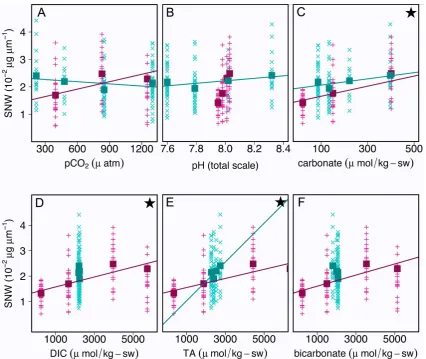
Lin-ear regression of SNW and carbonate chemistry parameters on all eight treatments together reveals a positive correla-tion (p <0.05) between SNW and carbonate ion concen-tration, DIC, TA andc (see Table 2 for statistical output).
However, when separating the two manipulations graphically (Fig. 2), it becomes obvious that the general trends of the two regression slopes (positive/negative) coincide only when plotted against carbonate ion concentration (Fig. 2c) and TA
(Fig. 2e). A tool to assess the difference in regression slopes is hoRS analysis, which checks for homogeneity of regres-sion slopes. The results of this analysis reveal that regresregres-sion slopes of the two manipulations are homogenous (p >0.05) in the regressions of carbonate ion concentration, DIC and TA, only (represented by a star in Fig. 2).
4 Discussion
4.1 Overview of foraminiferal studies with a focus on carbonate chemistry
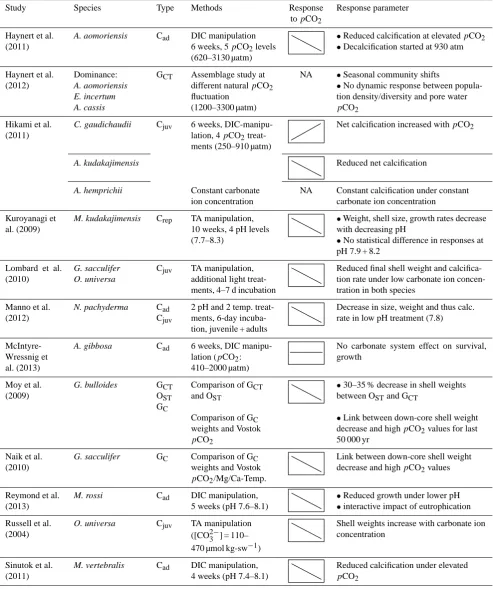
Over the recent years, a number of studies (Table 3) have as-sessed the effects of OA on foraminifera. Approaches were ranging from culturing under different pCO2 treatments,
looking at the geological past either through sediment core tops or whole cores, to assessing whole communities at natu-rally occurringpCO2gradients. Studied response parameters
were shell weight, SNW, size, growth/calcification rates and shell thickness and changes in communities (diversity, abun-dance). A multitude of responses have been documented that range from no effect ofpCO2, an increase/decrease (mostly)
with increasingpCO2to more complex responses where an
initial increase up to a certain intermediatepCO2level was
Fig. 2. SNW versus carbonate system parameters. Cyan x and pink + represent SNW of individual shells in the TA manipulation and the pH-stable manipulation, respectively. Closed squares in cyan and pink represent average SNW in the TA manipulation and the pH-stable manipulation, respectively. Cyan and pink lines represent linear regression lines for SNW versus the respective carbonate system parameter (TA- and pH-stable manipulation). Stars in the upper right corner represent a statistically significant (hoRS model, atp <0.05) homogeneity of regression slopes. Due to the relatively small ranges inxaxis, variations in some correlations (e.g., TA manipulation in D), the significance of regression slopes and thus the hoRS model is confined. Regression slopes have been omitted in these cases.
elevatedpCO2 of three foraminiferal species were studied.
The difference in the response patterns has been speculated by these authors to be attributed to the different calcification pathways of hyaline and porcellanous species (e.g. Ter Kuile et al., 1989). Calcification was elevated at intermediate lev-els ofpCO2in the case of the hyaline species (Baculogypsina sphaerulata, Calcarina gaudichaudii), whereas a decrease in
calcification accompanied increasing pCO2 values in Am-phisorus hemprichii, a porcellaneous species. Four studies
investigated the effect of elevated pCO2 on Marginopora,
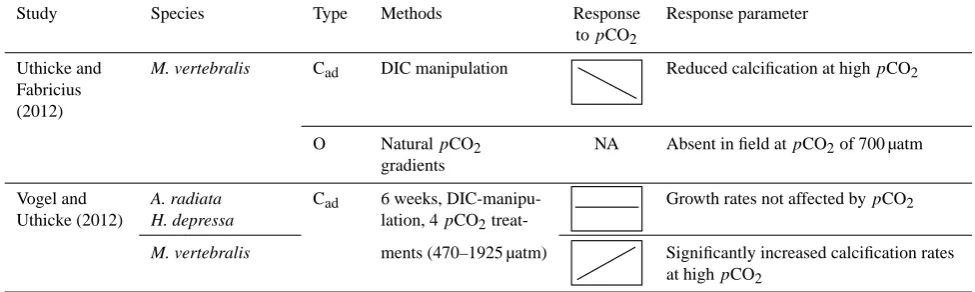
a larger benthic foraminifera. A comparison of these stud-ies could help to infer differences in responses attributed to different methods used. Vogel and Uthicke (2012) observed an increase in calcification rates with pCO2 for M. verte-bralis, whereas in both the studies of Sinutok et al. (2011)
and Kuroyanagi et al. (2009) the opposite effect was detected
(the latter study investigated a closely related foraminifera,
M. kudakajimensis). This difference could be attributed to the
employed manipulation methods (Kuroyanagi et al., 2009: TA manipulation and Vogel and Uthicke, 2012: DIC manipu-lation, manipulation of DIC by aeration with a certainpCO2)
or the chosen experimental setup (static/flow-through). The first option seems unrealistic in the light of a study of Hoppe et al. (2011), where the effect of elevatedpCO2in TA
abundances at control sites with present-day pCO2. This
might indicate that the latter species suffers from increased
pCO2and that the increased calcification rate with
increas-ingpCO2 reported by Vogel and Uthicke (2012) is a
labo-ratory artifact that does not apply to the field. As a caveat it must be added here that it is also possible that an envi-ronmental parameter other than, but correlating with,pCO2
caused the absence of M. vertebralis at 700 µatmpCO2.
An-other factor that could result in different calcification re-sponses under changing carbonate chemistry in different species is the presence or absence of symbionts. By photo-synthesis and respiration, symbionts may alter the carbon-ate system in the direct surrounding of the foraminifer and thus modify ambient values for pH, TA, etc (e.g. Rink et al., 1998).
Comparing these studies on a methodological level is beyond the scope of this paper and might better be done in a separate study. The variety in responses shows, how-ever, that there is no uniform response of foraminifera to OA. This makes it difficult to predict the overall response of foraminifera to ongoing OA and the subsequent impacts on biogeochemical cycling and ecology. To facilitate esti-mations on future foraminiferal functioning despite inter-species variability in calcification responses, an understand-ing of the physiological basis of calcification (and variability between species) is necessary (see also Rost et al., 2008). At the same time, such a biomineralization model may also explain the apparent variability in calcification responses ob-served so far (Table 3). In addition, a process-based charac-terization of foraminiferal calcification will also help to un-derstand the impact of different parameters of the carbonate system on elemental incorporation and stable isotope frac-tionation, thereby improving their paleoceanographic poten-tial. On long timescales, changes in the individual parame-ters of the C-system (e.g., alkalinity and pH) may not have been tightly coupled. Together, these two objectives make it necessary to study impacts of the different carbonate system components individually. Therefore, we cultured specimens of the benthic foraminifer Ammonia sp. under two carbon-ate chemistry manipulations, allowing the quantification of impacts of carbonate ion concentration as well as pH.
4.2 Growth rate
[image:7.595.310.546.64.205.2]The comparison of foraminiferal growth rates is complicated by the fact that, as a rule, juvenile specimens grow faster than adult specimens. Hence comparing the growth rate of a juve-nile to the one of an adult will result in a bias (i.e., a relative over-estimation of the juvenile growth rate). However, this bias cannot be detected in our data, because size and growth rates are positively correlated (Fig. 3). This reflects the fact that our specimens were not fully grown when harvested. It will be helpful to clarify the terminology used in the context of foraminiferal growth. In general, rates are often reported in units of mass of CaCO3deposited/time. This unit might
Fig. 3. Growth rates (10−2µg d−1ind−1) of all treatments versus diameter (µm).
be applied to an individual over a period of several weeks, but might also be applied to a single chamber-formation event. These two numbers represent distinct parameters and must not be confused, because there are considerable time spans separating two chamber formation events (Hemleben et al., 1987). To illustrate this, we compare our overall aver-age growth rate (which represents the sum of many cham-ber formation events including the time spans separating them) with the chamber-formation rate determined by Glas et al. (2012). Please note that the latter authors used the term calcification rate, again highlighting the need for clar-ity in matters of foraminiferal rates (growth, calcification, chamber formation). Our overall average of growth rates is 0.09 µg d−1ind−1 (= 0.00375 µg h−1ind−1), which is lower than their measured calcification rate (0.028 µg h−1, Glas et al., 2012). Hence, the inclusion of non-chamber-formation times reduces the rate by one order of magnitude. We sug-gest using terminology as specific as possible (e.g. chamber formation rate instead of calcification rate) and, most impor-tantly, reporting exactly how rates in terms of mass of CaCO3
deposited/time were determined.
4.3 Ecophysiological responses to carbonate chemistry
We used two different methods to manipulate the seawater carbonate chemistry: a TA manipulation (treatments A1–A4, Table 1) and a pH-stable manipulation (treatments B1–B4, Table 1). Since the carbonate system parameters co-vary dif-ferently in the two experimental approaches, it is possible, by exclusion, to reject certain parameters of the carbonate sys-tem as causes for the observed changes in SNW (Table 1). The general idea behind this is that the responsible parameter should cause the same trends in SNW in both manipulations (e.g., characterized by similar regression slopes).
4.3.1 Shell thickness (as size-normalized weight)
Table 3. Overview of foraminiferal response patterns to changes in carbonate chemistry. Responses are represented by simple trend plots. pH,pCO2and other carbonate system parameters covary in TA and DIC manipulation studies. This renders it possible to read off the respectivepCO2response, where not directly given, to enhance comparability. Analyzed parameters vary by study: shell weight, SNW (size-normalized weight), size, growth/calcification rates (see Sect. 4.2) and shell thickness. Responses are represented by simple trend plots. Those studies assessing the affects of OA on foraminiferal communities (diversity, abundance) have not been depicted by these trend plots (NA – not applicable). The studies were categorized as follows: G = geological record (GCT= core tops, GC= down core), O = open ocean (OST= sediment trap, OPT= plankton tow), C = culture experiments (Crep= asexually reproduced individuals, Cad/juv= adult/juvenile individuals collected from their natural habitat), and O = other type.
Study Species Type Methods Response Response parameter
topCO2
Allison et al. (2010)
E. williamsoni Cad TA manipulation 3 pH (7.7–8.3), 8 weeks
Chambers formed at low pH significantly thinner than at high pH
Barker and Edlerfield (2002)
G. bulloides GC Comparison of GC SNW and carbonate system
•Glacial: highest shell weights
•shell weights seem to be carbonate system-influenced
Beer et al. (2010)
G. bulloides OPT Comparison of OPTSNW and carbonate system
Strong interspecies variations: different response of SNW topCO2
G. ruber Difference in relative abundances
(G. bull. low carb/highpCO2/G. ruber high carb/lowpCO2)
Bijma et al. (1999, 2002)
O. universa G. sacculifer
Cjuv TA, DIC and pH-stable manipulation (O. uni-versa), G. sacculifer only TA manipulation
•Increase in shell weight with increase in carbonate ion concentration
•Below ambient steeper slope than above ambientpCO2(O. universa)
Cigliano et al. (2010)
11 taxa (E. aculea-tum dominance)
O 1-month settlement study at different natural pH gradients (8.2–7.1)
NA Fewer individuals and number of taxa in low pH conditions
de Moel et al. (2009)
G. ruber GCT Comparison of weights •Weight: lighter foraminifera in GCTthan
in GC
GC •Age: light-shelled specimens are
younger
Dias et al. (2010)
Various perforate & imperforate species
GCT Assemblage study at different natural pH gradients (8.1–6.6)
NA •Reduction in diversity and abundance •Shift from 24 to 4 sp. (all agglutinated) with decreasing pH
Dissard et al. (2010)
A. tepida Cad DIC manipulation:
230 + 1990 µatmpCO2
Higher shell-weights in lowpCO2 treatments
Fujita et al. (2011)
B. sphaerulata C. gaudichaudii
Crep DIC manipulation, 12 weeks, 5pCO2levels
Weight increases at intermediate
pCO2levels, then decreases
A. hemprichii (260–970 µatm) Weights decreased under higher pCO2
levels
Glas et al. (2012)
4 photosymbiotic (M. vertebralis, H. depressa, A. ra-diata, Peneroplis sp.), 2 non-symbio-tic species (Quin-queloculina sp., Miliola sp.)
O Short-term incubation under 3pCO2levels (ca. 430–2150 µatm), microelectrode measurements
NA Photosynthetic increase of surface pH insufficient to compensate for seawater pH decreases. Photosynthesis only partly protects symbiont bearing foraminifera against OA
Gonzalez-Mora et al. (2009)
G. bulloides & G. ruber
GC Comparison of GC weights and Vostok
Link between down-core shell weight decrease and highpCO2values
Table 3. Continued.
Study Species Type Methods Response Response parameter
topCO2
Haynert et al. (2011)
A. aomoriensis Cad DIC manipulation 6 weeks, 5pCO2levels (620–3130 µatm)
•Reduced calcification at elevatedpCO2 •Decalcification started at 930 atm
Haynert et al. (2012)
Dominance: A. aomoriensis E. incertum A. cassis
GCT Assemblage study at different naturalpCO2 fluctuation
(1200–3300 µatm)
NA •Seasonal community shifts
•No dynamic response between popula-tion density/diversity and pore water
pCO2
Hikami et al. (2011)
C. gaudichaudii Cjuv 6 weeks, DIC-manipu-lation, 4pCO2 treat-ments (250–910 µatm)
Net calcification increased withpCO2
A. kudakajimensis Reduced net calcification
A. hemprichii Constant carbonate
ion concentration
NA Constant calcification under constant carbonate ion concentration
Kuroyanagi et al. (2009)
M. kudakajimensis Crep TA manipulation, 10 weeks, 4 pH levels (7.7–8.3)
•Weight, shell size, growth rates decrease with decreasing pH
•No statistical difference in responses at pH 7.9 + 8.2
Lombard et al. (2010)
G. sacculifer O. universa
Cjuv TA manipulation, additional light treat-ments, 4–7 d incubation
Reduced final shell weight and calcifica-tion rate under low carbonate ion concen-tration in both species
Manno et al. (2012)
N. pachyderma Cad
Cjuv
2 pH and 2 temp. treat-ments, 6-day incuba-tion, juvenile + adults
Decrease in size, weight and thus calc. rate in low pH treatment (7.8)
McIntyre-Wressnig et al. (2013)
A. gibbosa Cad 6 weeks, DIC
manipu-lation (pCO2: 410–2000 µatm)
No carbonate system effect on survival, growth
Moy et al. (2009)
G. bulloides GCT
OST GC
Comparison of GCT and OST
•30–35 % decrease in shell weights between OSTand GCT
Comparison of GC weights and Vostok
pCO2
•Link between down-core shell weight decrease and highpCO2values for last 50 000 yr
Naik et al. (2010)
G. sacculifer GC Comparison of GC
weights and Vostok
pCO2/Mg/Ca-Temp.
Link between down-core shell weight decrease and highpCO2values
Reymond et al. (2013)
M. rossi Cad DIC manipulation,
5 weeks (pH 7.6–8.1)
•Reduced growth under lower pH •interactive impact of eutrophication
Russell et al. (2004)
O. universa Cjuv TA manipulation
([CO23−] = 110– 470 µmol kg-sw−1)
Shell weights increase with carbonate ion concentration
Sinutok et al. (2011)
M. vertebralis Cad DIC manipulation, 4 weeks (pH 7.4–8.1)
Reduced calcification under elevated
Table 3. Continued.
Study Species Type Methods Response Response parameter
topCO2
Uthicke and Fabricius (2012)
M. vertebralis Cad DIC manipulation Reduced calcification at highpCO2
O NaturalpCO2 gradients
NA Absent in field atpCO2of 700 µatm
Vogel and Uthicke (2012)
A. radiata H. depressa
Cad 6 weeks, DIC-manipu-lation, 4pCO2
treat-Growth rates not affected bypCO2
M. vertebralis ments (470–1925 µatm) Significantly increased calcification rates at highpCO2
at a statistically significant level (p >0.05). Furthermore, hoRS analysis reveals that regression slopes are hetero-geneous (at p <0.05) in the two manipulations: in the pH-stable manipulation, average SNW displays a positive correlation with pCO2 (R2=0.77), whereas the
corre-lation of average SNW and pCO2 is negative (R2=0.38)
in the TA manipulation (Fig. 2a). Thus, pCO2 cannot be
the parameter of the carbonate system causing a change in SNW. While average SNW is positively correlated to bicarbonate ion concentration (R2=0.81) in the pH-stable manipulation, the correlation is negative (R2=0.76) in the TA manipulation and hoRS analysis reveals that regression slopes are heterogeneous at p=0.05. Please note that SNW–bicarbonate correlation in the TA manipulation is based on a much smaller range of bicarbonate concentrations than in the case of the pH-stable manipulation. This renders the correlation less reliable (despite the relatively highR2). We point out, however, that even assuming that the cyan trend line in Fig. 2f was vertical, it has to be concluded that bicarbonate cannot be the parameter of the carbonate system causing SNW to vary. The reason is that the range in SNW in the TA manipulation is, by comparison with the pH-stable manipulation, too large with respect to the scatter in bicarbonate concentration. SNW displays overall a positive correlation with pH (Fig. 2b). However, this has to be interpreted as a coincidence, because the slope of the correlation in the pH-stable manipulation is about a factor of 30 steeper than in the TA manipulation: if the correlation were causal, then the two slopes should be similar. This is also supported by the hoRS model, which indicates that the two slopes are not homogenous (p <0.05). The large scatter in SNW in the pH-stable manipulation cannot be caused by the insignificant differences in pH and must therefore be caused by another carbonate system parameter, excluding pH as the SNW-influencing parameter (p >0.05). A similar reasoning holds true for DIC and TA: if DIC or TA were the controlling factor, SNW values should be more or less identical in the TA manipulation, given the little variation of DIC and TA in this manipulation (2215±23 and
2490±202 µmol kg-sw−1, respectively) when compared to the large range in the pH-stable manipulation (246–5729 and 342–6343 µmol kg-sw−1, respectively). There is no reason why SNW values should exhibit a large range (1.89–2.41 µg µm−1) in this treatment, which is similar to the range exhibited in the pH-stable manipulation, where the absolute change in DIC and TA is bigger by one order of magnitude. Consequently DIC and TA cannot be the parameters affecting SNW. Hence, based on the exclusion of certain correlations, [CO23−] and c are the only two
candidates that could be responsible for the observed change in SNW. However, foraminifera do not respond to
c as such, but to the concentrations of Ca2+ and CO23−.
Since calcium concentration in the culturing seawater was constant in all treatments (Table 1), we can conclude that carbonate ion concentration is the parameter of the carbonate system affecting SNW (homogeneous regression slopes at p <0.05) with the following correlation: SNW (10−2µg µm−1) = 1.76 (±0.06) + 9.51×10⁻⁴(±1.0×10⁻⁴) ×[CO23−].
4.3.2 Growth rate
4.4 Implications for foraminiferal calcification
The conclusion that carbonate ion concentration influences growth rate in Ammonia sp. poses the question why this is so. On the basis of our data, we cannot answer that ques-tion with any confidence, but one possibility could be the direct usage of carbonate ions for calcification by
Ammo-nia sp. (Ter Kuile et al., 1989) have observed highest DIC
uptake between pH 8 and 9 and concluded that bicarbon-ate might be the inorganic carbon species that is preferen-tially taken up by Amphistegina lobifera, since this is the prevailing DIC species at that pH range (e.g. Zeebe and Wolf-Gladrow, 2001). However, they could not exclude the possibility of CO2 or CO23− as DIC sources. Recent
re-sults suggest that foraminifera are capable of manipulat-ing the inorganic carbon speciation by elevatmanipulat-ing the intra-cellular pH during calcification (de Nooijer et al., 2009). Model calculations of Wolf-Gladrow et al. (1999) show that the rate of chamber formation determines what DIC species might be used in the calcification process: while comparably fast (e.g., Globigerinoides sacculifer: 15.6 nmol CaCO3h−1,
Wolf-Gladrow et al., 1999) rates can only be explained if both carbonate and bicarbonate ions are used or an inter-nal DIC pool is assumed, slower growth rates (e.g., Orbulina
universa,<5 nmol CaCO3h−1, Wolf-Gladrow et al., 1999)
can be sustained when only carbonate ions are used in the calcification process. The calculated relatively slow cham-ber formation rate of ca. 0.28 nmol CaCO3h−1(Glas et al.,
2012) for Ammonia sp. would theoretically allow the sole utilization of carbonate ions. This is in accordance with our conclusion based on the correlation between SNW, growth rates and carbonate ion concentration. Up to now it remains unclear whether reduced calcification will affect the survival of foraminifera in the future, but evidence has been pro-vided from naturally CO2-rich environments (Fabricius et al.,
2011; Dias et al., 2010) that a reduction in foraminiferal diversity and abundance is associated with highpCO2/low
[CO23−] levels. This could potentially affect marine ecosys-tems and oceanic uptake of atmospheric CO2, since a
reduc-tion in planktonic foraminiferal ballast would reduce organic carbon export to deeper waters (Passow, 2004).
4.5 Size-normalized weight as a carbonate ion proxy
Foraminiferal SNWs have been proposed to serve as a proxy for seawater carbonate ion concentration and thereby for at-mospheric CO2concentrations (e.g., Barker and Elderfield,
2002; Moy et al., 2009; Gonzalez-Mora et al., 2008; Naik et al., 2010; de Moel et al., 2009). The sensitivity of the rela-tionship between foraminiferal SNW and [CO23−] from field studies is different between species. The SNW of
Globigeri-noides bulloides decreases by approximately 35 % with a
de-crease in [CO23−] of 250 to 200 µmol kg−1, while over the same interval SNWs of Neogloboquadrina pachyderma do change considerably (Barker and Elderfield, 2002). The
re-lationship between the SNW for Ammonia sp. and [CO23−] found here results in a smaller change in SNW (approx-imately 40 % over a decrease from 500 to 100 µm kg−1
[CO23−]; Fig. 2). These differences may partly be caused by differences in determination of the SNW, which is known to influence inferred SNW–environmental parameter relation-ships (Beer et al., 2010). Another reason for differences in the sensitivity of the SNW–[CO23−] relationship may be caused by differences in morphology between species and thus un-derscores the need for species-specific calibrations when ap-plying SNW as a proxy for seawater [CO23−]. Thirdly, the effect of [CO23−] on SNW may also be modified by the presence (in Globigerinoides ruber) or absence (in G.
bul-loides, N. pachyderma and Ammonia sp.) of photosynthetic
symbionts that indirectly affect calcification in foraminifera. Assuming that the dependency of SNW on [CO23−] (rather than another component of the carbonate system) reported here is equally true for other (planktic) species, foraminiferal SNW in combination with another carbonate system proxy (e.g., boron isotopes as paleo-pH-proxy, e.g., Hemming and Hanson, 1992) could provide a paleoceanographic tool to aid in reconstructing the complete marine carbonate system.
5 Conclusions
We cultured the benthic foraminifera Ammonia sp. under two carbonate chemistry manipulations. The experimental setup allowed us to conclude that the observed increase in SNW and growth rate was caused by increasing [CO23−], despite the overall high variability in SNW and growth rates, which are a common feature for cultured Ammonia sp. These obser-vations on Ammonia sp. confirm the strong potential of SNW as a [CO23−] proxy.
Acknowledgements. We in particular wish to thank Klaus-Uwe Richter for support with the experimental setup. Caroline Otten, Yvette Bublitz, Marc Bullwinkel, Jana Hölscher, Beate Müller, and Charlyn Völker are thanked for laboratory assistance. This work was supported by the European Commission through grant 211384 (EU FP7 “EPOCA”). Financial support for BIOACID was provided by the German Federal Ministry of Education and Research (BMBF, FKZ 03F0608). The research leading to these results has received funding from the European Community’s Seventh Framework Programme under grant agreement 265103 (Project MedSeA). This work was funded in part by The European Research Council (ERC grant 2010-NEWLOG ADG-267931 HE). Nina Keul is the beneficiary of a doctoral grant from the AXA Research Fund.
References
Allison, N., Austin, W., Paterson, D., and Austin, H.: Culture stud-ies of the benthic foraminifera Elphidium williamsoni: Evalu-ating pH,1[CO23−] and inter-individual effects on test Mg/Ca, Chem. Geol., 274, 87–93, doi:10.1016/j.chemgeo.2010.03.019, 2010.
Anderson, O. R. and Faber, W. W.: An estimation of calcium car-bonate deposition rate in a planktonic foraminifer Globigeri-noides sacculifer using 45 Ca as a tracer; a recommended pro-cedure for improved accuracy, J. Foramin. Res., 14, 303–308, 1984.
Barker, S. and Elderfield, H.: Foraminiferal Calcification Response to Glacial-Interglacial Changes in Atmospheric CO2, Science, 297, 833–836, doi:10.1126/science.1072815, 2002.
Beer, C. J., Schiebel, R., and Wilson, P. A.: Testing planktic foraminiferal shell weight as a surface water [CO23−] proxy using plankton net samples, Geology, 38, 103–106, 2010.
Bijma, J., Spero, H. J., and Lea, D. W.: Reassessing Foraminiferal Stable Isotope Geochemistry: Impact of the Oceanic Carbonate System (Experiemental Results), in: Use of Proxies in Paleo-ceanography: Examples from the South Atlantic, edited by: Fis-cher, G. and Wefer, G., 489–512, Springer-Verlag, Heidelberg, 1999.
Bijma, J., Hönisch, B., and Zeebe, R. E.: Impact of the ocean car-bonate chemistry on living foraminiferal shell weight: Comment on Carbonate ion concentration in glacial-age deep waters of the Caribbean Sea by W. S. Broecker and E. Clark, Geochem. Geo-phys. Geosyst., 3, 1064, doi:10.1029/2002GC000388, 2002. Caldeira, K. and Wickett, M. E.: Ocean model predictions
of chemistry changes from carbon dioxide emissions to the atmosphere and ocean, J. Geophys. Res., 110, C09S04, doi:10.1029/2004JC002671, 2005.
Cigliano, M., Gambi, M., Rodolfo-Metalpa, R., Patti, F., and Hall-Spencer, J.: Effects of ocean acidification on invertebrate set-tlement at volcanic CO2 vents, Mar. Biol., 157, 2489–2502, doi:10.1007/s00227-010-1513-6, 2010.
Cuif, J., Dauphin, Y., and Sorauf, J.: Biominerals and fossils through time, Cambridge University Press Cambridge, UK, 2011.
de Moel, H., Ganssen, G. M., Peeters, F. J. C., Jung, S. J. A., Kroon, D., Brummer, G. J. A., and Zeebe, R. E.: Planktic foraminiferal shell thinning in the Arabian Sea due to anthropogenic ocean acidification?, Biogeosciences, 6, 1917–1925, doi:10.5194/bg-6-1917-2009, 2009.
de Nooijer, L. J., Reichart, G. J., Dueñas-Bohórquez, A., Wolthers, M., Ernst, S. R., Mason, P. R. D., and van der Zwaan, G. J.: Cop-per incorporation in foraminiferal calcite: results from cultur-ing experiments, Biogeosciences, 4, 493–504, doi:10.5194/bg-4-493-2007, 2007.
de Nooijer, L. J., Toyofuku, T., and Kitazato, H.: Foraminifera pro-mote calcification by elevating their intracellular pH, P. Natl. Acad. Sci., 106, 15374–15378, 2009.
Dias, B. B., Hart, M. B., Smart, C. W., and Hall-Spencer, J. M.: Modern seawater acidification: the response of foraminifera to high-CO2 conditions in the Mediterranean Sea, J. Geol. Soc., 167, 843–846, 2010.
Dickson, A. G. and Millero, F. J.: A comparison of the equilibrium constants for the dissociation of carbonic acid in seawater media, Deep-Sea Res., 34, 1733–1743, 1987.
Dickson, A., Sabine, C., Christian, J., et al.: Guide to best prac-tices for ocean CO2measurements, PICES Special Publication, 3, 2007.
Dissard, D., Nehrke, G., Reichart, G. J., and Bijma, J.: Impact of seawater pCO2 on calcification and Mg/Ca and Sr/Ca ra-tios in benthic foraminifera calcite: results from culturing ex-periments with Ammonia tepida, Biogeosciences, 7, 81–93, doi:10.5194/bg-7-81-2010, 2010.
Doney, S. C., Fabry, V. J., Feely, R. A., and Kleypas, J. A.: Ocean Acidification: The Other CO2Problem, Annu. Rev. Mar. Sci., 1, 169–192, 2009.
Dueñas-Bohórquez, A., Raitzsch, M., de Nooijer, L. J., and Re-ichart, G.-J.: Independent impacts of calcium and carbonate ion concentration on Mg and Sr incorporation in cultured benthic foraminifera, Mar. Micropaleontol., 81, 122–130, 2011. Fabricius, K., Langdon, C., Uthicke, S., Humphrey, C., Noonan, S.,
De’ath, G., Okazaki, R., Muehllehner, N., Glas, M., and Lough, J.: Losers and winners in coral reefs acclimatized to elevated carbon dioxide concentrations, Nat. Clim. Change, 1, 165–169, 2011.
Fabry, V. J., Seibel, B. A., Feely, R. A., and Orr, J. C.: Impacts of ocean acidification on marine fauna and ecosystem processes, ICES J. Mar. Sci., 65, 414–432, 2008.
Fujita, K., Hikami, M., Suzuki, A., Kuroyanagi, A., Sakai, K., Kawahata, H., and Nojiri, Y.: Effects of ocean acidification on calcification of symbiont-bearing reef foraminifers, Biogeo-sciences, 8, 2089–2098, doi:10.5194/bg-8-2089-2011, 2011. Glas, M. S., Langer, G., and Keul, N.: Calcification acidifies the
mi-croenvironment of a benthic foraminifer (Ammonia sp.), J. Exp. Mar. Biol. Ecol., 424-425, 53–58, 2012.
Gonzalez-Mora, B., Sierro, F. J., and Flores, J. A.: Controls of shell calcification in planktonic foraminifers, Quat. Sci. Rev., 27, 956– 961, 2008.
Haynert, K., Schönfeld, J., Riebesell, U., and Polovodova, I.: Biom-etry and dissolution features of the benthic foraminifer Ammonia aomoriensis at highpCO2, Mar. Ecol.-Prog. Ser., 432, 53–67, doi:10.3354/meps09138, 2011.
Haynert, K., Schönfeld, J., Polovodova-Asteman, I., and Thomsen, J.: The benthic foraminiferal community in a naturally CO2-rich coastal habitat of the southwestern Baltic Sea, Biogeosciences, 9, 4421–4440, 2012, doi:10.5194/bg-9-4421-2012, 2012. Hayward, B. W., Holzmann, M., Grenfell, H. R., Pawlowski, J., and
Triggs, C. M.: Morphological distinction of molecular types in Ammonia – towards a taxonomic revision of the world’s most commonly misidentified foraminifera, Mar. Micropaleontol., 50, 237–271, 2004.
Hemleben, C., Spindler, M., Breitinger, I., and Ott, R.: Morpholog-ical and physiologMorpholog-ical responses of Globigerinoides sacculifer (Brady) under varying laboratory conditions, Mar. Micropaleon-tol., 12, 305–324, 1987.
Hemming, N. G. and Hanson, G. N.: Boron isotopic composition and concentration in modern marine carbonates, Geochim. Cos-mochim. Ac., 56, 537–543, 1992.
foraminifers harboring different algal symbionts, Geophys. Res. Lett., 38, L19601, doi:10.1029/2011GL048501, 2011.
Hoppe, C., Langer, G., and Rost, B.: Emiliania huxleyi shows iden-tical responses to elevatedpCO2in TA and DIC manipulations, J. Exp. Mar. Biol. Ecol., 406, 54–62, 2011.
Hoppe, C. J. M., Langer, G., Rokitta, S. D., Wolf-Gladrow, D. A., and Rost, B.: Implications of observed inconsistencies in carbon-ate chemistry measurements for ocean acidification studies, Bio-geosciences, 9, 2401–2405, 2012,
http://www.biogeosciences.net/9/2401/2012/.
Keul, N., Langer, G., de Nooijer, L. J., Nehrke, G., Reichart, G.-J., and Bijma, J.: Incorporation of uranium in benthic foraminiferal calcite reflects seawater carbonate ion concen-tration, Geochemistry, Geophysics, Geosystems, 14, 102–111, doi:10.1029/2012GC004330, 2013.
Kuroyanagi, A., Kawahata, H., Suzuki, A., Fujita, K., and Irie, T.: Impacts of ocean acidification on large benthic foraminifers: Results from laboratory experiments, Mar. Micropaleontol., 73, 190–195, 2009.
Langdon, C. and Atkinson, M. J.: Effect of elevatedpCO2on pho-tosynthesis and calcification of corals and interactions with sea-sonal change in temperature/irradiance and nutrient enrichment, J. Geophys. Res., 110, C09S07, doi:10.1029/2004JC002576, 2005.
Langer, G. and Bode, M.: CO2mediation of adverse effects of sea-water acidification in Calcidiscus leptoporus, Geochem. Geo-phys. Geosyst., 12, Q05001, doi:10.1029/2010GC003393, 2011. Langer, G., Geisen, M., Baumann, K.-H., Kläs, J., Riebesell, U., Thoms, S., and Young, J. R.: Species-specific responses of calci-fying algae to changing seawater carbonate chemistry, Geochem. Geophys. Geosyst., 7, Q09006, doi:10.1029/2005GC001227, 2006.
Langer, G., Nehrke, G., Probert, I., Ly, J., and Ziveri, P.: Strain-specific responses of Emiliania huxleyi to changing seawater carbonate chemistry, Biogeosciences, 6, 2637–2646, doi:10.5194/bg-6-2637-2009, 2009.
Lombard, F., da Rocha, R. E., Bijma, J., and Gattuso, J.-P.: Ef-fect of carbonate ion concentration and irradiance on calcifi-cation in planktonic foraminifera, Biogeosciences, 7, 247–255, doi:10.5194/bg-7-247-2010, 2010.
Manno, C., Morata, N., and Bellerby, R.: Effect of ocean acidifi-cation and temperature increase on the planktonic foraminifer Neogloboquadrina pachyderma (sinistral), Polar Biol., 35, 1311–1319, 2012.
McIntyre-Wressnig, A., Bernhard, J., M., McCorkle, D., C., and Hallock, P.: Non-lethal effects of ocean acidification on the symbiont-bearing benthic foraminifer Amphistegina gibbosa, Mar. Ecol.-Prog. Ser., 472, 45–60, doi:10.3354/meps09918, 2013.
Mehrbach, C., Culberson, C. H., Hawley, J. E., and Pytkowicz, R. M.: Measurement of the Apparent Dissociation Constants of Carbonic Acid in Seawater at Atmospheric Pressure, Limnol. Oceanogr., 18, 897–907, 1973.
Moy, A. D., Howard, W. R., Bray, S. G., and Trull, T. W.: Reduced calcification in modern Southern Ocean planktonic foraminifera, Nature Geosci, 2, 276–280, doi:10.1038/ngeo460, 2009. Naik, S. S., Naidu, P. D., Govil, P., and Godad, S.: Relationship
be-tween weights of planktonic foraminifer shell and surface water
CO3= concentration during the Holocene and Last Glacial Pe-riod, Mar. Geol., 275, 278–282, 2010.
Passow, U.: Switching perspectives: Do mineral fluxes determine particulate organic carbon fluxes or vice versa, Geochem. Geo-phys. Geosyst, 5, Q04002, doi:10.1029/2003GC000670, 2004. Petit, J. R., Jouzel, J., Raynaud, D., Barkov, N. I., Barnola, J. M.,
Basile, I., Bender, M., Chappellaz, J., Davis, M., Delaygue, G., Delmotte, M., Kotlyakov, V. M., Legrand, M., Lipenkov, V. Y., Lorius, C., Pepin, L., Ritz, C., Saltzman, E., and Stievenard, M.: Climate and atmospheric history of the past 420,000 years from the Vostok ice core, Antarctica, Nature, 399, 429–436, doi:10.1038/20859, 1999.
Pierrot, D., Lewis, E., and Wallace, D.: MS Excel program devel-oped for CO2system calculations, ORNL/CDIAC-105. Carbon Dioxide Information Analysis Center, Oak Ridge National Lab-oratory, US Department of Energy, Oak Ridge, Tennessee, 2006. Raitzsch, M., Dueñas-Bohórquez, A., Reichart, G.-J., de Nooijer, L. J., and Bickert, T.: Incorporation of Mg and Sr in calcite of cultured benthic foraminifera: impact of calcium concentration and associated calcite saturation state, Biogeosciences, 7, 869– 881, doi:10.5194/bg-7-869-2010, 2010.
R Core Team: R: A Language and Environment for Statistical Com-puting, http://www.R-project.org/, iSBN 3-900051-07-0, 2012. Reymond, C. E., Lloyd, A., Kline, D. I., Dove, S. G., and Pandolfi,
J. M.: Decline in growth of foraminifer Marginopora rossi under eutrophication and ocean acidification scenarios, Glob. Change Biol., 19, 291–302, doi:10.1111/gcb.12035, 2013.
Rink, S., Koehl, M., Bijma, J., and Spero, H. J.: Microsensor studies of photosynthesis and respiration in the symbiotic foraminifer Orbulina universa, Mar. Biol., 131, 583–595, 1998.
Rost, B., Zondervan, I., and Wolf-Gladrow, D.: Sensitivity of phyto-plankton to future changes in ocean carbonate chemistry: current knowledge, contradictions and research directions, Mar. Ecol.-Prog. Ser., 227, 227–237, 2008.
Russell, A. D., Hönisch, B., Spero, H. J., and Lea, D. W.: Effects of seawater carbonate ion concentration and temperature on shell U, Mg, and Sr in cultured planktonic foraminifera, Geochim. Cos-mochim. Ac., 68, 4347–4361, 2004.
Sabine, C. L., Feely, R. A., Gruber, N., Key, R. M., Lee, K., Bullis-ter, J. L., Wanninkhof, R., Wong, C. S., Wallace, D. W. R., Tilbrook, B., Millero, F. J., Peng, T.-H., Kozyr, A., Ono, T., and Rios, A. F.: The Oceanic Sink for Anthropogenic CO2, Science, 305, 367–371, 2004.
Schiebel, R.: Planktic foraminiferal sedimentation and the ma-rine calcite budget, Global Biogeochem. Cy., 16, 1065, doi:10.1029/2001GB001459, 2002.
Siegenthaler, U., Stocker, T. F., Monnin, E., Lüthi, D., Schwan-der, J., Stauffer, B., Raynaud, D., Barnola, J.-M., Fischer, H., Masson-Delmotte, V., and Jouzel, J.: Stable Carbon Cycle-Climate Relationship During the Late Pleistocene, Science, 310, 1313–1317, 2005.
Sinutok, S., Hill, R., Doblin, M. A., Wuhrer, R., and Ralph, P. J.: Warmer more acidic conditions cause decreased productivity and calcification in subtropical coral reef sediment-dwelling calci-fiers, Limnol. Oceanogr., 56, 1200–1212, 2011.
Ter Kuile, B., Erez, J., and Padan, E.: Competition for inorganic carbon between photosynthesis and calcification in the symbiont-bearing foraminifer Amphistegina lobifera, Mar. Biol., 103, 253– 259, 1989.
Uthicke, S. and Fabricius, K. E.: Productivity gains do not compen-sate for reduced calcification under near-future ocean acidifica-tion in the photosynthetic benthic foraminifer species Margino-pora vertebralis, Glob. Change Biol., 18, 2781–2791, 2012. Vogel, N. and Uthicke, S.: Calcification and photobiology in
symbiont-bearing benthic foraminifera and responses to a high CO2 environment, J. Exp. Mar. Biol. Ecol., 424-425, 15–24, 2012.
Wolf-Gladrow, D. A., Bijma, J., and Zeebe, R. E.: Model simulation of the carbonate chemistry in the microenvironment of symbiont bearing foraminifera, Mar. Chem., 64, 181–198, 1999.