Overview: Life at the Edge
Concept 7.1: Cell membranes are fluid mosaics of lipids and proteins
• Phospholipids: amphipathic, both h-phob. and h-phil. regions, in bilayer
• Fluid Mosaic Model: membrane is fluid structure with “mosaic” of various
proteins embedded in it
Phospho -lipid
bilayer Hydrophobic
regions of protein
The Fluidity of Membranes
• Phospholipids in plasma membr. can move
within the bilayer
• Most lipids, some prot., drift laterally
• Molec. rarely flip-flop transversely across the
membrane
(a) Movement of phospholipids
Lateral movement
(107 times per second)
Flip-flop
Membrane Matters
• Temps cool, membranes switch from fluid state
to solid state (depends on lipids)
• Membr. must be fluid to work properly; about
as fluid as salad oil
• Membr. w/ unsat fatty acids more fluid
Fluid
Unsaturated hydrocarbon tails with kinks
Viscous
Good Cholesterol
• Diff. effects on memb. fluidity at diff. temps
• Warm temps (37°C), chol. restrains movement
of p-lipids
• Cool temps, maintains fluidity by preventing
tight packing
Cholesterol
Membrane Proteins and Their Functions
• Many diff. prot. embedded in the fluid matrix of the lipid bilayer
• Prot. determine most of PM’s specific fxn’s
Varied Proteins
• Peripheral prot.: on surface of membrane
• Integral prot.: penetrate hydrophobic core,
can be transmembrane, h-phob regions w/ nonpolar aa
N-terminus
C-terminus
Helix CYTOPLASMICSIDE
(a) Transport
ATP
(b) Enzymatic activity Enzymes
(c) Signal transduction Signal transduction
Signaling molecule
Receptor
(d) Cell-cell recognition
Glyco-protein
The Role of Membrane Carbohydrates in Cell-Cell Recognition
• Cells recog. ea. other by binding to surface
molec., often carbs, on the PM
The Permeability of the Lipid Bilayer
• H-phob molec., can dissolve in lipid bilayer,
pass through membrane rapidly
• Polar molec. (sugars) do not cross membr.
Transport Proteins
• Allow passage of h-phil. substances across
membr.
• Channel prot. have h-phil. channel that certain
molec. or ions can use as a tunnel
• Aquaporins facilitate the passage of water
molec. shape deflects
Carrier Proteins
• Bind to molec., change shape to shuttle them
across the membrane
• Protein is specific for the substance it moves
Concept 7.3: Passive transport: diffusion across a membrane w/ no E used
• Diffusion: substance move from [high] to [low]
(net), down [gradient]; passive
• Dynamic equilibrium: substances move at
Effects of Osmosis on Water Balance
• Osmosis: diffusion of water across memb.
Lower
concentration of solute (sugar)
H2O
Higher
concentration of sugar
Selectively permeable membrane
Same concentration of sugar
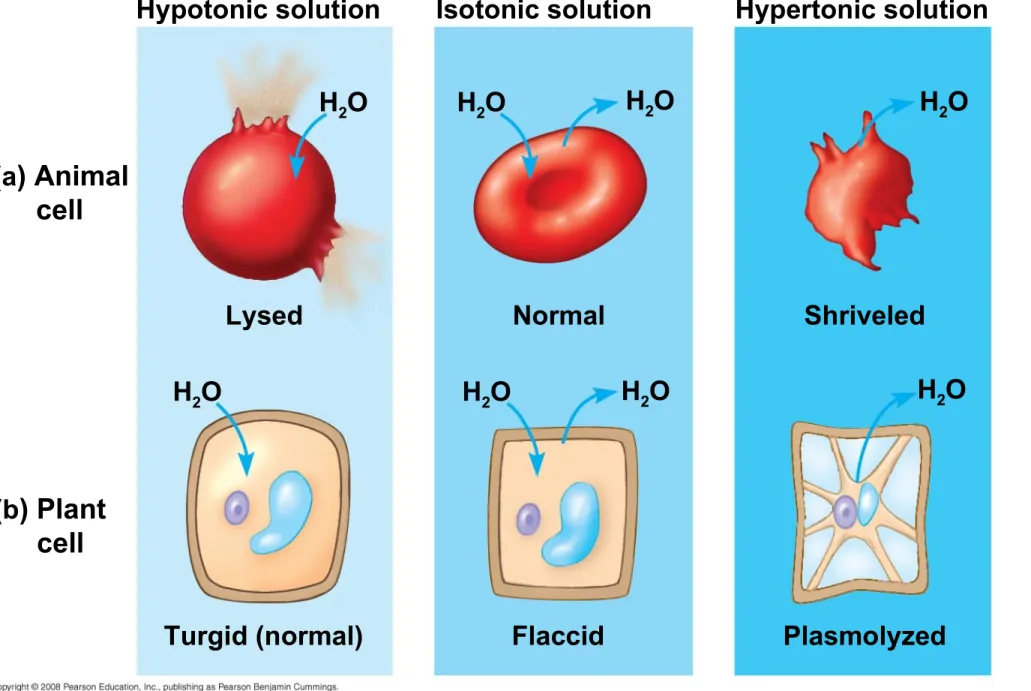
Water Balance of Cells Without Walls
• Tonicity: ability of solution to cause cell to gain or
lose water
• Isotonic: [solute] same in/out cell; no net H2O flow
• Hypertonic: [sol.] > outside cell; H2O flows out
• Hypotonic: [sol.] < outside cell; H2O flows in
Fig. 7-13
Hypotonic solution
(a) Animal
cell
(b) Plant
cell
H2O
Lysed
H2O
Turgid (normal)
H2O
H2O
H2O
H2O Normal
Isotonic solution
Flaccid
H2O
H2O Shriveled
Water Balance of Cells with Walls
• Cell walls give pressure against H2O: turgid
• plant cell / env. isotonic, cell flaccid (limp),
plant may wilt
Facilitated Diffusion: Passive Transport Aided by Proteins
• Facilitated Diff: transport prot. help molec.
diffuse across PM
• Specificity
• Ion channels: open/close response to stimulus
(gated channels)
EXTRACELLULAR FLUID
Channel protein
(a) A channel protein
Solute
CYTOPLASM
Solute Carrier protein
Need Energy for Active Transport (AT)
• AT: moves substance against its [gradient]
• Requires E (ATP)
• Carrier prot., solute binds, ATP donates P,
prot. changes shape, translocates solute which is released. Once released, prot. back to
original form, binds to another solute.
2
EXTRACELLULAR
FLUID
[Na+] high
[K+] low
[Na+] low
[K+] high
Passive transport
Diffusion Facilitated diffusion
Active transport
How Ion Pumps Maintain Membrane Potential
• Membrane potential: voltage difference
across membrane caused by differences in distribution of anions/cations
Like PB and J
• Electrochemical Gradient: drive diffusion of ions
• chem F (ion’s [gradient])
Pump It Up!
• Electrogenic Pump: trans. prot. that
generates voltage across a membrane
• Animals: Na+ - K+ ion pump
• Cell-walled: H+ pump
Cotransport: Coupled Transport by a Membrane Protein
• Cotransport: AT of solute indirectly drives
transport of another solute
• H+ pumps drive transport of nutrients into cell
Proton pump – – – – – – + + + + + + ATP H+ H+ H+ H+ H+ H+ H+ H+ Diffusion of H+
Sucrose-H+
cotransporter
Sucrose
Concept 7.5: Bulk transport by exocytosis and endocytosis
• Move lg. molec.
• Requires E
• Exocytosis: trans vesic. fuse w/ PM, dump
Endocytosis
• Take in in macromol. forming vesicles from PM
• 3 types:
– Phagocytosis (“cell eating”)
– Pinocytosis (“cell drinking”)
– Receptor-mediated (ligand binds to specific
PHAGOCYTOSIS EXTRACELLULAR
FLUID CYTOPLASM Pseudopodium “Food”or other particle Food vacuole PINOCYTOSIS 1 µm Pseudopodium of amoeba Bacterium Food vacuole
An amoeba engulfing a bacterium via phagocytosis (TEM)
Plasma membrane
Vesicle
0.5 µm
Pinocytosis vesicles forming (arrows) in a cell lining a small blood vessel (TEM)
RECEPTOR-MEDIATED ENDOCYTOSIS Receptor Coat protein Coated vesicle Coated pit Ligand Coat protein Plasma membrane