https://doi.org/10.3926/jiem.2973
Key Lessons to Sustain Continuous Improvement:
A Case Study of Four Companies
Luis Paipa-Galeano , César A. Bernal-Torres , Luis M. Agudelo-Otalora , Yavar Jarrah-Nezhad , Heither A. González-Blanco
Universidad de La Sabana (Colombia)
[email protected], [email protected], [email protected], [email protected], [email protected]
Received: July 2019 Accepted: February 2020
Abstract:
Purpose: This paper analyses the success factors and barriers of sustainable continuous improvement practices in terms of company’s maturity level. The key factors are necessary to establish strategies that reduce the risk of improvement failure and increase the company’s maturity level.
Design/methodology/approach: The paper presents a multi-case analysis of the success factors in the implementation of continuous improvement. This lead to comparison between the factors identified from the literature review and the practice of the continuous improvement programs in four large successful companies located in Bogota, Colombia applying Bessant's maturity model.
Findings: The results identified five success factors and three barriers that companies should consider while implementing sustainable continuous improvement programs. The key success factors are availability of resources; management commitment; employee participation in improvement task identification; clear and realistic objectives; and, finally, existence of a leader. The major barriers are lack of alignment between organizational and continuous improvement objectives; lack of motivation in the team; and, resistance to change. The results confirm that, in spite the high maturity, it is necessary to align the organizational and continuous improvement objectives.
Research limitations/implications: Since this research is a multi-case study, it is limited in terms of results generalizability for companies of different sizes, sectors and context. The academic and practical contribution of this paper is providing a better understanding of sustainable continuous improvement practices in Latin-American emerging economies.
Originality/value: The present research provides an integral analysis of the key success factors, the barriers, the level of maturity and the behaviours that the companies should implement to achieve the sustainability of continuous improvement in emerging economies such as Colombia.
Keywords:success factors, barriers, improvement maturity model, continuous improvement sustainability, kaizen, multi-case study, emerging economies
To cite this article:
1. Introduction
Porter (1985) affirm that strategic innovations in the company’s globalization process generate competitive advantages since they include product redefinition, cost reduction, adaptation to customer needs, and changes in the design and distribution of production, among others. Radical or incremental changes ensure achievement of these innovations. As a result, some companies opt for radical changes, such as processes redesign or reengineering (Borgianni, Cascini & Rotini, 2015; Hammer & Champy, 1994). At the implementation time, radical changes are challenging and need large investments. However, other companies prefer incremental changes known as continuous improvement (CI) due to the advantages of easy implementation and low costs (Imai, 2012; Singh & Singh, 2015).
In this paper, we analyse the success factors and barriers that lead to CI sustainability (CIS), for this reason, we understand CIS as an organization’s ability to maintain performance improvements in all organizational system and processes, involving all organizational participants through a planned, organized and systematic process.
Different authors agree that sustainability is maintaining the implemented improvement behaviours and note that the company should increase and sustain cumulative improvement (Bateman & David, 2002; Bessant, Caffyn & Gallagher, 2001; Caffyn, 1999; Dale, Boaden, Wilcox & McQuater, 1997; García-Sabater & Marín-García, 2009; Jaca, Suárez-Barraza, Viles, Mateo & Santos, 2011; Juran, Ballester & Medina, 1990; Michcol, Cano, Farías & Morales, 2012).
However, studies related to CI processes have shown that implemented improvements often cannot be sustained (Anand, Ward, Tatikonda & Schilling, 2009; Bateman & David 2002; Dale et al., 1997; Formento, Chiodi, Cusolito, Altube & Gatti, 2013; McLean, Antony & Dahlgaard, 2017). This is mainly due to the lack of organizational culture; collective learning; leadership and operators’ commitment; clear objectives and indicators; availability of resources, project identification and selection; data availability; stakeholder representation; and, structured methodology (Jaca et al., 2011; Albors, Hervás-Oliver & Segarra-Oña, 2009; García-Sabater & Marín-García, 2009; González-Aleu & Van Aken, 2016).
The main objective of the present research is to identify the key lessons to sustain CI by performing a multi-case study in four successful companies in Colombia. This goal arises from the gaps identified in the literature such as lack of multi-case studies in continuous improvement sustainability, lack of empirical analysis of the CIS conceptual models in Latin America and at last, lack of evidence about the generality and validity of the CIS models identified in developed countries in the companies of emerging economies.
2. Literature Review
2.1. Continuous Improvement Sustainability
There is no consensus among researchers regarding the definition of the CIS. According to Upton (1996), the CIS definition is maintaining implemented improvements while obtaining new opportunities to continue improving gradually. In addition, CIS is all standard development based on the improvements and an expansion of the gained knowledge to other areas (Bateman, 2005; Bateman & David, 2002; Bessant, Caffyn & Gallagher, 2001). Zairi (2005) defines CIS as an organization’s ability to adapt to the changes in business environment in order to obtain and apply the best practices, methodologies and techniques that ensure the superior organizational performance. In summary, these definitions share the idea that CIS is an organization’s ability to maintain performance improvements.
There have been many attempts by researchers to develop a unique model that guaranties the CIS and the company’s success. However, there is no consensus among researchers regarding the success and failure factors from the conceptual point of view. Additionally, the results of applying different models in organizations are rather controversial, and there is no general agreement on the main success factors.
In Spain, Garrigós, Oliver and Oña (2009) applied a survey of 55 questions to address the CI practices. They indicated that the implementation of CI required a clear methodology and the knowledge to apply CI tools. They concluded that it is important to maintain the management commitment related to time and resources, while assigning specific working groups dedicated to the CI. García-Sabater and Marín-García (2009) identified new success factors such as the promoter of CI, accordance of the structure with the CI processes, clear functions definition, and standardizing the methodology before applying CI in other parts of the organization.
Further, Michcol et al. (2012) explored the concept of maturity by surveying the company’s staff in order to evaluate their perception of organizational enablers and their influence to develop a successful CI Strategy. They conducted an interview of the CI leaders based on the Bessant model and identified the factors that lead to their success. These factors are the following: the deployment of correct CI strategic plan throughout the organization, definition and systematic measurement of objectives, leadership commitment, the organizational structure that supports CI, application of a formal methodology, and employee motivation.
González-Aleu and Van Aken (2016) conducted a systematic literature review from 98 articles between 1995 and 2014 that resulted in identification of 53 potential success factors classified into four groups related to task design, team design, organization, and CI processes. It is noticeable in the achieved results that first, the list of articles included 57 academic journal articles out of which 43 applied single case study method that indicates the lack of methodological diversity in the past literature. Secondly, the classification of the literature implicates the lack of single or group dominant publications outlets this means that the research area is not mature and new research can add to the prior knowledge. Thirdly, the researchers identified 300 unique authors from 22 different countries; however, more than 85% of this research occurred in developed countries including U.S., U.K., Canada, Sweden, Australia, Spain, Taiwan and Singapore. The rest of the published articles are in the emerging economies such as India, and Mexico. It is evident that just a small number of the conducted research are in the emerging countries and even less quantity in Latin America. It is remarkable that despite the fact that this research area appears to be relatively young, in the recent years, a dramatic increase in academic research interest in analysing critical success factors for continuous improvement processes (CIP) is evident. For instance, there were less than three articles published per year until 2007, however, more than 60 new authors have dedicated their research to CI success factors and the publishing rate has been significantly higher in the recent years. This demonstrates the importance of further research in this area for both the academy and the industry.
In contrast, McLean and Antony (2014) focused on the themes that lead to CI failure. The themes they identified are motives and expectations, organizational culture and environment, the management leadership, implementation approach, training, project management, employee involvement levels, and feedback and results.
For identifying other barriers to the success of CIS, Sánchez-Ruiz, Blanco and Diaz (2018) conducted an in-depth literature review and categorized the failure factors to 13 items. These factors are the lack of time, knowledge or experience about CI, clarity of CI objectives, suitable measurement system, management commitment, employee motivation, monitoring of proposed improvements, resources, change acceptance (employees, unions), profitability of the project, integration between CI aims and company competitive strategy, learning from mistakes, and formal process to solve problems.
The researchers conducted a great number of literature reviews and empirical studies to identify critical success factors (CSFs) and barriers related to the successful implementation of CI programs. The collected data are from companies of different sizes, economic sectors and countries that implemented continuous improvement initiatives program (Antony & Banuelas, 2002; Bateman & David 2002; Jaca et al., 2011; Jayaraman, Kee & Soh, 2012; Michcol et al., 2012).
Based on the prior revision, and considering that there are many key success factors identified to sustain CI, the present study identifies the following factors with higher occurrences in the literature:
2. Commitment and support: The main responsibility of the management is to promote and support the culture of improvement among employees (Berger, 1997; He, 2009) and to be a facilitator of the improvement process (García-Sabater & Marín-García, 2009; Bateman & Rich, 2003).
3. Availability of resources: The lack of resources is a clear cause of failure in the implementation of improvement programs (Bateman & Rich, 2003). Resources not only include financial but also time, staff, access to equipment and infrastructure, and training (Prajogo & Sohal, 2004).
4. Leadership: The leader is responsible for guiding the work team to apply different CI tools, coordinate activities, manage the resources and offer the improvement training. He should be a genuine improvement advocate (García-Sabater & Marín-García, 2009; Bateman & Rich, 2003; Sánchez-Ruiz et al., 2019; McLean & Antony, 2014).
5. Indicators and measurement of improvement: CI measurement and interventions affect the process in progress (Bessant & Francis, 1999; He, 2009) and allow learning from the outcomes (Bateman & Rich, 2003; Sánchez-Ruiz et al., 2019; McLean & Antony, 2014).
6. Official improvement teams: Interdisciplinary work teams formalize the planning and deployment processes, and they participate at all levels (Prado, Fernández-González & García-Lorenzo, 2004). These teams should develop an adequate organization plan based on the scope of the implementation, considering clear roles and defined hierarchies for efficient monitoring and control (García-Sabater & Marín-García, 2009).
7. Formal methodology: It facilitates CI progress in an orderly and formalized manner (Caffyn, 1999; McLean & Antony, 2014). According to Upton (1996), the methodology provides focus, motivation and empowerment.
8. Clear and achievable objectives: They are demanding, specific, and adjusted to the reality of the organization’s resources and external forces. These objectives specify and delimit the scope of the planned goals (Prajogo & Sohal, 2004; Sánchez-Ruiz et al., 2019).
9. Policies, standards and procedures: They are criteria, parameters and guides that assure the success of CI programs. According to Cooney and Sohal (2004), teams that generate clear policies and standards achieve success. In addition, Barraza and Dávila (2009) state that a fundamental CI principle is to standardize operations in order to sustain the obtained achievements.
10. Employee involvement: It begins with the employees’ desire to solve problems in the matters that affect them directly (Jaca, Viles, Mateo & Santos, 2012). These include problems in conception, planning and execution of the CI processes. Thus, the teams achieve more commitment, empowerment and appropriation (Prajogo & Sohal, 2004; Bateman, 2005).
11. Recognition systems: They are important factors at the time of generating commitment and motivation in the team. The recognition for the achievements can be whether material or immaterial (Bateman & Rich, 2003; Caffyn, 1999; García-Sabater & Marín-García, 2009).
12. Standardized assessment system: This system accompanied with learning from the outcomes is essential for the effective implementation of any CI process (Bateman & Rich, 2003).
The principal barriers frequently mentioned in the literature are:
1. Resistance to change: When implementing a CI plan, involved persons tend to think that the improvement happens with an increase in the workload. Additionally, natural human behaviour is to put up barriers and resist the possibility of change (Bessant & Francis, 1999).
2. Lack of motivation in the team: The team should see and understand each proposed activity as part of daily work and not as extraordinary resources or as activities outside the working hours; the team appropriates these activities in such a way that their execution is a win-win situation (Bateman & Rich, 2003).
4. Lack of alignment between the organization’s objectives: It is necessary for the CI program’s success to follow the same goal as strategic objectives of the company. It is necessary for the CI program to obtain high priority in order to succeed (Caffyn, 1999; Dale et al., 1997; Upton, 1996).
2.2. Assessment of the Sustainability of Continuous Improvement
In the literature, there are a variety of assessment models to measure the evolution and sustainability of CI behaviours in an organization (Upton, 1996; Bateman & Rich, 2003; and Bessant et al., 2001). This paper applies the Bessant et al. (2001) model, which is widely accepted and frequently referenced by other studies (Bhuiyan, Baghel & Wilson, 2006; Jørgensen et al., 2006). Bessant et al. (2001) developed this model in the Continuous Improvement Research for Competitive Advantage framework (CIRCA). The model allows classifying and evaluating organizations based on improvement practices and specific individual behaviours that support CI sustainability. The model defines five levels of evolution that converts into skills that people develop for the understanding and construction of CI (Bessant et al., 2001). The intention of this skill classification is to help companies understand their relative position in comparison to other companies in terms of plan development and capabilities expansion.
At the first level (precursor), the organization can randomly generate improvements or try to solve problems through processes, but there are no formal or structured efforts to improve the organization. At the second level (structured CI), the company starts an improvement initiative, and a high proportion of the staff participates, thus creating a formal commitment to building a CI system. At the third level (strategic CI), the organization commits to linking CI behaviours to its broader strategic concerns. At the fourth level (proactive CI), the organization attempts to delegate autonomy and strengthen individuals and groups to manage their own processes. Finally, at the fifth level (full capacity for CI) the organization demonstrates a persistent capacity to learn and convert it into the capacity to innovate. According to this model, to start CI, a company must engage in a series of routines or habits (Bessant & Francis, 1999; Bessant et al., 2001). These routines are composed of a set of behaviours, which comprise actions or responses of the company’s personnel under certain circumstances. The model proposes eight (8) routines, which comprise 36 behaviours (Bessant et al., 2001) (the basis of the questions applied in this research - Table 1).
Level Routine Behaviours
Level 1
Precursor
(1) Basic continuous improvement
1. A belief shared by all the company's personnel that improvements in small steps are valuable and that everyone can participate in the identification of problems and the generation of incremental improvements.
2. When something goes wrong, the natural reaction of the staff at all levels of the company is to look for the root cause of the problem instead of looking for the culprit.
3. The collaborators use a formal system for the problem identification and problem-solving cycle.
Level 2
Structured continuous improvement
(2) Involvement of operators in continuous improvement
4. The collaborators use appropriate tools and techniques to support continuous improvement.
5. The collaborators measure indicators to control the improvement process. 6. The collaborators (individually or as groups) carry out continuous improvement
activities – they participate in the continuous improvement process. 7. The team makes the decision about the implementation of the proposals for
improvement in a clearly defined manner.
(3) Support for continuous improvement
8. The managers support the continuous improvement process by allocating time, money, space or other resources necessary for continuous improvement. 9. The managers recognize the contributions of collaborators to continuous improvement and reward them formally (not necessarily with economic incentives).
10. The managers lead by example, actively participating in the design and implementation of continuous improvement.
Level Routine Behaviours Level 3 Improvement oriented to objectives (4) Focused improvement
12. Individuals and groups use strategic company objectives to focus and prioritize improvements.
13. All employees understand (for example, they can explain to others) the strategic objectives of the company or department.
14. Individuals and groups evaluate the proposed changes against the objectives of the company or department before starting the problem-solving cycle or
implementing a solution to ensure that these are consistent.
15. Individuals and groups measure and evaluate the outcomes of their improvement activities and the impact of these on strategic or departmental objectives. 16. Continuous improvement activities integrate into the usual work of individuals or
groups and are not distinct parallel activities.
(5) Integrate continuous and structured improvement
17. The structure and infrastructure of the company and the continuous improvement system support and reinforce each other through continuous assessment.
18. The person or group responsible for the design of the continuous improvement system ensures that the system fits with the current structure and infrastructure of the company.
19. The employees responsible for a certain system or process of the company perform periodic reviews to assess whether these processes remain compatible with the continuous improvement system.
20. The employees responsible for the continuous improvement system ensure that when a plan consists of a major organizational change, the possible impacts on the continuous improvement system are predetermined and they consider the necessary adjustments. Level 4 Proactive continuous improvement (6) Improvement expanded
21. The collaborators, in addition to their operational roles, cooperate with people from other areas to perform continuous improvement (for example, by participating in multidisciplinary teams).
22. The collaborators understand and share a comprehensive vision of the company (they understand the processes and feel ownership).
23. The collaborators direct their continuous improvement activities towards customers, both internally and externally.
24. There are specific projects for continuous improvement with the participation of stakeholders outside the company (customers, suppliers, etc.).
25. The representative activities of continuous improvement incorporate personnel from different organizational levels of the company.
(7) Programme improvement
26. A continuous improvement system applies a nonstop processes evaluation and development. A responsible individual or group assesses the system and measures the incidence of continuous improvement activities and their outcomes.
27. There is a planned cyclical process revision and modification.
28. Managers carry out a periodic review of the continuous improvement system by analysing its relationship with the organization as a whole in order to make substantial changes if deemed necessary.
29. Management supports the development and continuous evolution of the continuous improvement system by allocating enough resources (time, money, personnel).
Level 5 Full capacity for continuous improvement (8) Learning organization
30. The collaborators learn from their experiences, both positive and negative. 31. Employees in the company look for opportunities to learn or develop (for
example, active experimentation, establishing their own learning objectives). 32. Employees and groups at all levels share and make available what they have learned
from their experiences at work.
33. The company articulates and consolidates (by way of sharing) the learning of individuals and groups.
34. Managers accept and, when necessary, participate in all the learning that takes place in the company.
35. The collaborators and teams ensure that their learning is captured using mechanisms that the company has established for that purpose.
36. The designated employees use mechanisms to deploy the previously captured learning throughout the entire company.
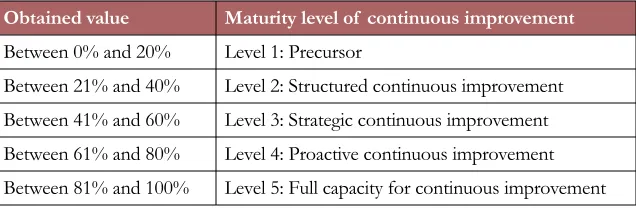
In order to determine the maturity level of a company’s CI system, it is necessary to calculate the average of the scores for each question (Likert scale of 1 to 5) defined in each of the eight factors. Subsequently, an average value of the averages is determined (Bessant & Francis, 1999; Bessant et al., 2001). The resulting value is then analysed to define maturity levels of CI with the following scale (Table 2).
Obtained value Maturity level of continuous improvement
Between 0% and 20% Level 1: Precursor
Between 21% and 40% Level 2: Structured continuous improvement Between 41% and 60% Level 3: Strategic continuous improvement Between 61% and 80% Level 4: Proactive continuous improvement Between 81% and 100% Level 5: Full capacity for continuous improvement
Table 2. Improvement maturity levels of the Bessantet al. (2001) model
3. Methodology
This research adopted multiple-case study methodology (Onwuegbuzie & Leech, 2010; Yin, 2009), which is considered adequate to obtain information about social processes and to describe phenomena (Eisenhardt & Graebner, 2007; Yin, 2009). Therefore, the authors contacted several large well-established and successful companies located in the Bogotá city in Colombia to verify their level of CIP application.
The authors chose four companies for the multi-case analysis based on the following selection criteria. The companies possess “ISO 9001:2015 Quality Management System” certification in the application of CI systems during the last two years. Their activity sector recognizes them by corporate image and reputation for their participation in the market with at least 30 years in operation. At last, they provided researchers access to their information and permitted interviews with their staff. Table 3 shows the main socio-demographic characteristics of the selected companies, where the company names have been changed to C1, C2, C3 and C4.
Company IndustrialSector Age Type employees (2018)Number of improvement programmesDuration of continuous
C1 Consumergoods > 30 years MultinationalColombian 4,047 >10 years
C2 Food > 50 years MultinationalColombian 1,028 >7 years
C3 Consumergoods > 100 years MultinationalColombian 2,044 >2 years
C4 Auto parts > 50 years Multinationalin Colombia 969 >12 years
Table 3. Characteristics of the companies participating in the study
C3 is a Colombian multinational company dedicated to the production, marketing and distribution of consumer goods, with more than 110 years in the market. It has three factories, two for food manufacturing and one for cleaning, personal care and domestic cleaning products. Currently, its products sell in more than 40 countries. In 2017, it is one of the 150 largest companies in the country. The company has 2044 employees.
C4 is a multinational company dedicated to the production and distribution of energy distribution systems for the automotive industry. The factory in Colombia has 969 employees, and since its inception, CI has been an integral part of the company’s principles.
The data collection process considers different sources. These sources include the documents provided by the companies, information on the companies' websites, interviews and surveys with the leaders and operation managers, and observations during repeated visits to their facilities in a limited period between February and April of 2018. The content analysis of the companies’ documents and websites identifies information about the industrial sector, quantity of years participating in the market, amount of employees, financial profile, recognition criteria, and the reasons behind the adoption of CI policies. Consequently, two experts validated the interview questions, and the authors applied it to the Chief Executive Officer (CEO) or the production manager of each company for approximately 60-90 minutes. The interview topics are CI related, particularly the key success factors and barriers presented in Appendix A.
In addition, the same high-level managers responded to the survey to measure the CI program maturity level by applying the Bessant et al. (2001) model and to evaluate the barriers of CIS success utilizing Likert-type items. The authors made visits to each factory various times and each visit lasted for approximately between 90 and 120 minutes to observe and validate the information in relation to CI success factors and barriers. The intermediate managers or the production manager directed the visits. They presented and explained how they perform their tasks, productive activities and improvements. In all cases, the visit completed by a discussion with the managers to clarify the principles behind the behaviours and tasks observed.
Finally, the collected data from the survey of the higher management was analysed applying descriptive statistical analysis aligned with the Bessant et al. (2001) model. The authors conducted a comparative analysis of the CI maturity level measurment and barriers of sustainability in the companies.
4. Results and Discussion
The CEOs that participated in the study mentioned that the implemented policy of quality and CI are to achieve the goals of sustainable development, profitable growth, satisfaction of customer needs, and well-being of all people working in the company and mitigating the impacts that their production processes and their products may have on the environment. The companies apply this policy to add value in manufacturing processes permanently.
4.1. Analysis of CIS Key Success Factors and Barriers
Figure 1. Results of the assessment of the key success factors for companies C1, C2, C3 and C4
Likewise, the results validate the importance of the key success factors mentioned by García-Sabater and Marín-García, (2009), Jaca et al. (2012), Bateman and Rich, (2003), Prajogo and Sohal, (2004) Sánchez-Ruiz et al. (2019), McLean and Antony (2014). These factors are the commitment of the managers; the availability of resources (money, time, technologies, etc.); participation of employees in the identification, definition, and finding the means for improvement activities; the clarity of the objectives; the scope of improvements; and, finally, the presence of responsible leader. In addition, training scored low among other parameters in the studied companies and contrasts with the conclusions by McLean and Antony (2014), Jaca et al. (2011), Sánchez-Ruiz et al. (2019), Bessant and Francis (1999) Jørgensen et al. (2006); and López et al. (2009). In the developed economies, training is a key factor in all business activities, and it is the companies’ commitment to their employees, while in countries of emerging economies such as Colombia, training is initially the employee´s resposibility.
In contrast, in Figure 2 the results of the three companies score high in the following barriers: lack of alignment between organization’s strategic objectives and continuous improvement objectives; lack of motivation in the team; and, resistance to change. The managers indicated that employees do not see an alignment between CIP goals and organizational objectives, and as a result, they do not feel motivated. The main issue is not the lack of communication or CI tools as affirmed by Bateman and Rich (2003), but incoherence of the communicated information with the reality of the objective and their implementation in the company. As a result, they resist to all CI related changes that in their perception conflict with the organizations objectives.
The results narrow the diverse amount of success factors mentioned by González-Aleu and Van Aken (2016) and the barriers identified by Sánchez-Ruiz et al. (2018), Jaca et al. (2011), Jayaraman et al. (2012), Michcol et al. (2012) for companies in emerging economies.
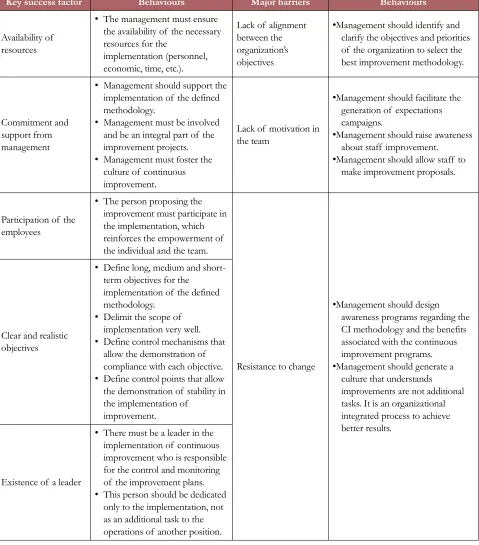
As a synthesis of the evidence in the four companies studied, Table 4 presents the key lessons learned based on the survey results in order of importance, specifically the main factors (success and barriers), and the corresponding behaviours, that were considered fundamental to the sustainability achievement of their CI systems
Key success factor Behaviours Major barriers Behaviours
Availability of resources
• The management must ensure the availability of the necessary resources for the
implementation (personnel, economic, time, etc.).
Lack of alignment between the organization’s objectives
•Management should identify and clarify the objectives and priorities of the organization to select the best improvement methodology.
Commitment and support from management
• Management should support the implementation of the defined methodology.
• Management must be involved and be an integral part of the improvement projects.
• Management must foster the culture of continuous improvement.
Lack of motivation in the team
•Management should facilitate the generation of expectations campaigns.
•Management should raise awareness about staff improvement.
•Management should allow staff to make improvement proposals.
Participation of the employees
• The person proposing the improvement must participate in the implementation, which reinforces the empowerment of the individual and the team.
Resistance to change
•Management should design awareness programs regarding the CI methodology and the benefits associated with the continuous improvement programs.
•Management should generate a culture that understands improvements are not additional tasks. It is an organizational integrated process to achieve better results.
Clear and realistic objectives
• Define long, medium and short-term objectives for the
implementation of the defined methodology.
• Delimit the scope of implementation very well.
• Define control mechanisms that allow the demonstration of compliance with each objective.
• Define control points that allow the demonstration of stability in the implementation of
improvement.
Existence of a leader
• There must be a leader in the implementation of continuous improvement who is responsible for the control and monitoring of the improvement plans.
• This person should be dedicated only to the implementation, not as an additional task to the operations of another position.
4.2. Maturity Analysis of Continuous Improvement Programs
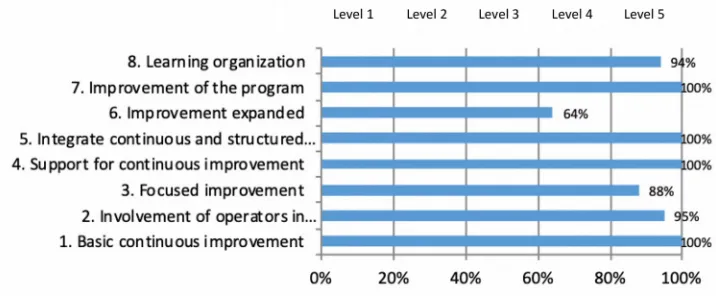
Regarding the maturity status of the CI programs, Figures 1, 2, 3, and 4 show the main outcomes of Bessant et al. (2001) model for each company.
52% - Level 3: Strategic continuous improvement
The evidence of staff participation at all levels in the identification and deployment of CI plans is clear. The observation is that for each problem, the company carries out a root cause analysis through a formal and standardized methodology. Management is fully empowered in the selection, assessment and deployment of CI plans, assigning all the necessary resources. The company approves ach plan if it contributes to the improvement of the outcomes of the organization's objectives.
Figure 3. Maturity level in C1
89% Level 5: Full capacity for continuous improvement
Clear progress in all behaviours is evident. The CI system implemented empowers all personnel throughout the organization. Management is fully empowered in the selection, assessment and deployment of CI plans, assigning all the necessary resources. There are personnel for CI dedicated to measuring and ensuring the implementation of the plans in a standardized manner.
Figure 4. Maturity level in C2
Additionally, in companies C1 and C3, although CI consolidation is not according to the model of Bessant et al. (2001), there is a high commitment to CI behaviour towards building a sustaining culture. Therefore, according to the cited model, these companies need to continue formalizing an improvement program aligned with the organizational objectives.
47% - Level 3: Strategic continuous improvement
The evidence of staff participation at all levels in the identification and deployment of CI plans is clear. The observation is that for each problem, the company carries out a root cause analysis through a formal and standardized methodology. Management is fully empowered to perform the selection, assessment and deployment of CI plans, assigning all the necessary resources. A consulting company provides assistance.
Figure 5. Maturity level in C3
93% - Level 5: Full capacity for continuous improvement
The corporate policy defined by headquarters ensures the empowerment of all personnel in the CI system implemented throughout the organization. They have their own continuous improvement system, with standardized tools to conduct the selection, assessment and deployment of each CI plan, which the management approves that ensures the availability of all resources. There is a CI department dedicated to measuring and ensuring the implementation of the plans in a standardized manner in all subsidiaries.
Figure 6. Maturity level in C4
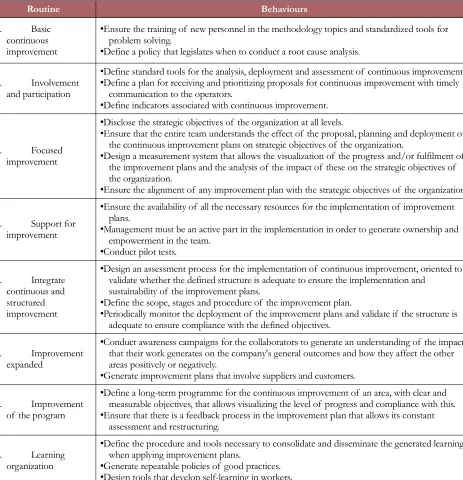
the analysis of root causes of the activities that need improvement. In order to involve employees in CI (routine 2), the following behaviours are necessary: possessing standard tools for the analysis; deployment and evaluation of CI; definition of a plan to receive and prioritize proposals for CI with timely communication to employees; and, definition of an agreement with the employee’s indicators associated with continuous improvement. Employee participation in the definition of CI indicators is very important because this gives clarity to what needs to be improved and when to achieve it..
Routine Behaviours
1. Basic
continuous improvement
•Ensure the training of new personnel in the methodology topics and standardized tools for problem solving.
•Define a policy that legislates when to conduct a root cause analysis.
2. Involvement and participation
•Define standard tools for the analysis, deployment and assessment of continuous improvement.
•Define a plan for receiving and prioritizing proposals for continuous improvement with timely communication to the operators.
•Define indicators associated with continuous improvement.
3. Focused
improvement
•Disclose the strategic objectives of the organization at all levels.
•Ensure that the entire team understands the effect of the proposal, planning and deployment of the continuous improvement plans on strategic objectives of the organization.
•Design a measurement system that allows the visualization of the progress and/or fulfilment of the improvement plans and the analysis of the impact of these on the strategic objectives of the organization.
•Ensure the alignment of any improvement plan with the strategic objectives of the organization.
4. Support for improvement
•Ensure the availability of all the necessary resources for the implementation of improvement plans.
•Management must be an active part in the implementation in order to generate ownership and empowerment in the team.
•Conduct pilot tests.
5. Integrate continuous and structured improvement
•Design an assessment process for the implementation of continuous improvement, oriented to validate whether the defined structure is adequate to ensure the implementation and
sustainability of the improvement plans.
•Define the scope, stages and procedure of the improvement plan.
•Periodically monitor the deployment of the improvement plans and validate if the structure is adequate to ensure compliance with the defined objectives.
6. Improvement expanded
•Conduct awareness campaigns for the collaborators to generate an understanding of the impact that their work generates on the company's general outcomes and how they affect the other areas positively or negatively.
•Generate improvement plans that involve suppliers and customers.
7. Improvement of the program
•Define a long-term programme for the continuous improvement of an area, with clear and measurable objectives, that allows visualizing the level of progress and compliance with this.
•Ensure that there is a feedback process in the improvement plan that allows its constant assessment and restructuring.
8. Learning organization
•Define the procedure and tools necessary to consolidate and disseminate the generated learning when applying improvement plans.
•Generate repeatable policies of good practices.
•Design tools that develop self-learning in workers.
5. Conclusions
The absence of a single or a group of dominant publications outlets is evidence of lack of maturity in CIS. The literature review indicates that there is a great deal of research about CIS in the countries of developed economies; however, their results are controversial, which evidences the need for new studies on the subject.
The empirical study results indicate five success factors and three barriers that companies should consider while implementing sustainable continuous improvement programs. The key success factors listed are in order of most important: availability of resources; commitment and support from management; the participation of employees in the identification of tasks to improve; clear and realistic objectives to CI; and, finally, existence of a leader or responsible for CI. The major barriers of CIS success are lack of alignment between organization’s strategic objectives and CI objectives; lack of motivation in the team; and, resistance to change. The results confirm that, in spite the high level of maturity in the companies, in order to motivate employees for their participation in improvement processes and generate improvement plans that involve suppliers and customers it is necessary to align the organization’s strategic objectives with continuous improvement objectives.
The presented research is limited to: first, multi-case study applying qualitative approach in terms of reliability, validity, and generalizability of the results; secondly, CI is used in a broad sense without analysing each tool, methodology (e.g. Six Sigma, Lean, Kaizen, etc.), or context (cultural, societal and economic) in detail. However, it has applicability and validity for companies of the similar size, sectors and contexts as the studied companies. Additionally, the study offers interesting insights on the empirical evidence on the lessons learned from CI practices in order to support managers on better decision making and understanding of CI for research.
Consequently, future research can contribute by focusing on new multi-case studies, mixed focus studies with the inclusion of large number of companies to evaluate and validate our results in relation to organization’s CI processes and performance. The research is necessary to validate the generality of the results in the companies that apply different techniques of CI (e.g. Six Sigma, Lean, Kaizen, etc.). Future research is able to contribute to our understanding of CIS by the inclusion of other additional factors that can affect the results such as company size, industrial sector, public vs. private, countries or geographical regions (considering cultural, societal and economic context), longitudinal and cross-sectional studies with representative statistical samples of the companies. It is necessary to conduct research that facilitates manager and employee training that enables them to design, implement and measure the CIS programs. Finally, in order to integrate the research in this subject area it is necessary to conduct systematic literature reviews applying text mining and natural language processing techniques to screen large quantity of documents that permits the development of a comprehensive framework with more dimensions and criteria.
5.1. Theoretical and managerial implications
The significance of the present research is that it provides a conceptual framework of factors and barriers that affect CIS and analyses them with the empirical evidence from four large recognized companies in an emerging economy. As a result, the study establishes five key success factors and three major barriers to sustain CI in the companies studied (Figure 7).
Figure 7. Key success factors and barriers for the CIS of companies of emerging economies
Declaration of Conflicting Interests
The authors declared no potential conflicts of interest with respect to the research, authorship, and/or publication of this article.
Funding
The authors received no financial support for the research, authorship, and/or publication of this article.
References
Albors, J., Hervás-Oliver, J.L., & Segarra-Oña, M. del V. (2009), Análisis de las prácticas de mejora continua en España: barreras y facilitadores. Economía Industrial, 373, 185-195.
Anand, G., Ward, P.T., Tatikonda, M.V., & Schilling, D.A. (2009). Dynamic capabilities through continuous improvement infrastructure. Journal of Operations Management, 27(6),
444-461.https://doi.org/10.1016/j.jom.2009.02.002
Anthony, J., & Banuelas, R. (2002). Critial success factor for the successful implementing of Six Sigma projects. The TQM Magazines, 41(2), 92-99. https://doi.org/10.1108/09544780210416702
Barraza, M.F.S., & Dávila, J.Á.M. (2009). Encontrando al kaizen: un análisis teórico de la mejora continua. Pecvnia, 7, 285-311. https://doi.org/10.18002/pec.v0i7.696
Bateman, N. (2005). Sustainability: the elusive element of process improvement. International Journal of Operations & Production Management, 25(3), 261-276. https://doi.org/10.1108/01443570510581862
Bateman, N., & David, A. (2002). Process improvement programmes: a model for assessing sustainability. International Journal of Operations & Production Management, 22(5), 515-526.
https://doi.org/10.1108/01443570210425156
Bateman, N., & Rich, N. (2003). Companies’ perceptions of inhibitors and enablers for process improvement activities. International Journal of Operations & Production Management, 23(2), 185-199.
https://doi.org/10.1108/01443570310458447
Berger, A. (1997). Continuous improvement and kaizen: standardization and organizational designs. Integrated Manufacturing Systems, 8(2), 110-117. https://doi.org/10.1108/09576069710165792
Bessant, J., Caffyn, S., & Gallagher, M. (2001). An evolutionary model of continuous improvement behavior. Technovation, 21(2), 67-77. https://doi.org/10.1016/S0166-4972(00)00023-7
Bessant, J., & Francis, D. (1999). Developing strategic continuous improvement capability. International Journal of Operations & Production Management, 19(11), 1106-1119. https://doi.org/10.1108/01443579910291032
Bhuiyan, N., Baghel, A., & Wilson, J. (2006). A sustainable continuous improvement methodology at an aerospace company. International Journal of Productivity and Performance Management, 55(8), 671-687.
https://doi.org/10.1108/17410400610710206
Borgianni, Y., Cascini, G., & Rotini, F. (2015). Business process reengineering driven by customer value: a support for undertaking decisions under uncertainty conditions. Computers in Industry, 68, 132-147.
https://doi.org/10.1016/j.compind.2015.01.001
Caffyn, S. (1999). Development of a continuous improvement self‐assessment tool. International Journal of Operations & Production Management, 19(11), 1138-1153. https://doi.org/10.1108/01443579910291050
Cooney, R., & Sohal, A. (2004). Teamwork and total quality management: a durable partnership. Total Quality Management & Business Excellence, 15(8), 1131-1142. https://doi.org/10.1080/1478336042000255442
Dale, B.G., Boaden, R.J., Wilcox, M., & McQuater, R.E. (1997). Sustaining total quality management: what are the key issues? The TQM Magazine, 9(5), 372-380. https://doi.org/10.1108/09544789710178668
Eisenhardt, K.M., & Graebner, M.E. (2007). Theory building from cases: opportunities and challenges. Academy of Management Journal, 50(1), 25-32. https://doi.org/10.5465/amj.2007.24160888
Formento, H., Chiodi, F., Cusolito, F., Altube, L., & Gatti, S.P. (2013). Key factors for a continuous improvement process. Independent Journal of Management & Production, 4(2), 391-415. https://doi.org/10.14807/ijmp.v4i2.76
García-Sabater, J.J., & Marín-García, J.A. (2011). Can we still talk about continuous improvement? Rethinking enablers and inhibitors for successful implementation. International Journal of Technology Management, 55(1), 28-42.
https://doi.org/10.1504/IJTM.2011.041678
García-Sabater, J.J., & Marín-García, J.A. (2009). Facilitadores y barreras para la sostenibilidad de la mejora continua: un estudio en proveedores del automóvil de la comunidad valenciana. Intangible Capital, 5(2), 1697-9818.
González-Aleu, F., & Van Aken, E.M. (2016). Systematic literature review of critical success factors for continuous improvement projects. International Journal of Lean Six Sigma, 7(3), 214-232. https://doi.org/10.1108/IJLSS-06-2015-0025
Garrigós, J.A., Oliver, J.L.H., & Oña, M.D.V.S. (2009). Análisis de las prácticas de mejora continua en España: barreras y facilitadores. Economía industrial, 373, 185-195.
Hammer, M., & Champy, J. (1994). Reingeniería de la Empresa: Olvide lo Que Usted Sabe Sobre Cómo Debe Funcionar Una Empresa, ¡Casi Todo Está Equivocado! Bogotá: Grupo Editorial Norma.
He, Z. (2009). Progress report: learn something about your six-sigma program’s maturity. Quality Progress, 24(4), 22-28.
Imai, M. (2012). La Clave de la Ventaja Competitiva Japonesa. México: Cecsa.
Jaca, C., Suárez-Barraza, M., Viles, E., Mateo, R., & Santos, J. (2011). Encuesta de sostenibilidad de sistemas de mejora continua: comparativa de dos comunidades industriales de España y México. Intangible Capital, 7(1), 1697-9818. https://doi.org/10.3926/ic.2011.v7n1.p143-169
Jaca, C., Viles, E., Mateo, R., & Santos, J. (2012). Components of sustainable improvement systems: theory and practice. The TQM Journal, 24(2), 142-154. https://doi.org/10.1108/17542731211215080
Jayaraman, K., Kee, T.L., & Soh, K.L. (2012). The perceptions and perspectives of lean six sigma (LSS) practitioners: An empirical study in Malaysia. The TQM Journal, 24(5), 433-446.
https://doi.org/10.1108/17542731211261584
Jørgensen, F., Boer, H., & Laugen, B.T. (2006). CI implementation: an empirical test of the CI maturity model. Creativity and Innovation Management, 15(4), 328-337. https://doi.org/10.1111/j.1467-8691.2006.00404.x
Juran, J.M., Ballester, M.G., & Medina, J.N. (1990). Juran y la Planificación Para la Calidad. España: Díaz de Santos. López, R.R., Morales, S.A.N., Toledo, C.E.E., & Delgado, V.I.A. (2009). Factores críticos de éxito una estrategia de
competitividad. Cultura Científica y Tecnológica, 6(31), 5-14.
McLean, R.S., Antony, J., & Dahlgaard, J.J. (2017). Failure of continuous improvement initiatives in manufacturing environments: a systematic review of the evidence. Total Quality Management & Business Excellence, 28(3-4), 219-237.
https://doi.org/10.1080/14783363.2015.1063414
McLean, R., & Antony, J. (2014). Why continuous improvement initiatives fail in manufacturing environments? A systematic review of the evidence. International Journal of Productivity and Performance Management, 63(3), 370-376.
https://doi.org/10.1108/IJPPM-07-2013-0124
Michcol, J.T., Cano, P., Farias, S.F., & Morales, J.J.N. (2012). Análisis de facilitadores para sostener la mejora continua en una empresa de autopartes. Conciencia Tecnológica. Departamento de Desarrollo Académico, 1(44), 41-50. Onwuegbuzie, A.J., & Leech, N.L. (2010). Generalization practices in qualitative research: a mixed methods case
study. Quality & Quantity, 44(5), 881-892. https://doi.org/10.1007/s11135-009-9241-z
Porter, M.E. (1985). The Competitive Advantage: Creating and Sustaining Superior Performance. New York, NY: Free Press. Prado, J.C.P., Fernández-González, A.J., & García-Lorenzo, A. (2004). Quality management and personnel
participation: improvement teams, a solution for ISO 9000 system maintenance problems in small to medium-sized enterprises. Human Factors and Ergonomics in Manufacturing & Service Industries, 14(3), 221-237.
https://doi.org/10.1002/hfm.10061
Prajogo, D., & Sohal, A. (2004). The sustainability and evolution of quality improvement programmes – an Australian case study. Total Quality Management & Business Excellence, 15(2), 205-220.
https://doi.org/10.1080/1478336032000149036
Sánchez-Ruiz, L., Blanco, B., & Gomez-Lopez, R. (2019). Continuous improvement enablers: Defining a new construct. Journal of Industrial Engineering and Management, 12(1), 51-69. https://doi.org/10.3926/jiem.2743
Sánchez-Ruiz, L., Blanco, B., & Diaz, E. (2018). Difficulty in implementing continuous improvement–Rasch measurement analysis. Business Process Management Journal, 25(6), 1228-1250. https://doi.org/10.1108/BPMJ-05-2017-0125
Singh, J., & Singh, H. (2015). Continuous improvement philosophy – literature review and directions. Benchmarking: An International Journal, 22(1), 75-119. https://doi.org/10.1108/BIJ-06-2012-0038
Upton, D.M. (1996). Mechanisms for building and sustaining operations improvement. Technology and Operations Management, 95(54), 1-28. https://doi.org/10.1016/0263-2373(96)00002-3
Yin, R. (2009). Case Study Research Design and Methods. India: Calif Sage Publication.
Zairi, M. (2005). TQM Sustainability: How to Maintain Its Gains through Transformational Change. Bradford: University of Bradford, School of Management.
Journal of Industrial Engineering and Management, 2020 (www.jiem.org)
Article’s contents are provided on an Attribution-Non Commercial 4.0 Creative commons International License. Readers are allowed to copy, distribute and communicate article’s contents, provided the author’s and Journal of Industrial Engineering and