Dr. Ankur Barua,
Senior Lecturer, Department of Community Medicine, International Medical University (IMU), No. 126, Jalan Jalil Perkasa 19, Bukit Jalil, 57000 Kuala Lumpur, Malaysia. Email: [email protected]
Address for correspondence
Access this article online www.japer.in
Validation of Feedback Questionnaire on Flipped Classroom (FC)
Activity
INTRODUCTION
‘Flipped classroom’ is a modern teaching-learning method to foster participate engagement during the delivery of a plenary session in a large classroom set-up.1 Flipped classes represent a type of blended learning where the instructor develops learning materials like videos or slide presentations or reading materials for students to refer outside the live classroom. Here, the real didactic lecture time is channelized towards application of the concepts imbibed invoking active learning methods which results in higher student achievement.1,2 The facilitators employ assessment methodologies like interactive quizzes or projects to check the utilization of resource materials by the participants and also to assess their comprehension abilities and application
of concepts.3
This methodology may be considered as the backwards classroom and reverse instruction. In a flipped class, students study the topic independently and then spend the plenary session solving problems, applying the concepts to case studies or doing practical application activities. Instructors act as facilitator or coach to help students in areas where they have trouble in application of concepts.4,5,6
It is important to obtain feedback from participants at the end of every flipped classroom for understanding its strengths and weaknesses which will eventually assist in developing strategies to improve its quality.3,4,7 With this background, a feedback questionnaire was developed and validated in order to obtain opinion from the participants after the conduction of a flipped classroom activity on Complementary Medicine Module in undergraduate Pharmacy programme.
Background
Using technology, lectures are now moved out of the classroom and delivered online as a means to provide interaction and collaboration. Flipped classroom (FC) is a modern instructional method to engage students in learning process by replacing the didactic lectures. In this study, a feedback questionnaire was developed to study the perception of participants on flipped classroom activities. Objective
To determine the reliability of a feedback questionnaire for monitoring flipped classroom activity on Complementary Medicine Module in undergraduate Pharmacy programme.
Materials and Methods
In this cross-sectional study, a flipped class was conducted on a group of 112 students of B. Pharm Semester 5 programme. The topic selected was popular herbal remedies of the complementary medicine module. A feedback questionnaire, based on five-point Likert scale, was developed to monitor flipped classroom activity.Flipped class was conducted with audio and video presentation in the form of a quiz using ten One Best Answer (OBA) type of multiple choice questions. Audience response was captured by using web-based interaction with Poll Everywhere. Feedback was obtained from every participant at the end of flipped classroom activity and debriefing was done.
Results
Randomly selected 112 complete responses were included in final analysis. There were 47(42.0%) male and 65(58.0%) female respondents. The test-retest reliability of the feedback questionnaire (kappa statistics) from the pilot study was found to be k=0.94. The overall Cronbach’s alpha of the final version of flipped classroom feedback questionnaire was 0.912.
Conclusion
The evidences from this study suggest that this feedback questionnaire is a valid teaching-learning tool for monitoring flipped classroom activities during the delivery of Complementary Medicine Module in undergraduate Pharmacy programme.
Keywords: Feedback, Pharmacy, Complementary, Medicine, Flipped, classroom, poll ABSTRACT
Ankur Barua1,
Kumar Shiva Gubbiyappa2,
Hasnain Zafar Baloch3,
Biswadeep Das1
1School of Medicine, 2School of Pharmacy, 3Department of e-Learning Resources, International Medical University (IMU), Bukit Jalil, Kuala Lumpur, Malaysia
MATERIALS AND METHODS
The Complementary Medicine Module under the Bachelor of Pharmacy programme for semester 5 students was designed to provide background knowledge on natural herbal products. This module was organized into components which included an introduction to complementary medicine, concepts of Ayurveda, homeopathy, herbal medicine, medical herbalism and popular herbal remedies.
Study Design: A cross-sectional study design was
conducted to validate the feedback questionnaire on ‘flipped classroom’ activities.
Setting: This study was conducted by the Department
of Life Sciences, School of Pharmacy at the International Medical University (IMU), Bukit Jalil Campus in Kuala Lumpur, Malaysia.
Study Period: This study was conducted for a period
of seventeen days from 1st July 2013 to 17th July 2013. Four i-lectures and pre-reading materials were made available for the participants on the e-learning portal of the International Medical University (IMU) two weeks prior to the flipped classroom activity. The flipped classroom activity was conducted on 17th July 2013 in the form of a Quiz and discussion. This was followed by an immediate feedback and debriefing session.
Inclusion Criteria:
All the undergraduate students of Pharmacy from Semester 5, who gave informed written consent to participate in this study, were included. They were all invited to participate in a Quiz and respond to a feedback questionnaire at the end of the flipped classroom activity.
Exclusion Criteria:
Eligible students who were absent on the day of the flipped classroom activity were excluded from this
study. Incomplete Quiz or feedback questionnaires were excluded from the final analysis.
Study Population:
In this study, 156 undergraduate students of Pharmacy from Semester 5, who were present on the day of intervention, were exposed to flipped classroom activity and were subjected to a Quiz and an immediate feedback activity. However, only 112 randomly selected, completely filled-up response sheets among the total participants were included in the final analysis. Details of the sample size calculation procedure are given below:
Sample Size Estimation:
The sample size was estimated for finite population with the help of statistical package EPI-Info version 5.0 for windows and verified by using the following formula -
= Nt2pq Here, the confidence level was taken as 95%. d2 (N-1) + t2pq
t= Normal deviate corresponding to the required CI. Here, it was 1.96 for 95%CI.
p = Proportion of positive feedback was expected to be at least 50%.
q = (100-p).
d = Absolute precision of the estimate was set at 5%. N = Total eligible population for this study comprised of 156 undergraduate students of Pharmacy from Semester 5, who were present on the day of the flipped classroom activity.
→ Hence, the minimum sample size was determined to be 112.
Sampling Method: Simple random sampling method
Ethical Considerations: Approval for the present study was obtained from the Department of Life Sciences, School of Pharmacy at the International Medical University (IMU), Kuala Lumpur, Malaysia. Informed written consent was obtained from every participant prior to the inception of the study. The information obtained during the data collection was strictly kept confidential. In order to maintain anonymity, a random code number was issued to each participant of this study while responding to the quiz and feedback questionnaire.
Study Instruments:
The ‘Poll Everywhere’ is web-based software for analysing instant poll responses from the audience by using smart devices like smart phone, tablet, computers or laptops. It is an interactive Audience Response System (ARS) which can be used in a flipped classroom activity. The instructor can assess the responses of the participants instantly during an interactive session and provide valuable feedback on spot to the respondents. For ‘Poll Everywhere’, the minimum required bandwidth of Local Area Network (LAN) is 4Mbps for downloading and 30Mbps for uploading. However, for Wifi internet connection, the minimum required bandwidth for downloading is 9Mbps and 17Mbps for uploading. Ten quiz questions, covering the learning outcomes of the flipped classroom activity, were included in this ‘Poll Everywhere’ software for seeking participant responses.8
A feedback questionnaire on the flipped classroom activity was adapted and modified from a validated questionnaire developed by Pierce R et. al.7 during 2012. The responses were based on a five-point Likert scale ranging from strongly disagree=0, disagree=1, neutral=2, agree=3 and strongly agree=4. This questionnaire was modified and revalidated during the pilot study to suit the needs. The final feedback questionnaire included the following items:
1. Pre-reading materials (i-Lecture/others) were available on e-learning portal before the flipped classroom activity.
2. Adequate time was provided to spend on the pre-reading materials (i-Lecture/additional references etc.) before the flipped classroom activity.
3. Pre-reading materials were relevant for the flipped classroom activity.
4. The classroom arrangements (positioning of the chairs for group activity, audio-visual facilities etc.) were conducive for the flipped classroom activity.
5. The activities during flipped classroom session increased my understanding of the key concepts. 6. The flipped classroom session inspired me to
pursue further learning for the module.
7. More lectures should be conducted in the flipped classroom mode.
8. Instructor was able to engage me in the flipped classroom activity.
9. Instructor was able to provide clarification on difficult concepts during the flipped classroom activity
10. Instructor was able to expand on i-lectures and pre-reading materials during the flipped classroom activity.
Data Collection Procedure
The Complementary Medicine Module contained 17 hours of lecture, 2 hours of guided reading and 3 hours of computer assisted learning and power-point presentation. In the present study, the topic selected for flipped classroom activity was ‘popular herbal remedies’ under Complementary Medicine Module. The flipped classroom activity was planned after a series of four lectures covering the same content area as the learning outcomes of the flipped classroom activity.
along with the conduction of flipped classroom activity were assessed. An item analysis along with test-retest reliability and intra-observer reliability (Cronbach’s alpha) of the feedback questionnaire were also assessed during this pilot study. The feedback questionnaire was further refined with the help of two content experts and an English language professional.9,10
Four i-lectures and pre-reading materials related to the learning outcomes of flipped classroom activity were made available in the e-learning portal for access to the students two weeks before the flipped classroom activity. All the learning outcomes from the flipped classroom activity were created from the four designated i-lectures and pre-reading materials. The flipped classroom activity was conducted for 50 minutes in the form of an instructor-created quiz with ten questions. Some audio and video presentations were used as indirect cues to the quiz questions which catered to the learning outcomes of the flipped classroom activity. Minimum two One Best Answer (OBA) questions were selected from each of the four lectures that were transformed into a flipped classroom activity. Each of the questions had five options with one correct answer. The evaluation of quiz (pre-test) during flipped classroom activity through ‘Poll Everywhere’ was conducted by using these ten One Best Answer (OBA) questions.
The students were instructed to bring their smartphones, tablets or laptops to the flipped classroom for interactive participation. Flipped classroom activity was conducted in the form of an interactive quiz session by using “Poll Everywhere" for web-based participant interaction. Though internet connection was provided, the participants were not given access to the four designated i-lectures and pre-reading materials during the flipped classroom activity while responding to the quiz. They were also not allowed to carry hand-outs of the designated i-lectures and pre-reading materials during the flipped classroom activity.
The instructor revealed one quiz question on ‘Poll Everywhere’ at a time and requested the participants to select their one best response from the given five options. One minute was allocated for the participants to register their responses online at ‘Poll Everywhere’ through their smart devices. After all the responses were captured the poll froze and the poll-result was displayed on the screen. Since, the quiz was conducted before any discussion, the poll responses were considered as pre-test in this study. The instructor discussed each of the options in brief and engaged the participants in debate for the next three minutes. The students were guided by the instructor to identify the correct answer for each quiz question only after evaluating all the five options. This procedure was repeated for all the ten quiz questions. Five minutes were allocated for poll and discussion on each quiz question during the flipped classroom activity. Hence, it was possible to conduct the entire flipped classroom activity within 50 minutes. Since, the answer for each quiz question was revealed at the end of discussion, an immediate post-test on the same questions was not deemed necessary. A feedback questionnaire based on five-point Likert scale with scores ranging from 0 to 4 was administered to the participants for ten minutes after the flipped classroom activity.7 This was followed by a debriefing session for five minutes.
Data Analysis
(A) Calculation of Discrimination Index (DI) of individual items
= Point-biserial (Spearman’s) Correlation Coefficient (B) Weightage of each response in each item of the questionnaire
= (Observed Item Score) X (Discrimination Index) X (Internal Reliability or Cronbach’s alpha)
(C) Correction Factor = [(Total Weighted score) / (Total Raw Score)]
(D) The cut-off point of an instrument without any gold standard
= Sum [(75th Percentile from Raw Score per Item) X (Correction Factor)]
Multiple Logistic Regression analysis was conducted to study the independent effect of each item of the feedback questionnaire on the overall outcome. In this study, a p-value <0.05 was considered as statistically significant.
RESULTS
All the participants in this study had completed two years of undergraduate pharmacy education. The total number of participants for flipped class activity was 156 undergraduate pharmacy students of semester 5. Only seven students from this batch were absent on the day of flipped class room activity. In the present study, randomly selected complete responses from 112 undergraduate pharmacy students of semester 5 were included for the final analysis.
The test-retest reliability of the feedback questionnaire (kappa statistics) from the pilot study was found to be k=0.94 and intra-observer reliability (Cronbach’s alpha) was found to be 0.879. The feedback questionnaire had undergone minor modifications after the pilot study to suit the needs. It was observed that the responses of the study population were skewed. In this condition, calculation of Median and its Interquartile Range was a better option for assessing the overall nature of the feedback. Table 1 describes the intra-observer reliability for individual items in feedback questionnaire. The
overall intra-observer reliability from Cronbach’s Alpha was found to be 0.912. The intra-observer reliability ranged between 0.755 and 0.888 for item deletion in Cronbach’s Alpha analysis. Since, none of the Cronbach’s Alpha values exceeded 0.912 in item deletion; all the ten items of feedback questionnaire, used to capture the perception of participants on the flipped classroom activity, were included in the final analysis.
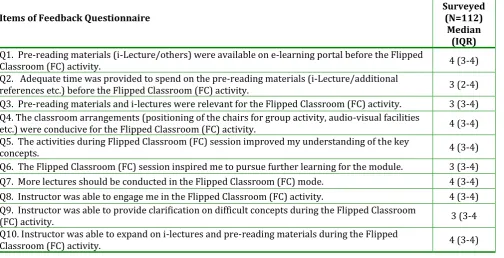
Table 2 describes the central tendencies and dispersions of responses on individual items in feedback questionnaire. The analysis revealed that majority agreed (3) or strongly agreed (4) on the following items: (a) i-lectures and pre-reading materials were available on e-learning portal before the flipped classroom activity, (b) i-lectures and pre-reading materials were relevant for the flipped classroom activity, (c) physical arrangements were conducive for flipped class room activity, (d) flipped classroom activity had increased the understanding of topics and pursue further learning for the module, (e) instructor was able to actively engage the students during the flipped classroom activity, (f) instructor was able to provide clarification on difficult concepts and (g) instructor was able to expand on the i-lectures and pre-reading materials.
However, the central tendency was found to be 3(agree) with IQR ranging between 2(neutral) and 4(strongly agree) for adequate time spent by the students on i-lectures and pre-reading materials. The results indicated that most of items were favouring the flipped class room activity which was considered as an effective teaching-learning tool by the participants and majority recommended that more lectures should be conducted in the flipped classroom mode.
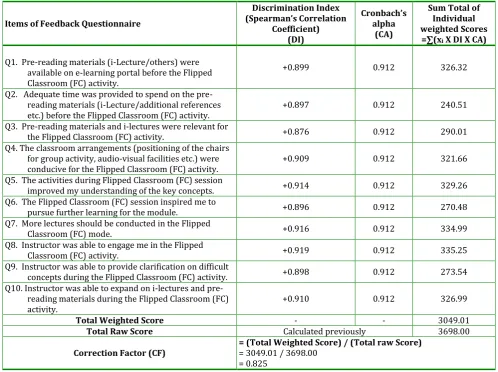
= (Observed Item Score) X (Discrimination Index) X (Internal Reliability or Cronbach’s alpha)
Using the above formula, the total weighted score of the feedback questionnaire was found to be 3049.01. Table 4 explains the calculation procedure of cut-off value in the feedback questionnaire on flipped classroom activity. The Correction Factor was calculated by using the following formula:
Correction Factor = [(Total Weighted score) / (Total Raw Score)].
In this study, the Correction Factor of the flipped classroom feedback questionnaire was calculated to be 0.825.
The cut-off point of the feedback questionnaire was estimated by using the following formula:
= Sum [(75th Percentile from Raw Score per Item) X (Correction Factor)]
Though the total score of the responses ranged between 0 and 40, but the final cut-off value of the feedback questionnaire was calculated to be 33 (after applying the above procedure).
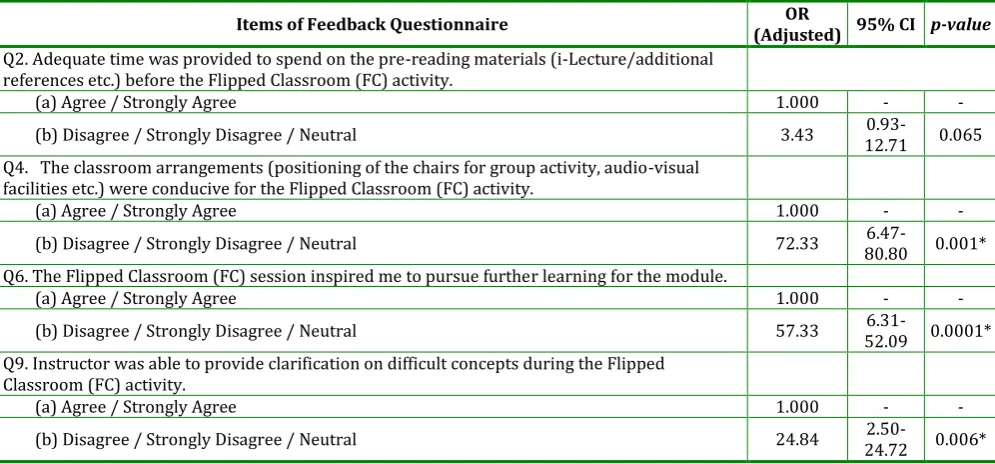
Table 5 reveals the multivariate analysis of responses on ‘Agree’ or ‘Disagree’ for feedback items. A statistically significant difference of responses was observed for the following items: (a) classroom arrangements (positioning of the chairs for group activity, audio-visual facilities etc.) were conducive for the flipped classroom activity, (b) flipped classroom session inspired me to pursue further learning for the module and (c) instructor was able to provide clarification on difficult concepts during the flipped classroom activity. The respondents who either remained neutral or disagreed to any of these three above items were most likely to provide an overall negative feedback on the flipped classroom activity. Table 6 reveals the multivariate analysis of responses on ‘Agree’ or ‘Strongly Agree’ for feedback items. A statistically significant difference of responses was observed for the following items: (a) pre-reading materials and i-lectures were relevant for the flipped classroom activity, (b) activities during flipped classroom session increased my understanding of the
key concepts, (c) more lectures should be conducted in the flipped classroom mode and (d) instructor was able to expand on i-lectures and pre-reading materials during the flipped classroom activity. The respondents who either agreed or strongly agreed to any of these four above items were most likely to provide an overall positive feedback on the flipped classroom activity.
DISCUSSION
Flipped classes enable instructors to engage the participants and facilitate them in critical thinking5 resulting in better understanding of the subject by promoting active learning.13 In this study, the flipped classroom instructional model for Complementary Medicine Module replaced instructor-dominated lectures with highly interactive student-instructor activities. The scheduled lecture time was used primarily for assessing student knowledge and fostering active learning through activities in the form of an interactive Quiz session.1,2 Four pre-recorded i-lectures and pre-reading materials were viewed independently by students prior to the flipped classroom activity. The primary purpose of this was to create an interest in active learning and transmission of information. These activities were expected to invoke active learning among the participants, resulting in better performance and culminating in higher achievements.1,2,4,5
The characteristic features and behaviours of any two individuals in a community are never the same in every aspect. Every individual differs from one another at least in a minor dimension. Similarly, even in a standardized population, every community also varies from one another at least in a minor capacity.11,12 Though sometimes we consider things to be absolutely homogenous, but there always exist a minute amount of heterogeneity in every parameter of our assessment. Thus, even if we achieve integrity in diversity of nature, we cannot really nullify the effect of diversity.17 So, it is not correct to set up a universal cut-off in any survey instrument to arrive at a diagnosis from various communities with diverse socio-cultural backgrounds. The weightage of each response in each item is directly proportional to the Discrimination Index (DI) as well as Internal Reliability or Cronbach’s alpha. Hence, in this study, the weighted score for responses for each item of the flipped classroom feedback questionnaire was obtained by calculating the Observed Item Score multiplied by the product of Discrimination Index and Internal Reliability or Cronbach’s alpha. The “Correction Factor” was developed for making an adjustment in the overall cut-off value of the instrument. It was obtained from the ratio of the total weighted score and the total raw score. The overall cut-off value for the instrument was obtained by multiplying the “Correction Factor” with the 75th Percentile of each item and finally adding them up together.11,12 This procedure helped in categorizing the outcome of flipped classroom feedback questionnaire into ‘positive’ and ‘negative’ feedbacks. This dichotomous outcome variable was used to identify the pure factors associated with it in the multivariate analysis. The respondents who either agreed or strongly agreed to any of the following four items were most likely to provide an overall positive feedback on the flipped classroom activity: (a) pre-reading materials and i-lectures were relevant for the flipped classroom activity, (b) activities during flipped classroom session increased my understanding of the
key concepts, (c) more lectures should be conducted in the flipped classroom mode and (d) instructor was able to expand on i-lectures and pre-reading materials during the flipped classroom activity.
Studies by Litzenger et.al.6 (2011), Pierce et.al.7 (2012), Gardner et.al.18 (2006) and Olds et. al.19 (2011) also reported that the Pharmacy students expressed a consistently high preference for the flipped classroom instructional model relative to the traditional instructor-led lecture model. They recognized the convenience and pedagogical benefits of the flipped classroom instructional model. They demonstrated the efficacy of active learning using the flipped classroom model to improve student outcomes. It was observed that the flipped classroom supported the fact that the quality (not necessarily the quantity) of student-teacher interaction was a compelling force in improving student performance.6,7,18,19 The positive feedback of the participants on the flipped classroom activity in this present study also conform these previous findings.
CONCLUSION
The overall intra-observer reliability from Cronbach’s Alpha was found to be 0.912 for the flipped classroom feedback questionnaire. The evidences from this study suggest that this feedback questionnaire is a valid teaching-learning tool for monitoring flipped classroom activities during the delivery of Complementary Medicine Module in undergraduate Pharmacy programme.
RECOMMENDATION
Table 1: Intra-Observer Reliability for Individual Items in Feedback Questionnaire
Overall Cronbach’s Alpha 0.912
Items of Feedback Questionnaire Cronbach’s Alpha if Item Deleted
Q1. Pre-reading materials (i-Lecture/others) were available on e-learning portal before
the Flipped Classroom (FC) activity. 0.798
Q2. Adequate time was provided to spend on the pre-reading materials
(i-Lecture/additional references etc.) before the Flipped Classroom (FC) activity. 0.888 Q3. Pre-reading materials and i-lectures were relevant for the Flipped Classroom (FC)
activity. 0.821
Q4. The classroom arrangements (positioning of the chairs for group activity, audio-visual
facilities etc.) were conducive for the Flipped Classroom (FC) activity. 0.780 Q5. The activities during Flipped Classroom (FC) session improved my understanding of
the key concepts. 0.845
Q6. The Flipped Classroom (FC) session inspired me to pursue further learning for the
module 0.755
Q7. More lectures should be conducted in the Flipped Classroom (FC) mode. 0.832 Q8. Instructor was able to engage me in the Flipped Classroom (FC) activity. 0.770 Q9. Instructor was able to provide clarification on difficult concepts during the Flipped
Classroom (FC) activity. 0.777
Q10. Instructor was able to expand on i-lectures and pre-reading materials during the
Flipped Classroom (FC) activity. 0.838
Table 2: Central Tendencies and Dispersions of Responses on Individual Items in Feedback Questionnaire
Items of Feedback Questionnaire
Total Surveyed
(N=112) Median
(IQR) Q1. Pre-reading materials (i-Lecture/others) were available on e-learning portal before the Flipped
Classroom (FC) activity. 4 (3-4)
Q2. Adequate time was provided to spend on the pre-reading materials (i-Lecture/additional
references etc.) before the Flipped Classroom (FC) activity. 3 (2-4) Q3. Pre-reading materials and i-lectures were relevant for the Flipped Classroom (FC) activity. 3 (3-4) Q4. The classroom arrangements (positioning of the chairs for group activity, audio-visual facilities
etc.) were conducive for the Flipped Classroom (FC) activity. 4 (3-4) Q5. The activities during Flipped Classroom (FC) session improved my understanding of the key
concepts. 4 (3-4)
Q6. The Flipped Classroom (FC) session inspired me to pursue further learning for the module. 3 (3-4) Q7. More lectures should be conducted in the Flipped Classroom (FC) mode. 4 (3-4) Q8. Instructor was able to engage me in the Flipped Classroom (FC) activity. 4 (3-4) Q9. Instructor was able to provide clarification on difficult concepts during the Flipped Classroom
(FC) activity. 3 (3-4
Q10. Instructor was able to expand on i-lectures and pre-reading materials during the Flipped
Table 3: Calculation of Weighted Scores in the Feedback Questionnaire
Items of Feedback Questionnaire
Discrimination Index (Spearman’s Correlation
Coefficient) (DI)
Cronbach’s alpha
(CA)
Sum Total of Individual weighted Scores
=∑(xi X DI X CA)
Q1. Pre-reading materials (i-Lecture/others) were available on e-learning portal before the Flipped Classroom (FC) activity.
+0.899 0.912 326.32
Q2. Adequate time was provided to spend on the pre-reading materials (i-Lecture/additional references
etc.) before the Flipped Classroom (FC) activity. +0.897 0.912 240.51
Q3. Pre-reading materials and i-lectures were relevant for
the Flipped Classroom (FC) activity. +0.876 0.912 290.01
Q4. The classroom arrangements (positioning of the chairs for group activity, audio-visual facilities etc.) were
conducive for the Flipped Classroom (FC) activity. +0.909 0.912 321.66
Q5. The activities during Flipped Classroom (FC) session
improved my understanding of the key concepts. +0.914 0.912 329.26
Q6. The Flipped Classroom (FC) session inspired me to
pursue further learning for the module. +0.896 0.912 270.48
Q7. More lectures should be conducted in the Flipped
Classroom (FC) mode. +0.916 0.912 334.99
Q8. Instructor was able to engage me in the Flipped
Classroom (FC) activity. +0.919 0.912 335.25
Q9. Instructor was able to provide clarification on difficult
concepts during the Flipped Classroom (FC) activity. +0.898 0.912 273.54 Q10. Instructor was able to expand on i-lectures and
pre-reading materials during the Flipped Classroom (FC)
activity. +0.910 0.912 326.99
Total Weighted Score - - 3049.01
Total Raw Score Calculated previously 3698.00
Correction Factor (CF) = (Total Weighted Score) / (Total raw Score) = 3049.01 / 3698.00 = 0.825
Table 4: Calculation of Cut-off Value in the Feedback Questionnaire
Flip Classroom Feedback Items Median Percentile 75th Correction Factor (CF)
(Median+75th
Percentile) X CF Q1. Prreading materials (i-Lecture/others) were available on
e-learning portal before the Flipped Classroom (FC) activity. 4 4 0.825 3.3 Q2. Adequate time was provided to spend on the pre-reading
materials (i-Lecture/additional references etc.) before the
Flipped Classroom (FC) activity. 3 4 0.825 3.3
Q3. Pre-reading materials and i-lectures were relevant for the
Flipped Classroom (FC) activity. 4 4 0.825 3.3
Q4. The classroom arrangements (positioning of the chairs for group activity, audio-visual facilities etc.) were conducive for
the Flipped Classroom (FC) activity. 3 4 0.825 3.3
Q5. The activities during Flipped Classroom (FC) session improved
my understanding of the key concepts. 4 4 0.825 3.3
Q6. The Flipped Classroom (FC) session inspired me to pursue
further learning for the module. 3 4 0.825 3.3
Q7. More lectures should be conducted in the Flipped Classroom
(FC) mode. 4 4 0.825 3.3
Q8. Instructor was able to engage me in the Flipped Classroom
(FC) activity. 4 4 0.825 3.3
Q9. Instructor was able to provide clarification on difficult
concepts during the Flipped Classroom (FC) activity. 3 4 0.825 3.3
Q10. Instructor was able to expand on i-lectures and pre-reading
materials during the Flipped Classroom (FC) activity. 4 4 0.825 3.3
Score Range = (0-40)
Table 5: Multivariate Analysis: Responses on Agree or Disagree for Items Q2, Q4, Q6 and Q9
Items of Feedback Questionnaire (Adjusted) OR 95% CI p-value
Q2. Adequate time was provided to spend on the pre-reading materials (i-Lecture/additional references etc.) before the Flipped Classroom (FC) activity.
(a) Agree / Strongly Agree 1.000 - -
(b) Disagree / Strongly Disagree / Neutral 3.43 12.71 0.93- 0.065
Q4. The classroom arrangements (positioning of the chairs for group activity, audio-visual facilities etc.) were conducive for the Flipped Classroom (FC) activity.
(a) Agree / Strongly Agree 1.000 - -
(b) Disagree / Strongly Disagree / Neutral 72.33 80.80 6.47- 0.001*
Q6. The Flipped Classroom (FC) session inspired me to pursue further learning for the module.
(a) Agree / Strongly Agree 1.000 - -
(b) Disagree / Strongly Disagree / Neutral 57.33 52.09 6.31- 0.0001*
Q9. Instructor was able to provide clarification on difficult concepts during the Flipped Classroom (FC) activity.
(a) Agree / Strongly Agree 1.000 - -
(b) Disagree / Strongly Disagree / Neutral 24.84 24.72 2.50- 0.006*
*Here, p-value of <0.05 was considered as significant.
Table 6: Multivariate Analysis: Responses on Agree or Strongly Agree for Items Q1, Q3, Q5, Q7, Q8 and Q10
Items of Feedback Questionnaire (Adjusted) OR 95% CI value p-Q1.Pre-reading materials (i-Lecture/others) were available on e-learning portal before the
Flipped Classroom (FC) activity.
(a) Strongly Agree 1.000 - -
(b) Agree 2.18 0.67-7.09 0.195
Q3. Pre-reading materials and i-lectures were relevant for the Flipped Classroom (FC) activity.
(a) Strongly Agree 1.000 - -
(b) Agree 5.68 1.48-21.76 0.011*
Q5.The activities during Flipped Classroom (FC) session increased my understanding of the key concepts.
(a) Strongly Agree 1.000 - -
(b) Agree 11.69 2.75-49.71 0.001*
Q7. More lectures should be conducted in the Flipped Classroom (FC) mode.
(a) Strongly Agree 1.000 - -
(b) Agree 3.75 1.05-13.46 0.042*
Q8. Instructor was able to engage me in the Flipped Classroom (FC) activity.
(a) Strongly Agree 1.000 - -
(b) Agree 2.29 0.67-7.83 0.185
Q10. Instructor was able to expand on i-lectures and pre-reading materials during the Flipped Classroom (FC) activity.
(a) Strongly Agree 1.000 - -
(b) Agree 4.32 1.23-15.20 0.023*
*Here, p-value of <0.05 was considered as significant.
REFERENCES
1. Hake RR. Interactive-engagement vs. traditional methods: A six-thousand-student survey of mechanics test data for introductory physics courses. American Journal of Physics 1998; 66: 64-74. 2. Knight JK, Wood WB. Teaching more by lecturing
less. Cell Biology Education 2005; 4: 298-310. 3. Barseghian, T. (2011, February 5). Three trends that
define the future of teaching and learning. In Mind
Shift from
http://blogs.kqed.org/mindshift/2011/02/three- trends-that-define-the-future-of-teaching-and-learning/
4. Alvarez B. (2011, September 2011). Flipping the classroom: Homework in class, lessons at home. Retrieved from the National Education Association.
5. Tucker B. (2012, Winter). The flipped classroom. Education Next (12)1. Retrieved from http://educationnext.org/the-flipped-classroom/ 6. Litzenger T, Lattuca L, Hadgraft R, et al. Engineering
education and the development of expertise. J Eng Educ. 2011; 100(1):123–50.
7. Pierce R, Fox J. Vodcasts and Active-Learning Exercises in a “Flipped Classroom” Model of a Renal Pharmacotherapy Module. American Journal of Pharmaceutical Education 2012; 76 (10), 196. 8. Kay RH, LeSage A. Examining the benefits and
challenges of using audience response systems: a review of the literature. Computers and Education 2009; 53: 819-827.
9. Ankur Barua. Methods for Decision-Making in Survey Questionnaires with continuous variables. Education Research Journal (ERJ) 2013; 3(3):47-9.
10. Ankur Barua, Kumaraswamy Kademane, Kumar Shiva Gubbiyappa, Rohit Kumar Verma, Muhammad Shahid Iqbal, Sami Abdo Radman Al-Dubai. A tool for decision-making in Norm-referenced survey questionnaires with items of continuous variables. Journal of Asian Scientific Research (JASR) 2013; 3(11): 1109-18.
11. Ankur Barua. Methods for Decision-Making in Survey Questionnaires based on Likert Scale. Journal of Asian Scientific Research (JASR) 2013; 3(1):35-8. 12. Ankur Barua, Kumaraswamy Kademane, Biswadeep
Das, Kumar Shiva Gubbiyappa, Rohit Kumar Verma, Sami Abdo Radman Al-Dubai. A tool for decision-making in Norm-referenced survey questionnaires
with items of ordinal variables. Journal of Asian Scientific Research (JASR) 2013; 3(11): 1109-18. 13. Mazur E. Can we teach computers to teach?
Computers in Physics 1991; 5: 31-38.
14. Lentz FE. Direct observation and measurement of academic skills: A conceptual review. In E. S. Shapiro & T. R. Kratochwill (Eds.). Behavioral assessment in schools. New York: Guilford; 1988: 76-120.
15. National Commission on Testing and Public Policy. From gatekeeper to gateway: Transforming testing in America. Chestnut Hill, MA: Boston College; 1990. 16. Quinto F, McKenna B. Alternatives to standardized
testing. Washington, DC: National Education Association, Division of Instruction and Professional Development; 1977.
17. IRA/NCTE Joint Task Force on Assessment. Standards for the assessment of reading and writing. Newark, DE: International Reading Association and Urbana, IL: National Council of Teachers of English; 1994.
18. Gardner S. Preparing for the Nexters. Am J Pharm Educ. 2006;70(4):Article 1.
19. Olds B, Johri A. Situated engineering learning: bridging engineering education research and the learning sciences. J Eng Educ. 2011; 100(1):151–185. How to cite this article: Ankur Barua, Kumar Shiva Gubbiyappa, Hasnain Zafar Baloch, Biswadeep Das; Validation of Feedback Questionnaire on Flipped Classroom (FC) Activity; J. Adv. Pharm. Edu. & Res. 2014: 4(3): 339-349.