http: // www.ijrtsm.com© International Journal of Recent Technology Science & Management 89
ISSN : 2455-9679
[Niraj et. al, 4(8), Aug 2019] Impact Factor : 3.340
IJRTSM
INTERNATIONAL JOURNAL OF RECENT TECHNOLOGY SCIENCE & MANAGEMENT
“
A REVIEW ON CUTTING PARAMETERS OPTIMIZATION FOR LATHE MACHINE BY
USING TAGUCHI METHOD
”
Niraj Kumar
1, Manish Gangil
21 M.Tech Scholar, Dept. of Mechanical Engineering, RKDF, University Bhopal, MP, India
2 Associate Professor, Dept. of Mechanical Engineering, RKDF, University Bhopal, MP, India
ABSTRACT
The motivation behind this paper is to make an endeavor to survey the writing on advancement of information cutting parameters for improved surface wrap up by gaining least surface harshness in turning process furthermore, to exhibit different techniques and practices that are being utilized for the forecast of surface unpleasantness. Surface harshness is one of the most usually utilized criteria to decide nature of a turned surface. This writing audit gathers distinctive work introduced on enhancement of procedure parameters and closes the most critical cutting parameters and most much of the time utilized enhancement methods for improving surface completion The cutting parameters like Cutting velocity, Feed rate, Depth of cut, Insert span and Cutting liquid are thought about.
Keyword: Turning process, Optimization Techniques, Surface Roughness, Taguchi Method
I.
I
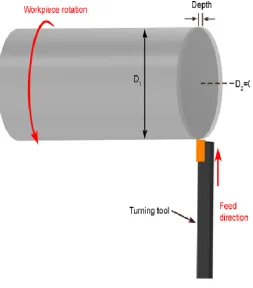
NTRODUCTIONTurning is a type of machining, a material evacuation process, which is utilized to make rotational parts by removing undesirable material as appeared in Figure 1.The turning procedure requires a turning machine or machine, work piece, installation, and cutting instrument. The work piece is a bit of pre-molded material that is verified to the apparatus, which itself is appended to the turning chine, and permitted to pivot at high speeds.
The shaper is ordinarily a solitary point cutting device that is likewise verified in the machine. Anticipating procedure of machinability models and deciding the ideal estimations of procedure parameters in assembling framework have been zones of enthusiasm for specialists and assembling engineers. To consider high profitability, high adaptability hard turning is currently a days an option in contrast to pounding in the completing of work pieces. The surface unpleasantness of machined parts is a noteworthy plan particular that is known to have extensive impact on properties such as wear opposition and weariness quality and alludes to deviation from the ostensible surface. The nature of a surface is a factor of significance in the assessment of machine apparatus efficiency. Consequently it is critical to accomplish a predictable surface completion and resilience since it assumes a significant job in numerous applications, for example, exactness fits, clasp openings and so forth. In a turning activity a significant assignment is select the proper cutting parameters for accomplishing high cutting execution. Cutting parameters influence surface harshness, surface of the item.
http: // www.ijrtsm.com© International Journal of Recent Technology Science & Management 90
ISSN : 2455-9679
[Niraj et. al, 4(8), Aug 2019] Impact Factor : 3.340
parameters and their exhibitions [1]. A lot of studies have explored the general impact of procedure parameters (embed range, cutting pace, feed rate, profundity of cut) on procedure capacities, for example, surface unpleasantness, device life, cutting powers and so on [2,3]. The vast majority of these models depend on the relapse investigation (RA), a not very many scientists utilized computational neural systems methods (CNN) [4-9].Turning is a type of machining, a material evacuation process, which is utilized to make rotational parts by removing undesirable material as appeared in Figure 1.The turning procedure requires a turning machine or machine, work piece, installation, and cutting instrument. The work piece is a bit of pre-molded material that is verified to the apparatus, which itself is appended to the turning chine, and permitted to pivot at high speeds.
The shaper is ordinarily a solitary point cutting device that is likewise verified in the machine. Anticipating procedure of machinability models and deciding the ideal estimations of procedure parameters in assembling framework have been zones of enthusiasm for specialists and assembling engineers. As wear opposition and weariness quality and alludes to deviation from the ostensible surface. The nature of a surface is a factor of significance in the assessment of machine apparatus efficiency. Consequently it is critical to accomplish a predictable surface completion and resilience since it assumes a significant job in numerous applications, for example, exactness fits, clasp openings and so forth. In a turning activity a significant assignment is select the proper cutting parameters for accomplishing high cutting execution. Cutting parameters influence surface harshness, surface of the item. Surface harshness is a factor that enormously impacts assembling cost and furthermore depicts the geometry of the machined surface join with the surface. To choose the cutting parameters appropriately a few numerical models which depend on measurable relapse or neural system methods have been created to build up the connection between cutting parameters and their exhibitions [1]. A lot of studies have explored the general impact of procedure parameters (embed range, cutting pace, feed rate, profundity of cut) on procedure capacities, for example, surface unpleasantness, device life, cutting powers and so on [2,3]. The vast majority of these models depend on the relapse investigation (RA), a not very many scientists utilized computational neural systems methods (CNN) [4-9].
http: // www.ijrtsm.com© International Journal of Recent Technology Science & Management 91
ISSN : 2455-9679
[Niraj et. al, 4(8), Aug 2019] Impact Factor : 3.340
II.
L
ITERATURER
EVIEWHari singh and Pradepkumar (2006) In this investigation paper the perfect setting of turning parameters (cutting pace, feed rate, significance of cut) realizing a perfect estimation of feed control when machining EN 24 steel with TiC tungsten secured carbide installs. The effect of picked turning parameters on feed control and resulting perfect setting of parameters have been worked on using Taguchi parameters arrangement approach.[1]
Thamizhmanii, S. Saparudin, S. Hassan (2007) Purpose of this investigation work is focussed on the assessment of perfect cutting condition to get lower surface repulsiveness in turning movement by Taguchi system. [2]
G. Akhyar, C.H. Che Haron, J.A. Ghani (2008) In this paper it is shows that the idea of arrangement can be improved by improving quality and proficiency in expansive activities. Taguchi's parameter design is a noteworthy mechanical assembly for healthy structure, which offers a direct and precise approach. Taguchi improvement methodology is associated with streamline cutting parameters in turning. The turning parameters surveyed are cutting speed of 55, 75, and 95 m/min, feed pace of 0.15, 0.25 and 0.35 mm/rev, significance of cut of 0.10, 0.15 and 0.20 mm and gadget assessments of K313, KC9225 and KC5010, each at three levels. [3]
Sijo M. T. additionally, Biju. N (2010) In this assessment paper Taguchi parameters streamlining reasoning and the turning parameters evaluated are cutting rate, feed rate, significance of cut, nose scope of equipment and hardness of material each at two levels. The result of assessment shows that the feed rate, cutting pace and nose length have present important duty externally obnoxiousness and significance of cut and hardness of material have less basic responsibility externally cruelty.[4]
PD Kamble, AC Waghmare, RD Askhedhar, SB Sahare and SS Khedkar (2011)- In this paper an undertaking is made to review the composition on improving the machining parameters in turning Processes. The latest frameworks for headway consolidate cushioned method of reasoning, scatter search technique, underground creepy crawly settlement methodology, innate figuring, Taguchi strategy and response surface way of thinking are being associated successfully in present day applications for perfect decision of system factors in the region of machining. Taguchi techniques is latest arrangement frameworks by and large used in endeavors for making the thing/process coldhearted toward any wild factors, for instance, normal elements.[5]
Suleiman Abdulkareem, Usman JibrinRumah and ApasiAdaokoma (2011), In this assessment work demonstrates an exploratory , feed rate and shaft speed on surface disagreeableness during turning of smooth steel. In this examination, the structure of preliminary which is an inconceivable resource for preliminary arrangement is used to upgrade the machining parameters for convincing machining of the work piece.[6]
Dr.S.S.Chaudhari, S.S. Khedkar, N.B. Borkar (2013) The introduction of the made things is often surveyed by a couple of value traits and responses and preliminary frameworks. In the present assessment a lone trademark response upgrade model reliant on Taguchi Technique is made to improve process parameters, for instance, speed, feed, significance of cut, and nose length of single point cutting mechanical assembly. Taguchi's L9 balanced group is picked for exploratory masterminding. The exploratory result examination exhibited that the mix of bigger measures of cutting speed, significance of cut and lower level of feed is key to achieve simultaneous expansion of material removal rate and minimization of surface obnoxiousness.[7]
Puneet Mangla, Nishant kr. Singh, Yashvirsingh (2011) In this assessment work the association between change in hardness caused on the material surface as a result of turning action with respect to different machining parameters have been investigated. Taguchi methodology has been used to structure the examination. EN 9 and Aluminum decided for work piece material and secured carbide instrument as a mechanical assembly material. [8]
http: // www.ijrtsm.com© International Journal of Recent Technology Science & Management 92
ISSN : 2455-9679
[Niraj et. al, 4(8), Aug 2019] Impact Factor : 3.340
components influencing surface repulsiveness by the Analysis of Variance (ANOVA) strategy. The feed rate supposedly was the most huge parameter influencing the surface unpleasantness in the turning technique been plotted.[9]
Rahul Davis (2014) Surface fulfillment is one of the key stresses during machining of various materials in the machining undertakings. The (ANOVA) and Signal-to-Noise extent were used to consider the introduction characteristics in turning action. The results of the examination show that none of the components was seen to be enormous. Taguchi method exhibited that feed rate sought after by significance of cut and shaft speed was the blend of the perfect degrees of factors while turning EN24 steel through carbide cutting gadget. The results gotten by this assessment will be important to other similar kind of study and can be helpful for further ask about on mechanical assembly vibrations, cutting forces, etc.[10]
S. K. Madhavi (2015) study is to improve strength and hardness of structure material by changing the machining parameters of turning process. By applying Taguchi methodology conveyed things, and building structures are made by breaking down collections. In this work, an endeavour has been made to deal with the related different criteria movement issue of turning process by considering three specific strategy parameters viz. cutting-speed, feed and centrality of cut. Decrease Relational Analysis has been gotten a handle on to change over various focal points of the redesign issue into a particular target work, suggested as Gray Relational Grade. The general Gray Relational Grade has been updated by utilizing Taguchi framework. Appraisal of fluctuation (ANOVA) has been driven for Gray social evaluation (GRG) to locate the ideal technique parameters. Sign to Noise (S/N) Ratio has been found for GRG to locate the ideal degrees of the framework parameters. At long last an alteration test has been made for three specific materials and the outcomes have been plotted.[11]
Mahadev Naik (2016) In the front line world surface fulfilment is most basic requirement for a couple, turned work piece in perspective on which makers are end eavoring to stay focused in market. Taguchi parameter configuration is useful asset and beneficial framework for moving quality and execution yield of gathering process. The inevitable results of the machiningeriments for AISI 410 Tempered Steel where used to portray the rule parts affecting the surface horrendousness by the examination Of change (ANOVA) framework. The feed rate supposedly was the most critical parameter influencing the surface obnoxiousness in turning process. Request Test moreover has been performed to anticipate and check the ampleness of model for picking ideal properties of reaction. The outcome gotten by above system will be helpful to other research works for comparative kind of spotlight for further get some information about on contraption vibrations, cutting powers, rake point, and so forth. [12]
S. Mohan Kumar (2017) Assembling of anything requires obvious machining technique to get The ideal completed area. This endeavor proposes the streamlining of philosophy parameters in turning framework utilizing Taguchi system (L9) so as to increase skilled Material Expulsion Rate (MRR). EN 24 is utilized as workpiece for doing primer to drive Material Expulsion Rate which is impacted by three machining parameters to be unequivocal shaft speed, feed rate and hugeness of cut. Various starters are finished by fluctuating one parameter and keeping other two fixed with the objective that streamlined estimation of every parameter can be picked up. In this endeavor dry turning development of EN 24 evaluated steel is performed utilizing HSS mechanical gathering. The degree of cutting parameters at three levels are center speed (200, 350 and 500 rpm), feed rate (0.1, 0.15 and 0.2 mm/rev), importance of cut (1.0, 1.5 and 2.0 mm) freely. Taguchi technique is a reasonable framework for streamlining of different machining parameters as it lessens number of appraisals. Taguchi even show is masterminded with three degrees of approach parameters and ANOVA is related with know the impact of every parameter on Material Evacuation Rate. For the given game-plan of conditions, turn speed impacts more on Material Evacuation Rate looked for after by feed rate and criticalness of cut.[13]
http: // www.ijrtsm.com© International Journal of Recent Technology Science & Management 93
ISSN : 2455-9679
[Niraj et. al, 4(8), Aug 2019] Impact Factor : 3.340
III.
C
ONCLUSIONFrom the above writing survey it is seen that different strategies are utilized to limit surface harshness by improving cutting parameters like cutting pace, axle speed, feed rate, profundity of cut, instrument edge, nose sweep and so forth. Among every one of these strategies it is seen that Taguchi Method is the most broadly utilized strategy. The utilization of different strategies like Genetic Algorithm, Response Surface Method and Artificial Neural Network are progressively expanding. In streamlining of surface harshness feed is observed to be the most influencing element pursued by profundity of cut and cutting pace.
REFERENCES
1) Hari singh and Pradepkumar "Progress of feed control for turned part through the Taguchi structure" Sadhana. Vol 31, pp-671-681,2006.
2) S. Thamizhmanii, S. Saparudin, S. Hassan "Appraisal of surface unpalatability by turning procedure utilizing Taguchi technique" Journal of Achievement in material and social affair arranging. Vol 20 pp-503-505,2007.
3) G. Akhyar, C.H. Che Haron, J.A. Ghani "Utilization of Taguchi Method in the Turning Parameters Optimization for Surface Roughness". Generally Journal of Science Engineering and Technology Vol. 1, No. 3, pp - 60-66,2008.
4) Sijo M.T and Biju N, "Taguchi process for improvement of cuttingprocess parameters in Turning Operations" AMAE.2010.01.536 pp-103-105,2010.
5) PD Kamble, AC Waghmare, RD Askhedhar, SB Sahare and SS Khedkar "Streamlining of Turning Operation – A Review". VSRD International diary of mechanical, vehicle and age arranging. Vol 1 (3) pp-110-119, 2011.
6) Suleiman Abdulkareem, Usman JibrinRumah and ApasiAdaokoma "Streamlining Machining Parameters during Turning Process". Generally speaking Journal of Integrated Engineering, Vol. 3 No. 1. p. 23-27,2011.
7) Dr.S.S.Chaudhari, S.S. Khedkar, N.B. Borkar. "Improvement of strategy parameters utilizing Taguchi approach with least entirety oil for turning". General Journal of Engineering Research and Applications (IJERA) ISSN: 2248-9622, Vol. 1, Issue 4, pp.1268-1273,2013.
8) Puneet mangla, Nishant kr. Singh, Yashvirsingh " Study of impact of turning parameters on work piece hadness utilizing Taguchi framework". ICAM, pp-695-700, 2011.
9) K.Manilavanya, R.K.Suresh,A.Sushil Kumar Priya,V.Diwakar Reddy." Optimization of Turning Operation Process Parameters in of AISI-1016 Alloy Steels with CBN Using Taguchi Method And Anova" IOSR Journal of Mechanical and Civil Engineering (IOSR-JMCE),p-ISSN: 2320-334X, Volume 7, Issue 2 PP 24-27, 2013.
10) Rahul Davis, Member, IAENG, Vikrant Singh, Shaluza Priyanka " Taguchi Design of Experiment Method of Turning Operation of EN 24 Steel " Proceedings of the World Congress on Engineering 2014 Vol II, WCE 2014, July 2 - , London, U.K.,2014.
http: // www.ijrtsm.com© International Journal of Recent Technology Science & Management 94
ISSN : 2455-9679
[Niraj et. al, 4(8), Aug 2019] Impact Factor : 3.340
12) Mahadev Naik, Ashish Gorule, Anil Ajgaonkar, TejasDudye, "Improvement of turning process parameters for AISI 410 Steel utilizing Taguchi technique" International Journal of Engineering, Science and Technology Vol. 7, No. 4, pp. 1-8, 2015.
13) Mr. S Mohan Kumar, Mr. K Kiran Kumar, Optimization Techniques in Turning Operation by utilizing Taguchi Method, International Journal of Engineering and Advanced Technology (IJEAT) ISSN: 2249 – 8958, Volume-6 Issue-6, August 2017.