J. Math. Comput. Sci. 9 (2019), No. 6, 784-795 https://doi.org/10.28919/jmcs/4240
ISSN: 1927-5307
SIEVING POLYNOMIAL FOR FACTORIZATION OF NUMBERS OF THE FORM n=m5+a4m4+a3m3+a2m2+a1m+a0 FOR ai<<m
P. ANURADHA KAMESWARI∗, G. SURYA KANTHAM
Department of Mathematics, Andhra University, Visakhapatnam - 530003, Andhra Pradesh, India
Copyright c2019 the author(s). This is an open access article distributed under the Creative Commons Attribution License, which permits
unrestricted use, distribution, and reproduction in any medium, provided the original work is properly cited.
Abstract. In the process of factorization of general integers in 1998 Zhang developed a method which can factor
integers of the formn=m3+a2m2+a1m+a0forai<<mby consideringx=b2m2+b1m+b0and as in 2002
Eric Landquist[10] generalized the method for numbers of the formn=m5+a
0. In this paper going in the lines
of Eric and using solutions of quadratic equationax2+bxy+cy2=z2we proposed some parametrization forbi’s
that are non trivial by consideringx=b3m3+b2m2+b1m+b0and obtained sieving polynomial for factoring of
the numbers of the formn=m5+a4m4+a3m3+a2m2+a1m+a0withai<<m.
Keywords:factorization; quadratic equation; parametrization; sieving polynomial.
2010 AMS Subject Classification:94A60, 11T71.
1.
INTRODUCTIONIn 1998 Zhang Mingzhi developed a method known as Special Quadratic Sieve by combining
the ideas of Quadratic Sieve and Number Field Sieve methods. In special quadratic sieve Zhang
[15] created a method with small residue for factorization of integers of the form n=m3+
a2m2+a1m+a0 withai<<mand it was noticed that for largeaithe method becomes slower than Quadratic sieve. In 2002 Eric Landquist[9] generalized the method for numbers of the
∗Corresponding author
E-mail address: [email protected]
Received July 31, 2019
formn=m5+a0. In our paper [1] we proposed a nontrivial parametrization and constructed
a sieving polynomial for numbers of the formn=mk+a0fork=4,5; a0<<m.In our paper [2] we adapted these ideas to the numbers of the formn=m4+a1m+a0witha1,a0<<mand
gave a sieving polynomial for factorization ofn=m4+a1m+a0.
In this paper going in the lines of Eric[10] and using solutions of quadratic equation ax2+
bxy+cy2=z2we proposed some parametrization, that produce non trivial choices forbi’s and obtained sieving polynomial for factoring the numbers of the form n=m5+a4m4+a3m3+
a2m2+a1m+a0 for ai <<m by considering x= b3m3+b2m2+b1m+b0 This process is described in section 2 and in section 3 the efficiency of the sieving is discussed, an algorithm is
given and an example with procedure is given.
2.
SIEVING POLYNOMIAL VIA PARAMETRIZATION FORn=m5+a4m4+a3m3+a2m2+a1m+a0
The quadratic sieve algorithm for factoring large numbers has several variations. The main
idea is to come up with two different integersxand y, such thatx2≡y2(modn)andx6≡y(mod n).Once suchxand y are found, there is a chance that gcd(x−y,n)and gcd(x+y,n)gives non trivial factor of n. In this section we propose to obtain this modular difference of squares for
numbers of the formn=m5+a4m4+a3m3+a2m2+a1m+a0through a sieving polynomial. Consider the numbers of the formn=m5+a4m4+a3m3+a2m2+a1m+a0 withm, ai ∈ Z where i=0,1,2,3,4 such that ai<<m and m=bn15c. We obtain difference of square x2≡ y2(modn) through several values of a polynomial f such that x2≡ f(modn) by taking x as below:
Forbiε Z.
x=b3m3+b2m2+b1m+b0
x2≡ f(b3,b2,b1)(modn)
and f(b3,b2,b1,b0)is to be made a sieving polynomial with small residues. This leads certain conditions onb0, b1and b2which can be met through some parameterizations forb0,b1,b2,b3.
In this section we propose a non trivial parametrization for b0,b1,b2 and b3 when n=m5+
with small residue.
Here we describe in the following theorem the process of obtaining a non trivial parametrization
forb3,b2,b1,b0that makes f(b3,b2,b1,b0)a sieving polynomial.
Theorem 1. Letn=m5+a4m4+a3m3+a2m2+a1m+a0withm, aiεZwherei=0,1,2,3,4
such thata0<<mandm=bn15cthen forx=b3m3+b2m2+b1m+b0,andx2≡ f(b3,b2,b1,b0)
(modn); then there is a non trivial parametrization forb3,b2,b1,b0such thatf(b3,b2,b1,b0)is a sieving polynomial of small residue modulon.
Proof: Given
(1) n=m5+a4m4+a3m3+a2m2+a1m+a0
Let
x=b3m3+b2m2+b1m+b0
x2=b23m6+b22m4+b21m2+b20+2b3b2m5+2b3b1m4+2b3b0m3+2b2b1m3+2b2b0m2+2b1b0m
and as
m5≡ −(a4m4+a3m3+a2m2+a1m+a0) (modn)
m6≡(a24−a3)m4+ (a3a4−a2)m3+ (a2a4−a1)m2+ (a1a4−a0)m+a0a4(modn)
we have
x2≡m4((a24−a3)b23−2b3b2a4+b22+2b3b1) +m3((a3a4−a2)b23−2b3b2a3+2b3b0+2b2b1) +m2((a2a4−a1)b23−2b3b2a2+b21+2b2b0)
+m((a1a4−a0)b23−2b3b2a1+2b1b0) + (a0a4b23−2b3b2a0+b20)(modn)
for
c4= (a24−a3)b23−2b3b2a4+b22+2b3b1
c3= (a3a4−a2)b23−2b3b2a3+2b3b0+2b2b1
c2= (a2a4−a1)b23−2b3b2a2+b21+2b2b0)
c1= (a1a4−a0)b32−2b3b2a1+2b1b0)
c0= (a0a4b23−2b3b2a0+b20)
now to obtain a small quadratic residue we needc4m4+c3m3+c2m2=0, that is
m4((a24−a3)b23−2b3b2a4+b22+2b3b1) +m3((a3a4−a2)b23−2b3b2a3+2b3b0+2b2b1) +
m2((a2a4−a1)b23−2b3b2a2+b21+2b2b0) =0.That is
b1m2+2b1m(b3m2+b2m)+b23(a24m2−a3m2+a3a4m−a2m+a2a4−a1)−2b2b3(a4m2+a3m+
a2) +2b3b0m+2b2b0=0. Now treating this as a quadratic equation inb1we have
b1=−(b3m2+b2m)± q
b23(m4−a2
4m2+a3m2−a3a4m+a2m−a2a4+a1)+
2b2b3(m3+a4m2+a3m+a2)−2b3b0m−2b2b0
Note an integer value for b1 can be evaluated whenever the term under the square root part is a perfect square. We parameterize the bi’s of the term in the square root so that the term under the square root is a perfect square. Note the term in the square root is a quadratic form
Q(u,v).When we parameterizebi’s asbi=ki1u+ki2vfori=0,2,3.We have for
b0=k0u+k1v
b2=k2u+k3v b3=k4u+k5v
the term in the square root given as
b23(m4−a24m2+a3m2−a3a4m+a2m−a2a4+a1) +2b2b3(m3+a4m2+a3m+a2)−2b3b0m−
2b2b0
=u2(k24(m4−a24m2−a3a4m+a3m2−a2a4+a2m+a1) +2k2k4(a4m2+a3m+a2)−2k0k4m−
+2uv(k4k5(m4−a24m2−a3a4m+a3m2−a2a4+a2m+a1) +k3k4(m3+a4m2+a3m+a2) +
k2k5(m3+a4m2+a3m+a2)−k1k4m−k1k2−k0k5m−k0k3)
+v2(k25(m4−a24m2−a3a4m+a3m2−a2a4+a2m+a1)+2k3k5(m3+a4m2+a3m+a2)−2k1k5m−
2k1k3)
=au2+buv+cv2
=Q(u,v) =z2
Now by the formulas for the solutions of the equationQ(u,v) =z2,as given in the theorem in [1] has solutions wheneveraorcis a square. In particular fora=t2and if rs is the fraction in its lowest terms we have the formulas foru,v,zgiven as
u=µs
v=µ
r
+st
λ
z=µr
Now Q(u,v) =u2(k24(m4−a24m2−a3a4m+a3m2−a2a4+a2m+a1) +2k2k4(a4m2+a3m+
a2)−2k0k4m−2k0k2) +2uv(k4k5(m4−a24m2−a3a4m+a3m2−a2a4+a2m+a1) +k3k4(m3+
a4m2+a3m+a2) +k2k5(m3+a4m2+a3m+a2)−k1k4m−k1k2−k0k5m−k0k3) +v2(k25(m4−
a24m2−a3a4m+a3m2−a2a4+a2m+a1) +2k3k5(m3+a4m2+a3m+a2)−2k1k5m−2k1k3)
we transformQ(u,v)as the quadratic form as above by choosingki’s appropriately. In particular
fork4=0, k0=−2k, k2=kwe have
Q(u,v) = (4k2)u2+uv(2kk5(m3+a4m2+a3m+a2+2m)−2kk1+4kk3) +v2(k25(m4−a24m2−a3a4m+a3m2−a2a4+a2m+a1)+
2k3k5(m3+a4m2+a3m+a2)−2k1k3) =au2+buv+cv2
with
a= (2k)2=t2
b=2kk5(m3+a4m2+a3m+a2+2m)−2kk1+4kk3
c=k25(m4−a24m2−a3a4m+a3m2−a2a4+a2m+a1)+
2k3k5(m3+a4m2+a3m+a2)−2k1k3
Then by the formulas above we have the term under the square root forb1isz2, hence is a perfect square. Therefore for appropriate choices ofk,k1,k3,k5we have non trivial parametrization for b0,b1,b2,b3given as
b0=−2ku+k1v b1=−kmu±z b2=ku+k3v
b3=k5v
Now substituting forb2,b1,b0, we have f(b3,b2,b1,b0)given as
f(b3,b2,b1,b0) =m((a1a4−a0)b23−(2b3b2a1) + (2b1b0)) + (a0a4b23)−(2b3b2a0) +b20 =u2(4k2m2+4k2)+
uv(4kk5m3−2kk1m2+4kk3m2−2a1kk5m−2a0kk5−4kk1)+
v2(−2k1k5m3+a1a4k25m+a0a4k25−2a1k3k5m−a0k52m−2k1k3m2−
2a0k3k5+k12)∓4kmuz±2k1mvz
Now to make f(b3,b2,b1,b0) = f(u,v)a small residue we takek3=−mk5
Therefore
f(u,v) =u2(4k2(m2+1)) +v2(k52(a1a4m+a0a4−2a1m+a0m) +k21)−
f(b3,b2,b1,b0)is a sieving polynomial with modulonfor nontrivial parametrization ofbi’s as above.
3.
EFFICIENCY OF SIEVING WITH f(u,v,k,k1,k5)FORn=m5+a4m4+a3m3+a2m2+a1m+a0
For the polynomial f(u,v,k,k1,k5)as sieving polynomial withu=u(λ,µ),v=v(λ,µ)if all
the parametersλ,µ,k,k1,k5are of ordernε note f(u,v,k,k1,k5)is dominated byn
2
5+8ε to keep this belown12 in order to speed up over quadratic sieve we need to haven
2
5+8ε <n
1
2, therefore
εis such thatε<801, and the sieving interval for f(λ,µ,k,k1,k5)is[d−n
1
80e,dn
1
80e]and sieving can be proceeded by fixing a subset J of list of all integers in the range I ={ni}ν
i=1 for ni
integers in the range[d−n801 e,dn 1
80e]and evaluating f(λ,µ,k,k1,k5)for integer values ofλ,µ ∈ I andk,k1,k5∈J.Note that if the sieving polynomial does not yield non trivial factorization in
the sieving interval then the sieving polynomial may be used with the parameters preplaced by
q√m+p0for p0varying in[d−n801 e,dn 1
80e]forq 3 (q
√
m+p0)2<<m.
An algorithm to evaluate f(λ,µ,k,k1,k5),x(λ,µ,k,k1,k5)is given in the following:
Algorithm:
step 0:(Initialize)n= (number), m=bn15c a4=bn−m
5
m4 c, a3=b
n−m5−a 4m4
m3 c, a2=b
n−m5−a
4m4−a3m3
m2 c a1=bn−m5−a4m4−a3m3−a2m2
m c, a0=bn−m 5−a
4m4−a3m3−a2m2−a1mc
LetI={x1,x2,· · ·xr}the set of integers in[d−n
1
80e,dn
1 80e] step 1: Set
λ =n1∈I.
step 2: Compute
t= (2k)
b=2kk5(m3+a4m2+a3m+a2)−2kk1
c=k52(−m4−2a4m3−a24m2−a3a4m−a3m2−a2a4−a2m+a1)
and evaluate
r=λ2t+bλ+ct
s=λ2−c
and compute the fraction rs in its lowest terms. step 3: Forµ = multiple ofλ ∈I
compute
u=sµ
v= (r+st
λ )µ
z=rµ
compute
X+=−2ku+k1v+zm X−=−2ku+k1v−zm
F+= (m)((a1a4−a0)b23−2b3b2a1+2b1b0) +a0a4b23−2b3b2a0+b20) =u2(4k2(m2+1)) +v2(k25(a1a4m+a0a4+2a1m+a0m) +k21)−
uv(2kk1m2+2a1kk5m+2a0kk5+4kk1)−4zmku+2zmk1v
F−=u2(4k2(m2+1)) +v2(k25(a1a4m+a0a+2a1m+a0m) +k21)−
print(λ, µ, k, k1, k5, X+, F+),&(λ, µ, k, k1, k5, X−, F−)
step 4: Go to step 5 ifk5=xr else takek5=x1+ go to step 1 step 5: Go to step 6 ifk1=xr else takek1=x1+ go to step 1.
step 6: Go to step 7 ifk=xr else takek=x1+ go to step 1. step 7: Ifλ =nν stop else takeλ =n1+ go to step 1.
Example 1. Factorization ofn=178499 : Note n is of the formn=m5+a4m4+a3m3+a2m2+
a1m+a0 for m=b(n1/5)c=12, a4=1, a3=2, a2=1, a1=2 and a0=2, now using the
sieving polynomial given by above theorem (1) we compute the values of f(λ,µ,k,k1,k5)for
I={−2,−1,2} ⊆[−2,2]using the above algorithm and use the list of the values in the sieving for factorization.
Now for factorization we need a factor base B≈L(n)
1 √
2, where L(n) =e √
(ln(n)(ln(ln(n)))) as
in [7] in order to have a reasonable chance of factoringn,using the factor base B we obtain F
from the list of f(λ,µ,k,k1,k5).For finding such F we go through the process of the sieve of
Eratosthenes as given below:
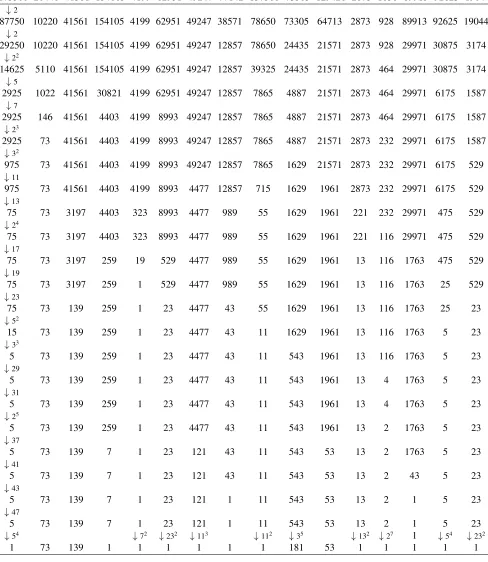
Forn=178499, B={2,3,5,7,11,13,17,19,23,29,31,37,41,43,47} I={−2,−1,2}and for the initial list of f(λ,µ,k,k3,k5)given as
175500,20440,76176,134800,41561,154105,4199,62951,49247,77142,
157300,73305,129426,154105,2873,1856,89913,92625,19044
Table 1: Sievingn=178499with prime powers for primes in B
175500 20440 41561 154105 4199 62951 49247 77142 157300 73305 129426 2873 1856 89913 92625 19044
↓2
87750 10220 41561 154105 4199 62951 49247 38571 78650 73305 64713 2873 928 89913 92625 19044
↓2
29250 10220 41561 154105 4199 62951 49247 12857 78650 24435 21571 2873 928 29971 30875 3174
↓22
14625 5110 41561 154105 4199 62951 49247 12857 39325 24435 21571 2873 464 29971 30875 3174
↓5
2925 1022 41561 30821 4199 62951 49247 12857 7865 4887 21571 2873 464 29971 6175 1587
↓7
2925 146 41561 4403 4199 8993 49247 12857 7865 4887 21571 2873 464 29971 6175 1587
↓23
2925 73 41561 4403 4199 8993 49247 12857 7865 4887 21571 2873 232 29971 6175 1587
↓32
975 73 41561 4403 4199 8993 49247 12857 7865 1629 21571 2873 232 29971 6175 529
↓11
975 73 41561 4403 4199 8993 4477 12857 715 1629 1961 2873 232 29971 6175 529
↓13
75 73 3197 4403 323 8993 4477 989 55 1629 1961 221 232 29971 475 529
↓24
75 73 3197 4403 323 8993 4477 989 55 1629 1961 221 116 29971 475 529
↓17
75 73 3197 259 19 529 4477 989 55 1629 1961 13 116 1763 475 529
↓19
75 73 3197 259 1 529 4477 989 55 1629 1961 13 116 1763 25 529
↓23
75 73 139 259 1 23 4477 43 55 1629 1961 13 116 1763 25 23
↓52
15 73 139 259 1 23 4477 43 11 1629 1961 13 116 1763 5 23
↓33
5 73 139 259 1 23 4477 43 11 543 1961 13 116 1763 5 23
↓29
5 73 139 259 1 23 4477 43 11 543 1961 13 4 1763 5 23
↓31
5 73 139 259 1 23 4477 43 11 543 1961 13 4 1763 5 23
↓25
5 73 139 259 1 23 4477 43 11 543 1961 13 2 1763 5 23
↓37
5 73 139 7 1 23 121 43 11 543 53 13 2 1763 5 23
↓41
5 73 139 7 1 23 121 43 11 543 53 13 2 43 5 23
↓43
5 73 139 7 1 23 121 1 11 543 53 13 2 1 5 23
↓47
5 73 139 7 1 23 121 1 11 543 53 13 2 1 5 23
↓54 ↓72 ↓232 ↓113 ↓112 ↓35 ↓132 ↓27 1 ↓54 ↓232
1 73 139 1 1 1 1 1 1 181 53 1 1 1 1 1
Through the sieving of Eratosthenes procedure we obtain B-smooth numbers as those F with
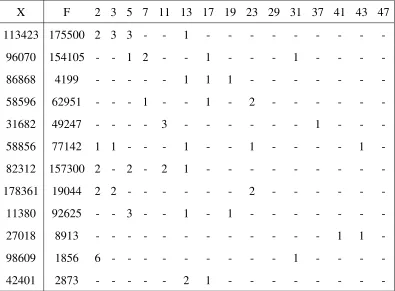
prime factors of the B-smooth numbers and their indices,are given in the following table.
Table 2: List ofX,F for primes in B
X F 2 3 5 7 11 13 17 19 23 29 31 37 41 43 47
113423 175500 2 3 3 - - 1 - - -
-96070 154105 - - 1 2 - - 1 - - - 1 - - -
-86868 4199 - - - 1 1 1 - - -
-58596 62951 - - - 1 - - 1 - 2 - - -
-31682 49247 - - - - 3 - - - 1 - -
-58856 77142 1 1 - - - 1 - - 1 - - - - 1
-82312 157300 2 - 2 - 2 1 - - -
-178361 19044 2 2 - - - 2 - - -
-11380 92625 - - 3 - - 1 - 1 - - -
-27018 8913 - - - 1 1
-98609 1856 6 - - - 1 - - -
-42401 2873 - - - 2 1 - - -
-We now look for relations modulo 2 between the rows of the above table. That we have from the
first,third,seventh,ninth and last row containF1=175500,F3=4199,F7=157300, F9=92625 and F12 =2873 with prime factors 2,3,5,11,13,17,19 in B of even index. Now finding the corresponding X1,X3,X7,X9,X12 we have for X1 =113423, X3=86868, X7=82312, X9=
11380, X12 =42401. This leads to the congruence(X1·X3·X7·X9·X12)2 ≡F1·F3·F7·F9·
F12(modn).That is(113423·86868·82312·11380·42401)2≡(22·32·54·11·133·17·19)2
Thus (6035)2 ≡(116947)2. Then we find a nontrivial factor of 178499 by combining the gcd(6035+116947,178499) =103.
4.
CONCLUSIONIn this paper sieving polynomials for factorization of the numbers of the form n=m5+
bxy+cy2=z2foraorcis a square. This process of arriving to a sieving polynomial of small residue for n=m5+a3m3+a2m2+a1m+a0 is described. An algorithm for evaluating the values of sieving polynomials is given and the sieving process leading to factorization of nis
described in an example.
Conflict of Interests
The author(s) declare that there is no conflict of interests.
REFERENCES
[1] P. Anuradha Kameswari, G. Suryakantham, Sieving polynomials for factorization of numbers of the form
n=mk+a0fork=4,5, Int. J. Appl. Eng. Res. 14 (4) (2019), 908 - 916.
[2] P. Anuradha Kameswari, G. Suryakantham, Sieving polynomials for factorization of numbers of the form
n=m4+a1m+a0, J. Computer Math. Sci. in Press.
[3] Tom M.Apostol, Introduction to Analytic number theory Springer Verlag, New York, 1989.
[4] Baker, A., A Comprehensive Course in Number Theory, Cambridge University Press, 2012.
[5] D. Burton, Elementary Number Theor Sixth ed, Mc Graw Hill, New York, 2007.
[6] Dickson Leonard Eugene, History of the Theory of Numbers, Volume II, Chelsea Publishing Company, 1919.
[7] Jeffery Hoftstein, Jill Pipher, Joseph H. Silverman, An Introduction to Mathematical Cryptography, Springer,
2008.
[8] Hardy GH., Wright EM., An introduction to the theory of numbers, Oxford University Press, 1979.
[9] Neal Koblitz, A course in number theory and cryptography, Springer Science & Business Media, 1994.
[10] Landquist, E., An implementation of Zhang’s Special Quadratic Sieve and Possible Extension, Math 488
(2002), 1-18.
[11] I. Niven, H. S. Zuckerman, and H.L. Montgomery, An Introduction to the Theory of Numbers, Fifth Edition,
John Wiley & Sons, New York, 1991.
[12] Crandall, R. and Pomerance, C., Prime Numbers: A Computational Perspective, Springer Science & Business
Media, 2005.
[13] Riesel,H., Prime Numbers and Computer Methods for Factorization, Revised and corrected second printing,
Birkh ¨auser Inc, 1987.
[14] Landquist, E., Possible ways to extend Zhang’s Special Quadratic Sieve, June 4, 2003.
[15] Mingzhi, Zhang., Factorization of the Numbers of the formm3+c2m2+c1m+c0, Springer-Verlag, London,