IMPROVED THREE PARTY EKE PROTOCOL
R.Padmavathy
National Institute of Technology, Warangal Andra Pradesh, India
e-mail: [email protected]
Abstract. The key exchange protocol using passwords achieved great attention due to its simplicity and efficiency.
On the other hand, the protocol should resist all types of password guessing attacks, since the password is of low entropy. Recently, Chang and Chang proposed a novel three party simple key exchange protocol. They claimed the protocol was secure, efficient and practical. Overriding their claims Yoon and Yoo presented an Undetectable online password guessing attack on the above protocol. Recently, a password key exchange protocol PSRJ was proposed and claimed to be in-vulnerable to Undetectable online password guessing attack proposed by Yoon and Yoo. This paper presents an Undetectable on-line password guessing attack on PSRJ protocol. Additionally, to overcome the attack, an enhancement over the existing protocol with reduced modular exponentiation operations is proposed.
Keywords: Chang-Chang password key exchange protocol, Undetectable online password guessing attack, PSRJ
protocol.
1. Introduction
The key exchange protocol is one of the most ele-gant ways of establishing secure communication bet-ween pair of users by using a session key. The session key, which is exchanged between two users, assures the secure communication for later sessions. The first practical key exchange protocol was proposed by Diffie and Hellman [1]. Since the introduction of key exchange protocol by Diffie and Hellman, various versions and improvements in key exchange protocol have been developed. In the line of key exchange protocol development, password based key exchange mechanism achieved attention due to its simplicity and wide range of applicability, as it requires the users to remember the password. Even though the protocol is simple and efficient, according to Ding and Horster [2], it should not be vulnerable to any type of off- line, undetectable or detectable on-line password guessing attacks, since the passwords are of low entropy.
In general, the password guessing attacks can be divided into three classes and they are listed below:
• Detectable on-line password guessing attacks:
An attacker attempts to use a guessed Password in an on-line transaction. He/She verifies the correct-ness of his/her guess using the response from ser-ver. A failed guess can be detected and logged by the server.
• Undetectable on-line password guessing
attacks: Similar to Detectable on-line password
guessing attack, an attacker tries to verify a
password guess in an on-line transaction. However, a failed guess cannot be detected and logged by server, as server is not able to distinguish an honest request from a malicious one.
• Off-line password guessing attacks: An attacker
guesses a password and verifies his/her guess on-line. No participation of server is required, so the server does not notice the attack.
Since the first proposal of Bellovin and Merrit (PAKE) [3], many efficient key exchange protocols based on password have been developed. Recently these two Party key exchange protocols were extended to three party, in which, the two parties initially communicate the passwords with the trusted server securely. Later the server authenticates the clients when they want to agree upon a session key. The 3-party protocol is introduced by Steiner et al [4]. Subsequently Ding and Hoster published on-line and offline guessing attacks on Stener’s protocol [2]. Later Lin et al. proposed two versions of improved three party protocol [5], one with server’s public key and another without.
avoid the above attack. Lo and Yeh [8] pointed out un-detectable password guessing attack on Yoon and Yoo protocol and proposed an enhanced protocol. Most recently, an enhanced protocol (PSRJ protocol) was proposed without XOR operation [9].
But the enhanced protocol (PSRJ protocol) falls to Undetectable on-line password guessing attack, if client ‘B’ intercepts the message coming from client ‘A’. To eliminate the undetectable on-line password guessing attack, an extension is done on the existing protocol.
The paper is organized as follows: Section 2 brief-ly reviews the PSRJ protocol. Section 3 shows the undetectable on-line password guessing attack. Sec-tion 4 describes the proposed protocol. SecSec-tion 5 dis-cusses the security and efficiency analyses and the concluding remarks are made in Section 6.
2. Review of PSRJ protocol
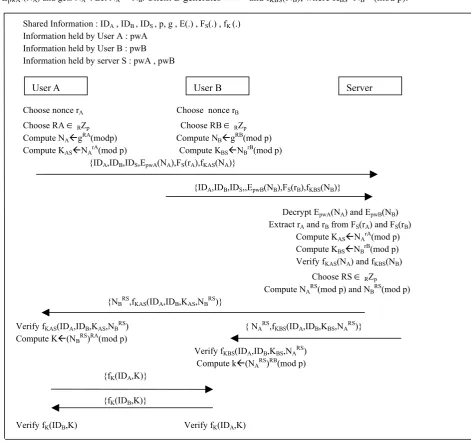
This section briefly reviews the enhanced protocol [9]. The notations used in this protocol are listed below:
• A,B : two communication parties
• S: the trusted server
• IDA, IDB, IDS: the identities of A,B and S, respectively
• pwA, pwB: the passwords securely shared by A with S and B
• EPWA (.), EPWB (.): a symmetric encryption scheme with a password PWA and password PWB respectively.
• rA, rB: the random numbers chosen by A and B,
respectively
• p: a large prime
• g: a generator of order p – 1
• RA, RB, RS: the random exponents chosen by A, B and S, respectively
• NA,NB: NA=gRA(mod p)and NB=gRB(mod p) • FS(.): the one-way trapdoor hash function(TDF)
where only S knows the trapdoor
• fK(.): the pseudo-random hash function (PRF)
indexed by a key K
• KAS, KBS: a one time strong keys shared by A with S and B with S respectively
The detailed procedures of the protocol can be described as follows.
1. A→S: IDA, IDB, IDS, EpwA(NA), FS(rA), fKAS(NA),
B→S: IDA,IDB,IDS, EpwB(NB), FS(rB), fKBS(NB).
Client A generates two random numbers RA and rA, and calculates EpwA(NA), FS(rA) and fKAS(NA),
where NA=gRA (mod p) and KAS=NArA (mod p). Next,
A sends these three messages to S via his/her own private communication channel.
Meanwhile, client B calculates NB=gRB (mod p),
KBS=NBrB (mod p), EPWB(NB), FS(rB) and fKBS(NB) with
two newly generated random numbers RB and rB.
Then, B transmits EpwB(NB), FS(rB) and fKBS(NB) to S
via his/her own private communication channel. 2. S → A: NBRS, fKAS(IDA, IDB, KAS, NBRS),
S→ B: NARS, fKBS(IDA, IDB, KBS, NARS).
Once receiving the message sent from A and B , S first utilizes pwA, pwB and decrypts EpwA(NA),
EpwB(NB) and gets NA, NB, then it utilizes a trapdoor to
obtain rA and rB from FS(rA) and FS(rB), verifies
whe-ther computed value fKAS(NA)(or fKBS(NB)) and
recei-ved value fKAS(NA) (or fKBS(NB)) are identical or not. If
this verification holds, S continues the residual pro-cedures of this protocol. Otherwise, S terminates this protocol at current session. Next, S computes NBRS,
NARS and corresponding hashed credential fKAS(IDA,
IDB, KAS, NBRS) and fKAS(IDA, IDB, KBS, NARS).
Finally, S sends these messages to A and B simul-taneously.
3. B → A: fK(IDB, K),
4. A → B: fK(IDA, K).
Upon obtaining the transmitted messages sent from S, B first verifies fKBS(IDA, IDB, KBS, NARS) to
authenticate S.
If this verification is passed, B believes the received NARS is valid and then computes the session
key K=(NARS)RB (mod p) and fK(IDB, K). Otherwise, B
terminates this protocol. Finally, B sends the fK(IDB,
K) to A. Note that fK(IDB, K) will be used by client A
to verify the legality of client B and the established session key K. At the same time, A verifies fKAS(IDA,
IDB, KAS, NBRS) to authenticate S. If this verification
does not hold, A terminates this protocol. Otherwise, A computes the session key K=(NBRS)RA (mod p) and
fK(IDA, K). Finally, A sends the fK(IDA, K) to B.
After A and B successfully examine the validation of the incoming messages fK(IDB, K) and fK(IDA, K),
both of them can ensure that they actually share the secret session key K=(NBRS)RA (mod p)=(NARS)RB(mod
p) at present. Otherwise, the protocol will be terminated. Figure 1 illustrates PSRJ protocol.
3. Undetectable on-line password guessing attack on PSRJ protocol
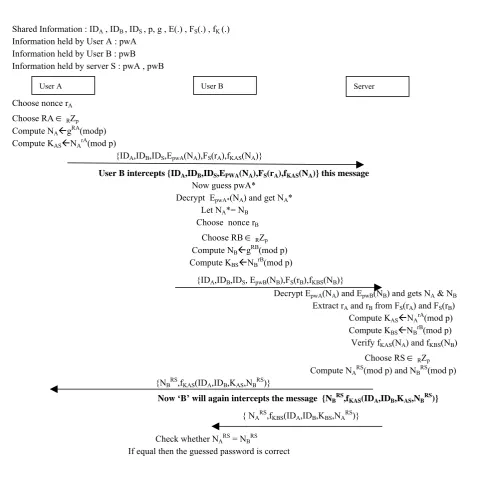
1. A→S:IDA, IDB, IDS, EpwA(NA), FS(rA), fKAS(NA).
Client A generates two random numbers RA and rA, and calculates EpwA(NA), FS(rA) and fKAS(NA),
where NA=gRA (mod p) and KAS=NArA (mod p). Next,
A sends these three messages to S via his/her own private communication channel.
2. B→ S:IDA, IDB,IDS, EpwB(NB), FS(rB), fKBS(NB).
Client ‘B’ intercepts this message i.e. IDA, IDB,
Now, he/she will guess a password pwA*, decrypts EpwA*(NA) and gets NA*. Let NA*= NB. Client B generates
a random number rB, and calculates EpwB(NB), FS(rB)
and fKBS(NB), where KBS=NBrB (mod p).
Shared Information : IDA , IDB , IDS , p, g , E(.) , FS(.) , fK (.)
Information held by User A : pwA Information held by User B : pwB Information held by server S : pwA , pwB
Choose nonce rA Choose nonce rB
Choose RA ∈RZp Choose RB ∈RZp
Compute NAÅgRA(modp) Compute NBÅgRB(mod p)
Compute KASÅNArA(mod p) Compute KBSÅNBrB(mod p)
{IDA,IDB,IDS,EpwA(NA),FS(rA),fKAS(NA)}
{IDA,IDB,IDS,,EpwB(NB),FS(rB),fKBS(NB)}
Decrypt EpwA(NA) and EpwB(NB)
Extract rA and rB from FS(rA) and FS(rB)
Compute KASÅNArA(mod p)
Compute KBSÅNBrB(mod p)
Verify fKAS(NA) and fKBS(NB)
Choose RS ∈RZp
Compute NARS(mod p) and NBRS(mod p)
{NBRS,fKAS(IDA,IDB,KAS,NBRS)}
Verify fKAS(IDA,IDB,KAS,NBRS) { NARS,fKBS(IDA,IDB,KBS,NARS)}
Compute KÅ(NBRS)RA(mod p)
Verify fKBS(IDA,IDB,KBS,NARS)
Compute kÅ(NARS)RB(mod p)
{fK(IDA,K)}
{fK(IDB,K)}
Verify fK(IDB,K) Verify fK(IDA,K)
Figure 1. The PSRJ protocol
Then, B transmits EpwB(NB), FS(rB) and fKBS(NB) to
S via his/her own private communication channel. 3. S → A: NBRS, fKAS(IDA, IDB, KAS, NBRS)
S→ B: NARS, fKBS(IDA, IDB, KBS, NARS).
Once receiving the message sent from A and B , S first utilizes pwA, pwB and decrypts EPWA(NA),
EPWB(NB) and gets NA, NB, then it utilizes a trapdoor
to obtain rA and rB from FS(rA) and FS(rB), verifies
whether computed value fKAS(NA)(or fKBS(NB)) and
received value fKAS(NA) (or fKBS(NB)) are identical or
not. If this verification holds, S continues the residual procedures of this protocol. Otherwise, S terminates this protocol at current session. Next, S computes NBRS, NARS, and corresponding hashed credential
fKAS(IDA, IDB, KAS, NBRS) and fKBS(IDA, IDB, KBS,
NARS). Finally, S sends {NBRS, fKAS(IDA, IDB, KAS,
NBRS) } to A and {NARS, fKBS(IDA, IDB, KBS, NARS)} to
B simultaneously.
‘B’ intercepts the message NBRS, fKAS(IDA, IDB,
KAS, NBRS) again.
It verifies whether NARS is equal to NBRS. If both
are equal then the guessed password is correct. Figure 2 illustrates the Undetectable on-line pas-sword guessing attack on the enhanced protocol.
4. The proposed protocol
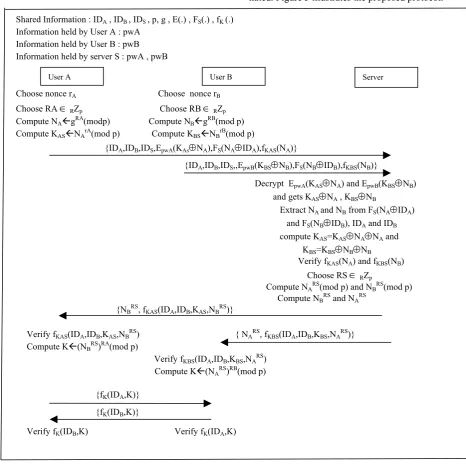
To overcome the Undetectable on-line password guessing attack, an extension is made on the PSRJ protocol. The detailed procedures of the proposed protocol can be described as follows.
1. A→S: IDA, IDB, IDS, EpwA(KAs⊕NA), FS(NA⊕IDA),
fKAS(NA).
B→.S: IDA,IDB,IDS, EpwB(KBs⊕NB), FS(NB⊕IDB),
fKBS(NB).
Client A generates two random numbers RA and rA,
and calculates EpwA(KAs⊕NA), FS(NA⊕IDA) and
fKAS(NA), where NA=gRA (mod p) and KAS=NArA (mod
p). Next, A sends these three messages to S via his/her own private communication channel.
Meanwhile, client B calculates NB=gRB (mod p),
KBS=NBrB (mod p), EpwB(KBS⊕NB), FS(NB⊕IDB) and
fKBS(NB) with two newly generated random numbers
RB and rB. Then, B transmits EpwB(KBS⊕NB),
FS(NB⊕IDB) and fKBS(NB) to S via his/her own private
communication channel.
Shared Information : IDA , IDB , IDS , p, g , E(.) , FS(.) , fK (.)
Information held by User A : pwA Information held by User B : pwB Information held by server S : pwA , pwB
Choose nonce rA
Choose RA ∈RZp
Compute NAÅgRA(modp)
Compute KASÅNArA(mod p)
{IDA,IDB,IDS,EpwA(NA),FS(rA),fKAS(NA)}
User B intercepts {IDA,IDB,IDS,EPWA(NA),FS(rA),fKAS(NA)} this message
Now guess pwA*
Decrypt EpwA*(NA) and get NA*
Let NA*= NB
Choose nonce rB
Choose RB ∈RZp
Compute NBÅgRB(mod p)
Compute KBSÅNBrB(mod p)
{IDA,IDB,IDS, EpwB(NB),FS(rB),fKBS(NB)}
Decrypt EpwA(NA) and EpwB(NB) and gets NA & NB
Extract rA and rB from FS(rA) and FS(rB)
Compute KASÅNArA(mod p)
Compute KBSÅNBrB(mod p)
Verify fKAS(NA) and fKBS(NB)
Choose RS ∈RZp
Compute NARS(mod p) and NBRS(mod p)
{NBRS,fKAS(IDA,IDB,KAS,NBRS)}
Now ‘B’ will again intercepts the message {NBRS,fKAS(IDA,IDB,KAS,NBRS)}
{ NARS,fKBS(IDA,IDB,KBS,NARS)}
Check whether NARS = NBRS
If equal then the guessed password is correct
Figure 2. Undetectable on-line password guessing attack on the PSRJ protocol
2. S → A: NBRS, fKAS(IDA, IDB, KAS, NBRS),
S→ B: NARS, fKBS(IDA, IDB, KBS, NARS).
Once receiving the message sent from A and B , S first utilizes a trapdoor to obtain NA⊕IDA and NB⊕IDB
from FS(NA⊕IDA) and FS(NB⊕IDB) then retrieves NA=
NA⊕IDA⊕IDA and NB= NB⊕IDB⊕IDB, respectively.
Next it uses the passwords pwA and pwB and decrypts
EpwA(KAs⊕NA) and EpwB(KBs⊕NB), respectively, and
gets KAS⊕NA and KBS⊕NB. Now, KAS=KAS⊕NA⊕NA
and KBS=KBS⊕NB⊕NB will be determined. fKAS(NA)
and fKBS(NB) are computed. S verifies whether
computed value fKAS(NA)(or fKBS(NB)) and received
value fKAS(NA) (or fKBS(NB)) are identical or not. If this
verification holds, S continues the residual procedures of this protocol. Otherwise, S terminates this protocol
at current session. Next, S computes NBRS, NARS, and
corresponding hashed credential fKAS(IDA, IDB, KAS,
NBRS) and fKBS(IDA, IDB, KBS, NARS). Finally, S sends
{NBRS, fKAS(IDA, IDB, KAS, NBRS) } to A and {NARS,
fKBS(IDA, IDB, KBS, NARS)} to B simultaneously.
3. B → A: fK(IDB, K).
4. A → B: fK(IDA, K).
Upon obtaining the transmitted messages sent from S, B first verifies fKBS(IDA, IDB, KBS, NARS) to
authenticate S. If this verification is passed, B believes the received NARS is valid and then computes the
session key K=(NARS)RB (mod p) and fK(IDB, K).
Otherwise, B terminates this protocol. Finally, B sends
the fK(IDB, K) to A. Note that fK(IDB, K) will be used
by client A to verify the legality of client B and the established session key K. At the same time, A verifies fKAS(IDA, IDB, KAS, NBRS) to authenticate S. If this
verification does not hold, A terminates this protocol. Otherwise, A computes the session key K=(NBRS)RA
(mod p) and fK(IDA, K). Finally, A sends the fK(IDA,
K) to B.
After A and B successfully examine the validation of the incoming messages fK(IDB, K) and fK(IDA, K),
both of them can ensure that they actually share the secret session key K=(NBRS)RA (mod p)=(NARS)RB(mod
p) at present. Otherwise, the protocol will be termi-nated. Figure 3 illustrates the proposed protocol.
Shared Information : IDA , IDB , IDS , p, g , E(.) , FS(.) , fK (.)
Information held by User A : pwA Information held by User B : pwB Information held by server S : pwA , pwB
Choose nonce rA Choose nonce rB
Choose RA ∈RZp Choose RB ∈RZp
Compute NAÅgRA(modp) Compute NBÅgRB(mod p)
Compute KASÅNArA(mod p) Compute KBSÅNBrB(mod p)
{IDA,IDB,IDS,EpwA(KAs⊕NA),FS(NA⊕IDA),fKAS(NA)}
{IDA,IDB,IDS,,EpwB(KBS⊕NB),FS(NB⊕IDB),fKBS(NB)}
Decrypt EpwA(KAS⊕NA) and EpwB(KBS⊕NB)
and gets KAS⊕NA , KBS⊕NB
Extract NA and NB from FS(NA⊕IDA)
and FS(NB⊕IDB), IDA and IDB
compute KAS=KAS⊕NA⊕NA and
KBS=KBS⊕NB⊕NB
Verify fKAS(NA) and fKBS(NB)
Choose RS ∈RZp
Compute NARS(mod p) and NBRS(mod p)
Compute NBRS and NARS
{NBRS, fKAS(IDA,IDB,KAS,NBRS)}
Verify fKAS(IDA,IDB,KAS,NBRS) { NARS, fKBS(IDA,IDB,KBS,NARS)}
Compute KÅ(NBRS)RA(mod p)
Verify fKBS(IDA,IDB,KBS,NARS)
Compute KÅ(NARS)RB(mod p)
{fK(IDA,K)}
{fK(IDB,K)}
Verify fK(IDB,K) Verify fK(IDA,K)
Figure 3. The proposed protocol
5. Security and Efficiency Analyses
The following are the security requirements to be met by a password key exchange protocol[6].
• Mutual authentication
• Resistance to the password guessing attacks.
• Transmission round and computation complexity.
The proposed protocol is satisfying the above re-quirements.The following section presents the brief report on the security analyses of the protocol with respect to requirements.
5.1. Mutual authentication
First, A and B use the trapdoor function FS to hide
the random number rA & rB and pwA & pwB to
encrypt NA & NB in step 1, as described in section 4 .
since only S knows the trap door , pwA & pwB , only S can authenticate A/B after receiving the message sent in step 1.
Second, S sends {NBRS, fKAS(IDA, IDB, KAS, NBRS)}
to A,{ NARS, fKBS(IDA, IDB, KBS, NARS} to B in step 2.
This message can be used to authenticate ‘S’ as mentioned in step 2 in section 4.
Third, A and B derive key from NBRSand NARS
respectively, as mentioned in step 2 in section 4. With the help of fK(IDB, K), fK(IDA, K) A and B can
authenticate each other.
5.2. Resistance to the password guessing attacks
First, a malicious attacker may try to guess the password with Undetectable on-line password gues-sing attacks. If that is the case, the mutual authentica-tion step is not possible. If B tries to guess A’s pass-word, then B should perform the following procedure to mount an Undetectable on-line password guessing attack. B obtains (KAS⊕NA)* by decrypting EPWA
(KAs⊕NA) with a guessed password pwA*. Next he
selects his random exponent RB and computes NB=gRB mod p and finds Fs(NB⊕IDB), f(KAS⊕NA)*(NB)
and sends EpwA((KAS⊕NA)*⊕NB), Fs(NB⊕IDB),
f(KAS⊕NA)*(NB) to server. Server authenticates the
clients and sends {NBRS, fKAS(IDA,IDB,KAS,NBRS)} to
A and { NARS, fKBS(IDA,IDB,KBS,NARS)} to B. Now
client B intercepts {NBRS, fKAS(IDA,IDB,KAS,NBRS)}
but cannot compare any two terms and verify whether the guessed password is correct or not. Hence B cannot mount an Undetectable on-line password guessing attack on the proposed protocol.
Second, an attacker may try to guess the password with detectable on-line password guessing attack. He guesses pwA* or pwB* to impersonate A or B, chooses RA or RB, computes NA=gRA mod p or
NB=gRB mod p and selects rA or rB, computes
KAS=NArA mod p or KBS=NBrB mod p and then sends EpwA*(KAs⊕NA), FS(NA⊕IDA), fKAS(NA) or EpwB*(KBs⊕NB), FS(NB⊕IDB), fKBS(NB). Server will decrypt EpwA*(KAs⊕NA) or EpwB*(KBs⊕NB) and gets (KAs⊕NA )*or (KBs⊕NB)*. Now NA or NB will be extracted from FS(NA⊕IDA), IDA or Fs(NB⊕IDB), IDB.
S computes KAS= (KAS⊕NA )*⊕KAS or KBS=(KBS⊕ NB)*⊕KBS and fKAS(NA) or fKBS(NB) will be determi-ned. But the computed hash values will not be equal to the received hash values. Hence S can detect this at-tack and take the counter measure. Hence, it is
impossible for an attacker to mount detectable on-line password guessing attack.
Third, an attacker may try to mount off-line password guessing attack to guess the password. He intercepts EpwA(KAS⊕NA), FS(NA⊕IDA), fKAS(NA) and
may guess a password, extracts KAS⊕NA, but it is
impossible for him to get NA until trapdoor is known,
which is known only to server. This implies that he cannot verify the hash value fKAS(NA). Hence off-line
password guessing attack on the proposed protocol is impossible.
Perfect forward secrecy: The enhanced protocol
has the perfect forward secrecy. The session key is computed as follows: K=(NBRS)RA (mod p)=(NARS)RB
(mod p). If the attacker gets {NBRS, fKAS(IDA, IDB,
KAS, NBRS)} or {NARS, fKBS(IDA, IDB, KBS, NARS)},
then in order to obtain the session key, he should know RBor RA. Since this is not possible he cannot get the key.
The session keys generated in different sessions are independent since RA and RB are randomly chosen by A and B respectively. This indicates that the attacker cannot obtain previous session keys even if he obtains the session key used in this run.
Known-Key Security: In the enhanced protocol
as RA, RB are randomly chosen by A and B, and are independent among protocol executions. This leads to the in-vulnerability of Known-Key security.
Server spoofing: The server computes fKAS(IDA,
IDB, KAS, NBRS), fKBS(IDA, IDB, KBS, NARS) and sends
to A and B, respectively. A and B can verify the iden-tity of server or authenticate the server by computing fKAS(IDA, IDB, KAS, NBRS), fKBS(IDA, IDB, KBS, NARS),
respectively. Thus, the attacker cannot impersonate the server to deceive the client.
Man-in the middle attack: Suppose the attacker
frames his own message i.e. EPWc(KCS⊕NC), FS(Nc⊕
IDC), fKCS(Nc) with the correct guesses password and
sends to server. The server will decrpt EPWC(KCS⊕NC)
and gets ‘KCS⊕NC’ and obtains 'NC⊕IDC' from
FS(NC⊕IDC). Finaly, S computes hash value which
will not match with the received hash value. Hence the protocol gets terminated and not allowing man-in the middle to mount any attack.
Trivial attack: An attacker may directly try to
compute the session key from NARS or NBRS. However,
due to the intractability of DLP and the one-wayness of hash function, the trivial attack is not possible in the proposed protocol.
Replay attack: Since one way trapdoor hash
function is used, the proposed protocol is in-vulnerable of this attack.
5.3. Transmission round and computation complexity
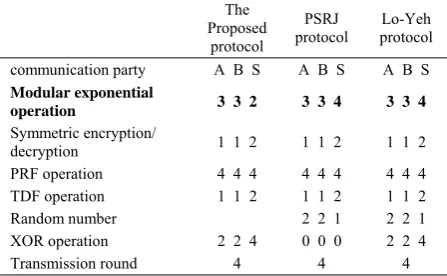
proposed protocol requires four message transmission rounds. Table 1 shows the performance comparison analyses of the proposed protocol, PSRJ protocol and Lo and Yeh protocol [8]. The modular exponential operations are reduced since client A sends EpwA
(KAS⊕NA), FS(NA⊕IDA), fKAS(NA) to S and client B
sends EpwB(KBS⊕NB), FS(NB⊕IDB), fKBS(NB) to S. S
decrypts EpwA(KAS⊕NA) and EpwB(KBS⊕NB) and gets
KAS⊕NA and KBS⊕NB respectively. Next S extracts NA
and NB from FS(NA⊕IDA), FS(NB⊕IDB) and IDA,IDB.
Now KAS and KBS are computed by KAS= KAS⊕
NA⊕NA and KBS=KBS⊕NB⊕NB. Since EpwA(KAS⊕NA),
FS(NA⊕IDA), EpwB(KBS⊕NB), FS(NB⊕IDB) are
arran-ged in a proper sequence two modular exponential operations are reduced on the server side hence computation complexity is reduced.
Table 1. Performance comparison between the proposed
protocol, PSRJ protocol and Lo and Yeh protocol
The Proposed
protocol
PSRJ protocol
Lo-Yeh protocol
communication party A B S A B S A B S
Modular exponential
operation 3 3 2 3 3 4 3 3 4
Symmetric encryption/
decryption 1 1 2 1 1 2 1 1 2 PRF operation 4 4 4 4 4 4 4 4 4 TDF operation 1 1 2 1 1 2 1 1 2
Random number 2 2 1 2 2 1
XOR operation 2 2 4 0 0 0 2 2 4
Transmission round 4 4 4
6. Conclusion
An enhanced password-key exchange protocol which is in-vulnerable to undetectable on-line pass-word attacks is proposed. The modular exponential operations are expensive. The designed protocol is developed with reduced modular exponential opera-tion on server side. The above results show that the proposed protocol is secure , efficient and practical.
References
[1] W. Diffie, M. Hellman. New Directions in
crypto-graphy. IEEE Transactions on Information theory, Vol. 22, No. 6 , 1976, 644-654.
[2] Y. Ding, P. Horster. Undetectable Online password guessing attacks. ACM operating systems Review, Vol.
29, No. 4,pp 77-86 (1995)
[3] S.M. Bellovin, M. Merrit. Encrypted key exchange:
password-based protocols secure against dictionary attacks. Proceedings of IEEE sysmposium on re-search in security and privacy, IEEE Computer society press, 1992, 72-84.
[4] M. Steiner, G. Tsudik, M. Waidner. Refinement and extention of encrypted key exchange. ACM Operating Systems Review, Vol. 29, No. 3, 1995, 22-30.
[5] C.L. Lin, H.M. Sun, M. Steiner, T. Hwang.
Three-party excrypted key exchange without server public-Keys. IEEE Communication letters, Vol. 5, No. 12,
2001, 497- 499.
[6] C.C. Chang, Y.F. Chang. A novel three party
encryp-ted key exchange protocol. Computer Standards and Interfaces, Vol. 26 , No. 5, 2004, 471-476.
[7] E.J. Yoon, K.Y. Yoo. Improving the novel three-party
encrypted key exchange protocol. Computer Stan-dards and Interfaces, 30, 2008, 309-314.
[8] N.W. Lo, K.-H. Yeh. Cryptanalysis of two three-party
encrypted key exchange protocols. Computer Stan-dards & Interfaces, Vol. 31, issue 6, Nov. 2009,
1167-1174.
[9] R. Padmavathy, S. Tallapally, R. JayadevGyani.
Improved Analysis of Chang and Chang password key exchange protocol, ACT 2009, 781-783, Doi
10.1109 / ACT.2009.197.