EFFICIENT GENERATION OF NEAR OPTIMAL INITIAL
POPULATIONS TO ENHANCE GENETIC ALGORITHMS
FOR JOB-SHOP SCHEDULING
Artur M. Kuczapski
1, Mihai V. Micea
1, Laurentiu A. Maniu
2, Vladimir I. Cretu
1 1Department of Computer and Software Engineering, "Politehnica" University of Timisoara, 2, V. Parvan Blvd., 300223, Timisoara, Romania
[email protected], [email protected], [email protected] 2
Advanced clean production Information Technology (acp-IT), 7, Constantin Brancusi Str., 300050, Timisoara, Romania
Abstract. This paper presents an efficient method of enhancing genetic algorithms (GAs) for solving the Job-Shop Scheduling Problem (JSSP), by generating near optimal initial populations. Since the choice of the initial population has a high impact on the speed of the evolution and the quality of the final results, we focused on generating its individuals using genetically evolved priority dispatching rules. Our experiments show a significant increase in quality and speed of scheduling with GAs, and in some cases the evolved priority rules alone determined better solutions then the GA itself. The analyzed reference GA uses Giffler & Thompson (GT) heuristic and priority lists. To speed up the generation of priority rules, we have used a "weighted sum of priority rules" formula that revealed significantly better performances than Genetic Programming (GP). For evaluation of the proposed algorithm, the well known benchmark data sets from Fisher & Thompson (F&T) and Laurence Kramer (LA) have been used.
Keywords: genetic algorithms, job-shop scheduling, initial populations, chromosomes.
1. Introduction
Production scheduling is one of the hardest combi-natorial optimization problems. A particular type of production scheduling is the Job-Shop Scheduling Problem (JSSP). This is the most addressed by re-searchers because it presents almost all the peculia-rities of this domain and in the same time it has a quite simple formal representation. It was demonstrated that JSSPs are NP-hard and therefore no deterministic algorithms can solve them in a reasonable amount of time [1] − [3].
Genetic Algorithms (GAs) have proven their efficiency in solving high complexity combinatorial optimization problems, thus many researchers have applied them also to the scheduling problems [4] − [7]. The results seem to be encouraging but the quality of the schedules depends on several parameters. To improve the performance of the GA-based techniques, considerable effort was spent on developing optimal chromosome representation and genetic operations for JSSP [5], [7], [8]. However, the performance of solutions still depends on the quality of the initial population.
This paper describes an efficient method for gene-rating near optimal initial populations in order to speed up GAs for JSSP. The proposed method also uses GAs, but in this case, for the purpose of evolving priority dispatching rules. These rules employ Giffler & Thompson (GT) heuristics to generate feasible schedules that serve as initial populations for the JSSP scheduling algorithms. To reduce the time required to find good dispatching rules, instead of Genetic Programming (GP) [9], [10], we use a "weighted sum of priority"-type of rules. This formula blends a set of predefined priority rules [2] − [4], [6], to create a better one.
2. Definition of the Job-Shop Scheduling Problem
A Job-Shop (JS) model contains a set of n jobs (J)
and a set of m machines (M), where each job j visits a
number of machines in a predetermined order. The processing times for each job at each machine are given and no machine can process more than one job at a time. If a job is started on a machine, then it cannot be interrupted (non preemptive), but any job can stay an arbitrary amount of time idle [1]. Briefly, the Job-Shop Scheduling Problem (JSSP) can be formulated as finding a job processing order at each machine that conforms to operations predetermined processing order of each job and minimizes or maxi-mizes a given objective function [1][13].
To simplify, we further make the following as-sumptions which, nevertheless, are not detrimental to the generality of the proposed method:
• Each job has to undergo exactly m processing
steps;
• No job can visit any machine more than once;
• The operation times are fixed and predetermined
(no setup-times allowed);
• Any operation time is represented as a positive
integer number which specifies the duration of the operation in terms of time units.
According to these statements, a JS can be de-scribed by a matrix of n × m entries JS[n, m], where each entry consists of two integer numbers. The row
JS[j] describes the list of the operations, according to
their execution order, for the job j, while the entry
JS[j, i] specifies the machine needed for the operation
i and the corresponding processing time.
There are several optimization objectives but the current paper will focus only on reducing the
make-span (Cmax), which is measured in time units, for all
our case studies and tests.
3. Generating Dispatching Rules
3.1. Dispatching Rules
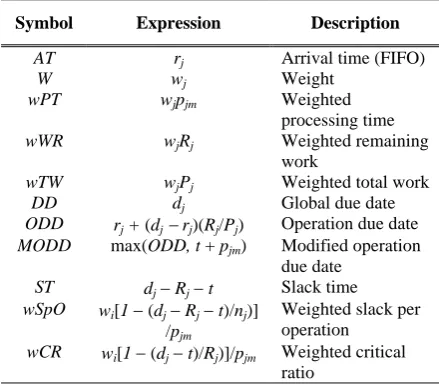
Many authors claim that priority dispatching rules can be successfully used in solving large JSSPs and even other scheduling problems [2], [3], [9]. In real applications, priority dispatching rules are actually the most widely used. Basically, a priority dispatching rule is a simple mathematical formula that, based on some processing parameters, specifies the priority of operations to be executed. The usual processing para-meters are shown in Table 1.
There are several dispatching rules which present a significant optimization capacity [1], [3], [6]. Table 2 shows some of these rules, in unsigned format, where the higher or the lower value has the highest priority, depending on the JSSP. This representation has been chosen because it will directly support the evolution of dispatching rules.
Table 1. Production parameters for priority dispatching
Symbol Description
rj Job arrival time – the moment when the job arrives at the machine
wj Job weight – the importance of the job pjm Processing time – the time needed to process
job j on machine m
nj Remaining operations – the number of remaining operations
Rj Remaining work – the time needed to complete the job’s remaining operations Pj Total work – the time needed to execute all
the operations of the job
dj Due date – the moment when the job should be finished
Table 2. Simple priority rules used in the GA
Symbol Expression Description
AT rj Arrival time (FIFO)
W wj Weight
wPT wjpjm Weighted processing time wWR wjRj Weighted remaining
work
wTW wjPj Weighted total work
DD dj Global due date
ODD rj + (dj −rj)(Rj/Pj) Operation due date MODD max(ODD, t + pjm) Modified operation
due date ST dj−Rj−t Slack time wSpO wi[1 − (dj−Rj−t)/nj)]
/pjm
Weighted slack per operation
wCR wi[1 − (dj−t)/Rj)]/pjm Weighted critical ratio
3.2. Evolving Dispatching Rules
Many researchers demonstrated that, for general JSSPs, simple priority rules alone cannot determine an optimal or near optimal solution [1], [3], [4], [9]. To improve the scheduling performance, they proposed the usage of evolutionary algorithms to generate bet-ter, composite dispatching rules (CDRs) which are mathematical combinations of various simple dispat-ching rules. Usually, Genetic Programming (GP) is employed for this purpose. The advantage of GP is that, theoretically, it can generate CDRs of any lexity, but on the other hand, generating high comp-lexity CDRs requires a long computational time. To reduce the solution space and the computation time needed, the complexity of the CDRs was limited, and a smaller number of simple dispatching rules were selected.
3.3. Chromosome Representation
To implement any evolutionary algorithm, first we need to define the representation of the solution. In our case the CDR is composed of a sum of priority
rules (PRi(x)) multiplied by their respective weights
(pwi):
( )
∑
( ) =⋅ = N
i
i i PR x pw
x CDR
1
, (1)
where CDR(x) is the composite dispatching rule
generated; N is the number of priority dispatching
rules used; pwi is a real number in the interval [−1, 1]
(the weight of the rule i); and PRi(x) is a priority
dispatching rule from those defined in Table 2. According to this representation the chromosomes that encode a CDR are constituted as a list of real numbers, from the interval [−1, 1], which has a length equal to the number of simple priority rules used. This representation has no additional constraints and it is similar to the classical chromosome representation, therefore all the genetic operations (crossover, selec-tion, mutation) are well defined. In comparison with the GP approach, this representation has a much smaller solution space and therefore can evolve much faster, but in the same time, theoretically, it cannot find solutions as good as GP can.
Table 3. Genetic Programming compared to “weighted sum of priority rules” approach
GP WSPR Input data OPT
Cmax Gn Cmax Gn FT6 (6x6) 55 58 58 55 23 FT10 (10x10) 930 1070 91 1043 27 FT20 (20x20) 1165 1264 77 1230 29
LA1 (10x5) 666 744 62 701 36 LA2 (10x5) 655 775 79 704 26 LA3 (10x5) 597 670 78 653 31
LA26 (20x10) 1218 1391 63 1348 35 LA27 (20x10) 1235 1547 66 1460 32 LA28 (20x10) 1216 1474 64 1460 35 LA29 (20x10) 1157 1462 83 1449 38 LA30 (20x10) 1355 1576 100 1560 35
LA36 (15x15) 1268 1546 51 1543 38 LA37 (15x15) 1397 1579 51 1580 29 LA38 (15x15) 1196 1415 70 1370 33 LA39 (15x15) 1233 1510 52 1417 34 LA40 (15x15) 1222 1356 96 1297 35
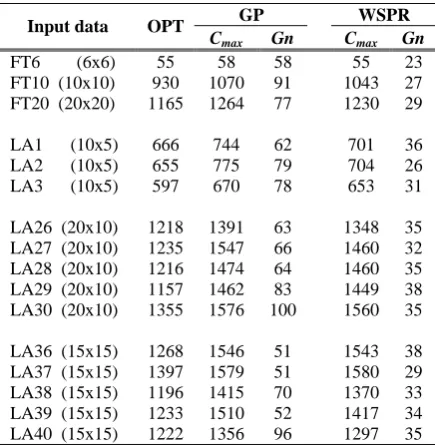
A set of tests have been conducted to compare the GP and the "weighted sum of priority rules" (WSPR) approaches. Table 3 shows the test results, where OPT
stands for the best known (optimal) solution, Cmax is
the overall makespan, Gn is the number of generations
needed to reach the solution, FT6 (6x6) is the 6x6 Fisher & Thompson problem (6 operations on 6 processing machines), LA1 (10x5) is the first Lau-rence Kramer problem (10 operations of 5 processing
machines), and so on. The test results show that WSPR performs constantly better than GP.
3.4. Crossover
In our implementation we used the standard uniform crossover operation that, according to our tests, proved to be better than simple or multipoint crossover. Each crossover operation generates two complementary children whose genes are selected randomly from the two parents. The procedure of crossover is exemplified in Figure 1, where genes 2, 3 and 4 were randomly selected to be swapped.
Figure 1. Uniform crossover operation example
3.5. Mutation
For mutation we have chosen to randomly alter a single gene in every chromosome selected to be mutated. The new value of the selected gene is generated randomly with a uniform distribution in the interval [−1, 1].
3.6. Reproduction
Although all genetic operations are well defined for canonical chromosome representation, we stress the fact that a significant performance increase can be obtained by using Stochastic Universal Sampling Selector (SUSS) [14] with exponential ranking.
Because usually the relative fitness difference between individuals in the same population is small, Roulette Wheel Selection proves to be insufficient to ensure convergence in the evolution [10]. To avoid this problem, we have used SUSS with linear and exponential ranking. The latter shows the best results with the following exponential formula:
(
)
i kPi = 0.011/k i−1, =1, (2)
where Pi is the probability to reproduce the i-th
individual, k is the number of individuals, and 0.01
(1%) is the probability to reproduce the worst individual.
3.7. Fitness Value
In order to use GAs, it is necessary to define a method that quantifies the "goodness" of a chromo-some. In our case the fitness value of a chromosome is
specified by the makespan (Cmax) of the generated
time, a decision rule is needed for selecting the first operation to run. In our case this decision rule is the CDR itself that we have to evaluate. When a schedule is generated the makespan is calculated.
3.8. Solutions Deviation
Figure 2 shows statistics for 100 consecutive runs of the CDR generation with GP and GA using WSPR. Both methods use the same population size, and stop
condition. We can observe that even if GP
occasionally generates better results, the GA-WSPR offers more reliable solutions with a better performance.
Figure 2. Distribution of 100 solutions of the FT10 dataset, using GP and GA-WSPR
4. Genetic Algorithms for JSSP
To evaluate the increase in performance, when using the proposed initial population generation me-thod, we have implemented a simple genetic scheduler based on GT heuristic. In our implementation each individual in the population represents a list of priorities for each operation to be scheduled (permu-tation). To translate this priority list in schedules the GT heuristic is used.
4.1. Chromosome encoding
As each individual should represent a permutation, we have chosen the ordinary representation of permu-tation problems for GA [8]. Each chromosome
consists of a list of n integer values, where n is the
total number of operations in the JSSP, with the
condition that each entry gi of the list should contain
an integer from 1 to n − i + 1. The meaning of each
entry gi is that on the i-th position of the permutation
is the gi-th element from a reference permutation
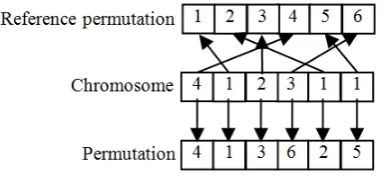
(1, 2, ..., n). In other words, to translate a chromosome to a permutation one must iterate over the entries and for each gi pick the gi-th element from a reference list
and add it to the i-th position of the permutation.
When an element is picked from the reference list, it must be deleted, so that the number of available
entries in the reference list is n − i + 1 for each
iteration. Figure 3 illustrates the translation from ordi-nary representation to permutation.
Figure 3. Translating ordinary representation to permutation
4.2. Genetic operations
This chromosome encoding has been used because the same genetic operation is applicable as in the case of GA-WSPR, so for crossover we have used the standard uniform representation, and for mutation, random gene altering with the condition that, if we
alter the i-th gene of the chromosome then the new
value should be generated for the interval [1, n − i + 1].
5. Experimental Results
For evaluating the performance increase we have tested the presented GA scheduling with and without initial population generation (IPG) using GA-WSPR. The two algorithms were executed several times for each benchmark data set, and then the mean value was calculated. In addition, we have calculated the mean number of generations resulted upon the algorithm stop condition. The configuration used during the eva-luation is presented in Table 4.
Table 4. Configuration of the test environment
Value Parameter CDR
Generation
GA Scheduling
Population size 20 50
Crossover ratio 0.9 0.9
Mutation ratio 0.1 0.1
Random new individuals ratio
0.25 0.25
Number of populations to stop (stop criteria)
20 50
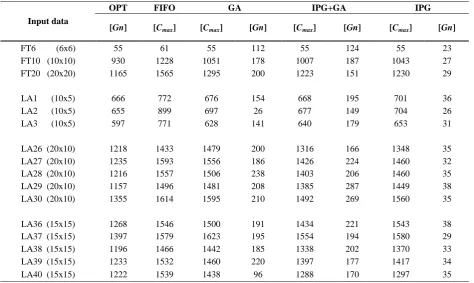
Table 5 synthesizes some of the most interesting measurement results. The input data column contains the same Fisher & Thompson and Laurence Kramer problems, as described in Table 3. In a similar way,
OPT means the best known (optimal) solution, Cmax is
the overall makespan (measured in time units), Gn is
Table 5. Experimental Results
OPT FIFO GA IPG+GA IPG
Input data
[Gn] [Cmax] [Cmax] [Gn] [Cmax] [Gn] [Cmax] [Gn]
FT6 (6x6) 55 61 55 112 55 124 55 23
FT10 (10x10) 930 1228 1051 178 1007 187 1043 27
FT20 (20x20) 1165 1565 1295 200 1223 151 1230 29
LA1 (10x5) 666 772 676 154 668 195 701 36
LA2 (10x5) 655 899 697 26 677 149 704 26
LA3 (10x5) 597 771 628 141 640 179 653 31
LA26 (20x10) 1218 1433 1479 200 1316 166 1348 35
LA27 (20x10) 1235 1593 1556 186 1426 224 1460 32
LA28 (20x10) 1216 1557 1506 238 1403 206 1460 35
LA29 (20x10) 1157 1496 1481 208 1385 287 1449 38
LA30 (20x10) 1355 1614 1595 210 1492 269 1560 35
LA36 (15x15) 1268 1546 1500 191 1434 221 1543 38
LA37 (15x15) 1397 1579 1623 195 1554 194 1580 29
LA38 (15x15) 1196 1466 1442 185 1338 202 1370 33
LA39 (15x15) 1233 1532 1460 220 1397 177 1417 34
LA40 (15x15) 1222 1539 1438 96 1288 170 1297 35
6. Additional Scheduling Aspects
Although in this research we addressed just the JSSP, the proposed method can be used for almost any kind of scheduling problems.
We have also obtained good results in optimizing the Total Weighted Tardiness in Flexible Job-Shop with Recirculation (FJSR) scheduling problem. In this case the GT heuristic has been modified so that the additional peculiarities of this model could be hand-led.
7. Conclusions
In this paper we propose an efficient method of enhancing genetic algorithms for the Job-Shop Sche-duling Problem by generating near optimal initial populations. We have shown that by using GAs and CDRs, it is possible to implement a fast evolutionary algorithm that generates good schedules in a short amount of time, which can be used as initial popula-tion for the target GA.
We have also shown that, for our purpose, it is much more efficient to use the "weighted sum of priority rules" representation than GP.
Finally we have proven that generating initial populations with CDRs can increase the quality of solutions up to 10% and, in the same time, the com-putational time can be reduced to up to 50%. Another advantage of the proposed method is that it can be easily adapted to other scheduling problems and it is feasible for large scale scheduling problems.
Acknowledgements
This work is supported by the Romanian Ministry of Education and Research, through the grant PNCDI II INOV-1262/2008-2011 and, in parts, through the grant PNCDI II ID-22/2007-2010.
References
[1] M.L. Pinedo. Planning and Scheduling in Manufac-turing and Services. 1st Ed. Springer New York, 2006.
[2] K. Kemppainen. Priority Scheduling Revisited: Do-minant Rules, Open Protocols, and Integrated Order Management. Helsinki School of Economics, 2005.
[3] A.S. Jain, S. Meeran. Deterministic job-shop scheduling: past, present and future. European Journal of Operational Research, 113 (2), 1999, 390−434.
[4] J. Käschel, T. Teich, G. Köbernik, B. Meier. Algo-rithms for the Job Shop Scheduling Problem: A Comparison of Different Methods. European Sympo-sium on Intelligent Techniques, Greece, Jun. 1999.
[5] C. Bierwirth. A Generalized Permutation Approach to Job Shop Scheduling with Genetic Algorithms. OR Spektrum, 17, 1995, 87−92.
[6] S.-C. Lin, E. D. Goodman, W. F. Punch, III. A Genetic Algorithm Approach to Dynamic Job Shop Scheduling Problems. Proceedings of the Seventh International Conference on Genetic Algorithms, 1997, 481−488.
[8] P. Larranaga, C. M. H. Kuijpers, R. H. Murga, I. Inza, S. Dizdarevic. Genetic Algorithms for the traveling Salesman Problem: A Review of Represen-tations and Operators. Artificial Intelligence Review, 13, 1999, 129–170.
[9] N.B. Ho, J. C. Tay. Evolving Dispatching Rules for solving the Flexible Job-Shop Problem. IEEE Con-gress on Evolutionary Computation, 3, 2005, 2848−2855.
[10] W. Banzhaf, P. Nordin, R.E. Keller, F.D. Francone. Genetic Programming: An Introduction − On the Automatic Evolution of Computer Programs and Its Applications. 1st Ed., Morgan Kaufmann San Francisco, 1997.
[11] H. Fisher, G. L. Thompson. Probabilistic Learning Combinations of Local Job-Shop Scheduling Rules. Industrial Scheduling, J. F. Muth and G. L. Thompson (eds.), Prentice-Hall Englewood Cliffs, NJ, 1963, 225−251.
[12] S. Lawrence. Resource constrained project schedu-ling: an experimental investigation of heuristic sche-duling techniques. Graduate School of Industrial Administration, Carnegie-Mellon University, Pitts-burgh, Pennsylvania, 1984.
[13] V. T'kindt, J.-C. Billaut. Multicriteria Scheduling. European Journal of Operational Research, 167 (3), Elsevier B. V., Dec. 2006, 589-591.
[14] J. E. Baker. Reducing Bias and Inefficiency in the Selection Algorithm. Proceedings of the Second International Conference on Genetic Algorithms and their Application (Hillsdale), 1987, 14−21.
[15] B. Giffler, G. L. Thompson. Algorithms for Solving Production-Scheduling Problems. Operation Re-search, 8 (4), 1960, 487−503.
[16] T. Yamada, R. Nakano. Genetic Algorithms for Job-Shop Scheduling Problems. Proceedings of Modern Heuristic for Decision Support, UNICOM Seminar, London, 1997, 67−81.