Krystyna Mowszet
a–D, Krzysztof Matusiewicz
a–D, Barbara Iwańczak
a, D–fValue of the Atopy Patch Test
in the Diagnosis of Food Allergy in Children
with Gastrointestinal Symptoms
Department of Pediatrics, Gastroenterology and Nutrition, Wroclaw Medical University, Poland
A – research concept and design; B – collection and/or assembly of data; C – data analysis and interpretation; D – writing the article; E – critical revision of the article; F – final approval of article; G – other
Abstract
Background. In recent years, food allergy, especially in the child population, has become an increasing problem in developed societies. In the youngest children, it is a frequent cause of gastrointestinal disorders. The atopy patch test, applied from several years in clinical practice, is one of the methods used in allergology.
Objectives. The objective of the work was an assessment of the diagnostic value of the atopy patch test in the diag-nosis of allergy to cow’s milk protein and to wheat proteins in children with gastrointestinal symptoms.
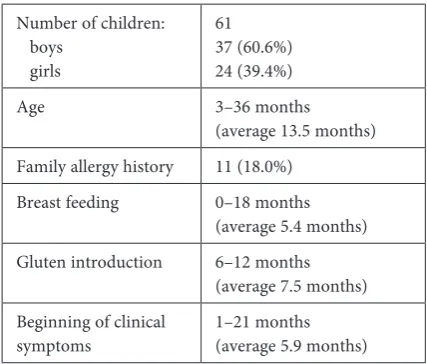
Material and Methods. The study was comprised of 61 children (37 boys and 24 girls, aged 3 to 36 months, average age 13.5 months). Their medical history might have indicated a connection between the symptoms and ingested food. In all the children, an atopy patch test and a skin prick test with native food allergens were carried out. Table 1 presents the characteristics of the studied patients. Diagnosis of allergy to cow’s milk protein and to wheat was verified in the open food challenge.
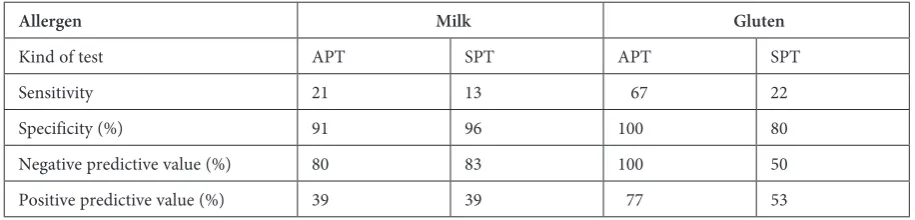
Results. Sensitivity of aPT for milk was 21%, specificity – 91%, PPV – 80%, NPV – 39% and for wheat – 67%, 100%, 100% and 77%, respectively (Table 4). for the skin prick test, sensitivity, specificity, PPV and NPV were 13%, 96%, 83% and 39% for milk and 22%, 80%, 50% and 53% for wheat.
Conclusions. aPT demonstrates high sensitivity and high specificity in the diagnosis of allergy to wheat in children with gastrointestinal symptoms. The sensitivity of aTP in the detection of allergy to cow’s milk in children with gastrointestinal symptoms was low and therefore the diagnosis should be verified by challenge tests (Adv Clin Exp Med 2014, 23, 3, 403–409).
Key words: food allergy, gastrointestinal symptoms, atopy patch test, children.
adv Clin Exp Med 2014, 23, 3, 403–409 ISSN 1899–5276
ORIGINaL PaPERS
© Copyright by Wroclaw Medical University
In recent years, food allergy, especially in the child population, has become an increasing prob-lem in developed societies [1–4]. In the youngest children, it is a frequent cause of gastrointestinal sickness. Clinical symptoms are engendered by an inappropriate immunologic response to proteins present in food. 90% of the cases are instigated by antigens of cow’s milk, hen eggs, soy, wheat, peanut tree nuts, fish and shellfish [5]. Reactions of hyper-sensitivity may appear directly after the consump-tion of allergic food and as such they represent an IgE-dependent reaction (type I Gell-Coombs re-action) or may appear several hours afterwards and are late reactions of a cellular type (type IV Gell-Coombs reaction). according to the current
in patients with atopic dermatitis and only recent-ly has it been recognized that food allergens have also dominated works in the literature for a long time on atopic patch tests in patients with atopic dermatitis [6–8]. The early opinion that a skin patch test is an eczematous reaction in patients with eczema and that the result of that test in pa-tients without atopic dermatitis may only be nega-tive has not been confirmed [20]. In recent years, a greater attention has begun to be paid to the IgE- -independent mechanism, since it has turned out to be very frequent and even predominant in the case of symptoms in the gastrointestinal system. Based on meticulous studies, it has been found that the symptoms of the alimentary tract are evoked by an IgE-independent mechanism with an inap-propriate response of T regulatory lymphocytes. In this situation, an increased production of IgE an-tibodies is absent and mastocytes linked to these antibodies are not abundant in the skin, therefore, commonly-used skin prick tests are negative and specific IgE antibodies in the blood are not detect-ed. Contrary to the skin prick test, the atopy patch test with food allergens, introduced recently to clinical practice, may detect IgE-independent re-actions and may be a good method in the diagno-sis of late allergic reactions [16–18].
a number of papers dealing with the utility of the food atopy patch test in food allergy in infants and children with atopic dermatitis has been pub-lished [16–20] but only a few have estimated the utility of these test in children with gastrointesti-nal symptoms [23–27]. The continuous search for new methods with high specificity and sensitivity is aimed at the introduction of necessary elimina-tion diets but also at the avoidance of unnecessar-ily wide restrictive diets.
Objective of the Work
The objective of the work was the assessment of the diagnostic value of atopy patch tests in the diagnosis of allergy to cow’s milk protein and to wheat in children with gastrointestinal symptoms.
Material and Methods
The study comprised 61 children (37 boys and 24 girls, aged 3 to 36 months, average age 13.5 months) who were hospitalized in the Clinic of Gastroenterology and Nutrition in Wrocław in the years 2010–2011 due to gastroenterological symp-toms such as regurgitation, vomiting, diarrhea, abdominal pain, lower abdominal tract bleeding, constipation, failure to thrive and malnutrition.
a medical history of those patients might have dicated the connection of these symptoms with in-gested food. Children with atopic dermatitis and alimentary tract infection were excluded from the study; and in children on gluten containing di-et celiac disease was excluded (negative tis-sue transglutainase and/or endomysium anti-bodies). In all children, atopy patch tests and a skin prick test with native food allergens were per-formed. Since milk and wheat belong to the most frequent food allergens, a food challenge with milk was performed in all 61 children from the study group and, independently, in 19 of them, a food challenge with wheat. Table 1 presents the charac-teristics of the studied patients. a diagnosis of al-lergy to cow’s milk protein and to wheat was veri-fied in an open food challenge.
Atopy Patch Test
atopy patch tests were applied to the skin of the child’s back by using standard aluminum cups of an internal diameter of 8 mm on adhesive tape (finn Cahmber Epitest Ltd., finland). Native foods were put into the chamber: 3.2% cow’s milk and wheat suspended in physiologic salt at a con-centration of 1 g per 10 mL. Microcellulose served as a negative control. after 20 min, the sites of the test application were checked for immediate reac-tions. The results of the test were red after 48-h occlusion: preliminary result – 15 min after occlu-sion removal and final result – 72 h after applica-tion of the test. according to the common rules of aPT reading [28–29], a lack of skin reaction (0) and only redness (–) were treated as a negative re-sult. Redness and infiltration (+), redness, infiltra-tion and papules (++), redness, infiltrainfiltra-tion and nu-merous confluent papules and vesicles (+++) were treated as a positive result [29].
Table 1. Characteristics of studied children
Number of children: boys
girls
61 37 (60.6%) 24 (39.4%) age 3–36 months
(average 13.5 months) family allergy history 11 (18.0%)
Breast feeding 0–18 months (average 5.4 months) Gluten introduction 6–12 months
(average 7.5 months) Beginning of clinical
Skin Prick Test
a skin prick test with native foods was per-formed with 3.2% cow’s milk and wheat flour sus-pended in a concentration of 1 g in 10 mL of sa-line. a drop of prepared allergen was applied to the skin of the inner side of the forearm. Codeine 9% solution was a positive control and physiolog-ic saline – a negative control. The results were read after 15 min. a blister with a diameter equal to or greater than 3 mm was treated as a positive result.
Food Challenge
Due to the young children’s age, the food chal-lenge was performed using the open method af-ter at least 4 weeks of an elimination diet. accord-ing to the method recommended by EaaCI, the dose of the challenging allergen was increased ev-ery 30 min. The challenge was done after a labial test. The initial dose of milk was 0.1 mL and the increments were a doubling of the previous dose every 30 min until the top dose was reached or an allergic reaction appeared. The initial dose of wheat was 100 mg and the incremental scheme was similar. The reaction was regarded as a posi-tive when the adverse symptoms appeared not lat-er than two hours aftlat-er the last dose of alllat-ergen. The patient was followed for 48 h in the clinic and, after that, at home under the supervision of a phy-sician. Either an early or late reaction was regard-ed as positive.
Statistical Analysis
In the statistical analysis, sensitivity, specifici-ty and positive and negative predictive values were calculated. for the calculation of sensitivity, speci-ficity and positive (PPV) and negative (NPV) pre-dictive values, SPSS v. 8.0 software was used.
Results
from the 61 children in whom the provoca-tion challenge was performed, in 39 (64%) an al-lergy to cow’s milk protein was confirmed: in two of them an early reaction was observed (vomiting, skin rush), with late reactions in the remaining. 19 children underwent elimination and a provoca-tion challenge with wheat. In nine of them (47%), hypersensitivity to gluten with late gastrointestinal symptoms was confirmed and in only one an early reaction was also observed (lids edema). an anal-ysis of gastrointestinal symptoms is presented in Table 2.
Table 3 presents the results of skin prick tests (SPT) and atopy patch tests (aPT) in the analyzed patients. a positive aPT result for cow’s milk was obtained in 10 children and in 8 of them, the food allergy was confirmed by a challenge test with milk. Positive SPT results were observed in only five chil-dren with a confirmed allergy to cow’s milk pro-tein. Positive results of aPT for wheat flour were observed in 6 children and only in children with a confirmed allergy. SPT with wheat flour was pos-itive in four children.
Table 2. Clinical symptoms in children with confirmed food allergy to cow’s milk and/or gluten
Symptom Allergy to cow’s milk
Total 39 children Total 22 childrenAllergy to gluten
number (%) number (%)
failure to thrive 10 25.6 6 27.3
Chronic diarrhea 5 12.3 5 22.7
Recurrent diarrhea 5 12.3 4 18.2
Bloody stools 9 23.0 1 4.6
Perineal pathology 6 15.3 1 4.6
Regurgitations or vomiting 13 33.3 0 0
Bloody vomiting 2 5.1 0 0
Colic, abdominalgia 10 25.6 0 0
Constipation 2 5.1 2 9.1
The sensitivity of aPT for milk was 21%, spec-ificity – 91%, PPV – 80%, NPV – 39% and for wheat – 67%, 100%, 100% and 77%, respectively (Table 4). for the skin prick test, sensitivity, speci-ficity, PPV and NPV were 13%, 96%, 83% and 39% for milk and 22%, 80%, 50% and 53% for wheat, respectively.
Discussion
Gastrointestinal symptoms suggesting food allergy such as vomiting, regurgitation, diarrhea and failure to thrive may rapidly lead to malnu-trition and therefore to severe symptoms of aller-gy. In our material, malnutrition was observed in more than 50% of children (body mass below 3rd
percentile). In our other study [30], in which the causes of malnutrition in children younger than three years, hospitalized in the gastroenterology unit, were evaluated, we observed that the most frequent reason for malnutrition was untreat-ed, both diagnosed and undiagnosed food aller-gy. Besides malnutrition, the most frequent symp-toms in the studied group of children were failure to thrive or even anorexia, colic/anxiety, diarrhea,
regurgitation and vomiting. The prompt establish-ment of a diagnosis and identification of sensitiz-ing food requires proper diagnostic methods with high sensitivity and specificity. The atopy patch test is a relatively new diagnostic method used in allergology [14, 15]. Most of the studies on the at-opy patch test estimated their utility in diagno-sis of allergy to milk, egg, soy and wheat in atopic dermatitis [16–22]. Only scarce studies evaluated the utility of aPT in allergy with gastrointestinal symptoms [23–26, 29].
In our work we tried to determine the utility of aPT in the diagnosis of allergy to cow’s milk and wheat in children with symptoms from the gastro-intestinal tract. In our study, the sensitivity of the test (milk 91%, wheat 100%) and its positive predic-tive value (milk 80%, wheat 100%) were high, and for wheat, the specificity and negative predictive values were also high (67% and 77%, respectively). all the parameters of aPT were better than those of SPT, which might confirm that for the symp-toms of allergy to cow’s milk and to wheat, in most cases an IgE-independent mechanism might be re-sponsible. In the case of cow’s milk, low sensitivity (21%) and low negative predictive value (39%) in-dicate that the negative result of the test does not
Table 3. Results of skin prick test and atopy patch tests in children with positive and negative result of food challenge for milk and wheat
Positive challenge for milk (39 children) Negative challenge for milk (22 children)
Test SPT APT SPT APT
Result + – + – + – + –
Number 5 34 8 31 1 21 2 20
Rate (%) 12.8 87.2 20.5 79.5 4.5 95.5 9.1 90.9
Positive challenge for wheat (9 children) Negative challenge for wheat (10 children)
Test SPT APT SPT APT
Result + – + – + – + –
Number 2 7 6 3 2 8 0 10
Rate (%) 22.2 77.8 66.7 33.3 20.0 80.0 0 100.0
Table 4. Utility of atopy patch tests and skin trick tests in diagnosis of food allergy in children with gastrointestinal symp-toms
Allergen Milk Gluten
Kind of test aPT SPT aPT SPT
Sensitivity 21 13 67 22
Specificity (%) 91 96 100 80
allow excluding the allergy and that an elimination and provocation challenge are indispensable. Con-trarily, a high specificity and positive predictive value might make it possible to omit a provocation challenge for both allergens, milk and wheat, since the risk of allergy in that case is very high.
Darsow et al. [31], in a multicenter study on a large group of patients with atopic dermatitis, obtained high specificity of aPT for wheat (91%) but low sensitivity (30%). Similarly, a high sensi-tivity of aPT in patients with atopic dermatitis was obtained by Tesse et al. [32] and the specificity of the test was also high (100% and 95%, respective-ly). In Polish literature, the first studies on the util-ity of aPT in the diagnosis of allergy in children were from a Białystok center [17]. In the study, comprising 27 children younger than three years with symptoms from the skin and alimentary tract which indicated food allergy, the sensitivity and specificity of aPT were 82% and 69%, respective-ly. In comparison to SPT and a specific IgE atopy patch test, they demonstrated significantly high-er specificity which allowed for detection of allhigh-er- aller-gy in children with late symptoms after milk con-sumption who had negative results of a skin prick test. Subsequent research of these authors demon-strated higher sensitivity and specificity of aPT in the diagnosis of allergy in children with atopic der-matitis in comparison to IgE-dependent tests (the skin prick test, specific IgE) not only for cow’s milk protein but also for cereals and soy protein [33]. The usefulness of aPT in children with suspi-cion of milk allergy and atopic dermatitis has been studied by Krogulska et al. [34]. The above-men-tioned authors obtained high specificity and high positive predictive value (87.5% and 87.4%, respec-tively), however, the sensitivity and negative pre-dictive value were lower (54.5% and 58.5%, respec-tively). Specificity and positive predictive value are higher than sensitivity and negative predictive val-ue in most studies, which could indicate that aPT in patients with atopic dermatitis is more useful for confirmation of allergy than for exclusion of it both for cow’s milk and wheat, which is similar to the results obtained in our work, but conduct-ed in patients with symptoms from the gastroin-testinal tract.
The number of studies evaluating aPT in pa-tients with gastrointestinal symptoms of allergy is significantly smaller. Canani et al. [26] studied children with gastrointestinal symptoms and used patch tests with both native allergens and commer-cial tests with milk and wheat. Besides unequivo-cally better results with native allergens than with commercial tests, the specificity of the test was al-so better than its sensitivity for both allergens,
however, the small sample size with wheat did not allow for strong conclusions. Cudowska et al. [22] conducted studies on aPT in patients with gastro-intestinal symptoms after milk consumption and obtained similar sensitivity, specificity and posi-tive predicposi-tive values (77%, 73 % and 71%, respec-tively) but a low negative predictive value (21%), which would confirm the better utility of aPT for confirmation of allergy in this group of patients than for exclusion of it. It seems that apparent dif-ferences in sensitivity and specificity may result from the amount of the extract in chambers, and the kind of solution – physiologic saline, water and a concentration of allergen. The use of native al-lergens seems to be more effective than the use of commercial tests. The use of aluminum chambers of 12 mm diameter seems to be more effective than the use of smaller chambers but there is a lack of unanimous recommendations.
Reading of the reaction results after 72 h also has its significance in the estimation of sensitivity and specificity of aPT. Heine et al. [27] demon-strated that the highest concordance of aPT with the results of the challenge for cow’s milk, wheat flour, hens’ egg and soy was observed with the pres-ence of infiltration and of seven or more papules in the place of occlusion on the skin. also, in children with gastrointestinal symptoms of allergy, Canani et al. [29] demonstrated a higher specificity and positive predictive value of the patch test when the edema/infiltration and papules were present con-comitantly. The above results may serve as a stan-dard for the reading of aPT results.
In spite of the progress of the studies on aller-gic mechanisms leading to particular gastrointesti-nal symptoms and the efforts to standardize atopic patch tests in all recommendations and standards elaborated by expert panels [1, 2, 8, 24, 36, 37], a positive result of the test with a particular aller-gen is treated as the detection of a potential can-didate which is responsible for clinical symptoms of allergy, however, a conclusive diagnosis is made only after provocation challenge.
Based on our work, it seems that the provo-cation challenge is more necessary in the case of a negative result of the test.
References
[1] Kaczmarski M, Wasilewska J, Jarocka-Cyrta E, Cudowska B, Żur E, Matuszewska E, Stańczyk-Przyłuska A, Zeman K, Kamer B, Korotkiewicz-Kaczmarska E, Czaja-Bulsa G, Czerwionka-Szaflarska M, Iwańczak B, Iwańczak F, Kamińska B, Korzon M, Maciorkowska E, Obuchowicz A, Socha J, Walkowiak J, Wąsowska- -Królikowska K, Woś H, Grzybowska-Chlebowczyk U, Toporowska-Kowalska E, Fyderek K, Adamska I, Kwiecień J, Jastrzębska-Piotrowska J: Polish statement on food allergy in children and adolescents. Post Dermatol alergol 2011, 28, 5, 331–367.
[2] Fiocchi A, Brozek J, Schunemann H, Bahna SL, von Berg A, Beyer K, Bozzola M, Bradsher J, Compalati E, Ebisawa R, Guzman MA, Li H, Heine RF, Keith P, Lack G, Landi M, Martelli R, Hugh FR, Stein SA, Terracciano L, Vieths S: World allergy Organization (WaO) Diagnosis and Rationale for action against Cow’s Milk allergy (DRaCMa) Guidelines. Pediatr allergy Immunol 2010, 21, Suppl. 21, 1–125.
[3] Kaczmarski M, Cudowska B, Bandzul K: Częstość występowania nadwrażliwości pokarmowej u niemowląt w regionie północno-wschodniej Polski. Nowa Pediatria 1999, 4, 26–28.
[4] Rona RJ, Keil T, Summers C, Gislason D, Zuidmeer L, Sodergren E, Sigurdardottir ST, Lindner T, Goldhahn K, Dahlstrom J, McBride D, Madsen C: The prevalence of food allergy meta-analysis. J allergy Clin Immunol 2007, 120, 638–646.
[5] Kaczmarski M: Nadwrażliwość pokarmowa u dzieci i młodzieży. Stand Med Pediatria 2009, 6, 379–398. [6] Vickery BP, Chin S, Burks AW: Pathophysiology of food allergy. Pediatr Clin North am 2011, 58, 363–376. [7] Sicherer SH, Sampson HA: food allergy. J allergy Clin Immunol 2010 125, Suppl. 2, 116–125.
[8] Boyce JA, Assa’ad A, Burks AW, Jones SM, Sampson HA, Wood RA, Plaut M, Cooper SF, Fenton MJ, Arshad SH, Bahna SL, Beck LA, Byrd-Bredbenner C, Camargo CA Jr, Eichenfield L, Furuta GT, Hanifin JM, Jones C, Kraft M, Levy BD, Lieberman P, Luccioli S, McCall KM, Schneider LC, Simon RA, Simons FE, Teach SJ, Yawn BP, Schwaninger JM: Guidelines for the diagnosis and Management of food allergy in the United States, Report of the NaIaID-Sponsored Expert Panel. J allergy Clin Immunol 2010, 126, 1–58.
[9] Bischoff S, Crowe SE: Gastrointestinal food allergy, new insights into pathophysiology and clinical perspectives. Gastroenterology 2005, 128, 1089–1113.
[10] Sampson HA, Anderson JA: Summary and recommendations, Classification of gastrointestinal manifestations due to immunologic reactions to foods in infants and young children. J Pediatr Gastroenterol Nutr 2000, 30, 87–94.
[11] Bonéa J, Clavera A, Guallara I, Plazab AM:allergic proctocolitis, food-induced enterocolitis, immune mecha-nisms, diagnosis and treatment. allergo et Immunopathol 2009, 37, 36–42.
[12] Wąsowska-Królikowska K, Krogulska A: alergia przewodu pokarmowego u dzieci, przebieg kliniczny, diagno-styka, leczenie. Przegl Pediatr 2006, 33, 125–133.
[13] Binddsler-Jansen C, Bollmer-Wehler U: Standardization of food challenges in patients with immediate reac-tions to foods – position paper from European academy of allergy and Clinical Immunology. allergy 2004, 59, 690–697.
[14] Isolauri E, Turjanmaa K: Combined skin prick and patch testing enhances identification of food allergy in infants with atopic dermatitis. J allergy Clin Immunol 1996, 97, 9–15.
[15] Niggemann B, Reibel S, Wahn U: The atopy patch test (aPT) – a useful tool for the diagnosis of food allergy in children with atopic dermatitis. allergy 2000, 55, 281–285.
[16] Roehr CC, Reibel S, Ziegert M. Sommerfeld C, Wahn U, Niggemann B: atopy patch tests, together with deter-mination of specific IgE levels, reduce the need for oral food challenges in children with atopic dermatitis. J allergy Clin Immunol 2001, 107, 548–553.
[17] Cudowska B, Kaczmarski M: atopy patch test in the diagnosis of food allergy in children with atopic eczema dermatitis syndrome. Rocz akad Med Bialymst 2005, 50, 261–267.
[18] Strömberg L: Diagnostic accuracy of the atopy patch test and the skin-prick test for the diagnosis of food allergy in young children with atopic eczema/dermatitis syndrome. acta Paediatr 2002, 91, 1044–1049.
[19] Hansen TK, Host A, Bindslev-Jensen C: an evaluation of the diagnostic value of different skin tests with egg in clinically egg-allergic children having atopic dermatitis. Pediatr allergy Immunol 2004, 15, 428–434.
[20] Ronchetti R, Jesenak M, Trubackova D, Pohanka V, Villa MP: Epidemiology of atopy patch tests with food and inhalant allergens in an unselected population of children. Pediatr allergy Immunol 2008, 19, 599–604.
[21] Ranc F: What is the optimal occlusion time for the atopy patch test in the diagnosis of food allergies in children with atopic dermatitis? Pediatr allergy Immunol 2004, 15, 93–96.
[22] Cudowska B, Kaczmarski M: atopy patch test in diagnosis of food allergy in children with gastrointestinal symp-toms. adv Medic Scienc 2010, 55, 153–160.
[23] Mehl A, Rolinck-Werninghaus C, Staden U, Verstege A, Wahn U, Beyer K, Niggemann B: The atopy patch test in the diagnostic workup of suspected food-related symptoms in children. J allergy Clin Immunol 2006, 118, 923–929.
[24] Canani RB, M. Costanzo D, Troncone R: The optimal diagnostic workup for children with suspected food allergy. Nutrition 2011, 27, 983–987.
[25] Mitchell EB, Crow J, Chapman MD: Basophils in allergen-induced patch test sites in atopic dermatitis. Lancet 1982, 1, 127–130.
[27] Heine RG, Verstege A, Mehl A, Staden U, Rolinck-Werninghaus C, Niggemann B: Proposal for a standardized interpretation of the atopy patch test in children with atopic dermatitis ad suspected food allergy. Pediatr allergy Immunol 2006, 17, 213–217.
[28] Turjanmaa K, Darsow U, Niggemann B, Rancé F, Vanto T, Werfel T: EaaCI/Ga2LEN Position paper, present status of the atopy patch test. allergy 2006, 61, 1377–1384.
[29] Canani BR, Buongiovanni A, Nocerino R, Cosenza L, Troncone R: Toward a standardized reading of the atopy patch test in children with suspected cow’s milk allergy-related gastrointestinal symptoms. allergy 2011, 66, 1494–1500. [30] Mowszet K, Piasecka A, Reich M, Iwańczak B: Przyczyny niedożywienia u dzieci do lat pięciu w materiale
własnym. adv Clin Exp Med 2005, 14, 315–322.
[31] Darsow U, Laifaoui J, Kerschenlohr K, Wollenberg A, Przybilla B, Wüthrich B, Borelli S Jr, Giusti F, Seidenari S, Drzimalla K, Simon D, Disch R, Borelli S, Devillers AC, Oranje AP, De Raeve L, Hachem JP, Dangoisse C, Blondeel A, Song M, Breuer K, Wulf A, Werfel T, Roul S, Taieb A, Bolhaar S, Bruijnzeel-Koomen C, Brönnimann M, Braathen LR, Didierlaurent A, André C, Ring J: The prevalence of positive reactions in the atopy patch test with areoallergens and ford allergens in subjects with atopic eczema, a European multicenter study. allergy 2004, 59, 1318–1325.
[32] Tesse R, Miniello VL, Fieromonte P: The diagnostic value of atopy patch test (aPT) with regard to late-phase clinical reactions to food in children with atopic dermatitis. allergy Clin Immunol 2004, 113, 290–297.
[33] Cudowska B, Kaczmarski M: atopowe testy płatkowe w diagnostyce alergii pokarmowej typu późnego u dzieci. Ped Pol 2008, 1, 13–19.
[34] Krogulska A, Wąsowska-Królikowska K, Dynowski J: Przydatność atopowych testów płatkowych z alergenami pokarmowymi w diagnostyce alergii pokarmowej u dzieci z atopowym zapaleniem skóry. Przegl Pediatr 2007, 37, 245–249.
[35] Heine RG, Verstege A, Mehl A, Staden U, Rolinck-Werninghaus C, Niggemann B: Proposal for a standardized interpretation of the atopy patch test in children with atopic dermatitis ad suspected food allergy. Pediatr allergy Immunol 2006, 17, 213–217.
[36] Vandenplas Y, Brueton M, Dupont C, Hill D, Isolauri E, Koletzko S, Oranje AP, Staiano A: Guidelines for the diagnosis and management of cow’s milk protein allergy in infants. arch Dis Child 2007, 92, 902–908.
[37] Koletzko S, Niggemann B, Koletzko B: Vorgehen bei Sauglingen mit Verdacht auf Kuhmilchproteinallergie. Monatsschr Kinderheilkd 2009, 157, 687–691.
Address for corresponcence:
Krzysztof Matusiewicz
Department of Pediatrics, Gastroenterology and Nutrition Wroclaw Medical University
M. Curie-Skłodowskiej 50/52 50-369 Wrocław
Poland
Tel.: +48 71 77 03 057 e-mail: [email protected]
Conflict of interest: None declared