T
OMASZG
RABOWSKI1, S
TANISŁAWW. G
UMUŁKA2, B
EATAB
ORUCKA1,
W
IESŁAWR
ASZEWSKI1Analysis Relationships Between Pharmacokinetic
Parameters in silico/in vivo
of Selected Antiviral Drugs
Based on Structural Analysis*
Analiza zależności parametrów farmakokinetycznych
in silico
/
in vivo
wybranych leków przeciwwirusowych
na podstawie analizy budowy cząsteczki
1Filab Center of Pharmacokinetics Research, Ravimed Sp. z o.o., Legionowo/Lajski, Poland 2Department of Pharmacodynamics, Medical University of Warsaw, Poland
Adv Clin Exp Med 2008, 17, 3, 285–292 ISSN 1230−025X
ORIGINAL PAPERS
© Copyright by Silesian Piasts University of Medicine in Wrocław
Abstract
Background.Pharmacokinetic calculations in silicoare the main e−ADME verification tool. Besides forecasting a drug’s pharmacokinetic parameters, one aim for this kind of analysis is the retrospective evaluation of a drug’s pharmacokinetics in vivo.
Objectives.The aim of the analysis was to calculate the physiochemical parameters of selected drugs used in the treatment or prevention of influenza and compare them with selected in vivopharmacokinetic data.
Material and Methods.Selected topological, constitutional, geometric, and electrostatic parameters of amanta− dine, rimantadine, carboxyoseltamivir, oseltamivir, and zanamivir were calculated. The parameters were correlat− ed with data illustrating the pharmacokinetics of these drugs in vivoto determine in silico/in vivo(ADME/e−ADME) correlations.
Results.Significant differences in LogP values between adamantadane derivatives and oseltamivir and zanamivir were found. Amantadine’s and rimantadine’s PSA values were low and satisfied the conditions of the rule of five, which clearly forecasts high bioavailability. All the analyzed drugs had completely different aPSA to PSA ratios, which means that in vivoSASA, and thus the possibility of disposition in the body, has a high to low sequence of rimantadine > amantadine > oseltamivir and very low for zanamivir, which is reflected in the formulation of the drug.
Conclusions.The lipophilicities (LogP and LogD) of both the rimantadine and amantadine molecules are reflect− ed by the half−lives of the drugs. The decidedly lipophilic character of both molecules combined with very low tPSA and PSA values results in relatively high values of distribution in vivo. In carboxyoseltamivir and zanamivir,
the in vivodistribution volumes are small and the half−lives of the drugs are short. The reasons for this include the
hydrophilicity and the large polar surface area of their molecules. The significant hydrophilicity of both drugs is also a reason for their large total clearance in vivo(Adv Clin Exp Med 2008, 17, 3, 285–292).
Key words:CLogP, PSA, rimantadine, bioavailability, pharmacokinetics.
Streszczenie
Wprowadzenie.Analiza farmakokinetyczna w płaszczyźnie in silicojest jednym z najważniejszych narzędzi we− ryfikacji potencjalnej charakterystyki DMPK (drug metabolism and pharmacokinetics) leku. Jednym z kierunków wykorzystania narzędzi obliczeniowych SAR (structure activity relationship) jest retrospektywna analiza porów− nawcza parametrów farmakokinetycznych uzyskanych w doświadczeniach in vivoz wynikami analizy in silico.
Cel pracy. Obliczenie parametrów fizjochemicznych wybranych leków stosowanych w leczeniu lub profilaktyce grypy w odniesieniu do poznanych wartości parametrów farmakokinetycznych tych leków uzyskanych in vivo.
At least several hundred different drug fea− tures are currently taken into account in SAR (structure−activity relationship) and similar analy− ses. Besides forecasting a drug’s pharmacokinetic parameters, one aim of this kind of analysis is the retrospective evaluation of the drug’s pharmacoki− netics in vivo. One of the known and frequently calculated SAR parameters is the octanol−water partition coefficient (LogP) and the polar surface area (PSA). The octanol−water partition coefficient is a parameter that, to some extent, defines drug molecules’ ability to pass through biological mem− branes. The merely partial possibility to define the parameter precisely is a result of the complex character of the drug’s distribution in lipophilic tissues. Lipophilicity results from the hydrophilic− ity and polarity of a molecule. Hydrophilicity can be defined as the capacity to dissolve in water, but polarity is a much more complex parameter. Polarity is most frequently presented as the resul− tant ensue[*?] of the interaction of a substance (drug) with three kinds of solvents: ethanol (a strongly polar proton donor), dioxane (a weakly polar proton donor), and nitromethane (a strongly polar proton acceptor).
Lipophilicity is one of the most important physiochemical parameters influencing bioavail− ability and the apparent volume of drug distribu− tion. It is, however, a parameter that provides information of a very complex character. At pre− sent this index is calculated according to algo− rithms and relationships determined on the basis of experimental data for many thousand compounds and with the use of appropriate software [1]. The most frequently applied algorithms allow calculat− ing LogKOW (U.S. Environmental Protection Agency), MiLogP [2–4], CLogP [5], LogP Broto [6], and many others. High LogP values (strongly and extremely lipophilic drugs) are not always connected with high bioavailability. The reason
for this is the binding of extremely lipophilic drugs in membrane substructures with a high affinity for this kind of drug. This, in turn, hinders transfer in hydrophilic spaces and further distribution of the drug in the body [7]. In extreme cases the drug may not even be subject to absorption, as in the case for paraffin oil. High lipophilicity, i.e. LogP5 (the rule of five), is usually linked with augment− ed affinity for the P−gp protein, higher affinity for CYP enzymes, and higher variability in the phar− macokinetic parameters of the drug, including an intensified “first passage” effect. Very highly lipophilic compounds are usually also weakly polar; hence, the mean resistance time of this kind of molecule and its half−life (t1/2) are usually
longer. Elimination of this kind of compound via the renal pathway with urine requires the previous participation of the proper enzymatic systems which transform the molecule into a more polar form. Strongly lipophilic drugs usually bind to proteins to a large extent and have large apparent distribution volumes, which is usually positively correlated with their effectiveness.
Because these drugs are electrolytes, lipo− philicity depends on the degree of dissociation and it is possible to calculate LogD based on the dis− sociation constant pK. LogD is similar to LogP but takes into consideration changes in lipophilicity depending on the degree of dissociation in a buffer, for example with pH 7.4, i.e. close to that of blood plasma. Strongly hydrophilic drugs (LogP > –4) are those that usually achieve small distribution volumes, bind weakly to proteins (and thus have a weak affinity to the CYP enzyme fam− ily), are most frequently eliminated via the renal pathway, and have a short elimination half−life.
Polar surface area (PSA) is a physicochemical parameter linked closely to bioavailability [8]. At present, an equally large cognitive role is attrib− uted to this parameter as to that of LogP. This
trycznych i elektrostatycznych amantadyny, rymantadyny, karboksyoseltamiwiru, oseltamiwiru i zanamiwiru. Uzy− skane wartości odniesiono do znanych parametrów farmakokinetycznych wybranych leków porównując wartości w środowiskach in silico/in vivo(ADME/e−ADME) (absorption, distribution, metabolism, elimination).
Wyniki. Uzyskane wyniki ilustrują duże zróżnicowanie analizowanych leków pod względem ich lipofilności wy− rażonej jako LogP. Amantadyna i rymantadyna charakteryzują się małą wartością PSA (polar surface area), co pre− dysponuje je do łatwego transportu biernego przez błony biologiczne. Wszystkie analizowane związki charaktery− zuje duże zróżnicowanie stosunku aPSA (apolar surface area) do PSA, co ma odniesienie do dostępności biolo− gicznej leków in vivo odpowiednio najwyższej dla rymantadyny > amantadyny > oseltamiwiru, oraz bardzo niewielkiej dla zanamiwiru, co w tym wypadku znalazło odniesienie w zastosowanej dla tej cząsteczki postaci leku.
Wnioski.Zarówno w przypadku amantadyny, jak i rymantadyny wyższe wartości LogP mają odniesienie do dłuż− szych okresów półtrwania leku in vivo. Zdecydowanie lipofilny charakter obu cząsteczek w połączeniu z małą war− tością PSA umożliwia łatwą dystrybucję leku in vivo. W przypadku oseltamiwiru i zanamiwiru zarówno objętość dystrybucji, jak i okres półtrwania w fazie eliminacji uzyskują małe wartości. Przyczyną tego stanu są większa hy− drofilność obu cząsteczek oraz większe wartości PSA. Skutkuje to również wyższym od lipofilnych cząsteczek kli− rensem in vivo(Adv Clin Exp Med 2008, 17, 3, 285–292).
applies especially to the analysis of e−ADME of a drug for forecasting the level of bioavailability and its later disposition in the body. This has been confirmed based on SAR analyses of most of the currently known drugs indexed in the World Drug Index. The vast majority of drugs possessing a PSA value <140 A2 show high bioavailability,
reaching 90% or more. For the majority of drugs, high PSA values (PSA >250 A2) are connected
with significantly decreased bioavailability as well as distribution possibilities and the ability to pene− trate consecutive membrane systems in vivo. The topological polar surface area tPSA is a derivative of PSA and its analysis is performed mainly based on analysis of the substituents of a compound. Analysis of the ratio of apolar surface area (aPSA) to polar surface area (PSA) makes it possible to determine the surface area of a drug accessible to a solvent (SASA). Thus the comparison of the aPSA/PSA ratio makes it possible to perform a comparative analysis of several compounds with various molecular volumes, spherical shapes, fold− ing, geometry, and molecular weights. Significant differences in PSA and the aPSA to PSA ratio indi− cate not only differences in drugs’ bioavailability, but also differences in affinity and the quality of drug transfer to various spaces of the biophase.
It was decided to verify the prognostic signif− icance of the above considerations in practice. The aim of the analysis was to calculate the physico− chemical parameters of selected drugs used in the treatment and prevention of influenza. These para− meters were compared with data illustrating the pharmacokinetics of those drugs in vivoin order to determine in silico/in vivo(ADME/e−ADME) cor− relations.
Material and Methods
Calculations of selected topological, constitu− tional, geometric, and electrostatic parameters of amantadine, rimantadine, carboxyoseltamivir,
oseltamivir, and zanamivir were performed. The selection of carboxyoseltamivir was justified by the fact that the compound is an active metabolite. The preliminary SAR analysis of amantadine, rimantadine, oseltamivir, and zanamivir required the transformation of the stoichiometric formulas of the above compounds into a SMILES code (Simplified Molecular Input Line Entry System). The program ACD Chem/Sketch v. 5.12/22 Mar 2002 (www.acdlabs.com) was used for this pur− pose. The SMILES code was applied to calculate LogP values in two variants (LogKOW, CLogP) and tPSA (Tab. 1). LogKOW was calculated with the Epiwin v. 3.10 software provided by the U.S. Environmental Protection Agency (www.epa.gov. com). CLogP was calculated with the ALOGPS 2.1 program. The other calculations were per− formed using the Java applet Molinspiration (www.molinspiration.com) and the preADMET software (Research Institute of Bioinformatics & Molecular Design, Korea; http://preadmet.bmdrc. org/pradmet/index.php). Calculations of PSA and aPSA (r=1.4 A) were performed with the Vega Open GL Standard software ed., release 1.5.0.92 (www.ddl.unimit.it/vega/index_noanim.htm) [9, 10]. The analysis of the significance of the results obtained for groups of parameters (permeability and aPSA/PSA) was performed with Student’s t
test. Differences with P < 0.05 were considered statistically significant.
Results
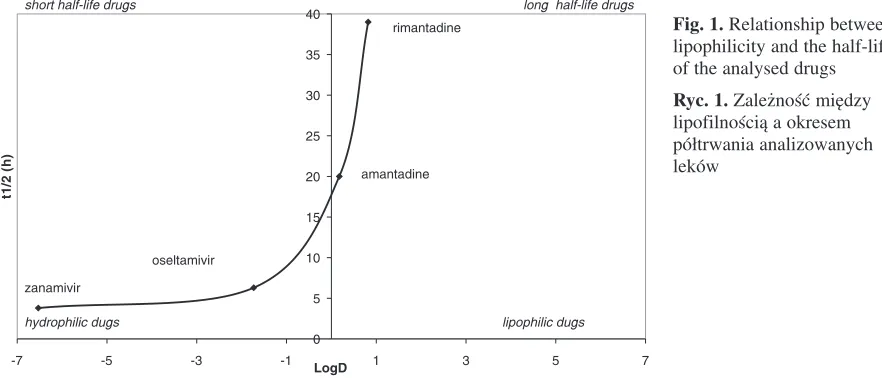
The lipophilicity sequence of the analyzed compounds from highest to lowest was shown to be rimantadine > amantadine > carboxyo− seltamivir > zanamivir (Tab. 2). The same is true for the LogD value. Increased lipophilicity (both for LogP and LogD) fully corresponded to long mean half−life (Fig. 1). The values show signifi− cant differences in LogP between adamantadane derivatives and oseltamivir and zanamivir.
Substance SMILES notation (Substancja) (Zapis SMILES)
Rimantadine CC(C12CC3CC(C1)CC(C3)C2)N Amantadine C1C2CC3CC1CC(C2)(C3)N
Carboxy NC1C\C(=C/C(OC(CC)CC)C1NC(C)=O)C(O)=O Oseltamivir
Zanamivir CC(=O)NC1C(C=C(OC1C(C(CO)O)O)C(=O)O)N=C(N)N Oseltamivir CCC(CC)OC1C=C(CC(C1NC(=O)C)N)C(=O)OCC
Table 1. SMILES codes applied for the calculations
Tabela 1. Kody SMILES zaadoptowane do analizy
Rimantadine is the drug with the highest LogP value in the whole analyzed group. However, the calculated value does not suggest extreme lipophilicity of the drug. In the analyzed group, only rimantadine has lipophilicity of a value con− sistent with the currently preferred range of the rule of five and the rule of three. The lipophilicity analysis performed using several different algo− rithms makes it possible to classify rimantadine and amantadine as weakly lipophilic drugs. Oseltamivir and zanamivir have LogP values char− acteristic for both weakly (oseltamivir) and strong− ly (zanamivir) hydrophilic drugs [1].
The Wienner and Balaban indexes make it pos− sible to classify a chemical compound as similar to currently known drugs (drugability). Besides these indexes, calculations were also performed for MDCK membrane permeability, Caco−2, HIA (human intestinal absorption), and solvation energy, using the preADME neuron network (Tab. 3). The Wienner index for all the analyzed molecules had values typical of currently known drugs. In the case of the Balaban index, the prodrug (oseltamivir), its
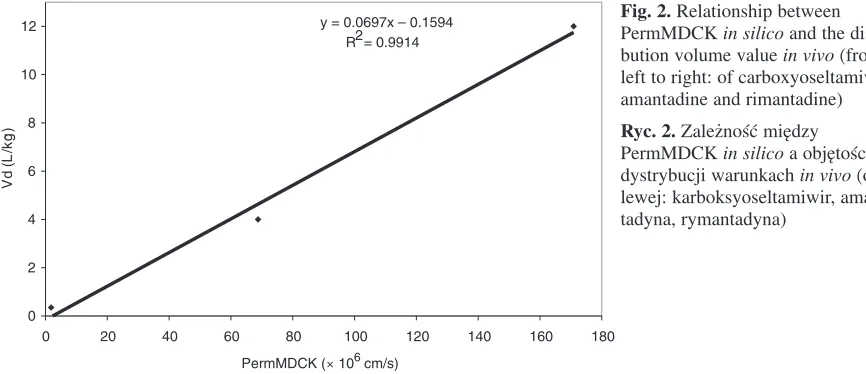
active form, and zanamivir exceeded the optimal value of the parameter [11, 12]. The relationship between the PermMDCK value and the distribution volume of rimantadine, amantadine, and car− boxyoseltamivir was defined based on calculations (Fig. 2). A high value of molecule transfer through membrane systems usually results in an increase in drug distribution volume. The solvation energies of all the analyzed molecules were negative. This points to an easy disruption of the crystalline struc− tures of these substances and the solvation of all dis− cussed drugs. The parameter indirectly modulates both the absorption, distribution, and redistribution of the drugs in the body.
Amantadine’s and rimantadine’s PSA values were low and satisfy the conditions of the rule of five, which unanimously forecasts high bioavailabil− ity (Tab. 6, Fig. 5) [13–15]. The only exception is zanamivir, for which the value significantly exceeds 140 A2. The value for carboxyoseltamivir is also
close to the limit of the optimal value suggested by Lipinski. In both compounds, the high PSA values and hydrophilic character determine a shorter half−
Lipophilicity Rimantadine Amantadine Carboxy oseltamivir Zanamivir Oseltamivir (Lipofilność)
XLogP 3.58 2.31 0.27 –3.01 1.01
LogKOWIN 3.34 2.44 0.18 –4.58 0.95
CLogP 3.96 1.99 –1.24 –5.57 2.13
MiLogP 2.46 2.65 –0.14 –3.64 0.85
Mean 3.33 2.35 –0.23 –4.20 1.24
LogD(7.4) 0.82 0.176 –1.73 –6.53 –0.073
Tabela 2.Wartości LogP oraz LogD analizowanych leków
ClogP – octanol−water partition coefficient (calculated by the ALOGPS 2.1 program). LogD(7.4)– octanol−water distribution coefficient for the physiological pH of blood plasma.
LogKOW – octanol−water partition coefficient (calculated by the Epi Suite program). LogP – octanol−water partition coefficient.
MiLogP – Moriguchi octanol−water partition coefficient (based on the Moriguchi algorithm). XlogP – database octanol−water partition coefficient.
Fig. 1.Relationship between lipophilicity and the half−life of the analysed drugs
Ryc. 1. Zależność między lipofilnością a okresem półtrwania analizowanych leków
0 5 10 15 20 25 30 35 40
−7 −5 −3 −1 1 3 5 7
LogD
t1
/2
(h
)
hydrophilic dugs lipophilic dugs
long half−life drugs short half−life drugs
amantadine rimantadine
life in vivo, higher total clearance, and a smaller vol− ume of drug distribution in the body. All the ana− lyzed drugs had completely different aPSA to PSA ratios, which means that in vivoSASA, and thus the possibility of disposition in the body, is highest for rimantadine, followed by amantadine and oselta− mivir, and very small for zanamivir, which is reflect− ed in the formulation of the drug (Tab. 4).
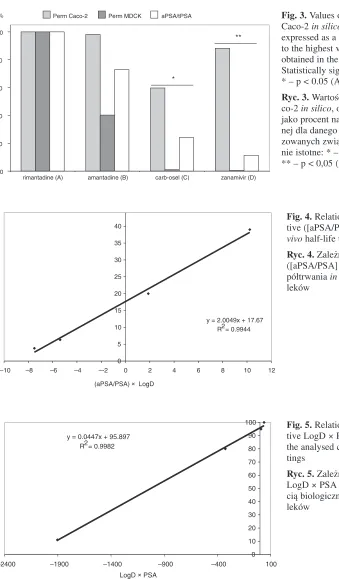
Complex comparison of the PermMDCK and PermCaco−2 values and of the aPSA/PSA ratio illustrates the distribution possibilities and the pos− sibility of transfer through membrane barriers in the body (Fig. 3). From the point of view of e−ADME analysis, the values obtained for rimantadine are closest to the optimal values. Processes deciding the fate of a drug in the body results from numerous factors regarding the structure of a drug. Combining information regarding LogD and aPSA/PSA ratios made it possible to define a linear relationship between these parameters and the mean in vivohalf− life of the analyzed drugs (Tab. 7, Fig. 4).
Discussion
The lipophilicity (LogP and LogD values) of both rimantadine and amantadine molecules was reflected in their half−lives (Fig. 1). The decidedly lipophilic character of both molecules combined with very low tPSA and PSA values results in rel− atively high values of distribution in vivo. Their higher lipophilicity does not exclude their easy transition into solution from the crystalline form. This is indicated by the negative value of the sol− vation energy. All the analyzed molecules have negative solvation energy (Tab. 3). The analysis of PermMDCK, PermCAco−2, and HIAin silicoindi− cates the possibility of high disposition of riman− tadine and amantadine molecules. This is con− firmed by both the long half−lives of these com− pounds and the large distribution volumes [16]. Both rimantadine and amantadine meet the requirements of Lipinski’s rule of five. In the case of carboxyoseltamivir and zanamivir, their in vivo
Indexes Drug
(Wskaźniki) (Lek)
rimantadine amantadine carboxy oseltamivir zanamivir oseltamivir
Wienner index 204 124 801 1114 1060
Balaban index 1.91 1.94 2.99 3.34 3.02
Perm Caco−2 (cm/s) × 106 2172 21.32 12.97 19.16 14.12
Perm MDCK (cm/s) × 106 170.89 68.78 1.82 0.75 5.03
HIA (%) 100 100 72.61 4.064 87.16
Free energy of solvation (KJ/M) –5.38 –6.82 –19.75 –32.29 –15.26
Table 3. Values of selected topological descriptors and analysis of permeability of membrane systems for the analyzed drugs
Tabela 3.Wartości wybranych parametrów topologicznych oraz wartości przepuszczalności przez układy błonowe
Caco−2 – colon carcinoma cancer cells.
MDCK – Martin Darby canine kidney cancer cells. Perm – permeability.
HIA – Human Intestinal Absorption.
Fig. 2. Relationship between PermMDCK in silicoand the distri− bution volume value in vivo(from left to right: of carboxyoseltamivir, amantadine and rimantadine)
Ryc. 2.Zależność między PermMDCK in silicoa objętością dystrybucji warunkachin vivo(od lewej: karboksyoseltamiwir, aman− tadyna, rymantadyna)
y = 0.0697x – 0.1594 R2= 0.9914
0 2 4 6 8 10 12
0 20 40 60 80 100 120 140 160 180
PermMDCK ( 10× 6cm/s)
V
d
(L
/k
g
Polar surface area Drug (Polarne pole powierzchni) (Lek)
rimantadine amantadine carboxy oseltamivir zanamivir oseltamivir
tPSA (A2) 26.02 26.02 101.65 200.73 90.66
PSA (A2) 46.50 54.40 188.10 291.60 123.80
aPSA (A2) 324.60 276.70 316.40 230.70 455.10
aPSA/PSA 6.98 5.09 1.68 0.79 3.68
aPSA/tPSA 12.48 10.63 3.11 1.15 5.02
Tabela 4. Wartości polarnego pola powierzchni oraz apolarnego pola powierzchni w analizowanej grupie leków
PSA – polar surface area.
tPSA – topological polar surface area. aPSA – apolar surface area.
Topological and structural indexes Drug (Wskaźniki topologiczne (Lek)
i strukturalne) rimantadine amantadine carboxy oseltamivir zanamivir oseltamivir
HBD 1 1 4 7 2
HBA 1 1 6 10 5
MW 179.3 151.25 284.36 332.3 312.4
MV 192.58 159.196 275.27 283.97 309.59
Table 5. Values of selected structural parameters of the analyzed molecules
Tabela 5. Wartości wybranych parametrów strukturalnych analizowanych cząsteczek
HBD – hydrogen bond donors. HBA – hydrogen bond acceptors. MW – molecular weight. MV – molecular volume.
Pharmacokinetic Drug
and structural indexes (Lek)
(Wskaźniki farmakokinetyczne rimantadine amantadine carboxy oseltamivir zanamivir i strukturalne)
F(%) 100 95 80 11
LogD(7.4)× PSA 38.13 9.57 –325.41 –1904.15
Table 6.Values of the derivative LogD × PSA and in vivobioavailability
Tabela 6. Wartości pochodnej LogD(7,4)× PSA w odniesieniu do dostępności biologicznej in vivo
F – absolute bioavailability. PSA – polar surface area.
LogD(7.4)– octanol−water distribution coefficient for the physiological pH of blood plasma.
Pharmacokinetic Drug and structural indexes (Lek)
(Wskaźniki farmakokinetyczne rimantadine amantadine carboxy oseltamivir zanamivir i strukturalne)
aPSA/PSA × LogD(7.4) 10.23 1.87 –5.38 –7.51
t1/2in vivo (h) 39 20 6.3 3.8
Table 7. Relationship between the derivative (aPSA/PSA) × LogD and in vivohalf−life t1/2of the analyzed drugs
Tabela 7.Zależność między pochodną ([aPSA/PSA] × LogD) oraz okresem półtrwania t1/2uzyskanym w warunkach in vivo
analizowanych leków
LogD(7.4)– octanol−water distribution coefficient according to the physiological pH of blood plasma.
volumes of distribution are small and the half−lives of both drugs are short [17]. The reasons for this include the hydrophilicity and the large polar sur− face areas of their molecules. The significant hydrophilicity of both drugs is also a reason for the large total clearance in vivo. In the case of car− boxyoseltamivir, the clearance is 2.5 times higher than the human glomerular filtration rate and is ca. 315 ml/min (GFR 125 ml/min for a human with
a body surface area BSA of 1.73 m2). This indi−
cates that drug elimination is also carried out by the tubular secretion path. Both carboxyo− seltamivir and zanamivir also have higher ramifi− cation index (R), molecular volume (MV), and molecular weight (MW) than rimantadine and amantadine (Tab. 5). In combination with the higher value of hydrogen bond donors and hydro− gen bond acceptors, this results in a very low
Fig. 3. Values of PermMDCK and Perm
Caco−2 in silico, and aPSA/tPSA
expressed as a percentage ratio, in relation to the highest value of a given parameter obtained in the analysed group of drugs. Statistically significant differences: * – p < 0.05 (A:C); ** – p < 0.05 (A:D)
Ryc. 3. Wartości PermMDCK, Perm Ca−
co−2in silico, oraz aPSA/tPSA wyrażone
jako procent największej wartości uzyska− nej dla danego parametru w grupie anali− zowanych związków. Różnice statystycz− nie istotne: * – p < 0,05 (A:C);
** – p < 0,05 (A:D) 0
20 40 60 80 100
rimantadine (A) amantadine (B) carb−osel (C) zanamivir (D) % Perm Caco−2 Perm MDCK aPSA/tPSA
*
**
Fig. 4. Relationship between the deriva− tive ([aPSA/PSA] × LogD) and the in vivohalf−life t1/2 of the analysed drugs
Ryc. 4.Zależność między pochodną ([aPSA/PSA] × LogD) oraz okresem półtrwania in vivot1/2analizowanych
leków
y = 2.0049x + 17.67 R2= 0.9944
0 5 10 15 20 25 30 35 40
–10 –8 –6 –4 –−2 0 2 4 6 8 10 12
(aPSA/PSA)× LogD
t1
/2
(h)
Fig. 5. Relationship between the deriva− tive LogD × PSA and bioavailability of the analysed compounds in in vivo set− tings
Ryc. 5. Zależność między pochodną LogD × PSA oraz absolutną dostępnoś− cią biologiczną in vivo analizowanych leków
y = 0.0447x + 95.897 R2= 0.9982
0 10 20 30 40 50 60 70 80 90 100
–2400 –1900 –1400 –900 –400 100
LogD×PSA
F(
%
tration of zanamivir. As a result, for zanamivir the only possibility is local administration (inhala− tion). The bioavailability of rimantadine following oral administration is approximately 100%, which is very high compared with that of zanamivir and oseltamivir [18]. A high value of bioavailability was also shown for amantadine [17]. For all the analyzed compounds the bioavailability values
to their free energies of solvation (FenSolv). The pharmacokinetic parameters of the antiviral drugs cited in literature confirm the results of the analy− sis of their physical and physiochemical properties based on theoretical assumptions. Drawing con− clusions regarding the clinical efficacy of individ− ual drugs on this basis would require further stud− ies, but the effort seems justified.
References
[1] Machatha SG, Yalkowsky SH: Comparison of the octanol/water partition coefficients calculated by CLogP, ACDLogP and KowWin to experimentally determined values. Int J Pharm 2005, 294, 185–92.
[2] Ertl P, Rohde B, Selzer P:Fast calculation of molecular polar surface area as a sum of fragment−based contribu− tions and its application to the prediction of drug transport properties. J Med Chem 2000, 5, 3714–3717.
[3] Ertl P, Muhlbacher J, Rohde B, Selzer P: Web−based cheminformatics and molecular property prediction tools supporting drug design and development at Novartis. SAR QSAR Environ Res 2003, 14, 321–328.
[4] Ertl P: Cheminformatics analysis of organic substituents: identification of the most common substituents, calcu− lation of substituent properties, and automatic identification of drug−like bioisosteric groups. J Chem Inf Comput Sci 2003, 43, 374–380.
[5] Kasim NA, Whitehouse M, Ramachandran C, Bermejo M, Lennernas H, Hussain AS, Junginger HE,
Stavchansky SA, Midha KK, Shah VP, Amidon GL: Molecular properties of WHO essential drugs and provi−
sional biopharmaceutical classification. Mol Pharm 2004, 12, 85–96.
[6] Broto P, Moreau G, VanDycke C:Molecular structures: perception, autocorrelation descriptor and QSAR stud− ies. System of atomic contributions for the calculation of the n−octanol/water coefficients. Eur J Med Chem 1984, 19, 71–78.
[7] Balaz S, Lukacova V: Subcellular pharmacokinetics and its potential for library focusing. J Mol Graph Model 2002, 20, 479–490.
[8] Clark DE: Prediction of intestinal absorption and blood brain barrier penetration by computational methods. Comb Chem High Throughput Screen 2001, 4, 477–496.
[9] Pedretti A, Villa L, Vistoli G:Vega A Versatile Program To Convert, Handle And Visualize Molecular Structure on Windows−Based Pcs. J Mol Graph 2002, 21, 47–49.
[10] Pedretti A, Villa L, Vistoli G: Vega – An Open Platform To Develop Chemo−Bio−Informatics Applications, Using Plug−In Architecture And Script Programming. J Comput Aided Mol Des 2004, 18, 167–173.
[11] Balaban AT: Highly discriminating distance−based topological index. Chem Phys Lett 1982, 89, 399–404.
[12] Balaban AT: Topological indices based on topological distances in molecular graphs. Pure Appl Chem 1983, 55, 199–206.
[13] Lipinski CA, Lombardo F, Dominy BW, Feeney PJ: Experimental and computational approaches to estimate
solubility and permeability in drug discovery and development settings. Adv Drug Del Rev 1997, 23, 3–25.
[14] Lipinski CA: Drug−like properties and the causes of poor solubility and poor permeability. J Pharmacol Toxicol Methods 2000, 44, 235–249.
[15] Lipinski CA: Single−Mode compound retrieval for QSAR, QSPR data sets, and batch mode exact structure
searching. J Pharm Sci 2002, 91, 2470–2472.
[16] Hayden FG, Minocha A, Spyker DA, Hoffman HE: Comparative single−dose pharmacokinetics of amantadine
hydrochloride and rimantadine hydrochloride in young and elderly adults. Antimicrob Agents Chemother 1985, 28, 216–221.
[17] Anonymous:Review on influenza antiviral medicinal products for potential use during pandemic. EMEA 2005, 1–18.
[18] Wills RJ, Choma N, Buonpane G, Lin A, Keigher N: Relative bioavailability of rimantadine HCl tablet and syrup formulations in healthy subjects. J Pharm Sci 1987, 76(12), 886–888.
Address for correspondence:
Tomasz GrabowskiRavimed Sp. z o.o. Polna 54
05−119 Łajski k/Legionowa Poland
Tel./fax: (+48) 22−7822167, (+48) 22−7822367 E−mail: [email protected]
Conflict of interest: None declared