Published by Central Fisheries Research Institute (SUMAE) Trabzon, Turkey in cooperation with Japan International Cooperation Agency (JICA), Japan
R E S E A R C H P A P E R
Selectivity of Different Alternative Cod Ends and Radial Square
Mesh Escape Panels (RSEP)
Yusuf Ceylan
1,* , Cemalettin Sahin
11 Recep Tayyip Erdoğan University, Faculty of Fisheries, Rize, Turkey.
Article History
Received 20 December 2017 Accepted 23 May 2018 First Online 04 June 2018
Corresponding Author Tel.: ++90.464 2179118 E-mail: [email protected]
Keywords Selectivity
Radial square mesh escape panel Bottom trawl
Mullus barbatus Black Sea
Abstract
Bottom trawl fishery is carried out intensively throughout the season in the Black sea. For this reason, the selectivity effects of five codend with different mesh size, shapes and escape panels (commercial (40D), 50 mm diamond-shaped (50D), and 40 mm square-mesh (40S) and radial square mesh escape panels (RSEP) which were added to the front and back section of 40D) were investigated. Using a commercial fishing trawl, 44 valid hauls were carried out from August 23rd to October 24th 2016 on the Sakarya coast to the South west of the Black Sea. The L50 valueof commercial cod end was calculated as was 12.9 cm for Mullus barbatus (red mullet), and was improved in cod ends with RSEPs. Further, the L50 values obtained from the other cod ends were found to be very high (40S: 15.62 cm, 50D: 15.24 cm). It was noticed that none of the cod ends showed sufficient selectivity for bluefish (Pomatomus saltatrix), which was caught as bycatch. The comparative account of the findings of current study with the previous studies advocates that the cod ends need to be made from PA netting and RSEP should be applied for more escape area.
Introduction
Bottom trawl fishery in the Black Sea is extensively carried out during the fishing season by 521 trawlers that are capable of bottom trawl fishing (Anonymous, 2018). In bottom trawl fishery, main target species are Mullus spp. and whiting (Merlangius merlangus). The mesh size and shape of codend were determined as 40 mm diamond and, this regulation will be changed to 44 mm at the beginning of the 2020 fishing season (Anonymous, 2016). There are no any standardizations (size, mesh number of perimeter i.e.) in related to codend. In addition, it is known that fishermen have applied many illegal methods, such as using double and lower mesh size codends (Ceylan, Şahin & Kalaycı, 2014; Ceylan and Sedef pers.com.).
Mullus spp. is the target species preferred by fishermen
and a very large part of total production (96%) obtained from bottom trawl fishery (Knudsen, Zengin, & Koçak, 2010). It has been reported that decreasing of marketable size of red mullet indicates that its stock was under pressure due to over fishing (Zengin et al.,
sexual maturity at more length, its minimum landing size MLS (11 cm) differs from M barbatus (13 cm)
(Anonymous, 2016). The definitions of these mullets vary in the literature and there is terminological confusion in Turkish identification of both species (Akdemir, 2015). As a result, there are major lacks that need to be regulated in terms of the management of
M. barbatus stocks in the Black Sea.
Bottom trawl fishery in Turkish seas has a multispecies character, so that some pelagic species are caught as bycatch by bottom trawlers in the Black Sea. Bluefish (Pomatomus saltatrix) is commonly targeted in purse seine fishery but it is one of the most caught species as bycatch by bottom trawlers at the beginning of the fishing season mostly in September and October (Ceylan, Şahin & Kalaycı, 2014; Özdemir, Erdem, Erdem & Özdemir, 2014; Yıldız & Karakulak, 2017). The MLS of blue fish was 20 cm before 2016 while it was currently defined as 18 cm in the Turkish fisheries circular covering the fishing seasons between 2016 and 2020. (Anonymous, 2016). The commercial codend doesn't exhibit sufficient selectivity for this species. If a regulation is made to reduce the bycatch ratio of blue fish, the losses of dominant target species must be taken into account in the trawl fishery (Özdemir et al., 2014). Therefore, it should be considered that a positive effect cannot be obtained at the same time for each species when a modification is made.
Recent studies have been conducted the effects of different types of net materials, the number of mesh around the codends, escape panels, mesh size, and the shape on the selectivity were evaluated (Broadhurst & Kennelly, 1996; Chen, Matuda & Honda 1991; Petrakis & Stergiou, 1997; Tokaç, Özbilgin & Tosunoğlu, 2004). It has been reported that various shapes and sizes of the mesh exhibit adverse effects on fishes with different body shape and swimming ability (Tosunoğlu, Aydın & Özaydın, 2008). The square-mesh nets ensure superior selectivity and have become more popular owing to their ability to protect their shape during the haul. Nevertheless, it has not been well adopted by fishermen due to the shift of knots and subsequent difficulty in repairing (Graham & Kynoch, 2001). Therefore, several studies have been carried out to increase the selectivity by applying square mesh panels to a certain portion of the codend (Armstrong, Briggs & Rihan, 1998; Broadhurst & Kennelly, 1996; Özbilgin, Tosunoğlu, Aydın, Kaykaç & Tokaç, 2005). In general, the panels placed in the upper and the front portions of the codends have shown positive effects on selectivity (Graham, Kynoch & Fryer, 2003; Metin et al.,
2005). Despite positive results, the top panel combinations developed for different species have sometimes been reported to be inadequate (Brcic, Herrman, & Sala, 2016; Santos, Herrman, Otero, Fernandez & Perez, 2016). Commercial codend with square mesh escape panel could not be obtained
sufficient selectivity value for both red mullet and blue fish (Metin et al., 2005; Özdemir et al., 2014). European Commission required fishermen have to use 40 mm square mesh or 50 mm diamond mesh codends in GFCM areas (E.C, 2006). Therefore, it’s important to be known the selectivity characteristics of these codends in the Black Sea. Due to the continuous advancements in the technology, development of novel and superior net materials, and efforts to increase the selectivity, abundant scientific explorations have been carried out in different periods in bottom trawl nets with a low selectivity feature.
The aim of the current study was to determine more selective alternative codends for bottom trawls used in the Black Sea. In this context the present study was conducted to investigate the selectivity effects of the radial square escape panel (RSEP) added to the front and rear portions of the commercial codend by expanding the square-mesh panel area, which offers a potential alternative to the commercial trawl codend, which is usually aimed at small size fish. In addition, the selectivity characteristics of 40 mm commercial codend 50 mm diamond-shaped codend and 40 mm square-mesh codend manufactured from polyamide (PA) material were also assessed.
Materials and Methods
Buglioni, Leonori, O’Neill, & Fryer, 2007). The cover was made from 24 mm PA material and was supported by two circles of 1.2 m in diameter (Wileman, Ferro, Fonteyne & Millar, 1996; Tosunoğlu, Tokaç, Lök, & Metin, 1997). The catch, which accumulates in the cover and the test codend, was dumped separately to the deck and the fish were measured nearest cm accuracy. The selectivity parameters of each haul for
M. barbatus as well as P. saltatrix were estimated by fitting a logistic function:
𝑟(𝑙) = exp(𝑣1+𝑣2𝑙) /[1 + exp(𝑣1+ 𝑣2𝑙)]
𝐿50=
−𝑣1
𝑣2
Where r(l) is retained proportion of length class and v : parameters to be estimated (Wileman et al.,
1996).
The data were analyzed using maximum-likelihood method using CC2000 software (ConStat, 1995). The mean L50 value (50% retention length) for
each codend was calculated by between-haul variation method developed by Fryer (1991) and the effects of RSEPs on the L50 were estimated with ECModel
software. The L50 value of each codend for P. saltatrix
was calculated as pooled data because required number of prey were not caught at each haul. A likelihood ratio test was performed to evaluate statistically differences between selection curves of blue fish obtained from codends (McCullagh & Nelder, 1991).
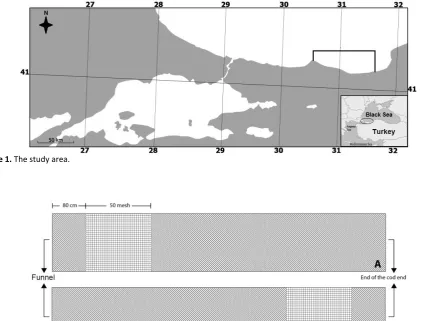
Figure 1. The study area.
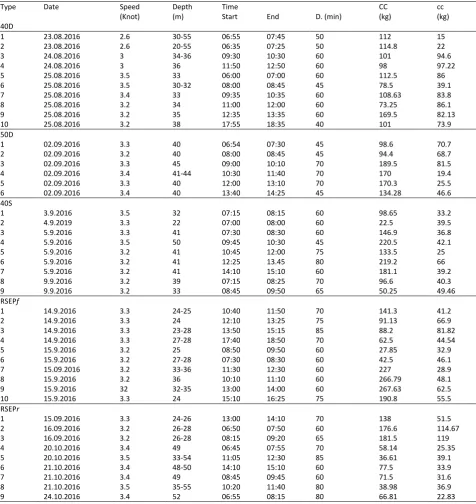
Figure 2. The codends which square mesh escape rings (A: RSEPf, B:RSEPr) added.
Table 1. The mean mesh sizes of used nets after samplings
Net materials 40D 40S 50D
Mesh size 40 40 50
Measured mesh size 42.34 41.87 51.51
SE 1.26 1.38 0.95
N 60 60 60
Min.- Max. (mm) 37-45 34-44 49-53
Results
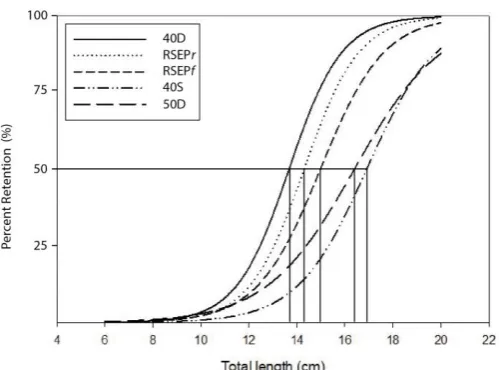
During the study, a total of 44 valid hauls were carried out with the tested codends from 40D to 10, 50D to 6, 40S to 9, RSEPf to 10 and RSEPr to 9. The details of the hauls, the total amount of catches obtained in the cover and the test codend are summarized in Table 2. The total catch volume in the cover ranged between 22.5–267.63 kg, while in the tested codends it ranged between 15–114.67 kg. About 10 valid hauls were carried out with the 40D at a depth between 20 and 55 m. The minimum and maximum haul speeds were 2.6 and 3.5 knots, respectively. The
total time of hauls was 545 min and duration of each hauls varied from 45 to 60 min. The total catch in cover and 40D codend were 956.7 kg and 679.9 kg, respectively. A total of 31458 red mullets and 12176 bluefish were caught throughout the sampling. The calculated L50 and SR values for red mullet and bluefish
were 12.98 cm and 2.83 cm, and 13.67 and 2.40 cm, respectively. Six valid hauls were conducted with the 50D at a depth ranging from 40 to 45 m. The minimum and maximum towing speeds were 3.2 and 3.5 knots, respectively. The total towing time was 335 min and haul durations varied from 45 to 70 min. During the sampling, the total catch volume was 826.7 kg in the
Table 2. The details of valid hauls performed in the sampling area
Type Date Speed
(Knot)
Depth (m)
Time CC
(kg)
cc (kg) 40D
Start End D. (min)
1 23.08.2016 2.6 30-55 06:55 07:45 50 112 15
2 23.08.2016 2.6 20-55 06:35 07:25 50 114.8 22
3 24.08.2016 3 34-36 09:30 10:30 60 101 94.6
4 24.08.2016 3 36 11:50 12:50 60 98 97.22
5 25.08.2016 3.5 33 06:00 07:00 60 112.5 86
6 25.08.2016 3.5 30-32 08:00 08:45 45 78.5 39.1
7 25.08.2016 3.4 33 09:35 10:35 60 108.63 83.8
8 25.08.2016 3.2 34 11:00 12:00 60 73.25 86.1
9 25.08.2016 3.2 35 12:35 13:35 60 169.5 82.13
10 25.08.2016 3.2 38 17:55 18:35 40 101 73.9
50D
1 02.09.2016 3.3 40 06:54 07:30 45 98.6 70.7
2 02.09.2016 3.2 40 08:00 08:45 45 94.4 68.7
3 02.09.2016 3.3 45 09:00 10:10 70 189.5 81.5
4 02.09.2016 3.4 41-44 10:30 11:40 70 170 19.4
5 02.09.2016 3.3 40 12:00 13:10 70 170.3 25.5
6 02.09.2016 3.4 40 13:40 14:25 45 134.28 46.6
40S
1 3.9.2016 3.5 32 07:15 08:15 60 98.65 33.2
2 4.9.2019 3.3 22 07:00 08:00 60 22.5 39.5
3 5.9.2016 3.3 41 07:30 08:30 60 146.9 36.8
4 5.9.2016 3.5 50 09:45 10:30 45 220.5 42.1
5 5.9.2016 3.2 41 10:45 12:00 75 133.5 25
6 5.9.2016 3.2 41 12:25 13.45 80 219.2 66
7 5.9.2016 3.2 41 14:10 15:10 60 181.1 39.2
8 9.9.2016 3.2 39 07:15 08:25 70 96.6 40.3
9 9.9.2016 3.2 33 08:45 09:50 65 50.25 49.46
RSEPf
1 14.9.2016 3.3 24-25 10:40 11:50 70 141.3 41.2
2 14.9.2016 3.3 24 12:10 13:25 75 91.13 66.9
3 14.9.2016 3.3 23-28 13:50 15:15 85 88.2 81.82
4 14.9.2016 3.3 27-28 17:40 18:50 70 62.5 44.54
5 15.9.2016 3.2 25 08:50 09:50 60 27.85 32.9
6 15.9.2016 3.2 27-28 07:30 08:30 60 42.5 46.1
7 15.09.2016 3.2 33-36 11:30 12:30 60 227 28.9
8 15.9.2016 3.2 36 10:10 11:10 60 266.79 48.1
9 15.9.2016 32 32-35 13:00 14:00 60 267.63 62.5
10 15.9.2016 3.3 24 15:10 16:25 75 190.8 55.5
RSEPr
1 15.09.2016 3.3 24-26 13:00 14:10 70 138 51.5
2 16.09.2016 3.2 26-28 06:50 07:50 60 176.6 114.67
3 16.09.2016 3.2 26-28 08:15 09:20 65 181.5 119
4 20.10.2016 3.4 49 06:45 07:55 70 58.14 25.35
5 20.10.2016 3.5 33-54 11:05 12:30 85 36.61 39.1
6 21.10.2016 3.4 48-50 14:10 15:10 60 77.5 33.9
7 21.10.2016 3.4 49 08:45 09:45 60 71.5 31.6
8 21.10.2016 3.5 35-55 10:20 11:40 80 38.98 36.9
9 24.10.2016 3.4 52 06:55 08:15 80 66.81 22.83
cover and 306.2 kg in the codends. A total of 33265 red mullets and 7397 blue fish were caught. The calculated L50 and SR values for red mullet and blue fish were
15.24 and 2.71 cm, and 16.39 and 4 cm, respectively. About 9 valid hauls were made with 40S at 40-45 m of depth. The minimum and maximum towing speeds were recorded as 3.1 and 3.5 knots, respectively. The total towing time was 715 min with haul duration between 45–80 min. During the sampling, the total catch volume was 1568.2 kg in cover and 460.3 kg in the codends. In total 27847 red mullets and 5239 bluefish were caught in the hauls. The calculated L50 and SR values for red mullets and
bluefish were 15.62 and 2.91 cm, and 16.9 and 3.17 cm, respectively. With RSEPf, 10 valid hauls were made at depth of 23–36 m. The minimum and maximum towing speeds recorded were 3.2 and 3.3 knots, respectively. The total towing time was 745 min with
haul duration varying between 60–85 min. During the sampling, the total catch volume was 1573.9 kg in the cover and 566.6 kg was in the test codend. With RSEPf, a total of 79584 red mullets and 10567 bluefish were caught. The calculated L50 and SR values for red mullet
and bluefish were 14.66 and 2.92 cm, and 14.98 and 2.89 cm, respectively. Likewise, with the RSEPr, 9 valid hauls were made at the depth between 24–55 m. The towing speed varied from 3.1 to 3.5 knots. The total towing time was 710 min with haul duration varying from 60 to 85 min. The total catch volume in the cover and the codend was 1001 and 519.3 kg, respectively. A total of 30001 red mullets and 1316 bluefish were caught. The calculated L50 and SR values for red mullet
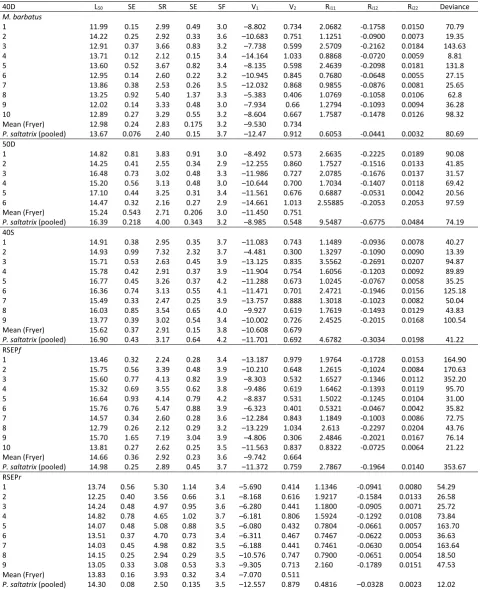
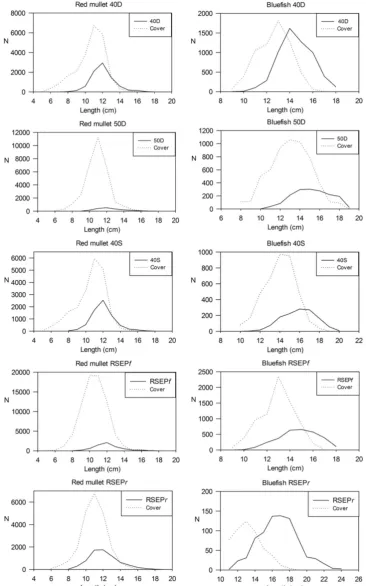
were 13.83 and 3.93 cm, while 14.3 and 2.5 cm for bluefish. The selectivity curves for M. barbatus and P. saltatrix are shown in Figure 3 and 4. It was found that the RSEPs significantly affect the L50 (P<0.05). The
Figure 3. Selectivity curves of M. barbatus.
calculated selectivity and regression parameters with their standard errors, matrix values of each haul and mean curves are shown in Table 3. Size frequencies of
M. barbatus and P. saltatrix caught in the cover and
tested codends are given Figure 5.
Selection curves of all the codends (50D, 40S, RSEPf and RSEPr) were compared to 40D and significant differences were found (p<0.05)
Table 3. Selectivity parameters for all hauls
40D L50 SE SR SE SF V1 V2 Ri11 Ri12 Ri22 Deviance
M. barbatus
1 11.99 0.15 2.99 0.49 3.0 –8.802 0.734 2.0682 -0.1758 0.0150 70.79
2 14.22 0.25 2.92 0.33 3.6 –10.683 0.751 1.1251 -0.0900 0.0073 19.35
3 12.91 0.37 3.66 0.83 3.2 –7.738 0.599 2.5709 -0.2162 0.0184 143.63
4 13.71 0.12 2.12 0.15 3.4 –14.164 1.033 0.8868 -0.0720 0.0059 8.81
5 13.60 0.52 3.67 0.82 3.4 –8.135 0.598 2.4639 -0.2098 0.0181 131.8
6 12.95 0.14 2.60 0.22 3.2 –10.945 0.845 0.7680 -0.0648 0.0055 27.15
7 13.86 0.38 2.53 0.26 3.5 –12.032 0.868 0.9855 -0.0876 0.0081 25.65
8 13.25 0.92 5.40 1.37 3.3 –5.383 0.406 1.0769 -0.1058 0.0106 62.8
9 12.02 0.14 3.33 0.48 3.0 –7.934 0.66 1.2794 -0.1093 0.0094 36.28
10 12.89 0.27 3.29 0.55 3.2 –8.604 0.667 1.7587 -0.1478 0.0126 98.32
Mean (Fryer) 12.98 0.24 2.83 0.175 3.2 –9.530 0.734
P. saltatrix (pooled) 13.67 0.076 2.40 0.15 3.7 –12.47 0.912 0.6053 -0.0441 0.0032 80.69 50D
1 14.82 0.81 3.83 0.91 3.0 –8.492 0.573 2.6635 -0.2225 0.0189 90.08
2 14.25 0.41 2.55 0.34 2.9 –12.255 0.860 1.7527 -0.1516 0.0133 41.85
3 16.48 0.73 3.02 0.48 3.3 –11.986 0.727 2.0785 -0.1676 0.0137 31.57
4 15.20 0.56 3.13 0.48 3.0 –10.644 0.700 1.7034 -0.1407 0.0118 69.42
5 17.10 0.44 3.25 0.31 3.4 –11.561 0.676 0.6887 -0.0531 0.0042 20.56
6 14.47 0.32 2.16 0.27 2.9 –14.661 1.013 2.55885 -0.2053 0.2053 97.59
Mean (Fryer) 15.24 0.543 2.71 0.206 3.0 –11.450 0.751
P. saltatrix (pooled) 16.39 0.218 4.00 0.343 3.2 –8.985 0.548 9.5487 -0.6775 0.0484 74.19 40S
1 14.91 0.38 2.95 0.35 3.7 –11.083 0.743 1.1489 -0.0936 0.0078 40.27
2 14.93 0.99 7.32 2.32 3.7 –4.481 0.300 1.3297 -0.1090 0.0090 13.39
3 15.71 0.53 2.63 0.45 3.9 –13.125 0.835 3.5562 -0.2691 0.0207 94.87
4 15.78 0.42 2.91 0.37 3.9 –11.904 0.754 1.6056 -0.1203 0.0092 89.89
5 16.77 0.45 3.26 0.37 4.2 –11.288 0.673 1.0245 -0.0767 0.0058 35.25
6 16.36 0.74 3.13 0.55 4.1 –11.471 0.701 2.4721 -0.1946 0.0156 125.18
7 15.49 0.33 2.47 0.25 3.9 –13.757 0.888 1.3018 -0.1023 0.0082 50.04
8 16.03 0.85 3.54 0.65 4.0 –9.927 0.619 1.7619 -0.1493 0.0129 43.83
9 13.77 0.39 3.02 0.54 3.4 –10.002 0.726 2.4525 -0.2015 0.0168 100.54
Mean (Fryer) 15.62 0.37 2.91 0.15 3.8 –10.608 0.679
P. saltatrix (pooled) 16.90 0.43 3.17 0.64 4.2 –11.701 0.692 4.6782 -0.3034 0.0198 41.22 RSEPf
1 13.46 0.32 2.24 0.28 3.4 –13.187 0.979 1.9764 -0.1728 0.0153 164.90
2 15.75 0.56 3.39 0.48 3.9 –10.210 0.648 1.2615 -0,1024 0.0084 170.63
3 15.60 0.77 4.13 0.82 3.9 –8.303 0.532 1.6527 -0.1346 0.0112 352.20
4 15.32 0.69 3.55 0.62 3.8 –9.486 0.619 1.6462 -0.1393 0.0119 95.70
5 16.64 0.93 4.14 0.79 4.2 –8.837 0.531 1.5022 -0.1245 0.0104 31.00
6 15.76 0.76 5.47 0.88 3.9 –6.323 0.401 0.5321 -0.0467 0.0042 35.82
7 14.57 0.34 2.60 0.28 3.6 –12.284 0.843 1.1849 -0.1003 0.0086 72.75
8 12.79 0.26 2.12 0.29 3.2 –13.229 1.034 2.613 -0.2297 0.0204 43.76
9 15.70 1.65 7.19 3.04 3.9 –4.806 0.306 2.4846 -0.2021 0.0167 76.14
10 13.81 0.27 2.62 0.25 3.5 –11.563 0.837 0.8322 -0.0725 0.0064 21.22
Mean (Fryer) 14.66 0.36 2.92 0.23 3.6 –9.742 0.664
P. saltatrix (pooled) 14.98 0.25 2.89 0.45 3.7 –11.372 0.759 2.7867 -0.1964 0.0140 353.67 RSEPr
1 13.74 0.56 5.30 1.14 3.4 –5.690 0.414 1.1346 -0.0941 0.0080 54.29
2 12.25 0.40 3.56 0.66 3.1 –8.168 0.616 1.9217 -0.1584 0.0133 26.58
3 14.24 0.48 4.97 0.95 3.6 –6.280 0.441 1.1800 -0.0905 0.0071 25.72
4 14.82 0.78 4.65 1.02 3.7 –6.181 0.806 1.5924 -0.1292 0.0108 73.84
5 14.07 0.48 5.08 0.88 3.5 –6.080 0.432 0.7804 -0.0661 0.0057 163.70
6 13.51 0.37 4.70 0.73 3.4 –6.311 0.467 0.7467 -0.0622 0.0053 36.63
7 14.03 0.45 4.98 0.82 3.5 –6.188 0.441 0.7461 -0.0630 0.0054 163.64
8 14.15 0.25 2.94 0.29 3.5 –10.576 0.747 0.7900 -0.0651 0.0054 18.50
9 13.05 0.33 3.08 0.53 3.3 –9.305 0.713 2.160 -0.1789 0.0151 47.53
Mean (Fryer) 13.83 0.16 3.93 0.32 3.4 –7.070 0.511
Discussion
When the explorations carried out in the Black Sea were thoroughly examined, it is clearly understood that the whiting, red mullet and turbot are the most targeted species, and the horse mackerel and the bluefish are caught as non-target or bycatch by bottom
trawl (Ceylan, Şahin & Kalaycı, 2014; Özdemir, Erdem & Erdem, 2012; Zengin, Genç & Tabak, 1997). In the communique issued by the Ministry of Food, Agriculture, and Livestock, Turkey (MoFAL), which regulates commercial fishery, the minimum landing size (MLS) of M. barbatus is 13 cm. The data obtained from the studies related to the length at first maturity size
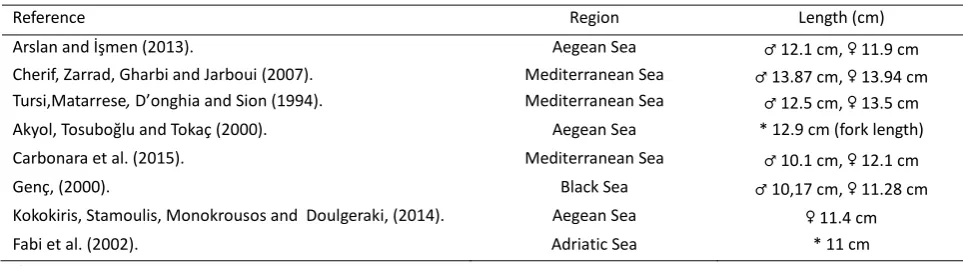
for M. barbatus in different regions are given in Table 4. The L50 value of 40D (L50: 12.98 cm) was found
acceptable value for the MLS specified, although taking into account the length at first maturity size obtained from previous studies, it still shows partial selectivity characteristics in catching the fish on the first maturity size.
The L50 value calculated in the current study is
very similar to that obtained previously for M. barbatus
using the same net material, and codends of similar mesh shape and size in the Black Sea (Zengin et al.,
1997, Genç, 2000). On the contrary, it was reported that L50 values were below the first maturity size as
well as the MLS in experiments where the codends were made from PE material, having the same characteristics in terms of codend circumference, mesh size and shape (Tokaç et al., 2004; Özbilgin, Tosunoğlu, Tokaç & Metin, 2011; Kaykaç, Zengin & Tosunoğlu, 2018). Many researchers have reported that the type of material used for manufacturing the codend also affects the selectivity and PA nets have a superior selectivity than PE nets (Akyol, Tosunoğlu & Tokaç, 2000; Deval, Bök, Ateş & Özbilgin, 2006; Tokaç et al.,
2004). The PA material has a more flexible structure and is suitable for taking the body shape and thereby allows the easy escape of a fish (Tokaç et al., 2004). The PA net material used in the study can be considered as the reason why the L50 value is higher than some
studies reported from other regions. In recent times, PE nets with less selectivity seem to be preferred by fisherman due to their robustness and durability. Given the fact that PA nets with the same mesh size give better selectivity results, only nets in the codend section should necessarily be made from PA material. The L50 value (15.24 cm) obtained with 50D was above
the first maturity size as well as the MLS. In a different study conducted in the Aegean Sea, the circumference of mesh was 264, and the L50 value for M. barbatus was
reported as 12.9 cm with 50 mm diamond-shaped codend of PE material (Dereli & Aydın, 2016). This could be attributed to the use of PE nets and the adverse effects of the number of the circumference on selectivity (Deval et al., 2006; Sala, Priour & Herrmann, 2006; Tokaç et al., 2004). In another study carried out
in the Aegean Sea, 50 mm diamond-shaped codend (PE) was reported to have no positive effect on the same level for all species. At the same time, they obtained more effective results on the horse mackerel because of its body size and swimming ability (Tosunoğlu, Aydın & Özaydın, 2008). It is inevitable that the use of 50D codend will positively contribute to the species selectivity, but it may also adversely affect the caught biomass of small fishes targeted such as whiting and red mullet. The use of 50D can help in increasing the selectivity of the size of high-bodied bycatch species such as bluefish, and shad etc. However, the total biomass of red mullet,the main targeted species will be negatively affected. Therefore, fishermen would not accept this codend as an economically viable gear. There are available several reports endorsing the superior selectivity of square-mesh codend over the diamond-shaped codend (Bahamon, Sarda & Suuronen, 2006, Dereli & Aydın, 2016, Özbilgin et al., 2015, Petrakis & Stergiou, 1997). The L50 value (15.62 cm) of
40S for red mullet is much above the MLS as well as the first maturity size and it is almost similar to that of 50D. It is presumed that fishermen will experience economic losses in short and long term due to the low retention rate of 40S. Using square mesh codends instead of commercial codend brings about 40% much more economic losses (Eryaşar & Özbilgin, 2015). They are also concerned that commercial losses may not be voluntary in using codend, which is entirely consisted of square meshes. It is well known that the slipping of knots and further difficulty in repairing square-mesh nets are also not much appreciated by fishermen (Metin et al., 2005). However, it was seen in this study that square-mesh nets hanging at a 45-degree angle could be repaired in the same way as diamond nets. Sometimes, it is not possible to achieve the consistent positive effect for each species in the bottom trawling with the same codend, especially when the fishes with different body shapes and behaviors are caught together by alone enlarging the mesh size or using square mesh, so that when a codend is designed, nets consisting of both square and diamond-shaped mesh must be used together (Metin et al., 2005; Petrakis & Stergiou, 1997, Tosunoğlu, Özbilgin & Özbilgin, 2003a,
Table 4. Some studies related to the length at first maturity size for Mullus barbatus
Reference Region Length (cm)
Arslan and İşmen (2013). Aegean Sea ♂ 12.1 cm, ♀ 11.9 cm
Cherif, Zarrad, Gharbi and Jarboui (2007). Mediterranean Sea ♂ 13.87 cm, ♀ 13.94 cm Tursi,Matarrese, D’onghia and Sion (1994). Mediterranean Sea ♂ 12.5 cm, ♀ 13.5 cm Akyol, Tosuboğlu and Tokaç (2000). Aegean Sea * 12.9 cm (fork length) Carbonara et al. (2015). Mediterranean Sea ♂ 10.1 cm, ♀ 12.1 cm
Genç, (2000). Black Sea ♂ 10,17 cm, ♀ 11.28 cm
Kokokiris, Stamoulis, Monokrousos and Doulgeraki, (2014). Aegean Sea ♀ 11.4 cm
Fabi et al. (2002). Adriatic Sea * 11 cm
b). It may also allow the escape of different species that might be caught unintentionally. Previously, there have been reported positive effects on the selectivity of square-mesh escape panels in different studies conducted in many regions (Graham & Kynoch, 2001; Graham, Kynoch & Fryer, 2003; Metin et al., 2005; Özdemir et al., 2012; Özdemir, Erdem, Erdem & Özdemir, 2014; Queirolo et al., 2008). In this study, instead of adding any panel, RSEPs completely surrounding the back and front of 40D codend were used taking account of capturing the different behavior and body shaped fish. The L50 value of the 40D below
the MLS was notably improved. The L50 values of the
RSEPs may likely to vary and this difference might be due to the fact that the codend knot and biomass that accumulates in the codend affects the mesh-opening of RSEPr. In order to conserve the stocks for a sustainable fishery, there is a great need to improve the selectivity of the trawler. The L50 values of M. barbatus obtained
in 50D (15.24 cm) and 40S (15.62 cm) were beyond the MLS as well as the first maturity size. Prima facie, stocks are very important for maintaining the sustainability, but they may not offer an advantage in terms of full use of stocks. The modifications of the commercial codend with RSEPf and RSEPr would provide positive contributions toward the sustainability of fish stocks as well as yields because the L50 values of
RSEPf (14.66 cm) and RSEPr (13.83 cm)were found at higher with the MLS in both the configurations. Because of the L50 value of RSEPr is closer to MLS, the
use of RSEPr is recommended for a sustainable fishery. Özdemir et al., (2014) investigated the selectivity of bluefish caught as bycatch in the Middle Black Sea. They reported that square mesh panels were placed on the top and both sides of the codend, and only one panel placing on the codend was not enough to increase the size selectivity and the square panel spreading over a wider area would give better effects. As an alternative to 40D, all of the L50 values obtained
for the bluefish from other tested codends (40D: 13.67, 50D: 16.39, 40S: 16.90, RSEPf: 14.98 and RSEPr: 14.30 cm) were increased but none was found above the MLS (Figure 4.). In the present study, the use of RSEPf
exhibited a positive effect on the selectivity.
In addition, it would have favorable effects on selectivity of target and bycatch species in the multi-species fishing areas. However, the fact that the used codends remain below the permissible size limit for the L50 of bluefish suggests that different measures should
be taken with new studies to be done for this species. It has been observed that fishermen use different legally inappropriate codends in the Black Sea, despite the fact that the bottom trawlers have to use a codend with the mesh size of 40 mm (Ceylan et al., 2014). Considering that fishermen are able to get an advance notice of the inspection at sea; it is very important that the measures taken by the authorities are acceptable and practicable by the fishermen. The achievement of
L50 value on the RSEPr codends and the minimum
landing size (13 cm) suggest that fishermen should at least use this amendment for the sustainability of stock and fishery. For this reason, it is indispensable to review the communique regulating fisheries for the Black Sea. However, only the technical measures written in a directive are not enough to protect the ecosystem. It is necessary to have strict surveillance. The site and time-related inspections can be carried out online, however, the fishing activity done on the boat and their compliance with the law can only be checked on board. Often, priority should be given to standardization of the fishing gear used by unrestrained fishermen, according to the ecosystem approach, not the commercial affairs. Therefore, it is essential to apply the scientific outcomes and the revisions to contribute to the superior selectivity. The selectivity characteristics of fishing gear should be improved and fishermen should be encouraged to use these gears depending upon the region and the target species.
Acknowledgements
This work was supported by Research Fund of the Recep Tayyip Erdogan University. Project Number: 2015.53001.103.03.07. The authors would like to thank to the captain of the SİNYOR PAŞA for his help during the sea trials. Thanks are also extended to Dr. Ahmet Raif ERYAŞAR and Tuncay YEŞİLÇİÇEK for their valuable comments on the manuscript.
References
Akdemir, T. (2015). Determination of the taxonomic status of the populations belonging to mullidae inthe Black Sea. MSc Thesis. İzmir Katip Çelebi University, İzmir, Turkey. Akyol, O., Tosunoğlu, Z. & Tokaç, A. (2000). Investigation of
the growth and reproduction of red mullet (Mullus barbatus Linnaeus, 1758) population in the Bay of Izmir (Aegean Sea). Anadolu University Journal of Science and Technology, 1,121-127.
Anonymous (2016). The Commercial Fish Catching Regulations in 2016–2020 Fishing Period (4/1 Notification No: 2016/35). Retrieved from https://www.tarim.gov.tr/BSGM/Duyuru/64/
Anonymous, (2018). Turkish Statistical Institute. Retrieved from
https://biruni.tuik.gov.tr/medas/?kn=97&locale=tr Armstrong, M. J., Briggs, R.P. & Rihan, D. (1998). A study of
optimum positioning of square-mesh escape panels in Irish Sea nephrops trawls. Fisheries Research, 34, 179– 189.
https://doi.org/10.1016/S0165-7836(97)00078-7 Arslan, M. & İşmen, A. (2013). Age, growth, reproduction and
feeding of Mullus barbatus in Saros Bay (North Aegean Sea). J. Black Sea/Mediterranean Environment, 19 (2), 217˗233.
Research, 81, 15-25. https://doi.org/10.1016/j.fishres.2006.05.020
Brcic, J., Herrmann, B.& Sala, A. (2016). Can a square-mesh panel inserted in front of the codend improve the exploitation pattern in Mediterranean bottom trawl fisheries? Fisheries Research, 183, 13–18. https://doi.org/10.1016/j.fishres.2016.05.007
Broadhurst, M.K., Kennelly & S.J. (1996). Effects of the circumference of codends and a new design of square-mesh panel in reducing unwanted by-catch in the New South Wales Oceanic prawn-trawl fishery, Australia. Fisheries Research 27, 203–214. https://doi.org/10.1016/0165-7836(95)00469-6 Carbonara, P., Intini, S., Modugno, E., Maradonna, F.,
Spedicato, M. T., Lembo, G., … Carnevali, O. (2015). Reproductive biology characteristics of red mullet (Mullus barbatus L., 1758) in Southern Adriatic Sea and management implications. Aquatic Living Resources, 28, 21-31. https://doi.org/10.1051/alr/2015005 Chen, C.T., Matuda, K., & Honda, M. (1991). Comparison of
the mesh selectivity of diamond and square-mesh codend with a model trawl net in an outdoor water tank. Nippon Suisan Gakkaishi, 57, 1313–1319. https://doi.org/10.2331/suisan.57.1313
Cherif M., Zarrad, R., Gharbi, M.H. & Jarboui, O. (2007). Some biological parameters of the red mullet, Mullus barbatus L., 1758, from the Gulf of Tunis. Acta Adriatica, 48 (2), 131-144.
Ceylan, Y., Sahin, C. & Kalaycı, F. (2014). Bottom trawl fishery discards in the Black Sea coast of Turkey. Mediterranean Marine Science, 15 (1), 156-164. http://dx.doi.org/10.12681/mms.421
ConStat, (1995). CC2000 selectivity software. Granspaettevej 10, DK-9800 Hjjlarring, Denmark.
Dereli, H. & Aydın, C. (2016). Selectivity of commercial and alternative codends for four species in the Eastern Mediterranean demersal trawl fishery. Turkish Journal of Fisheries and Aquatic Sciences, 16, 971-992.
https://dx.doi.org/10.1163/15685403-00003532 Deval, M. C., Bök, T., Ates, C. & Özbilgin, H. (2006). Selectivity
of PE and PA material codends for rose shrimp (Parapenaus longirostris) in Turkish twin rigged beam trawl fishery. Fisheries Research, 81, 72-79. https://doi.org/10.1016/j.fishres.2006.05.007
E.C., 2006: Council Regulation (EC 1967/2006) concerning management measures for the sustainable exploitation of fishery resources in the Mediterranean Sea, amending Regulation (EEC) No 2847/93 and repealing Regulation (EC) No 1626/94. Off. J. Eur. Union 409, 75. E.C., 2006: Council Regulation (EC 1967/2006) concerning
manage-ment measures for the sustainable exploitation of fishery resources in the Mediterranean Sea, amending Regulation(EEC) No 2847/93 and repealing Regulation (EC) No 1626/94.Off. J. Eur. Union 409, 75. Eryaşar, A. R. & Özbilgin, H. (2015). Implications for catch
composition and revenue in changing from diamond to square mesh codends in the northeastern Mediterranean. Journal of Applied Ichthyology, 31, 282– 289.
https://doi.org//10.1111/jai.12643
Fabi, G., Sbrana, M., Biagi, F., Grati, F., Leonori, I. & Sartor, P. (2002). Trammel net and gill net selectivity for Lithognathus mormyrus (L., 1758), Diplodus annularis (L., 1758) and Mullus barbatus (L., 1758) in the Adriatic and Ligurian seas. Fisheries Research, 54 (3), 375-388.
https://doi.org/10.1016/S0165-7836(01)00270-3 Fonteyne, R., Buglioni, G., Leonori, I., O’Neill, F.G., & Fryer,
R.J. (2007). Laboratory and Field Trials of Omega, a New Objective Mesh Gauge. Fisheries Research, 85 (1-2), 197-201.
https://doi.org/10.1016/j.fishres.2007.02.006
Fryer, R. J. (1991). A model of between-haul variation in selectivity. ICES Journal of Marine Science, 48 (3), 281-290. https://doi.org/10.1093/icesjms/48.3.281
Genç, Y., (2000). Population parameters and bio-ecological features of the red mullet (mullus barbatus ponticus, Ess. 1927) stocks from the Eastern Black sea coast of Turkey. PhD Thesis. Karadeniz Technical University, Trabzon, 181 pp. [In Turkish]
Graham, N.& Kynoch, R. J. (2001). Square mesh panels in demersal trawls: some data on haddock selectivity in relation to mesh size and position. Fisheries Research, 49, 207–218. https://doi.org/10.1016/S0165-7836(00)00211-3
Graham, N., Kynoch, R. J.& Fryer, R. J. (2003). Square mesh panels in demersal trawls: further data relating haddock and whiting selectivity to panel position. Fisheries Research, 62, 361–375. https://doi.org/10.1016/S0165-7836(02)00279-5
Kaykaç, M. H., Zengin, M.& Tosunoğlu, Z. (2018). Can Shifting Codend Mesh Shape and Mesh Size Increase the Size Selectivity of Red mullet (Mullus barbatus) in the Black Sea? Turkish Journal of Fisheries and Aquatic Sciences, 18, 859-870 https://doi.org/10.4194/1303-2712-v18_7_04
Keskin, Ç. (2012). A preliminary study on demersal fishes in the south-western Black Sea shelf (NW Turkey). J. Black Sea/Mediterranean Environment, 18 (3), 341-349. Kokokiris, L., Stamoulis, A., Monokrousos, N. & Doulgeraki, S.
(2014). Oocytes development, maturity classification, maturity size and spawning season of the red mullet (Mullus barbatus Linnaeus, 1758). Journal of Applied
Ichthyology, 30, 20–27.
https://doi.org/10.1111/jai.12292
Knudsen, S., Zengin, M., & Koçak, M.H. (2010). Identifying drivers for fishing pressure. A multidisciplinary study of trawl and sea snail fisheries in Samsun, Black Sea coast of Turkey. Ocean and Coastal Management, 53, 252-269.
http://dx.doi.org/10.1016/j.ocecoaman.2010.04.008 Metin, C., Özbilgin, H., Tosunoglu, Z., Gokce, G., Aydin, C.,
Metin, G., … Tokac, A. (2005). Effect of square mesh escape window on codend selectivity for three fish species in the Aegean Sea. Turkish Journal of Veterinary & Animal Sciences, 29, 461–468.
Özbilgin, H., Eryasar, A. R., Gökce, G., Özbilgin, Y.D., Bozaoğlu, A. S., Kalecik, E. & Herrmann, B. (2015). Size selectivity of hand and machine woven codends and short term commercial loss in the Northeastern Mediterranean. Fisheries Research, 164, 73-85.
https://doi.org/10.1016/j.fishres.2014.10.022
Özbilgin, H., Tosunoğlu, Z., Aydin, C., Kaykac, H. & Tokaç, A. (2005). Selectivity of standard, narrow and square mesh panel trawl codends for hake (Merluccius merluccius) and poor cod (Trisopterus minutus capelanus). Turkish Journal of Veterinary & Animal Sciences, 29, 967–973. Özbilgin, H., Tosunoğlu, Z., Tokaç, A. & Metin, G. (2011).
https://doi.org/10.4194/trjfas.2011.0203
Özdemir, S., Erdem, Y. & Erdem, E. (2012). The determination of size selection of whiting (Merlangius merlangus euxinus) by square mesh panel and diamond mesh codends of demersal trawl in the southern part of Black sea. Turkish Journal of Fisheries and Aquatic Sciences, 12, 407-410.
https://doi.org/10.4194/1303-2712-v12_1_00
Özdemir, S., Erdem, Y., Erdem, E. & Ozdemir, Z.B. (2014). Effects of square mesh panels position of bottom trawls on by-catch bluefish Pomatomus saltatrix (Linnaeus, 1776) selectivity in the Southern Coast of the Black Sea, Turkey. Cahiers De Biologie Marine, 55, 315–321. https://doi.org/10.3923/javaa.2010.436.440
Petrakis, G. & Stergiou, K. I. (1997). Size selectivity of diamond and square mesh codends for four commercial Mediterranean fish species. Ices Journal of Marine Science, 54, 13–23.
Queirolo, D., Melo, T., Hurtado, C., Montenegro, I., Gaete, E., Merino, J., … Escobar, R. (2008). Effect of the use of square mesh escape panels on the reduction of young fish in the common hake (Merluccius gayi gayi) trawl fishery. Latin American Journal of Aquatic Research,
36, 25-35. http://dx.doi.org/10.4067/S0718-560X2008000100003
Sala, A., Priour, D. & Herrmann, B. (2006). Experimental and theoretical study of red mullet (Mullus barbatus) selectivity in codends of Mediterranean bottom trawls. Aquatic Living Resource, 19, 317–327. https://doi.org/10.1051/alr:2007002
Santos, J., Herrmann, B., Otero, P., Fernandez, J. & Perez, N. (2016). Square mesh panels in demersal trawls: does lateral positioning enhance fish contact probability? Aquatic Living Resources, 29 (3), 302. https://doi.org/10.1051/alr/2016025
Tosunoğlu, Z., Tokaç, A., Lök, A. & Metin, C. (1997). The comparison of effects on cod-end selectivity of different two techniques of covered cod-end method used in trawl selectivity experiments. Turkish Journal of Veterinary and Animal Sciences, 21, 449-456.
http://mistug.tubitak.gov.tr/bdyim/abs.php?dergi=vet &rak=E2105-14
Tokac, A., Özbilgin, H. & Tosunoglu, Z. (2004). Effect of PA and
PE material on codend selectivity in Turkish bottom trawl. Fisheries Research, 67, 317–327. https://doi.org/10.1016/j.fishres.2003.10.001
Tosunoglu, Z., Aydin, C. & Özaydin, O. (2008). Selectivity of a 50-mm diamond mesh knotless polyethylene codend for commercially important fish species in the Aegean Sea. Journal of Applied Ichthyology, 24, 311–315. https://doi.org/10.1111/j.1439-0426.2008.01067.x Tosunoglu, Z., Özbilgin, Y.D. & Özbilgin, H. (2003a). Body
shape and trawl codend selectivity for nine commercial fish species. Journal of the Marine Biological Association of the United Kingdom, 83, 1309-1313. https://doi.org/10.1017/S0025315403008737
Tosunoglu, Z., Özbilgin, Y.D. & Özbilgin, H. (2003b). Determination of the appropriate hanging ratios to ease the escape of juvenile red mullet (Mullus barbatus L., 1758) and annular sea bream (Diplodus annularis L., 1758) from a trawl codend. Turkish Journal of Veterinary & Animal Sciences, 27, 1193-1199.
Tursi, A., Matarrese, A., D’onghia, G. & Sion, L. (1994). Population biology of red mullet (Mullus barbatus) from the Ionian Sea. Marine Life,4 (2), 33-43.
Wileman, D.A., Ferro, R.S.T., Fonteyne, R. & Millar, R.B. (editors) 1996. Manual of methods of measuring the selectivity of towed fishing gears. (ICES Coop. Res. Rep., No. 215). Copenhagen K., Denmark, 126 pp.
Yıldız, T. & Karakulak, F.S. (2017). Discards in bottom-trawl fishery in the western Black Sea (Turkey). Journal of Applied Ichthyology, 33, 689-698. https://doi.org/ 10.1111/jai.13362
Zengin, M., Genç, Y. & Tabak, İ. (1997). Determination of the selectivity of bottom trawl. Republic of Turkey, Minister of Agriculture and Rural Affairs, (Project No: TAGEM/ IY/96/12/1/004) Project Report, Trabzon, 51 pp. Zengin, M., Gümüş, A., Süer, S., Rüzgar, M., Van, A., Özcan