R E S E A R C H
Open Access
Designing and engineering evolutionary robust
genetic circuits
Sean C Sleight
*, Bryan A Bartley, Jane A Lieviant, Herbert M Sauro
Abstract
Background:One problem with engineered genetic circuits in synthetic microbes is their stability over evolutionary time in the absence of selective pressure. Since design of a selective environment for maintaining function of a circuit will be unique to every circuit, general design principles are needed for engineering evolutionary robust circuits that permit the long-term study or applied use of synthetic circuits.
Results:We first measured the stability of two BioBrick-assembled genetic circuits propagated inEscherichia coli over multiple generations and the mutations that caused their loss-of-function. The first circuit, T9002, loses function in less than 20 generations and the mutation that repeatedly causes its loss-of-function is a deletion between two homologous transcriptional terminators. To measure the effect between transcriptional terminator homology levels and evolutionary stability, we re-engineered six versions of T9002 with a different transcriptional terminator at the end of the circuit. When there is no homology between terminators, the evolutionary half-life of this circuit is significantly improved over 2-fold and is independent of the expression level. Removing homology between terminators and decreasing expression level 4-fold increases the evolutionary half-life over 17-fold. The second circuit, I7101, loses function in less than 50 generations due to a deletion between repeated operator sequences in the promoter. This circuit was re-engineered with different promoters from a promoter library and using a kanamycin resistance gene (kanR) within the circuit to put a selective pressure on the promoter. The evolutionary stability dynamics and loss-of-function mutations in all these circuits are described. We also found that on average, evolutionary half-life exponentially decreases with increasing expression levels.
Conclusions:A wide variety of loss-of-function mutations are observed in BioBrick-assembled genetic circuits including point mutations, small insertions and deletions, large deletions, and insertion sequence (IS) element insertions that often occur in the scar sequence between parts. Promoter mutations are selected for more than any other biological part. Genetic circuits can be re-engineered to be more evolutionary robust with a few simple design principles: high expression of genetic circuits comes with the cost of low evolutionary stability, avoid repeated sequences, and the use of inducible promoters increases stability. Inclusion of an antibiotic resistance gene within the circuit does not ensure evolutionary stability.
Background
Synthetic biology is the design and engineering of new biological functions and systems that do not occur in nature. This relatively new field has provided insight into the mechanisms of natural gene networks [1,2] and engineered multicellular pattern formations [3], bacterial photography [4], tumor-targeting bacteria [5], feed-for-ward network based concentration sensors [6], robust and tunable oscillators [7], and genetic networks that
count [8]. On the genome level, entire metabolic path-ways have been engineered to overproduce an anti-malaria compound [9], biofuels from plant biomass [10,11] lycopene through automated genome engineer-ing and accelerated evolution [12], and a synthetic chro-mosome [13] transplanted into a host bacterium [14]. Despite recent efforts of engineering at the genome level, most synthetic biology constructs are engineered at the level of genetic circuits encoded on plasmids.
Genetic circuits are built bottom-up from biological parts. A biological part is a DNA sequence that encodes a basic biological function [15]. Examples of parts * Correspondence: [email protected]
Department of Bioengineering, University of Washington, Seattle, WA 98195, USA
include promoters, ribosome binding sites (RBS), protein or RNA coding regions, and transcriptional terminators. Biological engineers can assemble individual parts or combination of parts together using a BioBrick assembly standard for physical composition [16] (described in [17]). Parts that conform to this BioBrick assembly stan-dard are BioBrick stanstan-dard biological parts, or BioBricks. Standard Assembly involves digestion of two BioBricks encoded on plasmids with different restriction enzymes that leave compatible sticky ends which can be ligated together into a new BioBrick. This assembly method effectively replaces the restriction sites between the assembled parts with a‘scar’ sequence, allowing for the new BioBrick to be later combined with other BioBricks. Alternative assembly strategies have recently been pro-posed [18,19] to improve upon the original assembly standard. The MIT Registry of Standard Biological Parts
(called “The Registry” from here on) maintains over
3000 BioBricks encoded on plasmids that are available to researchers with a wide variety of different functions, from bacterial photography, to quorum sensing to odor production and sensing.
BioBricks are widely available for the design of more complex systems, but in general are not well-character-ized [15,17]. The most well-characterwell-character-ized part to date is a cell-cell communication receiver device [17], which was provided with a published prototype“biological part
datasheet”containing information engineers would need
to use it in their own designs. One of the figures in this datasheet describes the reliability of this circuit over evolutionary time. Connecting the receiver device to a GFP-reporter device causes this circuit to repeatedly lose function in less than 100 generations due to a dele-tion mutadele-tion between transcripdele-tional terminators that are repeated in both the receiver and reporter devices. Another example of genetic circuits losing function over evolutionary time is illustrated by studies of microche-mostat-evolved strains containing a cell density regula-tion circuit that loses funcregula-tion in less than 100 hours [20,21]. The evolutionary stability of whole circuits is therefore an emergent property of the context of its bio-logical parts.
Evolutionary stability is a problem in genetic circuits if there is no selective pressure to maintain function of the circuit. The current belief is that this loss-of-function occurs because any cell in the population that acquires a mutation in the genetic circuit often has a growth advan-tage and can outcompete the cells in the population with all functional plasmids. As the cells divide, any cell with a larger percentage of mutant plasmids will eventually domi-nate the population until only cells with mutant plasmids remain. A simulation study predicted that the time for a non-functional mutant of a synthetic microbe to become the majority of the population is a function of the growth
rate difference between the mutant and functional cells, circuit size, circuit architecture, and mutation rate [22]. Non-functional mutants often have a growth advantage because a mutation that inactivates a genetic circuit can reduce its metabolic load. The magnitude of metabolic load caused by expression and replication of foreign genes is dependent on many factors such as plasmid size, plas-mid copy number, the foreign gene being expressed, anti-biotic resistance gene, metabolic state of the cell, growth media, and amount of dissolved oxygen in the media [23]. Dekel and Alon [24] directly measured the cost associated with expression and maintenance of Lac proteins when they provided no fitness benefit and found mutations that alleviated this cost in the non-selective environment. There are also examples of chromosomal genes that have lost function over evolutionary time when not under selec-tion [25,26] and so encoding synthetic circuits into the chromosome will only delay this problem.
The evolutionary stability of genetic circuits within synthetic microbes will be an increasingly significant issue as these circuits become more complex and need to be functional over longer periods of time. The ability to engineer evolutionary robust genetic circuits will be important for applied uses of synthetic microbes that perform long-term functions in the environment and possibly in the human body. This ability will also be important for the study of genetic circuits in microche-mostats and microfluidic devices over multiple genera-tions. Ideally, a selective regime should be used to maintain circuit function over evolutionary time. How-ever, design of a selective regime for synthetic microbes is unique to the genetic circuit of interest, and design for maintaining function of a particular circuit is often difficult. Therefore, general design principles are needed for engineering evolutionary robust circuits that will maximize stability over time.
As a first step towards this goal, this study aimed to understand the loss-of-function mutations that occur in two genetic circuits over evolutionary time and their evolutionary stability dynamics. Next, we re-engineered these circuits in various ways to determine the predict-ability of mutations in replicate evolved populations and whether we could make these circuits more evolutionary robust. The results from these experiments allowed us to observe the mutations in several diverse circuits, determine their evolutionary stability dynamics, and develop simple design principles for engineering evolu-tionary robust circuits.
Results
Loss-of-function mutations and evolutionary stability dynamics in two genetic circuits
We first measured the evolutionary stability dynamics of
MG1655 in order to determine the loss-of-function mutations that cause their instability and which circuit is the most robust over evolutionary time. High-copy plasmids were used instead of low or medium-copy plasmids to maximize selective pressure so that evolu-tion would occur more rapidly since replicaevolu-tion and expression of genetic circuits encoded on high-copy plasmids will increase metabolic load and lower fitness. Cells with a low metabolic load (e.g., cells with mutant plasmids) have greater fitness than cells with a higher metabolic load (e.g., cells with functional plasmids) (unpublished results). Therefore, we expect that mutants will be able to rapidly outcompete functional cells that have a high expression level. However, other factors besides expression level will play a role in this evolution-ary process such as mutation rate and the metabolic load associated with plasmid replication.
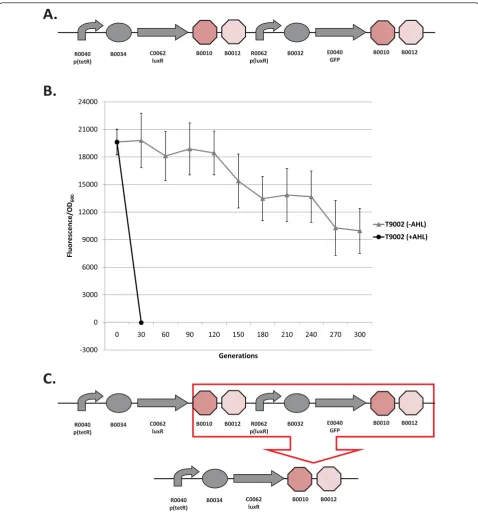
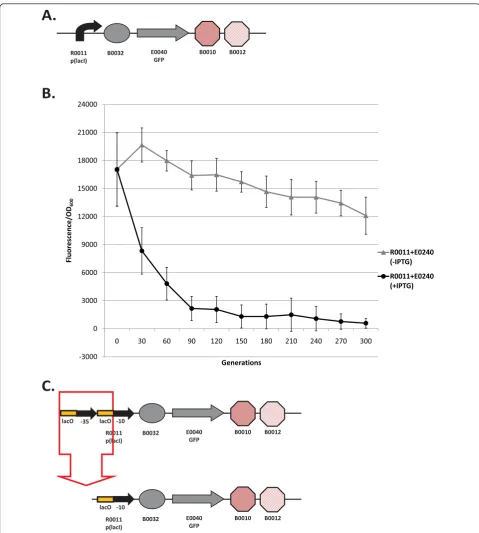
The two circuits we used to measure the evolutionary stability dynamics and determine the loss-of-function mutations were T9002 (Figure 1a) and I7101 (Figure 2a). T9002 is the Lux receiver circuit previously described
[17] and expresses luxR that activates GFP
expres-sion when the inducer AHL is added to the media (see Figure 1 legend for details). I7101 has alacI-regulated promoter and expresses GFP only when the inducer
IPTG is added to the media sincelacIis constitutively
overexpressed from the chromosome in this particular
strain (Escherichia coliMG1655 Z1). The evolutionary
stability dynamics were measured by serial propagation with a dilution factor that allows for about 10 generations per day.
Figure 1b shows the evolutionary stability dynamics of the T9002 circuit propagated in high input (with AHL) and low input (without AHL) conditions. From different timepoints in the experiment, the low and high input populations were induced with AHL to measure their normalized expression (here measured by fluorescence divided by cell density) over time. The low input evolved populations slowly lose their function to about 50% of the maximum after 300 generations. The evolved popu-lations in high input conditions rapidly lose their func-tion in less than 30 generafunc-tions (the dynamics of this evolutionary stability are described below in Figure 3). No functional clones were observed after 30 generations as determined by measurement of individual colonies. The mutation that repeatedly causes loss-of-function in the high input evolved populations is a deletion between two homologous transcriptional terminators (Figure 1c), the same mutation described in [17]. This mutation evi-dently occurs at such a high rate that mutants quickly
take over the population. In fact, Canton et al (2008)
[17] were unable to isolate a population derived from a single isolate that did not already carry the deletion. The mutant plasmid was transformed back into the
progenitor and was shown not to fluoresce after induc-tion with AHL. In this initial study we also tested the evolutionary stability of a BioBrick engineered ver-sion of the repressilator circuit [1]. We could not mea-sure its function over time due to unstable GFP expression at the population level, but found that the circuit repeatedly had a deletion between homologous
tetRpromoters.
Figure 2b shows the evolutionary dynamics of the I7101 circuit propagated in high (with IPTG) and low input (without IPTG) conditions. The evolved popula-tions in low input condipopula-tions lose about 70% of their function over 300 generations. The high input evolved populations lose about half their function in 30 genera-tions and nearly all function after 300 generagenera-tions. For this circuit, the loss-of-function is repeatedly a deletion between two homologous operator sequences in the promoter (Figure 2c). The mutant plasmid was trans-formed back into the progenitor and was shown not to fluoresce when induced with IPTG. This initial study suggests that the use of repeated parts in synthetic circuits should be avoided due to the high mutation rate. Also, there is a high metabolic load associated with the expression of genetic circuits on high-copy plasmids since keeping these circuits off substantially improves evolutionary stability.
Evolution experiment with re-engineered circuits
Based on the results of the previous experiments, we re-engineered the T9002 and I7101 circuits to test var-ious predictions of evolutionary stability and mutational predictability. For the T9002 circuit, the loss-of-function mutation was repeatedly a deletion between two homo-logous transcriptional terminators. Mutations and genetic rearrangements can occur due to misalignment of homologous sequences during replication (termed
“replication slippage”) [27]. Deletion mutations between repeated sequences are known to be dependent upon repeat length, proximity, and homology level [28]. These
deletions are recA-independent if the repeat length is
Figure 1Loss-of-function mutations and evolutionary stability dynamics in T9002. (A) The T9002 genetic circuit. Symbols depict promoters (bent arrows), ribosome binding sites (ovals), coding sequences (arrows), and transcriptional terminators (octagons). T9002 consists of two devices, a luxR receiver device and a GFP-expressing device. The first device is composed of thetetR-regulated promoter R0040 that is
use of different terminators will become increasingly important when more complex circuits are constructed and BioBricks become even more widespread in the community. Also, many of the studies on recombination between repeated sequences use antibiotic resistance
genes to measure recombination rates and may not relate to actual functioning circuits.
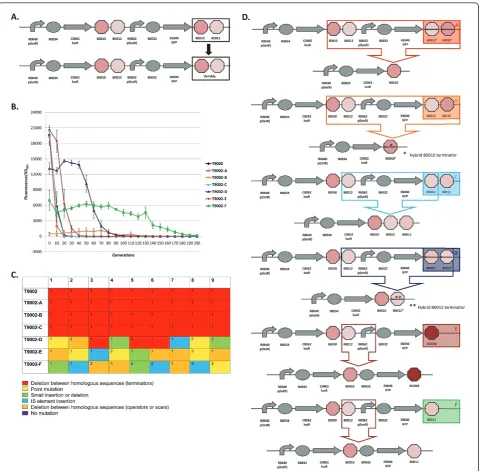
We also re-engineered the I7101 circuit in two sepa-rate ways. The first was to re-engineer I7101 with var-ious promoters from a promoter library to test whether Figure 3Loss-of-function mutations and evolutionary stability dynamics in re-engineered T9002 circuits. (A) T9002 re-engineering involves changing the second double transcriptional terminator with varying degrees of homology and orientation to the first double
evolutionary stability is inversely correlated with promo-ter strength. The second was to insert a kanamycin resistance gene (kanR) within the circuit to put a selec-tive pressure on the promoter. We engineered two ver-sions of the KanR circuit, one as a GFP-KanR fusion protein with a glycine-serine linker and another where
kanRis polycistronically expressed with GFP. Finally, we tested the effect of inducible vs. constitutive expression on evolutionary stability with two circuits having differ-entlacI-regulated promoters.
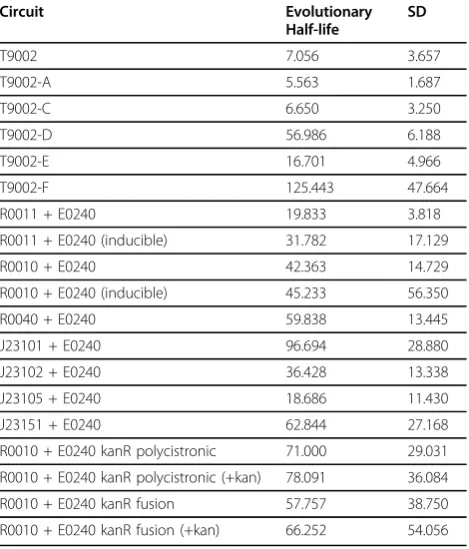
Since we learned from previous experiments that evo-lutionary stability dynamics of genetic circuits have high variability between replicate populations, we evolved nine independent populations of each re-engineered circuit for at least 300 generations. Three experimental replicate populations of three independent tranformants were used to test for independent mutational events. A single transformant may have a mutation at a low level that will eventually sweep through the population, so if only one transformant was used, the same mutation may show up in all replication populations. For each of the nine popu-lations in every circuit, the evolutionary half-life was measured to quantitate the number of generations until the expression level had decreased to half of its initial level (Table 1). Plasmids from a single clone from each evolved population were then sequenced after the popu-lation level had decreased to below 10% of the original expression level, or after 500 generations, whichever came first. Additional File 1, Supplementary Table S1 shows all mutations for each population in every circuit.
Re-engineered T9002 circuits with different
transcriptional terminators: loss-of-function mutations and evolutionary stability dynamics
Figure 3a shows the schematic for re-engineering the last transcriptional terminator in the T9002 circuit. The evolu-tionary stability dynamics for six re-engineered T9002 cir-cuits and the original T9002 circuit are shown in Figure 3b. Figure 3c shows the type of mutations that occurred in each of the nine replicate evolved populations. Finally, Figure 3d shows the most common mutations for each re-engineered circuit. The six re-re-engineered circuits are labelled T9002-A through T9002-F in Figure 3b and color-coded to correspond to the same circuit mutations shown in Figure 3d. These circuits were all propagated with the inducer AHL to allow for GFP expression. In the following paragraphs, the loss-of-function mutations and evolution-ary stability dynamics for the original T9002 circuit and each re-engineered circuit will be described in detail.
T9002: The original T9002 circuit decreases rapidly to about 30% of the original level after only 10 generations and all function is lost by 20 generations (Figure 3b). The same deletion between homologous terminators as was observed in previous experiments (Figure 1c) was
found in all nine replicate populations (Figure 3c). The evolutionary half-life of this circuit was found to be about 7.1 generations on average (Table 1).
T9002-A: The final double terminator in T9002 was re-engineered in the reverse complementary orientation (called B0025 in the Registry) to make T9002-A. The stability of this circuit has approximately the same expression level and stability dynamics as T9002, but has an evolutionary half-life of about 5.6 generations (Figure 3b, Table 1). This decreased stability may be because the terminator in the reverse orientation is more likely to cause replication slippage. Since the expression level is similar to T9002 and therefore the metabolic load should be roughly equivalent, the differ-ence in stability is primarily due to an increased muta-tion rate. Seven of nine replicamuta-tion populamuta-tions have a deletion between the first B0010 terminator and the reverse complement of B0010 (Figure 3c and 3d). This effect likely occurs because B0010 has a long hairpin structure, so one half of B0010 can interact with the other half of the reverse complementary B0010 sequence during DNA replication since they have perfect homol-ogy. Two of the nine populations had a deletion that formed a triple terminator of B0010-B0012-B0010 (Additional File 1, Supplementary Table S1).
Table 1 Evolutionary half-life of various genetic circuits
Circuit Evolutionary Half-life
SD
T9002 7.056 3.657
T9002-A 5.563 1.687
T9002-C 6.650 3.250
T9002-D 56.986 6.188
T9002-E 16.701 4.966
T9002-F 125.443 47.664
R0011 + E0240 19.833 3.818
R0011 + E0240 (inducible) 31.782 17.129
R0010 + E0240 42.363 14.729
R0010 + E0240 (inducible) 45.233 56.350
R0040 + E0240 59.838 13.445
J23101 + E0240 96.694 28.880
J23102 + E0240 36.428 13.338
J23105 + E0240 18.686 11.430
J23151 + E0240 62.844 27.168
R0010 + E0240 kanR polycistronic 71.000 29.031
R0010 + E0240 kanR polycistronic (+kan) 78.091 36.084
R0010 + E0240 kanR fusion 57.757 38.750
R0010 + E0240 kanR fusion (+kan) 66.252 54.056
T9002-B: The T9002-B circuit was re-engineered to re-arrange the B0010 and B0012 terminators to have B0012 first and then B0010. The re-arrangement decreases the expression level to almost zero initially and this expression drifts up over time and then decreases to zero (Figure 3b). For this circuit, evolution-ary half-life measurements are essentially meaningless due to the randomness of low expression. Notice that other re-engineered T9002 circuits also have decreased expression levels relative to T9002, presumably due to weaker terminator hairpin structures having increased mRNA degradation [30] or transcriptional readthrough that can decrease plasmid copy number [31]. Others have observed that removal of transcriptional termina-tors can decrease expression levels in general [32]. All nine populations have the same deletion between B0010 terminators (Figure 3c and 3d). Because the B0010 ter-minator is an inexact hairpin (there are some mis-matches), one half of the first B0010 interacts with the other half of the second B0010 terminator, causing a hybrid B0010 terminator (Figure 3d, Additional File 1, Supplementary Table S1).
T9002-C: The T9002-C circuit was re-engineered to have B0012 and B0011 as the final double terminator instead of B0010 and B0012. This circuit has nearly iden-tical stability dynamics as T9002, with an evolutionary half-life of about 6.7 generations on average (Figure 3b, Table 1). All nine populations have the same deletion between B0012 terminators that make a triple terminator of B0010-B0012-B0011 (Figure 3c and 3d). Since the expression level and stability dynamics are roughly equivalent to T9002, the mutation rate between repeated B0010-B0012 terminators (129 bp) is probably about the same as between repeated B0012 terminators (41 bp). Interestingly, no significant stability difference was observed between T9002-C (41 bp homology) and T9002 or T9002-A (both 129 bp homology), despite having similar expression levels. This result suggests that short-ening the repeated regions of homologous terminators did not increase evolutionary robustness, contrary to what we expected.
T9002-D: The T9002-D circuit has the same final B0012-B0011 terminator, but is the reverse complement of this sequence. The inclusion of this terminator decreases the initial expression level to about 65% of T9002 (Figure 3b). The evolutionary half-life of this cir-cuit is about 57 generations (Figure 3b, Table 1). Also, the slope of the stability plot is decreased relative to other circuits with higher expression (T9002, T9002-A, T9002-C, and T9002-E) and the stability lag (time for expression to decrease to zero along the x-axis) is increased (Figure 3b). In contrast to other circuits with repeated terminators, only 3/9 have deletions between homologous terminators forming a hybrid B0012
terminator (Figure 3c and 3d). This result is probably because, unlike T9002-C, the second B0012 is the reverse complement, and therefore the only homology in this circuit is the 8-bp of hairpin structure having complementary sequences; the rest of the terminator has a loop structure of non-complementary sequences. In other words, B0010 has sufficient homology in either the forward or reverse orientation to cause replication slippage, but in B0012 replication slippage is more likely to occur only in the forward orientation. The other mutations in this circuit are composed of point muta-tions, short insertions or delemuta-tions, deletions between scar sequences, or insertion sequence (IS) mutations (Figure 3c, Additional File 1, Supplementary Table S1).
T9002-E: The T9002-E circuit, like the T9002-F circuit, was re-engineered to have no homology between termi-nator sequences. This circuit has the highest initial expression level on average probably because J61048 is a very strong terminator, but has similar expression relative to the T9002, T9002-A, and T9002-C circuits (Figure 3b). Its evolutionary half-life is about 16.7 generations (Figure 3b, Table 1). Thus, relative to other circuits with the similar expression levels, it is the most evolutionary robust circuit, having over 2-fold higher stability than T9002. When the evolutionary half-life is measured for the nine replicate populations, this evolutionary half-life difference compared to T9002 is highly significant (one-tailed t-test, p = 0.0003). Notice that the stability slope is similar to T9002, T9002-A, and T9002-C circuits, but the stability lag is increased by about 10 generations. This difference in lag is likely due to a decreased mutation rate since mutations are more random compared to the other similar expression-level circuits (Figure 3c, Addi-tional File 1, Supplementary Table S1). The most com-mon mutation is a deletion between repeated scar
sequences that removes theluxR promoter and
effec-tively inactivates the circuit function (Figure 3d).
T9002-F: The T9002-F circuit was re-engineered with the B0011 terminator, so it also has no homology between terminator sequences. The B0011 is evidently a weak terminator since its initial expression level is about 4-fold lower than T9002. Its stability dynamics show that it is the most evolutionary robust of the re-engi-neered T9002 circuits, with an evolutionary half-life of about 125 generations (Figure 3b, Table 1). This result indicates that decreasing homology levels and expression through terminator re-engineering increased the evolu-tionary half-life of this circuit over 17-fold relative to T9002. Like T9002-E, the mutations in each of the nine populations are mostly random (Figure 3c, Additional File 1, Supplementary Table S1). Also like T9002-E, the most common mutation is a deletion between repeated
scar sequences that removes the luxRpromoter driving
T9002-F likely have similar mutation rates with zero terminator homology, the large stability difference between these circuits can be explained by expression levels alone.
Overall, excluding T9002-B, three of the five re-engi-neered T9002 circuits are more evolutionary robust than the original circuit. The order of evolutionary robust genetic circuits is: T9002-F > D > E > A = C = T9002. This increase in evolutionary robustness can be attributed to decreased expression levels (due to the terminator re-engineering) and to decreased mutation rate between homologous transcrip-tional terminators. The re-engineered circuits with homolo-gous transcriptional terminators almost always have deletions between homologous regions, whereas circuits without homology have mutations in other locations in the circuit. Re-engineering this circuit to remove all homology effectively removes a certain class of mutations from occur-ring. The T9002-E circuit is more evolutionary robust than other circuits with similar expression levels likely due to decreased mutation rate alone. Thus, evolutionary robust-ness can be increased by removing long repeated sequences from genetic circuits, but even short 8-bp scar sequences have the potential for replication slippage.
Re-engineered I7101 circuits with different promoters: loss-of-function mutations and evolutionary stability dynamics
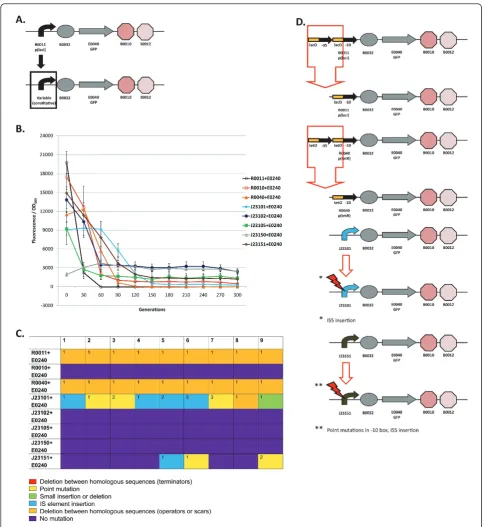
Figure 4 shows the re-engineering scheme for the I7101 circuit with different promoters (Figure 4a), evolutionary stability dynamics for these re-engineered circuits (Figure 4b), mutations found in the nine evolved popu-lations (Figure 4c), and the most common mutation for each re-engineered circuit (Figure 4d). These circuits were constitutively expressed (no inducer was required to activate the circuit). Many of these promoters were used in the promoter measurement kit, an effort to standardize promoter measurements between promoters [33]. This previous study used medium-copy plasmids whereas we used high-copy plasmids and different envir-onmental conditions. The loss-of-function mutations (if any) and evolutionary stability dynamics for the origi-nal I7101 circuit and each re-engineered circuit are described in detail below.
I7101 (R0011 + E0240): The evolutionary stability of the original I7101 circuit was measured constitutively (unlike Figure 2 with inducible expression) and is shown in Figure 4b. The evolutionary half-life of this circuit is about 20 generations (Table 1) and reaches zero after 40 generations (plotted every 30 generations for clarity). Not surprisingly, all nine populations have the same deletion between repeated operator sequences in the promoter (Figure 4c and 4d).
R0010 + E0240: When the R0011 promoter is swapped out for R0010, the wildtypelacI-regulated pro-moter without repeated operator sequences, the initial
expression level decreases slightly (Figure 4b). The evo-lutionary half-life of this circuit is about 42 generations (Table 1) and roughly double that of R0011 + E0240. This circuit is more evolutionary robust than R0011 + E0240 probably due to a combination of decreased expression level and mutation rate. Also, this circuit never reaches zero expression. When this circuit was sequenced, surprisingly no mutations were found in any of the nine populations (Figure 4c). However, expression levels decreased due to unknown mutations in the chro-mosome (Additional File 1, Supplementary Material).
R0040 + E0240: R0040 is a tetR-regulated promoter
with repeatedtetO operator sequences. This circuit’s
evolutionary half-life is about 60 generations (Figure 4b, Table 1). Unsurprisingly, all nine populations have a deletion between the repeated operator sequences, simi-lar to that of R0011 + E0240 (Figure 4c and 4d).
J23101/J23102/J23105/J23150/J23151 + E0240: All five of these circuits have very different initial expression levels and evolutionary half-lives, but are similar in that they maintain relatively high expression levels after an initial decrease except for J23150 + E0240 that main-tains a relatively constant level (Figure 4b, Table 1). Like R0010 + E0240, three circuits do not have any muta-tions in all nine populamuta-tions.
In summary for this section, re-engineered I7101 cir-cuits have a large amount of variation in stability. This variation is probably mostly due to differences in expres-sion level, but mutation rate also contributes to this variability. We expected that promoter strength to be inversely proportional to evolutionary half-life, and this hypothesis was tested in the Evolutionary half-life mea-surements of individual populations section (Additional File 1, Supplementary Material). Only circuits with repeated operator sequences reached zero expression, probably because the deletion removes the entire -35 region and therefore no leaky expression can occur. Pro-moters without repeated operator sequences should be used to maximize evolutionary stability.
Re-engineered I7101 circuits with a kanamycin resistance gene: loss-of-function mutations and evolutionary stability dynamics
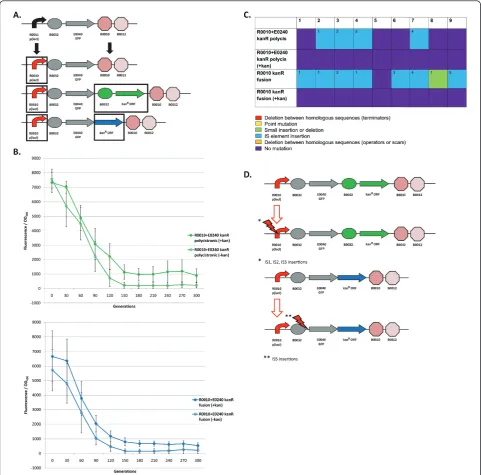
common mutation for each re-engineered circuit (Figure 5d). These circuits were constitutively expressed and the KanR circuits were propagated with and without kana-mycin (kan) in the media. We predicted that the kan propagated circuits would be more evolutionary robust than those without kan in the media.
The upper panel of Figure 5b shows the evolutionary
stability dynamics for the R0010 + E0240kanR
polycis-tronic circuits with and without kan in the media.
Intro-duction of thekanRcoding sequence into the R0010 +
E0240 circuit lowers expression by about 60% (Figure 4b and Figure 5b, upper panel). This lowered expression may be due to competition between the RBS used for GFP translation vs. the RBS used for KanR translation. This difference in expression complicates any useful comparisons between the R0010 + E0240 circuit and the
R0010 + E0240kanR polycistronic circuit. However,
since the KanR circuit was measured with and without kan in the media, we can determine the effect the kana-mycin is having on the circuit independent of expression levels. The KanR circuit propagated with kan has an evo-lutionary half-life of about 78 generations whereas with-out kan the half-life is 71 generations, but this result is not statistically significant (one-tailed t-test, p = 0.0896). However, the circuit propagated with kan remains at a higher level over time (Figure 5b, upper panel).
The lower panel of Figure 5b shows the same compar-ison between circuits except with the GFP-KanR fusion
version of the circuit. Introduction of the kanR fusion
coding sequence also lowers expression by about 60% and this may be due to folding issues in the GFP-KanR fusion protein. Similar to the polycistronic version of the KanR circuit, the fusion version also only has an evolutionary half-life difference of less than 10 genera-tions when propagated with kan compared to without kan in the media (Table 1 and Figure 5b, lower panel). Again, this result is not statistically significant (one-tailed t-test, p = 0.1174). Like the polycistronic version of this circuit, propagation in kan causes evolutionary stability to remain at a higher level over time (Figure 5b, lower panel).
Figure 5c shows the mutations found in each of the nine populations. Interestingly, 4/9 of the KanR polycis-tronic circuits and 7/9 of the KanR fusion circuits pro-pagated without kan in the media have IS mutations at the generation 200 timepoint. The KanR circuits propa-gated with kan in the media and the R0010 + E0240 cir-cuit have no mutations at this timepoint. However, after propagating these KanR circuits for 500 generations, 2/9 populations had mutations in the promoter that were not IS mutations. Evidently, mutations on the chromo-some confer resistance to kanamycin because introduc-tion of these mutated circuits back into the progenitor does not make these cells kan resistant.
Since only KanR circuits propagated without kan in the media have IS mutations, propagating strains car-rying the metabolic load of express resistance to both ampicillin (encoded on the plasmid backbone) and kanamycin could have caused a significant amount of cellular stress and triggered IS transposition. Some evi-dence suggests that IS transposition can occur in response to stress [34-38], but it also occurs in non-stressful conditions as well [26,38,39]. IS mutations probably occurred in the KanR circuits propagated with kan in the media as well, but cells carrying these circuits were selected against. Additional experiments partially explain why KanR circuits propagated with kan lose expression over time without having muta-tions in the circuit itself (Additional File 1, Supple-mentary Material).
The IS mutations in the KanR circuits propagated with-out kan in the media consisted of IS1, IS2, and IS5 muta-tions (Figure 5d, Additional File 1, Supplementary Table S1). A hotspot for IS5 mutations“C(T/A)A(G/A)”[40,41] often occurs in the“CTAG”portion of the scar sequence between either the promoter and RBS ("TACTAGAG”) or RBS and coding sequence ("TACTAG“). This one unex-pected result may be unfortunate for genetic circuits assembled with BioBricks if the host strain carries IS5 ele-ments and if evolutionary stability is an issue. Also, since the IS5 mutations in these circuits were located in a posi-tion just downstream of the promoter, we thought that the transposase gene within the IS element might be tran-scribed and translated. However, the orientation of these IS insertions in these circuits would not allow for expres-sion to occur. Unlike IS5 which has a defined hotspot, the IS1 and IS2 mutations are more random, but appear to transpose in A-T rich regions (Additional File 1, Supple-mentary Table S1).
Overall, the use of a kanamycin resistance gene within the circuit does not significantly increase evo-lutionary stability. Although propagation with kana-mycin in the media may put a selective pressure on the promoter, other mutational targets evidently can decrease expression of the circuit over time (Addi-tional File 1, Supplementary Material). IS mutations are responsible for loss-of-function in the KanR cir-cuits propagated without kan. Since there are
rela-tively few IS mutations in circuits without kanR
(Figures 3c, 4c, 5c, and 6c), this circuit may induce IS transposition bursts.
As a final note for this section, we also tried to insert
kanR into the T9002 circuit that would be
polycistroni-cally transcribed with GFP. The cells carrying this cir-cuit did not grow well when AHL was added to the
media. ExpressingkanRusing the strong luxRpromoter
of kanR may have helped to avoid this growth deficiency.
Constitutive vs. inducible expression between twolacI -regulated circuits: loss-of-function mutations and evolutionary stability dynamics
We also propagated twolacI-regulated circuits (R0011 + E0240 and R0010 + E0240) with inducible vs. constitu-tive expression. We speculated that there might be a dif-ference in stability since the constitutively expressed circuits may have a larger metabolic load. In the induci-ble circuits, the LacI protein may rebind to the DNA after some time and repress transcription. For inducible expression, we propagated the circuits in MG1655 Z1
strains that constitutively overexpresses lacI from its
chromosome. Constitutively expressed circuits were pro-pagated in the normal MG1655 strain that does not overproduce LacI. Figure 6 shows the regulation of the inducible circuits (Figure 6a), evolutionary stability dynamics for these re-engineered circuits (Figure 6b), mutations found in the nine evolved populations (Figure 6c), and most common mutation for each re-engineered circuit (Figure 6d).
For both circuits, evolutionary stability is increased on average when inducible expression is used com-pared to constitutive expression (Figure 6b). The evo-lutionary half-life of the R0011 + E0240 circuit under inducible control is about 32 generations vs. 20 for constitutive expression (one-tailed t-test, p = 0.0422). For R0010 + E0240, the inducible evolutionary half-life is 45 generations vs. 42 generations for constitutive expression (one-tailed t-test, p = 0.1083). Therefore, the evolutionary half-life is only significantly increased for one of the two circuits, but on average inducible expression increases evolutionary robustness. For the R0011 + E0240 circuit under inducible expression, by 30 generations the circuit is already about 4-fold higher even though it had a lower initial expression (Figure 6b, upper panel). After 60 generations, the cir-cuit under constitutive expression has lost all function and the inducible circuit has 25% of its original expres-sion level (Figure 6b, upper panel). Furthermore, the slopes are quite different between inducible and consti-tutive expression. The inducible R0010 + E0240 circuit is over 3-fold higher after 60 generations compared to the circuit under constitutive expression (Figure 6b, lower panel). The reason that inducible circuits may be more evolutionary robust than constitutive circuits is that there may a greater metabolic load to constantly express GFP. Perhaps in the inducible circuits, LacI eventually re-inhibits GFP expression and decreases this metabolic load.
The mutations in both circuits are similar for both inducible and constitutive expression (Figure 6c). For
R0011 + E0240, all have the same mutation between repeated operator sequences (Figure 6c and 6d). For R0010 + E0240, only one mutation was observed in one inducible population, an IS element insertion (Figure 6c and 6d), indicating that differences in inducible vs. con-stitutive expression largely do not change the type of mutations that occur.
Evolutionary half-life vs. initial expression level in T9002, T9002-E, R0011 + E0240, and R0010 + E0240 circuits evolved with different inducer concentrations
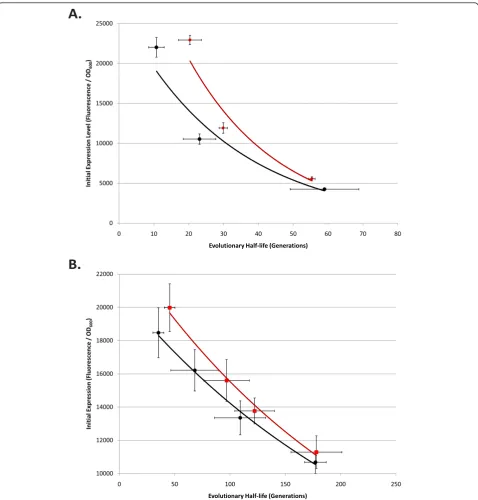
From the results in previous sections (Figures 3, 4, 5, 6, Table 1), we noticed that circuits with a high initial expression level tended to have low evolutionary stability. Also, particular circuits with high mutation rates had lower stability compared to circuits with lower mutation rates. To test the relationship between initial expression level and evolutionary half-life directly, we evolved four circuits for up to 300 generations propagated with differ-ent inducer concdiffer-entrations. We tested initial expression level vs. evolutionary half-life in T9002 (high mutation rate) vs. T9002-E (lower mutation rate) using different AHL concentrations. We also tested initial expression level vs. evolutionary half-life in R0011 + E0240 (high mutation rate) vs. R0010 + E0240 (lower mutation rate) using different IPTG concentrations in the Z1 strain.
The results of these experiments are shown in Figure 7. Figure 7a shows the mean initial expression level vs. mean evolutionary half-life for eight replicate populations from three different AHL concentrations in T9002 (black) and T9002-E (red). An exponential fit of these mean data points gives a much higher r2value than a linear fit (> 0.1) in both cases. T9002 has an r2value of 0.954 compared to the r2value of 0.955 in T9002-E. The curve for T9002 is shifted to the left from T9002-E due to its higher mutation rate (expression alone cannot account for the shift), but as expression is decreased the evolutionary half-life difference between these two circuits also decreases. This decrease may be because at high expression levels, the fitness differ-ence between the progenitor and mutant cells is the high-est, and therefore mutants outcompete functional cells in the population more quickly.
Figure 7b shows the mean initial expression level vs. mean evolutionary half-life for eight replicate popula-tions from four different IPTG concentrapopula-tions in R0011 + E0240 (black) and R0010 + E0240 (red). The R0011 +
E0240 exponential curve has an r2 value of 0.993
whereas the r2 value of R0010 + E0240 is 0.992. These
may have been more similar if there were more data points for the IPTG-induced populations at lower expression levels (evolutionary stability was relatively stable at 300 generations for these populations). The other striking difference between Figures 7a and 7b is that the T9002 and T9002-E circuits have a much lower evolutionary stability than the R0011 + E0240 and R0010 + E0240 circuits for any particular expression level. This result could be for a number of reasons that include mutation rate and fitness differences between functional and non-functional cells (due to circuit length, activator vs. repressor regulation, or something particular to the strongluxRpromoter).
We also performed a regression on the individual T9002, T9002-E, R0011 + E0240, and R0010 + E0240 initial expression level vs. evolutionary half-life for inde-pendently evolved populations (Additional File 1,
Sup-plementary Figures S2 and S3). While the r2 values are
not as high for individual data points compared to means (Figure 7) and range from about 0.6 to almost 0.9, the regressions are highly significant (p < 0.0001). For these regressions, an exponential fit is always higher than a linear fit in all cases, suggesting that on average, evolutionary half-life exponentially decreases with increasing expression levels. We also performed a regression on the initial expression level vs. evolutionary half-life for independent populations (shown in Figures 3, 4, 5, 6, Additional File 1, Supplementary Figures S4, S5, S6, S7, S8).
Discussion
Genetic circuits lose function over evolutionary time and are found to have a wide variety of mutations that cause their loss-of-function. Circuits with repeated sequences almost always have deletions between these sequences. These repeated sequences include transcrip-tional terminators, entire promoters, operator sequences within promoters, and occasionally between 8-bp scar sequences. In one re-engineered T9002 circuit, shorten-ing the length of homology from 129 bp to 41 bp did not significantly increase evolutionary stability. Stability was only increased when there was no homology what-soever between transcriptional terminators. Mutations between repeated sequences without perfect homology in the case of some re-engineered T9002 circuits are usually, but not always predictable.
In circuits without repeated sequences, mutations are more random between evolved replicate populations. Mutations that remove promoter function are most often selected for among all the genetic circuits tested. This result is likely because promoter mutations remove the metabolic load at both the transcriptional and trans-lational levels. Mutations within RBSs are not found and mutations in coding sequences are rare except when
that coding sequence is an activator of transcription
downstream (as in the case of the luxRcoding sequence
in T9002). In the case of T9002, removing homology between transcriptional terminators only shifts the
mutation to one that often removes function of theluxR
promoter or luxR coding sequence instead. A similar
story is seen with the KanR circuits. Even when a kana-mycin resistance gene is inserted within the circuit and cells with this circuit are propagated with kanamycin to select for promoter function, mutations in the chromo-some are selected for instead. Thus, without a selective pressure, removing the possibility of a mutation in one location only causes a mutation in another location. However, if this prevention lowers the mutation rate for a particular mutation, then evolutionary stability can be increased significantly, as shown for the T9002-E circuit. What is needed is a method to predict the evolution-ary stability of circuits from the properties of their parts, but the emergent behaviors of circuits will likely make prediction difficult. At the very least, publishing the evo-lutionary stability properties of simple circuits in future data sheets may allow engineers to calculate the expected evolutionary stability of more complex circuits. This calculation would likely require software (such as [42]) and mathematical modelling [43] that analyzes each part individually and the entire DNA sequence as a whole to determine the expected evolutionary stability. This calculation would also require standardization for methods to measure evolutionary stability and methods described here are not necessarily the best way. On the other hand, more general methods may be developed that focus less on design of the circuit and more on design of the environment to impose a selective pressure for function of the circuit [44]. Design of a selective environment is ideal, but is difficult to do when the out-put of most circuits (e.g., GFP) is not linked to survival or growth rate. A cell-sorter device that sorts between functional and non-functional cells may help with this issue, but may not be practical for performing routine experiments.
Using a low or medium-copy plasmid will help with stabi-lity as long as the expression level does not need to be high. For more complex circuits where a high expression level is needed for proper functioning of the circuit, decreasing expression level then comes at the cost of changing the function of the circuit.
The second design principle is to avoid repeated sequences. This principle may be obvious, but nearly every circuit in the Registry with more than one coding sequence has repeated B0015 terminators. When a circuit has a high metabolic load (higher than T9002) and repeated sequences on a high-copy number plasmid, the circuit will almost always lose function during overnight growth (unpublished results). Re-engineering the T9002 circuit to have two different transcriptional terminators (T9002-E) does significantly increase evolutionary half-life over 2-fold and is independent of expression levels. How-ever, since this circuit has high expression, this improve-ment only results in an increase of about 10 generations. Decreasing the expression level along with the mutation rate will increase the evolutionary half-life about 17-fold, as seen in the T9002-F circuit. This result suggests simple ways to increase evolutionary stability can be used without changing function of the circuit. For more complex cir-cuits, the community will need to identify many more ter-minators than those that currently exist in the Registry to design circuits without repeated sequences.
The third design principle is that use of inducible pro-moters generally increases evolutionary stability. This principle may or may not be significant depending on the circuit used. Inducible circuits are likely more stable due to decreased metabolic load and are preferred since expression can be controlled and fine-tuned, though in some circumstances a constitutive promoter may be desired. Therefore, the use of inducible promoters can be thought of one extra precaution to maximize evolu-tionary stability, but expression levels and repeated sequences should first be considered.
We emphasize that the design principles proposed may not be general since only relatively simple circuits were tested in this study. Evolutionary stability should be measured in larger and more complex circuits to understand if these design principles apply. Further-more, these simple design principles should not necessa-rily be all used simultaneously. A researcher may not want only to design circuits that have low expression, have no repeated regions, and use a promoter that is inducible. For instance, if recombination sites are needed in the circuit, then repeated or inverted sequences may be impossible to avoid. Besides the design for the proper function of the circuit, design for evolutionary robustness should be carefully considered. For this, we need to think about the probability of mutations occurring when the expression level, and
therefore metabolic load, is high. In this study, removing repeated regions often shifts mutations to the promoter, and putting a selection on the promoter often shifts the mutation to the chromosome.
Thus, mutations are unavoidable without a selective pressure, but evolutionary stability can likely be improved in the future by better design of selective environments where the circuit is linked to survival and/or growth rate, understanding of mutation rates in genetic circuits, fit-ness differences between functional and non-functional cells, and improvements to the host strain that decrease mutation rates or buffer metabolic loads more efficiently. Another way to improve evolutionary stability is to engi-neer an error detection and correction circuit that will correct mutations, but will need careful design since this circuit itself will be prone to mutation. Designing evolu-tionary robust genetic circuits therefore is somewhat of an artform at the moment besides a few simple design rules, but should be seen as something the engineer can eventually control.
Conclusions
A wide variety of loss-of-function mutations are observed in genetic circuits including point mutations, small insertions and deletions, large deletions, and inser-tion sequence (IS) element inserinser-tions that often occur in the scar sequence between parts. Promoter mutations are selected for more than any other biological part. Genetic circuits can be re-engineered to be more evolu-tionary robust with a few simple design principles: high expression of genetic circuits comes with the cost of low evolutionary stability, avoid repeated sequences, and the use of inducible promoters increases stability. Inclusion of an antibiotic resistance gene within the circuit does not ensure evolutionary stability.
Methods
Circuit engineering and use of strains
All circuits were either obtained from the Registry of Standard Biological Parts or engineered using the Clon-tech In-Fusion PCR Cloning Kit with the specific meth-ods described in [19]. All circuits are encoded on the pSB1A2 plasmid, a high copy number plasmid (100-300 plasmids/cell) with an ampicillin resistance gene. Plas-mids were transformed into strains via chemical
trans-formation. Escherichia coliMG1655 was the strain used
for constitutive expression and Escherichia coliMG1655
Z1 was used for inducible expression from lacI
-regu-lated promoters since this strain is lacIq
(overexpresses
lacIfrom its chromosome).
Evolution experiment
MG1655 Z1 competent cells. Three individual transfor-mant colonies were grown overnight at 37°C shaking at
250 RPM in + 100μg/mL ampicillin and supplemented
with 50 μg/mL kanamycin for KanR circuits. Freezer
stocks were saved of these cultures in 15% glycerol and stored at -80°C. These freezer stocks were streaked out
on LB + 100 μg/mL ampicillin plates with appropriate
inducer (1 × 10⁻⁷ M AHL for T9002 circuits and 1 ×
10-3M IPTG for LacI-regulated promoters) or antibiotic
(50 μg/mL kanamycin for KanR circuits) and grown
overnight at 37°C. Three colonies were chosen from each transformant (nine total colonies) and inoculated
into 1.5 mL LB + 100 μg/mL ampicillin media in
Eppendorf deep-well plates sealed with a Thermo Scien-tific gas permeable membrane to allow for maximum oxygen diffusion. T9002 circuit cultures were
supple-mented with the inducer 1 × 10⁻⁷M 3OC6HSL (AHL).
KanR circuit cultures were supplemented with 50 μg/
mL kanamycin. Also,lacI-regulated circuits under
indu-cible expression were supplemented with 1 × 10⁻³ M
IPTG. T9002 and R0011 + E0240 were also evolved without inducer as controls. The R0011 + E0240 circuit with a mutation in the promoter was evolved to mea-sure fluorescence background. Cultures were propagated with a serial dilution scheme using a 1:1000 dilution to achieve about 10 generations per day (log2 1000 = 9.97).
Evolved populations were grown for 24 hours at 37°C shaking at 250 RPM. Freezer stocks (with 15% glycerol) of each population were saved at -80°C every day for future study. All replicate populations were evolved in parallel to minimize experimental variability.
Evolutionary stability measurements
Every 24 hours, cell density (OD600) and fluorescence
(excitation wavelength: 485/15, emission wavelength: 516/20) of evolved populations were measured in a Bio-tek Synergy HT plate reader. 24 hours was used as the measurement timepoint because the rate of change of GFP was closest to zero (i.e. closest to steady-state). Evolved populations thus spent about 8-12 hours in lag or exponential phase and the remaining time in station-ary phase. For each timepoint, all populations were
thor-oughly mixed and 200 μl was transferred into black,
clear-bottom 96-well plates (Costar). OD was subtracted from blank media to measure the OD without back-ground. Fluorescence was subtracted from the R0011 + E0240 circuit with a mutation in the promoter to mea-sure background fluorescence. Fluorescence was then divided by OD to measure the normalized expression (Fluorescence/OD600).
Plasmid sequencing
At appropriate evolutionary timepoints, usually when circuit function had decreased to less than 10% of the
original expression level, or 500 generations, the evolved
populations were streaked out on LB + 100 μg/mL
ampicillin plates, supplemented with 1 × 10⁻⁷M AHL
(for T9002 circuits), 50μg/mL kanamycin (for KanR cir-cuits), or 1 × 10⁻³M IPTG (for lacI-regulated inducible circuits). Colonies were visualized for fluorescence on a Clare Chemical Dark Reader Transilluminator. Non-fluorescing colonies, or weakly Non-fluorescing colonies if no non-fluorescing colonies were present, were grown over-night in 5 mL of LB + 100 ug/mL ampicillin. Plasmids were extracted using the Qiagen Miniprep Kit or gly-cerol stocks were sent to the University of Washington High-Throughput Genomics Unit facility http://www. htseq.org. Purified plasmid DNA was sequenced using
the VF2 (5’-TGCCACCTGACGTCTAAGAA-3’) and VR
(5’-ATTACCGCCTTTGAGTGAGC-3’) primers specific
to the pSB1A2 vector (about 100 bp on either side of the circuit) or primers specific to the circuit.
Quantitative analysis of evolutionary half-life
Evolutionary half-life was calculated for each indepen-dently evolved population. First, the slope and y-intercept were calculated using the two normalized expression (Fluorescence/OD600) data points on either side of the
half maximum expression value on the evolutionary sta-bility plot. A linear regression on those two data points was performed using the equation y = ax + b, where y = the half maximum initial expression, a = the slope of the two data points, b = the y-intercept of the two data points, and solving for x gives the evolutionary half-life. This method gave a very accurate half-life estimate in terms of generations and was a better estimate than using third-order polynomial equations which we also calculated.
Experiment to measure evolutionary half-life vs. initial expression level in T9002, T9002-E, R0011 + E0240, and R0010 + E0240 circuits evolved with different inducer concentrations
This experiment was performed as described in the
“Evolution experiment” section above except that eight replicate populations were propagated with different inducer concentrations. The results of this experiment are shown in Figure 7. For the T9002 and T9002-E
cir-cuits, the AHL concentrations were 1 × 10⁻⁷M (high
expression level datapoint on the far left side of Figure 7a), 2 × 10⁻⁹ M (medium expression level), and 1 × 10⁻⁹ M (low expression level). For the R0011 + E0240 and R0010 + E0240 circuits, the IPTG concentrations were 5 × 10⁻⁵M (high expression datapoint on the far left side of Figure 7b), 3 × 10⁻⁵(medium-high expression level),
2 × 10⁻⁵(medium expression level), and 1 × 10⁻⁵(low
in the “Quantitative analysis of evolutionary half-life” section above. For each inducer concentration, the mean evolutionary half-life vs. initial expression level data point was plotted. These data points were fit to an exponential curve since this relationship always had the highest r2value.
Plasmid curing and re-transformation
To indirectly determine whether there are mutations on the chromosome, we first cured plasmids from evolved clones. Each evolved population was streaked out on to an LB plate and grown overnight at 37°C. Individual
colonies were streaked on to both LB and LB + 100μg/
mL ampicillin plates where each colony was marked with a number. These plates were then grown overnight at 37°C. Colonies that were sensitive to ampicillin were
grown overnight in LB and LB + 100 μg/mL ampicillin
as a control to ensure sensitivity. These ampicillin sensi-tive cultures were made electrocompetent and saved in 15% glycerol stocks at -80°C. Plasmids were then re-transformed into these strains via electroporation and plated on selective media.
Additional material
Additional file 1: Supplementary Material. This file contains the genetic circuit mutations in all evolved populations, regressions of initial expression vs. evolutionary half-life measurements and additional experiments that test for mutations on the chromosome of evolved strains.
Acknowledgements
We thank members of the Sauro and Klavins labs for materials and useful discussions. A special thanks goes to Aparna Jorapur for performing the plasmid concentration experiments and to Lucian Smith, Wilbert Copeland, and Kyung Kim for valuable suggestions. We also thank three anonymous reviewers for valuable feedback. This research was funded by the Sauro Startup Funds (University of Washington), National Science Foundation (NSF) Grant in Theoretical Biology (0827592), and BEACON: An NSF Center for the Study of Evolution in Action (0939454).
Authors’contributions
SS conceived of the study, designed the experiments, engineered all the genetic circuits except for those described below, performed all the experiments, analyzed the DNA sequences, and analyzed all other data. BB engineered four of the six re-engineered T9002 circuits, JL engineered six of the eight I7101 circuits from a promoter library, and HS participated in the overall design of the study. All authors read and approved the final manuscript.
Competing interests
The authors declare that they have no competing interests.
Received: 28 June 2010 Accepted: 1 November 2010 Published: 1 November 2010
References
1. Elowitz MB, Leibler S:A synthetic oscillatory network of transcriptional regulators.Nature2000,403(6767):335-338.
2. Gardner TS, Cantor CR, Collins JJ:Construction of a genetic toggle switch in Escherichia coli.Nature2000,403(6767):339-342.
3. Basu S, Gerchman Y, Collins CH, Arnold FH, Weiss R:A synthetic multicellular system for programmed pattern formation.Nature2005, 434(7037):1130-1134.
4. Levskaya A, Chevalier AA, Tabor JJ, Simpson ZB, Lavery LA, Levy M, Davidson EA, Scouras A, Ellington AD, Marcotte EM,et al:Synthetic biology: engineering Escherichia coli to see light.Nature2005, 438(7067):441-442.
5. Anderson JC, Clarke EJ, Arkin AP, Voigt CA:Environmentally controlled invasion of cancer cells by engineered bacteria.J Mol Biol2006, 355(4):619-627.
6. Entus R, Aufderheide B, Sauro HM:Design and implementation of three incoherent feed-forward motif based biological concentration sensors.
Systems and Synthetic Biology2007,1(3):119-128.
7. Stricker J, Cookson S, Bennett MR, Mather WH, Tsimring LS, Hasty J:A fast, robust and tunable synthetic gene oscillator.Nature2008,
456(7221):516-519.
8. Friedland AE, Lu TK, Wang X, Shi D, Church G, Collins JJ:Synthetic gene networks that count.Science2009,324(5931):1199-1202.
9. Tsuruta H, Paddon CJ, Eng D, Lenihan JR, Horning T, Anthony LC, Regentin R, Keasling JD, Renninger NS, Newman JD:High-level production of amorpha-4,11-diene, a precursor of the antimalarial agent artemisinin, in Escherichia coli.PLoS One2009,4(2):e4489.
10. Steen EJ, Kang Y, Bokinsky G, Hu Z, Schirmer A, McClure A, Del Cardayre SB, Keasling JD:Microbial production of fatty-acid-derived fuels and chemicals from plant biomass.Nature2010,463(7280):559-562. 11. Bayer TS, Widmaier DM, Temme K, Mirsky EA, Santi DV, Voigt CA:Synthesis
of methyl halides from biomass using engineered microbes.J Am Chem Soc2009,131(18):6508-6515.
12. Wang HH, Isaacs FJ, Carr PA, Sun ZZ, Xu G, Forest CR, Church GM: Programming cells by multiplex genome engineering and accelerated evolution.Nature2009,460(7257):894-898.
13. Gibson DG, Benders GA, Andrews-Pfannkoch C, Denisova EA, Baden-Tillson H, Zaveri J, Stockwell TB, Brownley A, Thomas DW, Algire MA,et al: Complete chemical synthesis, assembly, and cloning of a Mycoplasma genitalium genome.Science2008,319(5867):1215-1220.
14. Gibson DG, Glass JI, Lartigue C, Noskov VN, Chuang RY, Algire MA, Benders GA, Montague MG, Ma L, Moodie MM,et al:Creation of a Bacterial Cell Controlled by a Chemically Synthesized Genome.Science2010. 15. Endy D:Foundations for engineering biology.Nature2005,
438(7067):449-453.
16. Knight T:Idempotent Vector Design for Standard Assembly of Biobricks.
DSpace2003 [http://dspace.mit.edu/handle/1721.1/21168].
17. Canton B, Labno A, Endy D:Refinement and standardization of synthetic biological parts and devices.Nat Biotechnol2008,26(6).
18. Anderson JC, Dueber JE, Leguia M, Wu GC, Goler JA, Arkin AP, Keasling JD: BglBricks: A flexible standard for biological part assembly.J Biol Eng
2010,4(1):1.
19. Sleight SC, Bartley BA, Lieviant JA, Sauro HM:In-Fusion BioBrick assembly and re-engineering.Nucleic Acids Res2010,38(8):2624-2636.
20. You L, Cox RS, Weiss R, Arnold FH:Programmed population control by cell-cell communication and regulated killing.Nature2004, 428(6985):868-871.
21. Balagadde FK, You L, Hansen CL, Arnold FH, Quake SR:Long-term monitoring of bacteria undergoing programmed population control in a microchemostat.Science2005,309(5731):137-140.
22. Arkin AP, Fletcher DA:Fast, cheap and somewhat in control.Genome Biol
2006,7(8):114.
23. Glick BR:Metabolic load and heterologous gene expression.Biotechnol Adv1995,13(2):247-261.
24. Dekel E, Alon U:Optimality and evolutionary tuning of the expression level of a protein.Nature2005,436(7050):588-592.
25. Cooper VS, Lenski RE:The population genetics of ecological specialization in evolving Escherichia coli populations.Nature2000,407(6805):736-739. 26. Cooper VS, Schneider D, Blot M, Lenski RE:Mechanisms causing rapid and
parallel losses of ribose catabolism in evolving populations of Escherichia coli B.J Bacteriol2001,183(9):2834-2841.
28. Bzymek M, Lovett ST:Instability of repetitive DNA sequences: the role of replication in multiple mechanisms.Proc Natl Acad Sci USA2001, 98(15):8319-8325.
29. Bi X, Liu LF:recA-independent and recA-dependent intramolecular plasmid recombination. Differential homology requirement and distance effect.J Mol Biol1994,235(2):414-423.
30. Smolke CD, Keasling JD:Effect of gene location, mRNA secondary structures, and RNase sites on expression of two genes in an engineered operon.Biotechnol Bioeng2002,80(7):762-776.
31. Stueber D, Bujard H:Transcription from efficient promoters can interfere with plasmid replication and diminish expression of plasmid specified genes.EMBO J1982,1(11):1399-1404.
32. Kaur J, Rajamohan G, Dikshit KL:Cloning and characterization of promoter-active DNA sequences from Streptococcus equisimilis.Curr Microbiol2007,54(1):48-53.
33. Kelly JR, Rubin AJ, Davis JH, Ajo-Franklin CM, Cumbers J, Czar MJ, de Mora K, Glieberman AL, Monie DD, Endy D:Measuring the activity of BioBrick promoters using an in vivo reference standard.J Biol Eng2009, 3:4.
34. Ohtsubo Y, Genka H, Komatsu H, Nagata Y, Tsuda M: High-temperature-induced transposition of insertion elements in burkholderia multivorans ATCC 1761.Appl Environ Microbiol2005,71(4):1822-1828.
35. Twiss E, Coros AM, Tavakoli NP, Derbyshire KM:Transposition is modulated by a diverse set of host factors in Escherichia coli and is stimulated by nutritional stress.Mol Microbiol2005,57(6):1593-1607.
36. de Visser JA, Akkermans AD, Hoekstra RF, de Vos WM: Insertion-sequence-mediated mutations isolated during adaptation to growth and starvation in Lactococcus lactis.Genetics2004,168(3):1145-1157. 37. Eichenbaum Z, Livneh Z:UV light induces IS10 transposition in
Escherichia coli.Genetics1998,149(3):1173-1181.
38. Sleight SC, Orlic C, Schneider D, Lenski RE:Genetic basis of evolutionary adaptation by Escherichia coli to stressful cycles of freezing, thawing and growth.Genetics2008,180(1):431-443.
39. Schneider D, Lenski RE:Dynamics of insertion sequence elements during experimental evolution of bacteria.Res Microbiol2004,155(5):319-327. 40. Engler JA, van Bree MP:The nucleotide sequence and protein-coding capability of the transposable element IS5.Gene1981,14(3):155-163. 41. Schoner B, Kahn M:The nucleotide sequence of IS5 from Escherichia coli.
Gene1981,14(3):165-174.
42. Chandran D, Bergmann FT, Sauro HM:TinkerCell: modular CAD tool for synthetic biology.J Biol Eng2009,3:19.
43. Chandran D, Copeland WB, Sleight SC, Sauro HM:Mathematical modeling and synthetic biology.Drug Discovery Today2009,5(4):299-309. 44. Bayer TS, Hoff KG, Beisel CL, Lee JJ, Smolke CD:Synthetic control of a
fitness tradeoff in yeast nitrogen metabolism.J Biol Eng2009,3:1.
doi:10.1186/1754-1611-4-12
Cite this article as:Sleightet al.:Designing and engineering
evolutionary robust genetic circuits.Journal of Biological Engineering2010 4:12.
Submit your next manuscript to BioMed Central and take full advantage of:
• Convenient online submission
• Thorough peer review
• No space constraints or color figure charges
• Immediate publication on acceptance
• Inclusion in PubMed, CAS, Scopus and Google Scholar
• Research which is freely available for redistribution