R E S E A R C H A R T I C L E
Open Access
The Consolidated Framework for
Implementation Research (CFIR): a useful
theoretical framework for guiding and
evaluating a guideline implementation
process in a hospital-based nursing practice
Helga E. Breimaier
1*, Birgit Heckemann
2, Ruud J. G. Halfens
2and Christa Lohrmann
1Abstract
Background:Implementing clinical practice guidelines (CPGs) in healthcare settings is a complex intervention involving both independent and interdependent components. Although theConsolidated Framework for Implementation Research(CFIR) has never been evaluated in a practical context, it appeared to be a suitable theoretical framework to guide an implementation process. The aim of this study was to evaluate the comprehensiveness, applicability and usefulness of the CFIR in the implementation of a fall-prevention CPG in nursing practice to improve patient care in an Austrian university teaching hospital setting.
Methods:The evaluation of the CFIR was based on (1) team-meeting minutes, (2) the main investigator’s research diary, containing a record of a before-and-after, mixed-methods study design embedded in a participatory action research (PAR) approach for guideline implementation, and (3) an analysis of qualitative and quantitative data collected from graduate and assistant nurses in two Austrian university teaching hospital departments. The CFIR was used to organise data per and across time point(s) and assess their influence on the implementation process, resulting in implementation and service outcomes.
Results:Overall, the CFIR could be demonstrated to be a comprehensive framework for the implementation of a guideline into a hospital-based nursing practice. However, the CFIR did not account for some crucial factors during the planning phase of an implementation process, such as consideration of stakeholder aims and wishes/needs when implementing an innovation, pre-established measures related to the intended innovation and pre-established strategies for implementing an innovation. For the CFIR constructsreflecting & evaluatingandengaging,a more specific definition is recommended. The framework and its supplements could easily be used by researchers, and their scope was appropriate for the complexity of a prospective CPG-implementation project. TheCFIRfacilitated qualitative data analysis and
provided a structure that allowed project results to be organised and viewed in a broader context to explain the main findings.
Conclusions:The CFIR was a valuable and helpful framework for (1) the assessment of the baseline, process and final state of the implementation process and influential factors, (2) the content analysis of qualitative data collected throughout the implementation process, and (3) explaining the main findings.
Keywords:Consolidated Framework of Implementation Research (CFIR), Evaluation, Guideline implementation, Nursing
* Correspondence:[email protected] 1
Institute of Nursing Science, Medical University of Graz, Billrothgasse 6, 8010 Graz, Austria
Full list of author information is available at the end of the article
Background
Several implementation theories are available for use when translating research-based knowledge, such as evidence-based clinical practice guidelines (CPGs), into hospital-based nursing practice. These implementation theories refer to influential factors, but identical or simi-lar factors are often referred to with different names in different theories. Furthermore, implementation theories are often not exhaustive with regard to these factors. Therefore, Damschroder et al. combined 19 published implementation theories into the Consolidated Frame-work for Implementation Research (CFIR). The CFIR in-cludes five major domains (intervention characteristics, outer setting, inner setting, characteristics of individuals and process) with 39 underlying constructs and sub-constructs that can potentially influence efforts to change the practice [1]. Each (sub-) construct is defined; for example,tension for changeis defined as “the degree to which stakeholders perceive the current situation as intolerable or needing change”([1], p. 8). The constructs can be used as implementation and evaluation criteria in three different ways: they may (1) raise awareness for po-tential influential factors, (2) facilitate the analysis of piv-otal processes and outcomes and (3) help organise all findings of an implementation process to explain the outcomes (i.e., to understand what worked where and why) [1].
According to Grol et al., the CFIR can be considered an explanatory framework. To complement its use, a
‘process’or‘action theory’such as a participatory action research (PAR) approach is needed [2]. CFIR’s theory-based constructs and mechanisms can be used to help explain whether an implementation may or may not suc-ceed. Furthermore, it can be used to identify potential barriers and facilitators if used before or during an implementation. This, in turn, helps guide the selec-tion of strategies to overcome or affect these influen-tial factors [3]. The PAR approach, with its cyclical process, may aid the identification of each relevant step in a CPG implementation process.
To be truly useful, the CFIR must be a comprehensive, applicable and helpful framework that meets the above-mentioned criteria listed by Damschroder et al. [1]. Since its publication in 2009, the CFIR has been applied in a number of studies to either explain or describe research findings, in order to identify matters of interest or evalu-ate the framework itself. Sorensen and Kosten [4] ap-plied the framework to multiple articles appearing in one journal issue and found that the model could be useful to systematically describe the implementation re-search findings in a wide variety of clinical areas in the field of addictions. Damschroder and Lowery applied the CFIR as an interview guide and for analysis purposes in order to describe factors that explained variations in the
implementation success of a programme that had been run in the Veteran’s Affairs medical facilities and illustrate how the CFIR could be applied to identify influential con-textual constructs on the implementation process [5]. Damschroder and Lowery could thereby present specific examples to clarify the distinctions between a few con-structs identified as being closely related during the CFIR’s application; for example relative priority versus patient needs andresources; design quality and packaging versus access to knowledge and information[5].
Damschroder and Hagedorn used the CFIR as an or-ganisational framework to evaluate implementation the-ories used in substance abuse treatments. The authors concluded that the CFIR is a comprehensive practical taxonomy of constructs with the potential to influence implementation effectiveness. None of the evaluated im-plementation theories captured all constructs provided in the CFIR [3]. Hartzler et al. used the CFIR as a guide to explore publications for the transportability of contin-gency management in substance abuse treatment and to identify which of the CFIR domains had been treated in the examined literature [6]. The domains most often treated were intervention characteristics (59%) followed by characteristics of individuals (34%) and inner setting (32%). The examined literature focussed on process in 18% of the cases and outer setting in 8%. Powel et al. used the CFIR to examine‘research (and real-world im-plementation efforts)’ with the expectation that this would give ‘some indication of how comprehensively strategies address important aspects of implementation’ ([7], pp. 194-195). The domains were addressed by im-plementation strategies in 45-100% of the included stud-ies (characteristics of individuals: 100%, inner setting: 82%, process: 64%, outer setting:55% and characteristics of the intervention: 45%). The authors appraised the CFIR as useful to gain a greater understanding of the overall designs of studies included in their systematic re-view and the intended targets of the implementation strategies [7].
In a post-hoc, deductive analysis of narrative accounts of innovation in health care services, Ilott et al. evaluated the utility of the CFIR. They found the framework to be both useful and user-friendly, capturing the complexity of implementation in health care practice within this context and across multiple sites. Additionally, it was deemed simple to apply due to its conceptual clarity and its wide coverage of the five domains [8]. No study was found that applied and evaluated the CFIR for its com-prehensiveness, applicability and usefulness in an on-going implementation project.
usefulness and applicability were evaluated according to its application as a theoretical framework during the implementation process. The CFIR was applied as part of a fall-prevention CPG implementation project. The hospital-wide incidence of patient falls was used as a basis on which to implement the evidence-based guide-line “Fall prevention for older and elderly persons in hospitals and chronic care facilities” [9] (subsequently referred to as the Falls CPG). The incidence of patient falls was considered to be high by the nursing manage-ment of the respective Austrian university teaching hos-pital. The goal of the implementation of the Falls CPG was to improve nursing practice in two of the hospital’s departments (Accident Surgery Department (ASD) & Ophthalmic Department (OD)). The project concentrated on the implementation and service outcomes [10]. The main focus of the previous study was to investigate the ef-fectiveness of the implementation strategies used, and the resulting primary findings (service outcomes and resource use) were reported in Breimaier et al. [11].
Methods Design
The CFIR’s comprehensiveness, applicability and useful-ness were assessed through a post-hoc evaluation of how useful the framework actually was for guiding the mentation of the Falls CPG during the course of imple-mentation. The comprehensiveness review focussed on
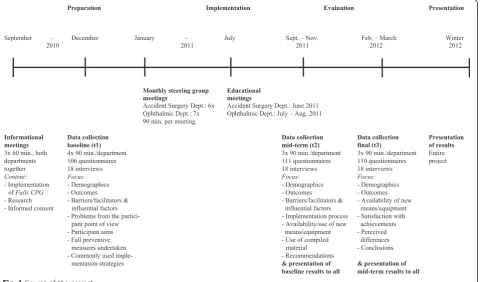
the (1) presence or absence of necessary constructs as well as (2) the definitions of existing constructs. The ap-plicability and usefulness review focussed on the CFIR (1) as a guide to develop assessment questions and as a framework to target influential factors, (2) as a template for content-analysis and (3) as a guide to interpret the main findings. The CFIR was applied within a before-and-after, mixed methods study design embedded in a participatory action research (PAR) approach for guide-line implementation. An overview of the implementation process steps is given in Fig. 1.
Procedure
The evaluation of the CFIR’s comprehensiveness, applic-ability and usefulness was based on data recorded during the implementation process. The main investigator’s re-search diary (RD), with consecutively entered notes, doc-umented the course of the project. These included: decisions made; perceived facilitators, barriers and their solutions; topics and results of ad hoc meetings held on demand between HEB and head nurse or HEB, head nurse and ward managers from the two participating de-partments; observations and experiences made by HEB with regard to CFIR’s comprehensiveness and its applica-tion. Minutes of the steering group meetings (SGMMs) (January to July 2011) also document the course of the project. To assess the influential factors of the intended Falls CPG implementation project, as suggested by the
CFIR [11], quantitative (questionnaire) and qualitative data (interviews, group discussions) were collected (baseline (t1), mid-term (t2), final (t3)).
Prior to the beginning of the implementation process, the CFIR was used to develop a list of questions, sidering each CFIR domain and respective (sub-) con-structs that was thought to be necessary and helpful for the assessment of the baseline of the project, could reveal influential factors during the course of the project and, fi-nally, be used to evaluate the implementation process it-self. This list of questions provided the basis for the applied questionnaires, respective semi-structured inter-view guides and reflective questions, which were asked during the steering group meetings. When analysing the qualitative data, the CFIR was used as a template for content analysis. Finally, the CFIR also was used as a guide to interpret the main findings. To do so, all findings obtained across all data sources per time point (interview, group discussions and questionnaire data, SGMMs, relevant RD entries) and across the three time points were organised under the respective CFIR domains, (sub-) constructs and its supplements (see Breimaier et al. [11]). The intention was (1) to reveal whether the qualitative and quantitative data, with regard to the same CFIR domain and (sub-) construct, supported each other or not, (2) find out how and which factors/ elements influenced the implementation process and the main outcomes of the implementation project as suggested by the CFIR [1] and (3) discover changes that occurred over the course of the project. The strength and direction of the influence of the identi-fied factors were assessed using the aggregated find-ings from all respective sources and marked with‘+’/
‘++’ (positive/very positive influence),‘-’ / ‘–’ (nega-tive/very negative influence) or‘+/-’(mixed influence). The main investigator’s thorough post-hoc reflections could be used as aids to combine relevant data for this assessment.
Details about the corresponding data collection tools and the respective data analysis methods are outlined in Additional file 1. The implementation and service results gained with respect to influential factors will be pub-lished elsewhere.
Results
CFIR comprehensiveness
Presence or absence of necessary constructs
The CFIR successfully covered a wide range of influ-ential factors relevant for an implementation project, such as available resources, nursing personnel’s per-ception of the underlying problem (patient falls) and the intervention (Falls CPG) itself, communication and its channels, the culture of the organisation, co-operation within and between teams and leaders and
the degree of receptiveness shown by the organisation with regard to implementation. However, during the preparation phase of the project, four constructs were added to the framework based on HEB’s reflection with regard to the implementation processes and her ex-perience as a nurse (RD 23/07/2010): (1) stakeholders’ aims—it was assumed that the nursing personnel had their own ideas about what they wanted to achieve with regard to the Falls CPG implementation, (2) stakeholders’ wishes/needs when implementing an innovation like the Falls CPG—information about what should be considered in the ongoing implementation process was collected, (3) pre-established strategies for the implementation of an innovation—information about what was known and common and what may fit or not was collected and (4) established (fall pre-ventive) measures related to the intended innovatio-n—it was assumed that fall prevention is within nursing personnel’s scope of responsibility for which measures exist.
Definitions of existing constructs
The underlyingreflecting & evaluatingconstruct (process domain) was defined very broadly as “quantitative and qualitative feedback about the progress and quality of implementation…”[1]. In the ongoing process followed during steering group meetings, the outcomes of the baseline assessment formed the basis for further ac-tion, which was repeatedly evaluated in each steering group meeting (see Fig. 1). To evaluate the proceedings from the nursing personnel’s perspective during the mid-term and final data collection periods (RD 21 & 24/05/2010, RD 20/07/2011, RD 23/02/2012), the def-inition of this construct was specified as: stakeholders’ conclusions about their satisfaction and contentedness with the project; project progress and achievements; the invested time and effort on behalf of stakeholders; the perceived change and impact; and stakeholders’ learning curves, as well as perceived barriers and facili-tators. Additionally, stakeholder recommendations for further CPG implementation projects and assessments of the sustainability of the implemented Fall CPG were requested.
CFIR applicability and usefulness
The CFIR as a guide to developing assessment questions and as a framework for revealing influential factors on the implementation process
The CFIR was simple to apply and supportive. It was helpful for the development of assessment questions for the Falls CPG implementation project. Moreover, ques-tions that guided reflecques-tions on and evaluaques-tions of the progress within the steering group meetings were in-cluded as an integral part of each meeting (ASD & OD SGMMs).
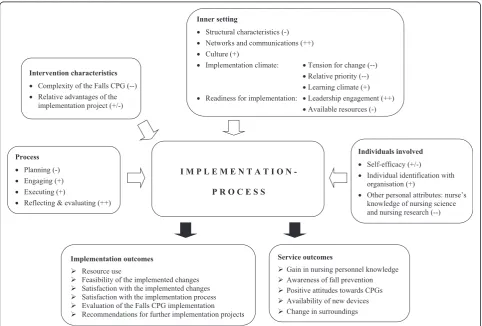
Several factors that influenced the Falls CPG imple-mentation project were revealed—both as barriers and facilitators. Factors that mainly influenced the Falls CPG implementation emerged from four out of the five CFIR domains:characteristics of the intervention, inner setting, characteristics of the individuals and process. The re-spective (sub-) constructs that mainly influenced the im-plementation process are illustrated in Fig. 2 together with a description of the outcomes achieved. Constructs of the outer settingwere not so highly influential during this implementation project and, therefore, are not in-cluded in the figure.
The CFIR as a template for content-analysis
In general, the task of assigning text passages from the interviews and group discussions to their respect-ive CFIR construct or sub-construct was unproblem-atic. During the analysis of the first interviews (t1), however, the difference between tension for change and relative priority (domain inner setting, construct implementation climate) was revealed as not clear. An examination of the respective definition given by Damschroder et al. [1] prompted the decision that tension for change would refer to an individual person’s perspective andrelative priority, to the organisation’s per-spective (RD 15/12/2010, 05/01/2011). Furthermore, a close examination of the respective definition allowed us to distinguish between adaptability (domain intervention characteristics) and compatibility (domain inner setting) (RD 10/01/2011). Engagement or non-engagement, as expressed by interviewees (t2 & t3), could not clearly be assigned to either the engaging or to the executing con-struct (both concon-structs belong to the process domain). Based on a discussion between HEB and BH, a new sub-construct was created, stakeholder involvement. This sub-construct was finally assigned to the code
Fig. 2Overview of main influential factors on implementation process ordered by CFIR domain and (sub-) constructs, and achieved
reflecting & evaluating (domain process), because it reflected stakeholders’ own perspective about their en-gagement in the project (RD 13, 22, 24 & 27/01/2012). Stakeholder involvementwas subsequently defined as the way in which stakeholders were incorporated into the pro-ject. During the analysis of the final interviews (t3), no fur-ther problems arose regarding content categorisation.
The CFIR as a guide to interpret the main findings
Overall, and bearing in mind the information pooled under the CFIR’s domains and (sub-) constructs, the Falls CPG implementation project with its achieved out-comes could be considered successful, and the applied multifaceted and tailored implementation strategies were effective. The knowledge gain with regard to prevention of patient falls, which was one main outcome of the study, improved significantly (p= .001) between t1 and t3 [11]. However, the increase totalled 4.1 % and was, therefore, considered to be overall small. A closer look at factors that were presumed to limit the gain of knowledge in nursing personnel provided an ex-planation for this phenomenon. Constructs of interven-tion and individuals characteristics had an influence on the tension for changeconstruct. This construct together with ODculture(inner settingdomain) influenced the two processconstructsstakeholders’involvementandexecuting, respectively. We hypothesise that these two process con-structs together withimplementation climate(inner setting domain) negatively influenced nursing personnel’s know-ledge gain. An overview is given in Fig. 3.
Discussion
This study was the first to apply and, subsequently, evalu-ate the CFIR for its comprehensiveness, applicability and
usefulness within a large-scale CPG-implementation project in acute nursing care. Herein, the CFIR guided the assessment of context and process, as well as the content-analysis of qualitative data. Moreover, it facili-tated the organisation of influential factors and outcomes, which helped us explain the main results. According to Powell et al., the CFIR provides one of the most compre-hensive overviews of the key theories and conceptual models that is a guiding force in implementation research and practice [7].
CFIR comprehensiveness
Presence or absence of necessary constructs
Applying the framework and its five domains and 39 underlying (sub-) constructs in the Falls CPG implemen-tation project helped all involved parties draw a compre-hensive picture of the context of the two participating departments and the implementation process. Ilott et al. concluded from their examination of the terminology’s coherence that the framework offered a comprehensive structure and consistent terminology for scrutinising im-plementationin situ[8]. Yet, when applying the CFIR in this Fall CPG implementation project, it became appar-ent that the framework lacked important aspects for baseline assessment. Firstly, the framework did not take into account the fact that stakeholders, depending on their role within the organization, have disparate ideas, aims, wishes and requirements with regard to an innovation. These need to be considered and discussed openly when designing a change process, not only to win stakeholder acceptance and increase involvement, but also to facilitate the identification and management of barriers and facilita-tors. The constructs stakeholders’aims and stakeholders’ wishes/needs when implementing an innovation, which
were identified as being important in the present project, were lacking in the CFIR. The new constructs would en-hance the characteristics of individuals’ domain. Accord-ing to its definition, individuals are, among other thAccord-ings, interested parties [1].
Secondly, the framework did not consider the fact that an innovation in healthcare is never introduced in a neu-tral environment, devoid of pre-existing work practices or change strategies. To make the right choice with re-gard to implementation strategies, it is essential to con-sider the existing conditions at the point an innovation is introduced (i.e., pre-existing structures and measures). It would make little sense to introduce pre-existing as-pects that are already in line with recommendations of the guideline to be implemented. Such an introduction might strengthen the recommendations, but would waste energy and resources, both of which are limiting factors in the contemporary healthcare system, and could potentially create opposition among those in-volved. Those impacted by introduced changes must be addressed wherever they happen to be at that particular point in time ([12], p. 219). To augment the baseline as-sessment, an additional construct, labelled pre-estab-lished measures related to the intended innovation, could be included as part of theimplementation climate construct of theinner settingdomain.
Since the nursing work environment is characterized by constant change, it was assumed that nursing personnel had previous experience with alterations in processes and strategies. Including a setting’s pre-established strategies for implementing an innovationcould also increase the practical value of the framework, be-cause this would tell the implementers what might or might not be utilised in the implementation process and could provide tips for applicable implementation strat-egies. This additional construct could be included as a seventh construct to the inner setting domain. In this sense, the CFIR is in line with the recommendations of Ilott et al. [8]. They, however, suggested adding a sixth domain that would pertain to practical strategies in the CFIR. From their point of view, these strategies could then be linked to the other five domains. They argued that specific knowledge translation strategies, such as audits, were implicit in some constructs – in this case within goals & feedback [8]. Powell et al. also argued that the CFIR suggests implicitly that “successful implementation may necessitate the use of an array of strategies that exert their effects at multiple levels of the implementation con-cept” ([7], p. 194). However, it is questionable whether such possible implementation strategies should be added as a sixth domain to the CFIR. Existing lists, such as for example the framework for implementation interventions/ strategies provided by the CochraneEffective Practice and Organisation of Care (EPOC) Review Group [13], could
instead be used and its strategies mapped to the CFIR constructs.
Definitions of existing constructs
The CFIR’s constructs have been criticized for their wide-ranging and multi-faceted nature, with some re-quiring more detailed descriptions [8]. This was particu-larly true for the reflecting & evaluating construct (processdomain), which was defined as“quantitative and qualitative feedback about the progress and quality of implementation accompanied with regular personal and team debriefing about progress and experience”[1]. This definition can be understood in two ways: as a way of continuously reflecting on and evaluating the ongoing process, but also assessing the process at the end of the implementation project from the perspective of all in-volved parties. This idea is in line with that of other implementation researchers [14]. In the Falls CPG im-plementation project in question, both perspectives were used. Assessing the implementation process from the participants’perspective enabled relevant aspects to be captured for the implementation of further endeavours in the same setting, for example, participant learning, per-ceived barriers and facilitators and views/recommenda-tions on how to ensure sustainable implementation. Ilott et al. also regarded thisreflecting & evaluatingconstruct as inadequate, especially in view of its importance for the achievement of longer-term change [8]. Sustainability was regarded as an additional important aspect that was lack-ing in the framework, but any innovation that is not imple-mented sustainably would be “a waste of time, financial resources and leadership effort at a time of economic austerity”([8], p. 8).
Our results indicated that the underlying engaging construct (process domain) should not only include those persons with formal or informal power, but also all other stakeholders, because their support or opposition, expressed through often seemingly insignificant contri-butions, can significantly influence the implementation process. As a group, they have the power to support or hinder the innovation process. This large, but often overlooked, group of people must, therefore, be consid-ered during the implementation process. According to Damschroder, this will be included in the second version of the CFIR [14].
projects. Not assessing each CFIR construct every time is in line with existing literature: Damschroder and Hagedorn, meanwhile, suggested evaluating the list of CFIR constructs to identify those with the highest ap-plicability in the intended study. The assessment of the study could then focus on those relevant constructs [3]. Damschroder and Lowery concluded in a later paper that they would only include twelve constructs for guid-ing future implementation if they differentiated between high and low implementation effectiveness [5].
CFIR applicability and usefulness
The CFIR as a guide to developing assessment questions and as a framework for revealing influential factors on the implementation process
All in all, the CFIR proved to be easily applicable and highly useful for its intended application as a guide that could be used to develop assessment questions and as a framework to reveal influential factors on the guideline implementation process. For the implementation project presented in this paper, the provided and added (sub-) constructs could be easily utilised for developing and compiling baseline, mid-term and final assessments. The majority of the constructs were clearly defined, which facilitated the development of relevant questions with respect to the search for pre-existing instruments. Our results supported the findings of Illot et al., who evalu-ated the CFIR as a “high-level conceptual framework that encompasses a range of concepts that are applicable to a wide variety of situations”([8], p. 915).
The CFIR as a template for content-analysis and as a guide to interpret the main findings
TheCFIR, with its added (sub-) constructs, could easily be utilised to guide qualitative data analysis within a prospect-ive CPG implementation project. Furthermore, by applying the CFIR, information about whether the employed imple-mentation strategies were effective and why they worked or failed was gathered. By combining all data collected during the course of the project (i.e., qualitative and quan-titative data, the main investigator’s research diary records and steering group team meeting minutes) under the CFIR frame, the interrelations between the CFIR domains and constructs became visible. This helped us explain the main findings.
Limitations
The principle limitation of this evaluation was that the as-sessment of how useful the CFIR actually was for guiding the implementation of a CPG during the course of imple-mentation (i.e., the CFIR’s comprehensiveness, applicabil-ity and usefulness) was performed retrospectively. This retrospective assessment of the main investigator’s diary, steering group meeting minutes and qualitative and
quantitative data were used to develop the main focus of the study as well as main investigator’s post-hoc reflec-tions, and thus contrasts with a thoroughly and prospect-ively planned research study conducted with validated instruments/procedures.
Conclusions
The CFIR proved to be a valuable and helpful, although not exhaustive, framework that could be used to assess the baseline, process and final state of a CPG implemen-tation project. The findings of the study indicated that this framework should be supplemented with other im-portant factors and local features to achieve a sound basis for the planning and realisation of an ongoing pro-ject. Furthermore, it was recognized that a clear defin-ition of underlying constructs, for example reflecting & evaluating, would facilitate the use of the CFIR to imple-ment an innovation. The CFIR also proved to be both applicable and useful during the development of relevant interview and group discussion questions, compilation of several data collection tools, analysis of qualitative data, and organisation of the obtained results into the CFIR’s domains and underlying constructs, which can help explain and interpret the outcomes of an imple-mentation project.
Relevance to clinical practice and further research
The CFIR and the authors’ proposed supplements can help nurse managers, other responsible staff and/or re-searchers obtain a comprehensive overview of factors in-fluencing an implementation project. They may also facilitate the contextualisation of findings, explanation of crucial elements in the process and assessment of final outcomes of an implementation project.
This evaluation provides valuable insights that support further improvements in the general applicability and comprehensiveness of the CFIR, for example, a clear def-inition of constructs. The CFIR’s constructs themselves exceeded the scope of this evaluation. The validity of the CFIR constructs requires evaluation in further research projects. The results of the retrospective evaluation of the CFIR in question should be confirmed and refined as part of a carefully planned, prospective research project in the future.
Additional File
Additional file 1:Data collection tools and data analysis.Description of questionnaires and semi-structured interview guides as well as mode of data analysis. (DOC 118 kb)
Abbreviations
RD: Research diary; SGMM: Steering-group-meeting minutes; t1: Baseline data collection; t2: Mid-term data collection; t3: Final data collection.
Competing interests
The authors declare that they have no competing interests.
Authors’contributions
HEB was responsible for the study conception and design, preparation of the questionnaires, implementation strategies, data collection, data analysis and manuscript drafting. BH contributed to developing the interview guide, to data interpretation and to revising the first draft for important intellectual content. RJGH and CL were responsible for the study conception and design and critical revisions of the manuscript for important intellectual content. All authors read and approved the final manuscript.
Authors’information
HEB: PhD student, MScN, BScN, RN, Institute of Nursing Science, Medical University of Graz, Austria.
BH: PhD student, MSc, BSc, RN, Department of Health Services Research, Caphri, Maastricht University, The Netherlands.
RJGH: PhD, FEANS, Associate Professor Nursing Science Department of Health Services Research, Caphri, Maastricht University, The Netherlands. CL: Head of Institute, PhD, FEANS, MA, RN, Institute of Nursing Science, Medical University of Graz, Austria.
Acknowledgements
We wish to thank all participating graduate and assistant nurses and the management of the two departments from the University Hospital Graz for their collaboration in preparing the project and during the implementation process as well as for spending their precious time in sharing their unique experiences with us.
Funding
The Austrian Federal Province of Styria: Land Steiermark, Abteilung 3—Wissenschaft und Forschung (Project no.: A3-16.M-94/2010-15) provided financial support for this study.
Author details
1Institute of Nursing Science, Medical University of Graz, Billrothgasse 6, 8010 Graz, Austria.2Department of Health Services Research, CAPHRI, Maastricht University, Duboisdomein 30, 6229 GT Maastricht, The Netherlands.
Received: 3 March 2014 Accepted: 13 July 2015
References
1. Damschroder LJ, Aron DC, Keith RE, Kirsh SR, Alexander JA, Lowery JC. Fostering implementation of health services research findings into practice: a consolidated framework for advancing implementation science. Implement Sci. 2009;4:50. doi:10.1186/1748-5908-4-50.
2. Grol RPTM, Bosch MC, Hulscher MEJL, Eccles MP, Wensing M. Planning and studying improvement in patient care: the use of theoretical perspectives. Milbank Q. 2007;85:93–138.
3. Damschroder LJ, Hagedorn HJ. A guiding framework and apporach for implementation research in substance use disorders treatment. Psychol Addict Behav. 2011;25:194–205.
4. Sorensen JL, Kosten T. Developing the tools of implementation science in substance use disorders treatment: application of the Consolidated Framework for Implementation Research. Psychol Addict Behav. 2011;25:262–8.
5. Damschroder LJ, Lowery JC. Evaluation of a large-scale weight management progam using the consolidated framework for implementation research (CFIR). Implement Sci. 2012;8:51. doi:10.1186/1748-5908-8-51.
6. Hartzler B, Lash SJ, Roll JM. Contingency management in substance abuse treatment: a structured review of the evidence for its transportability. Drug Alcohol Depend. 2012;122:1–10.
7. Powell BJ, Proctor EK, Glass JE. A systematic review of strategies for implementing empirically supported mental health interventions. Res Soc Work Pract. 2014;24:192–212.
8. Ilott I, Gerrish K, Booth A, Field B. Testing the Consolidated Framework for Implementation Research on health care innovations from South Yorkshire. J Eval Clin Pract. 2013;19:915–24.
9. Bachner D, Haas W, Semlitsch B, Schaffer S, Uhl C, Weiß R. Evidence-based Leitlinie“Sturzprophylaxe für ältere und alte Menschen in Krankenhäusern und Langzeitpflegeeinrichtungen”. Graz: Steiermärkische
Krankenanstaltengesellschaft mbH; 2009.
10. Proctor E, Silmere H, Raghavan R, Hvmand P, Aarons G, Bunger A, et al. Outcomes for implementation research: conceptual distinctions, measurement challenges, and research agenda. Adm Policy Ment Health. 2011;38:65–76.
11. Breimaier HE, Halfens RJG, Lohrmann C. Effectiveness of multifaceted and tailored strategies to implement a fall-prevention guideline into acute care nursing practice: a before-and-after, mixed-method study using a participatory action research approach. BMC Nurs. 2015;14:18. doi:10.1186/ s12912-015-0064-z.
12. Gomez P, Probst G. Die Praxis des ganzheitlichen Problemlösens. Vernetzt denken. Unternehmerisch handeln. Persönlich überzeugen. Bern: Haupt Verlag; 1999.
13. Cochrane Effective Practice and Organisation of Care Review Group (EPOC) data collection checklist. [http://epoc.cochrane.org/sites/epoc.cochrane.org/ files/uploads/datacollectionchecklist.pdf].
14. Damschroder LJ. CFIR Taxonomy. CFIR Wiki (last modified on 29 August 2014). [http://cfirwiki.net/wiki/index.php?title=CFIR_Taxonomy]
Submit your next manuscript to BioMed Central and take full advantage of:
• Convenient online submission
• Thorough peer review
• No space constraints or color figure charges
• Immediate publication on acceptance
• Inclusion in PubMed, CAS, Scopus and Google Scholar
• Research which is freely available for redistribution