Eccentricity Sequence and the Eccentric Connectivity
Index of Two Special Categories of Fullerenes
FATEMEH KOOREPAZAN–MOFTAKHAR AND KHADIJEH FATHALIKHANI1
(COMMUNICATED BY ALI REZA ASHRAFI)
Department of Pure Mathematics, Faculty of Mathematical Sciences, University of Kashan, Kashan 8731751167, Iran
ABSTRACT. In this paper, we calculate the eccentric connectivity index and the eccentricity sequences of two infinite classes of fullerenes with 50 + 10k and 60 + 12k (k N) carbon atoms.
Keywords: Eccentricity sequence, Eccentric connectivity index, Fullerene.
1.
I
NTRODUCTIONIn mathematical chemistry a molecule can be modeled by a graph in which vertices are the atoms and two vertices are adjacent if and only if there is a bond between the two corresponding atoms.
Suppose u and v are two vertices of a graph G. Define dG(u,v) to be the length of a
shortest path connecting u and v in G. The eccentricity ecG(u) is the largest distance
between u and any other vertex in G. The maximum eccentricity over all vertices of G is called the diameter of G, D(G), and the minimum eccentricity is called the radius of G and denoted by R(G). The set of all vertices whose eccentricities are equal to R(G) is called the center of G. Furthermore, the eccentric connectivity index of a graph G is defined as c(G)
=
V(G)v ecG(v)degG(v), where degG(v) is the degree of the vertex v in G [9]. This index
has been widely studied by many authors. We refer the reader to [1, 2, 4, 7], for more information on this topic. For a connected graph G with vertex set V(G) = {v1, v2, ..., vn}
the eccentricity sequence of G, ec(G), is defined as ec(G) = {ecG(v1), ecG(v2), … ,ecG(vn)}
[3, 8].
1
Corresponding author ( Email: [email protected])
The fullerene C60 is first discovered by Harry Kroto in 1985. Since these molecules
have several commercial applications, they are of great importance. A fullerene with n vertices is a planner, 3regular and 3connected graph containing 12 pentagonal and n/2 + 10 hexagonal faces.
The aim of this paper is to compute the eccentricity sequence and the eccentric connectivity index of fullerenes with exactly 50 + 10k and 60 + 12k (kN) carbon atoms. The notations used in the whole paper are standard and derived from [10].
2.
M
AINR
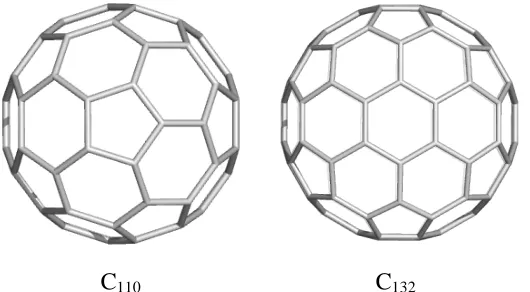
ESULTSHere, we present some results for the eccentric connectivity index and the eccentricity sequence of fullerenes with exactly 50 + 10k and 60 + 12k (k N) carbon atoms. Some examples of these fullerenes are depicted in Figures 1 and 2.
C100 C120
Figure 1: Fullerenes of type C50 + 10k and C60 + 12k for k = 5.
C110 C132
Figure 2: Fullerenes of type C50 + 10k and C60 + 12k for k = 6.
If k is even, then there are k/2 + 3 different classes of eccentricities in which k/2 + 6 is the lower bound and k + 8 is the upper bound.
If k is odd, then there are k/2 + 3 different classes of eccentricities in which the lower and the upper bounds are k/2 + 6 and k + 8 respectively.
Proof. In [6] it is proved that the automorphism group of C50 + 10k is isomorphic to dihedral
group of order 20, D20. In the action of the automorphism group on the set of all vertices,
when k is even, there are k/2 + 4 different orbits and when k is odd, then k/2 + 4 different orbits exist. It is clear that all of the vertices of an arbitrary orbit have the same eccentricity. Furthermore, two of these orbits have the same eccentricity. Therefore, the number of different eccentricities of the vertices of C50+10k is k/2+3 when k is even and is k/2 + 3
when k is odd.
In C50 + 10k there are two pentagons opposite to each other and the diameter is
obtained by the length of the shortest path connecting two vertices of these pentagons. Notice that there are 12 pentagons in such molecules. By increasing k, the number of octagons goes up and as a results, the fullerene becomes in a shape of a tube. In fact, the fullerenes of type C50 + 10k are constructed of two caps and a tube. In each cap, there is a
path of length four from a vertex of one of the mentioned opposite pentagons into a vertex of the tube. Moreover, the length of the tube is twice the number of its hexagons. Since there are k/2 hexagons in the tube, the length of the path in the tube is k. As a result, the diameter is k + 8. Similarly, the same method can be applied for the radius of C50+10k.
Theorem 2. If k ≥ 9, in the fullerenes of type C60 + 12k the following results hold:
If k is even, then there are k/2 + 3 different classes of eccentricities in which k/2 + 7 is the lower bound and k + 9 is the upper bound.
If k is odd, then there are (k +3)/2 different classes of eccentricities in which the lower and the upper bounds are (k+15)/2 and k + 8, respectively.
Proof. By using [5] and the same method as Theorem 1, the result can be proved.
In what follows, the eccentricity sequence of these two types of fullerenes is calculated:
Theorem 3. In the C50 + 10k fullerenes, k ≥ 7, the eccentricity sequence can be obtained as
If k is even, then . 8 k , , 8 k , 7 k , , 7 k , , 6 k 5 . 0 , , 6 k 5 . 0 ) G ( ec 10 30 20 10
If k is odd, then
. 8 k , , 8 k , , 6 2 k ,..., 6 2 k ) G ( ec 20 20 20
Proof. For k even, the orbits in which 1, 6 and 5k+21 are the representatives of orbits of size 10 and the size of all other orbits is 20. Each orbit has its own eccentricity and the first and the last orbits (orbits with 1 and 5k + 21 as the representatives) have the minimum and the maximum number of eccentricities. Moreover, the orbits in which 6 and 11 are representatives have the same eccentricities. Similarly, when k is odd, numbers 1, 6, 11, ..., 5k + 16 are representatives of the orbits. Since all of orbits have the same size, by considering Theorem 1 the result is obtained.
Theorem 4. In the C60 + 12k fullerenes, k ≥ 9, the eccentricity sequence can be obtained as
follows:
If k is even then,
24 24 12 9 k , , 9 k , , 7 k 5 . 0 , , 7 k 5 . 0 ) G ( ec
If k is odd then,
. 8 k , , 8 k , , 2 15 k , , 2 15 k ) G ( ec 48 24 24
Proof. In the action of the automorphism group on the set of all vertices, the following holds:
When k is odd, {1, 7, 13, 25, .., 6k + 19} is the set of all representatives of the orbits. Numbers 7 and 13 are obtained by adding 6 to their previous numbers and the others are obtained by adding 24. In addition, the number of elements in the first and second orbits is 12 and it is 24 in the others. Now by the same method as Theorem 3, the result is obtained.
Now we compute the eccentric connectivity index of these fullerenes:
Theorem 5. In the fullerene molecules of type C50 + 10k, k ≥ 7, the eccentric connectivity
index is computed as follows:
If k is even, then
1050 k
330 k
5 . 22 ) v ( ec ) v ( deg )
G
( G 2
) G ( V
v G
c
If k is odd, then
5 . 1087 k
330 k
5 . 22 ) v ( ec ) v ( deg )
G
( vV(G) G G 2
c
Proof. Since C50 + 10k is a 3regular graph, the degree of each vertex is 3. Also, in the
Theorem 3, the eccentricity of the vertices has been presented.
Also we can write:
Theorem 6. In the fulleren molecules of type C60 + 12k, k ≥ 7, the eccentric connectivity
index is as follows:
If k is even, then
1413 n
432 n
27 ) v ( ec ) v ( deg )
G
( vV(G) G G 2
c
If k is odd, then
1476 n
432 n
27 ) v ( ec ) v ( deg )
G
( vV(G) G G 2
c
Proof. It suffices to apply the same method as Theorem 5 and also use Theorem 4.
R
EFERENCES1. A. R. Ashrafi, T. Došlić, M. Saheli, The eccentric connectivity index of
TUC4C8(R) nanotubes, MATCH Commun. Math. Comput. Chem., 65, 221230
(2011).
2. A. R. Ashrafi, M. Saheli, M. Ghorbani, The eccentric connectivity index of nanotubes and nanotori, J. Comput. Appl. Math., 235, 45614566 (2011).
3. S. Djafari, F. KoorepazanMoftakhar, A. R. Ashrafi, Eccentric sequences of two infinite classes of fullerenes, J. Comput. Theor. Nanosci., 10, 26362638 (2013).
4. H. Dureja, A. K. Madan, Superaugmented eccentric connectivity indices: new-generation highly discriminating topological descriptors for QSAR/QSPR modeling, Med. Chem. Res., 16, 331–341 (2007).
5. F. KoorepazanMoftakhar, A. R. Ashrafi, Symmetry and PI index of C60+ 12n
Fullerenes, J. Comput. Theor. Nanosci., 10, 2490–2492 (2013).
6. F. Koorepazan Moftakhar, A. R. Ashrafi, Z. Mehranian, Symmetry and PI Polynomials of C50+10n Fullerenes, MATCH Commun. Math. Comput. Chem., 71,
425 – 436 (2014).
7. V. Kumar, S. Sardana, A. K. Madan, Predicting anti–HIV activity of 2,3–diary l–1,3–thiazolidin–4–ones:computational approaches using reformed eccentric connectivity index, J. Mol. Model., 10, 399–407 (2004).
8. A. I. Ogbonna, Eccentricity sequence of 2, M.Sc. Thesis, Youngest State University, December (2010).
9. V. Sharma, R. Goswami, A. K. Madan, Eccentric connectivity index: A Novel Highly Discriminating Topological Descriptor for Structure-Property and Structure-Activity Studies, J. Chem. Inf. Comput. Sci., 37, 273–282 (1997). 10.D. B. West, Introduction to Graph Theory, Prentice Hall, Inc., Upper Saddle