ISSN 2374-2666 (Print) 2374-2658 (Online) Copyright © The Author(s). 2015. All Rights Reserved. Published by American Research Institute for Policy Development
DOI: 10.15640/jibf.v3n1a2 URL: http://dx.doi.org/10.15640/jibf.v3n1a2
Development of the Islamic Banking System
Ahmad Alharbi
1Abstract
This paper will illustrate the historical development of Islamic banking industry. In addition, it will provide information about the Islamic banking development in many countries around the world. This information provides important context for understanding modern-day financial practices.
Keywords: Development, Historical, Islamic banks, Regulators, Region
JEL Classification: G21; F37; P120
1. Introduction
Islamic banks can be defined as a financial institution that (a) abides by shariah principles in all of its activities through its role as a financial intermediary between savers and investors;(b) provides banking services within the framework of legitimate contracts; and (c) achieves a balance between economic and social return. And the beginnings of Islamic banking, in its wider sense, date back to the early days of Islam and the rise of the Islamic Empire. The boom in the internal and external trades in the dawn of Islam led to the creation of Islamic financial tools such as deposits, money transfers, checks, bills of exchange, and so forth to cope with these commercial developments. Later, the Europeans adopted these Muslim practices and continued to evolve them until modern days. In Islamic countries, Islamic financial practices withered gradually due to the weakening of the Islamic empire, until these practices were replaced by the Western financial model in the early 20th century. However, Islamic financial practices emerged again in the middle of the of the same century. In this paper we try to track the development of the Islamic banking industry and to see if there are a real boom in the industry worldwide.
2. Historical Development of Islamic Banks
The origin of Islamic finance dates back to the dawn of Islam 1,400 years ago. Historical books written during the early years of Islam indicated that during the 1stcentury of Islam (AD 600), some forms of banking activities existed that were similar to modern banking transactions. Furthermore, these ancient books revealed that Al-Zubair bin Al-Awam, one of the most famous personalities in Islam, was accepting deposits from people as loans and investing that money. At the time of his death, his debt had reached 2,200,000 dinar2, as counted by his son Abduallah. Also, he had several branches in different parts of the Islamic
1
La Trobe University, Bundoora, Melbourne, Australia, 3086. Email: [email protected]
2 The dinar was in the era of the Prophet, peace be upon him, equal to 12 dirham‘s. The dinar at present time equals to four grams
Empire to return deposits to their owners—some contemporary scholars call this collection of Furthermore, the writings of Al-Djahshiyari (1938), Al-Kubaisi (1979), Al-Ali (1953, 1981), Al-Duri (1986, 1995), Fischel (1992), and Al-Hamdani (2000) show that there were bankers called sarraffeen or sayarifah (singular sarraf) or jahabidhah (banks called dawawin al- jahabidhah) in the Islamic Empire. (Chachi 2005). in the Islamic Empire. Also, according to Chachi (2005), during the Abbasid-caliphs period (from the 8th century) the term sarraffeen was used to refer to financial clerks, experts in matters of coins, skilled money examiners, treasury receivers, government cashiers, money changers, or collectors to designate the well- known, licensed merchant bankers in those times. In addition, the first check in history was drawn by a sarraf in Baghdad in the 4th century AH (10th century AD), and it was cashed by the prince of Aleppo, Saif Al-Dawla Al-Hamadani. Perhaps De Roover (cited in Chachi 2005) says it most clearly:―There can be no banking where there are no banks‖ (p. 10). Indeed, the historical records indicate that there were banks in those days.
Nasser (1996, pp. 15–16) argues that Muslims contributed greatly to the development of banking practices because, during the Islamic empire, there was
1. a legislative system, which included firm rules and regulations to govern all transactions; 2. a strong judicial system, which was capable of enforcing all legitimate contracts;
3. different kinds of commercial papers and banknotes that were widely accepted, such as promissory notes (reqaah al-sayarifah), bills of exchange (suftaja), and goods sukuk; and
4. licensed bankers, who had offices or agencies in different parts of the Islamic Empire and accepted deposits, assigned debt(hawalah), exchanged money, issued banknotes, and performed many other services.
Udovitch (cited in Chachi 2005) discussed some of these transactions as well: ―The suftaja always and the hawala usually occurred as a written obligation, and were thus the first and most important forms of commercial credit papers in the Medieval Near East‖ (p. 12). Beginning with the decline of the Islamic Empire from about the 12th Century BC, the rule of the sarraffeen began to weaken. Their loss of power within society can be attributed to several internal and external factors. This allowed Western influence to increase throughout Islamic countries, especially through colonization. Under European influence, many Islamic countries began to adopt a Western banking model in the 19th century. This started by opening branches of foreign banks or by establishing banks within countries. For instance, in Egypt, the first conventional bank opened its doors in 1856 under the name Bank of Egypt. This bank was a branch of an English bank but was closed in 1911. The National Bank of Egypt was established in 1898 by Ralph Suarez and Constantine Salvagos (Jewish businessmen) with an English partner; the bank is still in operation today(Nasser 1996; National Bank of Egypt 2009).
This trend continued in all Islamic countries until the middle of the 20th century, when the calls to establish Islamic financial institutions gained momentum with the independence of some colonized Islamic countries. In Islamic societies, scholars have three opinions regarding the European banking model (Nasser 1996, pp. 23–24):
1. All bank activities are halal (adhere to shariah). Supporters of this opinion, such as the founders of Bank of Egypt, use weak arguments to present their points of view.
2. Bank activities are haram (contradictory to shariah principles) but necessary. Some scholars argue that banks play an important role in the economy and therefore they see no harm in establishing banks based on the European Model, even though some of their activities are haram. This argument is strong because it is based on one of the basic Islamic juristic rules:al-drurat tubeah al-mahdurat (necessity knows no law).
3. Bank activities are necessary, but riba is not necessary for bank operations. Supporters of this opinion argue that Islamic jurisprudence has many forms of contracts that allow Muslims to avoid riba and can be implemented by banks. Among Muslims worldwide, this is the most acceptable of the three arguments because many people are not using banks regularly.
However, in the1940s, the third opinion gained momentum, especially on an intellectual level. This trend continued in the 1950s and 1960s, when the first Islamic banks in the modern history were established. This implies that modern Islamic banks have undergone three phases of development.
2.1 Phase 1: Interest-Free Banking as an Idea3
This stage began in the early 1900s and was marked by the writings of Abul Aala Maudud (1937), Hasan Al-Banna (1939), Hifz Al-Rahman (1942), Muhammad Hamidullah (1944), Anwar Qureshi (1946), Naiem Siddiqi (1948), and Mohammad Yousuf Al-Dean (1950). The number of published studies on this topic totaled 31 from 1940 to 1974 (Al-Ansari, Hasan & Metwaly 1988, pp. 24–25). The first work devoted to the subject of interest-free banks was Muhammad Uzair‘s research in 1955 (Gafoor 1995).
2.2 Phase 2: The Emergence and Establishment of Islamic Banks (1963–1976)
This stage involved tremendous development at both the intellectual and implementation levels. The early banks became pillars for the continued development of the Islamic financial system. The following points summarize the events that took place during this period.
1. Local savings banks were established in Mit Ghamr, Egypt, in 1963. Many researchers consider these banks to be the first banks without interest in Islamic society. However, these banks merged with government banks in 1967 for political reasons (Al-Marwyne 1985; Wilson 1983).
2. In the following years, more studies dedicated to Islamic banks began to emerge. A short list of these studies includes Abdo (1970), Araby (1967), Al-Najjar (1971), Gelani (1965), Khurshid and Farrukh (1970), Nejatullah Siddiqi (1961, 1969), and Shalbi (1969; Al-Ansari, Hasan&Metwaly 1988).
3. Institutional involvement also increased. Some examples include the Islamic Research Academy Al-Azhar conference, the Finance Ministers of the Islamic Countries conference held in Karachi in 1970,the First International Conference on Islamic Economics in Makkah in 1976, the International Economic Conference in London in 1977, and an Egyptian study in 1972 (Gafoor 1995; Nasser 1996, p. 30).
In the Karachi conference, delegates from Egypt proposed that an international Islamic bank be established, and delegates from Pakistan proposed that an international union for Islamic banks be established.
4. Nasser Social Bank was established in Egypt in1971 by Presidential Decree 66. The bank‘s charter clearly identified that it was an interest-free bank. Also, Act 13 of the decree stated that the bank would not be subject to the regulations applied to conventional banks. The purpose of the bank was to broaden the social solidarity among citizens and to create a competent and just society. The bank‘s capital was formed from funds allocated by the president of the republic from outside the state budget resources specified for this purpose. In addition, money was allocated from public bodies and economic units. However, the Nasser Bank Law did not mention that the bank had to adhere to shariah. Still, because the bank was a member of the International Union of Islamic banks, it was considered an Islamic bank (Al-Marwyne 1985).
5. In 1974, the finance ministers of all Islamic countries held a convention on the establishment of the Islamic Development Bank (IDB). The IDB was considered to be the first international Islamic bank that was established, albeit in part, by members of the OIC. The bank began operating in 1977, and since then it has played a pivotal role in the development of the Islamic banking and finance industries. The purpose of the bank is to foster the economic development and social progress of member countries and Muslim communities individually as well as jointly in accordance with the principles of shariah. As of June 1992, the bank‘s paid-up capital was 2billion Islamic dinars (an IDB accounting unit that is equivalent to one special drawing right of the International Monetary Fund). From July 1992 to December 2000, the bank increased its capital to 6billion Islamic dinars. In 2001 the bank increased its capital from6 billion to 15 billion Islamic dinars (USD 20.55 billion).
3 However, before this period there was an effort to establish an interest free institutions in the southern India, which can be
6. The Dubai Islamic Bank was established as a joint stock company. The main founders were Saeed Lootah, Nasser Lootah, Sultan Lootah, Mohammed Lootah, and Abdallah Saeed. The governor of Dubai, Sheikh Rashid Al-Maktoum, issued the Amiri Decree, which allowed the bank to be established as of March 12, 1975 (Al-Marwyne 1985). The bank‘s capital was 50 million Arab Emirate dirham (AED) dividedby100 thousand shares with a face value of AED500 each. The founders bought 10 thousand shares with a value of AED5 million, paid in full (Al-Marwyne 1985). This bank is generally considered to be the first private Islamic bank. Also, some researchers refer to it as the first Islamic bank.
2.3 Phase 3: The Spread of Islamic Banks, 1977 to Present
During this phase, the number of Islamic banks around the world boomed, and many of the banks established in the early 1970s and 1980s are still in operation today (Abdeen & Shook 1984, p. 167; Shehata 2006, p.18).4 Also, many conventional banks have established Islamic windows, and still other conventional banks have fully converted to Islamic banking. Furthermore, several Islamic bodies were established to regulate and promote the Islamic finance industry. Finally, Iran and Sudan Islamized their entire financial systems. The following sections discuss these and other key events in this period.
1. The International Association of Islamic Banks was established in 1977. The CEOs of the Islamic banks agreed to establish the International Union of Islamic Banks in 1997, with the headquarters in Makkah. The aim of this union was to strengthen cooperation and increase coordination among Islamic banks. However, although the union still exists, it has not begun operations (Shehata 2006, p. 19).This changed in July 1999 when the International Association of Islamic Banks was reorganized and renamed the General Council for Islamic Banks and Financial Institutions (CIBAFI), Bahrain was chosen as itsheadquarters. The council opened its doors at the end of 2001 as one of the organizations of the Organization of the Islamic Conference (Taqi Al-Dean 2005; El-Shiekh 2010). By 2012 there were 114 council members, including 66 key members and 48 observers.
2. The Faisal Islamic Bank of Egypt was established as an Egyptian joint stock company by Presidential Decree 48 in 1977 and by a decree from the Egyptian Ministry of Finance. The bank‘s capital was USD 8 million, divided into 80,000 shares with a face value of USD 100 each. The Egyptian side owned 51% of the capital, and they were authorized to offer 25%of their share to the public.
The Saudi side owned 49% of the capital and had the right to offer some of it to the public. Since then, the bank has increased its capital several times. The bank charter indicates that the bank must comply with shariah in all of its transactions (Al-Marwyne 1985).
3. The Faisal Islamic Bank of Sudan was established in February 1976 when Prince Mohammed Al-Fisal and some Sudanese businessmen obtained approval from the Sudanese president. The bank was established as a public joint stock company by Presidential Decree 9 on April 4, 1977. A gathering of 86 people from Sudan, Saudi Arabia, and others from the Gulf State countries made the bank‘s establishment possible, and they offered to provide half of the bank‘s capital. The bank‘s capital was 6 million Sudanese pounds divided into 600 shares with a face value of 10 Sudanese pounds. The Saudis owned 40% of the bank, the Sudanese owned 40%, and the remaining 20% was offered to the public in other countries. The bank capital increased in 1981 and 1982. In addition, the bank was excused from some of the laws that applied to other banks and was exempted from paying taxes (Al-Marwyne 1985).
4 Nasser Social Bank (Egypt, 1971), Islamic Development Bank (Saudi Arabia, 1975), Dubai Islamic Bank (Dubai, 1975), Faisal
4. The International Institute of Islamic Banks and Islamic Economics was established in1981by the International Union of Islamic Banks in response to sustained growth in the number of Islamic banks and the need for qualified staff (Arabic and Islamic universities were unable to provide such individuals to fill the shortage). The Turkish Federative State of Cyprus was chosen to be the headquarters of the institute for political reasons (Shehata 2006, p. 19).
5. The establishment of the Supreme Supervisory Commission on Fatwa and Shariah was established in 1983. According to Shehata (2006, p. 20), the commission had several primary objectives. First, the commission aimed to examine all the fatawas released by the supervisory boards and fatawa committees of the Islamic financial institutions that were members of the International Union of Islamic Banks and to give opinions regarding their adherence to shariah principles. The second objective was to monitor the activities of the members of the International Union of Islamic banks to ensure their compliance with the provisions of Islamic shariah and alert stakeholders to any deviation from shariah principles. To be able to play this role, the committee was granted jurisdiction to review the laws and regulations of those institutions.
The third main aim was to give legal opinions from a shariah perspective as requested by the financial institutions that were members of the union, their supervisory boards, or the secretariat of the union. Ultimately, the commission ceased its activities for several reasons, and each Islamic financial institution established its own shariah supervisory board.
6. The AAOIFI was established in 1990.The objective of this organization is to prepare accounting, auditing, governance, ethical, and shariah standards for Islamic financial institutions and the Islamic finance industry. 7. The Islamic Financial Services Board was established in 2002. It issues guiding principles and standards for the
Islamic financial industry to ensure its soundness and stability.
8. The Islamic International Foundation for Economics and Finance was established in 2004 as one of the bodies of the Muslim World League. The foundation‘s headquarters are located in Riyadh, Saudi Arabia, and according to the foundation‘s website (Islamic International Foundation for Economics and Finance 2006, translated from Objectives section), its objectives are to
a support for the coordination and integration among scientific research institutions in the field of Islamic economics;
b. found a scientific body dedicated to developing Islamic economic theory; c. explore the future applications of Islamic economic theory;
d. develop the Islamic economic model;
e. discover tools, models, and products that will assess the application of Islamic economic theory; and f. contribute to finding alternative solutions to the problems of the traditional economic system.
9. The International Islamic Centre for Reconciliation and Commercial Arbitration (IICRCA) was established in April 2005 through the concerted efforts of the Islamic Development Bank, the General Council for Islamic Banks and the Financial Institutions and the United Arab Emirates in the host country. The IICRCA is an independent international non-profit organization that specializes in arbitrating and conciliating settlement disputes regarding Islamic shariah provisions.
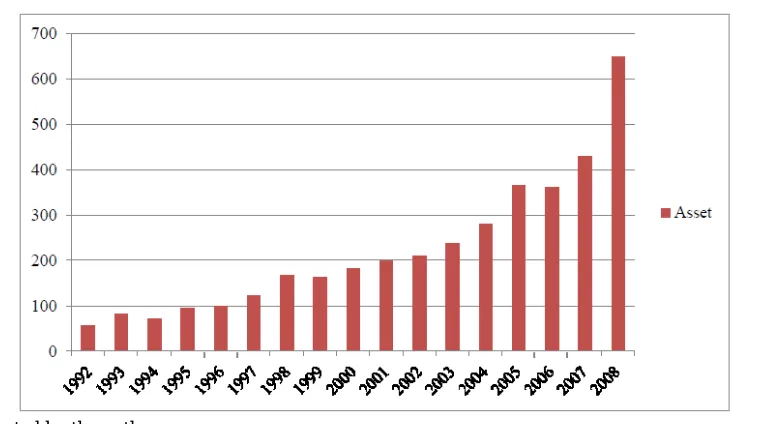
The agency‘s main objective is to settle financial and commercial disputes that arise among financial and commercial institutions that operate according to Islamic shariah. In addition, many countries in Asia, Africa, Europe, and the Middle East have enacted laws allowing Islamic banks to operate more efficiently. Furthermore, Dow Jones has also introduced the Dow Jones Islamic Market Index of 600 companies worldwide that adhere to shariah principles. In OIC countries, Islamic retail banking assets have grown by an average of 42% since 1992, and by the end of 2008, their worth reached USD 648.6 billion (2005 dollars; see Figure
Figure 1: Assets of Full-Fledged Islamic Retail Banks in OIC Countries (2005 USD prices, in Billions)
Source: Constructed by the author.
3. Recent Developments in Islamic Banking
The development of the Islamic banking industry is moving at a fast pace, and almost every country now has some form of Islamic financing. This section will give a brief description about the development of the Islamic banking industry in Asia-Pacific region, Africa, Middle East and Turkey Region, and North America.
3.1 Trends of Islamic Banking in Australia and the Asia-Pacific Region
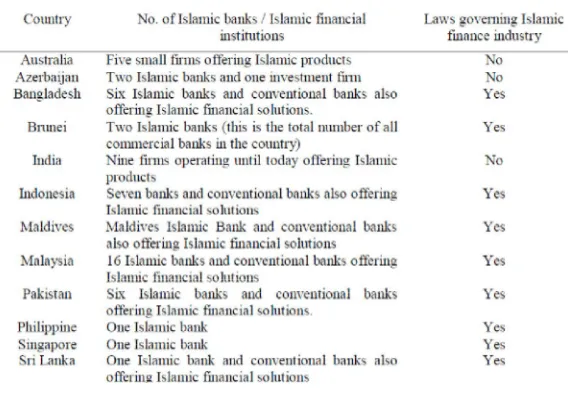
The Asia-Pacific region has established itself as a strong hold for Islamic finance. The industry is growing rapidly in many parts of this region, and this growth has been supported by a Muslim population that now makes up 62% of the region‘s total population. Table 1 shows the percentage of Muslims in major countries in the region. Even some of the Asia-Pacific nations with small Muslim populations, such as Australia and Singapore, have begun to engage in Islamic finance as well. The early efforts to establish an Islamic financing institution not in the region but in the world began in this area, specifically in southern India as mentioned earlier. However, laws in India did not allow the Islamic financial industry to flourish, and the institutions there remained small and do not satisfy the needs of Indian Muslims. However, the opposite took place in Pakistan, it started to Islamize its financial system since the late 1970s. Given that the Islamic financial industry in the country began to boom. Going to Malaysia which considered as a hub of the Islamic finance industry, the first Islamic financial institute in the country was Tabugn Haji (August 1962) as a pioneering effort to give Muslims the opportunity to invest their money in interest-free bank accounts. Currently, Islamic financial institutions operate alongside conventional financial institutions in the country, but the country has separate legislation and regulations for each. Indonesia engaged in the Islamic finance industry in 1992, laws issued to promote the Islamic finance industry and ever since the industry starts flourishing in the country.
Table 1: Potential Market Size in Asia-Pacific Region for Islamic Banks
Source: Constructed by the author using data from the CIA Fact Book (population in July 2011), except where otherwise noted.
a Data from Australia‘s 2006 census.
Table 2: Shows the Trend of Islamic Finance in Major Countries in Asia-Pacific Region
2.2 Trends of Islamic Banking in Africa
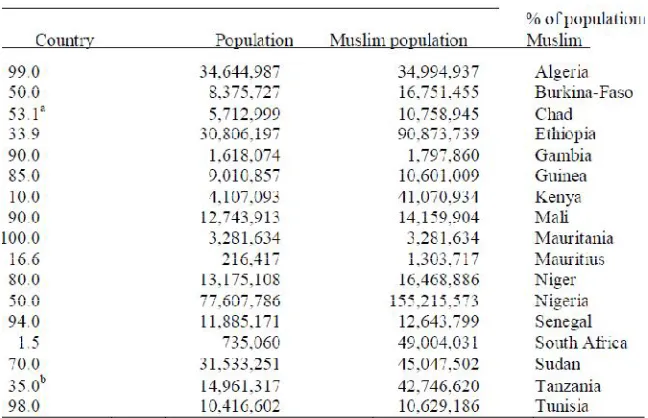
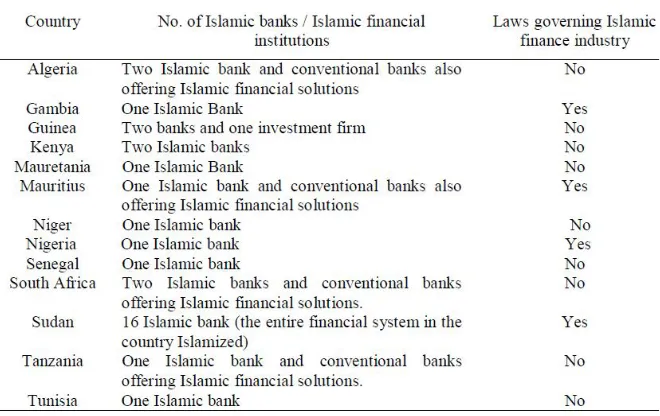
Africa is the second-largest continent. Its 1.2 billion people make up 15% of the world‘s population. Muslims make up half of the continent‘s population. Therefore, the region has promise for the growth of Islamic banking. Table 3 lists the Muslim populations of many African countries. Nasser (2005) gives a detailed account of Islamic banks in Africa. One of the early attempts to establish Islamic banks in Africa (with the exception of Sudan) took place in 1982, when the international Islamic finance organization Dar Al-Maal Al-Islami Trust (DMI)5 filed an application to the central bank of the Monetary Union of West Africa. In 1982, the union consisted of seven countries (Benin, Gabon, Guinea, Ivory Coast, Mail, Niger, and Senegal), some of which contained majority Muslim populations (Niger, Mali, and Senegal).
5
Table 3 Potential Market Size in Africa for Islamic banks
Source: Constructed by the author using data drawn from the CIA Fact Book (population in July 2011), except where otherwise noted.
a1993 census.
b35% in mainland (more than 99% of the population in Zanzibar).
The central banks of the countries in the Monetary Union of West African monetary formed a committee to gather information about the possibility of establishing Islamic banking in their countries. Information was gathered and analyzed from June 13, 1982, to August 13, 1982. After the committee submitted its report to the seven countries‘ governments, a council made up of finance ministers from the seven countries amended the third paragraph of Article 2of the monetary union‘s provision on central bank laws, which allowed union-member governments to grant exceptions to Islamic financial institutions. The amendment was signed into law on September 22–23, 1982. This led to the establishment of several Islamic financial institutions: Faisal Islamic Bank of Niger (February 22, 1983),the Islamic Investment Company of Niger (March 9, 1983), Faisal Islamic Bank of Senegal (February 22, 1983), and the Islamic Investment Company of Senegal (March 9, 1983).
Table 4: Shows the Trend of Islamic Finance in Major Countries in Africa
2.3 Trends of Islamic Banking in Europe
Islamic finance is developing rapidly in Europe, and many European financial intuitions perceive it as a profitable opportunity to create new business. The first attempt at Islamic banking in the Western world took place in Luxembourg in l978 when the Islamic Banking System International Holding was established. Dar Maal Al-Islami Trust, made Switzerland its headquarters and this was 1981. In the same year, Al-Baraka Intentional Company was founded in the United Kingdom (Bekkin 2007). Also, the International Islamic Bank of Denmark incorporated in 1983 (the bank liquidated in 1986 due to excessive financing exposure to a single client; Bekkin 2007; Grais & Pellegrini 2006). Bosna Bank International Sarajevo was established on October 19, 2000. In February 2001, ABCIB Islamic Asset Management was established as a wholly owned subsidiary of ABC International Bank, it located in the UK. In August 2004, the Islamic Bank of Britain was established in the UK, making it the first full-fledged Islamic bank to operate in the country. Islamic Bank of Britain was authorized and is regulated by the British government‘s Financial Services Authority. Also, the European Islamic Investment Bank was incorporated in January 2005 and received authorization from the Financial Services Authority in March 2006. Later that year, Bank of London and the Middle East incorporated and received authorization from the Financial Services Authority in July.
Table 5: Potential Market Size in Europe for Islamic Banks
Source: Constructed by the author using data are from CIA World Fact Book (July2011), except where otherwise noted.
a Data from International Religious Freedom Report (2010). b Data from 2001 Census.
Table 6: Shows the Trend of Islamic Finance in Some Countries in Europe
2.4 Trends of Islamic Banking in the Middle East and Turkey
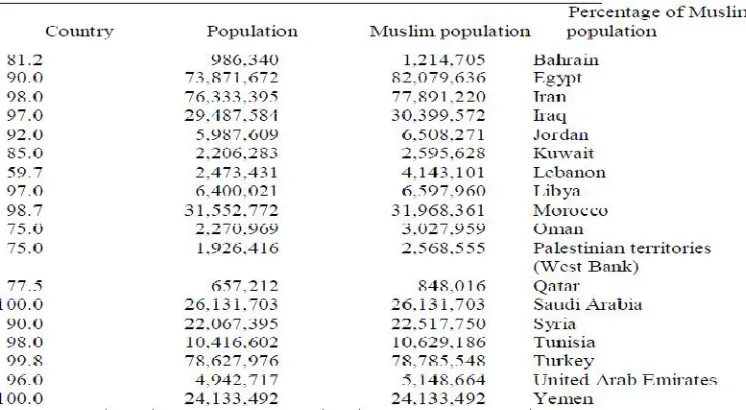
Table 7: Potential market size in Middle East and Turkey for Islamic banks
Source: Constructed by the author using data are from CIA World Fact Book (July2011), except where otherwise noted.
Table 8: Islamic Finance Assets in GCC and non-GCC MENA Region (USD, Figures in Billions)
Source: Data drawn from Timewell and Di Vanna (2008).
2.5 Trends in Islamic Banking in North America
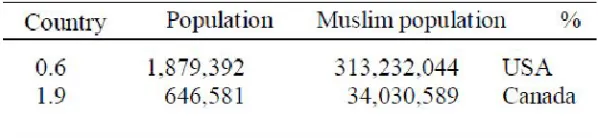
The exact number of Muslims in North America is unknown because the government statistics in the US and Canada cannot collect religious affiliations, by law. This is done to prevent discrimination based on religion. Table 10 gives an indication of the number of Muslims in North America.
Table 10: Potential Market size in North America for Islamic Banks
Source: Data drawn from CIA Factbook (based on the Canadian population in July 2011).
The history of Islamic finance in the United States began with the establishment of the Amana Funds in 1986, located in Washington, and American Finance House-LARIBA in California in 1987. In its first year, the institution mainly provided home financing to American Muslims. In 1998 LARIBA acquired Bank of Whittier. However, research by Dr. Al-Qudah (2005) indicates that LARIBA‘s financing contracts do not adhere to shariah principles. The other milestone for Islamic finance in the United States took place in the late 1990s, when the New York branch of United Bank of Kuwait obtained two interpretive letters issued by the Office of the Comptroller of the Currency to offer Islamic retail banking services in the country. The first approval letter was issued in 1997, which involved a residential net lease-to-own home- finance product through an ijarah wa iqtina contract. Under this scheme, the Office of the Comptroller of the Currency determined that United Bank of Kuwait would act as ―riskless principal‖ because the bank would not buy real estate until the lessee requested it and then rent it to the lessee. The bank would hold the legal title of the property until the payment of the final lease installment, at which point the lessee would take the title of the property. The second letter was issued in 1999 in response to the bank‘s proposal to offer certain murabaha- based financing products. Similar to the previous scheme, the Office of the Comptroller of the Currency viewed the bank as acting as ―riskless principal‖ in such transactions and therefore permitted the activity. In 1999 the mortgage company HSBC was authorized by the New York State Banking Departmentto offer a murabaha product for real estate financing. However, HSBC‘s New York City office had limited success and recently withdrew from the market.
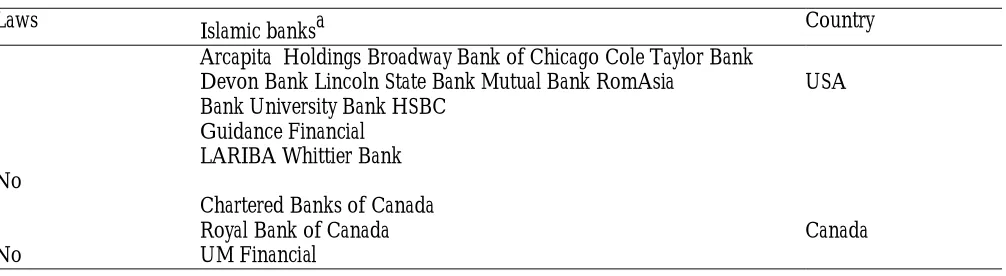
Also, the Canada Mortgage and Housing Corporation, a federal Canadian crown corporation, has shown some interest in Islamic finance by requesting proposals for research reports on the subject (Carruthers 2008).The number of Islamic financial institutions in North America is small (Table 11), and this opens the possibility for more to be established in the future.
Table 11: Islamic Financial Institutions in North America
Country Islamic banksa
Laws
USA Arcapita Holdings Broadway Bank of Chicago Cole Taylor Bank
Devon Bank Lincoln State Bank Mutual Bank RomAsia Bank University Bank HSBC
Guidance Financial LARIBA Whittier Bank No
Canada Chartered Banks of Canada
Royal Bank of Canada UM Financial
No
Source: Constructed by the author using data from Shayesteh (2009); Chiu, Newberger and Paulson (2005) ; Zyp (2009).
a Includes fully fledged Islamic banks, Islamic windows, offshore Islamic banking units, finance houses, and Islamic investment banks.
b Subsidiary of Arcapita bank (Islamic bank located in Bahrain). 4. Conclusion
There is no doubt that Islamic financial industry is booming world wide, though regulators must react to this by issuing laws to govern Islamic financial institutions operations. This to allow those institutions to operate efficiently, be competitive with its counterparts, and to facilitate its growth.
References
Abdeen, A and Shook, D. 1984. The Saudi financial system: in the context of Western and Islamic finance, Wiley, New York.
Al-Marwyne, M. 1985. ‗Islamic bank and its areas of work: comparative study‘(in Arabic), Master‘s Thesis, Umm Al-Qura, Makkah.
Al-Ansari, M., Hasan, M. and Metwaly, S. 1988. Islamic Banks (in Arabic) Al-Ahram Establishment, Cairo, Egypt.
Al-Qudah, M. 2005. ‗Islamic finance companies operating on the American arena‘ (in Arabic), inthe Third Periodical Conference of the Assembly of Muslim Jurists in America Proceedings, Nigeria, July, viewed 25 April 2011, <http://iefpedia.com/arab/?p=24170>.
Bekkin, R. 2007. ‗Islamic finance: Western and Russian approaches‘, in the Understanding Islamic Finance from Capital Markets to Real Estate Conference Proceedings, Geneva, 19–20 September, viewed 6 February 2010, <http://www.bekkin.ru/eng/index.php?rub=35&art=226>.
Carruthers, S. 2008. Canada: Islamic financial services in Canada: recent developments and long-term prospects, Mondaq, viewed 22 August 2009,
<http://www.mondaq.com/canada/article.asp?articleid=63250>.
Chachi, A. 2005. ‗Origin and development of commercial and Islamic banking operations‘, Islamic Economics, vol. 18, pp. 3–25.
Chiu, S., Newberger, R. and Paulson, A. 2005. Islamic finance in the United States: A small but growing industry, The Federal Reserve Bank of Chicago, viewed 23 August 2009,
<http://www.chicagofed.org/digital_assets/publications/chicago_fed_letter/2005/cflmay2 005_214.pdf>. El-Shiekh, S. 2010. Article: Dr. Ahmed Al-Najjar and Islamic banking (9), The International Association of Islamic
Gafoor, A. 1997. Interest free commercial banking, Apptec, Groningen, Netherlands.
Grais, W. & Pellegrini, M. 2006. ‗Corporate governance in institutions offering Islamic financial services: issues and options‘, Working paper series, No. 4052. World Bank.
Husain, I. 2005. ‗Islamic financial services industry: the European challenges‘, in the Keynote Address in the Islamic Financial Services Forum Proceedings, Islamic Financial Services Board and the Central Bank of Luxembourg, Luxembourg, 8 November, viewed 26 May 2009,
<http://www.bis.org/review/r051207e.pdf>.
Muhammed, A., Saleh, A., Ahmad, Satti, M. and Bakhit, M. 2006. Documenting the experience of Sudan in the field of banking and Islamic financial institutions (in Arabic), Central Bank of Sudan, Viewed 6 February 2009,
<http://www.cbos.gov.sd/sites/default/files/wathaig_book_03.pdf>.
Nasser, A. 1996. Essentials of Islamic banks assets and operational aspects(in Arabic), Apollo, Cairo.
Nasser, S. 2005. ‗The relationship between Central Banks and Islamic banks‘ (in Arabic), PhD Dissertation, University of Algiers, Algeria.
Nisar, S. (2002), ‗The state of Islamic finance in India: strengths and weaknesses‘, Review of Islamic Economics, no. 12, pp. 87-99. Nouri, M. 2009. ‗Experience of Islamic banking in Europe: the tracks, challenges and prospects‘ (in Arabic), in the Nineteenth Session of the European Council for Fatwa and Research Proceedings, Istanbul, 30 June-4 July, viewed 28 January 2010,
<http://iefpedia.com/arab/?p=11573>.
Partington, R. 2011. ‗Deutsche bank predicts Islamic finance boom, ‘Financial News 15 November, viewed 1 December 2011,
<http://www.efinancialnews.com/story/2011-11-15/deutsche-bank-analysts-predict-islamic-finance-boom>.
Ranzini, S. 2007. ‗Islamic finance (finally) taking root in North America‘, Islamic Finance News, vol. 4, pp. 10–11. Shayesteh, A. 2009. ‗Islamic Banks in the United States: Breaking Through the Barriers‘, New Horizon, no. 171, p.
36-39.
Shehata, H. 2005. The emergence of the idea of Islamic banks-Islamic banks past (in Arabic), Dar El-Mashora, viewed 2 November 2011, <http://www.darelmashora.com>.
Shehata, H. 2006. Islamic banks between thought and practice (in Arabic),1st edn, Cairo, Egypt, viewed 15 January 2010, <http://www.darelmashora.com>.
Taqi Al-Dean, R. 2005. ‗The role of the general council of banks and Islamic financial institutions in the development of uniform rules for banking transactions‘(in Arabic), in the Islamic Financial Institutions Landmarks, Reality and Future Prospects Conference Proceedings, Dubai, 15–17 May, pp. 471-450.
Timewell, S. and DiVann, J. 2008. ‗Top 500 Islamic financial institutions‘, The banker. Wilson, R. 1983. Banking and Finance in the Arab Middle East, Macmillan, London.