Effects of chronic exposure to carbamazepine on hematological
parameters in Cyprinus carpio
Rezaei M.¹; Mashinchian Moradi A.¹*; Mortazavi P.²; Jamili Sh.¹
,³
Received: March 2017 Accepted: April 2017
Abstract
Tests on pysicochemical parameters in the recent years have confirmed the existence of drug residues and their metabolites in different parts of aquatic environments the permanent release of which has led to micro-persistent pollution. The drugs are designed in a way to be chemically stable, resistant to degradation and to survive by using their biological effects on the organisms. In the present research study, toxicity and the effect of carbamazepine on Cyprinus carpio was examined using blood responses. Thus, the effects of three different concentrations of carbamazepine (1.25, 2.5 and 5 mg L-1) on the changes of blood factors such as red blood cell (RBC), hemoglobin (Hb), hematocrit (Hct), mean cellular volume (MCV), mean cellular hemoglobin (MCH), mean cellular hemoglobin concentration (MCHC), white blood cell (WBC), lymphocyte (Lymph), neutrophil (Neut) and monocyte (Mono) were studied on blood samples collected on days 7, 14 and 21 after exposure to the drug. The results showed that RBC, WBC and lymph counts were reduced in fishes treated with carbamazepine (CBZ). In contrast, the value of Hb, Hct, MCV, MCH, Neut and Mono were increased after exposure to carbamazepine. No significant difference was observed in the MCHC levels in all concentrations. Changes in hematological parameters can act as a biomarker in testing the toxicity of CBZ in aquatic environments. However, detailed studies regarding the application of special biomarkers for assessing human drugs is required.
Keywords: Carbamazepine, Hematological parameters, Cyprinus carpio
1-Department of Marine Biology, Science and Research Branch, Islamic Azad University, Tehran, Iran
2-Department of Pathology, Science and Research Branch, Islamic Azad University, Tehran, Iran
3-Department of Marin Biology, Iranian Fisheries Science Research Institute (IFSRI), Agricultural Research Education and Extension Organization (AREEO), Tehran, Iran *Corresponding author's Email: [email protected]
Introduction
Nowadays, a large number of drugs are used for preventing, detecting and treating the diseases in animals and human beings. A large number of these drugs are not completely decomposed after application (Bound and Voulvoulis, 2004). As a result, the metabolites of drugs and some unchanged forms of these compounds are excreted at first and then, they enter the ecosystem (Fent et al., 2006).
Carbamazepine was one of the most frequently used drugs in aquatic systems that was recognized as an anthropogenic marker in water bodies which is due to its stability in surface waters and sewages (Clara et al., 2004). However, its detrimental ecological effects on aquatic organisms especially fishes are less recognized.
Carbamazepine is usually used to control seizures disorders, neurological pains and for a variety of mental disorders (Jones et al., 2002; RxList, 2006). The physiological rule of CBZ is to stabilize the inactive status of sodium channels so that the brain cells are less stimulated (Contardo-Jara et al., 2011). CBZ is a relatively lipophilic compound (Kow=2.2( )Gagné et al., 2006). CBZ has been assessed as a toxic compound for aquatics such as bacteria, seaweeds, invertebrates and fishes (Ferrari et al., 2003; Li et al., 2011b).
It is estimated that 1014 tons of Carbamazepine is used each year all over the world (Zhang et al., 2008). According to the findings of Food and Drug Organization of the Ministry of Health, Treatment and Medical
Education in Iran, the production of the aforementioned drug in 2014 was equal to 35 tons.
The fishes were selected amongst the other aquatic organisms for examining the effects of environmental pollution on aquatic ecosystems. In recent years, sensitive biomarkers have been extensively used to test the probable dangers for the aquatic organisms. In general, the changes of these biomarkers in blood play an effective role in detecting the structural and functional status of the organisms confronted with toxic materials and also monitoring the aquatic environment (Van der Oost et al., 2003; El-Sayed et al., 2007).The interaction of a toxic material and a biological system can be examined using hematological biomarkers (Li et al., 2010). The changes in hematological biomarkers (RBC and WBC count, Hb, Hct, MCV, MCH and MCHC) are extensively used for examining toxic stress, and integrity of the immune system (Talas and Gulhan, 2009; Kavitha et al., 2010). The changes of these biomarkers, are sensitive to the environmental and physiological changes and are easily measurable and they analyze the physiological changes in organisms (Remyla et al., 2008)
In the northern coast of Iran, factors such as high density of human population, the lack of an appropriate wastewater treatment system and the existence of urban and hospital
wastewater, have allowed
pharmaceutical pollutants to enter the Caspian Sea and thus, pharmaceutical pollution is recognized as a significant
dangerous factor that threatens the biology and the survival of the organisms.
The impact of drugs on the physiology of aquatic organisms has been investigated in several studies. For example, Li et al. (2010) examined hepatic liver antioxidants and
hematological parameters in
Oncorhynchus mykiss exposed to
carbamazepine. The fish were exposed to sublethal concentrations (1.0 µg L-1, 0.2 µg L-1 and 2.0 µg L-1) of carbamazepine for 7, 21 and 42 days. Compared to the control group, the fish exposed to higher concentration of CBZ showed higher levels of hemoglobin. Saravanan et al. (2011) investigated the
ecotoxicological impact of
clofibric acid and diclofenac on
hematological, biochemical,
ionoregulatory and enzymatic responses in Cyprinus carpio. The fish were exposed to different concentrations (1, 10, 100 µg L-1) for 96 hours. At all concentrations, the level of red blood cells reduced in the fish treated with diclofenac and clofibric acid. On the contrary, the level of white blood cell increased in the fish. However, a mixed trend was observed in hemoglobin, hematocrit, mean cellular volume, mean cellular hemoglobin, and mean cellular hemoglobin concentration. In another study Li et al. (2011a) investigated the acute toxicity of carbamazepine in O.
mykiss. The fish exposed to CBZ,
showed higher levels of Er, Hb, MCHC, monocytes, granulocytes neutrophil and lower MCV and lymphocytes, compared to the control group.
The present study aims to study the effects of carbamazepine on C. carpio, using hematological parameters in order to evaluate the probable dangers of drugs transferred from water in the survival and physiology of aquatics and contribute to risk management decisions in the future for this emerging contaminant in water.
Materials and methods
Chemicals
Carbamazepine and other chemicals were obtained from Sobhan Darou Corporation (Iran). The CBZ was dissolved in dimethyl sulfoxide (DMSO) in order to make a stock solution at a concentration of 100 mg ml-1.
Fish
C. carpio, weighing 25 to 35g
(mean±SD), were obtained from a local commercial hatchery (Golestan, Iran). They were held in aquaria containing 160 liters of freshwater continuously aerated to maintain dissolved oxygen values of 7.5–8.0 µg L-1. Temperature and pH were 26±1 ◦C and 7.1±0.2 respectively. Photoperiod was a 12:12 light–dark cycle. Water was renewed (50%) daily to avoid accumulation and contamination to excretory materials. In this study, tap water -chlorine free- was used and the physicochemical characteristics of tap water such as temperature, pH, dissolved oxygen, total alkalinity and total hardness were measured according to APHA (1998) and maintained during the study. Fish were acclimatized for 14 days before the beginning of the experiment and
were fed commercial fish food. The fish were starved for 24 h prior to sampling to avoid prandial effects during the assay.
Exposure to CBZ
A 140 l semi-static system was used in which 20 fish were distributed to each of the 15 aquaria randomly. Given that LC50 levels in the C. carpio fish was determined as 59.70 µg L-1 for 24 hours (Malarvizhi et al., 2012), and the fish were exposed long term to drug, the test concentrations were considered less than 1.4 LC50. The nominal used concentrations of CBZ were 1.25 mg L -1
, 2.5 mg L-1 and 5 mg L-1.
Carbamazepine was dissolved in DMSO with a final concentration of less than 0.05%. Two other groups were used as contrast groups, a control group exposed to clean freshwater and a DMSO group exposed to the volume of DMSO (v/v, 0.05%) used for the highest CBZ concentration. Each experimental condition was run in triplicate. The feeding of fish was performed daily, with commercial fish pellets at 1% total body weight at a fixed time and the extra food was removed. Fifty percent of the exposed solution was renewed each day after 2 h of feeding to maintain the appropriate concentration of CBZ and DMSO and water quality. The test equipment was cleaned every 14 days. Since the effect of chronic toxicity of carbamazepine was investigated in the present study, sampling was performed at 7, 14 and 21 day intervals in order to identify the effects of sublethal concentrations in fish and prevent death of fish due to
side effects. Experiments were done in accordance with the European Communities Council Directive (86/609/EEC).
Collection and preparation of blood samples
Blood samples were taken from each fish by caudal venipuncture using a syringe heparinized at a concentration of 5000 IU heparin sodium salt in 1ml. An aqueous solution of heparin sodium salt at 0.01 ml/1 ml blood was used to stabilize the samples.
Hematological analysis
Hb was estimated by the
cyanmethaemoglobin method (Drabkin, 1946). RBC and WBC were counted by the method of Rusia and Sood (1992). Hct was estimated according to Nelson and Morris (1989). Differential white blood cells were counted following the method of Svobodova et al. (1991). Erythrocyte indices like MCV, MCH and MCHC were also calculated according to standard formulae as follows:
MCV (fl) =
× 100
Statistical assays
All values were expressed as mean±SD and analyzed by SPSS software.
One-way repeated measure ANOVA
following S-N-K’s test was used to
determine whether results of treatments were significantly different from the control group (p<0.05).
Results
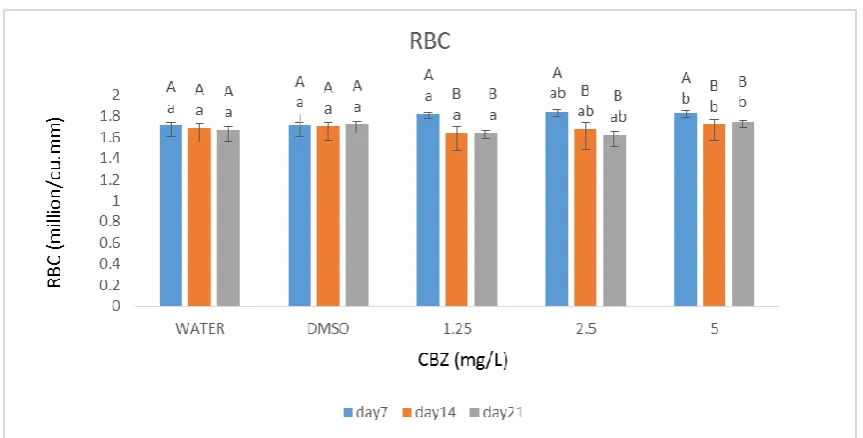
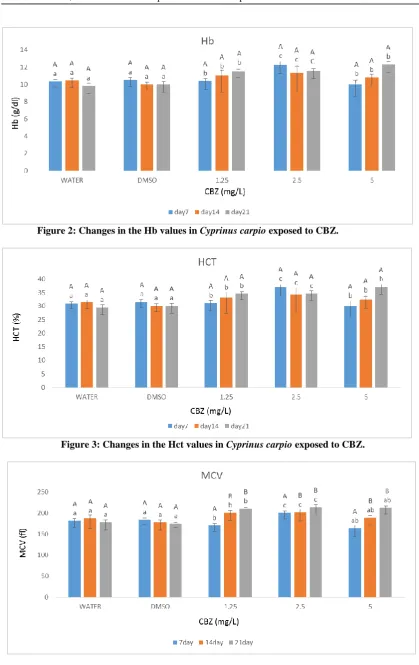
Hematological parameters of C. carpio that were exposed to CBZ showed changes in comparison with control groups. The results showed the reduction of RBC in the treated fish exposed to the drug on the 14th and 21st days. Hb and Hct contents were increased in the different drug concentrations. Also, MCV, MCH values were increased in fishes treated with drugs which corresponded with increasing periods for exposure to the drug. No significant difference was
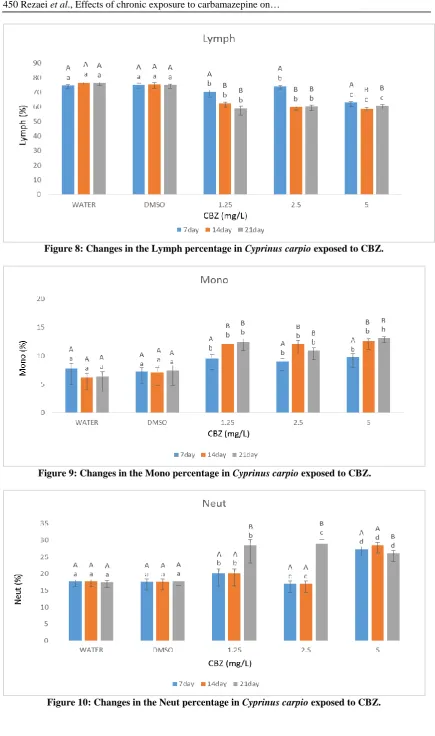
seen in the values of MCHC in all the concentrations. The WBC count and the percentage of lymphocytes in treated fishes exposed to drug on the 14th and 21st days were reduced and conversely, the percentage of neutrophil on the 21st day and monocytes on the 14th and 21st days, in treated fishes exposed to carbamazepine increased.
In Figs. capital letters represent significant differences between treatments in terms of time.
Lowercase letters represent significant differences between treatments in terms of the concentration factor.
Figure 1: Changes in the RBC count in Cyprinus carpio exposed to CBZ
Figure 2: Changes in the Hb values in Cyprinus carpio exposed to CBZ.
Figure 3: Changes in the Hct values in Cyprinus carpio exposed to CBZ.
Figure 4: Changes in the MCV values in Cyprinus carpio exposed to CBZ.
Figure 5: Changes in the MCH values in Cyprinus carpio exposed to CBZ.
Figure 6: Changes in the MCHC values in Cyprinus carpio exposed to CBZ.
Figure 7: Changes in the WBC count in Cyprinus carpio exposed to CBZ.
Figure 8: Changes in the Lymph percentage in Cyprinus carpio exposed to CBZ.
Figure 9: Changes in the Mono percentage in Cyprinus carpio exposed to CBZ.
Figure 10: Changes in the Neut percentage in Cyprinus carpio exposed to CBZ.
Discussion
Toxicity tests were used extensively in order to evaluate the effect of the toxicity of the chemical materials on non-target organisms (Quinn et al., 2008; Ginebreda et al., 2010; Santos et al., 2010). Pharmaceuticals are active biologically and the persistent particles enter the aquatic environments through waste water treatment plant (WWTP) and they may affect the aquatic organisms due to their innate biological activities, both in acute and chronic concentrations. Pharmaceuticals can even agitate their toxicity effects on non-target organisms even in low concentrations and thus, studying the toxicity of these compounds can help the activities and the toxicity of the pharmaceuticals (Hoeger et al., 2008; Malarvizhi et al., 2012).
The results of present research on blood parameters showed a reduction in the count of red blood cells in fishes exposed to pharmaceuticals on the 14th and 21st days.
This may have resulted from the hemolysis of the red blood cells by carbamazepine. It may also be due to the destruction of hematopoietic centers by CBZ. Finally we also observed a reduction of RBC.
Saravanan et al. (2011) investigated the ecotoxicological impacts of clofibric acid and diclofenac in common carp (C. carpio) and demonstrated a reduction in RBC count caused either by the inhibition of erythropoiesis or by the destruction of red blood cells by the drugs CA and DCF.
In another research by Ambili et al. (2013) on the effects of the antibiotic oxytetracycline on Indian major carp Labeo rohita it was reported that due to prolonged exposure of the antibiotic, the gill region was affected, resulting in impaired osmoregulation and anemia and leading to a decrease in RBC count. The results showed that the values of Hb and HCT were increased after exposure to the drug. Despite the reduction of RBC, Hb was increased. This may be because the red blood cells swell and as a result, the values of Hb increase which was due to the presence of more oxygen in response to hypoxia induced by the drug.
In a study by Li et al. (2010), rainbow trout (O. mykiss) was exposed to different concentrations of carbamazepine (1 ug L-1, 0.2 mg L-1, 2 mg L-1). In comparison with the control group, fishes exposed to higher concentrations of CBZ, showed higher level of hemoglobin. They showed that the significant high percentage of Hb and PCV were perhaps attributable to the erythropoiesis reactivation mechanism induced by the spleen and liver to compensate for the cerebral hypoxia induced by environmental stress.
Saravanan et al. (2011) reported that the elevated level of Hb content in C. carpio, exposed to clofibric acid and Diclofenac might have resulted from replacement of oxidized denatured Hb and to supply more oxygen to tissues. Swelling of RBCs due to stress and disorders of respiratory capacity, caused by the damage in the gill, may also increase Hct level.
MCV, MCH, MCHC are widely used for determining the size, content and density of Hb in red blood cells. (Ambili et al., 2013). The increase of MCV and MCH were seen in CBZ-treated fish which was simultaneous with time increase but no significant difference was seen in the value of MCHC of treatments in all the concentrations. With regard to the reduction of red blood cells and the increase of Hb and HCT by exposure to drug, may be probably due to the swell of RBCs and the signs of macrocytic anemia.
Saravanan et al. (2012) also suggested that increase in MCV and MCH along with the reduction in MCHC shows that the type of anemia is macrocytic.
Changes in the level of MCV, MCH and MCHC with lower and higher concentrations of drugs may be the response of stress to the drugs. The increase in MCV may be due to the increase of immature RBC. In addition, anemia due to disorders in gas exchange across the gills may lead to the increase of MCH and MCV (Caravalho and Fernandes, 2006). An increase in MCV and MCH levels also indicates the swelling of RBCs which is caused by the toxicity of the drug. (Li et al., 2011b).
WBCs play a significant role in regulating the immunological function in organisms and changes in the number of WBC to pollutants, signifying the reduction of the non-specific immunity of the fishes (Kavitha et al., 2010). A significant difference was seen in the exposed fish between the first week and the other days. A significant
reduction was observed in the number of white blood cells and the percentage of lymphocyte on days 14 and 21. With regard to long-term exposure to carbamazepine, the hematopoietic centers may have been destructed and as a result WBC reduced.
The toxicity data in the present study also show the increase of neutrophil on the 21st day and the increase of monocytes on the 14th and 21st days in fish exposed to carbamazepine because of the neutrophils and monocytes infiltrating cells in the inflammatory response of cells to prevent their damage.
Li et al. (2011a) noted that generally, a decrease in lymphocyte numbers and a concurrent increase in monocytes and neutrophilia occur in response to a stressor. The results of this study were similar to our findings with regard to the changes of differential white blood cells.
Unlike the results of this study, Saravanan et al. (2012) reported an increase in the WBC count in fishes treated with Ibuprofen for 35 days showing that the stimulatory effect of the toxicant on the immune system and
release of lymphocyte from
lymphomyeloid tissue act as a defense mechanism which may increase WBC count in fishes. It seems that the reduced count of white blood cells is mainly caused by reduction in the lymphocyte count. Defects in the construction of white blood cells caused by the stress resulting from the introduction of drugs into the fish habitat, affect the hematopoietic tissues including the kidney which leads to a
decline in the production of white blood cells.
In general, changes in hematological parameters in fish exposed to
pharmaceuticals indicate a
compensatory response to maintain gas exchange (Li et al., 2011b), and this may vary in relation to the toxicant, concentration, exposure period and the tested species (Borges et al., 2007). In the present study, it is concluded that CBZ with impact on hematological profiles of common carp (C. carpio) is toxic to aquatic organisms. These parameters can effectively be used as potential biomarkers of CBZ toxicity in the evaluation of environmental biomonitoring and it can also act as an early warning signal for pharmaceutical exposure to aquatic organisms. However, more detailed studies on the application of special biomarkers for biomonitoring human drugs are necessary.
References
Ambili, T.R., Saravanan, M., Ramesh, M., Abhijith, D.B. and Poopal, R.K., 2013. Toxicological effects of the antibiotic oxytetracycline to an Indian major carp Labeo rohita. Archives of Environmental Contamination and Toxicology, 64, 494–503.
APHA (American Public Health Association), 1998. Standard methods for the examination of water and wastewater, 20th ed. American Public Health Association, Washington, DC. 138 P.
Borges, A., Scotti, L.V., Siqueira, D.R., Zanini, R., Do Amaral, F.
and Jurinitz, D.F., 2007. Changes in hematological and serum biochemical values in jundia Rhamdia quelen due to sub-lethal
toxicity of cypermethrin.
Chemosphere, 69, 920–926.
Bound, J.P. and Voulvoulis, N., 2004. Pharmaceuticals in the aquatic environment-A comparison of risk assessment strategies. Chemosphere, 56, 1143–1155.
Caravalho, C.S. and Fernandes, M.N., 2006. Effect of temperature on copper toxicity and hematological responses in the neotrophical fish, Prochilodus scrofa at low and high pH. Aquaculture, 251, 109–117.
Clara, M. Strenn, B. and Kreuzinger, N., 2004. Carbamazepine as a possible anthropogenic marker in the aquatic environment: Investigations on the behavior of carbamazepine in wastewater treatment and during groundwater infiltration, Water Research, 38, 947–954.
Contardo-Jara, V., Lorenz, C., Pflugmacher, S., Nützmann, G., Kloas, W. and Wiegand, C., 2011.
Exposure to human pharmaceuticals Carbamazepine, Ibuprofen and Bezafibrate causes molecular effects
in Dreissena polymorpha. Aquatic
Toxicology, 105, 428– 437.
Drabkin, D.L., 1946. Spectrometric studies, XIV: the crystallographic and optimal properties of the hemoglobin of man in comparison with those of other species. Journal of Biological Chemistry, 164, 703– 723.
El-Sayed, Y.S., Saad, T.T. andEl-Bahr, S.M., 2007. Acute
intoxication of deltamethrin in monosex Nile tilapia, Oreochromis niloticus with special reference to the clinical, biochemical and
haematological effects.
Environmental Toxicology and
Pharmacology, 24, 212–217.
Fent, K., Weston, A.A. and Caminada, D., 2006. Ecotoxicology of human pharmaceuticals. Aquatic Toxicology, 76, 122–159.
Ferrari, B., Paxeus, N., Lo Giudice, R., Pollio, A. and Garric, J., 2003.
Ecotoxicological impact of pharmaceuticals found in treated
wastewaters: study of
carbamazepine, clofibric acid, and diclofenac. Ecotoxicology and Environmental Safety, 55, 359–370.
Gagné, F., Blaise, C. and André, C., 2006. Ocurrence of pharmaceuticals products in a municipal effluent and toxicity to rainbow trout (Oncorhynchus mykiss) hepatocytes. Ecotoxicology and Environmental Safety, 64, 329–336.
Ginebreda, A., Mun˜ oz, I., López de Alda, M., Brix, R., López-Doval, J. and Barceló, D., 2010.
Environmental risk assessment of pharmaceuticals in rivers: relationships between hazard indexes and aquatic macro invertebrate diversity indexes in the Llobregat River (NE Spain). Environment International, 36, 153–162.
Hoeger, B., Dietrich, D.R., Schmid, D., Hartmann, A. and Hitzfeld, B., 2008. Distribution of intraperitoneally injected diclofenac in brown trout (Salmo trutta f.
Fario). Ecotoxicology and Environmental Safety, 71, 412–418.
Jones, O.A.H., Volvoulis, N. and Lester, J.N., 2002. Aquatic environmental assessment of the top
25 English prescription
pharmaceuticals. Water Research, 36, 5013–5022.
Kavitha, C., Malarvizhi, A., Senthil Kumaran, S. and Ramesh, M., 2010. Toxicological effects of arsenate exposure on hematological, biochemical and liver transaminases activity in an Indian major carp,
Catla catla. Food and Chemical
Toxicology, 48, 2848–2854.
Li, Z.H., Velisek, J., Zlabek, V., Grabic, R., Machova, J., Kolarova, J. and Randak, T., 2010. Hepatic, antioxidant status and hematological parameters in rainbow trout, Oncorhynchus mykiss, after chronic exposure to carbamazepine.
Chemico-Biological Interactions,
183, 98–104.
Li, Z.H., Zlabek, V., Velisek, J., Grabic, R., Machova, J., Kolarova, J., Li, P. and Randak, T., 2011a.
Acute toxicity of carbamazepine to
juvenile rainbow trout
(Oncorhynchus mykiss): Effects on antioxidant responses, hematological parameters and hepatic EROD. Ecotoxicology and Environmental Safety, 74, 319–327.
Li, Z.H., Velisek, J., Zlabek, V., Grabic, R., Machova, J., Kolarova, J., Li, P. and Randak, T., 2011b.
Chronic toxicity of verapamil on
juvenile rainbow trout
(Oncorhynchus mykiss): Effects on
morphological indices,
hematological parameters and antioxidant responses. Journal of
Hazardous Materials, 185, 870–880.
Malarvizhi, A., Kavitha, Ch., Saravanan, M. and Ramesh, M., 2012. Carbamazepine (CBZ) induced enzymatic stress in gill, liver and muscle of a common carp, Cyprinus carpio. Journal of King Saud University – Science, 24, 179– 186.
Nelson, D.A. and Morris, M.W., 1989. Basic methodology. Hematology and coagulation, part IV. In: Nelson, D.A., Henry, J.B. (Eds.), Clinical Diagnosis and
Management by Laboratory
Methods, 17th ed. W.B. Saunder Company, Philadelphia, USA. pp. 578–625.
Quinn, B., Gagné, F. and Blaise, C., 2008. An investigation into the acute and chronic toxicity of eleven pharmaceuticals (and their solvents) found in wastewater effluent on the cnidarian, Hydra attenuata. Science
of the Total Environment, 389, 306–
314.
Remyla, S., Ramesh, M., Sajwan, K.S. and Senthil Kumar, K., 2008.
Influence of zinc on cadmium induced haematological and biochemical responses in a freshwater teleost fish Catla catla. Fish Physiology and Biochemistry, 34, 169–174.
Rusia, V. and Sood, S.K., 1992.
Routine hematological tests. In: Kanai, L., Mukerjee (Eds.), Medical Laboratory Technology, vol. I., fifth reprint. Tata McGraw Hill
Publishing Company Limited, New Delhi. pp. 252–258.
RxList, 2006. The internet drug index. <http://www.rxlist.com>.
Santos, L.H.M.L.M., Araujo, A.N., Fachini, A., Pena, A., Deleure-Matos, C. and Montene-gro, M.C.B.S.M., 2010. Ecotoxicological aspects related to the presence of pharmaceuticals in the aquatic environment. Journal of Hazardous Materials, 175, 45–95.
Saravanan, M., Karthika, S., Malarvizhi, A. and Ramesh, M., 2011. Ecotoxicological impacts of clofibric acid and diclofenac in common carp (Cyprinus carpio) fingerlings: Hematological, biochemical, ionoregulatory and enzymological responses. Journal of
Hazardous Materials, 195, 188–
194.
Saravanan, M., Usha Devi, K., Malarvizhi, A. and Ramesh, M., 2012. Effects of Ibuprofen on hematological, biochemical and enzymological parameters of blood in an Indian major carp, Cirrhinus
mrigala. Environmental Toxicology
and Pharmacology, 34, 14–22.
Svobodova, Z., Pravda, D. and Palackova, J., 1991. Unified methods of haematological examination of fish. Research Institute of Fish Culture and Hydrobiology. Vodnany. 3l P.
Talas, Z.S. and Gulhan, M.F., 2009.
Effects of various propolis concentrations on biochemical and hematological parameters of rainbow trout (Oncorhynchus mykiss).
Ecotoxicology and Environmental Safety, 72, 1994–1998.
Van der Oost, R., Beyer, J. and Vermeulen, N.P.E., 2003. Fish bioaccumulation and biomarkers in environmental risk assessment.
Environmental Toxicology and
Pharmacology, 13, 57–149.
Zhang, Y., Geißen, S.U. and Gal, G., 2008. Carbamazepine and diclofenac: Removal in wastewater treatment plants and occurrence in water bodies. Chemosphere, 73, 1151–1161.