www.soundeffects.dk
Michael Jackson’s sound stages
Dr. Morten Michelsen Associate Professor of Musicology
‘You can actually paint sonic panoramas with musical sounds’.
(Swedien, 2003, p. 145)1
Abstract
In order to discuss analytically spatial aspects of recorded sound William Moylan’s concept of ‘sound stage’ is developed within a musicological framework as part of a sound paradigm which includes timbre, texture and sound stage. Two Michael Jackson songs (‘The Lady in My Life’ from 1982 and ‘Scream’ from 1995) are used to: a) demonstrate the value of such a concep-tualisation, and b) demonstrate that the model has its limits, as record producers in the 1990s began ignoring the conventions of stereo recording’s illusion of three dimensions and reached for a severing of the intimate relations between sound and Euclidic space.
In the last one and a half decades interest in the analysis of recorded sound has grown immensely. The 1990s and the years around 2000 saw a couple of seminal texts published: William Moylan’s The Art of Recording (1992 and later editions) was
the first extended discussion of how we may talk about recorded sound, and Serge Lacasse’s thesis on vocal staging (2000) and Albin Zak’s Making Tracks (2001) took
up the gauntlet. Since then we have seen The Research Centre for the History and
Analysis of Recorded Music take up residence in London in 2004 and the Art of Record Production conference take place each year since 2005 and the likewise named jour -nal be published since 2007. Needless to say, this has been supported by a
grow-ing research community, and the field of study has been summarised by Simon Zagorski-Thomas in his article ‘The Musicology of Record Production’ (2008).
In this article I would like to address and connect two topics: the music-analyt
-ical concept of the sound stage and the actual sound of Michael Jackson’s music. Moylan developed the concept of the sound stage and defined it as follows: ‘The
sound stage is the location within the perceived performance environment, where the sound sources are perceived to be collectively located, as a single ensemble’
(1992, pp. 207-208). Lacasse’s concept of staging is equally very useful, as his defini -tion may be extended to encompass other sounds than vocals,2 and other popular
music scholars have contributed to methodological and theoretical explorations of
these topics (e.g. Zak, 2001; Zagorski-Thomas, 2005 and 2006; Walther-Hansen, 2009) and to historical studies (e.g. Katz, 2005; Doyle, 2005). Film studies has contributed quite extensively to the analytical exploration of sound, whether musical or not,3
and, of course, acoustics has been doing analytic work all the time, even though
their results only seldom have been of any direct use to music analysts. Also, the
the music-analytical development – Moylan’s book being one of these. On the other hand, there is to my knowledge next to no literature discussing the music or the sound of Michael Jackson in any detail, even though his videos and his image issues
have attracted much scholarly attention.4
Related to these two topics – sound and Michael Jackson’s music – is a more fun
-damental problematic, namely how to talk about sound. Even though some highly relevant work has been done by the researchers mentioned, we still need to develop
concepts and methods that are meaningful when such a notoriously elusive aspect of our musical everyday life is called upon by discourse. In the words of Moylan, with regard to the spatial aspect:
Space in music can be profoundly important. These qualities can create a context for the song and its materials, be used to enhance musical ideas and the instruments and voices that present them, can even function as musical materials, and much more. Still, the breadth and the significance of their role in recorded music is not defined or fully understood. (Moylan, 2008)
The main aim of such work is to open up sound – whether musical, non-musical or
somewhere in-between – for discussion. And, not least, for discussions about
musi-cal meaning production. For this purpose I will present what I have musi-called a sound
parameter which includes the sound stage. Later on I will demonstrate the sound
stage as used by Michael Jackson and his producers, engineers and programmers in two recordings. The first is a very good example of a conventional, three-dimen -sional music production, and the second tests the limits of analytical models based on the concept of the sound stage.
A sound parameter
Some years ago I proposed a sound parameter with the intention of making it pos -sible for others than recording specialists to articulate observations on recorded
sound. Taking my cue from Jan LaRue (1970), it was intended as an extension of the
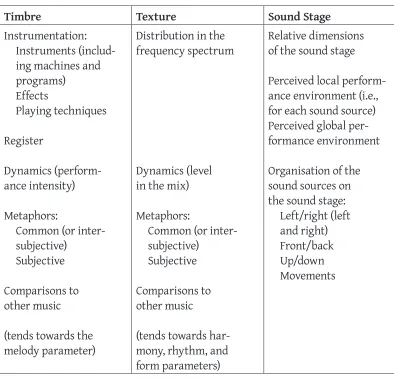
Figure 1: A sound parameter (Michelsen, 1997, p. 124)
The first two columns, timbre and texture, are quite conventional. What may be
new are the two different sets of dynamics: the dynamics at the point of record-ing and the dynamic level in the mix. Also, metaphors seem to be extremely
help-ful tools when talking about sound, and their workings may be understood and theorised with reference to research made in the tradition following the works of George Lakoff and Mark Johnson (Lakoff & Johnson, 1980; Johnson, 1987; see also Michelsen, 1997, pp. 65-79). Comparisons to other music seem to be a great help as well when trying to explain what something sounds like, thus avoiding language to
some extent.
The third column might merit a few more words, as it conceives of the sound stage as a three-dimensional illusionary space constructed in recording and mixing studios and mediated though conventional stereo or surround sound systems or headphones.5 The horizontal dimension is defined by the stereo perspective’s left/
Timbre Texture Sound Stage
Instrumentation: Instruments
(includ-ing machines and programs)
Effects
Playing techniques
Register
Dynamics (perform -ance intensity)
Metaphors:
Common (or
inter-subjective) Subjective
Comparisons to other music
(tends towards the melody parameter)
Distribution in the frequency spectrum
Dynamics (level
in the mix)
Metaphors:
Common (or
inter-subjective) Subjective
Comparisons to other music
(tends towards har-mony, rhythm, and form parameters)
Relative dimensions of the sound stage
Perceived local perform -ance environment (i.e., for each sound source)
Perceived global per -formance environment
Organisation of the
sound sources on the sound stage:
Left/right (left
and right)
Front/back Up/down
right and controlled using the panning knob, the depth dimension by the perceived
distance between sound source and listener,6 and the vertical dimension by fre-quency distribution. The vertical dimension is somewhat contested. Moylan states
that the sound stage has only two dimensions, width and depth (Moylan, 1992, p. 207), but accepts that the pitch area may be conceived of as a space, even though
it cannot be measured (ibid., pp. 27, 174). Other writers like Albin Zak accept this vertical dimension as defined by frequencies (or rather, frequency bands). Never -theless, the vertical dimension is more abstract – some would say metaphorical (e.g.
Zagorski-Thomas, 2006, p. 2) – than the two other dimensions, even though Western music culture has quite clear perceptions of which sounds are above which.
The dimensions of the sound stage cannot be established precisely. Relative sizes can be given (small, medium or big), but metaphors will be needed to give a sense of size and materiality, e.g. cathedral, concrete storage room, garage or heavily damped
living room. And Euclidic metaphors are not always enough. Moylan argues that the
sound stage is constructed either by giving each sound source its own acoustic char-acteristics (the perceived local performance space) or by adding general acoustic characteristics in the mixing process (the perceived global performance space). The
two principles might be mixed as well. In the first case the listener unconsciously
orders the sounds in a certain acoustic relationship, based on the most dominating sound sources (Moylan, 1992, p. 234-239). The fact that different local performance spaces can exist within a global performance space is called the illusion of space within space. The space of single sound sources can be placed on a continuum from
a precise point to larger, more or less well-defined areas. The exact placement of dis
-tance or place with regard to right/left is quite imprecise, but placing sound sources and their environments in relation to each other makes up for this.
The sound parameter suggested here is quite systematic. Albin Zak mentions
most of the elements named in this context, but he is less rigid, partly because his intention is to describe the recording process from recordists’ perspective,7 and
partly because he wants to stress the interrelatedness of all aspects of the music. I
mention this in order to point out that Zak, being both a recordist and a musicolo -gist, basically agrees that the elements of the present sound parameter are relevant
and that it corresponds roughly to his findings. I might add that some acousticians
as well seem to accept the three-dimensional stage metaphor as a useful way of
conceptualising the spatial qualities of recorded sound. The same researchers even accept talking about it in more or less subjective ways (Rumsey, 2002; Toulson, 2006).
‘The Lady in My Life’
Michael Jackson’s recording of ‘The Lady in My Life’, the last track on the 1982 album
was composed by Rod Temperton, produced by Quincy Jones and Michael Jack
-son and recorded by Bruce Swedien. The musicians are Greg Phillinganes (Fender Rhodes), Michael Boddicker (emulator), Paul Jackson (guitar), Louis Johnson (bass) and the three Toto members David Paich, Steve Porcaro and Jeff Porcaro, the first two on synthesisers, the last one on drums. I will single out Jackson’s vocal in order
to demonstrate the discussion of timbre.
In this song Michael Jackson’s range goes from a to a’ with small detours below
and above, and the diction is always very clear. In verses and refrains he sings in
a straight manner with small dynamic inflections, but applies a small amount of
vibrato at phrase endings. In the contrast part he applies glottal stops as well. With
regard to performance intensity, he sings still louder; there are three dynamic levels
in verse, bridge and refrain, respectively (from crooning to a loud, nasal head reso-nance). The loudest level is used in the two long codas. The local performance space
changes accordingly, as Jackson sings still closer to the microphone (the sibilants in the 5.000-8.000 Hertz area become clearer). In the codas he takes up vocal techniques and expressions like belting, glissando, falsetto, vocal noises and heavy breathing.
There are two voice personas present: the boyish, harmonious ballad singer of
the first part and the more teenage-like, compressed and noise-filled soul singer
with a few falsetto and ‘uh-oh’ outbursts of the second part. The difference is clear,
but not striking, and it is supported by the rhythmical feeling (legato versus a bit more staccato, full phrases versus short outbursts). Metaphorically speaking one could talk about a rhythmic change from floating to abrupt, a rhetorical change from eloquent to unarticulated and a timbral change from the controlled tremble
of the vibrato to the falsetto’s abundance of feeling. In general, there is a movement from controlled to uncontrolled, but also from the naive (clear diction and pitch)
to sensual knowledge (affectionate, fondling, begging). At the same time, the choir (also sung by Jackson) sticks to the soft sounds during the soul singing.
The six bar introduction (the first 22 seconds) can show some aspects of the song’s texture (the combined instrumental timbres) as illustrated in figure 2. The x
axis denotes time measured in bars and the y axis the relative placement of
instru-ments according to main frequencies. The coloration denotes four dynamic levels,
ranging from pp to f.
Often variations in texture and sound stage placement contribute to underline
the song’s form (in general, time might be considered the fourth dimension of the
sound stage). This happens in several ways in this quite simple song. First, vocals and accompaniment are dynamically intensified, when the first verse takes over
from the intro. Second, the primary vocal changes its dynamics, its local perform-ance space and its location on the sound stage. These changes can be heard at the
codas (2:38-3:42 and 3:43-4:56) reverse the dynamic intensification, thus creating a
dynamic curve for the entire song.
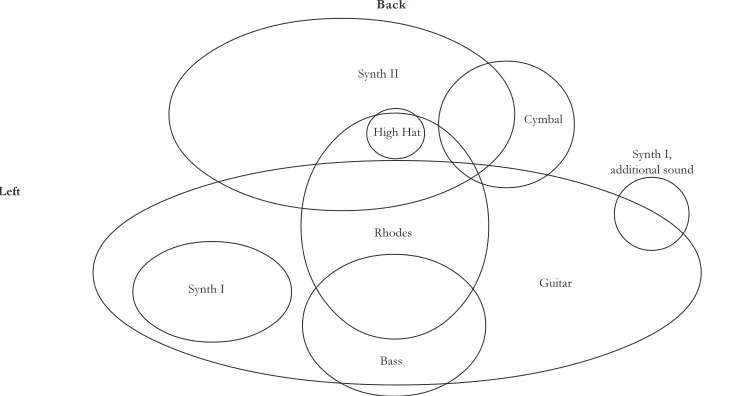
Apart from these details, this is quite an ordinary, if very well done, stereo recording from a sound stage perspective. In the sketch below (figure 3) the rela -tional size and the placement of sound sources’ local performance spaces can be seen.
Figure 3: ‘The Lady in My Life’, sound stage, bars 1-6
The sound stage in figure 3 is seen from above (the texture in figure 2 shows the vertical distribution). Bass, percussion and Fender Rhodes are placed at the front of relatively small, perceived local performance spaces (much high frequency informa
-tion), while guitar and synth II are placed further back in their larger, local spaces
Figure 2: ‘The Lady in My Life’, texture, bars 1-6
Measure1 2 3 4 5 6
Beat 1 2 3 4 1 2 3 4 1 2 3 4 1 2 3 4 1 2 3 4 1 2 3 4
Cymbal high
High hat Synth I (Moog-sound)
Synth II ("organ") Rhodes Guitar
Bass low
Colour legend:
(partly due to the amount of delay). The high frequencies and the very clear, if soft attacks on most nodes contribute a certain crispness to the overall texture. The sound stage is quite spacious, and there is plenty of room for each sound source, also
the ones following later (voice(s), synth-trumpet and synth-strings). The dynamics
at the point of recording are kept low, and the figure shows the dynamics in the
mix.
The bass and the time-marker on the second and fourth beat are placed conven -tionally in the middle, and the Rhodes has the role of soloist because of its staging.
The guitar has a rather large, local performing space, which helps to define the
global performing space. The synthesiser sounds do that as well by being placed
right, left and to the back. The synth I sound seems to consist of two separate sounds
placed left and right, triggered by the same playing impulse. In general, the place-ment of the sound sources in relation to each other is clear and helps to establish a sense of perspective. Also, the order of the sound sources’ appearance helps build
the sound stage. In bar one ground and back are established, and in bars three and five synth II establishes a still higher ceiling and a back cloth still further away.
Synth I and guitar might be considered soloists, but they are not convincing in that
role. Only the appearance of the Rhodes in the right place in bar five constitutes a soloist – but one that still leaves a lot of space for Jackson’s vocal in the following.
I consider such sound stage constructions one of the basic conventions in stereo
recording practices. It was developed during the 1960s, and the changes in The
Beatles’ recordings during that decade are a particularly good demonstration of
how bass, drums and solo vocals came to be placed at the centre, while guitars, key
-boards and other accompanying instruments together with backing singers were placed to the left or right or in the background. Since then the basic placement plan
has hardly changed, while the clarity of the three-dimensional, illusory space has
changed quite a lot. Different styles have used space differently,10 and record
pro-ducers have their individual ‘sound signatures’ as well.
As soon as conventions are doing their cultural work, somebody will tinker with
them or even try to overthrow them. Through the last 50 years of recording history there have been numerous examples of this, many of them fascinating, but they have not managed to establish general norms different to the sound stage.
Never-theless, discussions of sound need to take such experiments into account, partly
because there are so many of them, and partly because the analysis of experiments
might refine the way we analyse music recorded adhering to the conventions. We need not stray away from the Jackson repertoire in order to find such experiments.
‘Scream’
From Thriller onwards to his death, Jackson himself, several producers and record
-ing technicians had access to state of the art equipment (sometimes even proto -types11), to unlimited studio time and to highly inventive programmers. Combined
with their own, often innovative practices this has resulted in many different
con-structions of illusionary spaces, some traditional, some quite strange. HIStory
con-sists of two CDs, one containing a selection of greatest hits and one containing new
recordings. The second is a veritable catalogue of sound stages, and the ‘Scream’
sound stage is probably the most outstanding. By 1995 the Jackson recording team had changed from analogue to digital recording equipment (Swedien, 2003, p. 154).
This made it possible to shape the sound stage in much more detail than before. The main principle for the construction of the ‘Scream’ sound stage seems to be an attempt to intimidate the listener in the same way that the song’s persona is intimidated (or pressured), presumably by the gutter press (cf. Michelsen,
forth-coming) – and to create a great dance track. That is, I take it that the producers and
the technicians have tried to establish an anaphone to the lyrics. In the ‘Scream’ introduction this intimidation is attained in several different ways: spatial confu-sion, distortion, very small local performance spaces and the placement of certain sounds to the forefront of the stage.
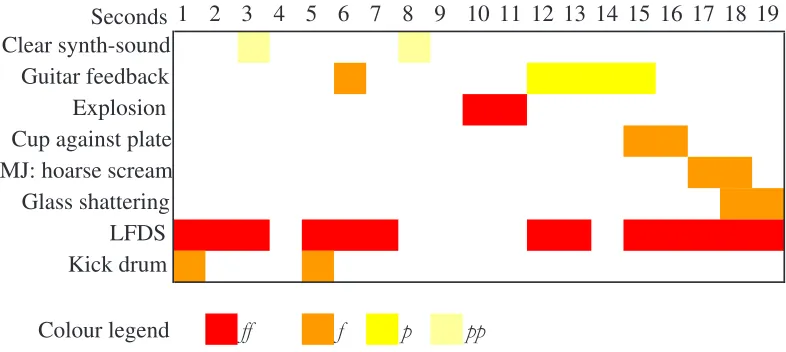
Below is the texture for the first 19 seconds (there is no regular pulse). The ‘instrumentation’ is quite uncommon, suggesting a sound collage rather than a
normal piece of music.
Figure 4: ‘Scream’, texture, Intro I (0:00-0:19)
The first sound we hear is a low frequency, heavily distorted and slightly restricted sound (LFDS) (because the top frequencies are cut off), placed at the mid forefront.
Seconds 1 2 3 4 5 6 7 8 9 10 11 12 13 14 15 16 17 18 19 Clear synth-sound
Guitar feedback Explosion Cup against plate MJ: hoarse scream Glass shattering
LFDS Kick drum
It is almost thrown in the face of the listeners, most of whom would certainly not
expect such an aural gesture in a Michael Jackson recording. The local performance space is impossible to judge, but it is spread between left and right, very much to the front, and not stretching very far back. The LFDS is supported by a kick drum at the first two onsets. After two seconds a clear synth sound defines a large global per
-forming space by appearing in the back. Although this to a certain extent defines a three-dimensional space, the stark contrast between LFDS and the clear synth sound is what sticks and thus contributes to the confusion about spatial definition.
The relation between the two sounds might also be construed as one sound (source and reverb) because of the temporal and spatial relations (one following the other,
front/back). Acoustic conventions make this probable, but the actual sounds make
it improbable, thus further contributing to the confusion.
The explosion contributes to the confusion as explosions are conventionally used
to blow up rooms or spaces. The guitar feedback – a barely controlled sound maybe indicating something or someone being on the brink of losing it – once again dem
-onstrates a space behind the all-dominating LFDS,12 while the cup and saucer sound
suddenly establishes a totally different place. Everyday sounds placed among more or less musical sounds and explosions stick out, and often they have very specific connotations – here maybe ‘kitchen’, ‘having a chat’, ‘peace and quiet’. Nevertheless,
incongruity is used once again.
Michael Jackson’s hoarse scream is somewhat distorted, the frequency range
compressed, and the local performance space is small. The effect is somewhat claustrophobic, and the panning of the local space from right to left contributes to the spatial disorientation. The last sound source, the shattering of glass, is placed
mid-back and is panned left to right just after the scream panning in the opposite
direction. Again two sounds following each other in a distinct pattern suggests a
relation – Michael Jackson thrown through a window or Michael Jackson smashing
a window in anger?
In this short description of the first 19 seconds of ‘Scream’ the placement of
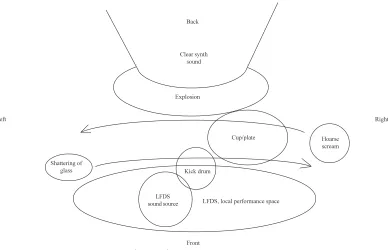
sound sources has been related to the three-dimensional sound stage, implying that this example is a deviation from a convention demonstrated in ‘The Lady in My Life’. It proved possible to place the sound sources within a three-dimensional,
if fragmented space. A sound stage sketch would look somewhat like this (see Figure
5 on next page).
Like the ‘Lady …’, the sound stage of ‘Scream’ changes through time. In the second
part of the introduction the beginning of a steady pulse helps to establish a solid
base (a ‘floor’, so to speak), and the vocals in the following two verses (Michael and Janet Jackson’s solo voices), the bridge (solo voices and chorus) and the refrain help
(harmonised solo voices) open up the space still more. Although the harmonised
spatial confusion because of the artificiality of their local performing spaces. The
consonants s and p sound as if uttered right next to your ear, while other parts of the sound seem a bit further away (with each repeat the refrain’s vocal textures become still denser). The spatial density is underlined by its disappearance in the contrast section beginning at 2:57 and in the second part of the guitar solo at 3:19. Because of the few sound sources, the sound stage is almost transparent and thus
functions as a stark contrast first and foremost pointing to the great textual density
of the rest of the song.
The point of this short analysis is that the sound sources contribute to the ques -tioning of the sound stage, both from a technical, a perceptive and a hermeneutic point of view – their connotations clash, maybe suggesting a surreal scenario: a
narrative that contains explosions, kitchen chats, screams, smashed windows and skewed perspectives and which never becomes coherent. It is possible to draw a sketch of the sound stage, but it is quite imprecise and varies depending on the playback equipment. A reason for not drawing this sketch at all could be that the
whole point may be that the illusionary, three-dimensional space is fragmented
and, thus, impossible to imagine as a Euclidean space and to represent in a simple
two-dimensional model.
Conclusions
Even though the general layout of the ‘Lady …’ sound stage is to some extent natu -ralistic (that is, it can be imagined as a three-dimensional space imitating a live band set-up), some of the sound sources are in fact not that naturalistic, in part
because they have been modified, using an equaliser to change their normal fre
-quency pattern (the cymbal is a good example). Also, later on in the song, the back
-ing choir, consist-ing of multiple Jacksons, is placed in a local performance space that bears no resemblance to known spaces. Nevertheless, this does not change the
overall impression of an ordinary band set-up recorded in conventional stereo, and the recording is a good example of a ‘naturalistic’ recording aesthetic that commu-nicates the impression of a three-dimensional space.
The ‘Scream’ intro, on the other hand, seeks to circumvent these conventions,
and I assume that it happens in an attempt to illustrate the song’s lyrics. It is also an indication that mid-1990s’ state of the art pop productions, using still more
advanced digital recording, began to look for other aural conventions than the illu -sion of three-dimen-sionality. In fact, sometimes the whole notion of sound as
nec-essarily inhabiting some kind of space is challenged, here by the LFDS and on the next full Jackson album, Invincible (2001), by some of the vocal stagings.13 But judging
from the recordings, Jackson, his producers and Swedien did not want to go all the
way. According to Swedien (2003), he maintained a ‘bit’ of the traditional stereo illu-sion:
I love to take a piece of music, and with it, create a recorded sound field, or sonic image, that could not possibly occur in a natural acoustic environment. […] at the same time it has always been extremely important to me to have a bit of stark reality of sound buried somewhere on my work for the ear to relate to – to ‘ground’ the ear so to speak. (pp. 145-146)
In the last decade, even this last ‘bit’ has become still more challenged by a number of producers from, say, Max Martin to Madonna (and her collaborators) to Air
(Walther-Hansen, 2009), reaching towards completely different kinds of spatiality by using still more sophisticated, digital hard- and software. Or as Virgil Moorefield
describes it, ‘recording’s metaphor has shifted from one of the “illusion of reality” (mimetic space) to the reality of illusion (a virtual world in which everything is pos-sible)’ (2005, p. xiii).
But still the sound parameter appears to be a useful conceptualisation and sys-tematisation for discussing many of the aural aspects of recordings. It might also
be helpful in discussions of film soundtracks and sound designs. It may be used and
elaborated upon in sophisticated ways by specialists, while non-specialists may be
Notes
1. Together with different producers, Bruce Swedien has worked as a recordist and mixer on all Michael Jackson albums from Off the Wall (1979) to Invincible (2001).
2. Lacasse defines vocal staging as ‘any deliberate practice whose aim is to enhance a vocal sound, alter its timbre, or present it in a given spatial and/or temporal configuration with the
help of any mechanical or electrical process, presumably in order to produce some effect on potential or actual listeners’ (2000, p. 5).
3. According to Altman et al. most studies have focussed either on the spoken dialogue, the sound effects or the music. But he proposes to take all of it into account at the same time as a ‘multiplane product’ (2000, pp. 341, 358). This is reflected in contemporary film productions, where sound designers responsible for a film’s general sound are normally credited (Mancini, 1985, p. 361).
4. In an article on Jackson’s ‘Black or White’ video the authors intend to do ‘a “reading” of the
Black or White video based upon both the visual and the musical elements’ (Burnett & Deivert, 1995, p. 20). Nevertheless, the sole comment on the musical elements reads like this: ‘Musi
-cally, “Black or White” is not simply another dance song. It is a complex mixture of heavy metal, hard rock, rap, and a touch of funk, combined with a blues harmony and a pop melody’ (ibid., p. 36). This mirrors the general balance between comments on visuals and sounds in both academic and journalistic texts on Michael Jackson. Swedish Olle Edström’s short book
on the release of Dangerous (1992) is one exception to this, as it contains short music-analytical
comments on each of the album’s songs, while Melissa Campbell’s short article on Jackson’s nonverbal vocalisations (2003) and Virgil Moorefield’s comments on ‘Billy Jean’ (2005, pp. 85-89) are two other exceptions. Also, Popular Music and Society is about to release a special
issue on Jackson’s music following his death in 2009 – and more than 40 years after his initial breakthrough as a member of the Jackson Five.
5. The term itself comes from film production, where it designates an actual indoor stage used for the simultaneous recording of picture and sound (White & Louie, 2005, p. 362). During the
last 10-15 years sound stage has become common in audio circles to designate the illusion-ary, (two- or) three-dimensional space in recordings. Among the competing terms have been
soundscape (Schafer, 1977, pp. 274-275), sound box (Moore, 2001, p. 121) and sound-field (Swed
-ien, 2003, pp. 146-148). Originally, these terms referred to somewhat different phenomena, but
they have been used to designate phenomena related to the sound stage as well.
6. Judging distance is a complex process. Distance is first and foremost given by the amount of
timbral information and detail and sometimes also by the ratio between direct and indirect
sound information (Moylan, 1992, pp. 218-219).
7. Zak uses the word recordist as a general term for anyone involved in the recording process, be
it songwriters, performers, engineers or producers, and to denote overlaps among these roles (2001, p. xii).
8. Different combinations of sound carriers and playback systems sound somewhat differently.
There is no ideal listening situation or set-up, but in order to at least partly overcome this I
have listened to the music on several different stereo sets at different playback levels, chang
-ing between speakers (listen-ing in the ‘sweet spot’) and headphones.
9. It might be heard as a mistake that happened because of the rush to re-mix and shorten the original master. ‘The Lady in My Life’ lost one verse in this process (Jones, 2001, pp. 238-239;
Swedien, 2003, pp. 112-113). But the 2001 re-mastered edition of Thriller has the same changes, thus indicating that they may be intentional.
10. See Moore (2001, pp. 120-126) for descriptions of several different sound stages in the period from the 1960s to the 1980s.
12. The guitar feedback is not indicated in figure 5, because different playback equipment places
the sound slightly to the right, but in very different places with regard to distance, ranging
from near to the cup/plate to behind the clear synth sound.
13. Taking its cue from the chorus staging in ‘The Lady in My Life’, one example of the radical vocal staging is the chorus of ‘Unbreakable’. An apt metaphor for describing this sound spa
-tially might be the aural equivalent to a hall of mirrors.
Discography
Jackson, M. (1979). Off the Wall. New York: Epic.
Jackson, M. (1982). The Lady in My Life. On: Thriller. New York: Epic. Jackson, M. (1982). Thriller. New York: Epic.
Jackson, M. (1987). Bad. New York: Epic.
Jackson, M. (1991). Black or White. On: Dangerous. New York: Epic. Jackson, M. (1991). Dangerous. New York: Epic.
Jackson, M. (1995). Scream. On: HIStory. New York: Epic. Jackson, M. (1995). HIStory. New York: Epic.
Jackson, M. (2001). Unbreakable. On: Invincible. New York: Epic. Jackson, M. (2001). Invincible. New York: Epic.
References
Altman, R. with Jones, M., & Tatroe, S. (2000). Inventing the Cinema Sound Track: Hollywood’s Mul
-tiplane Sound System. In: Buhler, J., Flinn, C., & Neumeyer, D. (Eds.), Music and Cinema (pp.
339-359). Hanover and London: Wesleyan University Press.
Burnett, R., & Deivert, B. (1995). Black or White: Michael Jackson’s Video as a Mirror of Popular Cul -ture. Popular Music and Society,19(3), 19-40.
Campbell, M. (2003). Saying the Unsayable: The Non-Verbal Vocalisations of Michael Jackson. Con-text,26, 17-26.
Doyle, P. (2005). Echo and Reverb: Fabricating Space in Popular Music Recording 1900-1960. Middletown
(CT): Wesleyan University Press.
Edström, O. (1992). Michael Jackson: Dangerous och dess mottagande [Michael Jackson: Dangerous and its Reception]. Göteborg: Musikvetenskap, Göteborg University.
Johnson, M. (1987). The Body in the Mind: The Bodily Basis of Meaning, Imagination, and Reason. Chicago
and London: University of Chicago Press.
Jones, Q. (2001). The Autobiography of Quincy Jones. London: Hodder & Stoughton.
Katz, M. (2004). Capturing Sound: How Technology has Changed Music. Berkeley, Los Angeles and London: University of California Press.
Lacasse, S. (2000). Listen to My Voice: The Evocative Power of Vocal Staging in Recorded Rock Music and Other Forms of Vocal Expression (Doctoral dissertation). University of Liverpool. Accessed 13 October
2010 on: http://www.mus.ulaval.ca/lacasse/ texts/THESIS.pdf
Lakoff, G., & Johnson, M. (1980). Metaphors We Live By. Chicago and London: Chicago University Press.
LaRue, J. (1970). Guidelines for Style Analysis. Warren, Michigan: Harmonie Park Press.
Mancini, M. (1985). The Sound Designer. In: Weis, E., & Belton, J. (Eds.), Film Sound: Theory and Practice
(pp. 361-368). New York: Columbia University Press.
Michelsen, M. (1997). Sprog og lyd i analysen af rockmusik [Language and Sound in the Analysis of
Rock Music] (Doctoral dissertation). University of Copenhagen. Accessed 12 December 2011 on:
http://www.staff.hum.ku.dk/momich/afhandling.pdf
Michelsen, M. (forthcoming). Leave Me Alone: Michael Jackson’s Angry Voice. Danish Musicology Online. Accessed on: http://www.danishmusicologyonline.dk/
Moore, A. (2001). Rock: The Primary Text. Developing a Musicology of Rock (2nd ed.). Aldershot, UK and Burlington, US: Ashgate.
Moorefield, V. (2005). The Producer a Composer: Shaping the Sounds of Popular Music. Cambridge, MA and
London: MIT Press.
Moylan, W. (1992). The Art of Recording: The Creative Resources of Music Production and Audio. New York: Van Rostrand Reinhold.
Moylan, W. (2008). Considering Space in Music. Proceedings from the 2008 Art of Record Production Con-ference. Accessed on: http://www.artofrecordproduction.com
Rumsey, F. (2002). Spatial Quality Evaluation for Reproduced Sound: Terminology, Meaning, and a Scene-Based Paradigm. Journal of the Audio Engineering Society,50(9), 651-666.
Rule, G. (1995). Behind the Scenes with M.J.’s Dream Team [interviews with Steve Porcaro, Michael Boddicker, Jason Miles, Jeff Bova, Andrew Scheps]. Keyboard, 11, 75-84.
Schafer, R.M. (1977). The Tuning of the World. New York: Alfred A. Knopf.
Swedien, B. (2003). Make Mine Music. N.c.: MIA Musikk.
Toulson, E.R. (2006). A Need for Universal Definitions of Audio Terminologies and Improved Knowl -edge Transfer to the Audio Consumer. In: Proceedings from the 2006 Art of Record Production Confer-ence. Accessed on: http://www.artofrecordproduction.com
Walther-Hansen, M. (2009). The Influence of Music Technology on the Perception of the Performer in Phonographic Space. In: Proceedings from the 2009 Art of Record Production Conference. Accessed on: http://www.artofrecordproduction.com
White, G.D., & Louie, G.J. (2005). The Audio Dictionary (3rd ed.). Seattle: University of Washington Press. Zagorski-Thomas, S. (2005). Shouting Quietly: Changing Musical Meaning by Changing timbre with Recording Technology [Paper delivered at the Conference for Interdisciplinary Musicology (CIM05), Montréal, Canada, 10-13 March, 2005].
Zagorski-Thomas, S. (2006). Functional Staging Through the Use of Production Techniques in late 20th Century African and Cuban Popular Music Recordings. In: Proceedings from the 2006 Art of Record Production Conference. Accessed on: http://www.artofrecordproduction.com
Zagorski-Thomas, S. (2008). The Musicology of Record Production. Twentiethcentury music, 4(2),
189-207.