International
J
ournal ofP
harmaceuticalB
iological andC
hemicalS
ciencese-ISSN: 2278-5191
International Journal of Pharmaceutical, Biological and Chemical Sciences (IJPBCS) | OCT-DEC 2014 | VOLUME 3 | ISSUE 4 | 01-08
www.ijpbcs.net or www.ijpbcs.com
R
esearch
A
rticle
Pa
ge
1
DEVELOPMENT AND VALIDATION OF RP-HPLC METHOD FOR SIMULTANEOUS
ESTIMATION OF PARACETAMOL AND PAMABROM IN BULK DRUG AND
MARKETED FORMULATION
M. T. Harde1, 3*, S B. Wankhede2, P D. Chaudhari31
Department of Pharmaceutical Sciences, JNTU, Hyderabad-500085. 2
Pad. Dr. D.Y. Patil Institute of pharmaceutical Science and Research, Sant Tukaram Nagar, Pimpri, Pune - 411018, Maharashtra, India.
3P. E Society’s Modern College of Pharmacy, Sector No. 21, Yamunanagar, Nigdi, Pune - 411044, Maharashtra, India.
*Corresponding Author Email: [email protected]
INTRODUCTION
Pamabrom (PBM) is chemically, 1:1 mixture of
2-amino-2-methyl-1-propanol and 8-bromotheophyllinate
(Figure 1), it has a diuretic property[1]. It is official in US
pharmacopoeia[2]. It is assayed by liquid
chromatography as per USP[3]. Pamabrom, a xanthine
derivative, is a safe and effective diuretic in relieving the
water-accumulation symptoms of water-weight gain,
bloating, swelling, and/or full feeling associated with the
premenstrual and menstrual periods. It works, as all
diuretics, by pulling excessive water from throughout the
body. Literature review reveals plasma HPLC method
for estimation of Pamabrom in pharmaceutical dosage
form [4-5].
Figure1: Chemical structure of Pamabrom Figure 2: Chemical structure of Paracetamol ABSTRACT:
Aim: A HPLC method has been described for simultaneous determination of Pamabrom and Paracetamol in marketed formulation. Methods: This method is based on HPLC separation of the two drugs on the Kromasil C18 column (250 mm × 4.6 mm, 5.0μ), with isocratic conditions and mobile phase containing water: methanol: acetonitrile in a ratio of 70:20:10, v/v/v at a flow rate of 1 ml/min, using UV detection at 279 nm. This method has been applied to formulation without any interference of excipients of formulation. Results: The linear regression analysis data for the calibration plots showed a good linear relationship over the concentration range of 100 – 500 μg/ml for Paracetamol and 5 – 25 μg/ml for Pamabrom respectively. The method was validated as per the ICH guidelines. The limit of detection (LOD) and limit of quantitation (LOQ) was 4.28 μg/ml and 12. 99 μg/ml for Paracetamol and 0.23 μg/ml and 0.95 μg/ml for Pamabrom, respectively. Result of assay and recovery study was statistically evaluated for its accuracy and precision. Conclusion: According to the validation results, the proposed method was found to be specific, accurate, precise and economic for the estimation of Paracetamol and Pamabrom in bulk and tablet dosage form.
KEYWORDS:
M. T. Harde* et al;DEVELOPMENT AND VALIDATION OF RP-HPLC METHOD FOR SIMULTANEOUS...
International Journal of Pharmaceutical, Biological and Chemical Sciences (IJPBCS) | OCT-DEC 2014 | VOLUME 3 | ISSUE 4 | 01-08| www.ijpbcs.net
Pa
ge
2
Paracetamol (PCM) chemically it is
N-(4-hydroxyphenyl) acetamide (Figure 2). Paracetamol
is official in IP, BP, USP and JP [6-8]. It is classified
as a mild analgesic and antipyretic properties. It is
much safer than aspirin in terms of gastric
irritation, ulceration and bleeding. Literature survey
revealed that number of methods has been reported
in literature for the individual analysis of
paracetamol and pamabrom by UV
spectrophotometric, RP-HPLC and HPTLC method
alone and in combination with other drugs. The
suggested method was validated as per ICH
guidelines. The validation parameters studied was
accuracy, precision, linearity, LOD and LOQ,
robustness[9-13]. However, none of the previous
method reports was sensitive, selective and
economic enough for the estimation of pamabrom
and paracetamol. The aim of present work was to
develop the comparatively simple, economical,
accurate HPLC method for the estimation of
paracetamol and pamabrom in bulk drug and tablet
dosage form.
MATERIALS AND METHODS
Materials & Reagents
Working standards of pharmaceutical grade PCM,
was received as gift sample from Emcure
Pharmaceuticals Ltd, Pune and PBM was obtained
as generous gift from Pan Drugs, Ahmadabad,
India. Combination tablet BACKAID MAX
containing 500 mg PCM and 25 mg PBM was used
for study. All the chemicals used were of HPLC
grade, purchased from Merck Chemicals, India.
Instrumentation
The instrument used was Waters 510 HPLC system
equipped with a rheodyne injecting facility programmed at 20μl capacity per injection was
used. The detector consisted of UV–Visible
detector operated at wavelength 279 nm. Data
acquisition was made with DataAce software. The
column used was Kromasil C-18 (250mm x 4.6mm,
5μm). Analytical balance used for weighing was
Schimadzu AUX-220. Ultrasonicator used was
Sonarex Super RK 102 (Berlin, Germany)
equipment with thermostatically controlled heating
(30–80 ◦C).
Preparation of Mobile Phase
Mobile phase was prepared by mixing water:
methanol: acetonitrile in a ratio of 70:20:10, v/v/v.
The mobile phase was ultrasonicated for 20 minutes and then it was filtered through 0.45 μ
membrane filter.
Chromatographic Conditions
The mobile phase consisted of water: methanol:
acetonitrile was used as a mobile phase in a ratio
water: methanol: acetonitrile in a ratio of 70:20:10,
v/v/v. Detection was carried out at 279 nm. Study
was carried out using Kromasil C18 (250 X 4.6 mm, 5μm) column at ambient temperature with a
flow rate 1.0 ml/min. Mobile phase was filtered through a 0.45μm nylon membrane (Millipore Pvt.
Ltd. Bangalore, India) and degassed in an
ultrasonic bath.
Preparation of Standard Stock Solution
An accurately weighed quantity of PCM (125.0
mg) and PBM (6.25 mg ) was transferred to 50. 0
ml volumetric flask dissolved and diluted up to
mark with mobile phase. From this solution, 1.0 ml
was transferred to 10.0 ml volumetric flask and
diluted to the mark with mobile phase.
(Concentration of 250 µg/ml PCM and 12.5 µg/ml
PBM, respectively). The solution was found to be
stable during the period of study.
Analysis of Formulation
Accurately weighed 20 tablets, each containing 500
mg PCM and 25 mg PBM was crushed to fine
powder and accurately weighed quantity equivalent
to about 125.0 mg paracetamol and 6.25 mg
pamabrom was transferred to 50.0 ml volumetric
flasks, dissolved and diluted up to mark with
mobile phase. From this solution, 1.0 ml was
M. T. Harde* et al;DEVELOPMENT AND VALIDATION OF RP-HPLC METHOD FOR SIMULTANEOUS...
International Journal of Pharmaceutical, Biological and Chemical Sciences (IJPBCS) | OCT-DEC 2014 | VOLUME 3 | ISSUE 4 | 01-08| www.ijpbcs.net
Pa
ge
3
to the mark with mobile phase. The solution was
filtered through 0.45 µ membrane filter. Equal
volume of standard and sample solution (20 µL)
were injected (in triplicate) into the column and
chromatographed using optimized chromatographic
conditions.
METHOD VALIDATION PARAMETERS
The method was validated for linearity, accuracy,
precision, limit of detection, limit of quantitation
and robustness.
Linearity
The standard solution was prepared by dilution of stock solution containing 1000μg/ml PCM and 500μg/ml PBM. Linearity test solutions were
prepared at five different concentration levels ranging from 100 to 500 μg/ml PCM and 5 to 25 μg/ml PBM concentration. Three replicate of each concentration was injected. The peak area was
plotted against the corresponding concentration to
obtain the calibration graphs.
Precision
The intra-day precision study of PCM and PBM
was carried out by estimating the correspondence
responses six times on the same day and inter-day
precision study was carried out by estimating the
correspondence responses six times next day. The
repeatability of sample application and
measurement of peak area for active compound
were expressed in terms of relative standard
deviation (%R.S.D.) and standard error (S.E.).
Method repeatability was obtained from R.S.D
value by repeating the assay six times in same day
for intra-day precision. The intraday and inter-day
variation for determination of pamabrom and
paracetamol was carried out at three different
concentration levels 80, 100 & 120 %.
Recovery Study
The recovery study was carried out by applying the
method to marketed formulation to which known
amount of API of PCM and PBM corresponding to
80, 100 and 120% of label claim had been added
(standard addition method). At each level of the
amount three determinations were performed and
the results obtained were compared with expected
results.
Limit of Detection & Limit of Quantitation
The detection limit of an individual analytical
procedure is the lowest amount of analyte in a
sample that can be detected but not necessarily
quantitated as an exact value. The quantitation limit
of an individual analytical procedure is the lowest
amount of analyte in a sample that can be
quantitatively determined with suitable precision
and accuracy. The quantitation limit is a parameter
of quantitative assays for low levels of compounds
in sample matrices, and is used particularly for the
determination of impurities and/or degradation
products.
The limit of detection (LOD) and limit of
quantitation (LOQ) were calculated for the
proposed method which was based on the standard
deviation of the y intercept and the slope of the
calibration curves.
LOD is calculated from the formula:
3.3 σ
LOD =
S
Where,
σ = The standard deviation of the response for the lowest concentration in the range
M. T. Harde* et al;DEVELOPMENT AND VALIDATION OF RP-HPLC METHOD FOR SIMULTANEOUS...
International Journal of Pharmaceutical, Biological and Chemical Sciences (IJPBCS) | OCT-DEC 2014 | VOLUME 3 | ISSUE 4 | 01-08| www.ijpbcs.net
Pa
ge
4
LOQ is calculated from the formula:
10 σ
LOQ =
S
Robustness
To evaluate HPLC method robustness, a few
parameters were deliberately varied. The
parameters included variation of flow rate, mobile
phase composition and wavelength.
RESULTS AND DISCUSSION
The proposed method describes a new RP-HPLC
method for the determination of PCM and PBM in
tablet dosage form (Backaid Max) employing
Waters 510 HPLC system, UV/VIS detector,
Kromasil C-18 (4.6 × 250mm, 5μm) column and
mobile phase comprising of water :methanol :
acetonitrile (70:20:10 v/v/v). This method was
found to be sensitive, accurate and economical.
To optimize the RP-HPLC parameters, several
mobile phase compositions were tried. A
satisfactory separation and good peak symmetry
was found in a mixture of water: methanol:
acetonitrile (70:20:10 v/v/v) at 1.0 ml/min flow
rate. The optimum wavelength for detection was set
at 279 nm at which better detector responses of
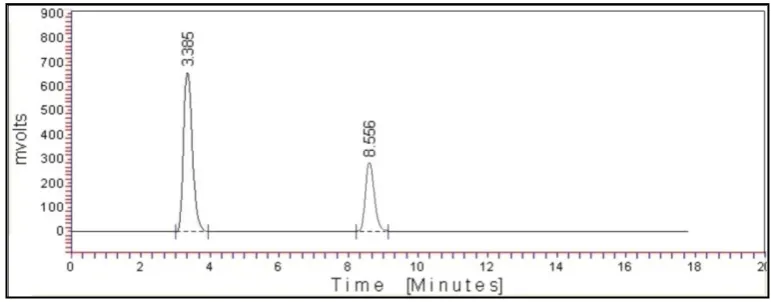
drugs were obtained. The retention time was found
to be 3.38 and 8.55 min. The obtained
chromatogram is shown in Figure 3.
Figure 3: Typical Chromatogram of PCM & PBM (Rt 3.385 & 8.556) respectively.
System Suitability Testing
The system suitability test was applied to a representative chromatogram to check the various parameters such as
column efficiency, resolution, precision and peak tailing. The result obtained is shown in Table No. 01.
Table No: 1 System Suitability Parameters
Sr. No. Parameter PCM PBM
1. Resolution (R) 7.12
2. Peak Asymmetry (As) 1.15 1.11 3. No. of therotical plates (N) 11412 4583
Linearity
Calibration curve was obtained in a concentration
range from 5 - 25 μg/ml for PBM. The response of
the drug was found to be linear in the investigation.
The linear regression equation was Y= 11839x +
M. T. Harde* et al;DEVELOPMENT AND VALIDATION OF RP-HPLC METHOD FOR SIMULTANEOUS...
International Journal of Pharmaceutical, Biological and Chemical Sciences (IJPBCS) | OCT-DEC 2014 | VOLUME 3 | ISSUE 4 | 01-08| www.ijpbcs.net
Pa
ge
5
standard calibration curve of Mean Peak Area vs. Concentration is depicted in Figure 04.
Figure 4: calibration curve of Pamabrom
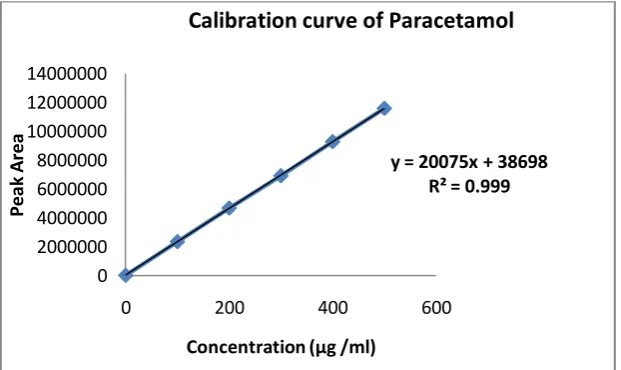
Calibration curve was obtained in a concentration
range from 100 - 500 μg/ml for PCM. The response
of the drug was found to be linear in the
investigation. The linear regression equation was
Y= 20075x + 38698 with correlation coefficient
0.999. The standard calibration curve of Mean Peak
Area vs. Concentration is depicted in Figure 05.
Figure 5:Standard Calibration Curve for Paracetamol
Precision
Three different concentrations of working standard
solution of pamabrom and paracetamol were
prepared. All the solutions were analyzed thrice, in
order to record any intra-day variation in the result.
The result obtained for intra-day variations are
shown in the Table No. 02. For inter-day variation
study, three different concentrations of the
combined standards were analyzed for three days.
The result obtained for inter-day variations are
shown in the Table No. 03.
y = 11839x + 14459 R² = 0.999
0 500000 1000000 1500000 2000000 2500000 3000000 3500000
0 10 20 30
P
ea
k
A
rea
Concentration (μg/ml)
Calibration curve of Pamabrom
y = 20075x + 38698 R² = 0.999
0 2000000 4000000 6000000 8000000 10000000 12000000 14000000
0 200 400 600
P
ea
k
A
rea
Concentration (µg /ml)
M. T. Harde* et al;DEVELOPMENT AND VALIDATION OF RP-HPLC METHOD FOR SIMULTANEOUS...
International Journal of Pharmaceutical, Biological and Chemical Sciences (IJPBCS) | OCT-DEC 2014 | VOLUME 3 | ISSUE 4 | 01-08| www.ijpbcs.net
Pa
ge
6
Table No: 2 Intra-day Precision Data
Parameters PCM PBM
Concentration (μg/ml ) Concentration (μg/ml )
200 250 300 10 12.5 15
% Estimated 99.72 99.12 99.57 99.51 99.27 99.35
S. D. ± 0.6090 ± 0.4050 ± 0.4750 ± 0.8280 ± 0.4807 ± 0.5901
C. V. 0.6107 0.4085 0.4771 0.8321 0.4842 0.5940
* Mean of six determinations, SD: Standard Deviation, RSD: Relative Standard Deviation
Table No: 3 Inter-Day Precision Data
Parameters PCM PBM
Concentration (μg/ml ) Concentration (μg/ml )
200 250 300 10 12.5 15
% Estimated 98.99 99.6 99.68 99.25 99.44 98.95
S. D. ± 0.3594 ± 0.5682 ± 0.7562 ± 0.4932 ± 0.6030 ± 0.3881
C. V. 0.3631 0.5705 0.7586 0.4969 0.6064 0.3922
* Mean of six determinations, SD: Standard Deviation,RSD: Relative Standard Deviation
Limit of Detection & Limit of Quantitation
The sensitivity of method is described in terms of Limit of Detection and Limit of Quantitation. LOD and LOQ
values for PCM and PBM were found to be 4.28 µg/ml, 12.99 µg/ml and 0.23µg/ml, 0.95 µg/ml, respectively.
The results of LOD and LOQ studies are shown in Table No. 04.
Table No: 4 LOD & LOQ of PCM & PBM
Parameter PCM PBM
Limit of Detection (μg/ml) 4.28 0.23 Limit of Quantification (μg/ml) 12.99 0.95
Accuracy
The HPLC area responses for accuracy determination are depicted in Table No. 05. The results show that best
recoveries (98.50 - 99.20 %) of the spiked drug were obtained at each added concentration; it indicates accuracy
of the method.
Table No: 5 Statistical Validation for Recovery Study
Level of
recovery
% Mean Recovery Standard Deviation % R.S.D. S.E
PCM PBM PCM PBM PCM PBM PCM PBM
80 % 98.86 99.53 ± 0.268 ± 0.832 0.271 0.835 0.155 0.480
100 % 99.52 98.56 ± 0.413 ± 0.697 0.414 0.707 0.238 0.402
120 % 99.44 98.75 ± 0.232 ± 0.276 0.233 0.279 0.134 0.159
M. T. Harde* et al;DEVELOPMENT AND VALIDATION OF RP-HPLC METHOD FOR SIMULTANEOUS...
International Journal of Pharmaceutical, Biological and Chemical Sciences (IJPBCS) | OCT-DEC 2014 | VOLUME 3 | ISSUE 4 | 01-08| www.ijpbcs.net
Pa
ge
7
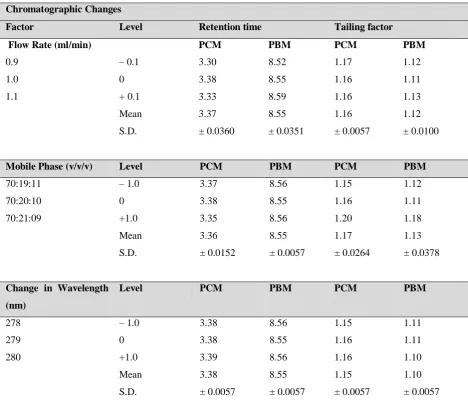
Table No: 6 Result of Robustness Studies
* Average of three determinations, S.D. is Standard deviation; RSD is the Relative Standard Deviation
Robustness
The result of robustness study of the developed assay
method was established in Table No. 06. The result
indicates during all variance conditions, assay value of
the test preparation solution was not affected and it was
in accordance with that of actual. System suitability
parameters were also found satisfactory; hence the
analytical method would be concluded as robust.
CONCLUSION
All these factors lead to the conclusion that the proposed
method is simple, specific, accurate, precise and
reproducible. Statistical analysis proves that the method
is suitable for the analysis of paracetamol and
pamabrom.
ACKNOWLEDGEMENTS
The authors express their gratitude to the Principal,
Modern college of pharmacy, Pune, India for providing
necessary infrastructural facilities. Thanks are also
extended to Emcure Pharmaceuticals, Pimpri, Pune and
Pan Drug Ltd, Ahmadabad, India for providing gift
samples of the pure drugs for research work.
REFERENCES
1. Pamabrom drug profile available from http://en.wikipedia.org/wiki/pamabrom.
2. US Pharmacopoeia 34 NF 29. The United States Pharmacopoeial Convention, Rockville, 2011; 3: 3800.
Chromatographic Changes
Factor Level Retention time Tailing factor
Flow Rate (ml/min) PCM PBM PCM PBM
0.9 – 0.1 3.30 8.52 1.17 1.12
1.0 0 3.38 8.55 1.16 1.11
1.1 + 0.1 3.33 8.59 1.16 1.13
Mean 3.37 8.55 1.16 1.12
S.D. ± 0.0360 ± 0.0351 ± 0.0057 ± 0.0100
Mobile Phase (v/v/v) Level PCM PBM PCM PBM
70:19:11 – 1.0 3.37 8.56 1.15 1.12
70:20:10 0 3.38 8.55 1.16 1.11
70:21:09 +1.0 3.35 8.56 1.20 1.18
Mean 3.36 8.55 1.17 1.13
S.D. ± 0.0152 ± 0.0057 ± 0.0264 ± 0.0378
Change in Wavelength
(nm)
Level PCM PBM PCM PBM
278 – 1.0 3.38 8.56 1.15 1.11
279 0 3.38 8.55 1.16 1.11
280 +1.0 3.39 8.56 1.16 1.10
Mean 3.38 8.55 1.15 1.10
M. T. Harde* et al;DEVELOPMENT AND VALIDATION OF RP-HPLC METHOD FOR SIMULTANEOUS...
International Journal of Pharmaceutical, Biological and Chemical Sciences (IJPBCS) | OCT-DEC 2014 | VOLUME 3 | ISSUE 4 | 01-08| www.ijpbcs.net
Pa
ge
8
3. United State Pharmacopoeia–34 & National Formulary-29, Asian Edition, United States Pharmacopoeia Convention, Rockville, MD, USA, 2011; 1720, 1800. 4. Drug information of pamabrom and paracetamol
available from http://druginformation- directory.blogspot.in/2010/05/acetaminophen-and-pamabrom.html.
5. Zhou L, Gu L, Wang Y, Linang J. HPLC for the determination of two constituents in compound Acetaminophen and Pamabrom tablets in human plasma. Chin J New Drug Clin Remed 2007; (DOI:-CNKI: SUN: XYYL.0.2007-03-008).
6. Indian Pharmacopoeia, Government of India, Ministry of health & family welfare, published by Indian Pharmacopoeial commission, Ghaziabad, India, 2010; 2: 1859-61.
7. British Pharmacopoeia, 6th edition, the stationary office, London medicines & healthcare product regulatory agency, 2010; Vol II: 1612.
8. Japanese Pharmacopoeia, Society of Japanese Pharmacopoeia, 15th edition, shibuya, Tokyo, Japan,
2006; 267-68.
9. Lakade S. H., Bhalekar M. R., Harde M. T., 2012. Developed and validated reverse phase HPLC method for the determination of febuxostat in bulk and formulations. Int. J. Pharm Pharm Sci., 4(4) : 46-48
10. ICH; Q2A: Text on Validation of Analytical Procedures; International Conference on Harmonization; Geneva; 1994; 1-5.
11. ICH; Q2B: Validation of Analytical Procedures: Methodology; International Conference on Harmonization; Geneva; 1996; 1-8.
12. International Conference on Harmonization Q2 (R1) Validation of Analytical Procedure: text and methodology, Nov. 1996.
13. International Conference on Harmonization, Q2B: Validation of Analytical Procedures: Methodology and Availability, Federal Register, 62(96), 1997, 27463-27467.
Date of Communication: August 2013
Date of Acceptance: Feb 2014
Date of Publication: Nov 2014
*Corresponding author address:
Email address: