A DIGITAL SCRAMBLING METHOD BASED ON BALANCING NUMBERS
P. K. RAY1, B. K. PATEL2, D. P. CHOWDHURY3, S. KUJUR4,§
Abstract. In this article, a new approach to the study of image scrambling based on balancing numbers, balancing transformation is presented. The properties of the proposed transformation and its periodicity are studied in details. In order to reduce the periods of the balancing transformation, we separate the consecutive pixels as far as possible from each other in that domain of the digital images.
Keywords: balancing numbers, Fibonacci transformation, Lucas transformation, balanc-ing transformation, periodicity.
AMS Subject Classification: 11B37, 11B39, 11T71.
1. Introduction
Digital image scrambling is commonly approached to secure the image data security. In recent years, researchers have developed a number of methods to scramble the (x, y) positions of images [1, 3, 4, 5, 6, 11, 14]. There were several image scrambling schemes for protecting the confidentiality of sensitive images basically through cryptographic and stenographic techniques [4]. In [5], Dong-xu et al., have formed and studied extensively on two nonlinear transformations, i.e., one is higher dimensional Arnold transformation and other is higher dimensional Fibonacci-Q transformation. They used the properties of these two transformations for scrambling digital images. Bai et al., presented a digital image scrambling algorithm based on Knight-tour problem (KTP) [1]. In [13], Zou et al., has introduced two new methods for scrambling digital images and established the periodicity of these transformations. In a subsequent paper [15], Zou et al., presented two transformations, namely Fibonacci transformation and Lucas transformation, based on the well known Fibonacci numbers and Lucas numbers. They have also shown that the Fibonacci transformation and Lucas transformation are uniform and can be applied to digital image scrambling. Bing et al., studied the periodicity of the Arnold transformation
1
School of Mathematical Sciences, Sambalpur University, Sambalpur, 768019, India. e-mail: [email protected]; ORCID: https://orcid.org/0000-0002-1208-8113.
2
International Institute of Information Technology, Bhubaneswar, 751003, India. e-mail: [email protected]; ORCID: https://orcid.org/0000-0001-7637-8489.
3 Department of CSE, National Institute of Technology Rourkela, Rourkela, 769008, India.
e-mail: [email protected]; ORCID: https://orcid.org/0000-0002-4622-2157
4 Department of Mathematics, National Institute of Technology Rourkela, Rourkela, 769008, India.
e-mail: [email protected]; ORCID: https://orcid.org/0000-0001-9622-6714. § Manuscript received: March 3, 2017; accepted: September 18, 2017.
TWMS Journal of Applied and Engineering Mathematics, Vol.9, No.2; cI¸sık University, Department of Mathematics, 2019; all rights reserved.
up to two dimensions [3]. Also in [3], they proposed a new method for computing the periods of the Arnold transformation. It is experimentally proved that any transformation with higher periodicity may reduce the level of image security [6]. The periodicity of the above methods are high reaching. In this paper, we present digital image scrambling method based on the sequence of balancing numbers and also discuss its uniformity and periodicity.
The concept of balancing numbers was first introduced by Behera et al., [2] in the year 1999 which are obtained from a simple Diophantine equation
1 + 2 +· · ·+ (n−1) = (n+ 1) + (n+ 2) +· · ·+ (n+r),
calling n as balancing number and r as balancer corresponding to n. The balancing numbers, though obtained from a simple Diophantine equation, are very useful for the computation of square triangular numbers. If n is a balancing number then 8n2+ 1 is a perfect square, and hence n2 is a square triangular number and the positive square root of 8n2 + 1 is called a Lucas-balancing number. The balancing numbers satisfy the recurrence relation Bn+1 = 6Bn−Bn−1, for n ≥ 1 with initial conditions B0 = 0 and
B1 = 1, where Bn denotes the n-th balancing number. The first four balancing numbers
are 1,6,35 and 204 with balancers 0,2,14 and 84 respectively. The n-th Lucas-balancing number is denoted byCnand defined asCn=
p
8B2
n+ 1. These numbers satisfy the same
recurrence relation as that of balancing numbers with different initialsC0 = 1 andC1= 3. It is observed that Lucas-balancing numbers are very closely associated with balancing numbers just like Lucas numbers are associated with Fibonacci numbers [7].
The balancing numbers and Lucas-balancing numbers are related to Pell and associated Pell numbers by several means. Every even Pell number is twice of a balancing number and the sum of first 2n−1 Pell numbers is equal to the sum ofn-th balancing number [8]. The balancing numbers satisfy many interesting identities. The Fibonacci numbers satisfy the strongly divisibility Fgcd(m,n) = gcd(Fm, Fn), while balancing numbers satisfy
Bgcd(m,n) = gcd(Bm, Bn) [7]. The sum of firstn odd terms of the sequence of balancing
numbers is equal to square of the n-th balancing numbers, a property satisfied by the sequence of natural numbers. This property makes the sequence of balancing numbers a natural sequence.
The identity that connects three adjacent Fibonacci numbers is the famous Cassini for-mula, which is given byFn−1Fn+1−Fn2 = (−1)n. This formula is used to established many
important properties involving Fibonacci numbers and their related sequences. Cassini for-mula for balancing numbersBn−1Bn+1−Bn2 = 1 which was introduced in [7], is also very
useful to proof many important identities concerning balancing numbers.
2. THE BALANCING TRANSFORMATION
Based on the sequence of balancing numbers, we develop a new transformation, balanc-ing transformation which is applicable to digital image scramblbalanc-ing.
Definition 2.1. Let T1 = a, T2 = b and Tn = 6Tn−1−Tn−2 for n ≥ 3, where a, b are
non-negative integers. The sequence {Tn} is called the generalized balancing sequence.
When a = 1,3 and b = 6,17, then the generalized balancing sequence {Tn} is the
sequence of balancing numbers{Bn}and the sequence of Lucas-balancing numbers {Cn}
respectively.
Theorem 2.1. Let {Tn} be the generalized balancing sequence defined by a and b and {Bn} be the sequence of balancing number, then
Tn=bBn−1−aBn−2, n≥3.
Now we establish the Cassini formula for generalized balancing sequence Tn where
Tn=bBn−1−aBn−2, n≥3.
Theorem 2.2. The Cassini formula for the sequenceTnis given byTn+1Tn−1−Tn2 =−µ,
where µ=a2−6ab+b2.
Proof. Since Tn=bBn−1−aBn−2,and using Cassini formula for balancing numbers, we
have
Tn+1Tn−1−Tn2= (bBn−aBn−1)(bBn−2−aBn−3)−(bBn−1−aBn−2)2 =−a2(Bn2−2−Bn−1Bn−3)−b2(Bn2−1−BnBn−2)
+ab(Bn−1Bn−2−BnBn−3)
=−(a2−6ab+b2) =−µ,
which ends the proof.
The following results are immediate consequence of Theorem 2.3.
Corollary 2.1. For the sequence of balancing numbers {Bn}, Bn+1Bn−1−Bn2 =−1. Corollary 2.2. For Lucas-balancing sequence {Cn}, Cn+1Cn−1−Cn2 = 8.
Definition 2.2. A generalized balancing sequence{Tn}is called a distinguished generalized
balancing sequence{DTn} ifTn and Tn+1 are relatively prime.
For example, the sequence of balancing numbers {Bn} is in {DTn} as the consecutive
balancing numbers are relatively prime.
Consider a sequence of consecutive distinct integers{0,1,2, . . . , m−1}. It can be easily shown that, for a distinguished generalized balancing sequence {DTn}, the sequence of
integers{Sk}, Sk= (kDTn+r) mod DTn+1, for k= 0,1,2, . . . , m−1 is a permutation of
the original sequence{0,1,2, . . . , m−1}.
Keeping the above result in mind, we now define the balancing transformation as follows.
Definition 2.3. For a given positive integerr, the balancing transformation is defined as:
Sk= (kBn+r) mod Bn+1, for k= 0,1,2, . . . , Bn+1−1.
Here the values ofrplay the role of secret key for balancing transformation. For different applications of this transformations, different values ofr may be chosen.
The following results are shown in [7]. These results help to explain the uniformity and periodicity of the balancing transformations which we are going to introduce in the next section.
Proposition 2.1. Let Bn is the n-th balancing number, then
• B22n−1 =B2n+1B2n−1.
• B22n+1−1 =B2nB2n+2. • B2n+2 divides B22n+1−1.
3. UNIFORMITY AND PERIODICITY OF THE BALANCING TRANSFORMATION
Periodicity of Fibonacci transformation was studied by Wall in the year 1960 [12]. Panda et al. studied the periodicity of balancing numbers modulo primes and modulo terms of certain sequences, which exhibit some important results, some of them are identical with the corresponding results of Fibonacci numbers while some others are more interesting [9]. They observed that the period of the balancing sequence coincide with the modulus of congruence if the modulus is any power of 2. Also, they claimed that there are three known primes for which π(p) = π(p2), where π(p) denotes the period of the sequence of balancing numbers modulo prime, while there are no such primes are available till date for Fibonacci sequence. Some similar results are also studied using matrix algebra by Patel et al. in [10]. In this section, the uniformity properties and periodicity of balancing transformation are examined.
The following results show the uniformity property of balancing transformation. After applying this transformation to the results, it is observed that the adjacent pixels are uniformly distributed. For the sequence {Sk}, we have the following results from the
above table.
Obsevation 3.1. Let Bn,Cn andPn be then-th balancing number, n-th Lucas-balancing
number and n-th Pell number respectively, then
• |Sk+1−Sk|=Bn or P2n+1.
• |Sk+2−Sk|= 2Bn. • |Sk+3−Sk|= 3Bn or Cn. • |Sk+4−Sk|= 4Bn. • |Sk+Bn−1 −Sk|= 6.
The equidistant pixels are scattered uniformly across the whole images by applying the balancing transformations to each row and then each column to the image. Conse-quently, the original image can be recovered by implementing the same transformation N times, this we call as balancing periodic transformation. Further, the period of the balancing transformation has a period depending on the values of Bn and Bn+1. It is
observed that the period of the balancing transformation comes in terms of Pell numbers or Lucas-balancing numbers. In particular, the periods of even balancing numbers are in terms of Pell numbers while for odd balancing numbers, those are distinct Lucas-balancing numbers. In particular,B2n=P2n+1 and B2n+1 =Cn+2, where the key r is different for
eitherP2n+1 and Cn+2. If we chooser =P2n+1 forB2n or Cn+2 forB2n+1, the period of balancing transformation is 2.
Zou et al. showed that the period of the Fibonacci transformation is either 2 or 4, depends on the size of the image [15]. As the period of the Fibonacci transformation is less, distortion of the image is poor. Lucas transformation gives the higher periodicity, as a result having more time complexity. The balancing transformation has less periodicity as compared to Lucas transformation and the distortion is high as compared to Fibonacci transformation, which eliminates the short coming of above two transformations.
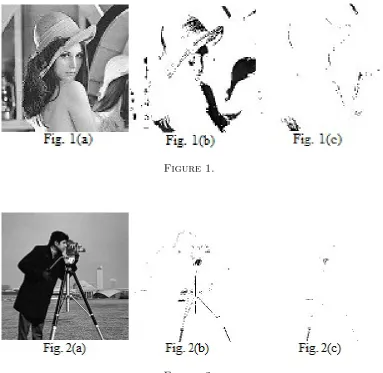
on original images [Fig. 1(a) and Fig. 2(a)], first row wise and then column wise. The transformed images of the original images after 7 and 20 iterations are shown in Fig. 1(b), Fig. 1(c), and Fig. 2(b), Fig. 2(c) respectively.
Figure 1.
Figure 2.
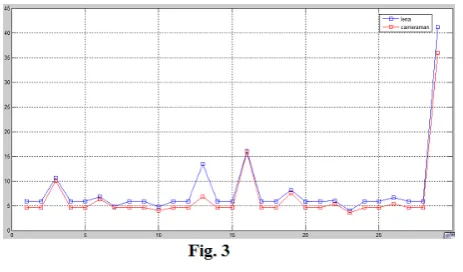
Peak Signal to Noise Ratio (PSNR) is error metrics used to compare image quality. It is used to find out how much distortion is there in the image. The PSNR is used in the transformed image of cameraman.jpg and Lena.jpg in Fig. 3.
In the above figure blue line indicates for Lena image and the red line indicates for cameraman image.
4. Conclusion
Figure 3.
It is experimentally observed that as compared to Fibonacci transformation and Lucas transformation, balancing transformation over come both the poor distortion and higher periodicity, respectively.
References
[1] Bai, S., Cao, C., (2002), A novel algorithm for scrambling the details of digital image, Proceeding of the 4-th world congress on Intelligent Control and Automation, pp. 1333-1336.
[2] Behera, A., Panda, G. K., (1999), On the square roots of triangular numbers, The Fibo. Quart., 37 (2), pp. 98-105.
[3] Bing, L., Jia-wei, X., (2005), Period of Arnold transformation and it’s application in image scrambling, J. Cent. South Univ. Tech., 12 (1), pp. 278-282.
[4] Chang, C., Lin, I., YU, Y., (2006), A new stenographic method for color and gray scale image hiding, Computer Vision and Image Understanding, 20.
[5] Dong-XU, Q., Jian-cheag, Z., Xiao-you, H., (2000), A new class of scrambling transformation and it’s application in the image information covering, Since in China(Series E), 43 (3), pp. 307-312. [6] Mishra, M., Mishra, P., Adhikary, M. C., Kumar, S., (2012), Image encryption using Fibonacci-Lucas
transformation, Inter. Jour. On Cryptography and Information Security, 2(2), pp. 131-141.
[7] Panda, G. K., (2009), Some fascinating properties of balancing numbers, Proc. of the eleventh Inter. Conf. on Fibo. Nos. and Their Applications., Congr. Numer., 194, pp. 185-189.
[8] Panda, G. K., Ray, P. K., (2011), Some links of balancing and cobalancing numbers with Pell and associated Pell numbers, Bulletin of the Institute of Mathematics, Academia Sinica (New Series), 6(1), pp. 41-72.
[9] Panda, G. K., Rout, S. S., (2014), Periodicity of Balancing numbers, Acta Math. Hungar., 143(2), pp. 274-286.
[10] Patel, B. K., Ray, P. K., (2016), The Period, Rank and Order of the sequence of Balancing numbers Modulom, Math. Reports, 18(68), pp. 395-401.
[11] Qi, D. X., (1999), Matrix transformation and its applications to image hiding, J. North China univ. of tech., 11(1), pp. 24-28.
[12] Wall, D. D., (1960), Fibonacci Series Modulom, Amer. Math. Monthly, 67, pp. 525-532.
[13] Zou, J. C., Ward, R. K., (2003), Introducing Two New Image Scrambling Methods, Proc. of IEEE Pac. Rim Conf. on Comm., Comp. and Sig. Proc., pp. 708-711.
[14] Zou, J. C., Ward, R. K., (2003), Some novel image encryption methods based on chaotic dynamical systems, Proc. of the 9th Joint Inter. Computer Conf., Zhuhai, Chaina, pp. 188-191.
Prasanta Kumar Rayis currently working as a Professor in the School of Math-ematical Sciences, Sambalpur university, India. He has more then twenty five years of teaching and research experiences. Prof. Ray has published over thirty five peer reviewed papers in reputed national and international journals.
Bijan Kumar Patelis currently a postdoctoral fellow in the Department of Math-ematics, Indian Institute of Science Education and Research (IISER) Bhopal, India. He received his Doctor degree in Mathematics from International Institute of Informa-tion Technology Bhubaneswar, India. His research interest includes Number Theory and Cryptography. Dr. Patel has published over ten peer reviewed papers in reputed international journals.
Debbrota Paul Chowdhuryis currently a PhD scholar in the Department of Com-puter Science and Engineering, National Institute of Technology, Rourkela, India. He received his Masters degree in Computer Science and Engineering from International Institute of Information Technology, Bhubaneswar, India and Bachelors degree in Computer Science and Engineering from University Institute of Technology, Burdwan, India. His research interest includes image processing, computer vision, bio-metrics, machine learning and deep learning.