DOI: 10.22092/ijfs.2018.117930
Determining gill-net selectivity for longtail tuna (Thunnus
tonggol Bleeker, 1851) using artisanal fishery data in the
Iranian waters of the Oman Sea
Sadough Niri A.
1; Kamrani E.
2*; Khanipour A.A.
3; Madsen N.
4;
Sourinejad I.
2Received: September 2017 Accepted: November 2017
1-Department of Fisheries, Faculty of Marine Sciences, Chabahar Maritime University, Chabahar, Iran
2-Department of Fisheries, Faculty of Marine Sciences and Technology, University of Hormozgan, Bandar Abbas, Iran
3-Inland Waters Aquaculture Research Center, Iranian Fisheries Science Research Institute, Agricultural Research, Education and Extension Organization (AREEO), Bandar Anzali, Iran
4-Section for Environmental Technology, Department of Chemistry and Bioscience, Aalborg University, Denmark
*Corresponding author's Email: [email protected]
Keywords: Gillnet selectivity, Longtail tuna, Thunnus tonggol, Chabahar, Oman Sea
Introduction
Belonging to Scombridae family, longtail tuna (Thunnus tonggol) is an economically important epipelagic species inhabiting tropical to subtropical regions of the Indo-Pacific, and is found almost exclusively in the neritic waters close to landmasses and rarely in offshore, turbid waters and estuaries (Froese and Pauly, 2015). Longtail tuna catch by gillnet fleets is done in the coastal waters of different countries including Iran, Indonesia, Pakistan, Malaysia, Oman, Yemen, India and Thailand (Pierre et al., 2014; Geehan et al., 2016). This species is one of the smallest species of the genus Thunnus, but relatively large compared
with other neritic species of tuna (Griffiths et al., 2010). This species is commonly found around 40-70 cm and to a maximum of 145 cm in fork length in the Indian Ocean (IOTC, 2016). Longtail tuna feeds on fishes, crustaceans and cephalopods (Abdussamad et al., 2012). Nominal catch data were extracted from the IOTC (Indian Ocean Tuna Commission) Secretariat database for the period 1950 - 2015, given that total catches of longtail tuna rapidly increased between 2004 and 2012, when catches reached a maximum of 170,359 t and currently this has declined and reached total catches of 132,723 t in 2015 (IOTC, 2017). The
annual catch of longtail tuna in 2011 was reported as 80877 t in southern Iranian waters (Persian Gulf and Oman Sea). Regarding overexploitation, total catch of longtail tuna has decreased to 59647 t in 2015 (IFO, 2016). The International Union for Conservation of Nature (IUCN) listed the longtail tuna stock as a critically endangered species (IUCN, 2015; Collette et al., 2015). As a passive fishing gear, gillnets are widely used in small-scale fisheries fleets to catch demersal, benthic and pelagic species (Fabi et al., 2002). The gillnet fishery is the most important among the fishing methods in the Iranian waters of the Persian Gulf and Oman Sea. The main target species of the multifilament drift gillnet fishery in waters of the Oman Sea are large pelagic fish, especially tuna such as longtail tuna, yellowfin tuna and skipjack tuna. As a mathematical function, fishing gear selectivity describes a proportion of fish in each size class that is retained from a population by effort unit of fishing gear. Various approaches have been used to estimate the selectivity of fishing gear (Millar and Fryer, 1999). There are two main approaches for estimating selectivity curves including direct and indirect methods. In the indirect method, data on the size distribution of the fish population being fished is not available in most gillnet selectivity operations. Thus, the size frequency distribution of the fish population and the selectivity curves are calculated simultaneously (Hovgard and Lassen, 2000). Presented by Sechin (1969) and Kawamura (1972), "Sechin"
formula is an indirect method in gillnet size selectivity. This method is simple and widely used to determine size selectivity of fishing gear using the morphological characteristics, and body girth rather than fish length of the captured fish. Different studies have been done on gillnet size selectivity using the Sechin method (Ehrhardt and Die, 1988; Santos et al., 1995; Santos et al., 1998; Fabi et al., 2002; Ozekinci, 2005; Hosseini et al., 2017). In Iranian waters of the Oman Sea, studies and published data on the size selectivity of gillnets are scarce. Therefore, this study aimed to determine the size selectivity of multifilament gillnet for longtail tuna in the Iranian waters of the northeastern Oman Sea.
Materials and methods
This study was conducted from October 2016 to May 2017. The study area was included in the main tuna gillnet fishing grounds in northeast Oman Sea (in southeastern Iran) (25° 08’ N - 60° 43’ E ; 25° 10’ N, 60° 25’ E) in front of the Chabahar Harbor. Samples were collected using multifilament drift gillnets of local fishermen that were 182.88 m long, 14 m high, with hanging ratio of 0.5 and stretched mesh sizes of 100, 110, 130 and 165 mm (with Twine No. 210D/30 or 36). Fishing operation consisted of setting the drift gillnets 1 hour before sunset and hauling them after 10-12 hours. After any fishing operation, sampled longtail tuna specimens were removed from the nets and separated from the catch. For each specimen, fork length (FL), head girth (Gh) and maximum girth (Gmax) were
measured to the nearest lower cm and total body weight was measured to the nearest 50 g (Kaymaram et al., 2013). Sechin model, modified by Reis and Pawson (1992), was used for determining selectivity. The cumulative normal distribution (Φ) was used to determine the percentage retained and the percentage passing the gills. The following equation was used to determine length distribution of fish small enough to enter a mesh beyond the head:
P (Ghj≤2m)=Φ[(2m - Ghj) σhj-1)]
and similarly that of fish too large to pass through the mesh is calculated using the following formula:
P (2m≤Gmaxj) =1- Φ [(2m–Gmaxj) σmaxj-1]
Finally, using the Sechin model, selection curve is determined using the following equation:
Selection (Sj)=Φ[(2m-Ghj) σhj -1)] {1- Φ
[(2m–Gmaxj) σmaxj-1]}
In this equation Sj is the selectivity in
the jth length interval, Ghj is mean head
girth in the jth length interval, σhj is
standard deviation of head girth, Gmaxj
is mean maximum girth in the jth length
interval, σmaxj is standard deviation of
maximum girth, 2m is the mesh perimeter and Φ is cumulative standardized normal distribution function (µ=0 and σ=1). The Excel
software was used for analysis. Sechin added coefficients to this formula to account for body compressibility at retention point and elasticity of netting material (Sechin, 1969; Kawamura, 1972; Ehrhardt and Die, 1988; Santos et al., 1995; Santos et al., 1998; Fabi et al., 2002; Ozekinci, 2005; Hosseini et al., 2017). In this study, these were not used because they were insignificant to the relevant data.
Results and discussion
Fork length of 477 specimens measured and recorded ranged from 32 to 90 cm. The mean fork length was obtained as 55.15±0.61 cm. The relationships between head girth and fork length, and maximum girth and fork length was obtained by fitting the linear regression for longtail tuna. The relationship between head girth and fork length was obtained as: Gh=0.5379 FL+0.4955
(R2=9823) and the relationship between maximum girth and fork length was calculated as: Gmax=0.5879 FL+0.5095
(R2=9849).
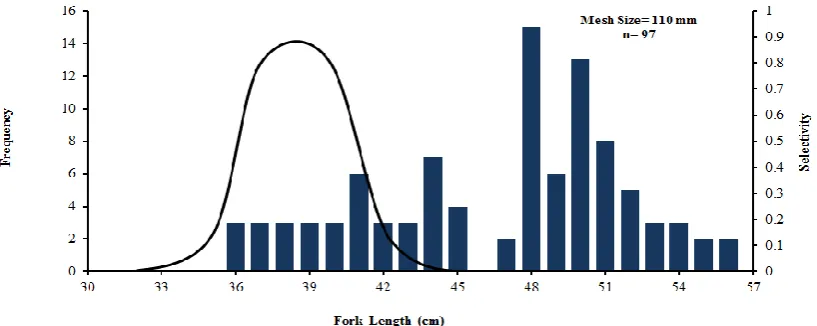
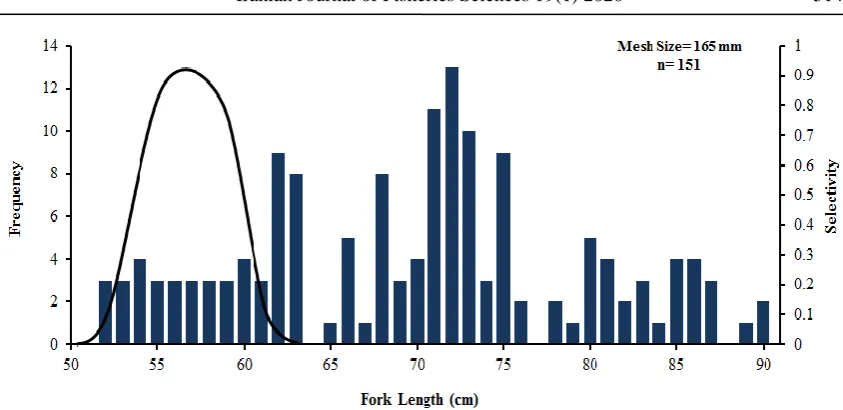
Figs. 1, 2, 3 and 4 show the estimated drift gillnet selectivity curve (line) and length-frequency distribution (bars) of longtail tuna for 100, 110, 130 and 165 mm mesh sizes.
Figure 1: Estimated drift gillnet selectivity curve (line) and length-frequency distribution (bars) of longtail tuna for 100 mm mesh sizes in Oman Sea.
Figure 2: Estimated drift gillnet selectivity curve (line) and length-frequency distribution (bars) of longtail tuna for 110 mm mesh sizes in Oman Sea.
Figure 3: Estimated drift gillnet selectivity curve (line) and length-frequency distribution (bars) of longtail tuna for 130 mm mesh sizes in Oman Sea.
Figure 4: Estimated drift gillnet selectivity curve (line) and length-frequency distribution (bars) of longtail tuna for 165 mm mesh sizes in Oman Sea.
Using Sechin method, optimal catch size of 100, 110, 130 and 165 gillnet mesh sizes were determined as: 35, 38, 46 and 57 cm, respectively. Moreover, selection coefficient (K=mesh size/ Optimal catch size) was calculated as 0.285, 0.289, 0.282 and 0.289, respectively. This study investigated the multifilament drift gillnet selectivity for longtail tuna as one of the most important pelagic fish species in the Iranian waters of the northeastern Oman Sea. Relationship between head girth or maximum girth and fork length of longtail tuna and the correlation coefficient values (r2) were high for all obtained linear regressions. All girth-length regressions were found to be linear. Fisheries management and research often require the use of biometric relationships such as weight-length which, among other uses, is applied when estimating the production and biomass of a fish population. Similarly, other relationships can be very useful, such as morphometric relationships relating to different body dimensions, e.g. length and girth
(Mendes et al., 2006). It is widely accepted that fish morphology strongly influences the retention by fishing gear. The probability of a fish being retained by a given mesh is thus primarily determined by the relationship between the body shape and the mesh opening. Consequently, girth and its associated dimensions (height and width) have been considered as critical parameters in understanding the gear selection process (Reis and Pawson, 1992). Girth data have been used to describe selection patterns during indirect selectivity experiments with gillnets (Reis and Pawson, 1999; Kurkilahti et al., 2002) and to estimate selectivity even in the absence of experimental data (Sechin, 1969). Moreover, girth-length relationships have been important in gillnets selectivity studies to understand the selection pattern of species that differ in behavioral and morphological characteristics (Campos and Fonseca, 2003). Nowadays, the Sechin approach has been commonly used for determining size selectivity of gillnets and various fish species.
Optimal catch size of 100, 110, 130 and 165 cm gillnet mesh sizes for longtail tuna were determined as: 35, 38, 46 and 57 cm, respectively and selection coefficient (K) was calculated 0.285, 0.289, 0.282 and 0.289, respectively. Since the fish mostly retained were snagged by pre-operculum or orbital girth and were being fished less in the gilled than in the wedged position, there is no overlapping between selectivity curves and size frequency (Millar and Fryer, 1999; Hosseini et al., 2017). The shape of Sechin's selection curves is dependent on the difference between Gh
and Gmax. When the difference is small
the selection curve will appear narrow, whereas a large difference will lead to a wide selection curve. The differences may be linked to the morphology of the anterior part of the fish (Hovgard and Lassen, 2000). In this study, due to the isometric growth of longtail tuna and the small difference between Gh and
Gmax, the selectivity curves were
bell-shaped, the shape of normal distribution and narrow. Attention must be drawn to the fact that fish retention by fishing gear is primarily related to girth rather than to length. This research is the first documented study on selectivity of multifilament drift gillnet for longtail tuna in Iranian waters of the Oman Sea. The information on the girth-length relationships and gillnet selectivity can be useful in the technical design for selective fishing gears, particularly for gillnets.
Acknowledgement
This research was supported and funded by the University of Hormozgan (Iran).
The authors would like to thank the staff of this University. We are also grateful to Mr. Mehran Parsa for his cooperation in the sample collection during the research.
References
Abdussamad, E.M., Said Koya, K.P., Ghosh, S., Rohit, P., Joshi, K.K., Manojkumar, B., Prakasan, D., Kemparaju, S., Elayath, M.N.K., Dhokia, H.K, Sebastine, M. and
Bineesh, K.K., 2012. Fishery,
biology and population characteristics of longtail tuna, Thunnus tonggol (Bleeker, 1851) caught along the Indian coast. Indian Journal of Fisheries, 59(2), 7-16.
Campos, A. and Fonseca, P., 2003.
Selectivity of diamond and square mesh cod ends for horse mackerel (Trachurus trachurus), European hake (Merluccius merluccius) and axillary sea bream (Pagellus acarne) in the shallow ground fish assemblage off the south-west coast of Portugal. Scientia Marina, 67(2), 249-260.
Collette, B. B., Abdulqader, E., Alam, S., Alghawzi, Q., Bishop, J., Hartmann, S., Kaymaram, F. and Smith-Vaniz, W.F., 2015. Thunnus tonggol. The IUCN red list of threatened species 2015: e.T170351A57243599.
(http://www.iucnredlist.org/details/f ull/170351/26)
Ehrhardt, N.M. and Die, D.J., 1988.
Selectivity of gill nets used in the commercial Spanish Mackerel fishery of Florida. Transactions of
the American Fisheries Society, 117, 574-580.
Fabi, G., Sbrana, M., Biagi, F., Grati, F., Leonori, I. and Sartor, P., 2002.
Trammel net and gill net selectivity for Lithognathus mormyrus (L., 1758), Diplodus annularis (L., 1758) and Mullus barbatus (L., 1758) in the Adriatic and Ligurian Seas. Fisheries Research, 54(3), 375-388.
Froese, R. and Pauly, D., 2015. Fish base. (www.fishbase.org).
Griffiths, S.P., Fry, G.C., Manson, F.J. and Lou, D.C., 2010. Age and growth of longtail tuna (Thunnus tonggol) in tropical and temperate waters of the central Indo-Pacific. ICES Journal of Marine Science, 67(1), 125-134.
Geehan, J., Pierre, L. and Fiorellato, F., 2016. Review of the statistical data available for bycatch species. IOTC-2016-WPNT06-07.
Hosseini, S.A., Kaymarm, F.,
Behzady, S., Kamaly, E. and Darvishi, D., 2017. Drift gillnet selectivity for indo-pacific king mackerel, Scomberomorus guttatus, using girth measurements in the North of Persian Gulf. Turkish Journal of Fisheries and Aquatic Sciences, Accepted Manuscript, DOI: 10.4194/1303-2712-v17_6_08.
Hovgard, H. and Lassen. H., 2000.
Manual on estimation of selectivity for gillnet and longline gears in abundance surveys. FAO Fisheries Technical Paper, 397, 84.
IFO, 2016. Iran (Islamic Republic of) national report to the scientific committee of the Indian Ocean Tuna
Commission, 2016. IOTC–2016– SC19–NR11. 22 P.
IOTC Secretariat, 2016. Longtail tuna supporting information for the 6th Session of the IOTC Working Party on Neritic Tunas. 2016.
IOTC Secretariat, 2017. Assessment of Indian Ocean longtail tuna (Thunnus tonggol) using data-limited methods. IOTC–2017–WPNT07–15 Rev_1.
IUCN, 2015. IUCN red list of
threatened species (ver. 2017.2).
Available at:
http://www.iucnredlist.org. (Accessed: 23 October 2017).
Kawamura, G., 1972. Gillnet mesh selectivity curve developed from length-girth relationship. Bulletin of the Japanese Society for the Science of Fish, 38, 1119-1127.
Kaymaram, F., Darvishi, M.,
Behzadi, S. and Ghasemi, S., 2013.
Population dynamic parameters of Thunnus tonggol (Bleeker, 1851) in the Persian Gulf and Oman Sea. Iranian Journal of Fisheries Sciences, 12(4), 855-863.
Kurkilahti, M., Appelberg, M.,
Hesthagen, T. and Rask, M., 2002.
Effects of fish shape on gillnet selectivity: a study with Fulton’s condition factor. Fisheries Research, 54(2), 153-170.
Mendes, B., Fonseca, P. and Campos, A., 2006. Relationships between opercula girth, maximum girth and total length of fish species caught in gillnet and trammel net selectivity surveys off the Portuguese coast. Journal of Applied Ichthyology, 22(3), 209-213.
Millar, R.B. and Fryer, R.J., 1999.
Estimating the size-selection curves of towed gears, traps, nets and hooks. Reviews in Fish Biology and Fisheries, 9, 89–116.
Ozekinci, U., 2005. Determination of the selectivity of monofilament gillnets used for catching the annular sea bream (Diplodus annularis L., 1758) by length-girth relationships in Üzmir Bay (Aegean Sea). Turkish Journal of Veterinary Animal Science, 29, 375-380.
Pierre, L., Geehan, J. and Herrera, M., 2014. Review of the statistical data available for bycatch species. IOTC-2014- WPNT04-07 Rev, 1, 17-19.
Reis, E.G. and Pawson, M.G., 1992.
Determination of gill-net selectivity for bass (Dicentrarchus labrax L.) using commercial catch data. Fisheries Research, 13(2), 173-187
Reis, E.G. and Pawson, M.G., 1999.
Fish morphology and estimating selectivity by gillnets. Fisheries Research, 39(1), 263-273.
Santos, M.N., Monteiroa, C.C. and Erzinib, K., 1995. Aspects of the biology and gillnet selectivity of the axillary seabream (Pagellus acarne, Risso) and common pandora (Pagellus erythrinus, Linnaeus) from the Algarve (south Portugal). Fisheries Research, 23, 223-236.
Santos, M.N., Monteiroa, C.C.,
Erzinib, K. and Lasserre, G., 1998.
Maturation and gill-net selectivity of two small sea breams (genus Diplodus) from the Algarve coast (south Portugal). Fisheries Research, 36, 185-194.
Sechin, Y.T., 1969. A mathematical model for the selectivity curve of a gill net. Rybnoe Khozyajstvo, 45(9), 56-58 (in Russian).