OPEN A
CCE
SS
JZ
AR R
esearch article
OPEN A
CCE
SS
Subspecies identification with mtDNA and morphometrics in captive
palm cockatoos,
Probosciger aterrimus
Hélène Bussière1, Baptiste Mulot2,3, Eric Bairrão Ruivo2 and Eric Pasquet4
12 av du Général Maistre, 75014 Paris, France 2ZooParc de Beauval, 41110 Saint-Aignan, France
3Association Beauval Conservation et Recherche (ABCR), 41110 Saint-Aignan, France 4UMS2700 CNRS, SSM, BP 26, 57 rue Cuvier, 75231 Paris, France
Correspondence: Hélène Bussière, DVM, MSc. 2 av du Général Maistre 75014 Paris; [email protected]
Keywords:
genetics, discriminant analysis,
P. a. goliath, P. a. aterrimus
Article history:
Received: 27 May 2013 Accepted: 11 November 2013 Published online: 31 January 2014
Abstract
The European breeding programme (EEP) for palm cockatoos Probosciger aterrimus has managed two subspecies, P. a. goliath and P. a. aterrimus, separately since it was found that only these two subspecies were distinct genetic lineages. Until recently a captive palm cockatoo was assigned to one or the other subspecies relying solely on morphology, P. a. goliath being reputedly larger than P. a. aterrimus. This study aimed at first to determine the subspecies of 78 captive palm cockatoos – mainly members of the EEP population – by sequencing a mitochondrial marker which had proved relevant for wild specimens. We also collected several anatomical measurements in order to compare the morphology with the molecular marker and to assess the presumed link between morphology and subspecies. Ten different haplotypes were found over 54 non-related samples, which could be arranged into two groups consistent with the subspecies P. a. goliath and P. a. aterrimus. Morphometric analyses revealed significant differences between the two subspecies, although there was some overlap between values
for P. a. goliath and P. a. aterrimus. A stepwise discriminant analysis, which included one criterion for
females and two criteria for males, allowed a correct assignation of 95% on average for our sample. These results allowed us to confirm that the captive population of palm cockatoos consists of two distinct genetic subgroups, which overall match with morphotypes. Therefore to preserve these two different conservation units we advise that P. a. goliath and P. a. aterrimus continue to be managed as two separate breeding populations. Morphology using a recommended set of measurements gives a fairly reliable insight into the subspecies identity for a newly introduced palm cockatoo, but testing mtDNA is highly recommended to confirm the correct subspecies determination.
Introduction
In modern zoology, including ornithology, the subspecies is the only recognised infraspecific taxonomic rank; it is the lowest rank included in the official nomenclature of the International Code of Zoological Nomenclature (ICZN 1999), which has established the standard trinomial nomenclature of genus–species–subspecies. The subspecies concept was originally based on differences in geographical distribution of phenotypic traits in populations within a species (Mayr 1942; Wilson and Brown 1953). This concept has, however, encountered numerous criticisms and remains controversial: in the biological species concept as defined by Mayr, subspecies, unless separated by physical boundaries, interbreed at their boundaries resulting in gene flow between them and blurring of morphological characters. However many species unquestionably consist of a set of populations represented by subspecies, so detractors have not criticised the concept of subspecies in itself but rather its improper application. Indeed taxonomists have often focused on mean differences
for a character between populations regardless of the extent of overlap, thus ignoring the predictability issue (Patten and Unitt 2002). For that matter, a standard level for defining a subspecies has been largely established on the “75% rule”, meaning that 75% of a population must lie outside 99% of the range of other populations for a given defining character or set of characters to be recognised as a subspecies (Patten and Unitt 2002; Mayr and Ashlock 1991).
and that is measurably distinct in its phenotype, genotype or both. Ideally these multiple criteria would co-vary but several studies have revealed a lack of consistency between the traditionally recognised subspecies and the phylogenetic clusters identified using molecular methods. Subspecies traditionally recognised are rarely distinct phylogenetic units, but island subspecies are more likely to show monophyly compared to continental subspecies (Zink 2004; Phillimore and Owens 2006).
The palm cockatoo Probosciger aterrimus is a large black parrot and the only member of the tribe Microglossini. It is classified as Least Concern by IUCN and has ever been since 2004, though the population trend is known to be decreasing. Its range consists of New Guinea and surrounding islands and Cape York Peninsula in Australia. Traditional taxonomy recognised three subspecies:
P. a. aterrimus, P. a. goliath and P. a. stenolophus (Coates 1985,
Rowley 1997; Marchant and Higgins 1999; Taylor 2000). Other subspecies that have been proposed include P. a. macgillivrayi, P.
a. intermedius and P. a. alecto,but these are reported to lack any
clear morphological distinction (Rand and Gilliard 1967; Schodde and Mason 1997; Marchant and Higgins 1999). Figure 1 shows the approximate location of subspecies. P. a. goliath is reputedly larger than P. a. aterrimus, and P. a. stenolophus is described as the same size as or larger than P. a. goliath and to have narrower crest feathers (Rand and Gilliard 1967; Rowley 1997; Marchant and Higgins 1999, Taylor 2000), although no quantitative data on biometrics are available for any of the subspecies. More recent research on the phylogeography of palm cockatoos has revealed that, according to use of an mtDNA marker, only two east–west lineages could be distinguished (Murphy et al. 2007). Murphy et al. (2007) therefore proposed that only two subspecies should be recognised and given independent conservation status: P.
a. goliath in the Vogelkop up to the Weyland Range and in the
western islands, and P. a. aterrimus elsewhere.
Captive management of palm cockatoos has been supervised since 1988 in North America by a Species Survival Plan (SSP) (Taylor 2000) and since 1991 in Europe by a European Breeding Programme (EEP) (Bairrão Ruivo 2012). In both cases the captive population is believed to consist of both P. a. goliath and P. a.
aterrimus, and both the SSP and EEP want to avoid the production of subspecific hybrids (Taylor 2000; Bairrão Ruivo 2012). In France, this management decision follows a ministerial decree enacted in 2004 by the Ministry of Ecology and Agriculture (Article 17 Arrêté du 25 mars 2004). Until the current study was undertaken for the EEP population, subspecies determination was based on weight and size only. The SSP generally consider birds weighing less than 800 g to be P. a. aterrimus and those weighing near to or more than 1000 g to be P. a. goliath (Taylor 2000), whereas the birds in the EEP were considered as P. a. aterrimus when weighing around 500–600 g and as P. a. goliath aat round 800–1000 g (Bairrão Ruivo, personal communication).
The use of an mtDNA marker (Murphy et al. 2007) represented a new opportunity to have the captive population of palm cockatoos studied genetically. The palm cockatoo EEP thus decided to support genetic research to investigate subspecific identification in the EEP population of palm cockatoos. It was acknowledged that some individuals may be hybrids between the two subspecies and that these could not be identified through maternally inherited mtDNA.
This research thus aimed first at assessing whether the same haplotypes as identified by Murphy could be found in the palm cockatoo EEP population. This possible genetic test would bring an additional criterion to help identify captive individuals as
belonging to one or the other currently recognised subspecies. The second aim was to assess the correlation between the genotype and the phenotype using several anatomical measurements and weight. These results would indicate if it was relevant to maintain breeding populations for the two presumably distinct groups. If so, each individual palm cockatoo within the breeding programme should be investigated and its subspecies updated according to genetic and morphological data.
Materials and methods
Sampling
In 2011, institutions holding palm cockatoos included in the EEP were sent an information note and a questionnaire to complete. It was indicated that all palm cockatoos in the EEP should be tested as to subspecies and those that were not tested could not have a breeding recommendation. The participants were requested to take a blood sample using the tubes provided, containing EDTA and thymol, to provide information on identification, suspected subspecies, sex and age, and to take body measurements according to illustrations provided (see “Morphometrics” below for more details). All the information and blood samples were to be sent back to us, and we stored the blood samples at around 4° C until processing them.
Genetic analysis
DNA extraction was performed with DNeasy Blood and Tissue kit (Qiagen®), following the indications for blood samples with nucleated blood cells.
Sex determination or confirmation was performed by PCR using primers 2550F and 2718R to amplify introns from the CHD-Z and CHD-W genes (Fridolfsson and Ellegren 1999)
.
A 280 base pair (bp) sequence in domain III of the control region – a non-coding area of the mtDNA – was amplified using primers designed by Murphy et al. (2007) (PCd3F#3: CGTTTGTTCGTGATCAACTCGTGTC; PCd3R#1: TGGTGGTAATCCATCTTAGCATC )
Each reaction contained 2 µl buffer (containing 25 µM MgCl2), 1 µl DMSO, 0.8 µl of a 6.6 mM dNTP mix, 0.32 µl of a 10 pM/ ml solution of each primer, 0.12 µL (0.6 units) of Quiagen Taq polymerase and sterile water up to 20 µl.
PCR thermal cycling for both consisted of an initial denaturing step of 5 min at 94° C, followed by repeated denaturing, annealing, and extension steps for 35 cycles of 40 s at 94° C, 40 s at 49° C, and 60 s at 72° C, with a final extension step of 5 min at 72° C.
Samples were then placed in a 2% agarose gel containing 10 µl ethidium bromide and electrophoresis was run in 0.5X TBE at 135 V for approximately 15 min. Gels were visualised under UV light and photographs were taken of all successful runs.
Female sex was assigned if both the CHD-Z and CHD-W bands were present, and male sex was assigned if a single CHD-Z band was present.
The amplification of the mtDNA marker was considered successful if a band appeared around 300 bp, comparing it to the 100 bp ladder obtained with the DNA molecular weight marker XIV.
Sequencing was performed on ABI 3730xl (96-capillary) following the manufacturer’s instructions and the sequences were then aligned in CodonCode Aligner 3.7.1. Analyses of sequences variability were performed with Mega 5.1.
Morphometrics
Eight body-size measurements were taken for each bird: body mass (±1 g), wing chord length (carpal joint to longest primary feather unflattened chord, ±1 mm), tarsometatarsus length (±0.5 mm), beak length, beak height and beak width (all ±0.5 mm), red
cheek patch height and length (±0.5 mm). We gave no particular recommendation concerning the time when the measurements should be taken, so weight could correspond to an empty or full crop weight.
Statistical analyses were performed with Tanagra 1.4.42 Software (2003). Since no data on biometrics had been published for the wild population, the statistical analysis only concerns the samples collected for the purposes of this research.
A multivariate analysis of variance (MANOVA) was performed to evaluate overall differences between sexes and subspecies based on the genotype determined previously. Analysis of variance for each measurement was then performed separately for males and females, with a t-test assuming unequal variance between the two subspecies groups.
In order to test for clustering in groups based on morphology, regardless of the subspecies – either assumed or based on the mtDNA marker – a clustering analysis using a k-means algorithm was performed. This method enables later evaluation of the extent to which the subspecies and/or the sex subgroups match with the morphology subgroups.
Finally a forward step-wise general discriminant analysis (Williams 1983; Wilson et al. 2012) was performed separately for males and females to evaluate whether the morphology could be used to identify reliably an individual’s subspecies.
Results
Sampling
We collected 78 samples from 19 institutions, among which 60 – from 18 institutions – are part of the palm cockatoo EEP. Twelve birds from Jurong Bird Park in Singapore and six confiscated birds from the CITES Centre in Prague were also included. After determination by PCR, 45 males and 33 females were found. This population includes known close relatives (parents–offspring or siblings).
Genetic analysis
The amplified sequences were aligned and consisted of up to 286 bp. For further analysis, only the sequences from site 6 to site 221 – resulting in a 216-bp sequence – were taken into account in order to exclude from the analysis end sequences, which were of poor quality for some samples.
Of the 78 samples collected, 24 were either offspring of a female included in the study and/or siblings. These individuals obviously shared exactly the same sequence, and their sequences were therefore discarded to avoid biases in genetic distance analyses. The following statistics have thus been calculated with 54 a priori
non-related samples.
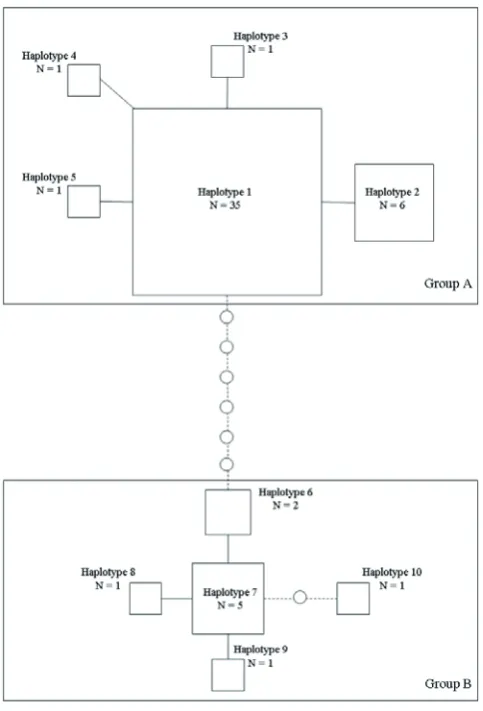
Over the 216-bp defined sequence, 14 variable sites were identified, among which six sites were singletons – each of these six mutations was present in one sample only. Apart from these single nucleotide mutations, two insertion–deletion (indel) mutations were identified: a single nucleotide indel in one individual and the same 7-bp indel as found by Murphy et al. (2007) in 10 birds – and eight offspring. We found 10 different haplotypes, five of them showing the 7-bp indel (Table 1).
In group A, two haplotypes were linked by only one mutational step and in group B two haplotypes were linked by one or two mutational steps. Nucleotide divergence was found to be 1.25% overall. It reached 3.65% between groups A and B and was 0.164% and 0.572% within each respective group.
According to this genetic analysis, we found 44 non-related birds plus 16 offspring or siblings – 33 males and 27 females –
belonging to group A and 10 non-related birds plus 8 offspring – 12 males and 6 females – belonging to group B. All these results are summarised in Table 2.
Referring to the findings of Murphy et al. (2007), groups A and B defined here correspond to clades 2.1 and 2.2, which were found to gather eastern – P. a. aterrimus – and western – P. a. goliath – birds respectively. Individuals belonging to either group A or B will therefore be referred to as aterrimus or goliath respectively in the remainder of this paper.
Morphometrics
All the birds were at least one year old – and up to 37 years old – at the time when measurements were taken, and were thus all considered fully-grown adults. We relied on growth curves recorded in the birds’ husbandry notes at ZooParc de Beauval, which showed that hand-reared palm cockatoos reached adult size before one year. For the 69 individuals – 39 males and 30 females – for which all measurements were available, overall morphology differed between the sexes (Wilks’ λ = 0.24, F(8, 60) = 24.28, p <
0.0001). This result led us to compare each measurement and perform further discriminant analyses separately for males and females.
An outcome of the previous mtDNA analyses was that six of 69 individuals were found to have parents belonging to the two different genetic groups. Unless indicated otherwise, morphometric data for these six hybrids were discarded from further statistical analyses.
For the remaining 63 individuals – 17 goliath and 46 aterrimus
– the overall morphology differed between subspecies (Wilks’ λ = 0.29, F(8, 54) = 16.66, p < 0.0001).
Figure 2. Network representation of the 54 non-related palm cockatoos in this study. Note: Boxes represent haplotypes and their size is proportional to sample size. Circles indicate missing haplotypes.
Table 1. Haplotype diversity within 54 palm cockatoos for a 216-bp sequence.
Haplo-type
Informative sites
Number of
individuals1
30 42 43 66 68 121 122 134 137 146 148 151 161 162 163 164 165 166 167 168 180 215
1 G C C C T C T C - T T C - - - T C T 35
2 . . . C . - . . . - - - . . . 6
3 . . . T . . . . - . . . - - - . . . 1
4 . . T . . . - . . . - - - . . . 1
5 . . . G . . . - - - . . . 1
6 A . . . - C . T A T C A C C T C T C 2
7 A . . . . T . . - C . T A T C A C C T C T C 5
8 A . . . . T . . - C C T A T C A C C T C T C 1
9 A . . . . T . T - C . T A T C A C C T C T C 1
10 A T . . C T . . - C . T A T C A C C T C T C 1
1Haplotype 1 and Haplotype 8 were shared respectively by 16 and 8 other individuals, offspring or siblings.
Table 2. Distribution of the 78 individuals in our sample1 according to
genetic results.
Male Female Total
Group A 33 (26) 27 (18) 60 (44)
Group B 12 (11) 6 (5) 18 (16)
Total 45 (37) 33 (23) 78 (60)
1The numbers of individuals from the palm cockatoo EEP population are
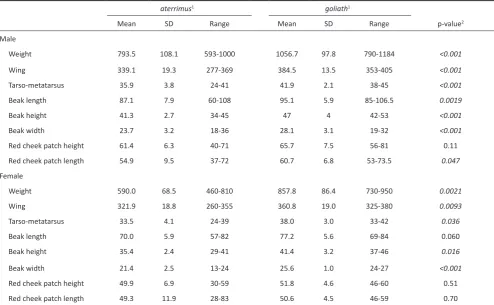
For males, all measurements except for the red cheek patch measures differed significantly with a strong p-value in goliath
and aterrimus birds (Table 3). These measurements were approximately 9–19% higher – 33% for weight – on average for
the goliath group. However, it should be noted that the ranges
of recorded values overlap for all measurements between the
goliath and aterrimus groups. This statement is also true for
measurements among females. Only beak length and both the
red cheek patch measurements failed to be significantly different in females. Wing length, tarsometatarsus length, beak height and width were significantly higher by 10–20% and weight by 45% on average for goliath female birds.
In the light of these results, red cheek patch measurements do not seem to be appropriate distinctive measurements. Several participants also reported these measurements as the most difficult ones to take and the most variable ones depending on the
Figure 3. Principal Component Analysis (PCA) scatter plot representing the 69 palm cockatoos included in the k-means clustering.
Table 3. Body size (mm) and body mass (g) measurements.
aterrimus1 goliath1
Mean SD Range Mean SD Range p-value2
Male
Weight 793.5 108.1 593-1000 1056.7 97.8 790-1184 <0.001
Wing 339.1 19.3 277-369 384.5 13.5 353-405 <0.001
Tarso-metatarsus 35.9 3.8 24-41 41.9 2.1 38-45 <0.001
Beak length 87.1 7.9 60-108 95.1 5.9 85-106.5 0.0019
Beak height 41.3 2.7 34-45 47 4 42-53 <0.001
Beak width 23.7 3.2 18-36 28.1 3.1 19-32 <0.001
Red cheek patch height 61.4 6.3 40-71 65.7 7.5 56-81 0.11
Red cheek patch length 54.9 9.5 37-72 60.7 6.8 53-73.5 0.047
Female
Weight 590.0 68.5 460-810 857.8 86.4 730-950 0.0021
Wing 321.9 18.8 260-355 360.8 19.0 325-380 0.0093
Tarso-metatarsus 33.5 4.1 24-39 38.0 3.0 33-42 0.036
Beak length 70.0 5.9 57-82 77.2 5.6 69-84 0.060
Beak height 35.4 2.4 29-41 41.4 3.2 37-46 0.016
Beak width 21.4 2.5 13-24 25.6 1.0 24-27 <0.001
Red cheek patch height 49.9 6.9 30-59 51.8 4.6 46-60 0.51
Red cheek patch length 49.3 11.9 28-83 50.6 4.5 46-59 0.70
1Sample sizes: aterrimus – 29 males except for weight (27) and red cheek patch length (28) and 22 females except for weight (20); goliath – 12 males and
5 females. 2Significant comparisons (significance level set to 0.05) given in italics.
aterrimus female
aterrimus male
goliath female
goliath male
hybrid female
opening of the beak. These factors resulted in a lack of reliability for red cheek patch measurements, and so they were not used in further analyses.
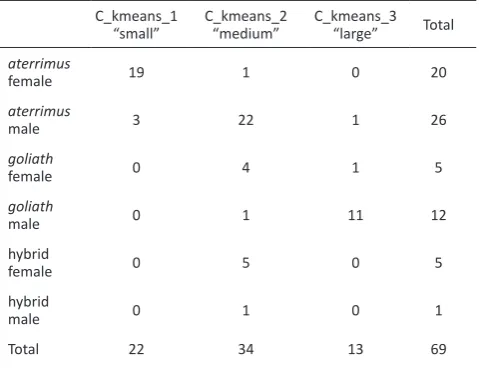
The clustering analysis was performed using a k-means algorithm setting the number of clusters to three in order to get three different size groups referred to as small, medium and large. Our designation is arbitrary and does not reflect the actual size of the birds: all six measurements have equal importance in the determination of clusters. Since this statistical method does not depend on classification of individuals – neither for their subspecies or sex – all the palm cockatoos including hybrids were included in the analysis. A contingency table between the resulting morphological clusters and the “subspecies based on genotype + sex” group reveals a significant difference in frequencies (Table 4; χ2 = 100, p < 0.0001). It is noteworthy that there is no goliath
individual, neither male nor female, in the first “small” group, and no aterrimus female in the third “large” group. Figure 3 shows the distribution of the 69 palm cockatoos included in the clustering analysis.
The final discriminant function obtained by a forward step-wise discriminant analysis selected two variables as significant measurements for distinguishing males between the subspecies: wing and tarso-metatarsus lengths. Assignation was correct for 26 out of 26 (100%) for aterrimus and 11 out of 12 (92%) for
goliath. This model leads to the same error rates as when all six
measurements were taken into account in the linear discriminant analysis. The unstandardised discriminant model derived from these two discriminating variables is as follows:
D = 0.058 x wing length (mm) + 0.185 x tarso–metatarsus length (mm) – 27.60
A male palm cockatoo was defined as belonging to the goliath
subgroup if its measures led to a positive D, or to the aterrimus
subgroup if D was negative; the overall error rate obtained by cross validation was 6.7%.
For females, only the weight was included in the final discriminant function. The percentage of correct assignation was lower, with 4 out of 5 (80%) goliath and 19 out of 20 (95%)
aterrimus correctly identified. This model has again the same error rate as the discriminant analysis taking all six criteria into account. The unstandardised discriminant model derived from the variable weight is as follows:
D = 0.0133 x Weight (g) – 8.53
A female palm cockatoo was defined as belonging to the goliath
subgroup if its measures led to a positive D, or to the aterrimus
subgroup if D was negative; the overall error rate obtained by cross validation was 10%.
Discussion
The two genetic clusters we found for captive palm cockatoos are consistent with the two clades identified by Murphy et al. (2007) from wild specimens. The nucleotide variability figures were also similar, although we found an average nucleotide divergence lower for each group. Since we excluded related samples – offspring and siblings – from the variability analysis, this observation cannot be explained by this bias. However, we cannot rule out a possible family relationship between founders of the captive population. The precise geographical origin of these palm cockatoos – which are of wild or unknown origin – is generally unknown; their distribution could therefore be less representative of the overall geographic range of palm cockatoos than the sample studied by Murphy et al. It may also be accounted for by lower sample sizes for both subspecies.
Mitochondrial DNA is maternally inherited and cannot therefore identify possible hybrids between P. a. goliath and P. a. aterrimus
subspecies. For this particular aim, we tried simultaneously throughout this research to identify nuclear markers for subspecies. Because nuclear introns – non coding sequences – are known for their high sequence variation (Primmer et al. 2002), and thus more likely to show variability between the two subspecies, we investigated a dozen of them – autosomal or linked to the Z chromosome – for single nucleotide polymorphism (SNP). Unfortunately, no relevant SNP was found in the markers tested. Even though the sequenced introns overall represented 7060 bp, identification of relevant SNP for subspecies identification in palm cockatoos could be looked for in the future using restriction-site associated DNA (RAD) sequencing, which would enable much higher throughput genotyping (McCormack et al. 2013).
The morphometric analysis is most probably biased by a lack of consistency due to different people taking the measurements, and due to differences between institutions in diet and husbandry conditions that may affect body condition or other morphometric measurements such as beak length (which depends on how much it is worn down). Despite these biases, our morphometric analysis showed that there is a significant correlation between overall size – taking into account all six measurements – and the subspecies– sex category. Palm cockatoos carrying the goliath haplotype were found to have higher values for each measurement than those carrying the aterrimus haplotype. This finding is consistent with all previous morphological descriptions for P. a. goliath and P. a.
aterrimus. However, we found that each morphological criterion measured here shows overlap between the two subgroups. Subspecies assignation relying on morphology cannot lead to a 100% correct classification. Predictive discriminant analysis using wing length and tarsometatarsus length remains satisfactory for males, since it enables a correct subspecies assignation with a 6.7% error rate, which is equal to the prediction obtained with six measurements. For females, the resulting equation is not as satisfactory since it only takes into account weight, which is a criterion dependent on other parameters – full vs empty crop, diet, activity, possible illness, reproductive status – and it shows a higher error rate of 10%. It would be interesting to have a larger sample size for females in order to calculate a more robust equation.
For 51 out of the 60 individuals included in the EEP, the marker sequence belonged to the group corresponding to the presumed subspecies. If we base this solely on genotyping, subspecies assignation was thus correct in 85% of the cases using a morphology overview – without precise measurement – Table 4. Contingency table displaying the distribution of the 69 palm
cockatoos included in the k-means clustering among the three defined morphological clusters
C_kmeans_1
“small” C_kmeans_2 “medium” C_kmeans_3 “large” Total
aterrimus
female 19 1 0 20
aterrimus
male 3 22 1 26
goliath
female 0 4 1 5
goliath
male 0 1 11 12
hybrid
female 0 5 0 5
hybrid
male 0 1 0 1
and of course based on the parents’ origin when it was known. Among the remaining nine individuals, three had their subspecies determinations changed: two females from P. a. goliath to P. a.
aterrimus and one male from P. a.aterrimus to P. a. goliath. These three individuals were of unknown or wild origin, without any geographical indication for the latter. Their previous subspecies determinations were based only on their size. We can assume that the two females were considered as rather large and the male as rather small to be respectively determined as goliath and aterrimus. However, in this study these two females are classified in cluster 1, “small”, and the male in cluster 3, “large”, which means that they have a morphotype corresponding to their subspecies. These three individuals indicate the lack of reliability of assigning a palm cockatoo to a subspecies only on visual inspection without precise measurements and without comparison with individuals belonging to both subspecies. Six individuals were determined to be hybrids: one was born from a female goliath and a male aterrimus and five were siblings and born from a female aterrimus and a male goliath. Interestingly all these hybrids – five females and one male – are assigned to group 2, “medium”.
For captive breeding programmes, dealing with subspecies can be challenging. If breeding programme coordinators choose to manage subspecies separately, they create an artificial barrier that prevents gene flow for populations that may actually interbreed to a greater or lesser extent in the wild. In the particular case of palm cockatoos, little is known about the zone of hybridisation in New Guinea and the surroundings island: Murphy et al. (2007) mentioned the possibility of a hybrid population in the Weyland range. Nuclear markers are lacking to confirm this hypothesis. It has, however, been recommended that independent conservation status should be given to P. a. aterrimus and P. a. goliath, since they correspond to distinct east–west genetic lineages endemic to each area (Murphy et al. 2007). In terms of morphology, there are unfortunately no data available regarding geographical distribution in situ that could show a similar correlation as found in our sample.
From an ecological point of view, subspecies are populations with different phenotypes corresponding to adaptive traits to particular environments in terms of diet, habitat, population density, and competing species (Hamilton 1961; Grant 1968). Conservation efforts in situ aim at preserving these adaptive traits: subspecies are therefore considered as conservation units and should be maintained. Conservation breeding programmes in captivity should follow the same management directive, all the more when there is a clear discrimination between infraspecific populations as observed in this study. In the light of these results, we therefore conclude that captive breeding programmes for palm cockatoos should continue to manage separate breeding populations of P.
a. aterrimus and P. a. goliath. The main difficulty for the future
for the European Breeding Programme, which was confirmed by this research, is the very low number of representativesof P. a.
goliath.
Acknowledgements
We sincerely thank ABCR for the financial support provided. This research was made possible thanks to the cooperation of all the institutions participating in the palm cockatoo EEP (Belfast Zoo, Zoo Brno, Hayle Paradise Park, Tisch Family Zoological Gardens, Kölner Zoo, Zoo Leipzig, Zoo Liberec, Loro Parque, Tiergarten Nürnberg, Palmitos Park, Zoo Praha, Wilhelma Zoologisch-Botanischer Garten Stuttgart, Zoological Center of Tel Aviv-Ramat Gan, Tiergaten Schönbrunn, Weltvogelpark Walsrode, Miejski Ogrod Zoologiczny w Warszawie, Zoo Wuppertal), as well as the Jurong Bird Park. We are grateful to Roger Wilkinson for his valuable help and to all the members of the Parrot TAG for their support. This work was carried out in the molecular platform “Service de Systématique Moléculaire” at Muséum National d’Histoire Naturelle (CNRS – UMS 2700), and we wish to thank all the staff, and especially Céline Bonillo, who generously shared their experience to help us with the experiments. This project was supported by the network “Bibliothèque du Vivant” funded by the CNRS, the Muséum
National d’Histoire Naturelle, the INRA and the CEA (Centre National de Séquençage). Thank you to Steve Murphy for his help and involvement in our research.
References
Backström, N., Fagerberg S. and Ellegren, H. (2008) Genomics of natural bird populations: a gene-based set of reference markers evenly spread across the avian genome. Molecular Ecology 17, 964–980.
Bairrão Ruivo, E. (2012) Palm Cockatoo Probosciger aterrimus Studbook
Nr 17. European Breeding Programme (EEP) for the Palm Cockatoo
(Probosciger aterrimus ssp).
BirdLife International 2012. Probosciger aterrimus. In: IUCN Red List of
Threatened Species. Version 2012.2. www.iucnredlist.org (downloaded
on 17 January 2013).
Coates, B.J. (1985) The Birds of Papua New Guinea. Alderley, Qld: Dove Publications.
Fridolfsson, A.-K. and Ellegren, H. (1999) A simple and universal method for molecular sexing of non-ratite birds. Journal of Avian Biology 20, 116–121.
Grant, P.R. (1968) Bill size, body size, and the ecological adaptations of bird species to competitive situations on islands. Systematic Biology 17 , 319–333.
Hamilton, T.H. (1961) The adaptive significances of intraspecific trends of variation in wing length and body size among bird species. Evolution
15, 180–195.
International Commission on Zoological Nomenclature – ICZN (1999).
International Code of Zoological Nomenclature. London: International
Trust for Zoological Nomenclature.
Joseph, L. and Omland, K.E. (2009) Phylogeography: its development and impact in Australo-Papuan ornithology with special reference to paraphyly in Australian birds. Emu 109, 1–23.
Marchant, S. and Higgins, P.J. (1999) Palm cockatoo. In: The Handbook
of Australian, New Zealand and Antarctic Birds, Volume 4, 32–39.
Oxford: Oxford University Press.
Mayr, E. (1942) Systematics and the Origin of Species. New York: Columbia University Press.
Mayr, E., and Ashlock, P.D. (1991) Principles of Systematic Zoology, 2nd edn.
New York: McGraw-Hill.
McCormack, J.E., Hird, S.M., Zellmer A.J., Carstens, B.C., and Brumfield, R.T. (2013) Applications of next-generation sequencing to phylogeography and phylogenetics. Molecular Phylogenetics and Evolution 66, 526– 538.
Murphy, S.A., Double, M.C., and Legge, S.M. (2007) The phylogeography of palm cockatoos, Probosciger aterrimus, in the dynamic Australo-Papuan region. Journal of Biogeography 34, 1534–1545.
Patten, M.A., and Unitt, P. (2002) Diagnosability versus mean differenes of Sage Sparrow subspecies. The Auk 119, 26–35.
Phillimore, A.B, and Owens, I.P.F. (2006) Are subspecies useful in evolutionary and conservation biology? Proceedings of the Royal
Society B 273, 1049–1053.
Primmer, C.R., Borge, T., Lindell, J., and Saetre, G.-P. (2002) Single-nucleotide polymorphism characterization in species with limited available sequence information: high nucleotide diversity revealed in the avian genome. Molecular Ecology 11, 603–612.
Rand, A.L., and Gilliard, E.T. (1967) Handbook of the Birds of New Guinea.
London: Wiedenfeld and Nicolson.
Rowley, I. (1997) Family Cacatuidae (cockatoos). Handbook of the birds of
the world, Volume 4. Sandgrouse to Cuckoos (ed. by del Hoyo I., Elliot
A., Sargatal J.), p 246–279. Barcelona: Lynx Edicions.
Schodde, R., and Mason, I.J. (1997) Zoological Catalogue of Australia,
Volume 37.2 Aves (Columbidae to Coraciidae). Melbourne: CSIRO
Wildlife and Ecology.
Taylor, M.R. (2000) Natural history, behaviour and captive management of the palm cockatoo Probosciger aterrimus in North America.
International Zoo Yearbook 37, 61–69.
Williams, B.K. (1983) Some observations on the use of discriminant analysis in ecology. Ecolog 64 , 1283–1291.
Wilson, E.O. and Brown, Jr. W.L. (1953) The subspecies concept and its taxonomic application. Systematic Zoology 2, 97–11.
Wilson, R.E., Eaton, M.D., and McCracken, K.G. (2012) Plumage and body size differentiation in blue-winged teal and cinnamon teal. Avian
Biology Research 5, 107–116.
Zink, R.M. (2004) The role of subspecies in obscuring avian biological diversity and misleading conservation policy. Proceedings of the Royal
Society B 271, 561–654.