Iran University of Medical Sciences
____________________________________________________________________________________________________________________
1. PhD student in Medical Education, Department of medical education, Iran University of Medical Sciences, Tehran, Iran.
2. (Corresponding author) MSc in Nursing, School of Nursing and Midwifery, Saveh University of Medical Sciences, Saveh, Iran.
The effects of team-based learning techniques on nursing
students’ perception of the psycho-social climate of the classroom
Hamid Reza Koohestani1, Nayereh Baghcheghi*2
Received:9 October 2015 Accepted:29 January 2016 Published:1 November 2016
Abstract
Background:Team-based learning is a structured type of cooperative learning that is becoming increasingly more popular in nursing education. This study compares levels of nursing students’ perception of the psycho-social climate of the classroom between conventional lecture group and team-based learning group.
Methods:In a quasi-experimental study with pretest-posttest design 38 nursing students of second year partic-ipated. One half of the 16 sessions of cardiovascular disease nursing course sessions was taught by lectures and the second half with team-based learning. The modified college and university classroom environment inventory (CUCEI) was used to measure the perception of classroom environment. This was completed after the final lec-ture and TBL sessions.
Results: Results revealed a significant difference in the mean scores of psycho-social climate for the TBL method (Mean (SD): 179.8(8.27)) versus the mean score for the lecture method (Mean (SD): 154.213.44)). Also, the results showed significant differences between the two groups in the innovation (p<0.001), student cohe-siveness (p=0.01), cooperation (p<0.001) and equity (p= 0.03) sub-scales scores (p<0.05).
Conclusion:This study provides evidence that team-based learning does have a positive effect on nursing stu-dents’ perceptions of their psycho-social climate of the classroom.
Keywords:Team-based learning, nursing students, Perception, Psycho-social climate, Classroom.
Cite this article as:Koohestani HR, Baghcheghi N. The effects of team-based learning techniques on nursing students’ perception of the psycho-social climate of the classroom.Med J Islam Repub Iran2016 (1 November). Vol. 30:437.
Introduction
Team-based learning is a specific instruc-tional strategy and framework that uses in-tentionally formed teams of learners to deepen student learning and develop high-performing teams (1). TBL requires that instructors shift their paradigms: 1) the course goal shifts from knowing content to applying concepts, 2) the instructor shifts from delivering information to creating op-portunities that will engage students in learning, 3) students shift from passive to active participants, and 4) the responsibility for learning shifts from the instructor to the student (2). TBL “flips the classroom” so that students are responsible for initial ex-posure to content through guided self-study (3).
TBL consists of three stages. At the first stage, students need to study and make preparations for class discussions. The sec-ond stage is to measure students' knowledge of the subjects to be studied in the first phase with individual readiness assessment test (IRAT). This step involves a group readiness assessment test (GRAT) by establishing small groups for discus-sions between the teacher and classmates. At the third stage, higher-level concepts are discussed in the groups. In fact, effective learning in TBL is conducted through inter-active discussions based on key educational principles and evaluations (1) TBL im-proves student participation and engage-ment during class (4).
In medicine, team-based learning (TBL)
is an established active learning strategy that uses patient cases with emphasis on exploring multiple problem solutions, using evidence to support proposed solutions, and reflecting on a solution’s strengths and weaknesses to develop problem-solving skills (5). For medical students, TBL has produced equal or superior academic out-comes compared to lecture-based approach (6-12). Overall, the literature in this area is limited, but evidence exists that students in TBL classes score higher on examinations. Further high-quality experimental studies are needed to confirm that TBL positively affects examination scores and other learn-ing outcomes (13)
The quality of the educational environ-ment is also indicative of the effectiveness of an educational program(14). Classroom environment is “the tone, ambience, culture or atmosphere of a classroom or school. It evolves from the relationships between stu-dents, and between teacher and stustu-dents, and the types of activities, actions, and in-teractions that are rewarded, encouraged and emphasized in the classroom”(15). De-veloping and implementing a positive psy-chosocial environment should be one of the main responsibilities of educators. As edu-cators influence the climate, learning is en-hanced or hindered (16). Students’ percep-tions of the educational milieu can be a ba-sis for implementing modifications and thus optimize the educational environment. (17). If the classroom environment is ener-getic, encouraging, facilitating, it can help students to avoid any kind of frustration, and to understand each other's emotions, feeling and manage their own and other's emotions (18).
Most studies on the effects of active and passive methods of teaching, have consid-ered learning variable as independent vari-able and the emphasis is on learning and academic achievement of students, howev-er, less attention has been paid to the ef-fects of active techniques on classroom en-vironment.
The aim of this study was to determine the effects of team-based learning
tech-niques on nursing students’ perception of psycho-social climate of the classroom.
Methods
Research Design
This quasi-experimental, pretest-posttest study was conducted in the academic year 2013. All nursing students in their 4th se-mester of the program, studying in a nurs-ing college in Saveh in Iran (n=38) were selected. Half of 16 cardiovascular disease nursing course sessions, was run through lecture and the other half was instructed through TBL method. The first eight ses-sions were taught by conventional lectures. Explanations were given about the TBL technique during the ninth session that was pertinent to the eight next sessions. Fur-thermore, in accordance with the provisions of the TBL technique, students were divid-ed into groups of 6 to 7, and for each group, a name was chosen and a manager appoint-ed.
TBL method
Prior to the beginning of the instructional unit, students was given a reading and other assignments that should contain in-formation on the concepts and ideas that must be understood to be able to solve the problem the instructor identified for this unit in the backward design activity.
The first in-class activity was an individ-ual RAT (IRAT) on the preclass assign-ments. The IRATs typically consist of 8–10 multiple-choice questions with no access to materials or peer discussion that, in combi-nation, to assess whether students have a sound understanding of the key concepts from the readings. The IRAT questions were focused on foundational concepts (and avoid picky details) but were difficult enough to create discussion within the teams. Following the IRAT, students retook the same test, but this time the teams must agree on the answers to each test question (Group Readiness Assurance Test, GRAT), using IF-AT (Immediate Feedback As-sessment Technique) scratch cards to gain immediate feedback. With the IF-AT
swer sheets, students scratch off the cover-ing of one of four (or five) boxes in search of a mark that indicates they have found the correct answer. If they found the mark on the first try, they received full credit. If not, they continued scratching until they did found the mark, but their score was reduced with each unsuccessful scratch.
At this point readiness assurance process, students proceed to the fourth phase (appeal phase). This phase gives students the op-portunity to refer to their assigned reading material and appeal any questions that were missed on the group test. In this phase, stu-dents were allowed to do a focused restudy of the assigned readings to challenge the teacher about their responses on specific items on the group test or about the confusion created by either the quality of the questions or inadequacies of the preclass readings. The fifth and final part of the readiness assurance process (RAP) involved oral feedback from the instructor. This feedback came immediately after the appeals process and allowed the instructor to clear up any confusion students may have about any of the concepts presented in the readings. Teams then worked through application activities, reaching consensus on answers though intra-team discussion. The facilitators led inter-team discussions about the applications. At the end of each session, the topic of the next session was introduced, and some related resources were determined for self-study.
Instrument
The modified college and university classroom environment inventory (CUCEI) was used to measure the perception of the classroom environment. This was complet-ed after the final lecture and TBL sessions. This particular inventory was used because of its suitability for use in small higher ed-ucation classrooms of about 30 students. The CUCEI has been found to be a valid and reliable instrument in assessing the col-lege classroom environment (19,20).
The modified version of the CUCEI con-tained 49 items with 5-point Likert-type (1
=strongly agree to 5= strongly disagree) separated into the following seven catego-ries: 1.Personalization—the interaction be-tween the students and instructor as well as concern for the welfare of the students. 2. Innovation—the extent to which new and interesting activities are introduced in a les-son 3. Student cohesiveness-the extent to which students interact with each other and help each other. 4. Task orientation—the extent to which classroom activities is well-organized and clearly explained. 5. Coop-eration—the extent to which students coop-erates rather than compete with one another on learning tasks; and. 6.Individualization-the extent to which students is able to make decisions and show autonomy in the class-room 7. Equity-The extent to which stu-dents are treated equally by the teacher (20-22)
This questionnaire has already been vali-dated and tested for reliability in Iran by Torabizeh et al, 2010(23). The content va-lidity of the translated questionnaire was evaluated by ten members of the nursing faculty. The reliability of the questionnaire was acceptable (Cronbach's alpha 0.85) as well as the categories. The categories cronbach's alphas were 0.81 for personali-zation category, 0.79 for involvement, and 0.78 for student cohesiveness category, 0.91 for satisfaction category, 0.81 for task orien-tation category, 0.87 for innovation catego-ry, 0.83 for Individualization category.
Data analysis
Data was analyzed using SPSS at an al-pha level of 0.05. Descriptive and correla-tion analyses were conducted. The Kolmo-gorov-Smirnov test showed normal distri-bution of data in different variables (p>0.22) and the paired-Samples t-test was used to examine differences in each subscale and total scores mean of CUCEI in the lecture and TBL groups. Identities were kept strictly confidential, and all ques-tionnaires were anonymously analyzed.
Result
The mean±SD age of the participants was
20.1±3.20 yrs (Age range 19-22 yrs) and 50.87% (n=19) of the participants were fe-male.
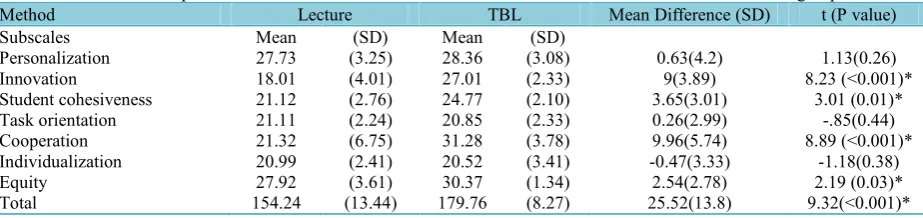
Table 1 shows the mean scores and stand-ard deviations for each subscale and the total score of CUCEI in the lecture and TBL methods.
A paired-samples t-test was conducted to compare the mean total scale scores of the inventory between the TBL and the lecture methods. Results of the statistical test re-vealed a significant difference in the mean scores for the TBL method (Mean (SD): 179.8 (8.27)) versus the mean score for the lecture method (Mean (SD): 154.2 (13.44)). The results of Table 1 suggest that the use of TBL in the classroom had a significant, positive effect on students’ overall perceptions of the psycho-social climate of the classroom.
In addition, paired-sample t test was conducted to compare the mean seven subscales scores of the inventory between the TBL and the lecture methods. The results showed no significant difference between the two methods in the subscales scores of personalization, task orientation and individualization (p>0.05), but did show a significant difference between the two methods in the innovation (p<0.001), student cohesiveness (p=0.01), cooperation (p<0.001) and equity (p= 0.03) sub-scales scores (p<0.05).
Discussion
There has been growing interest and con-cern about the role of the learning envi-ronment in medical education. Educational environment is one of the most important
factors in determining the success of an ef-fective curriculum (17). There are various factors to facilitate learning achievement and learning outcomes. Proper learning en-vironment is one of the possible solutions in order to improve learning outcomes (24). Nair (2002) has also indicated that the learning environments of students have a significant influence on the outcomes of student learning within the classroom (25).
Our study showed that TBL does have a positive effect on students’ perceptions of their learning environment. We found that TBL in comparing with traditional lecture method can result in increasing perception of the psycho-social climate of the class-room especially in innovation and coopera-tion sub-scale domains among nursing stu-dents.
Positive learning atmospheres do not happen automatically; they are climates the instructor molds and shapes. Various fac-tors can influence this result, such as the effect of innovation, team cooperation and student cohesiveness in the learning pro-cess.
Although there is no report of a similar study in past studies, various studies have been conducted to evaluate the effectiveness of TBL. Most studies on the effects of TBL have considered learning variable as the independent variable and the emphasis is on learning and academic achievement of students.
For example, Hashmi (2014) conducted a study to determine if TBL was more effec-tive than a traditional didactic lecture (TDL) in improving knowledge outcomes about diabetes management in fourth-year
Table 1. Descriptive statistics for each subscale and the total score of CUCEI in the lecture and TBL groups
Method Lecture TBL Mean Difference (SD) t (P value)
Subscales Mean (SD) Mean (SD)
Personalization 27.73 (3.25) 28.36 (3.08) 0.63(4.2) 1.13(0.26) Innovation 18.01 (4.01) 27.01 (2.33) 9(3.89) 8.23 (<0.001)* Student cohesiveness 21.12 (2.76) 24.77 (2.10) 3.65(3.01) 3.01 (0.01)* Task orientation 21.11 (2.24) 20.85 (2.33) 0.26(2.99) -.85(0.44) Cooperation 21.32 (6.75) 31.28 (3.78) 9.96(5.74) 8.89 (<0.001)* Individualization 20.99 (2.41) 20.52 (3.41) -0.47(3.33) -1.18(0.38) Equity 27.92 (3.61) 30.37 (1.34) 2.54(2.78) 2.19 (0.03)* Total 154.24 (13.44) 179.76 (8.27) 25.52(13.8) 9.32(<0.001)*
* Statistically significant (p<0.05)
medical students and to check the students' view of the TBL method in comparison with their earlier experience with TDL. The result showed students included in the study achieved higher mean test scores on test questions that assessed their knowledge of diabetes mellitus content learned using the TBL strategy compared with TDL method (p<0.001). Also, TBL learning method was favored by a majority of medi-cal students compared to the TDL session (26) .
In another study Currey J (2015) evaluat-ed postgraduate critical care nursing stu-dents' attitudes to, and engagement with, TBL. The result showed that postgraduate critical care nursing students responded positively to the introduction of TBL and showed increased engagement with learn-ing. In turn, these factors enhanced nurses' professional skills in teamwork, communi-cation, problem-solving and higher order critical thinking (11).
The result of Jafari (2014) study in Iran revealed more success and satisfaction from team-based learning compared to conventional lectures in teaching neurology to undergraduate students (27). Team-based learning (TBL) is becoming increasingly more popular in nursing education (10). Result of Currey et al., (2015) study showed that postgraduate critical care nurs-ing students responded positively to the in-troduction of TBL and showed increased engagement with learning. In turn, these factors enhanced nurses' professional skills in teamwork, communication, problem solving and higher order critical thinking. Developing professional skills and advanc-ing knowledge should be core to all critical care nursing education programs to im-prove the quality and safety of patient care (11).
The present study support the work of Dart et al. (2000), who found that courses that had deep or meaningful approaches to the learning within the classroom were characterized by relationships in the class-room, student participation in the structure of the learning environment, and
investiga-tive skills inherent to the teaching of the class (28).
The psychosocial environment is as im-portant as the physical environment for the learning environment. That is, the recent educational setting is inclined to the use of the modern technology as the physical en-vironment. However, the effect of the using technology has not positively affected both the improvement of learning the environment and learning outcomes all the time. When properly using both the physi-cal and psychosocial environment on bal-ance (Improving the psychosocial environ-ment as well as the physical environenviron-ment in learning, learning environment effectively improve to enhance learning outcomes (in-crease the learning outcomes) (29) .
Though a learning environment may pos-sess intangible elements, the concept of a learning environment is a necessary aspect of managing a classroom that “emphasizes the importance of meaningful, authentic activities that help the learner to construct understandings and develop skills relevant to solving problems” (30).
Well-developed instructional strategies such as TBL offer many potential benefits to learners. Cooperation enhances student satisfaction with the learning experience by actively involving students in designing and completing class procedures and course content. In the typical educational frame-work, competition is valued over coopera-tion. However, a major component of TBL includes training students in the social skills needed to work cooperatively.
General guidelines for classroom motiva-tion suggest an emphasis on challenging, engaging, informative activities and the building of enthusiasm and a sense of re-sponsibility in learners (31). Team-based learning is a highly interactive method that responsibility for learning shifts from in-structor to student and teacher shifts from “sage on stage” to “guide at side” and pro-vides opportunities to practice and improve communication, interpersonal, and collabo-ration skills as part of preparing student pharmacists for interprofessional practice.
All these factors can create a motivational framework and improve the psycho-social environment of the class.
The findings of this study may prove helpful to change the opinion of students, lecturers, and educational managers about the effects of choosing appropriate training methods for knowledge transfer and achieving educational objectives.
Nurse educators must continually im-prove their teaching skills through innova-tion. Nurse educators need to shift the par-adigm toward a more learner-centered envi-ronment. Again, TBL could help educators move away from competitive or individual-istic teaching methods and assessment. The author hopes this research study will help nursing science educators introduce this paradigm into the nursing curriculum.
While these study results provided sup-port for the use of TBL in the classroom, additional research may be needed to gen-eralize results to other population groups.
Conclusion
This study provides evidence that TBL is an effective method for improving nursing students’ perceptions of their learning envi-ronment especially in innovation and coop-eration sub-scale; thereby it is recommend-ed to increase nursing students' participa-tion in argument by applying active teach-ing methods which can provide the oppor-tunity for increase nursing students’ per-ception of the psycho-social climate of the classroom. The TBL is recommended as a highly interactive method for nursing cur-ricula.
Limitations
Because a convenience sample was used for this study, external validity or generali-zations are limited outside of the target program and should be approached with caution. A larger sample size, with perhaps a longer duration, could allow more general conclusions about the effects of TBL on nursing students’ perception of the psycho-social climate of the classroom. However this is a pilot study, the results provide
di-rection to continuing nursing education program planners regarding appropriate content and methodology for programs.
References
1. Michaelsen LK PD, McMahon LL, eds. Team-Based Learning for Health Professions Education. A Guide to Using Small Groups for Improving Learning. Sterling, VA: tylus Publishing LLC; 2008. 2. Simonson SR. Making students do the thinking: team-based learning in a laboratory course. Advances in physiology education 2014;38(1):49-55.
3. Bleske BE, Remington TL, Wells TD, Dorsch MP, Guthrie SK, Stumpf JL, et al. Team-based learning to improve learning outcomes in a therapeutics course sequence. American journal of pharmaceutical education 2014;78(1):13.
4. McMullen I, Cartledge J, Levine R, Iversen A. Team-based learning for psychiatry residents: a mixed methods study. BMC medical education 2013;13:124.
5. Medina MS, Conway SE, Davis-Maxwell TS, Webb R. The impact of problem-solving feedback on team-based learning case responses. American journal of pharmaceutical education 2013;77(9):189. 6. Allen RE, Copeland J, Franks AS, Karimi R, McCollum M, Riese DJ, 2nd, et al. Team-based learning in US colleges and schools of pharmacy. American journal of pharmaceutical education 2013; 77(6):115.
7. Haidet P, Morgan RO, O'Malley K, Moran BJ, Richards BF. A controlled trial of active versus passive learning strategies in a large group setting. Advances in health sciences education : theory and practice 2004;9(1):15-27.
8. Koles PG, Stolfi A, Borges NJ, Nelson S, Parmelee DX. The impact of team-based learning on medical students' academic performance. Academic medicine : journal of the Association of American Medical Colleges 2010;85(11):1739-45.
9. Borges NJ, Kirkham K, Deardorff AS, Moore JA. Development of emotional intelligence in a team-based learning internal medicine clerkship. Medical teacher 2012;34(10):802-6.
10. Elliott S. Using a modified team-based learning approach to teach nursing students about communicable disease control and community health nursing. The Journal of nursing education 2014;53(11):651-3.
11. Currey J, Oldland E, Considine J, Glanville D, Story I. Evaluation of postgraduate critical care nursing students' attitudes to, and engagement with, Team-Based Learning: A descriptive study. Intensive & critical care nursing : the official journal of the British Association of Critical Care Nurses 2015;31(1):19-28.
12. Baghcheghi N, Koohestani HR, Rezaei K. A
comparison of the cooperative learning and traditional learning methods in theory classes on nursing students' communication skill with patients at clinical settings. Nurse education today 2011; 31(8):877-82.
13. Sisk RJ. Team-based learning: systematic research review. The Journal of nursing education 2011; 50(12):665-9.
14. Chari S, Gade S. Student perception of the undergraduate educational environment in a medical college of Central India: A pilot study. Panacea Journal Of Medical Sciences 2014;4(1):87-92.
15. Logan KA, Crump BJ, Rennie LJ. Measuring the computer classroom environment: Lessons learned from using a new instrument. Learning Environments Research 2006;9(1):67-93.
16. Rowbotham MA. Teacher perspectives and the psychosocial climate of the classroom in a traditional BSN program. International journal of nursing education scholarship 2010;7:Article1.
17. Aghamolaei T, Fazel I. Medical students' perceptions of the educational environment at an Iranian Medical Sciences University. BMC medical education 2010;10:87.
18. Malik A KS, Khurshid F. Perceived Learning Environment and Emotional Intelligence among Prospective Teachers. British Journal of Humanities and Social Sciences 2011;2(2):1-9.
19. Pulvers K, Diekhoff GM. The relationship between academic dishonesty and college classroom environment. Research in Higher Education 1999;40(4):487-98.
20. Treagust DF, Fraser BJ. Validation and Application of the College and University Classroom Environment Inventory (CUCEI) 1986.
21. Nair CS, Fisher DL. Classroom Environments and Students' Attitudes to Science at the Senior Secondary and Tertiary Levels 1999.
22. Goyak AM. The effects of cooperative learning techniques on perceived classroom environment and critical thinking skills of
preservice teachers: Liberty University; 2009. 23. Torabizadeh K, Fathiazar E, Rahmani A. The Effect of Two Teaching Methods on Nursing Students Perception of Psycho-Social Climate of the Classroom: Jigsaw Puzzle Versus Programmed Lecture. Iranian Journal of Medical Education 2010;9(4):290-301.
24. Fraser BJ. Classroom environment instruments: Development, validity and applications. Learning environments research 1998; 1(1):7-34.
25. Nair CS. Changing learning environments for quality tertiary classes. Spheres of influence: ventures and visions in educational development Perth: University of Western Australia. 2002.
26. Hashmi NR. Team Based Learning (TBL) in undergraduate medical education. Journal of the College of Physicians and Surgeons--Pakistan: JCPSP 2014;24(8):553-6.
27. Jafari Z. A comparison of conventional lecture and team-based learning methods in terms of student learning and teaching satisfaction. Medical journal of the Islamic Republic of Iran 2014;28:5.
28. Dart BC, Burnett PC, Purdie N, Boulton-Lewis G, Campbell J, Smith D. Students' conceptions of learning, the classroom environment, and approaches to learning. The Journal of Educational Research 2000;93(4):262-70.
29. Lee S, Cho K, editors. The Relations between Physical Environment and Psychosocial Environment: Literature Review. Society for Information Technology & Teacher Education International Conference; 2013.
30. Wilson BG. Constructivist learning environments: Case studies in instructional design: Educational Technology; 1996.
31. Forsyth DR, McMillan JH. Practical proposals for motivating students. New directions for teaching and learning. 1991(45):53-65.