ISSN: 2008-6822 (electronic)
http://dx.doi.org/10.22075/ijnaa.2016.479
Strong convergence of modified iterative algorithm
for family of asymptotically nonexpansive mappings
Godwin Chidi Ugwunnadi
Department of Mathematics, Michael Okpara University of Agriculture, Umudike, Abia State, Nigeria (Communicated by A. Ebadian)
Abstract
In this paper we introduce new modified implicit and explicit algorithms and prove strong convergence of the two algorithms to a common fixed point of a family of uniformly asymptotically regular asymptotically nonexpansive mappings in a real reflexive Banach space with a uniformly Gˆateaux differentiable norm. Our result is applicable inLp(`p) spaces, 1< p <∞and consequently in sobolev
spaces.
Keywords: Fixed point; Banach space; Asymptotically nonexpansive mapping.
2010 MSC: Primary 26A25; Secondary 39B62.
1. Introduction
Let E be a real Banach space and E∗ be the dual space of E. The normalised duality mapping
J :E →2E∗ is defined by
J x={x∗ ∈E∗ :hx, x∗i=kxkkx∗k,kx∗k=kxk ∀ x∈E}, (1.1) where h., .i denotes the pairing between the elements of E and those of E∗.
Let S(E) := {x ∈ E : kxk = 1} be the unit sphere of E. Then space E is said to have Gaˆteaux differentiable norm if for any x∈S(E) the limit
lim
λ→0
kx+λyk − kxk
λ (1.2)
exists∀y ∈S(E). The norm ofE is said to be uniformly Gˆateaux differentiable if for each y∈S(E),
the limit (1.2) is attained uniformly for x∈S(E).
Email address: [email protected](Godwin Chidi Ugwunnadi)
A mapping T :E →E is said to be L-Lipschitz if there exists a constant L >0 such that
kT x−T yk ≤Lkx−yk for all x, y ∈E. (1.3)
If (1.3) is satisfied with L ∈ [0,1), respectively L = 1, then the mapping T is called a contraction,
respectively nonexpansive. A mapping T : K → K is called asymptotically nonexpansive if there exists a sequence ρn∈[1,∞), lim
n→∞ρn = 1 such that for all x, y ∈K
||Tnx−Tny|| ≤ρn||x−y|| for all n∈N. (1.4)
The class of asymptotically nonexpansive mappings was introduced by Goebel and Kirk [14] as an important generalization of the class of nonexpansive mappings. Goebel and Kirk [14] proved that ifK is a nonempty, bounded, closed and convex subset of a real uniformly convex Banach space and
T is a self asymptotically nonexpansive mapping of K, then T has a fixed point. T is said to be uniformly L−Lipschitzianif there exists L≥0 such that
||Tnx−Tny|| ≤L||x−y||, ∀x, y ∈E. (1.5)
A point x ∈ K is called a fixed point of T provided T x = x. We denote by F(T) the set of all fixed point of T (i.e., F(T) = {x ∈ E : T x = x}). T is said to be demiclosed at p if whenever {xn} is a sequence inK which converges weakly tox∗ ∈K and {T xn} converges strongly top, then T x∗ =p. It is well known that if T : K → K is asymptotically nonexpansive, then T is uniformly
L−Lipschitzian; (I−T) is demiclosed at 0, andF(T) is closed and convex (see for example [15, 22]). The mapping T is said to be asymptotically regular if
lim
n→∞||T
n+1x−Tnx||= 0
for all x∈K. It is said to be uniformly asymptotically regular if for any bounded subset C of K,
lim
n→∞supx∈C||T
n+1x−Tnx||= 0.
Let C be a closed subset of a Hilbert space H and T be a self-nonexpansive mapping. The classicalM ann iteration method [20] is given by
xn+1 = (1−αn)xn+αnT xn, n≥1, (1.6)
where{αn}is a sequence of real numbers in [0,1], has extensively been investigated in literature (see,
e.g., [6, 28, 37] and references therein). If the control sequence {αn} is chosen so that P
∞
n=0αn(1−
αn) = ∞, then the sequence {xn} generated by (1.6) converges weakly to a fixed point of T (this
is indeed true in a uniformly convex Banach space with Frech´et differentiable norm [28]). Related works can also be found in [1, 2, 3, 4, 9, 11, 17, 23, 19, 24, 30, 33]. However, this convergence is in general not strong (see the counter example in [12], see also [13]). Attempts to modify the Mann iteration method (1.6) so that strong convergence is guaranteed have recently been made. Nakajo and Takahashi [29] proposed the following modification of the Mann iteration method
x0 ∈C chosen arbitrarily
yn=αnxn+ (1−αn)T xn,
Cn={z ∈C:||yn−z|| ≤ ||xn−z||}, Qn={z ∈C :hxn−z, x0−xni ≥0} xn+1 =PCn∩Qn(x0), n≥0.
They proved that the sequence {xn} defined by (1.7) converges strongly to the fixed point of
nonexpansive T.
It is worth mentioning that Scheme (1.7) involves computation of closed convex subsetsCn and Qn
of C for each n≥1 and hence is not easy to compute. In [31], Schu introduced a Mann type process given by
xn+1 = (1−αn)xn+αnTnxn, n≥1, (1.8)
to approximate fixed point of asymptotically nonexpansive self-mapping. He proved that, if C is a nonempty, closed and bounded and T is completely continuous asymptotically nonexpansive self-mapping with sequence{kn} ⊂[1,∞), for all n≥1, and
P∞
n=1(kn2−1)<∞then the sequence {xn}
given by (1.9) converges strongly to some fixed point ofT.
Rhoades [25] and Chidume et al. [8] extended the results of Schu [31] to uniformly convex Banach spaces which are more general than Hilbert spaces using a modified Ishikawa iteration method [18] under different settings. In [21], Osilike and Aniagbosor proved that the theorems of Schu and Rhoades remain true without the boundedness condition imposed on C, provided that F(T)6=∅. Recently, Chidume et al. [10] proved that, ifT is completely continuous and asymptotically nonex-pansive mapping in the intermediate sense with a sequence{νn}such thatP
νn <∞withF(T)6=∅, then, for arbitrary x0 ∈C, the sequence defined by:
xn+1 = (1−αn)xn+αnTnxn, n≥1, (1.9)
where {αn} is a sequence in [,1−], for some > 0, converges strongly to some fixed point of T. They also proved weak convergence of the scheme without the assumption that T is completely continuous.
But it is worth mentioning that in all the above results, either compactness assumption or complete continuity, is imposed on the mapT or the convergence is weak. A natural question arises:
Question. Besides the concepts mentioned before, could one construct a new Mann iterative algo-rithm in order to get strong convergence?
In 2009, Yao et al. [35] introduced a new modified Mann iterative algorithm which is different from those in the literature for a nonexpansive mapping in a real Hilbert space. To be more precise, they proved the following theorem.
Theorem 1.1. LetC be a nonempty, closed and convex subset of a real Hilbert space. LetT :C →
C be a nonexpansive mapping such that F(T) 6= ∅. Let {αn} and {βn} be two real sequences in
(0,1). For x0 ∈C given arbitrarily, let the sequence {xn}, n≥0 be generated iteratively by
vn =PC[(1−αn)xn],
xn+1 = (1−βn)vn+βnT vn.
(1.10)
Suppose that the following conditions are satisfied:
(i) limn→∞αn = 0 and
P∞
n=0 =∞;
then the sequence {xn} generated by (1.10) converges strongly to a fixed point of T.
Recently, Shehu and Ugwunnadi [36], extended the result of Yao et al. [35] to uniformly convex Banach space which is also uniformly smooth. Under some assumption on {αn},{βn}, they proved
that the sequence{xn}generated by (1.10), under their assumption converges strongly to the unique some fixed point T.
It is our purpose in this paper to modified the algorithm (1.10) and prove strong convergence of both implicit and explicit of the modified algorithm to a common fixed point of a family of uniformly asymptotically regular asymptotically nonexpansive mappings in a real reflexive Banach space with a uniformly Gˆateaux differentiable norm. Our result is applicable in Lp(`p) spaces, 1< p < ∞ and
consequently in sobolev spaces.
2. Preliminaries
LetK be a nonempty, closed, convex and bounded subset of a Banach spaceE and let the diameter of K be defined by d(K) := sup{kx−yk:x, y ∈K}. For eachx∈K, letr(x, K) := sup{kx−yk:
y∈K} and letr(K) := inf{r(x, K) :x∈K} denote the Chebyshev radius of K relative to itself. Thenormal structure coefficient N(E) of E (introduced in 1980 by Bynum [5], see also Lim [26] and the references contained therein) is defined by N(E):=inf{dr((KK)): K is a closed convex and bounded subset ofE withd(K)>0}. A spaceEsuch thatN(E)>1 is said to haveuniform normal structure
. It is known that every space with a uniform normal structure is reflexive, and that all uniformly convex and uniformly smooth Banach spaces have uniform normal structure (see e.g.,[7, 27]).
The following lemmas are used for our main result.
Lemma 2.1. Let E be a real normed space. Then
||x+y||2 ≤ ||x||2+ 2hy, j(x+y)i,
for all x, y ∈E and for allj(x+y)∈J(x+y).
Lemma 2.2. (Suzuki [32]) Let {xn} and {yn} be bounded sequences in a Banach space E and let
{βn} be a sequence in [0,1] with 0 <lim infβn ≤lim supβn < 1. Suppose that xn+1 = βnyn+ (1− βn)xn for all integer n≥1 and lim sup
n→∞
(||yn+1−yn|| − ||xn+1−xn||)≤0. Then, lim
n→∞||yn−xn||= 0.
Lemma 2.3. (Xu [34]) Let {an} be a sequence of nonegative real numbers satisfying the following
relation:
an+1 ≤(1−αn)an+αnσn+γn, n≥0
where, (i) {αn} ⊂[0,1], P
αn = ∞; (ii) lim supσn ≤ 0;; (iii) γn ≥ 0; (n ≥ 0), P
γn < ∞. Then,
an→0 as n→ ∞.
3. The main results
In the sequel we assume for the sequences{βn},{σin} ⊂(0,1), that P i≥1
Theorem 3.1. Let E be a real reflexive Banach space with a uniformly Gaˆteaux differentiable norm. Let{Ti}∞i=1 be a family of uniformly asymptotically regular asymptotically nonexpansive self mappings of E with sequences {vin} such that vin →0 as n→ ∞ for each i≥1 and F =
T∞
i=1F(Ti)6=∅. Let
{αn}∞n=1 and {βn}∞n=1 be sequences in (0,1), and suppose that the following conditions are satisfied: (C1) lim
n→∞αn= 0 and nlim→∞
vn
αn = 0, where vn:= sup
i≥1 {vin}
(C2) Σ∞n=0αn =∞
(c4) βn∈[a, b] ∀n≥1 and for some a, b∈(0,1).
For some fixed δ∈(0,1), let {xn}∞n=1 be a sequence defined iteratively by x0 ∈C chosen arbitrarily,
yn = (1−αn)xn
xn= [1−δ(1−βn)]yn+δPi≥1σinT
n
i yn, n≥0.
(3.1)
Then, {xn}∞
n=1 converges strongly to p∈F.
Proof . First, we show that {xn} defined by (3.1) is well defined. For all n ∈ N, let define the
mapping
Tnδx:= [1−δ(1−βn)](1−αn)x+δ
X
i≥1
σinTin(1−αn)x.
Indeed, for all x, y ∈E, we have
||Tnδx−Tnδy|| ≤ [1−δ(1−βn)](1−αn)||x−y|| +δX
i≥1
σin||Tin(1−αn)x−Tin(1−αn)y||
≤ [1−δ(1−βn)](1−αn)||x−y||
+δ(1−βn)(1 +vn)(1−αn)||x−y||
≤ [1−αn+δ(1−βn)vn]||x−y||
≤ 1−αn[1−δ(1−βn)vn/αn]
||x−y||.
Since, lim
n→∞δ(1−βn)vn/αn = 0, then there existn0 ∈Nsuch thatδ(1−βn)vn/αn <1/2 for alln ≥n0.
Therefore, for n≥n0. we have
1−αn[1−δ(1−βn)vn/αn]<1.
Hence,
||Tnδx−Tnδy|| ≤ ||x−y||, n ≥n0.
Letp∈F, then from (3.1), we obtain
||xn−p|| ≤ [1−δ(1−βn)]||yn−p||+δ
X
i≥1
σin||Tinyn−p||
≤ [1−δ(1−βn)]||yn−p||+δ(1−βn)(1 +vn)||yn−p||
= [1 +δ(1−βn)vn]||yn−p||
≤ [1 +δ(1−βn)vn]
(1−αn)||xn−p||+αn||p|| = [1 +δ(1−βn)vn](1−αn)||xn−p||
+αn[1 +δ(1−βn)vn]||p||
= [1−αn+δ(1−αn)(1−βn)vn]||xn−p||
+αn[1 +δ(1−βn)vn]||p||
≤ [1−αn+δ(1−βn)vn]||xn−p||
+αn[1 +δ(1−βn)vn]||p||
= 1−αn[1−δ(1−βn)vn/αn]
||xn−p||
+αn[1 +δ(1−βn)vn]||p||.
Therefore
||xn−p|| ≤
[1 +δ(1−βn)vn]||p||
1−δ(1−βn)vn/αn .
Since δ(1−βn)vn → 0 and δ(1−βn)vn/αn → 0 as n → ∞, then there exists n0 ∈ N such that
δ(1−βn)vn <1/2 and δ(1−βn)(vn/αn)<1/2 respectively for all n≥n0.
Hence ||xn −p|| ≤ 3||p||, for all n ≥ n0. Thus {xn} is bounded, which imply that {yn} is also
bounded. From (3.1), we also obtain that
||yn−xn||=αn||xn|| →0 as n → ∞ (3.2)
which implies
X
i≥1
σin||Tinyn−yn||=||xn−yn|| →0 as n→ ∞
hence
||Tinyn−yn||=||xn−yn|| →0 as n → ∞ (3.3)
for each i≥1. Therefore
||Tinxn−xn|| = ||Tinxn−Tinyn||+||Tinyn−yn||+||yn−xn||
≤ (2 +vn)||xn−yn||+||Tinyn−yn|| From (3.2) and (3.3), we obtain
||Tinxn−xn|| →0 as n → ∞ for each i≥1. (3.4)
For each i≥1, using the asymptotic regularity of Ti, we obtain
lim
n→∞||Tixn−xn|| = nlim→∞||xn−T
n
i xn||+ lim n→∞||T
n
i xn−Tin+1xn||
+ lim
n→∞||T
n+1
i xn−Tixn||
≤ (1 +L) lim
n→∞||xn−T
n i xn||
+ lim
n→∞||T
n+1
i xn−T n
where L= sup
i≥1
Li, hence
lim
n→∞||yn−Tiyn|| ≤ nlim→∞||yn−xn||+ limn→∞||xn−Tixn||
+ lim
n→∞||Tixn−Tiyn||
≤ (1 +L) lim
n→∞||xn−yn||
+ lim
n→∞||xn−Tixn||= 0 (3.6)
We next show that xn →p(as n→ ∞). Indeed, define a map φ:E →R by
φ(y) :=µn||yn−y||2, ∀y∈E.
Then, φ(y) → ∞ as ||y|| → ∞, φ is continuous and convex, so as E is reflexive, there exists q ∈ E
such thatφ(q) = min
u∈Eφ(u). Hence, the set
K∗ :={y∈E :φ(y) = min
u∈Eφ(u)} 6=∅.
Since lim
n→∞||yn−Tiyn||= 0,nlim→∞||yn−T
m
i yn||= 0, for anym ≥1 and eachi≥1, by induction. Now
letv ∈K∗, we have lim
n→∞φ(Tiv) = nlim→∞µn||yn−Tiv||
2
= lim
n→∞µn||yn−Tiyn+Tiyn−Tiv||
2
≤ lim
n→∞µn[(1 +vn)||yn−v||]
2
= lim
n→∞φ(v),
and hence Tiv ∈K∗.
Now let z ∈ F, then z = Tiz. Since K∗ is a closed convex set, there exists a unique v∗ ∈ K∗ such
that
||z−v∗||= min
u∈K∗||z−u||. But
lim
n→∞||z−Tiv ∗||
= lim
n→∞||Tiz−Tiv ∗|| ≤
lim
n→∞(1 +vn)||z−v ∗||
,
which implies v∗ =Tiv∗ and so K∗∩F 6=∅.
Letp∈K∗∩F andt ∈(0,1), then it follows that φ(p)≤φ(p−tp) and using Lemma 2.1, we obtain that
||yn−p+tp||2 ≤ ||yn−p||2+ 2thp, j(yn−p+tp)i
which implies that
µnh−p, j(yn−p+tp)i ≤0.
Moreover
µnh−p, j(yn−p)i = µnh−p, j(yn−p)−j(yn−p+tp)i
+µnh−p, j(yn−p+tp)i
Since j is norm-to-weak∗ uniformly continuous on bounded subsets ofE, we have that
µnh−p, j(yn−p)i ≤0. (3.7)
Sinceδ(1−βn)vn→0 andδ(1−βn)vn/αn →0 asn → ∞, if we denote bywn the value of 2vn+v2n,
it implies thatδ(1−βn)wn →0 and δ(1−βn)wn/αn→0 as n → ∞, then there existsn0 ∈N such that δ(1−βn)wn <1/2 and δ(1−βn)(wn/αn)< 1/2, for all n ≥n0. From recursion formula (3.1), we obtain
||xn−p||2 = ||[1−δ(1−βn)](yn−p) +δ
X
i≥1
σin(Tinyn−p)||2
≤ [1−δ(1−βn)]||yn−p||2+δ
X
i≥1
σin||Tinyn−p||2
≤ [1−δ(1−βn)]||yn−p||2+δ(1−βn)(1 +vn)2||yn−p||2
= [1−δ(1−βn) +δ(1−βn)(1 +wn)]||yn−p||2 = [1 +δ(1−βn)wn]||(1−αn)(xn−p)−αnp||2
≤ [1 +δ(1−βn)wn]
(1−αn)||xn−p||2+ 2αnh−p, j(yn−p)i
= [1 +δ(1−βn)wn](1−αn)||xn−p||2 +2αn[1 +δ(1−βn)wn]h−p, j(yn−p)i
= [1−αn+δ(1−αn)(1−βn)wn]
+2αn[1 +δ(1−βn)wn]h−p, j(yn−p)i
≤ h1−αn
1−δ(1−βn)wn/αn
i
+2αn[1 +δ(1−βn)wn]h−p, j(yn−p)i.
Therefore
||xn−p||2 ≤
2[1 +δ(1−βn)wn]h−p, j(yn−p)i
(1−δ(1−βn)wn/αn)
hence
µn||xn−p||2 ≤3µnh−p, j(yn−p)i. (3.8)
Therefore, from (3.7) we obtain µn||xn−p|| ≤ 0. Hence, there exists a subsequence {xnk} of {xn} such thatxnk →pask→ ∞. To complete the proof, let {xnj}be another subsequence of {xn}such that xnj →z asj → ∞, from (3.8) we obtain
µn||z−p||2 ≤0.
which implies thatz =pand hence {xn} converges strongly top∈F asn→ ∞. This complete the
proof.
Theorem 3.2. Let E be a real reflexive Banach space with a uniformly Gaˆteaux differentiable norm,
K a nonempty closed convex subset ofE. Let {Ti}∞i=1 be a family of uniformly asymptotically regular asymptotically nonexpansive self mappings of E with sequences {vin} such that vin → 0 as n → ∞
for each i≥1 andF =T∞
i=1F(Ti)6=∅. Let {αn}
∞
n=1 and {βn}∞n=1 be sequences in(0,1), and suppose that the following conditions are satisfied:
(C1) lim
n→∞αn= 0 and nlim→∞
vn
αn = 0, where vn:= sup
i≥1
{vin} and
P∞
(C2) Σ∞n=0αn =∞ and lim n→∞
P
n≥1|σi,n+1−σin|= 0
(C3) P∞
n=1βn <∞
For some fixed δ∈(0,1), let {xn}∞n=1 be a sequence defined iteratively by x0 ∈C chosen arbitrarily,
yn = (1−αn)xn
xn+1 = [1−δ(1−βn)]yn+δPi≥1σinT
n
i yn, n≥0.
(3.9)
Then, {xn}∞n=1 converges strongly to p∈F.
Proof . Letp∈F be arbitrary, we obtain from (3.9)
||xn+1−p|| = ||[1−δ(1−βn)](yn−p) +δ
X
i≥1
σin(Tinyn−p)||
≤ [1−δ(1−βn)]||yn−p||+δ(1−βn)(1 +vn)||yn−p|| = [1−δ(1−βn) +δ(1−βn)(1 +vn)]||yn−p||
= [1 +δ(1−βn)vn]||(1−αn)(xn−p)−αnp||
≤ [1 +δ(1−βn)vn]
(1−αn)||xn−p||+αn||p||
≤ [1 +δ(1−βn)vn] max{||xn−p||,||p||}
.. . ≤
n
Y
j=1
[1 +δ(1−βj)vj] max{||x1−p||,||p||}. (3.10)
Since P∞
n=1vn < ∞. it follows from (3.10) that {xn} is bounded. Hence {yn} is also bounded. Furthermore, it follows from (3.9) that
||yn−xn||=αn||xn|| →0 as n → ∞ (3.11)
Define two sequences by γn := (1−δ)βn +δ and zn := xn+1
−xn+γnxn
γn . From the recursion formula (3.9), we observe that
zn= [1−δ(1−βn)](yn−xn) +δ
P
i≥1σinT
n
i yn+βnxn γn
which implies
zn+1−zn =
[1−δ(1−βn+1)](yn+1−xn+1) +δ
P
i≥1σi,n+1Tin+1yn+1+βn+1xn+1
γn+1
−[1−δ(1−βn)](yn−xn) +δ
P
i≥1σinTinyn+βnxn γn
= [1−δ(1−βn+1)](yn+1−xn+1)
γn+1
−[1−δ(1−βn)](yn−xn)
γn
+
δP
i≥1σi,n+1
Tin+1yn+1−Tin+1yn
γn+1
+
δP
i≥1σin+1
Tin+1yn−Tinyn
γn+1
+δ
P
i≥1σi,n+1Tinyn γn+1
− δ
P
i≥1σinTinyn γn
+βn+1
γn+1
xn+1−
βn γn
therefore
||zn+1−zn||=
[1−δ(1−βn+1)]
yn+1−xn+1
γn+1
+
[1−δ(1−βn)]
yn−xn γn + δP
i≥1σi,n+1
T
n+1
i yn+1−Tin+1yn
γn+1
+
δP
i≥1σin+1
T
n+1
i yn−Tinyn
γn+1
+
δP
i≥1σi,n+1T
n i yn γn+1
−δ
P
i≥1σinT
n i yn γn
+
βn+1
γn+1
||xn+1||+
βn γn
||xn||
≤
[1−δ(1−βn+1)]
yn+1−xn+1
γn+1
+
[1−δ(1−βn)]
yn−xn
γn
+
δ(1−βn)(1 +vn+1)
yn+1−yn
γn+1
+
δP
i≥1σin+1
T
n+1
i yn−Tinyn
γn+1
+ δ
γn+1γn
X
i≥1
γnσi,n+1−γn+1σin
Tinyn
+
βn+1
γn+1
||xn+1||+
βn γn
||xn||.
(3.12)
But
yn+1−yn = (1−αn+1)xn+1−(1−αn)xn
= (1−αn+1)(xn+1−xn) + (αn+1−αn)xn
so that
||yn+1−yn||= (1−αn+1)||xn+1−xn||+|αn+1−αn|||xn||. (3.13)
From (3.13) and (3.12), we obtain ||zn+1−zn|| − ||xn+1−xn||
≤
[1−δ(1−βn+1)]
yn+1−xn+1
γn+1
+
[1−δ(1−βn)]
yn−xn
γn
+δ(1−βn)
γn+1
(1 +vn+1)(1−αn+1)−1
||xn+1−xn||+
δ(1−β)
γn+1
|αn+1−αn|||xn||
+
δP
i≥1σin+1
T
n+1
i yn−Tinyn
γn+1
+ δ
γn+1γn
X
i≥1
γnσi,n+1−γn+1σin
Tinyn
+ βn+1
γn+1
||xn+1||+
βn γn
||xn||
≤
[1−δ(1−βn+1)]
yn+1−xn+1
γn+1
+
[1−δ(1−βn)]
yn−xn
γn
+δ(1−βn)
γn+1
(1 +vn+1)(1−αn+1)−1
||xn+1−xn||+
δ(1−β)
γn+1
|αn+1−αn|||xn||
+
δP
i≥1σin+1
T
n+1
i yn−Tinyn
γn+1
+ δM
∗
γn+1γn
h
γn
X
i≥1
|σi,n+1−σin|+|γn−γn+1|(1−αn)
i
+ βn+1
γn+1
||xn+1||+
βn γn
for some M∗ >0, thus lim sup
n→∞
(||zn+1−zn|| − ||xn+1−xn||)≤0,
and by Lemma 2.2, we have
lim
n→∞||zn−xn||= 0.
Hence
||xn+1−xn||= (1−γn)||zn−xn|| →0 as n→ ∞. (3.14)
From the recursion formula (3.9), we obtain
δX
i≥1
σin||Tinyn−yn||=||xn+1−xn|| →0 as n→ ∞.
For each i≥1, we get lim
n→∞||T
n
i yn−yn||= 0. (3.15)
Therefore
||Tinxn−xn|| ≤ ||Tinxn−Tinyn||+||Tinyn−yn||+||yn−xn||
≤ (2 +vn)||xn−yn||+||Tinyn−yn||
From (3.11) and (3.15), we obtain
||Tinxn−xn|| →0 as n → ∞ for each i≥1. (3.16)
For each i≥1, using the asymptotic regularity of Ti, we obtain
lim
n→∞||Tixn−xn|| ≤ nlim→∞||xn−T
n
i xn||+ lim n→∞||T
n
i xn−Tin+1xn||
+ lim
n→∞||T
n+1
i xn−Tixn||
≤ (1 +L) lim
n→∞||xn−T
n
i xn||+ lim n→∞||T
n+1
i xn−Tinxn||= 0 (3.17)
hence lim
n→∞||yn−Tiyn|| ≤ nlim→∞||yn−xn||+ limn→∞||xn−Tixn||
+ lim
n→∞||Tixn−Tiyn||
≤ (1 +L) lim
n→∞||xn−yn||+ limn→∞||xn−Tixn||= 0 (3.18)
For each m≥0, letzm ∈E be the unique fixed point of the contraction mapping
zm := [1−δ(1−αm)](1−βm)zm+δ
X
i≥1
on E, for i ≥1 (see Theorem 3.1). Then we obtain by letting ym = (1−αm)zm and wm denote by
2vm+vm2
||zm−yn||2 = ||[1−δ(1−βm)](ym−yn) +δ
X
i≥1
σim(Timym−yn)||2
≤ [1−δ(1−βm)]||ym−yn||2+δ
X
i≥1
σim||Timym−yn||2
≤ [1−δ(1−βm)]||ym−yn||2
+δX i≥1
σim
h
||Timym−Timyn||+||Timyn−yn||
i2
≤ [1−δ(1−βm)]||ym−yn||2
+δX i≥1
σim
h
(1 +vm)||ym−yn||+||Timyn−yn||
i2
≤ [1−δ(1−βm)]||ym−yn||2
+δ(1−βm)(1 +vm)2||ym−yn||2
+2δX i≥1
σim(1 +vm)||ym−yn||||Timyn−yn||
+δX i≥1
σim||Timyn−yn||2
= [1 +δ(1−βm)wm]||ym−yn||2
+2δX i≥1
σim(1 +vm)||ym−yn||||Timyn−yn||
+δX i≥1
σim||Timyn−yn||2
= [1 +δ(1−βm)wm]||(1−αm)(zm−yn)−αmyn||2
+2δX i≥1
σim(1 +vm)||ym−yn||||Timyn−yn||
+δX i≥1
σim||Timyn−yn||2
≤ [1 +δ(1−βm)wm]
h
(1−αm)2||zm−yn||2+ 2αmh−yn, j(zm−yn)i
i
+2δX i≥1
σim(1 +vm)||ym−yn||||Timyn−yn||
+δX i≥1
σim||Timyn−yn||2
≤ [1 +δ(1−βm)wm](1−αm)2||zm−yn||2 +2[1 +δ(1−βm)wm]αmh−zm, j(zm−yn)i
+2αm[1 +δ(1−βm)wm]||zm−yn||2
+2δX i≥1
σim(1 +vm)||ym−yn||||Timyn−yn||
+δX i≥1
≤ [1 +δ(1−βm)wm](1 +α2m)||zm−yn||2
+2αm[1 +δ(1−βm)wm]h−zm, j(zm−yn)i
+2δX i≥1
σim(1 +vm)||ym−yn||||Timyn−yn||
+δX i≥1
σim||Timyn−yn||2
≤ h1 +αm
n
δ(1−βm)(wm/αm) +αm[δ(1−βm)wm]
oi
||zm−yn||2
+2αm[1 +δ(1−βm)wm]h−zm, j(zm−yn)i
+2δX i≥1
σim(1 +vm)||ym−xn||||Timyn−yn||
+δX i≥1
σim||Timyn−yn||2.
Therefore
h−zm, j(yn−zm)i ≤
n
δ(1−βm)(wm/αm) +αm[δ(1−βm)wm]
o
||zm−yn||2
2[1 +δ(1−βm)wm]
+2δ
P
i≥σim(1 +vm)||ym−yn||||Timyn−yn||
2αm[1 +δ(1−βm)wm]
+δ
P
i≥1σim||T
m
i yn−yn||2
2αm[1 +δ(1−βm)wm]
Now, taking limit superior asn → ∞firstly, and then as m→ ∞, we have
lim sup
m→∞
lim sup
n→∞
h−zm, j(yn−zm)i ≤0 (3.19)
But by Theorem 3.1,zm →pasm → ∞and the fact thatE has a uniformly Gˆateaux differentiable
norm implies thatj is norm-to-weak∗ uniformly continuous on bounded sets. Thus, since h−p, j(yn−zm)i = h−p, j(yn−p)−j(yn−zm)i+hzm−p, j(yn−zm)i
+h−zm, j(yn−zm)i
≤ h−p, j(yn−p)−j(yn−zm)i+||zm−p||||yn−zm||
+h−zm, j(yn−zm)i
we get that
lim sup
n→∞
h−p, j(yn−p)i ≤ lim sup m→∞
lim sup
n→∞
h−zm, j(yn−zm)i
≤ 0
Finally, we prove thatxn→pasn → ∞.Sinceδ(1−βn)vn→0 and δ(1−βn)vn/αn→0 asn→ ∞,
alln ≥n0. From recursion formula (3.1), we obtain ||xn+1−p||2 = ||[1−δ(1−βn)](yn−p) +δ
X
i≥1
σin(Tinyn−p)||2
≤ [1−δ(1−βn)]||yn−p||2+δ
X
i≥1
σin||Tinyn−p||2
≤ [1−δ(1−βn)]||yn−p||2+δ(1−βn)(1 +vn)2||yn−p||2
= [1−δ(1−βn) +δ(1−βn)(1 +wn)]||yn−p||2 = [1 +δ(1−βn)wn]||(1−αn)(xn−p)−αnp||2
≤ [1 +δ(1−βn)wn]
(1−αn)||xn−p||2
+2αnh−p, j(yn−p)i
= [1 +δ(1−βn)wn](1−αn)||xn−p||2
+2αn[1 +δ(1−βn)wn]h−p, j(yn−p)i
= [1−αn+δ(1−αn)(1−βn)wn]
+2αn[1 +δ(1−βn)wn]h−p, j(yn−p)i
≤ h1−αn
1−δ(1−βn)wn/αn
i
+αn
1−δ(1−βn)wn/αn
×2[1 +δ(1−βn)wn]h−p, j(yn−p)i 1−δ(1−βn)wn/αn
.
Observe thatP
αn(1−δ(1−βn)wn/αn) =∞ and
lim sup
n→∞
2[1 +δ(1−βn)wn]h−p, j(yn−p)i
1−δ(1−βn)wn/αn
.≤0.
Applying Lemma 2.3, we obtain||xn−p|| →0 as n → ∞. This completes the proof.
Remark 3.3. By Gossez and Lami [16], we know that if E satisfies Opial’s condition, then E has a weakly continuous duality mapping. Thus, Theorem 3.2 hold in uniformly convex and uniformly smooth Banach spaces which satisfies Opial’s condition and also hold in real Hilbert spaces.
4. Numerical example
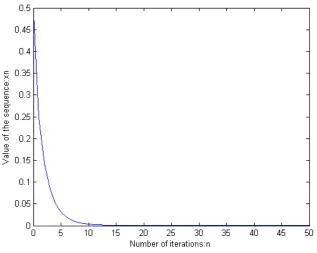
In this section, we discuss the direct application of Theorem 3.2 with a typical example on real line. LettingT :C ⊆E →C, then we consider the following:
E =R, C = [0,1], T x=x, αn=
1
n+ 1, βn= 1
2n2+ 1, δ = 1
2, ∀n ≥1
T here is nonexpansive which is particular case of our Theorem. Thus the scheme can be simplified as
xn+1 =
n(n2+ 1)
(n+ 1)(2n2+ 1) +
nn+2
(2n2+ 1)(n+ 1)n
xn, n ≥1. (4.1)
Figure 1: x1= 0.5, the convergence process of the sequnece{xn}generated by (4.1).
Acknowledgments
The author would like to thank Editors and the anonymous referees for their careful reading and suggestions.
References
[1] B. Ali, Common fixed points approximation for asymptotically nonexpansive semigroup in Banach space,ISRN Mathematical Analysis, vol.2011 Article ID 684158, 14 pages, 2011.
[2] B. Ali,Convergence of a Hybrid iterative scheme for fixed points of nonexpansive maps, solutions of Equilibrium and variational inequalities problems, J. Maths. Articl ID: 370143, 11 pages Doi: 10.1155/2013/370143.
[3] B. Ali and G.C. Ugwunnadi, Convergence theorem for a family of generalized asymptotically nonexpan-sive semigroup in Banach Spaces, Int. J. Math. and Math’l Sc., Vol. 2012, Article ID 986426, 16 pages doi:10.1155/2012/986426.
[4] B. Ali, G.C. Ugwunnadi and Y. Shehu: A general iterative algorithm for nonexpansive mappings in Banach spaces,(English summary), Ann. Funct. Anal. 2 (2011) 10–21.
[5] W. L. Bynum,Normal structure coefficients for Banach spaces, Pacific J. Math. 86 (1980) 427–436.
[6] C. Byrne,A unified treatment of some iterative algorithms in signal processing and image reconstruction, Inverse Problems 20 (2004) 103–120.
[7] C.E. Chidume, Geometric properties of Banach spaces and nonlinear iterations, Springer Verlag Series: Lecture Notes in Mathematics, Vol. 1965 (2009), XVII, 326p, ISBN 978-1-84882-189-7.
[8] C.E. Chidume, E.U. Ofoedu and H. Zegeye;Strong and weak convergence theorems for asymptotically nonexpan-sive mappings, J. Math. Anal. Appl. 280 (2003) 364–374.
[9] C.E. Chidume and N. Shahzad,Strong convergence of an implicit iteration process for a finite family of nonex-pansive mappings, Nonlinear Anal. 62 (2005) 1149–1156.
[11] D. Dukic, L.J. Paunovic and S. Radenovic, Convergence of iterates with errors of uniformly quasi-Lipschitzian mappings in cone metric spaces, Kragujevac J. Math. 35 (2011) 399–410.
[12] A. Genel and J. Lindenstraus,An example concering fixed points,Israel J. Math. 22 (1975) 81–86.
[13] O. Gler, On the convergence of the proximal point algorithm for convex optimization, SIAM J. Control Optim. 29 (1991) 403–419.
[14] K. Goebel and W.A. Kirk,A fixed point theorem for asymptotically nonexpansive mappings, Proc. Amer. Math. Soc. 35 (1972) 171–174.
[15] J. Gornicki, Weak convergence theorems for asymptotically nonexpansive mappings in formly convex Banach spaces,Comment, Math. Univ. Carolin. 30 (1989) 249–485.
[16] J.P. Gossez, D.E. Lami, Some geometric properties related to the fixed point theory for nonexpansive mappings, Pacific J. Math. 40 (1972) 565–573.
[17] F. Gu,On the convergence of a parallel iterative algorithm for two finite families of uniformly L-Lipschitzian mappings, Bull. Malays. Math. Sci. Soc. 34 (2011) 591–599.
[18] S. Ishikawa,Fixed point by a new iteration method,Proc. Amer. Math. Soc. 44 (1974) 147–150.
[19] L. ´Ciri´c, A. Rafiq, S. Radenovi´c, M. Rajovi´c and J.S. Ume, On Mann implicit iterations for strongly accretive and strongly pseudo-contractive mappings, Appl. Math. Comput. 198 (2008) 128–137.
[20] W.R. Mann,Mean value methods in iteration, Proc. Am. Math. Soc. 4 (1953) 506–610.
[21] M.O. Osilike and S.C. Aniagbosor, Weak and strong convergence theorems for fixed points of asymptotically nonexpansive mappings,Math. Comput. Model. 32 (2000) 1181–1191.
[22] Q.-B. Zhang and C.-Z. Cheng,Strong convergence theorem for a family of Lipschitz pseudocontractive mappings in Hilbert space,Math. Comput. Model. 48 (2008) 480–485.
[23] X. Qin, Y.J. Cho and S.M. Kang,An iterative method for an infinite family of nonexpansive mappings in Hilbert spaces, Bull. Malays. Math. Sci. Soc. 32 (2009) 161–171.
[24] A. Razani and M. Yazdi: Anew iterative method for nonexpansive mappings in Hilbert spaces, J. Nonlinear Anal. Optim. 3 (2012) 85–92.
[25] B.E. Rhoades, Fixed point iteration methods for certain nonlinear mappings, J. Math. Anal. Appl. 183 (1994) 118–120.
[26] T.C. Lim,Characterization of normal structure, Proc. Amer. Math. Soc. 43 (1974) 313–319.
[27] T.C. Lim and H.K. Xu, Fixed point theorems for asymptotically nonexpansive mappings, Nonlinear Anal. 22 (1994) 1345–1355.
[28] S. Reich,Weak convergence theorems for nonexpansive mappings in Banach spaces, J.Math. Anal. Appl. 67 (1979) 274–276.
[29] K. Nakajo and W. Takahashi,Strong convergence theorems for nonexpansive mappings and nonexpansive semi-groups, J. Math. Anal. Appl. 279 (2003) 372–379.
[30] Y. Shehu and G.C. Ugwunnadi,Convergence Theorems for multi-valued mappings, Bull. Malays. Math. Sci. Soc. 37 (2014) 359–367.
[31] J. Schu, Weak and strong convergence of fixed points of asymptotically nonexpansive mappings, Bull. Austral. Math. Soc. 43 (1991) 153–159.
[32] T. Suzuki,Strong convergence of Krasnoselskii and Mann’s type sequences for one-parameter nonexpansive semi-groups without Bochner integrals,J. Math. Anal. Appl. 305 (2005) 227–239.
[33] Z.M. Wang, M.K. Kang, Y.J. Cho, Convergence theorems based on the shrinking projection method for hemi-relatively nonexpansive mappings, variational inequalities and equilibrium problems.(English summary), Banach J. Math. Anal. 6 (2012) 11–34.
[34] H.K. Xu,Iterative algorithms for nonlinear operators, J. London Math. Soc. 66 (2002) 240–256.
[35] Y. Yao, H. Zhou and Y.C. Liou, Strong convergence of a modified Krasnoselski-Mann iterative algorithm for nonexpansive mappings,J. Appl. Math. Comput. 29 (2009) 383–389.
[36] Y. Shehu and G.C. Ugwunnadi, Approximation of Fixed Points of Nonexpansive Mappings by Modified Krasnoselski-Mann Iterative Algorithm in Banach Space, Thai J. Math. 13 (2013) 405–419.