M
ODULE
-4
F
UELS
&
COMBUSTION
Engineering Chemistry-I (CHE-1001)
Fuels can be defined as energy rich chemicals which yield energy by a process of combustion (oxidation) and get converted to energy deficient compounds.
Carbon, constituting coal and petroleum, is oxidized to carbon dioxide and hydrogen to water with the simultaneous release of energy.
Fuels can be classified on the basis of their occurrence:
1. Natural or primary fuels:
Fuels which are found in nature as such are called natural fuels. E.g., wood, coal, peat, petroleum and natural gas.
2. Artificial or secondary fuels:
Fuels which are prepared artificially generally from primary fuels are called secondary fuels.
E.g., coke, kerosene oil, petrol, coal gas etc.
Fuels are classified on the basis of the physical state of their
natural existence:
Types of fuels
Solid fuels
Liquid fuels
Solid fuels have moderate ignition temperature and also have the advantages of low cost of production, safety against spontaneous explosion and convenience of transport and storage.
However, the calorific value and thermal efficiency of solid fuels are low due to the constituent moisture and ash content.
Solid fuels require a large excess of air for complete combustion and they burn with clinker formation blocking the circulation of air and corroding the grate bars in the furnace.
The combustion process of solid fuels cannot be controlled easily.
CHARACTERISTICS OF SOLID FUEL
Primary fuels: Coal is the only solid primary fuel of industrial importance. Wood, another primary solid fuel, is relatively cheap but inefficient.
Secondary fuels: Charcoal and coke, obtained from coal are secondary solid fuels.
Liquid fuels have higher calorific value per unit mass of fuel compared to solid fuels.
They require less amount of air for complete combustion than solid fuels.
The combustion process can be easily controlled by regulating the flow of the liquid fuel.
The products of combustion are relatively clean, free from dust and soot. Liquid fuels can be used in internal combustion engines unlike solid fuels. The liquid fuels have certain disadvantages such as high cost of production and storage, risk of fire hazard, requirement of special burners and bad odour.
LIQUID FUELS
Crude petroleum is the primary liquid fuel from which secondary fuels such as liquefied petroleum gas (LPG), petrol, kerosene and diesel are derived by refinery processes.
Natural gas is the primary gaseous fuel obtained from on-shore and off-shore gas wells.
Secondary gaseous fuels obtained from coal include coal gas, producer gas and water gas.
Gaseous fuels have greater advantages compared to solid and liquid fuels in that they have relatively higher calorific value.
They burn completely with a slight excess of air achieving higher temperatures without any smoke or ash formation and hence are environmentally clean.
The combustion process can be easily controlled to suit the requirements of variation of temperature, length of flame and change in atmosphere (oxidizing or reducing).
Gaseous fuels can be preheated from hot waste gases and thereby enhancing the economic recovery of heat.
They also find use in internal combustion engines.
The disadvantages of gaseous fuels include their high cost of production and high risk of fire hazard.
High calorific value
Moderate ignition temperature (Ignition temperature is the lowest temperature to which the fuel must be heated for spontaneous smooth burning).
Low moisture content: Moisture content decreases the calorific value of the fuel as well as the cost of handling, storing and transporting the fuel.
Low ash content:Ash is the non-combustible waste material obtained by burning coal, which decreases the heating value of the fuel and poses disposal problem. Ash forms clinkers hindering complete burning of the fuel.
The fuel should burn in air without producing too much of smoke. It should not undergo spontaneous combustion causing fire hazards.
The rate of combustion should be moderate to achieve the desired temperature quickly as a low rate will not produce the required higher temperature.
The combustion process should be easily controllable to start or stop depending on requirement.
Harmless combustion products: The combustion products liberated on burning the fuel should be harmless from health and environmental pollution points of view.
Calorific intensity: Calorific intensity should be high for a fuel so that it produces a small flame and the heat liberated by combustion is concentrated over relatively a small area and high local temperature is attained.
Economical: The fuel should be readily available, economical, easy to store and transport.
Calorific value of a fuel is defined as the total quantity of heat liberated by burning a unit mass or volume of fuel completely. The calorific value is expressed in terms of calories per gram (one calorie is the amount of heat required to raise the temperature of 1 gram of water through 1°C at 15°C.
Higher or gross calorific value (HCV or GCV): It is defined as the total amount of heat produced by burning completely one unit mass or volume of the fuel and allowing the combustion products to cool to room temperature (15 °C). It may be represented as; HCV = LCV + latent heat of water vapour.
Lower or net calorific value (LCV or NCV): It is defined as the net heat liberated by burning completely or unit mass or volume of the fuel and the combustion products are allowed to escape (in other words, LCV does not include the latent heat of steam or water vapour formed.
LCV can be calculated from a knowledge of the latent heat of steam, which is 587 k.cal/kg and the hydrogen content of the fuel and the fact that one part by mass of hydrogen produces 9 parts by mass of water, that is
Calorific value of a fuel is determined by burning a known amount of fuel under high-pressure oxygen atmosphere in a calorimeter and measuring the rise in temperature of the water surrounding the calorimeter.
The heat evolved is calculated from the rise in temperature.
Calorific value of solid and non-volatile liquid fuels is determined in a bomb calorimeter under constant volume conditions.
Boy’s gas calorimeter is used for the determination of calorific value of volatile liquids and gaseous fuels.
Principle: A known mass of the fuel is burnt and the quantity of heat produced is absorbed in water and measured.
Construction:
The apparatus consists of a cylindrical stainless steel reactor or bomb capable of withstanding pressures up to 50 atmospheres.
The bomb has a gas-tight screw cap and two stainless steel electrodes, an oxygen inlet valve and a pressure release valve.
The sample crucible is made of nickel or stainless steel and is supported by a ring attached to one of the electrodes.
The bomb is immersed in water placed in a copper calorimeter, which in turn is surrounded by an inner air jacket and an outer water jacket to prevent heat loss due to radiation.
The calorimeter is provided with electrically operated stirrer and a Beckmann thermometer to measure the rise in temperature accurately to 1/100th of a degree.
BOMB
CALORIMETER
Thermometer
Stirrer
full of water
ignition wire
Steel bomb
About 0.5 to 1.0 g of air dried sample fuel is weighed accurately in the sample crucible, which is then placed over the supporting ring within the bomb.
A fine magnesium fuse wire is placed on the fuel sample and stretched across the electrodes.
About 10 mL of water is introduced into the bomb to absorb any vapors of sulphuric acid and nitric acids formed during the combustion of the sample fuel.
The gas-tight screw cap is fitted and the bomb is filled with oxygen gas up to 25 atmospheric pressure.
A weighed quantity of water sufficient to submerge the bomb is taken in the weighed copper calorimeter (W grams) and the calorimeter in turn is placed in the air-jacket and the outer water-jacket.
The bomb is lowered into the calorimeter.
The water in the calorimeter is stirred and after a few minutes of equilibration the temperature of water is accurately measured.
The electrodes of the bomb are connected to a 6-12 volt battery to ignite the magnesium fuse wire.
The sample fuel burns and the heat liberated causes a rise in temperature of stirred water in the calorimeter.
The temperature of water is monitored at regular one-minute intervals till the temperature rises to a maximum and then falls at a uniform rate.
The stirring of water is stopped and the bomb is removed from the calorimeter and allowed to stand aside for about half-an-hour to allow the acid mist to settle within the bomb.
The amount of sulphuric and nitric acids formed during combustion are determined from this solution in order to determine sulphur and nitrogen content of the sample fuel.
S + 2H + 2O2 H2SO4 + heat N + 2H + 3O2 2HNO3 + heat
Determination of Sulphur content
Sulphur content is determined gravimetrically by precipitating the sulphuric acid formed as white ppt of BaSO4.
Determination of Nitrogen content
The nitrogen content is determined by titrating the nitric acid with a standard solution of base.
The amount of heat liberated by the known weight of sample fuel is the same as the heat absorbed by water and calorimetric setup.
The gross calorific value is calculated using the formula and expressed as cal/g or k.cal/kg.
m
t
t
w
W
)(
)]
[(
2
1Where ,
W is the weight of water take in the copper calorimeter in grams,
w is the water equivalent of calorimeter together with the bomb, stirrer and thermometer in grams,
t2 and t1 are the final and initial temperatures in °C, respectively and m is the weight of the fuel sample in grams.
The water equivalent of the apparatus and water in the calorimeter is determined experimentally by burning a known weight of a standard substance (whose calorific value is known) in the bomb calorimeter under identical conditions as used for the sample fuel.
Salicylic acid, benzoic acid or camphor are commonly used as standard substances for the determination of water equivalent of calorimeter and its contents.
Cooling correction is calculated as the product (t.dt) where t is the time taken to cool the water in the calorimeter from the maximum temperature to room temperature in minutes and dt is the rate of cooling (dt° min).
The formula incorporating these corrections is:
m ] correction wire fuse correction acid -) correction cooling t w)(t
[(W 2 1
Fuse wire correction to be incorporated in the above formula is
determined from the heat liberated by the same length of magnesium fuse wire in the absence of sample fuel (blank calorimeter experiment).
The acid concentration is obtained from the amount of sulphur and nitrogen present in the sample.
The acid correction is : 2.25 cal/mg of S, and
1.43 cal/ml of 0.1 N HNO3 formed.
The NCV of the fuel is calculated by subtracting the latent heat of water vapor formed during the combustion of m grams of fuel. The formula is:
NCV = GCV – (0.09 H × 587),
Air requirement for the combustion process is calculated to ensure the complete burning of the fuel.
The combustion process of fossil fuels in the presence of oxygen involves highly exothermic reactions with the formation of carbon dioxide and water as the major products of combustion.
Since air is used as the source of oxygen in the burning of fuels the flue gases contain nitrogen, apart from carbon dioxide and water vapor.
Minimum O2 required should be calculated on the basis of complete combustion.
The mass of any gas can be converted to its volume at certain temperature and pressure by assuming that the gas behaves ideally and using the gas equation:
PV = nRT
The total amount of hydrogen is either present in the combined form, such as H2O (non-combustible substances) or free form (available hydrogen).
The latter (available hydrogen) only takes part in combustion reaction.
Nitrogen, ash and CO2 present in the fuel or air are incombustible matters and hence do not take any oxygen during combustion.
The total amount of oxygen consumed by the fuel will thus be given by the sum of the amounts of oxygen required by the individual combustible
The following chemical principles are to be applied:
Substances always combine in definite proportions. These proportions are determined by their molecular masses. E.g.,
C(s) + O2(g) CO2(g) (Having mass proportion = 12:32:44)
22.4 L of any gas at 0°C and 760mm pressure (i.e. at STP) has a mass equal to its 1 mol, i.e., 22.4 L of O2 at STP will have a mass of 32 g.
Air contains 21% of oxygen by volume; and 23% of oxygen by mass.
Minimum oxygen required for combustion = Theoretical oxygen required – O2 present in the fuel.
O
H
O
H
CO
O
C
2
2
2
1
2
2
2
It is carried out to ascertain the composition of coal.
Ultimate analysis includes the estimation of carbon, hydrogen, sulphur, nitrogen and oxygen.
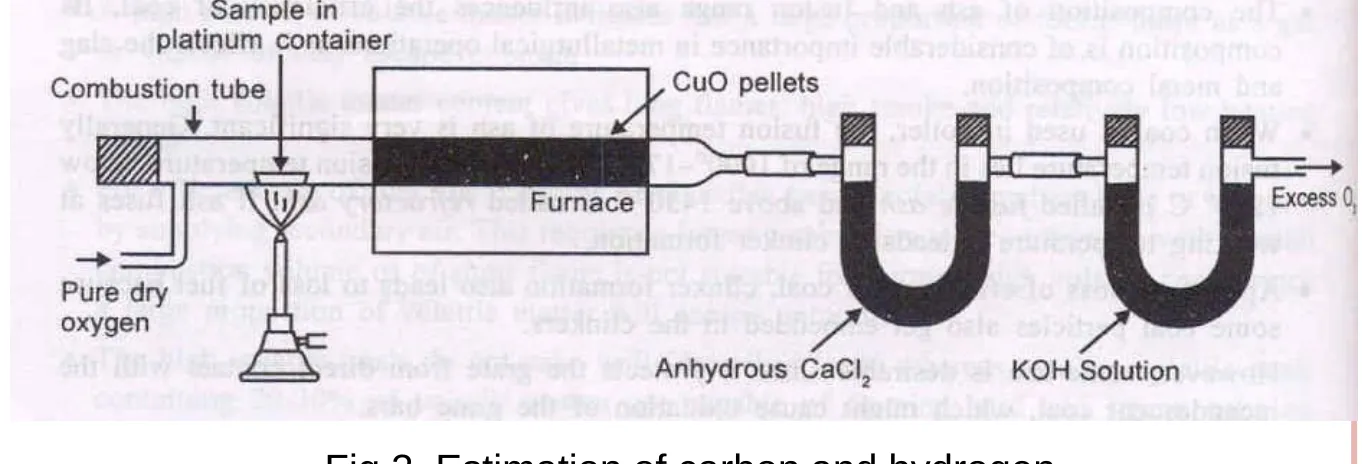
1. Carbon and Hydrogen: A known amount of coal is taken in a combustion tube and is burnt in excess of pure oxygen.
Fig 3. Estimation of carbon and hydrogen O H CaCl O H CaCl O H CO K CO KOH 2 7 . 2 2 7 2 2 3 2 2 2
44 g of CO2 contain = 12 g of carbon
Y g of CO2 contain = 12 y
taken coal of weight 100 44 12 carbon of
Percentage y
18 g of water contain = 2 g of hydrogen
Z g of water contain 182 zgof hydrogen
taken
coal
of
weight
100
18
2
hydrogen
of
Percentage
z
Calorific value of a fuel is directly related to its carbon content.
A higher percentage of carbon reduces the size of the combustion chamber
High percentage of hydrogen also increases the calorific value of coal. The content of hydrogen in coals varies between 4.5 to 6.5 percent from peat to bituminous stage.
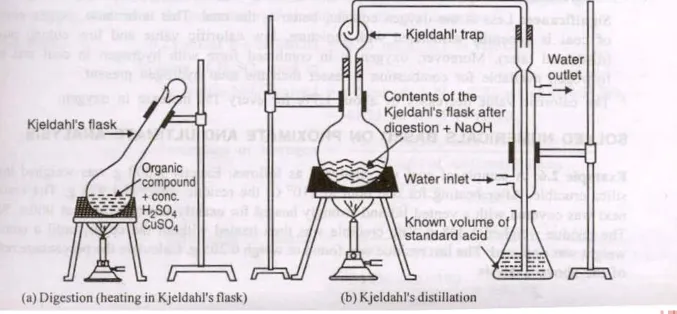
Nitrogen present in coal sample can be estimated by Kjeldahl’s method.
The contents are then transferred to a round bottomed flask and solution is heated with excess of NaOH.
The ammonia gas thus liberated is absorbed in a known volume of a standard solution of acid used.
4
2
)
4
(
Heat
4
2
Nitrogen
H
SO
NH
SO
The unused acid is then determined by titrating with NaOH. From the volume of acid used by NH3 liberated, the percentage of nitrogen can be calculated.
4
2
)
4
(
4
2
3
2
2
3
2
4
2
2
4
2
)
4
(
SO
NH
SO
H
NH
O
H
NH
SO
Na
NaOH
SO
NH
Proximate Analysis of Coal
Proximate analysis of coal is related with the determination of following points:
Moisture content
Volatile matter content Ash content
Moisture content:
When wet coal is exposed to atmosphere, it get dried but still there is some moisture in that coal. Such coal is known as air dried coal
That air dried moisture is determined by heating a known amount of coal (air dried) to 105-110 ºC in an electric hot air oven for about one hour.
Then it is cooled in a dessicator and weighed. Loss in weight of coal is reported as the moisture content on percentage basis.
taken
coal
of
weight
100
loss
content
moisture
Percentage
in
weight
Significance:
Excess of moisture is undesirable in coal. Moisture lowers the heating value of coal It also increases the transport cost
Presence of excessive moisture quenches fire in the furnace
Hence lesser the moisture content, better is the quality of coal as a fuel.
The volatile matter in coal consists of a complex mixture of gaseous and liquid products resulting from the thermal decomposition of coal. Volatile matter does not contain the moisture of coal
It is determined by heating a known amount of moisture free coal sample in a covered platinum crucible to 950 ± 20 ºC for 7 minutes
At this temperature hydrocarbons and hydrogen are driven off.
crucible is cooled, first in air, then inside a dessicator and weighed. Loss in weight of coal is reported as the moisture content on percentage basis.
taken coal free moisture of weight 100 loss matter volatile
Percentage in weight dueto removalof volatilematter
The high volatile matter content gives long flames, high smoke and relatively low heating values.
A high percentage of volatile matter indicates that a large proportion of fuel is burnt as gas or vapour or may escape unburnt.
A large apace is required to burn the highly volatile coal with the help of secondary air.
The coal containing less than 14 % of volatile matter do not cake at all are thus not suitable for manufacturing coke.
Volatile matter:
Coal contains mineral inorganic substances which are converted into ash by chemical reactions during the combustion of coal.
Ash mainly consists of silica, alumina, iron oxide ad small quantities of lime, magnesia etc.
It is determined by heating the residue left after the removal of volatile matter at 700 ± 50 ºC for about half an hour without covering.
Then it is cooled in a dessicator and weighed. Loss in weight of coal is reported as the moisture content on percentage basis.
Ash is of two types: intrinsic ash and extrinsic ash
Intrinsic ash:
the mineral matter originally present in the vegetable matter from which the coal was formed is called intrinsic ash. It consists of Na, k, Mg, Ca and Si.Extrinsic ash:
the mineral matter, like clay, gypsum, dirt which gets mixed up during mining and handling of coal constitute the extrinsic ash which remains as a residue after the combustion. It may consist of anhydrous CaSO4, CaCO3, Fe2O3 etc.taken
coal
of
weight
100
content
ash
Percentage
weight
of
residue
left
The high percentage of ash is undesirable. It does not contribute to the calorific value and creates many difficulties in efficient utilization of coal.
In furnace grate, ash may restrict the passage of air and lower the rate of combustion.
High amount of ash leads to large heat losses and cause problems of clinkering. It has been estimated that the 1% increase in ash equivalent to 0.3-0.4 % decrease in boiler efficiency.
When coal is used in the boiler, the fusion temperature of ash is very significant. Generally fusion temperature lies in the range 1000-1700 ºC. Ash having fusion temperature below 1200 ºC is called fusible ash and above 1430 ºC is called refractory ash. If ash fuses at working temperature it leads to clinker formation.
Apart from loss of efficiency of coal clinker formation also leads to loss of fuel. Because some coal particles also get embedded in the linkers.
However, some ash is desirable since it protects the grate from direct contact with the incandescent coal, which might cause oxidation of grate bars.
Fixed carbon content increases from low ranking coals such as lignite to high ranking coals like anthracite.
Higher is the percentage of fixed carbon greater is its calorific value and better is the quality of coal.
This represents the quantity of carbon which can be burnt by a primary current of air.
The percentage of fixed carbon is given by
% fixed carbon = 100 – (% moisture content + % volatile matter + % ash content)
Significance:
Higher the percentage of fixed carbon, greater is the calorific value.
The percentage of fixed carbon helps in designing the furnace and shape of the fire box because it is the fixed carbon that burns in the solid state.
It is the process of heating the coal in absence of air to a sufficiently high temperature, so that the coal undergoes decomposition and yields a residue which is richer in carbon content than the original fuel.
some coals have a tendency to soften and swell at higher temperatures, to form a solid coherent mass with porous structure. Such coals are called caking coals. The residue formed is called coke.
If the coke is hard, porous and strong, than the coal, from which it is formed, it is called coking coal.
This property is found only in bituminous type of coal.
Coals with a high percentage of volatile matter are not fit for coking and are used for gas making. The coals having 20-30 % volatile matter are good coking coals.
Carbonization of Coal (Manufacture of Coke)
First moisture and occluded gases are driven off.
At about 260-270oC carbon, water, H
2S, some low molecular alkenes
and alkanes are evolved.
At about 350oC the decomposition of coal is accompanied by evolution
of gases and elimination of tarry vapours takes place.
At about 400oC, caking coal becomes soft and plastic.
At about 700oC, hydrogen is evolved
Above 800oC, main gaseous products are evolved
Gases evolved from the plastic mass, expand it to give foam like appearance.
At further high temperatures this foam like mass solidifies to form a solid mass with porous structure called coke.
(i) Low temperature carbonization
(ii) High temperature carbonization
When the destructive distillation of coal is carried out at temperatures between 500-700oC.
It is practiced for the production of semi coke. Which is also called soft coke.
The yield of coke is about 75-80 %.
The coke thus produced contains 5 to 15 % volatile matter.
The various products of low temperature carbonization are semi coke, low temperature tar, crude low temperature spirit and gas.
Types of carbonization
It is carried out at 900-1200oC. HTC is used for the production of pure,
hard, strong and porous metallurgical coke containing 1-3 % volatile matter. The yield of the coke is 65-75%.
The byproducts-gas and tar have greater amounts of aromatic hydrocarbons. The gas which is obtained has lower calorific value of about 5000-6000 kcal/m3 than that produced in LTC; but the yield of the gas is higher.
The coke obtained is very much harder than the coke obtained from LTC process and hence is called hard coke.
LTC plants normally use low rank coals. These low rank coals produce excessive smoke on burning.
Semi coke from LTC is highly reactive and can be easily ignited into a smokeless flame
The gas which is obtained as a byproduct has higher calorific value of about 6500-9500 kcal/m3.
The properties of coke depend on porosity, reactivity and the amount of volatile matter retained by coke during carbonization. Coke is mainly used as a heat source and reducing agent in metallurgy. A good coke in metallurgical process should possess the following characteristics:
Purity: The metallurgical coke should contain lower percentage of moisture, ash, sulphur and phosphorous.
Porosity: The coke should be porous so as to provide contact between carbon and oxygen.
Strength: The coke used in metallurgical process should have high strength so as to withstand the weight of the ore, flux etc. in the furnace.
Size: Metallurgical coke should be of medium size.
Combustibility: Coke should burn easily. The combustibility of coke depends on the nature of the coal, carbonization temperature and reaction temperature.
Calorific value: It should be high.
Reactivity: Reactivity of coke is its ability to react with CO2, steam, air and oxygen. The reactivity should not be too high. The reactivity toward CO2 represent the reduction of CO2
)
(
2
)
(
)
(
2
g
C
s
CO
g
CO
(i) Beehive Oven
(ii) Otto Hoffmann oven
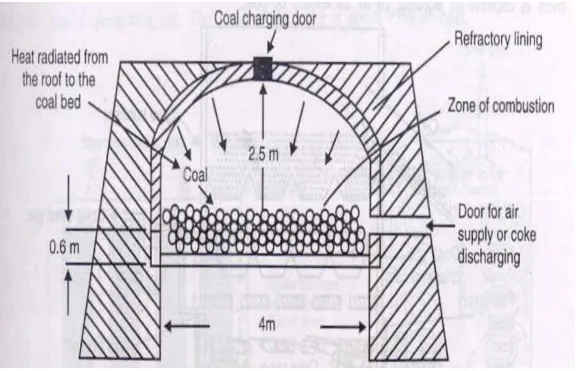
(i) Beehive oven: A beehive oven is a fire-brick chamber having a dome-shaped structure. The dimensions of a typical oven are 4m and 2.5m high. The roof is provided with a hole for charging the coal from the top. Another hole, the discharging hole is provided in the circumference of the lower part of the wall. A number of ovens are built in a row with common walls between neighbouring ovens.
Manufacture of Metallurgical Coke:
The demerits are
No recovery of byproducts, which are useful chemicals and are allowed to escape.
Lower coke yield due to partial combustion
Lack of flexibility of operation
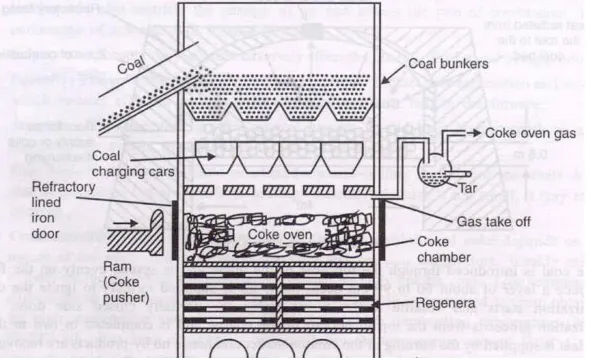
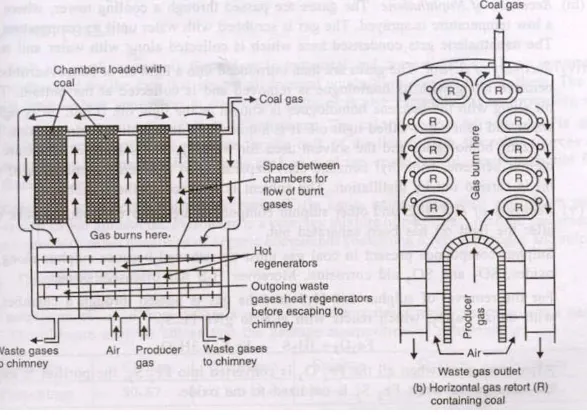
The beehive ovens have been replaced by chamber ovens which works on regenerative principle of heat economy. All the valuable products are recovered from the outgoing flue gases.
Construction: It consists of no. of narrow rectangular chambers made of silica bricks.
Coal is charged into the chamber.
The coke ovens are heated to 1200oC by burning gaseous fuels.
The process of carbonization takes place layer by layer in the coal charge.
As the coal adjacent to the oven walls gets heated, a plastic zone is formed which moves away from the walls towards the central zone.
As the coal is converted into coke, there is decrease in volume. This is because of the removal of volatile matter in the form of tar and gas at about 500oC. At further high temperature, the plastic mass solidifies into
hard and porous mass called coke.
Carbonization of a charge of coal takes about 11-18 hours. After the process is complete, red hot coke is pushed outside by means of a ram which is electrically driven. The coke falls into a quenching car. The yield is 75 % of coal.
Regenerative principle is employed to achieve as economical heating as possible.
Regenerators are built underneath the ovens.The flue gases pass their heat to the checker brick work of regenerators until the temperature rises to 1000oC.
The gases and vapours evolved on carbonization in coke ovens are not allowed to mix with the combustion and are collected separately.
The coke oven gas is treated separately for the recovery of the valuable byproducts.
Recovery of Tar: The gas from the coke ovens is passed through a tower in which liquor ammonia is sprayed.Tar and dust get collected in a tank. The tank is provided with a heating coils to recover back ammonia.
Recovery of ammonia: The gases are then passed through a tower where water is sprayed to recover ammonia. The ammonia can also be recovered by dissolving it in H2SO4 to form (NH4)2SO4, which is then used as a fertilizer.
Recovery of Naphthalene: The gases are passed through a cooling tower, where water at a low temperature is sprayed.The gas is scrubbed with water until its temp. reduces.
Recovery of H2S and other S compounds:
These are removed from the coke oven gas after the light oil has been separated out.
The SO2 obtained can be used for the manufacturing of sulphuric acid, which can be used to absorb NH3 from the coal gas.
O
H
S
Fe
S
H
O
Fe
2
3
3
2
2
3
3
2
The importance of liquid fuels is the fact that almost all combustion engines run on them.
The largest source of liquid fuels is petroleum. The calorific value of petroleum is about 40000 kJ/kg.
There are other supplements of liquid fuels such as coal tar, crude benzol, syntheic liquid fuel made from coal etc.
Liquid Fuels
The term petroleum means rock oil. It is also called mineral oil.
Petroleum is a complex mixture of paraffinic, olefinic and aromatic hydrocarbons with small quantities of organic compounds containing oxygen, nitrogen and sulphur.
It is defined as the percentage of iso octane present in a mixture of iso-octane and n-heptane, which has the same knocking characteristics as that of fuel under examination, under same set of conditions.
Thus a gasoline with an octane no of 80, would give the same knocking as a mixture of iso octane and n-heptane containing 80% of iso octane by
volume.
Greater the octane number, greater is the antiknock property of the fuel.
Octane number
Fuels required for diesel engine are in contrast to petrol engine fuels,
hence a separate scale is used to grade the diesel oils as they cannot be graded on octane number scale.
The cetane rating of a fuel depend upon the nature and composition of hydrocarbon.The straight chain hydrocarbons ignite quite readily while aromatics do not ignite easily. Ignition quality order among the constituents of diesel engine fuels in order of decreasing cetane no, is as follows:
n-alkanes> naphthenes > alkenes > branched alkanes > aromatics
The cetane number of a diesel oil is defined as the percentage of cetane in a mixture of cetane and a-methyl naphthalene which will have the same ignition characteristics as the fuel under test, under same set of conditions.
Cetane is n-hexadecane
It is the gaseous product of combustion of fuels in ovens and furnaces. When combustion is complete, flue gas consists of carbon dioxide, water vapour, nitrogen and excess oxygen.
Analysis of flue gases give an idea about the complete or incomplete combustion process.
If the analysis shows the presence of CO, It indicates the incomplete combustion of the fuel or shortage of oxygen. Hence the supply of oxygen is increased.
If the gas analysis shows the presence of high percentage of oxygen in flue gases then it shows that combustion is complete but the supply of air is much in excess.
If the analysis shows the presence of appreciable amounts of oxygen and carbon monoxide, it indicates that the combustion is irregular and non-uniform.
The fuel-air mixture should normally burn smoothly and rapidly in the internal combustion engine.
The fuel-air mixture may be heated to a temperature greater than the ignition temperature due to compression, resulting in spontaneous combustion even before sparking. This is called pre-ignition.
A self-ignition of the last portion of the fuel mixture can also occur after sparking because of the high temperature and the spreading flame front.
The pre-ignition and self-ignition of fuel-air mixture lead to an explosive combustion producing a shock wave within the cylinder.
The shock wave results in a rattling sound of the engine (called knocking) and dissipates the energy by hitting the cylindrical wall. Knocking results in a decreased power output besides causing
mechanical damage by overheating the cylinder.
The phenomenon of knocking has been attributed to the chemical reaction of cracking and oxidation of the fuel hydrocarbons by a chain mechanism.
The knocking tendency decreases in the order: n-alkanes > branched chain alkanes > cycloalkanes > alkenes > aromatics.
C6H6 + 3 ½ O2 2CO2 + 3H2O …..Normal combustion C6H6 + O2 CH3O-OCH3 …..Explosive combustion CH3O-OCH3 CH3CHO + H2O
CH3CHO + 1 ½ O2 HCHO + CO2 + H2O
HCHO +O2 CO2 + H2O
Octane number or rating is the percentage of octane in a mixture of iso-octane and n- heptane, which matches the knocking characteristics of the fuel under test under the same set of conditions.
Greater the octane number of gasoline greater is its resistance to knocking. The anti-knocking properties of gasoline can be improved by suitable additives.
Lead tertraethyl (TEL) is the most commonly used additive (0.05 to 0.1 %) to give leaded petrol. Lead and lead oxide formed as combustion products
inhibit the free radical chain reaction responsible for knocking.
Cetane number or value is the percentage of cetane in a mixture of cetane and α-methylnapthalene, which has the same ignition lag (long ignition delays lead to a fuel accumulation in the engine resulting in explosive combustion on ignition called diesel knock) as the diesel fuel under test.
The ignition quality of hydrocarbons decreases in the order: n-alkanes > napthalenes > alkenes > iso-alkenes > aromatics.
The cetane number of diesel fuel can be raised by the addition of pre-ignition dopes such as ethyl nitrate and iso-amyl nitrate.
The Diesel Index indicates the ignition quality of the fuel. It is found to correlate, approximately, to the cetane number of commercial
fuels. It is obtained by the following equation
Diesel Index and cetane number are usually about 50. Lower values will result in smoky exhaust
100
60
int
F
x
Degrees
API
gravity
F
po
aniline
Index
Diesel
o o
LPG contains hydrocarbons up to C-4 which can be readily liquefied at high pressures but remain as gases at atmospheric pressure.
The main constituents are propane and butane. The calorific value is about 25,000 kcal/m3.
LPG burns completely forming only non-hazardous carbon dioxide and water vapor and is hence environmentally safe.
LPG supplied in cylinders for domestic purposes is usually mixed with a small amount of sulphur compounds to facilitate leak detection.
Natural gas is the gaseous mixture that is associated with petroleum reservoirs, coal seams and decay of organic material.
It is a mixture of combustible hydrocarbons mainly methane (75-90%), ethane (10%), propane (3%) and smaller amounts of butane and higher paraffinic hydrocarbons.
It also contains nitrogen, hydrogen, carbon dioxide, hydrogen sulphide, water and traces of rare gases.
Methane component of natural gas is used as a fuel while other hydrocarbon components are separated and used as feedstock for production of chemical and liquid fuels.
Natural gas is processed to remove i) vapours of higher hydrocarbons by either condensation, or absorption in oil or adsorption on charcoal (or silica or alumina gel); and ii) other contaminants such as water, dust, hydrogen sulphide, carbon dioxide and nitrogen.
Carbon dioxide and hydrogen sulphide are removed by absorption of the contaminants with monoethanolamine.
The calorific value of natural gas varies between 8000 and 14000 kcal/m3.
Biodiesel is the clean burning fuel obtained from renewable resources such as vegetable oils.
These oils are converted to biodiesel by tans-esterification reaction with excess methanol in th presence if catalysts.
A mixture of methyl esters, formed as the product, is called the biodiesel and has the desired characteristics of diesel fuel with cetane numbers in the range of 50-62 depending on the vegetable oil used for trans-esterification.
Fatty Acid Alcohol Glycerin
Biodiesel
Vegetable Oil
Biodiesel can be used as an alternative fuel for compression ignition engine or can be blended with petroleum diesel and used.
Anaerobic (in the absence of air) digestion or fermentation of biological matter by bacteria gives biogas.
Natural gas is a biogas obtained by anaerobic fermentation of biological matter of animal and plant origin buried under earth’s crust over prolonged periods.
Similarly sewage can also be digested to give sewage gas.
A slurry of fresh cattle dung and water is allowed to undergo fermentation by naturally existing anaerobic bacteria in steel or concrete tank called digester or gobar gas plant.
The liberated gobar gas collects into the gasholder covering the digester. The gobar gas is a mixture of mainly methane (55%) and carbon dioxide (35%) together with small amounts of nitrogen (2-3 %) and hydrogen (7-8%) and traces of hydrogen sulphide and has a calorific value of about 5300 kcal/m3.
It is mostly used as a domestic fuel and aluminium.
Heat
O
H
CO
O
CH
4
2
2
2
2
2