!
Scuola di Dottorato in Scienze Psicologiche e della Formazione
XXVII° ciclo
PhD Thesis
DOES THE WAY WE INTERACT WITH TECHNOLOGY
AFFECT COGNITIVE PERFORMANCE?
An in-depth analysis of writing devices
Supervisor:
Prof. Remo Job
Acknowledgements
I would like to express my special appreciation and thanks to my advisor Professor Dr. Remo JOB. You have been a model for me since your first lesson I had the pleasure to attend. The opportunity to stay under your wing during the Doctoral School was an honor. I would like to thank you for encouraging my research and for allowing me to grow as a researcher. Your advice has been priceless. I will never forget the hours passed reading my paper drafts discussing my work and your pleasant company during travels to China and Japan. There are no words to express my thanks for these great opportunities.
I cannot express enough gratitude to Dr. Marieke LONGCAMP and Dr. Jean-Luc VELAY. You were mentors in inspiring my work during the preparation of my doctoral thesis. The opportunity to know you personally and working beside you was a gift. I also want to thank you for your kindness and hospitality during my stay in Marseille. Most of the experimental work in this thesis is due to your help, but most of all, my knowledge on the topic of typing and my skills in research are due to your encouragement and to the challenges our work gave us.
Also thanks to Dr. Francis-Xavier ALARIO for the precious comments and suggestions during the analysis and the final draft of our study. In addition, I appreciate Dr. Marianne VAUGOYEAU’s help during the long months passed running the experiments.
Thanks to the Laboratoire de Neurosciences Cognitives at Aix-Marseille Université for allowing me to conduct my internship and to the beautiful people and good scientists I met.
my first study, Professor Dr. Francesco VESPIGNANI by helping me in my first approaches to R and Dr. Wibke HACHMANN who kindly revised the final draft.
A special thanks to my family. Words cannot express how grateful I am to my mother and to my father for all of the sacrifices that you have made on my behalf. Your prayers for me were what sustained me thus far. None of my successes would’ve been possible without the love of my parents, my grandparents, my sister and my brother.
I would also like to thank all of my friends, in particular Ioana, Isabel, Gioia and Matteo, who supported me. Rovereto became the best place in the world thanks to you.
Finally, I would like to express appreciation to Vladimir who was always my support system in the moments when there was no one to answer my queries. Your patience and your love overthrew our distance.
This thesis is the end of a long-lasting dream. The opportunity to have attended this doctoral school and to present this thesis will remain one of the main delights in my life.
Index
General Introduction ………
11.
Handwriting versus typing: an embodied perspective….
71.1.
Technology and Cognition: Does the writing device we use constrain the way we retrieve word meanings? ……… 101.2.
Movements count: further analyses of the meaning-location congruency effect ………... 192.
Typing, mobile typing and motor expertise ………..
272.1.
Motor expertise for typing impacts word recognition …………... 302.2. Motor expertise in spelling recovery: the spelling probe task……… 41
2.3.
Two thumbs and one index: a comparison of manual coordination in touch typing and mobile typing ………... 503.
Mobile technologies and learning ………..
683.1.
Ergonomics: Possible Roles in Helping Literacy Acquisition in Developing Countries ……… 703.2.
Cognitive-Educational Constraints for Socially-Relevant MALL Technologies ………... 86General Conclusions ……….
96Supplementary Material ....………...
101General Introduction
“Writing is a technology”, claimed Ong (1986). Writing is a means by which we materialize our thoughts through a combination of intellectual and manual skills. Therefore, writing is a complex skill indispensable for shaping language development and manual abilities in children and to contribute to the intellectual development of all of us. Writing is extremely interiorized in our culture and in each literate human being in the way that “we cannot separate it from ourselves or even recognize its presence and influence” (Ong, 1986, p.24).
The main technological tools dedicated to writing can be divided into devices for handwriting and devices for typing. On the one hand, we can cite touchscreens and graphic tablets on which we can handwrite directly with a pen and, on the other hand, classical keyboards and touchscreen keyboards, with different sizes and configurations, on which we type with our hands or using other supports like touch pens.
Considering the different spatial, visual and tactile properties of each of these devices, it is intuitive that they allow different interactions that probably entail different cognitive performances. Nevertheless, the writing modalities they provide are those generally involved in traditional handwriting and in typing. In essence, the pen – on a paper or on a touchscreen – and the keyboard require different motor-perceptual mechanisms: on the one hand, in order to interact with handwriting devices we have to grasp a pen and manually draw letter by letter, on the other hand, in order to interact with typing devices we have to tap a set of keys that correspond to each letter.
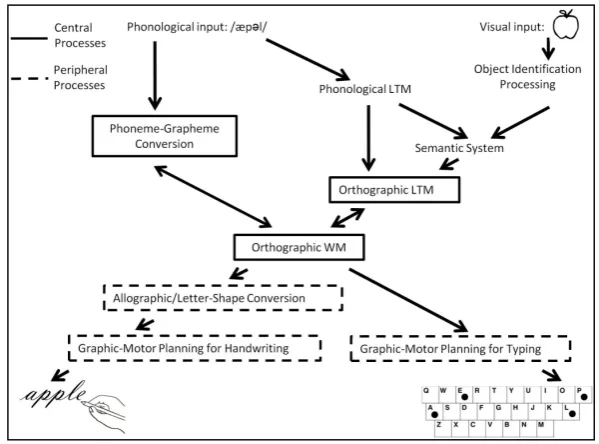
Fig. A. A schematic depiction of the cognitive architecture of the written word production system © 2011 Purcell, Turkeltaub, Eden and Rapp.
Peripheral processes are involved in the conversion of abstract letter strings into detailed motor information that is propagated down the motor system. This process is specific for different affordances depending on whether we have a pen and paper or a keyboard in front of us. On the one hand, during handwriting, specific letter forms are selected passing from the Letter-Shape Conversion to the Graphic Motor Planning process that assembles the letter forms. Then, an Effector-Specific Motor Program organizes the appropriate execution of the motor gesture. Typing, on the other hand, consists of a translation phase, during which the character is translated into a keypress schema that includes the planning of hand and finger motor commands, and, finally, an execution phase, during which the typing movement is executed.
the keyboard involves both hands without grapho-motor movements implicated, but a sequence of keypress schemata. Accordingly, motor execution programs constitute great differences. In detail, handwriting movements implicate the execution of graphic shapes, associating each letter or stroke with its specific movement, each visual shape with its motor program. In typing, there is an activation of keypress schemata that transforms the visual form of each letter into a movement of fingers, palms and arms to a given key. A good hand-writer reaches a high level of standardization of the idiosyncratic movement necessary to draw the letter; a good typist has to be fast and accurate in reaching keys with a precise association between ten fingers and letter positions (Mangen, 2014). Another difference regards visual attention. It is focused on one point in handwriting in the way that, during planning and execution of the movement, the regulation of spatiality contemporarily involves coordination and ego-centric and allo-centric reference frames (Purcell, Turkeltaub, Eden & Rapp, 2011). Conversely, writing trough the keyboard splits visual attention – focused on the screen – and the haptic input – focused on the keys. In this case, the spatiality of the limbs movement is associated uniquely with the position of the keys on the keyboard. In comparison with the classical PC, recent tablet technologies reduced the space between keys and screen, shortening the oscillation of visual attention, but no evidence demonstrated a benefit of this reduction (Mangen, 2014). Therefore, it is intuitive that the speed of writing differs: handwriting is typically slower. Skilled writers can produce a cursive script at a rhythm of six strokes per second (van Galen, 1990), whereas a skilled typist can reach a mean interval between keystrokes of 60 msec and 200 words per minute (Rumelhart & Norman, 1982).
technologies for handwriting, on the one hand, and for typing, on the other hand, have to be compared in order to know if different devices and affordances affect these writing processes.
This thesis sustain that it is reasonable to think that the motor-perceptual differences between the two writing modalities can lead to different cognitive performances in linguistic tasks, depending on the writing movement that has to be performed but also on the experience that we have with this movement. Given the large diffusion of different technologies, it is more and more interesting to observe and analyze the differences that these technologies evoke not only in writing but also in other tasks where linguistic knowledge has to be mobilized. Is it possible that the use of digital devices for writing affects higher and lower cognitive processes? And if so, how is this influence characterized?
The aim of the present thesis is to analyze different behaviors while we use different writing technologies and to discuss the findings from a cognitive science point of view. The thesis is presented like a collection of papers, results of my research activity and experiences during my participation in the doctoral school. I divided my work in three separate chapters in which different research points of views are analyzed, different experimental procedures are used and different technological devices for writing are tested.
In Chapter 1, I report a study aimed at investigating whether technologically mediated linguistic performance reflects cross-modal interaction and whether it is modulated by the technology used. We compared the use of a pen on a touchscreen and of a classical keyboard during a writing task where semantic-spatial information has to be recovered and made specific reference to previous findings in the field of embodied cognition that were never tested in writing tasks before.
our linguistic abilities. The second part of the chapter (Paragraph 2.3) is dedicated to a study that represents a new incentive to writing technologies research. We compared typing performances on a classical keyboard and on a mobile phone touchscreen keyboard to reason on the possibility that the two writing devices are used in a similar manner given the same configuration of keys in spite of the haptic differences during typing. The aim was to test if the typical bimanual advantage of typing on a keyboard can be observed also on a mobile device.
Mobile technologies are the argument of Chapter 3 in which I present two theoretical papers dedicated to the potential of these devices for learning, in general, and for second language learning, in particular. This dissertation adds to the wider discussion on the influence of Information and Communication Technologies in education and on how the new and old technologies can be useful in those developmental situations where economic, social and educational resources are very limited.
Finally, the General Conclusions of the thesis aims to inspire future work to favoring a multidisciplinary research approach that includes the motor knowledge of writing with different technologies in literacy acquisition.
Chapter 1
Handwriting versus typing: an embodied
perspective
It is known that our movements organize our perception and help in shaping our spatial representations (Viviani, 2002). Starting from infancy, we learn to associate actions and the corresponding visual and tactile perception building coherent and unified representations of objects. Motor theories of perception and, in particular, the embodied cognition theory are relevant in this context. These theories support the idea of a mental simulation of actions, even when these actions are simply observed. In detail, the embodied cognition approach emphasizes the influence of the body on cognitive processes and considers that cognition is intrinsically built and shaped by body fundamentals derived from the direct experience with the world, therefore through perception and motor actions (for reviews see Anderson, 2003; Barsalou, 2008; Fischer & Zwaan, 2008; Grafton, 2009). To sustain this theory, numerous behavioural and neuroimaging studies locate cerebral motor structures that are activated during the visual presentation of images of objects to which a specific action can be attributed, but also during the observation of actions performed by others (for reviews, see Grèzes & Decety, 2001; Martin & Chao, 2001).
Šetić & Domijan, 2007; Estes, Verges & Barsalou, 2008; Fischer & Zwaan, 2008; Nazir, Jeannerod & Hauk, 2008; Pecher, van Dantzig, Boot, Zanolie, & Huber, 2010).
With regard to writing, Longcamp, Anton, Roth and Velay (2003; 2005a) focused on alphabetic characters, that according to these authors are treated as objects to which we associate specific writing movements. They examined the relationship of the peripheral motor components of writing letters and characters to the subsequent recognition performances, sustaining that the cerebral representation of letters, instead of being strictly visual, can be based on a complex neural network that includes motor-perceptual components acquired through the concomitant learning of reading and writing. In detail, these authors discovered an activation of motor patterns usually involved in handwriting during the recognition of previously learned letters and characters (see also Ouellette, 2010; Shahar-Yames & Share, 2008; Bosse, Chaves & Valdois, 2014; Bara & Gentaz, 2011). In the typing domain, a similar automatic activation of motor patterns was observed in skilled typists that it has been attributed to the overlearning of keypress patterns. For example, the work of Rieger (2004) showed a strong effect of congruency during the discrimination of letter colors: skilled typists were faster when the responding finger for the color discrimination task was the one usually used to type the respective target letter (see also Van den Bergh, 1990; Beilock & Holt, 2007; Yang, Gallo & Beilock, 2009). Further discussion on this topic is addressed in Paragraph 2.1.
The cited studies about the impact of different writing modalities on letter recognition stand isolated in the panorama of writing research and of the embodied cognition approach. Furthermore, there is a shortage of studies that investigate the recovery of semantic and sensorimotor information during language production (Nazir et al., 2008).
In the present chapter, I report a study that aims to contribute to closing this gap in writing modalities research and in the embodiment approach to language comprehension in using a comparison of different writing tools in a production task. Our hypothesis claims that semantically relevant representations are recovered during the production of written code. In particular, we compared handwriting and typing technologies – in detail a pen on a touchscreen and a classical keyboard – in a cross-modal interaction task where we tested the presence of the spatial iconicity effect, which indicates the systematic encoding of the representation of stimulus location during perception.
1.1
Technology and Cognition: Does the device we use constrain the
way we retrieve word meanings?
Cerni Tania & Job Remo
Department of Psychology and Cognitive Science University of Trento, Italy
Published as:
Cerni, T, & Job, R. (2013). Technology and Cognition: Does the Device We Use Constrain the Way We Retrieve Word Meanings? In T. Yoshida, G. Kou, A. Skowron, J. Cao, H. Hacid, & N. Zhong (Eds.), Active Media Technology. 9th International Conference, AMT 2013, Maebashi, Japan, October 29-31. (pp. 251-257). Lecture Notes in Computer Science, Vol. 8210. Springer International Publishing Switzerland.
Abstract. We examined the possible implication of two different technological tools, the touchscreen and the keyboard, on cross-modal interaction in writing. To do this, we revisit experiments (e.g. Šetić & Domijan, 2007) that investigated the recovery of spatial iconicity in semantic judgment and applied them in writing to dictation. In the present experiment participants had to type or to handwrite on a touchscreen, in the upper part or in the lower part of the screen, words whose referents are typically associated with the top or the bottom part of space. In this way congruent (e.g. “cloud” at the top of the screen) or incongruent (e.g. “cloud at the bottom of the screen) conditions were created. The hypothesis was that incongruent conditions give rise to a delay in starting to write more pronounced for touchscreen session than for the keyboard one. Results are discussed in terms of embodied cognition theory.
Introduction
Do technologies shape cognition, and/or does the way people use and interact with technologies affect their performance in cognitive tasks? The response to both questions are clearly positive if we consider broad levels of analyses (e.g. Pezzulo, Barsalou, Cangelosi, Fischer, McRae & Spivey, 2013), but empirical evidence is still lacking for more focused, fine-grained analyses of specific tasks. In this paper we report a study aimed at investigating whether technologically mediated linguistic performance reflects cross-modal interaction and whether it is modulated by the technology used. To do so we will focus on some effects that have been motivated by the embodied approach to cognition.
Accounts of embodied cognition propose that perceptual and motor aspects of a word meaning are intimately related, and this may have implication for language processing as well as for language representation. Specifically, the view that language is closely linked to perceptual and motor representations allows postulating that perceptual and motor aspects of meaning are activated during language processing and may thus interact with the actual processing of the linguistic message. To illustrate, recognizing a word or a sentence would require the re-enactment of the perceptual and motor-related processing performed during actual learning and everyday experiences with the concept the word refers to (see, among others, Zwaan & Yaxley, 2003; Šetić & Domijan, 2007; Estes, Verges & Barsalou, 2008; Pecher, Van Dantzig, Boot, Zanolie & Huber, 2010).
and participants move their hand in the same direction (i.e. away from the body) to respond responses are faster than in the condition in which the sentence meaning and the direction of the response are incongruent; (c) response position, such that congruency between the directionality of an action implied by a verb and the location of the response key with respect to the body speed up response time (Job, Treccani & Mulatti, 2011).
While accounts of these results have been offered that did not make reference to the embodied approach (e.g. Job, Treccani & Mulatti, 2011; Lakens, 2011) the pattern show a congruency effect between the meaning of the words and the locations of the stimuli on the screen.
Most of the studies have focused on reading (and comprehension) while only few have addressed writing (and production). Among the latter, Jasmine and Casasanto (2012) have reported the QWERTY effect, named after the disposition of the keys on the keyboard. Some words are spelled with more letters on the right side of the keyboard and others with more letters on the left side, and the authors found a relationship between the emotional valence of the words and key position so that words with more letters on the right were rated as more positive than words with more letters on the left. Interestingly, the effect was stronger for more recently coined words.
In this study we report an experiment in which we investigated whether the interaction between perception and language reported by Šetić and Domijan (2007) would emerge in writing. Furthermore, we investigated whether the technical device used for writing modulates the participants’ performance. Specifically, we used both a touchscreen and a keyboard, on the assumption that the use of the pen on the touchscreen would favor the asymmetry between congruent and incongruent location effect while the keyboard would be less prone to let the effect to emerge.
Methods
course credits. In a brief pre-experimental sessions each participant completed a short questionnaire about his/her habits of writing with pen, keyboard and touchscreen in order to expunge participants unfamiliar with any of these devices.
Procedure. A set of 40 Italian words referring to animals and 40 referring to objects were selected. In each category, half of the concepts had a typical location at the top (i.e. eagle, sky) and a half at the bottom (i.e. mouse, carpet) of space. All 80 words were vocally registered with Cool Edit Pro 2.0 reducing rumor and hiss and controlling the length of the silence at the beginning and at the end of each word (120 ms).
The experimental procedure consisted of two writing conditions performed in succession by each participant. In the first condition, participants had to manually write with a pen on a touchscreen (LG FLATRON T1910); in the second condition, participants had to write with the keyboard with the support of the same screen used as a normal computer screen.
All of the 80 words were automatically dictated by the computer in each condition.
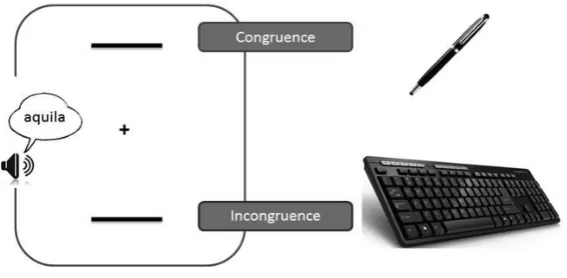
Fig. 1.A. Schematic pattern of the experimental design
Each word was presented twice so that one time it was written at the top and one time at the bottom of the screen for each writing condition (pen vs. keyboard) for a total of 160 stimuli divided into four blocks per condition. In this way, a congruent (i.e. eagle at the top of the screen) and an incongruent (i.e. eagle at the bottom of the screen) condition was devised. Words presentation was random for each block and for each participant with the only constraint that the same word did not appear in the same block or in consecutive blocks.
The difference between the procedures of the two conditions consisted in the input system of writing. For the handwriting condition, the experimenter fixed the screen in a sloping position in order to facilitate writing on the screen and to prevent fatigue of the arm. During the experiment, the participant had to position the pen at the center of the screen, on a specified fixed point. When the software recorded the position of the pen, the audio of the word started. In this way we are able to control the position of the participant for every trial. Then, when the participant finished writing, he/she had to return to the central point to stop the current trial and to begin the next.
letters of the keyboard, the participants were instructed to put the hands on the space bar and to keep it pressed. This input activated the audio of the word and, once the line appeared on the screen, the participants had to release the bar and write the corresponding word. The end of the trial coincided with the press of the enter key and then the return to the bar space to hear the next word.
Participants were instructed to be fast an accurate. Reaction time from the presentation of the to-be-written-on line to the beginning of writing was registered and collected. At the beginning of each condition, a brief training was administered that contained, unlike the experiment, some comprehension questions to verify access to the meaning of the dictated words. The stimuli were seven words, without any specific reference to the top or to the bottom of the space. Associated with three of these words we used three simple yes-no questions (“is it an object?”, “is it an animal?”, “has it the wings?”) that the participant answered orally, for handwriting condition, and pressing the corresponding keys, for the keyboard condition. Erroneous responses were very few (. 17), confirming access to semantics in this condition.
Results
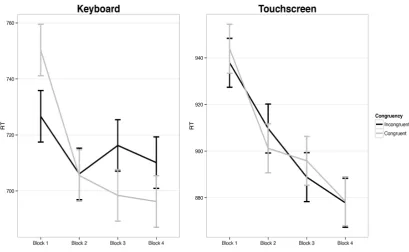
Response times (RTs) shorter than 250 ms and longer than 2000 ms (3%) and errors (0,13%) were eliminated and did not enter into any of the following analyses. RTs for correct responses are plotted in Figure 1.B, separately for touchscreen and keyboard, as a function of the condition (congruent vs. incongruent) and block (1 to 4). A repeated measure ANOVA with device (touchscreen and keyboard) and location congruency (congruent and incongruent) was run on the RTs. The effect of the device is significant (F1 (1,23) = 16.9, F2 (1,79) = 48.6), with responses via keyboard being faster than response via touchscreen. The effect of the location congruency is not significant (Fs < 1): independently from the writing device, words written in a congruent or in an incongruent location were equally fast.
continuously across blocks while for the keyboard, after an increased from block 1 to block 2 there is no further increase from block 2 to block 4 (paired t-test: t (23) = 3.44, p < .002).
Fig. 1.B. Plot of the RT means along the four experimental blocks
Discussion
Thus, the difference between the two different writing modalities may be ascribed to the different manual skills involved in each. Mangen and Velay (2010) point out that in handwriting we use only one hand and we are the maker of the shape of the letters but the keyboard involves both the hands without grapho-motor movements implicated.
Another difference regards visual attention that is focused on one point in handwriting, whereas writing trough the keyboard split visual attention - focused on the screen - and the haptic input - focused on the keys.
It is plausible to hypothesize that these manual variances have different cognitive consequences. Several studies show that memory for figures, alphabetic characters, and pseudo-characters are improved thanks to previous handwriting experiences, given the directed experimentation of the shape of the proposed stimuli in comparison with both the previous keyboard or the sole visual experiences (Longcamp, Zerbato-Poudou & Velay, 2005b; Longcamp, Boucard, Gilhodes & Velay, 2006; James & Atwood, 2009).
Furthermore, different cerebral structures mediating performance in the two writing modalities, and their links with other linguistic process – for example reading – have been identified (e.g. Longcamp, Hlushchuk & Hari, 2011; James & Engelhardt, 2012).
These theoretical proposals can be seen in connection with the embodied cognition approach, as they assume that the perceptual mechanisms involved in language are bounded with motor actions, here the action of writing.
The second finding from the study regards the issue of spatial iconicity in writing. Our attempt to replicate in writing the results reported by, e.g., Šetić and Domijan (2007) was not successful.
of the presented study show no difference between congruent and incongruent condition in either the devices.
This pattern suggests either that in linguistic production there is not a recovery of spatial iconicity of the produced words, irrespective of the writing tool or that structural constraints of the experiments, such as timing, may have prevented the effect to emerge. Further data are needed to disentangle this result.
An interesting, and unexpected, finding is the dissociation between the learning curve of the two writing conditions, with a continuous improvement in the touchscreen condition but a flat performance after block 2 in the keyboard condition. This pattern may reflect a “floor” constraint for the latter condition, such that the planning and execution of the writing performance have reached maximum speed by the end of the first block. An alternative, not necessarily inconsistent, account would allow for the fine-grade adjustment for the trajectory movement in reaching the indicated line in the touchscreen condition, adjustment that requires time to reach the optimal standard.
1.2
Movements count: further analyses of the meaning-location
congruency
The experimental procedure of this study was not easy to realize given the technical complexity of programming a similar design with a touchscreen and with a keyboard.
The two writing modalities, handwriting and typing, required two different movements to perform the task. After the visualization of the to-be-written-on line, in the touchscreen condition participants moved the pen from the central point directly to the line while, in the keyboard condition, they moved the hand from the bar space to the first key. This requires to separate the writing movement from the perceived line on which the text appears. In the original paper, presented in the previous paragraph, the analyses used the RTs related to the time difference between starting to write (the first point on the touchscreen or the first keypress) and the appearance of the to-be-written-on line. We chose to consider this measure because it includes a set of processes – the time necessary to process (a) the presented word and its meaning, (b) the spatial information, encapsulated in the meaning, (c) the congruence or the incongruence between the meaning and the location of the line on the screen and (d) the time necessary to start writing – that together provide a comprehensive level of analysis of the writing process.
Given the fact that the time necessary to start writing (d) is a measure that in our study estimated two different movements, we consider useful to split the original RTs into two separate measures in order to provide a more movement-free measure of the writing process.
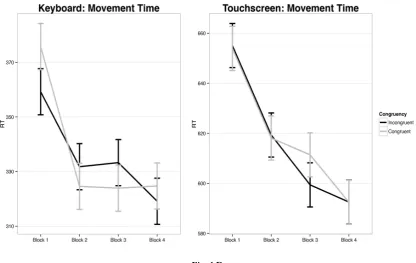
condition. We named these RTs as “Processing time”. In the second analysis, we considered only the movement. To do so, we measured the time between the moment participants moved from the central point, or from the bar space, and the beginning of the writing performance – the first point on the touchscreen or the first keypress on the keyboard. We name these RTs as “Movement time”.
The main idea is that if we compare results with these two different reaction times, which corresponded to different moments in the task performance, we might gain important insights in how the writing in the two conditions is accomplished.
Results
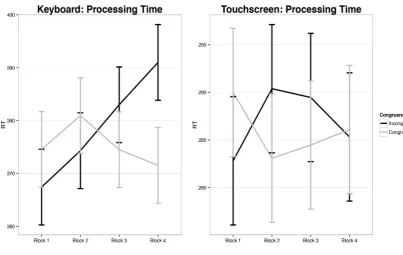
The results are plotted in Figure 1.C and Figure 1.D for the Processing Time and the Movement Time, respectively.
For both analyses, RTs that were minus or plus 2.5 standard deviation from the mean, were removed (2% for Processing time; 1.4% for Movement time). Errors were just removed in the original sample (Paragraph 1.1) previously to outliers detection. A repeated measure ANOVA with device (touchscreen and keyboard), location congruency (congruent and incongruent) and blocks (1 to 4) interaction was run for each type of departed measures. For the Movement Time an analysis that compares R2 adjusted of segmented and linear regression models fitted to the two writing condition was also performed.
The Processing Time
The effect of the device was significant (F1 (1, 23) = 15.9, p < .001, F2 (1, 79) = 49.1, p <
analysis, but they reached significance in the by-item analysis: F2 (3, 1262) = 2.9, p < .05 and F2 (3 ,1262) = 3.0, p < .05 respectively.
To investigate in more detail these results, we analyzed separately the data sets for the keyboard condition and the one for the touchscreen condition. The interaction between location congruency and blocks proved significant only in the keyboard condition (F1 (3, 69) = 3.2, p < .05, F2 (3, 632) = 5.3, p < .01). Figure 1.C shows that, in the fourth block, congruent responses were faster than incongruent ones (t (23) = 2.8, p < .01). No significant results were found in the touchscreen condition.
The Movement Time
The effect of the device was significant (F1 (1, 23) = 18.5, p < .01, F2 (1, 79) = 431.5, p < .01), with responses via keyboard being faster than responses via touchscreen. Contrary to the Processing Time analysis, this result was equal to the analysis in Cerni & Job (2013). Also the effect of blocks was significant (F1 (1, 23) = 12.4, p < .01, F2 (1, 79) = 26.1, p < .01).
The effect of the location congruency was not significant and also none of the interactions were significant (p > .05).
The comparison between segmented and linear regression models did not reach significance for the learning curve effect showing that the performances with both devices are not linear.
Discussion
The two additional analyses present some interesting results that allow to better clarify the location congruency effect in writing but also to better characterize the diversity of movements between the two writing devices.
First, the different modulation of performances with the two devices is confirmed by both the additional analyses. The Movement Time analysis, replicates the original findings by Cerni & Job (2013): responses via keyboard were faster than responses via touchscreen. In contrast, the results obtained in the Processing Time analysis shows an opposite pattern with the touchscreen condition being faster than the keyboard condition. We interpreted this pattern of data as showing that the mechanisms involved in the processing of the stimulus and the planning of the response are faster when writing on the touchscreen, but the whole writing response, including the movement, is faster when writing on the keyboard.
With regard to the iconicity effect, our original hypothesis rested on the assumption that the overlap between the movement and the meaning (up and down) in the touchscreen condition can be a strong factor for the activation of the iconicity effect. Lachmair, Dudschig, De Fillippis, de la Vega & Kaup (2011) found results that lead us to suppose this overlap. In three lexical decision task experiments participants were exposed to words with reference on the top or on the bottom of the space. The response system required them to perform either an up or a down movement starting from a middle point. Results indicated that responses were faster when the response direction matched the referent’s location. Our experimental procedure in the touchscreen condition was similar to these tasks, but did not report a significant effect neither in our first analysis (Paragraph 1.1), nor in the analysis of the Movement Time.
Interestingly, Lachmair et al. (2011) conducted a further analysis considering separately the movement times as dependent variable. They reported no significant results for these measures suggesting that the congruency effect emerged prior to the response movement. In addition, they reported the location congruency effect in a fourth experimental session, where the response system was the traditional button press and hands stayed rested on the respective buttons. These further results are consistent with our findings in the keyboard condition where we reported the congruency effect in the Processing Time and no effects in the Movement Time. On the contrary, in the touchscreen condition the congruency effect did not emerge neither in the Processing Time analysis where the movement was not counted.
the fourth block the attentional processes can be directed to the visualization of the line, which may induce the location congruency effect.
In the Movement analysis, the fact that the iconicity effect did not reach significance supports the idea that the word meaning and the possible congruence/incongruence with the to-be-written-on line are processed before the movement.
The last results to discuss concern the different patterns of the learning performance in the two writing conditions. In the original analysis by Cerni & Job (2013) the keyboard performance showed a pattern such that, after an acceleration of RTs during the first block, performance became flat within the following blocks. In the touchscreen condition, performance continued to increase linearly during the four blocks suggesting a fine-grade adjustment for the trajectory movement during the task.
The Movement Time analyses do not show the same results and indicate that the learning curves of both the touchscreen and the keyboard are segmented. The similarity of Figure 1.B (Paragraph 1.1) and Figure 1.D suggests that the slopes of the curves found by Cerni and Job (2013) are mainly driven by the movement performances. The keyboard condition presents the same learning curve found in the original analysis, but the learning curve in the touchscreen condition presents a major discrepancy between the first and the others experimental blocks than the curves of the original analysis. It is possible that, in the touchscreen condition the Processing Time and the Movement Time interfered more than in the keyboard condition in the adjustment to the task suggesting that not only the movement but also the time necessary to start the movement had a role in shaping the learning curve found by Cerni and Job (2013).
The novelty of the task used in our study to investigate location congruency effect and the similarity and dissimilarity between our findings and the previous studies on this topic need further experimentations to confirm any conclusion. To overcome structural constraints of this study, a more specific semantic context that usually has facilitated the access to the searched
effect can be constructed. Specifically, in previous research on spatial iconicity the tasks were
Chapter 2
Typing, mobile typing and motor expertise
Nowadays, typewriting is becoming the most practiced output modality in written communication. Many of us know how to type without a formal training, with an association between keys and fingers that remains personal and non-systematic (hunt-and-peck typing). Conversely, typing expertise is characterized by a strong and systematic association between hand and finger movements, and keys. Based on the fixed division of the left and right sides of the keyboard and on the stable motor representation, all ten fingers are used so that each word is typed exactly in the same way by all experts, but with variable associations between fingers and keys by non-experts (Rieger, 2012).
Typing does not consist only in these behaviors of experts and non-experts; therefore, it does not depend only on experience and schooling, but also on the devices designed for typing. Nowadays, if we speak about typing in general, we should include new text entry methods designed for mobile typing devices. A great amount of writing activities that a personal computer allows is now present also on mobiles. For example, word processors, spreadsheets, schedulers, web search, blogs and other desktop applications are adapted to mobiles of every size: from tablets to smartphones. Consider that one of the activities that make mobile phones popular is text messaging, indeed, a text entry activity. Therefore, typing on mobile platforms is a daily situation for many of us (MecKenzie & Soukoreff, 2002).
& Clarkson, 2005), on alternative mobile typing modalities (i.e. Wilson & Agrawala, 2006; Bi, Chelba, Ouyang, Partridge & Zhai, 2012) and on the expertise level of mobile typing (i.e. Clarkson, Clawson, Lyons & Starner, 2005). Nevertheless, a standard in mobile typing comparable to the standard of touch typing does not exist, which renders the comparison of users' performances difficult.
Furthermore, in the field of cognitive science and linguistic studies, there is an absence of investigations on the cognitive implication of mobile typing in the models of writing. If we know little about peripheral processes of handwriting and typing, we know almost nothing about mobile typing.
At the basis of the studies presented in this chapter lies the concept of bimanual advantage: a remarkably stable feature of typewriting movements, which was among the first phenomena observed in experimental studies of expert typists. In detail, the cross-hands (bimanual) interkeystroke intervals – the elapsed time between two successive keypresses – are shorter than within-hand (unimanual) interkeystroke intervals (i.e. Shaffer, 1976, 1978; Terzuolo & Viviani, 1980; Rumelhart & Norman, 1982; Ostry, 1983; Larochelle, 1984; Salthouse, 1986; John, 1996; Wu & Liu, 2008). For an expert, a word containing only alternations between the left and right hand is much easier to type than a word containing letters associated with the same hand, because skilled typists move their hands in parallel (Gentner, Grudin, & Conway, 1980). This pattern is not present in novice typists (Larochelle, 1983).
This important difference between expert and non-expert typists is at the heart of the first part of the present chapter (Paragraphs 2.1 and 2.2) in which I present a study dedicated to test the impact of motor expertise of writing on linguistic performances where spelling knowledge has to be mobilized.
consists of four tasks: a typing to dictation task, a lexical decision task, a spelling task and a handwriting task. Our hypothesis sustains that in these tasks, words that are usually typed with more bimanual transitions may be written, spelled and recognized faster that words with less bimanual transitions by expert typists compared to non-experts.
In Paragraph 2.1, I present a paper that addresses the influence of the bimanual motor advantage in typing on a lexical decision task. The aim was to test whether lexical decision performance showed a differential effect of motor difficulty in expert and non-expert typists. In Paragraph 2.2, I discuss the extra results of the spelling “probe” task where we tested the influence of the bimanual advantage on spelling recovery. Unfortunately, data of the handwriting task are not available herein, but the experimental design is briefly discussed.
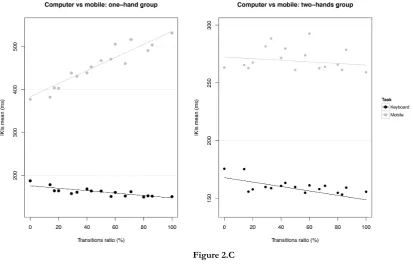
In the last session of the chapter (Paragraph 2.3), I present a paper focusing on the comparison between touch typing and mobile typing with the assumption that strategies typical to standard typing can be found also in mobile typing. In detail, the study tested the possibility that motor knowledge of typing, which concerns the bimanual transition advantage and the unimanual disadvantage, can have an impact on both computer and mobile keyboards. Is it possible that typing with ten fingers on a classical keyboard has the same motor constraints as typing on a mobile with only one index or two thumbs?
2.1
Motor expertise for typing impacts word recognition
Tania Cerni¹, Jean-Luc Velay², Francois-Xavier Alario³, Marianne Vaugoyeau² & Marieke Longcamp²
Department of Psychology and Cognitive Science, University of Trento, Italy¹ Laboratoire de Neurosciences Cognitives, CNRS - Aix-Marseille Université, France²
Laboratoire de Psychologie Cognitive, CNRS - Aix-Marseille Université, France³
Submitted in October 2014 to: Psychological Science
Introduction
Reading and writing have typically been studied separately, as if they were encapsulated systems. Yet some researchers have hypothesized the existence of specific directional influences of the motor aspects of writing on reading, the rationale being that reading acquisition and practice is supported by contemporary performance of writing gestures (Tan, Spinks, Eden, Perfetti & Siok, 2005; James & Engelhardt, 2012; Mikulak, 2014). Empirical evidence in favor of such an influence has been reported for handwriting. Knowledge of graphic movements specific to characters impacts their visual recognition and the associated neural substrates (Velay & Longcamp, 2012 for review). Letter recognition being the very first step in word reading, motor knowledge is likely to affect skilled reading beyond single letters. Handwriting is still widely taught in elementary schools worldwide, yet typing is clearly becoming the dominant writing modality in adulthood and perhaps even earlier. This massive shift of expertise in the general population calls for better understanding of the possible consequences, if any, of typing practice on reading.
To this date, typing practice has revealed no measurable effect on single character recognition, presumably because the movement performed to strike a given key bears no relationship with the shape of the character to be recognized (Longcamp et al., 2005; 2008; James & Atwood, 2009; Tan, Xu, Chang & Siok; 2012). These observations suffer from two limitations though. First, the participants tested were hunt-and-peck typists displaying moderate skills and variable associations between fingers and keys. Second, the experiments focused on single characters, whereas typing expertise relies on stable motor representations of each keystroke and their sequence (Rumelhart & Norman, 1982; Rieger, 2004). Indeed, while the shape of the characters is fundamental in handwriting, a critical dimension of typing is the sequence of keystrokes.
Beilock, 2009). This effect is thought to origin from motor coordination properties of letter pairs: alternating between hands to type a pair is easier and faster for experts (Shaffer, 1976; Rumelhart & Norman, 1982; Ostry, 1983). Yet the evidence remains scarce and the possible consequences of typing expertise on visual word recognition are not apparent.
Here we directly tested whether word recognition, indexed by the primary task of lexical decision, is impacted by typing expertise and typing properties of words. The motor transition effect implies that for an expert, a word containing a majority of bimanual transitions is much easier to type than a word containing more unimanual transitions (Gentner, Grudin, & Conway, 1980). This pattern is not present in novice typists (Larochelle, 1983). We designed a set of French words in which we manipulated the number of cross- and within-hand transitions. We tested whether lexical decision performance for those words and matched pseudowords showed a differential effect of motor difficulty in expert and non-expert typists.
Methods
Participants. The experiment was designed to include sixteen participants per group. This number was set to optimize the counter-balancing of the tasks and response matching. To reach this number, twenty expert typists (formally trained for touch-typing), French native speakers, had to be tested. Four of the typists of the initial group of 16 produced errors rates in the typing task above 40% of the trials and an had to be replaced by another 4 typists. The control group was composed of 16 participants without a major experience of typing, selected to match the typists for age, gender, education and handedness. Non-experts used to type with a maximum of three fingers per hand and they had not had any formal training with a standard typing method. None of the participants in the control group had to be discarded but one turned out to be an expert (see below).
on a per word basis. Typing rate was calculated as words (5 characters) typed per minute (MacKenzie, 2013) (results in Table A). Finally, we recorded videos of the participants while they did the typing pretest to ensure that experts and non-experts used the number and position of fingers expected for each group.
One of the non-expert participants was finally affected to the experts group, given her very good typing performance and use of 10 fingers despite her self-report of typing habits. Eventually then, the expert group included 17 participants (1 male/16 female) and the control group included 15 participants (1 male/14 female; Table A).
Table A
Features of the sample
Experts Non-experts
N 17 15
Mean age 41.7 43.6
Daily handwriting time (minutes) 60.7 97.1
Daily typing time (minutes) 265 137.5
Typing experience (years) 24 16.6
Right handed (%) 70 90
Typing accuracy (%) 90 90
Typing rate (wpm) 40.6 28.5
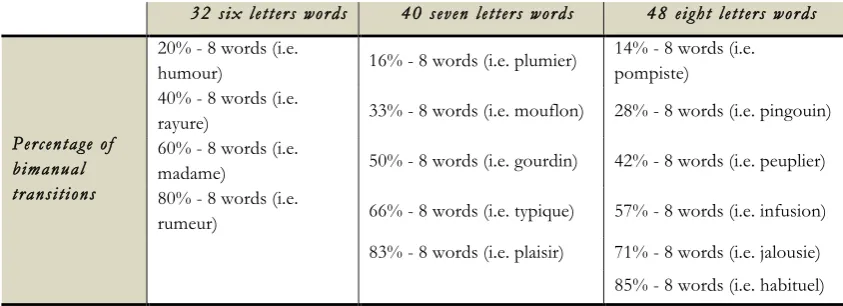
letters “x”, “w”, “c”, nor “v” because these have no right hand counterpart in the AZERTY keyboard. They were all 6 to 8 letters long. The experimental words were divided into 15 transition ratio categories (from 14%, for example "pompiste" to 85%, for example "habituel"; bold letters being typed with the right hand on the AZERTY keyboard). Across these 15 categories, the items were matched for: the hand used to type the first letter, the average number of letters typed with the left and right hand, lexical frequency, number of syllables and phonemes, presence of homophones and homographs, frequency of bigrams, number of phonological neighbors, and lastly orthographic regularity. Table S2 in the Supplementary Material summarizes these properties, and shows that only bigram frequency and orthographic Levenshtein distance (old20) were significantly different across transition ratio categories. These selection criteria resulted in 120 experimental words.
For the lexical decision task, we also prepared a list of 120 pseudowords, created by changing a letter from each of the experimental words. The substitute letter respected the bimanual transition structure of the base-word and lead to a minimal trigram frequency given its position of 10.
To these strictly controlled lists of stimuli, we added 36 words and 36 pseudowords with transition ratios 0 and 100% (i.e. typed with a single hand or hand transitions at every letter). These served as fillers and were not further analyzed. It was not possible to identify in the ‘LEXIQUE’ database (or toolbox) sets of words with 0 and 100% transitions that respected the matching criteria described above for the experimental items.
The equipment included headphones to present audio stimuli, a QWERTY DirectIN Millisecond Accurate Keyboard (http://www.empirisoft.com/), adapted as an AZERTY keyboard with stickers on the keys, for collecting responses; high quality sound and video cards, and a CRT screen with a 70 Hz refresh rate. Stimulus presentation and response recordings were controlled by the software Presentation® 16.3 (http://www.neurobs.com/). The audio stimuli were recorded from a native female French speaker in an anechoic room and segmented with Audacity 2.0.3.
Tasks.
Typing task. Participants typed the words dictated one per trial in a random order. Each trial started by a fixation cross in the center of the screen, along with the auditory word presentation. Participants were instructed to start typing as soon as they had identified the word. Typed letters were displayed on-line on the center of the screen, replacing the fixation cross. The duration of each trial (stimulus plus input) was set to 4000 ms for experts and 5000 ms for non-experts. The task was split into two blocks separated by a brief pause.
A response was considered incorrect if participants pressed either the backspace or a wrong key. The remaining correct responses were used to calculate the response times (RTs: time between the beginning of the trial and the first keystroke) and the average interkeystroke intervals (IKIs) per trial.
right index (F1) and right middle fingers (F2) and the association between finger and response (word vs pseudoword) was counterbalanced across participants. We collected response times and error rates.
Data processing and statistical analysis. In the Typing task, we excluded the errors (18.7% for the expert group; 13.8 % for the non-experts group – tot 16.4%). Outliers were considered after errors detection. For each participant, response times above and below 2.5 standard deviations from their mean were considered as outliers and discarded from the dataset (.03% replacements for the experts, and .03% for the non-experts). The same was done with IKIs (18.2% replacements for the expert group, and 16.8% for the non-experts group – tot 17.5%).
Inthe Lexical decision task, errors in discriminating words and pseudowords were discarded from the dataset (4.5% for the expert group; 4.2 % for the control group – tot 4.4%).
Outliers were considered after error detection, for each participant as reaction time above and below 2.5 standard deviations from the mean (2.7% for the expert group; 2.5% for the control group – tot 2.6% for lexical decision) and the corresponding reaction times were also discarded from the dataset.
The resulting RTs and IKIs were log-transformed (Baayen, 2008) and examined with linear mixed regression models (Baayen, 2008; Baayen, Devidson & Bates, 2008; software R, package lmerTest for models processing and p-values). Transition ratio values were modeled as a continuous predictor. We constructed models for each task separately, and in all models, subjects and items were considered as random-effects while group (expert vs non-expert), bimanual transitions ratio and the interaction between the two were considered as fixed effects. Furthermore we included in the models all the linguistic and task-dependent variables that reached significance, discarding those that failed to reach significance.
Results
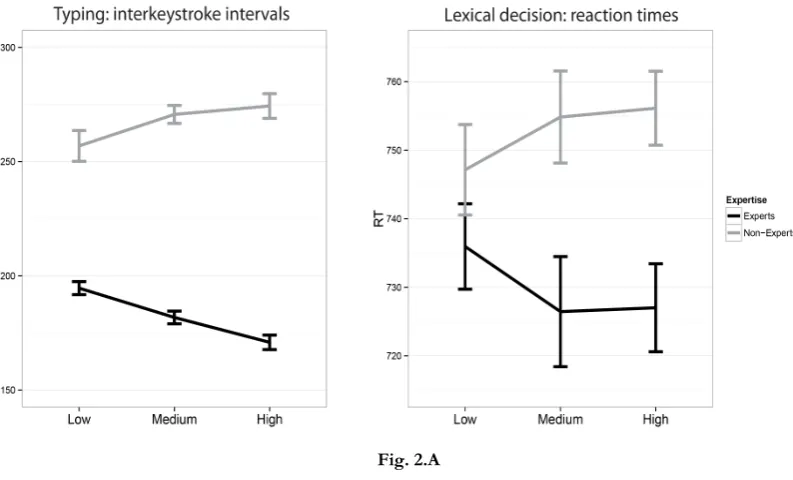
A summary of findings is presented on Figure 2.A.
Typing Task. The error analysis on the typing task showed a significant effect of group (β = -.59, SE = .28, z = -2.06, p < .05).
IKIs
We included in the final model the number of letters in the word, frequency, bigrams frequency, the orthographic Levenshtein (old20) distance and the hand used to type the first letter.
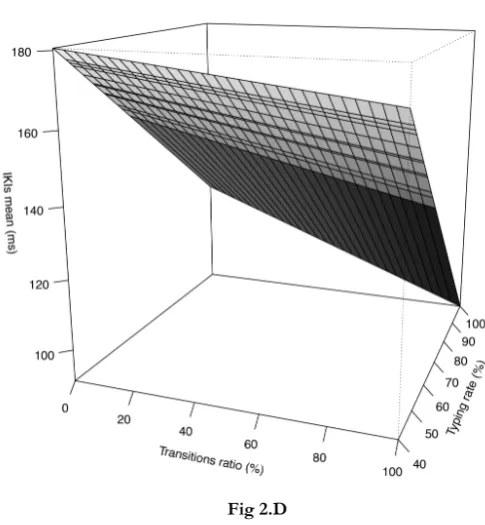
In this task all the variables of interest reached significance: IKIs differed significantly between groups (β = .2, SE = .06, t = 3.3, p < .01) and were modulated by transition ratio (β = -.002, SE = .0003, t = -6.7, p < .001). Finally, the interaction between group and transition ratio was highly significant: β = .003, SE = .0002, t = 16.6, p < .001.
Splitting the two groups into two separate databases allowed us to test if the effect of transitions ratio is significant or not for each group.
The effect of bimanual transitions ratio, was highly significant for both groups, yet in opposite directions: with experts, IKI’s increased as the bimanual transition ratio increased (β = -.002, SE = .0003, t = -5.7, p < .001); with non-experts, the IKIs decreased as bimanual transition ratio increased (β = .001, SE = .0003, t = 5.1, p < .001).
The complete results of the models are reported in Table S3, in the Supplementary Material.
Response times
No effect of transition ratio was observed. Furthermore, the interaction between group and bimanual transition ratio did not reach significance. The only effect that reached significance was the difference between the groups: β = .2, SE = .04, t = 5.5, p < .001.
Fig. 2.A
Note. Summary of chronometric performance in typing to dictation and lexical decision. For clarity, the data have been pooled from 15 into 3 categories of bimanual transition ratio: words with a low ratio of bimanual transition (14 to 33%), a medium ratio (40 to 60%), and a high ratio (66 to 85%). The error bars represent the within-subject confidence intervals (Morey, 2008), further statistics reported in the main text.
Lexical Decision Task. We included in the model: trial rank, frequency (of the word or of the base-word for pseudowords, Perea, Rosa & Gomez, 2005) and number of letters.
Detailed effects on response times are reported in Table S4 in the Supplementary Material. As expected, we found an effect of lexicality (β = -.16, SE = .03, t = -5.9, p < .001). Furthermore, no effects of group or bimanual transition ratio were observed.
the two-ways interaction between lexicality, group and bimanual transition ratio approached significance (β = -.0007, SE = .0004, t = -1.8, p = .06).
We then analyzed word and pseudoword datasets separately to estimate the interaction between group and ratio of bimanual transition in two different models. Detailed effects on response times for words and pseudoword are reported in Table S4 in the Supplementary Material.
Pseudowords
The final model included the trial rank and the number of letters in the word.
No effects of group or bimanual transition ratio were observed.
The interaction between group and bimanual transition ratio reached significance (β = .0006, SE = .0002, t = 2.6, p < .01), showing the same trend than in the typing task. For experts, detecting pseudowords tended to get faster as the number of transitions increased, while for non-experts the trend was opposite.
Words
The final model included the trial rank, frequency, and the orthographic Levenshtein distance (old20).
No effects of group or bimanual transition ratio were observed.
The interaction between group and bimanual transition ratio did not reach significance.
Discussion
in the opposite direction. This differential effect on motor execution in typing sets the ground for the central result of the study, namely that the ratio of bimanual transitions had a significant effect on RTs in the lexical decision task. Word recognition processes appear related to the motor representations associated with the usual production of the same words on the keyboard. The influence of typing knowledge could stem from an early stage of orthographic processing, where letter strings are visually processed. Given previous evidence of motor-perceptual interactions for written visual stimuli (Velay & Longcamp, 2012), it is possible that in experts, visual perception of letter strings triggers the parallel activation of associated patterns of hand and finger typing movements, which could in turn exert an influence on the recognition processes. The stability of the motor patterns for typing would accordingly modulate the RTs. The effect is mostly driven by pseudowords whose processing takes more time and presumably relies on noisier evidence (Ratcliff, Gomez & McKoon, 2004; Dufau, Grainger & Ziegler, 2012). The influence of motor representations could be stronger in this case (for a similar argument in speech, see Du, Buchsbaum, Grady & Alain, 2014).
Despite a tradition of separate investigations of reading and writing, some authors assume shared cognitive components (Caramazza, Capasso, & Miceli, 1996; Rapp & Lipka, 2011). In the specific case of typing, brain regions known to process orthography and phonology of single words are commonly activated by reading and typed spelling (Purcell, Napoliello & Eden, 2011). For instance, the graphemic buffer, is involved in reading letter strings through the grouping of single letters into an ordered set of graphemes via the sublexical route (Perry, Ziegler & Zorzi, 2007), and is also a fundamental component of the cognitive architecture of written production (Rapp, 2002). This serial process of building graphemes nodes from letters could be a possible vehicle for the activation of motor information.
2.2
Motor expertise in spelling recovery: the spelling probe task
In the introduction of the chapter, I cited the fact that the typing tasks and the lexical decision task were inserted into a broader experimental design that comprehended in addition a handwriting task and a spelling task.
In this paragraph, I want to introduce briefly the handwriting task, even though we have no data analysis. Then, I describe in more detail the aim of the spelling task, the method we used and, finally, the results. Both these two additional tasks used the same set of words and were performed by the same participants during a unique experimental session. All of the four tasks are counterbalanced between participants.
The handwriting task. In summary, in the handwriting task, participants have to handwrite under dictation all the stimuli with a specific pen on a paper fixed on a Wacom Tablet Intuos 3, format A4. The stimuli presentation and the registration of the inputs are regulated by the software MovAlyzeR (NeuroScript).
During a single trial, a word, selected in random order, is dictated by the system and the participant had to write it in cursive one below the other, following dedicated boxes that are prepared on the white paper. Each trial lasted 3200 msec. The task is divided into 2 blocks. As dependent variable we measured the latency in starting to write, the duration of motor execution of the words and the error rate.
It has to be specified that data processing and statistical analysis are being performed by an expert in MovAlyzeR (Neuroscript), at the Laboratoire de Neurosciences Cognitives, CNRS - Aix-Marseille Université, Marseille. Unfortunately, I cannot provide the results in this dissertation.
The spelling “probe” task
The task aims to determine the possibility that typing motor experience can influence the aspects of the highest level in the processing of written language, in particular spelling. To this end a recent line of research in writing investigates if an interaction exists between peripheral-motor processes of writing and the central processes of spelling. As just cited in the general introduction of this thesis, central processes have a role in the deconstruction of the visual/oral stimulus into abstract letters that are then converted into motor command by peripheral processes (Purcell, Turkeltaub, Eden & Rapp, 2011). Considering handwriting, Delattre, Bonin and Berry (2006) found that writing irregular words needs more time in latency and duration of the writing movements compared to writing regular words. These results suggest that central processes of assembling spelling are not finished during motor execution. The same conclusions were proposed by Roux, McKeeff, Grosjacques, Afonso and Kandel (2013). Authors found that letter duration was longer for irregular than for regular words, an effect that is modulated by the position of the irregularity in the stimuli.
In this experiment, we focused on the possibility that this interaction between central and peripheral processes can be seen as bidirectional to give a contribution to the hypothesis that writing is a complex process that is not limited either to motor command or to linguistic processes, but characterized by an interaction between the two. In this way the motor constraints of writing, related to the peripheral processes of writing, may have influence on the central processes, intended as processes involved in retrieving, assembling and selecting orthographic representations (Delattre, Bonin and Barry, 2006).
the assumption that participants have to access the spelling of words to give their answer. To perform the task, it is necessary to access to the orthographic representation of the word in the Orthographic Long-Term Memory (O-LTM) and/or the involvement of sub-lexical processing. Later the Orthographic Working Memory (O-WM) is responsible of the effective verification of the presence of the letter. Lexical and sub-lexical processes are clearly categorized as central processes in spelling, whereas the O-WM, identify also as graphemic buffer, is classically associated to central processing, but can be seen in the interface between central and peripheral processes and across writing modalities (Purcell, Turkeltaub, Eden & Rapp, 2011). The role of the O-WM consists in maintaining active the abstract letters, basis for the activation of keypresses subsequently performed by peripheral processes.
Given this pattern, in this study, we tested the possibility that motor constraints of typing, when associated to a great experience with this writing modality, can influence central processes independently from the letter conversion into keypress.
We used the same words we selected in the previous tasks, where we manipulated the amount of bimanual transitions, testing if the bimanual facilitation influences spelling of words when motor execution is not required. We tested this hypothesis comparing the two groups of expert and non-expert typists, expecting a facilitation of spelling in function of the increase of bimanual transitions ratio only in experts, who possess an automatism in the typing movements.
Materials and methods
Participants and Stimuli. The same participants, divided into a group of experts and a group of non experts typists, and the same stimuli of the previous study (Par. 2.1) were used in this task.
in the word – e.g. if we presented the words “madame”, the probe “D” (left key) does not constitute a transition with the previous letter “A” (left key) and it was categorized as “No transitions”. Conversely, the probe “M” (right key) constitutes a transition with the previous letter “A” (left key) and was categorized as “Transitions”. For this last variable we counted the number of “Transitions”. These additional variables can be viewed in Table S5 in the Supplementary Material.
The task was programmed in Presentation 16.3 and was conducted with the support of the same equipment of the typing and lexical decision tasks. The presented audio files were the ones used in the typing task.
Procedure. At the beginning of each trial, a central fixation-cross appeared and, after 300 msec, an audio word was presented. After the sound presentation an upper case letter replaced the cross for 1000 msec and was followed by a blank response screen for 2000 msec. Participants had to press a designed key (F1 or F2) if the letter belonged to the heard word or the other designed key (F2 or F1) in the opposite case. The response system was alternated between participants and was identical to the one we used in the lexical decision task.
Two lists were created so that half of the words were associated with a yes response in one of the list and with a no response in the other. Then, the two lists were counterbalanced between participants. We assigned probes to words in order to counterbalance their position along the words, choosing from the first to the last letters. Then, for the probes not present in the words we manually assigned the letters to words.
We collected the reaction times in identifying the presence or the absence of the probe in the word and the error rates.
In the Spelling Probe task errors in choosing if the presented letters belong or not to the heard word were discarded from the dataset (5.8% for the expert group; 5.1 % for the control group – tot 5.8%).
Outliers were considered after errors detection for each participant as reaction times above and below 2.5 standard deviations from the mean (2.4% for the experts and 2.2% for the non-experts – tot 2.3% ) and the corresponding reaction times were also discarded from the dataset. Error rates were also analyzed but results did not show any significant effect of interest and were not reported.
Reaction times were log-transformed for the analysis. We used linear mixed models where we inserted all the transitions ratio values, modeled as a continuous predictor, the item-related variability and associated linguistic parameters. In all models, subjects and items were considered as random-effects while group (expert vs non-expert), bimanual transitions ratio and the interaction between the two were considered as fixed effects. Furthermore, we included in the models all the linguistic and task-dependent variables that reach significance, discarding those that failed to reach significance.
Results
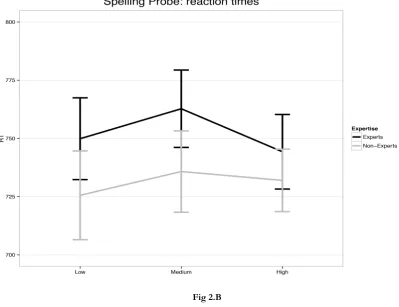
Completed results of the model are reported in Table S6 in the Supplementary Material. Graphical representation can be consulted in Figure 2.B.
The final model was composed by the following linguistic and task dependent variables: trial rank, the hand used to type the first letter of the word and the number of syllables.
The results confirmed the absence of an effect of group (p > .05) and of transitions ratio (p > .05). Then, reaction times for “yes” responses were shorter than reaction times for “no” responses (β = -.08, SE = .02, t = -3.2, p < .01) showing a facilitation in answering when the letter was present in the word.
As in lexical decision task, yes and no responses were split into two separate databases to confirm the absence of an effect for the interaction between group and transitions ratio.
Fig 2.B
Note. Summary of chronometric performance in the spelling probe task. For clarity, the data have been treated as in Figure 2.A, in Paragraph 2.1
No responses. In the final m