R E S E A R C H
Open Access
How does selfing affect the dynamics of selfish
transposable elements?
Thibaud S Boutin
1,2, Arnaud Le Rouzic
1and Pierre Capy
1,2*Abstract
Background:Many theoretical models predicting the dynamics of transposable elements (TEs) in genomes, populations, and species have already been proposed. However, most of them only focus on populations of sexual diploid individuals, and TE dynamics in populations partly composed by autogamous individuals remains poorly investigated. To estimate the impact of selfing on TE dynamics, the short- and long-term evolution of TEs was simulated in outcrossing populations with various proportions of selfing individuals.
Results:Selfing has a deep impact on TE dynamics: the higher the selfing rate, the lower the probability of invasion. Already known non-equilibrium dynamics (complete loss, domestication, cyclical invasion of TEs) can all be described whatever the mating system. However, their pattern and their respective frequencies greatly depend on the selfing rate. For instance, in cyclical dynamics resulting from interactions between autonomous and non-autonomous copies, cycles are faster when the selfing rate increases. Interestingly, an abrupt change in the mating system from sexuality to complete asexuality leads to the loss of all the elements over a few hundred generations. In general, for intermediate selfing rates, the transposition activity remains maintained.
Conclusions:Our theoretical results evidence that a clear and systematic contrast in TE content according to the mating system is expected, with a smooth transition for intermediate selfing rates. Several parameters impact the TE copy number, and all dynamics described in allogamous populations can be also observed in partly
autogamous species. This study thus provides new insights to understand the complex signal from empirical comparison of closely related species with different mating systems.
Background
Transposable elements (TEs) are now considered as major components of genomes. These DNA sequences are able to invade, to multiply, and to spread across spe-cies despite their deleterious impact (on average) on their host. The capacity to generate structural and func-tional variability illustrates their impact on genome evo-lution [1-3]. If their ubiquity and their features can be only explained by selfishness [4,5], they are also able to enhance genome evolvability and to promote molecular exaptation. Their influence on genome evolution is sup-ported by an increasing number of observations [6,7],
including gene regulation via epigenetics landmarks
[8-10], or the emergence of the V(D)J immune system in mammals [11].
The complex co-evolutionary dynamics between TEs and genomes was also enlightened by several population genetic models (see [12] for a review). Usually, the mod-els assume that the number of copies grows to an equi-librium after a burst of amplification, this equiequi-librium being achieved when replicative transposition balances natural selection against insertions [13,14]. However, independent biological data on TE activity from several
elements includingAlu elements in humans [15],copia
elements, and LTR retrotranposons in plants [16,17] or in Drosophila [18], as well as Class II elements [19], clearly show that the transposition rate is not constant. Indeed, transposition bursts are frequently observed. Changes in activity can be due to epigenetic factors, such as modified methylation patterns [20], and explain why some natural populations have variable TE activity. In any case, if an equilibrium could be reached on a short scale, maintaining such a status over long evolu-tionary stages seems unrealistic. Investigations based on
* Correspondence: [email protected] 1
LEGS, CNRS UPR9034, IDEEV FR3284, Avenue de la terrasse, Bat 13, 91198 Gif-sur-Yvette, France
Full list of author information is available at the end of the article
simulations assuming random mating and accounting for parameters like copy activity, copy impact on host fitness, and mutation on TE activity [21,22], show that non-equilibrium dynamics are likely and predict cycles of re-amplification similar to those observed in‘Lotka
-Volterra’ prey-predator dynamics [23]. ‘Molecular
domestication’events (TE insertions reaching fixation in the host population because of their positive impact on their fitness) can also be reproducedin silicowith mod-els allowing a low rate of beneficial insertions [22]. By analogy, it was recently proposed that genomes could be seen as ecosystems in which TEs families are co-evol-ving species [24-26].
TEs being sexually transmitted parasites, almost all models assume random mating. Surprisingly, little is known on how TE copies behave in completely selfing species. Yet, hermaphroditism is widespread in the living world, particularly in plants, but also in about one-third of animal species [27]. Self-crossing enables individuals to reproduce on their own by self-fertilization; it gener-ally induces inbreeding depression or decrease in genetic variation, but can also be advantageous when mates are scarce due to the rarefaction of the partners [28,29].
It is generally assumed that selfing has a strong func-tional impact on genomes and on their components, including selfish elements such as TEs [30]. During the last decade, a few models focusing on the impact of self-ing on TE dynamics were developed [31,32]. As expected, they predict a decline of the probability of TE invasion due to reduced exchanges between selfers: the selfish invasion strategy of TEs relies on being trans-mitted to the offspring at higher frequency than expected under Mendelian segregation, and becomes ineffective in absence of outcrossing. So far, little is known about TE dynamics in partial selfers beyond the unrealistic assumption of the transposition-selection equilibrium [32].
Here, we propose to extend the existing theoretical corpus in two directions: (i) assessing the impact of intermediate selfing rates on non-equilibrium TE dynamics, and (ii) evaluating the influence of the mating system on the evolutionary properties of TEs and of their host species. To this end, the fate of TEs in popu-lations with various selfing rates was followedin silico from the very first steps of the genome invasion to the long-term evolution (10,000 generations). In addition, we simulated the consequences of switching from an outcrossing to a self-fertilizing population.
Results
TE dynamics from the first generation after introduction to their long-term evolution were explored by
indivi-dual-based simulations. In a population of N diploid
hermaphrodites, each parent can be a selfer with
probabilityZ, and reproduces proportionally to its fit-nessw(see‘Methods’section, parameters of the model
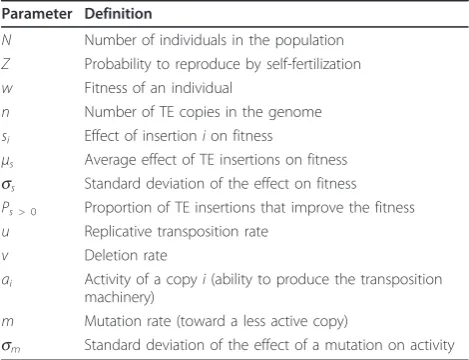
are summarized in Table 1). The selective impact si of
each TE insertion can vary from highly deleterious to advantageous according to the distribution probability of selective impacts (see [22]). A copy duplicates through replicative transposition (rate u), but can also be elimi-nated by deletion (e.g., excision with no reinsertion, or after ectopic recombination between two copies in direct orientation) with a ratev. Mutations occurring at ratemdecrease the copy activity. Copies with no activ-ity are non-autonomous, they are stilltrans-mobilizable; thanks to the transposition machinery produced by autonomous copies. In the simulations, only the ele-ments able to transpose (i.e., autonomous and non-autonomous elements) were explicitly modeled, immo-bile relic copies are considered as deleted.
Population invasion
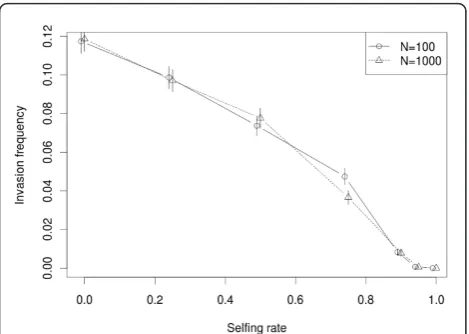
A population was considered as invaded by the TE family when one copy per individual on average is pre-sent 100 generations after the initial introduction. Copies spread from their single ancestor during an initial burst of transposition, when most of the copies are highly active. This invasion is expected to be facili-tated by outcrossing [33]: the more selfing, the lower the probability of invasion. This is illustrated in Figure 1 for two population sizes. In addition, the distribution of copy number greatly varies according to the selfing rate.
After 100 generations, when Z= 0.9, most individuals
from successfully invaded populations have a single
copy, while whenZ= 0 (i.e., random mating), the
aver-age copy number per individual is much higher. Exam-ples of the copy number distribution per individual after 100 generations are provided in Additional file 1.
Table 1 Parameters of the model
Parameter Definition
N Number of individuals in the population Z Probability to reproduce by self-fertilization w Fitness of an individual
n Number of TE copies in the genome si Effect of insertionion fitness
μs Average effect of TE insertions on fitness ss Standard deviation of the effect on fitness Ps> 0 Proportion of TE insertions that improve the fitness u Replicative transposition rate
v Deletion rate
ai Activity of a copyi(ability to produce the transposition machinery)
m Mutation rate (toward a less active copy)
On one hand, when the selfing rate is high (Z ≥0.9), the invasion frequency is very small after 100 genera-tions. However, in successfully invaded populations, active copies can be maintained for a while (up to 1,000 generations, data not shown) with apparent bursts in the 100 first generations (Additional file 2). These bursts do not correspond to an increase in copy number in the whole population, they are rather due to the accumula-tion of homozygous copies in some lineages until selec-tion removes them. The invasion of a TE family is a stochastic process and is partly driven by genetic drift, but contrary to the well-known influence of population size on the fixation probability of deleterious mutations, the invasion frequency of TEs is virtually insensitive to the number of individuals. This effect, already documen-ted in [34], is due to the deterministic aspect of TE invasion above a copy number threshold in the popula-tion, which does not depend directly on the population size. Moreover, there is no or little effect of the prob-ability of adaptive insertion during the first steps of invasion whatever the selfing rate: such rare insertions are unlikely to happen soon enough to influence the early dynamics (data not shown).
Beyond the initial burst
In the absence of a copy number control mechanism, the initial invasion may drive the host population to extinction, owing to the genetic load generated by a
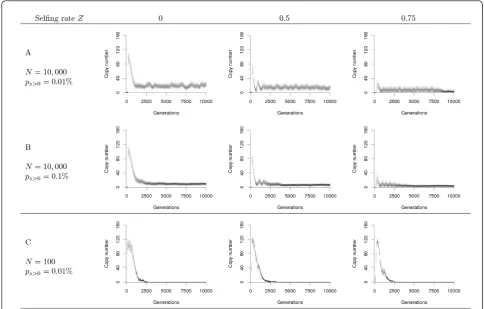
growing number of deleterious insertions [34]. In our model, the decrease in copy number is due to their elimination by natural selection and to a reduction of the general activity of transposition (regulation). After the initial burst, TE dynamics may go through cycles of re-invasion, molecular domestication, or loss (Figure 2), in the same way as for random mating populations [22]. Stable transposition-selection equilibria were not observed with the tested set of parameters.
The accumulation of mutations leads to the emer-gence of low-activity and non-autonomous copies. The reduction of the global transposition activity is due to the decline of the production of efficient transposition machinery. As long as the average activity in a genome is non-null, both autonomous and non-autonomous copies can transpose. In such a situation, the non-auton-omous copies parasitize the autonnon-auton-omous elements, and cycles of decline/re-invasion can be maintained up to the end of the simulation (10,000 generations). Previous analysis has shown that these cycles can be explained by interactions between autonomous and non-autonomous copies, similarly to prey-predator (or host-parasite) interactions [22,25]. Autonomous copies are equivalent to hosts, as they are able to spread and maintain by themselves, but non-autonomous copies act as parasites: they can transpose only when autonomous copies are present in the same genome, forcing them to share the transposition machinery.
Figure 2A and 2B show that the frequency of the cycles increases with the selfing rate in large populations
(N= 10,000). This phenomenon is clearer when cycles
are maintained over a long period, e.g., when the prob-ability of adaptive insertion is relatively low (Figure 2A), but it is still detectable when this probability is high (Ps
> 0 = 0.1%) before the fixation of adaptive insertions (Figure 2B). When the selfing rate increases, the fixation of adaptive insertion is delayed, while the copy number is about the same at the top of the first peak (compari-son betweenZ= 0 orZ= 0.5).
As the probability of adaptive insertions increases, advantageous elements can be fixed more often (Figure 2B), provided that their positive effect is strong enough to overcome genetic drift. These beneficial insertions do not need to maintain their transposition activity to sur-vive, and they eventually become inactive. The presence of a substantial amount on non-autonomous copies that are not purged by natural selection or deletions prevents the reinvasion of autonomous copies as observed in the cyclic dynamics, and transposition activity tends to be lost. At the end of this‘molecular domestication’ pro-cess, other neutral and deleterious copies are progres-sively eliminated from the genome by selection, deletion, and drift, leading to the maintenance of few adaptive insertions that are totally inactive (a= 0).
Figure 1Effect of selfing rate on the probability of invasion. Initially, each population has only one full active copy. The probability of adaptive insertion was fixed toPs> 0= 0.1%, this parameter does not affect the pattern (data not shown). TheY-axis is the percentage of invasion achieved (the frequency of the simulations with at least 1 copy per individual on average at generation 100), and theX-axis is the selfing rate (Z). Two
Molecular domestication is consistently observed when the probability of adaptive insertion is high (Ps> 0 = 0.5%, data not shown). For intermediate values, the proportion of domestication increases with the probabil-ity of adaptive insertions, and decreases with the selfing rate. Selfing populations also tend to fix less adaptive insertions on average.
The analysis of the joint effect of selfing and popula-tion size is also interesting. Indeed, while selfing has a clear effect on the long-term evolutionary dynamics of
TEs in large populations (N = 10, 000), its impact is
lowered by genetic drift in small populations (N= 100), in which TEs are generally lost after few thousand gen-erations whatever the mating system (Figure 2C). Indeed, genetic drift also affects TE sequences, and increases the chances to lose all active copies in the population when the average copy number is low. This observation confirms previous findings [22], and high-lights a mechanism acting in a direction opposite to the
improved purging efficiency in large population-size spe-cies [35,36].
Transition to selfing
A family of TEs could invade a population with a very high selfing rate but has low chances to reach a high copy number if they are deleterious. However, an interesting situation can be found when a TE-rich outcrossing population switches to selfing. This was simulated with an abrupt transition in the mating sys-tem after the initial transposition burst. A few genera-tions after the shift, the selfing population is de facto subdivided into competing lineages with slightly dif-ferent TE composition (Figure 3). The lineages with the lowest copy number can persist longer. Finally, all TEs are lost after a few thousand generations. The loss remains a stochastic process, and in small
popu-lations (N = 100), the mean number of TEs can
increase stochastically within lineages for several
hundred generations, but active TEs always disappear eventually.
Discussion
Model interpretation
Our results confirm that the mating system has a deep impact on TE dynamics. Most of the main dynamics already described in random-mating populations were found. Depending on the properties of the TE family and of the host population (including population size and selfing rate), the initial burst can be followed by the loss of all copies, by the fixation of a few beneficial insertions (molecular domestication), or by cycles of reinvasions. As in random-mating populations, the population size has little influence on the first steps of TE invasion [34]. However, the TE dynamics in small populations are less stable, and lead more often to the loss of TE activity. Partial selfing affects the outcome of the model, and as a general rule, TEs are less likely to maintain (either as active parasites or as ‘ domesti-cated’insertions) in selfing populations. The probabil-ity of invasion decreases with the selfing rate, but when it occurs, the initial burst of transposition remains comparable to outcrossers (except for a slight delay), followed by one of the typical dynamics (cycles, loss, or domestication), depending on the mutation rate and the frequency of beneficial insertions. Thereby, the efficiency of TEs as genomic parasites decreases regularly with the selfing rate, but rare suc-cessful invasions can still occur even in populations with 90% selfers.
The model on which our simulations are based is ori-ginal, and provides significant novelties compared to the existing literature: (i) the reproduction mode is flexible and allows partial selfing; (ii) TEs are affected by muta-tion, which generates inactive copies, similar to those found in sequenced genomes; (iii) transposition regula-tion occurs spontaneously as a consequence of copy polymorphism (the transposition rate depends on the ratio between autonomous and non-autonomous copies); and (iv) simulations are initiated from a single copy, instead of TEs artificially distributed among indivi-duals. In previous study, dealing with diploid random mating populations (e.g., [22]), short- and long-term evolution was generally disconnected. Indeed, long-term simulations were initiated with many TE copies (often one copy per individual on average), so that the element cannot be immediately lost by drift. In this study, these two stages of the TEs dynamics are not disconnected and simulations were followed from the initial introduc-tion of a single copy up to 10,000 generaintroduc-tions. Our results being similar to those previously published for the same sets of parameters, disconnection of short- and long-term evolution seems to have little effect on the dynamics observed, which strengthens previously pub-lished work.
For modeling purposes, the system had to be simpli-fied. For instance, only mobile copies are tracked, and the loss of mobility is assimilated to deletion. As a result, some populations may quickly lose all of their TEs in the simulations, while their genome may still contain relic copies. Our purpose being to investigate
the influence of sexual reproduction, both transposition
and deletion rates were maintained constant (u = 0.1,v
= 0.001, respectively). These figures are quite high com-pared to empirically measured rates (e.g., [37]), but dynamical parameters are known to scale the dynamics of the process without affecting the pattern [22,38] (i.e., decreasing the transposition rate slows down the dynamics by the same order of magnitude). Interest-ingly, the reproduction mode itself might influence transposition parameters. For instance, it is likely that ectopic recombinations (and thus opportunities for TE deletion) are less frequent in selfers. Our model did not consider such complex mechanisms, but this evidences how simplistic our understanding of TE dynamics remains.
An interesting observation is that amplification-loss cycles, suggested by genomic data and described theore-tically in [23], can be also observed in autogamy, but with a higher frequency (Figure 2). This accelerated evo-lution can be attributed to the non-random distribution of TE copies among individuals in partial selfers: as illu-strated in Additional file 1, the variance in copy number (and thus the variance in fitness) increases with selfing (the distribution is wider than the expected Poisson under random mating), thus increasing the efficiency of natural selection and accelerating the elimination of TEs. The number of‘domesticated’copies is also lower in selfers: in absence of recombination (or in exclusively homozygous individuals after several generations of self-ing), adaptive insertions always remain associated to deleterious elements, which prevents their spread, according to the Hill-Robertson effect [39,40].
Our results also highlight the consequences of a shift from outcrossing to selfing, a frequent evolutionary transition among hermaphrodite flowering plants [41]. Such an event increases homozygosity, and subsequently leads to the formation of divergent lineages with variable TE copy number. As a consequence, the variability in TE content (and accordingly, the variance in fitness) is much larger between lineages than within lineages, explaining the rapid loss of TEs in the simulations. Nevertheless, this model does not explain why some selfing species still maintain active TEs in their genomes.
Confrontation with data
Models of TE dynamics predict that selfish genetic ele-ments should be unable to invade the genome of auto-gamous or asexual host species. We have also shown that TE copies should rapidly be lost after a shift from outcrossing to selfing. However, this prediction is not strongly supported by empirical data. Indeed, TEs are a major component of plant genomes, including selfing
species such as the common wheatTriticum aestivum,
whose genome is made of about 80% of TEs [42-44]. In addition, the comparison of the distribution of
some TE families in Arabidopsisgenus remains
incon-clusive. As expected, the self-fertilizing Arabidopsis
thalianahas less polymorphic TE insertion sites than
its outcrossing sister-species Arabidopsis lyrata, and
also displays less TE copies in total [45,46]. However, the contrast remains much weaker than predicted by theory.
Several non-exclusive mechanisms have been proposed to explain the discrepancies between theory and obser-vations. Recurrent horizontal transfers of active elements in self-fertilizing or asexual species could partly explain how genomic parasites are maintained in spite of unfa-vorable mating systems. Ancient asexual species are rare, as they are expected to be outcompeted by more evolvable sexual relatives, but an interesting exception can be found in Bdelloid Rotifers, in which asexual lineages are maintained for tens of millions years par-tially because of massive horizontal genes transfers com-pensating the absence of sexual genetic exchanges [47]. TEs were part of this alien DNA material, and some of them have slightly been amplified since these animals display a low content in potentially active repeated TE sequences [48]. In fact, TEs are more likely to be later-ally transferred than any other genetics elements because they are fully equipped for genomic mobility. Such a phenomenon seems to have an important role in the spread of TEs between Eucaryotes [49], and horizon-tally transmitted TEs have been found in both animals
[50-53] and plants such as the genus Oryza that
includes selfing species [54,55].
Another explanation for the weak contrast between selfing and outcrossing genomes lies in the nature of the deleterious effect of repeated sequences [56]. While heterozygous insertions are likely to be involved in potentially catastrophic ectopic recombinations, homo-zygous copies may be closer to neutrality. TEs could thus be protected from natural selection in mostly homozygote selfers [31,32,57]. If biologically important, this phenomenon should be detected by comparing the TE-content of autosomes versus X chromosomes (hemi-zygous in males), expected to display less copies. Unfor-tunately, X chromosomes also experience lower recombination rates, which has the opposite effect [58]. Here again, the evidence is thus equivocal: homozygosity
actually reduces ectopic recombinations in Drosophila
melanogaster[59], but the X chromosome of mice and humans is particularly rich in L 1TE sequences [60,61]. In addition, other mechanisms such as X inactivation may interfere with the expected pattern. The recent
comparison between the genomes of A. lyrata and A.
but rather supports a selection against negative impact of insertions on surrounding genes [62].
Whatever is the focus of the natural selection, its effi-ciency depends directly on the effective host population size (Ne). In a full selfing population,Neis reduced by half [63]. It was recently argued that population process could be a key factor in the patterning of TE distribu-tion in plants [64]. The rare empirical populadistribu-tion studies suggest a demographic impact (more copies in
bottle-necked populations) among plants like Arabidopsis
[45,65], but also in animals like nematodes [66]. Finally, observed differences might be due to non-deterministic factors: non-equilibrium dynamics are common in our simulations, and two species considered at two different stages of their cyclical dynamics may differ considerably in their TE content. In general, genetic drift may also play an important role in the persistence of active copies, as shown here and previously [22].
Conclusion
In this article, our intention was to determine, using a realistic individual-based model, how TEs evolve in spe-cies with different selfing rates. We confirmed the well-known result that selfing tends to reduce TE content, by preventing the invasion, and by decreasing the number of copies. The dynamics described in outcrossing species are also found in partly self-fertilizing ones, but the details of the invasion process may be significantly affected. Interestingly, TE invasion remains possible even at high selfing rates. Our models also suggest that auto-magous populations fail at fixing rare beneficial inser-tions. Because selfing lessens by several ways the potentially beneficial mutagenic impact of TE copies, our results strengthen the catastrophic evolutionary conse-quences of the loss of sexual reproduction. If the mating system changes from outcrossing to selfing, the genome content in TE is strongly affected. However, sequenced genomes show that species classified as self-fertilizing often maintain a significant amount of active TEs, which contradicts the theory. Among other explanations, this observation suggests that species classified as selfers might experience rare outcrossing events, hindering the eradication of their genomic parasites. Moreover, hori-zontal transfers can play an important role in the mainte-nance of TE-mediated evolvability in selfing lineages.
Methos
Transposable elements
The model used for the simulations is individual-based and stochastic, inspired from the framework described in [22]. Within a genome, each copy can be duplicated
with a maximum rate of transpositionu= 0.1, and may
be excised with a ratev= 0.001. In addition, each copy is defined by its own activityai, i.e., the capacity of the
elementito produce a functional transposition
machin-ery. Thus, the effective rate of transposition is u· ¯a, wherea¯ is the mean activity of all (n) TE copies of a
genome defined asa¯= 1 n
ai. Mutation of copy activity
occurs with a rate m= 0.001. The activity of a mutated
element isai=ai− |δ|, whereδ∼N(μ= 0,σm= 1). On average, it thus takes one or two mutations to turn a fully active element (ai= 1) to an inactive copy (ai= 0),
which is stilltrans-mobilizable. Here, we did not
con-sider the possibility for an element to lose its mobility in presence of transposition machinery: mutational events leading to immobilization are associated with deletions (the element disappears from the pool of observable copies).
Host population
The population is based on a constant number of N
diploid hermaphrodites with a genome made up of 5 chromosomes of 100 cM each. Throughout the non-overlapping generations, individuals are able to
repro-duce proportionally to their fitness w. The fitness is
defined byw= 1 +Σ si, where si∼N(μs=−0.01,σs)is the selective impact of the insertioni. The varianceσ2 s of this distribution conditions the probability of adaptive insertions, Psi >0(see [22] for more details). Z being
the selfing rate, each offspring has a probability Z of
having a unique parent (which provide two gametes)
and a probability 1 - Zof having two parents randomly
drawn in the population, each of them providing one gamete. Gametes are generated by drawing the number of recombinations in a Poisson distribution, spreading the recombinations out uniformly in the genome, and copying randomly one of the chromosomes until a recombination is met, at which point the copy continues from the homologous chromosome. The recombination rate is the same in selfers than in outcrossers.
Simulations
In most of the simulations, a single fully active copy was introduced in one of the individuals of the population. The dynamics of the element was followed from genera-tion 1 to 10,000. To analyze the transigenera-tion from cross fertilization to strict self-fertilization, the set of para-meters used was one of those which led to a cyclic dynamics (see legend of Figure 2). Then, the mating
sys-tem was switched (from Z= 0 to Z= 0.9 or Z= 1) at
the top of the first wave.
Additional material
the 100thgeneration for different selfing rates in a small population (N= 100).
Additional file 2: First step of invasion. This figure shows the dynamics of TEs invasion for different selfing rates in a small population (N= 100). A single simulation is presented for each case. The level of gray is proportional to the frequency at which each copy number is present in the population at each generation.
Abbreviations
LTR: long terminal repeats; TE: transposable element.
Acknowledgements
The authors thank Tatiana Giraud for helpful discussions, and the two anonymous reviewers for detailed comments and suggestions. This study was financially supported by the University Paris-Sud 11 and the CNRS through the following institutions: UPR9034, IFR 115: Génomes, Transcriptomes, Protéomes; GDR 2157: Les éléments transposables: du génome aux populations; PPF Bioinforamtique et Biomathématiques de l’Université Paris-Sud 11. ALR was supported by the European grant EVOLGA ERG-256507.
Author details 1
LEGS, CNRS UPR9034, IDEEV FR3284, Avenue de la terrasse, Bat 13, 91198 Gif-sur-Yvette, France.2Université Paris-Sud, Orsay, France.
Authors’contributions
TSB and PC designed the research. TSB and ALR carried the research out and analyzed the data. ALR conceived the core software. TSB, ALR, and PC interpreted the data and wrote the article. All the authors read and approved the final manuscript.
Competing interests
The authors declare that they have no competing interests.
Received: 7 November 2011 Accepted: 7 March 2012 Published: 7 March 2012
References
1. McDonald J:Evolution and consequences of transposable elements.Curr Opin Genet Dev1993,3:855-864.
2. Capy P, Gasperi G, Biémont C, Bazin C:Stress and transposable elements: co-evolution or useful parasites?Heredity2000,85:101-106.
3. Hua-Van A, Le Rouzic A, Boutin TS, Filee J, Capy P:The struggle for life of the genome’s selfish architects.Biol Direct2011,6:19.
4. Orgel LE, Crick FHC:Selfish DNA: the ultimate parasite.Nature1980,
284:604-607.
5. Doolittle WF, Sapienza C:Selfish genes, the phenotype paradigm and genome evolution.Nature1980,284(5757):601-603.
6. Volff JN:Turning junk into gold: domestication of transposable elements and the creation of new genes in eukaryotes.Bioessays2006,
28(9):913-922.
7. Sinzelle L, Izsvak Z, Ivics Z:Molecular domestication of transposable elements: from detrimental parasites to useful host genes.Cell Mol Life Sci2009,66(6):1073-1093.
8. Slotkin RK, Martienssen R:Transposable elements and the epigenetic regulation of the genome.Nat Rev Genet2007,8(4):272-285. 9. Bossdorf O, Richards CL, Pigliucci M:Epigenetics for ecologists.Ecol Lett
2008,11(2):106-115.
10. Richards EJ:Population epigenetics.Curr Opin Genet Dev2008,
18(2):221-226.
11. Agrawal A, Eastman QM, Schatz DG:Transposition mediated byRAG1and
RAG2and its implications for the evolution of the immune system.
Nature1998,394:744-751.
12. Le Rouzic A, Deceliere G:The models of population genetics of transposable elements.Genet Res2005,85:171-181.
13. Charlesworth B, Charlesworth D:The population dynamics of transposable elements.Genet Res1983,42(1):1-27.
14. Capy P, Anxolabéhère D, Langin T:The strange phylogenies of transposable elements: are horizontal transfers the only explantation?
Trends Genet1994,10:7-12.
15. Xing J, Hedges D, Han K, Wang H, Cordaux R, Batzer M:Aluelement mutation spectra: molecular clocks and the effect of DNA methylation.J Mol Biol2004,344(3):675-682.
16. Hawkins JS, Proulx SR, Rapp RA, Wendel JF:Rapid DNA loss as a counterbalance to genome expansion through retrotransposon proliferation in plants.Proc Natl Acad Sci USA2009,106(42):17811-17816. 17. Vitte C, Panaud O:Formation of solo-LTRs through unequal homologous
recombination counterbalances amplifications of LTR retrotransposons in riceOryza sativaL.Mol Biol Evol2003,20(4):528-540.
18. Vieira C, Biémont C:Transposition rate of the412retrotransposable element is independent of copy number in natural populations of
Drosophila simulans.Mol Biol Evol1997,14(2):185-188.
19. Quesneville H, Nouaud D, Anxolabehere D:Pelements and MITE relatives in the whole genome sequence ofAnopheles gambiae.BMC Genom2006,
7:214.
20. Tsukahara S, Kobayashi A, Kawabe A, Mathieu O, Miura A, Kakutani T:Bursts of retrotransposition reproduced inArabidopsis.Nature2009,
461(7262):423-426.
21. Kaplan N, Darden T, Langley CH:Evolution and extinction of transposable elements in mendelian populations.Genetics1985,109:459-480. 22. Le Rouzic A, Boutin TS, Capy P:Long-term evolution of transposable
elements.Proc Natl Acad Sci USA2007,104(49):19375-19380.
23. Le Rouzic A, Capy P:Population genetics models of competition between transposable element subfamilies.Genetics2006,174(2):785-793. 24. Brookfield J:The ecology of the genome - mobile DNA elements and
their hosts.Nat Rev Genet2005,6(2):128-136.
25. Le Rouzic A, Dupas S, Capy P:Genome ecosystem and transposable elements species.Gene2007,390(1-2, Sp. Iss. SI):214-220.
26. Venner S, Feschotte C, Biemont C:Dynamics of transposable elements: towards a community ecology of the genome.Trends Genet2009,
25(7):317-323.
27. Jarne P, Auld JR:Animals mix it up too: the distribution of self-fertilization among hermaphroditic animals.Evolution2006,
60(9):1816-1824.
28. Darwin C:Cross and Self-Fertilization in PlantsLondon: Murray; 1876. 29. Ghiselin MT:The evolution of hermaphroditism among animals.Q Rev
Biol1969,44(2):189-208.
30. Wright SI, Ness RW, Foxe JP, Barrett SCH:Genomic consequences of outcrossing and selfing in plants.Int J Plant Sci2008,169:105-118. 31. Wright S, Schoen D:Transposon dynamics and the breeding system.
Genetica1999,107:139-148.
32. Morgan MT:Transposable element number in mixed mating populations.
Genet Res2001,77(3):261-275.
33. Hickey DA:Selfish DNA: a sexually-transmitted nuclear parasite.Genetics 1982,101(3-4):519-531.
34. Le Rouzic A, Capy P:The first steps of transposable elements invasion: parasitic strategyvs. genetic drift.Genetics2005,169:1033-1043. 35. Lynch M, Conery JS:The origins of genome complexity.Science2003,
302(5649):1401-1404.
36. Lynch M:The Origins of Genome Architecture.1 edition. Sunderland, MA: Sinauer Associates Inc; 2007.
37. Nuzhdin SV, Mackay TFC:The genomic rate of transposable element movement inDrosophila melanogaster.Mol Biol Evol1995,12:180-181. 38. Dolgin ES, Charlesworth B:The fate of transposable elements in asexual
populations.Genetics2006,174(2):817-827.
39. Hill WG, Robertson A:The effect of linkage on limits to artificial selection.
Genet Res1966,8(3):269-294.
40. Felsenstein J:The evolutionary advantage of recombination.Genetics 1974,78(2):737-756.
41. Goldberg EE, Kohn JR, Lande R, Robertson KA, Smith SA, IgićB:Species selection maintains self-incompatibility.Science2010,330(6003):493-495. 42. Smith DB, Flavell RB:Characterisation of the wheat genome by
renaturation kinetics.Chromosoma1975,50:223-242.
44. Charles M, Belcram H, Just J, Huneau C, Viollet A, Couloux A, Segurens B, Carter M, Huteau V, Coriton O, Appels R, Samain S, Chalhoub B:Dynamics and differential proliferation of transposable elements during the evolution of the B and A genomes of wheat.Genetics2008,
180(2):1071-1086.
45. Lockton S, Gaut BS:The evolution of transposable elements in natural populations of self-fertilizingArabidopsis thalianaand its outcrossing relativeArabidopsis lyrata.BMC Evol Biol2010,10:10.
46. Hollister JD, Smith LM, Guo YL, Ott F, Weigel D, Gaut BS:Transposable elements and small RNAs contribute to gene expression divergence betweenArabidopsis thalianaandArabidopsis lyrata.Proc Natl Acad Sci USA2011,108(6):2322-2327.
47. Gladyshev EA, Meselson M, Arkhipova IR:Massive horizontal gene transfer in bdelloid rotifers.Science2008,320(5880):1210-1213.
48. Gladyshev EA, Arkhipova IR:Genome structure of bdelloid rotifers: shaped by asexuality or desiccation?J Hered2010,101(Suppl 1):S85-S93. 49. Schaack S, Gilbert C, Feschotte C:Promiscuous DNA: horizontal transfer of
transposable elements and why it matters for eukaryotic evolution.
Trends Ecol Evol2010,25(9):537-546.
50. Loreto ELS, Carareto CMA, Capy P:Revisiting horizontal transfer of transposable elements inDrosophila.Heredity2008,100(6):545-554. 51. Gilbert C, Pace JK, Feschotte C:HorizontalSPINning of transposons.
Commun Integr Biol2009,2(2):117-119.
52. Gilbert C, Schaack S, Pace JK, Brindley PJ, Feschotte C:A role for host-parasite interactions in the horizontal transfer of transposons across phyla.Nature2010,464(7293):1347-1350.
53. Gilbert C, Hernandez SS, Flores-Benabib J, Smith EN, Feschotte C:Rampant horizontal transfer ofSPINtransposons in squamate reptiles.Mol Biol Evol2011,29(2):503-515.
54. Diao X, Freeling M, Lisch D:Horizontal transfer of a plant transposon.
PLoS Biol2006,4:e5.
55. Roulin A, Piegu B, Wing RA, Panaud O:Evidence of multiple horizontal transfers of the long terminal repeat retrotransposonRIRE1within the genusOryza.Plant J2008,53(6):950-959.
56. Nuzhdin SV:Sure facts, speculations, and open questions about evolution of transposable elements.Genetica1999,107:129-137. 57. Charlesworth D, Charlesworth B:Transposable elements in inbreeding
and outbreeding populations.Genetics1995,140:415-417. 58. Charlesworth B, Lapid A, Canada D:The distribution of transposable
elements within and between chromosomes in a population of
Drosophila melanogaster. I. Element frequencies and distribution.Genet Res1992,60(2):103-114.
59. Montgomery EA, Huang SM, Langley CH, Judd BH:Chromosome rearrangement by ectopic recombination inDrosophila melanogaster: genome structure and evolution.Genetics1991,129(4):1085-1098. 60. Boyle AL, Ballard SG, Ward DC:Differential distribution of long and short
interspersed element sequences in the mouse genome: chromosome karyotyping by fluorescencein situhybridization.Proc Natl Acad Sci USA 1990,87(19):7757-7761.
61. Korenberg JR, Rykowski MC:Human genome organization:Alu, lines, and the molecular structure of metaphase chromosome bands.Cell1988,
53(3):391-400.
62. Hu TT, Pattyn P, Bakker EG, Cao J, Cheng JF, Clark RM, Fahlgren N, Fawcett JA, Grimwood J, Gundlach H, Haberer G, Hollister JD, Ossowski S, Ottilar RP, Salamov AA, Schneeberger K, Spannagl M, Wang X, Yang L, Nasrallah ME, Bergelson J, Carrington JC, Gaut BS, Schmutz J, Mayer KFX, de Peer YV, Grigoriev IV, Nordborg M, Weigel D, Guo YL:TheArabidopsis lyratagenome sequence and the basis of rapid genome size change.
Nat Genet2011,43(5):476-481.
63. Pollak E:On the theory of partially inbreeding finite populations. I. Partial selfing.Genetics1987,117(2):353-360.
64. Tenaillon MI, Hollister JD, Gaut BS:A triptych of the evolution of plant transposable elements.Trends Plant Sci2010,15(8):471-478.
65. Lockton S, Ross-Ibarra J, Gaut BS:Demography and weak selection drive patterns of transposable element diversity in natural populations of
Arabidopsis lyrata.Proc Natl Acad Sci USA2008,105(37):13965-13970. 66. Dolgin ES, Charlesworth B, Cutter AD:Population frequencies of
transposable elements in selfing and outcrossingCaenorhabditis
nematodes.Genet Res2008,90(4):317-329.
doi:10.1186/1759-8753-3-5
Cite this article as:Boutinet al.:How does selfing affect the dynamics of selfish transposable elements?Mobile DNA20123:5.
Submit your next manuscript to BioMed Central and take full advantage of:
• Convenient online submission
• Thorough peer review
• No space constraints or color figure charges
• Immediate publication on acceptance
• Inclusion in PubMed, CAS, Scopus and Google Scholar
• Research which is freely available for redistribution