S H O R T G E N O M E R E P O R T
Open Access
Genome sequence of the model plant
pathogen
Pectobacterium carotovorum
SCC1
Outi Niemi
1,2*, Pia Laine
3, Patrik Koskinen
1,3, Miia Pasanen
4, Ville Pennanen
1,2, Heidi Harjunpää
1,2,
Johanna Nykyri
4, Liisa Holm
1,3, Lars Paulin
3, Petri Auvinen
3, E. Tapio Palva
1,2and Minna Pirhonen
4Abstract
Bacteria of the genus
Pectobacterium
are economically important plant pathogens that cause soft rot disease on a
wide variety of plant species. Here, we report the genome sequence of
Pectobacterium carotovorum
strain SCC1, a
Finnish soft rot model strain isolated from a diseased potato tuber in the early 1980
’
s. The genome of strain SCC1
consists of one circular chromosome of 4,974,798 bp and one circular plasmid of 5524 bp. In total 4451 genes were
predicted, of which 4349 are protein coding and 102 are RNA genes.
Keywords:
Pectobacterium
, Soft rot, Plant pathogen, Necrotroph, Potato, Finland
Introduction
Pectobacterium
species are economically important plant
pathogens that cause soft rot and blackleg disease on a
range of plant species across the world [1, 2]. The main
virulence mechanism employed by
Pectobacterium
is the
secretion of vast amounts of plant cell wall-degrading
enzymes [1, 3]. Due to their ability to effectively
macer-ate plant tissue for acquisition of nutrients,
Pectobacter-ium
species are considered classical examples of
necrotrophic plant pathogens. Among the
Pectobacter-ium
species,
P. carotovorum
has the widest host range
while potato is the most important crop affected in
tem-perate regions [1, 4].
P. carotovorum
strain SCC1 was
isolated from a diseased potato tuber in Finland in the
early 1980
’
s [5]. It is highly virulent on model plant hosts
such as tobacco (
Nicotiana tabacum
) and thale cress
(
Arabidopsis thaliana
) as well as on the original host,
potato (
Solanum tuberosum
). For three decades, the
strain has been used as a model strain in the study of
viru-lence mechanisms of
Pectobacterium
as well as in the
study of plant defense mechanisms against necrotrophic
plant pathogens ([e.g. [6
–
13]). Here we describe the
anno-tated genome sequence of
P. carotovorum
strain SCC1.
Organism information
Classification and features
P. carotovorum
strain SCC1 is a Gram-negative, motile,
non-sporulating, and facultatively anaerobic bacterium
that belongs to the order of
Enterobacterales
within the
class of
Gammaproteobacteria
. Cells of strain SCC1 are
rod shaped with length of approximately 2
μ
m in the
ex-ponential growth phase (Fig. 1). Strain SCC1 is
patho-genic causing soft rot disease in plants. It was originally
isolated from a diseased potato tuber in Finland in 1982
[5]. It also provokes maceration symptoms on model
plants Arabidopsis, tobacco, and tomato (
Solanum
lyco-persicum
), and is used as a soft rot model in research.
Strain SCC1 has previously been described belonging
to
P.
carotovorum
subsp.
carotovorum
based
on
biochemical properties such as its ability to grow at
+37 °C and in 5% NaCl, its sensitivity to erythromycin,
its ability to assimilate lactose, melibiose and raffinose
but not sorbitol, and its inability to produce reducing
sugars from sucrose and acid from
α
-methyl glucoside
[14]. A phylogenetic tree generated based on seven
housekeeping genes (
dnaN, fusA, gyrB, recA, rplB, rpoS
and
gyrA
) clusters strain SCC1 together with other
P.
carotovorum
strains (Fig. 2). However, sequence based
* Correspondence:[email protected]1Division of Genetics, Department of Biosciences, University of Helsinki,
Helsinki, Finland
2Viikki Plant Science Centre, University of Helsinki, Helsinki, Finland
Full list of author information is available at the end of the article
phylogenetic analysis was inconclusive regarding the
subspecies status. Overall, the phylogeny of
Pectobacter-ium
species and subspecies is currently in turmoil and
assigning strains to subspecies is challenging [15].
P. carotovorum
strain SCC1 has been deposited at the
International Center for Microbial Resources - French
collection of plant-associated bacteria (accession: CFBP
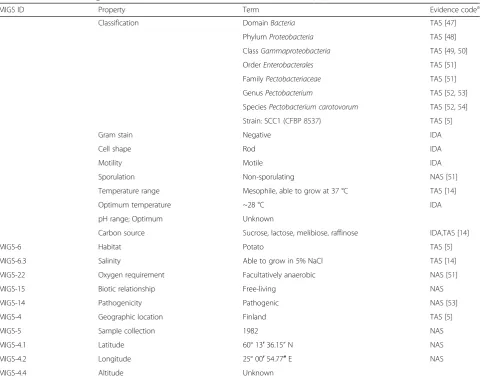
8537). MIGS of strain SCC1 is summarized in Table 1.
Genome sequencing information
Genome project history
P. carotovorum
strain SCC1 has been used as a model
soft rot pathogen in the field of plant-pathogen
inter-actions ever since its isolation in the 1980
’
s. The
sequencing of the genome of strain SCC1 was
initi-ated in 2008 in order to further facilitate its use as a
model pathogen.
The project was carried out jointly by the Institute of
Biotechnology,
Department
of
Biosciences
and
Department of Agricultural Sciences at the University of
Helsinki, Finland. The genome was sequenced, assembled
and annotated. The final sequence contains two scaffolds
representing one chromosome and one plasmid. The
se-quence of the chromosome contains one gap of estimated
length of 3788 bp. The genome sequence is deposited in
GenBank under the accession numbers CP021894
(chromosome) and CP021895 (plasmid). Summary
infor-mation of the project is presented in Table 2.
Growth conditions and genomic DNA preparation
After isolation from potato in 1982,
P. carotovorum
strain SCC1 has been stored in 22% glycerol at
−
80 °C.
For preparation of genomic DNA, the strain was first
grown overnight on solid LB medium (10 g tryptone, 5 g
yeast extract, 10 g NaCl, and 15 g agar per one liter of
medium) at 28 °C. A single colony was then picked and
grown overnight in 10 ml of liquid LB medium at 28 °C
with shaking. Cells were harvested by centrifugation for
20 min at 3200 g at 4 °C and resuspended into TE buffer
(10 mM Tris-HCl pH 7.5, 1 mM EDTA). SDS (5%
w
/
v
)
and Proteinase K (1 mg/ml) were used to break the cells
for one hour at 50 °C. Genomic DNA was extracted
using
phenol-chloroform
purification
followed
by
ethanol precipitation. The quantity and quality of the
DNA was assessed by spectrophotometry and agarose
gel electrophoresis.
Fig. 1Photomicrograph of Gram stained exponentially growing Pectobacterium carotovorumSCC1 cells. A light microscope with 100× magnification was used
Table 1
Classification and general features of
Pectobacterium carotovorum
strain SCC1 [46]
MIGS ID Property Term Evidence codea
Classification DomainBacteria TAS [47]
PhylumProteobacteria TAS [48]
ClassGammaproteobacteria TAS [49,50]
OrderEnterobacterales TAS [51]
FamilyPectobacteriaceae TAS [51]
GenusPectobacterium TAS [52,53]
SpeciesPectobacterium carotovorum TAS [52,54]
Strain: SCC1 (CFBP 8537) TAS [5]
Gram stain Negative IDA
Cell shape Rod IDA
Motility Motile IDA
Sporulation Non-sporulating NAS [51]
Temperature range Mesophile, able to grow at 37 °C TAS [14]
Optimum temperature ~28 °C IDA
pH range; Optimum Unknown
Carbon source Sucrose, lactose, melibiose, raffinose IDA,TAS [14]
MIGS-6 Habitat Potato TAS [5]
MIGS-6.3 Salinity Able to grow in 5% NaCl TAS [14]
MIGS-22 Oxygen requirement Facultatively anaerobic NAS [51]
MIGS-15 Biotic relationship Free-living NAS
MIGS-14 Pathogenicity Pathogenic NAS [53]
MIGS-4 Geographic location Finland TAS [5]
MIGS-5 Sample collection 1982 NAS
MIGS-4.1 Latitude 60° 13′36.15”N NAS
MIGS-4.2 Longitude 25° 00′54.77″E NAS
MIGS-4.4 Altitude Unknown
a
Evidence codes - IDA: Inferred from Direct Assay; TAS: Traceable Author Statement (i.e., a direct report exists in the literature); NAS: Non-traceable Author Statement (i.e., not directly observed for the living, isolated sample, but based on a generally accepted property for the species, or anecdotal evidence). These evidence codes are from the Gene Ontology project [55]
Table 2
Project information
MIGS ID Property Term
MIGS 31 Finishing quality One gap remaining, otherwise finished
MIGS-28 Libraries used Standard 454 and Solid libraries
MIGS 29 Sequencing platforms 454, SOLiD, Sanger
MIGS 31.2 Fold coverage Chromosome 40×, plasmid 67×
MIGS 30 Assemblers gsAssembler v 1.1.03.24
MIGS 32 Gene calling method Prodigal
Locus Tag SCC1
Genbank ID CP021894,CP021895
GenBank Date of Release July 27, 2017
GOLD ID
BIOPROJECT PRJNA379819
MIGS 13 Source Material Identifier CFBP 8537
Genome sequencing and assembly
Genome sequencing was performed at DNA and
Genomics
Laboratory,
Institute
of
Biotechnology,
University of Helsinki, Finland. Genomic DNA was
se-quenced using 454 (454 Life Sciences/Roche), SOLiD3
(Life Technologies) and ABI 3130xl Genetic Analyzer
(Life Technologies) instruments. DNA was fragmented
into approximate size of 800 bp using Nebulizer (Roche)
followed by standard fragment 454 library with the GS
FLX series reagents. For the SOLiD library genomic
DNA was fragmented with a Covaris S2 Sonicator
(Covaris Inc.) to approximate size of 250 bp. The library
was prepared using the SOLiD library kit (Life
technolo-gies).Newbler (version 1.1) was used to assemble
366,453 pyrosequencing reads (77,6 Mbp) in
approxi-mate length of 240 bp with default settings into 100
large (>1000 bp) contigs. GAP4 program (Staden
pack-age) was used for contig editing, primer design for PCRs
and primer walking, and finishing the genome. Gaps
were closed using PCR and traditional primer walking
Sanger sequencing method. Finally, SOLiD reads were
mapped to the genome and fifteen single genomic
posi-tions were fixed. Final sequencing coverages were 40× in
genome and 67× in plasmid sequences.
Genome annotation
Coding sequences were predicted using the Prodigal
gene prediction tool [16]. GenePRIMP [17] was run to
correct systematic errors made by Prodigal and to
reana-lyze the remaining intergenic regions for missed CDSs.
Functional annotation for the predicted genes was
per-formed using the PANNZER annotation tool [18]. The
annotation was manually curated with information from
publications and the following databases: COG [19],
KEGG [20], CDD [21], UniProt and NCBI
non-redundant protein sequences. To identify RNA genes,
RNAmmer v1.2 [22] (rRNAs) and tRNAscan-SE [23]
(tRNAs) were used. Clusters of Orthologous Groups
as-signments and Pfam domain predictions were done
using the WebMGA server [24]. Transmembrane helices
were predicted with TMHMM [25] and Phobius [26].
For signal peptide prediction, SignalP 4.1 [27] was used.
CRISPRFinder [28] was used to detect Clustered
Regu-larly Interspaced Short Palindromic Repeats (CRISPRs).
Genome properties
The genome of
P. carotovorum
SCC1 consists of one
cir-cular 4,974,798 bp chromosome and one circir-cular
5524 bp plasmid (Table 3, Fig. 3). The total genome size
is 4,980,322 bp with an overall G + C content of 51.85%
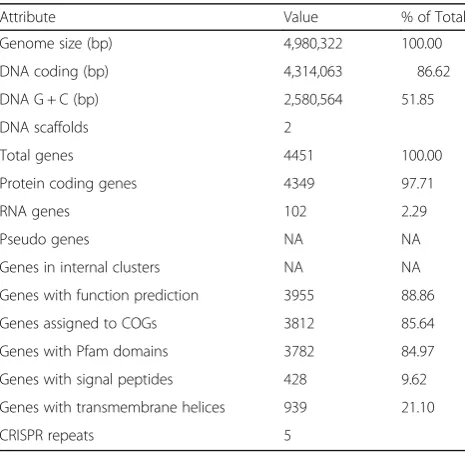
(Table 4). A total of 4451 genes were predicted, out of
which 4440 are chromosomal and 11 reside on the
plas-mid. 4349 (97.71%) genes are protein coding and 102
(2.29%) are RNA genes (77 tRNA, 22 rRNA, and 3 other
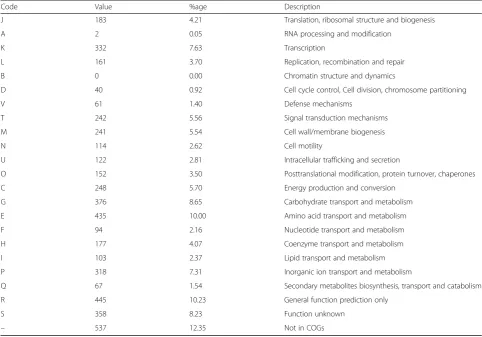
RNA genes). Of the 4349 protein coding genes, 3812
(87.65%) could be assigned to COG functional categories
(Table 5).
Insights from the genome sequence
P. carotovorum
strain SCC1 harbors a small cryptic
plas-mid of 5524 bp, pSCC1. The plasplas-mid contains sequences
for RNAI and RNAII, two non-coding RNAs involved in
replication initiation and control in enterobacterial RNA
priming plasmids such as ColE1 [29]. A similar
replica-tion region has previously been described in the small
cryptic plasmid pEC3 of
P. carotovorum
subsp.
caroto-vorum
strain IFO3380 [30]. In addition to the two RNA
genes, pSCC1 was predicted to contain nine
protein-coding genes. Four of these (
mobABCD
) encode
mobilization proteins. The
mob
locus is required for
mobilization of non-self-transmissible plasmids and is
found on many enterobacterial plasmids including pEC3
[31]. No function could be assigned to the remaining
five genes on pSCC1. One of them, SCC1_4463, is very
similar to genes found in many
Enterobacteriaceae
genomes,
especially
those
of
genera
Enterobacter
,
Escherichia
and
Salmonella
, whereas similar genes to
the other four on pSCC1 are not widely present in other
sequenced genomes.
Pectobacterium
infection is characterized by
macer-ation symptoms caused by the secretion of a large
ar-senal of plant cell wall-degrading enzymes. Accordingly,
the genome of
P. carotovorum
strain SCC1 was found to
contain genes for eleven pectate lyases (
pelABCILWXZ
,
hrpW
, SCC1_1311, and SCC1_2381), one pectin lyase
(
pnl
), four polygalacturonases (
pehAKNX
), one
oligoga-lacturonate lyase (
ogl
), three cellulases (
celSV
,
bcsZ
), one
rhamnogalacturonate lyase (
rhiE
), two pectin
methyles-terases (
pemAB
), and two pectin acetylesterases (
paeXY
).
In addition, the genome harbors two genes encoding
proteases previously characterized as plant cell
wall-degrading enzymes (
prt1
,
prtW
) as well as a number of
putative proteases, some of which may function in plant
cell wall degradation. Different
Pectobacterium
species
and strains have been found to harbor very similar
col-lections of plant cell wall-degrading enzymes [32], and
the number and types of enzymes in the genome of
strain SCC1 fit this picture well.
Protein secretion plays an essential role in soft rot
pathogenesis [33]. The most important secretion system
in
Pectobacterium
is the type II secretion system, also
Table 3
Summary of
P. carotovorum
SCC1 genome: one
chromosome and one plasmid
Label Size (Mb) Topology INSDC identifier RefSeq ID
Chromosome 4.974798 Circular CP021894
known as the Out system (
outCDEFGHIJKLMN
), which
transports proteins from the periplasmic space into the
extracellular environment [34]. It is responsible for the
secretion of most plant cell wall-degrading enzymes such
as pectinases and cellulases as well as some other
virulence factors such as the necrosis-inducing protein
Nip [33, 35]. Furthermore,
Pectobacterium
genomes
typ-ically harbor multiple type I secretion systems, which
se-crete proteases and adhesins [33]. At least four type I
secretion systems are encoded in the genome of
P.
carotovorum
SCC1
(
prtDEF
,
SCC1_1144
–
1146,
SCC1_1589
–
1591, and SCC1_3286
–
3288). Strain SCC1
also harbors a type III secretion system cluster
(SCC1_2406
–
2432), which has previously been
charac-terized in this strain and shown to affect the speed of
symptom development during infection [6, 36]. Overall,
the role of the type III secretion system in
Pectobacter-ium
is not well understood and
P. wasabiae
and
P.
par-mentieri
seem to lack it completely [32, 37]. The type IV
secretion system has been shown to have a minor
contri-bution to virulence of
P. atrosepticum
[38]. However, it
is sporadically distributed among
Pectobacterium
strains
[33], and no type IV secretion genes could be found
from the genome of
P. carotovorum
SCC1. Finally, the
type VI secretion system has also been shown to have a
small effect on virulence at least in some
Pectobacterium
species [32, 39]. In
P. carotovorum
SCC1, one type VI
secretion system cluster is present in the genome
(SCC1_0988
–
1002).
Soft rot pathogens have been suggested to be able to use
insect vectors in transmission, and indeed, certain
P.
Fig. 3Circular maps of the chromosome and plasmid ofPectobacterium carotovorumSCC1. Rings from the outside to the center: Genes on forward strand (colored by COG categories), Genes on reverse strand (colored by COG categories), GC content, GC skew. Maps were generated using the CGView Server [45]Table 4
Genome statistics
Attribute Value % of Total
Genome size (bp) 4,980,322 100.00
DNA coding (bp) 4,314,063 86.62
DNA G + C (bp) 2,580,564 51.85
DNA scaffolds 2
Total genes 4451 100.00
Protein coding genes 4349 97.71
RNA genes 102 2.29
Pseudo genes NA NA
Genes in internal clusters NA NA
Genes with function prediction 3955 88.86
Genes assigned to COGs 3812 85.64
Genes with Pfam domains 3782 84.97
Genes with signal peptides 428 9.62
Genes with transmembrane helices 939 21.10
carotovorum
strains can infect
Drosophila
flies and persist
in their guts [40]. This ability has been linked to the Evf
(
Erwinia
virulence factor) protein [41]. The
evf
gene is
present in the genome of
P. carotovorum
SCC1 suggesting
that the strain may have the ability to interact with insects.
Conclusions
In this study, we presented the annotated genome
se-quence of the pectinolytic plant pathogen
Pectobacter-ium carotovorum
SCC1 consisting of a chromosome of
4,974,798 bp and a small cryptic plasmid of 5524 bp.
Strain SCC1 was originally isolated from a diseased
po-tato tuber and it has been used as a model strain to
study interactions between soft rot pathogens and their
host plants for decades. In accordance with the
patho-genic lifestyle, the genome of strain SCC1 was found to
harbor a large arsenal of plant cell wall-degrading
en-zymes similar to other sequenced
Pectobacterium
ge-nomes. In addition, an insect interaction gene,
evf
, is
present in the genome of strain SCC1 suggesting the
possibility of insects as vectors or alternative hosts for
this strain. The genome sequence will drive further the
use of
P. carotovorum
SCC1 as a model plant pathogen.
Acknowledgments None.
Funding
We acknowledge the support of the Academy of Finland (Center of Excellence program 2006–2011, grants 213,509 and 129,628 and grants 136,470, 120,821, and 128,566), Biocentrum Helsinki, Biocenter Finland, University of Helsinki, the Emil Aaltonen foundation, the Finnish Doctoral Program in Computational Sciences FICS, the Viikki Doctoral Program in Molecular Biosciences, and the Finnish Doctoral Program in Plant Science.
Authors’contributions
ETP and MPi initiated the study and provided the strain and background information. HH isolated the genomic DNA. PL, PA and LP designed sequencing strategy and performed genome sequencing and assembly. PK, LH and ON annotated the genome. ON manually corrected the functional annotation. MPa and MPi conducted the phylogenetic analysis. ON, MPa and MPi performed biological experiments. ON, VP, JN and MPi analysed the contents of the genome. ON wrote the manuscript. MPi, PL and MPa contributed to writing. All authors read and approved the final manuscript.
Competing interests
The authors declare that they have no competing interests.
Publisher
’
s Note
Springer Nature remains neutral with regard to jurisdictional claims in published maps and institutional affiliations.
Table 5
Number of genes associated with general COG functional categories
Code Value %age Description
J 183 4.21 Translation, ribosomal structure and biogenesis
A 2 0.05 RNA processing and modification
K 332 7.63 Transcription
L 161 3.70 Replication, recombination and repair
B 0 0.00 Chromatin structure and dynamics
D 40 0.92 Cell cycle control, Cell division, chromosome partitioning
V 61 1.40 Defense mechanisms
T 242 5.56 Signal transduction mechanisms
M 241 5.54 Cell wall/membrane biogenesis
N 114 2.62 Cell motility
U 122 2.81 Intracellular trafficking and secretion
O 152 3.50 Posttranslational modification, protein turnover, chaperones
C 248 5.70 Energy production and conversion
G 376 8.65 Carbohydrate transport and metabolism
E 435 10.00 Amino acid transport and metabolism
F 94 2.16 Nucleotide transport and metabolism
H 177 4.07 Coenzyme transport and metabolism
I 103 2.37 Lipid transport and metabolism
P 318 7.31 Inorganic ion transport and metabolism
Q 67 1.54 Secondary metabolites biosynthesis, transport and catabolism
R 445 10.23 General function prediction only
S 358 8.23 Function unknown
– 537 12.35 Not in COGs
Author details
1Division of Genetics, Department of Biosciences, University of Helsinki,
Helsinki, Finland.2Viikki Plant Science Centre, University of Helsinki, Helsinki, Finland.3Institute of Biotechnology, University of Helsinki, Helsinki, Finland. 4Plant Pathology, Department of Agricultural Sciences, University of Helsinki,
Helsinki, Finland.
Received: 7 August 2017 Accepted: 5 December 2017
References
1. Pérombelon MCM. Potato diseases caused by soft rot erwinias: an overview of pathogenesis. Plant Pathol. 2002;51:1–12.
2. Czajkowski R, Pérombelon MCM, van Veen JA, van der Wolf JM. Control of blackleg and tuber soft rot of potato caused byPectobacteriumandDickeya species: a review. Plant Pathol. 2011;60:999–1013.
3. Davidsson PR, Kariola T, Niemi O, Palva ET. Pathogenicity of and plant immunity to soft rot pectobacteria. Front Plant Sci. 2013;4:191. 4. Toth IK, Bell KS, Holeva MC, Birch PRJ. Soft rot erwiniae: from genes to
genomes. Mol Plant Pathol. 2003;4:17–30.
5. Saarilahti HT, Palva ET. Major outer membrane proteins in the
phytopathogenic bacteriaErwinia carotovora subsp. carotovoraand subsp. atroseptica. FEMS Microbiol. Lett. 1986;35:267–70.
6. Rantakari A, Virtaharju O, Vähämiko S, Taira S, Palva ET, Saarilahti HT, et al. Type III secretion contributes to the pathogenesis of the soft-rot pathogen Erwinia carotovora: partial characterization of the hrp gene cluster. Mol PlantMicrobe Interact. 2001;14:962–8.
7. Li J, Brader G, Palva ET. The WRKY70 transcription factor: a node of convergence for Jasmonate-mediated and Salicylate-mediated signals in plant defense. Plant Cell. 2004;16:319–31.
8. Brader G, Sjöblom S, Hyytiäinen H, Sims-Huopaniemi K, Palva ET. Altering substrate chain length specificity of an acylhomoserine lactone synthase in bacterial communication. J Biol Chem. 2005;280:10403–9.
9. Kariola T, Brader G, Li J, Palva ET. Chlorophyllase 1, a damage control enzyme, affects the balance between defense pathways in plants. Plant Cell. 2005;17:282–94. 10. Kariola T, Brader G, Helenius E, Li J, Heino P, Palva ET. EARLY RESPONSIVE TO
DEHYDRATION 15, a negative regulator of Abscisic acid responses in Arabidopsis. Plant Physiol. 2006;142:1559–73.
11. Kwon SJ, Jin HC, Lee S, Nam MH, Chung JH, Kwon SI, et al. GDSL lipase-like 1 regulates systemic resistance associated with ethylene signaling in Arabidopsis. Plant J. 2009;58:235–45.
12. Po-Wen C, Singh P, Zimmerli L. Priming of the Arabidopsis pattern-triggered immunity response upon infection by necrotrophicPectobacterium carotovorumbacteria. Mol Plant Pathol. 2013;14:58–70.
13. Singh P, Kuo Y-C, Mishra S, Tsai C-H, Chien C-C, Chen C-W, et al. The Lectin receptor Kinase-VI.2 is required for priming and positively regulates Arabidopsis pattern-triggered immunity. Plant Cell. 2012;24:1256–70. 14. Pasanen M, Laurila J, Brader G, Palva ET, Ahola V, van der Wolf J, et al.
Characterisation ofPectobacterium wasabiaeandPectobacterium carotovorum subsp. carotovorumisolates from diseased potato plants in Finland. Ann Appl Biol. 2013;163:403–19.
15. Zhang Y, Fan Q, Loria R. A re-evaluation of the taxonomy of
phytopathogenic generaDickeyaandPectobacteriumusing whole-genome sequencing data. Syst Appl Microbiol. 2016;39:252–9.
16. Hyatt D, Chen G-L, Locascio PF, Land ML, Larimer FW, Hauser LJ. Prodigal: prokaryotic gene recognition and translation initiation site identification. BMC Bioinformatics. 2010;11:119.
17. Pati A, Ivanova NN, Mikhailova N, Ovchinnikova G, Hooper SD, Lykidis A, et al. GenePRIMP: a gene prediction improvement pipeline for prokaryotic genomes. Nat Methods. 2010;7:455–7.
18. Koskinen P, Törönen P, Nokso-Koivisto J, Holm L. PANNZER: high-throughput functional annotation of uncharacterized proteins in an error-prone environment. Bioinformatics. 2015;31:1544–52.
19. Tatusov RL, Galperin MY, Natale DA, Koonin EV. The COG database: a tool for genome-scale analysis of protein functions and evolution. Nucleic Acids Res. 2000;28:33–6.
20. Kanehisa M, Goto S. KEGG: kyoto encyclopedia of genes and genomes. Nucleic Acids Res. 2000;28:27–30.
21. Marchler-Bauer A, Lu S, Anderson JB, Chitsaz F, Derbyshire MK, DeWeese-Scott C, et al. CDD: a conserved domain database for the functional annotation of proteins. Nucleic Acids Res. 2011;39:D225–9.
22. Lagesen K, Hallin P, Rødland EA, Stærfeldt H-H, Rognes T, Ussery DW. RNAmmer: consistent and rapid annotation of ribosomal RNA genes. Nucleic Acids Res. 2007;35:3100–8.
23. Lowe TM, Eddy SR. tRNAscan-SE: a program for improved detection of transfer RNA genes in genomic sequence. Nucleic Acids Res. 1997;25:955–64. 24. Wu S, Zhu Z, Fu L, Niu B, Li W. WebMGA: a customizable web server for fast
metagenomic sequence analysis. BMC Genomics. 2011;12:444. 25. Krogh A, Larsson B, von Heijne G, Sonnhammer EL. Predicting
transmembrane protein topology with a hidden Markov model: application to complete genomes. J Mol Biol. 2001;305:567–80.
26. Käll L, Krogh A, Sonnhammer ELL. Advantages of combined transmembrane topology and signal peptide prediction—the Phobius web server. Nucleic Acids Res. 2007;35:W429–32.
27. Petersen TN, Brunak S, von Heijne G, Nielsen H. SignalP 4.0: discriminating signal peptides from transmembrane regions. Nat. Methods. 2011;8:785–6. 28. Grissa I, Vergnaud G, Pourcel C. CRISPRFinder: a web tool to identify
clustered regularly interspaced short palindromic repeats. Nucleic Acids Res. 2007;35:W52–7.
29. Cesareni G, Helmer-Citterich M, Castagnoli L. Control of ColE1 plasmid replication by antisense RNA. Trends Genet. 1991;7:230–5.
30. Nomura N, Murooka Y. Characterization and sequencing of the region required for replication of a non-selftransmissible plasmid pEC3 isolated fromErwinia carotovora subsp. carotovora. J Ferment Bioeng. 1994;78:250–4. 31. Nomura N, Yamashita M, Murooka Y. Genetic organization of a
DNA-processing region required for mobilization of a non-self-transmissible plasmid, pEC3, isolated fromErwinia carotovora subsp. carotovora. Gene. 1996;170:57–62. 32. Nykyri J, Niemi O, Koskinen P, Nokso-Koivisto J, Pasanen M, Broberg M, et al. Revised phylogeny and novel horizontally acquired virulence determinants of the model soft rot PhytopathogenPectobacterium wasabiaeSCC3193. PLoS Pathog. 2012;8:e1003013.
33. Charkowski A, Blanco C, Condemine G, Expert D, Franza T, Hayes C, et al. The role of secretion systems and small molecules in soft-rot
enterobacteriaceae pathogenicity. Annu Rev Phytopathol. 2012;50:425–49. 34. Johnson TL, Abendroth J, Hol WGJ, Sandkvist M. Type II secretion: from
structure to function. FEMS Microbiol Lett. 2006;255:175–86.
35. Laasik E, Põllumaa L, Pasanen M, Mattinen L, Pirhonen M, Mäe A. Expression of nipP.W ofPectobacterium wasabiaeis dependent on functional flgKL flagellar genes. Microbiology. 2014;160:179–86.
36. Lehtimäki S, Rantakari A, Routtu J, Tuikkala A, Li J, Virtaharju O, et al. Characterization of the hrp pathogenicity cluster ofErwinia carotovora subsp. carotovora: high basal level expression in a mutant is associated with reduced virulence. Mol Gen Genomics. 2003;270:263–72.
37. Kim H-S, Ma B, Perna NT, Charkowski AO. Phylogeny and virulence of naturally occurring type III secretion system-deficientPectobacteriumstrains. Appl Environ Microbiol. 2009;75:4539–49.
38. Bell KS, Sebaihia M, Pritchard L, Holden MTG, Hyman LJ, Holeva MC, et al. Genome sequence of the enterobacterial phytopathogenErwinia carotovora subsp. atrosepticaand characterization of virulence factors. Proc Natl Acad Sci U S A. 2004;101:11105–10.
39. Liu H, Coulthurst SJ, Pritchard L, Hedley PE, Ravensdale M, Humphris S, et al. Quorum sensing coordinates brute force and stealth modes of infection in the plant pathogenPectobacterium atrosepticum. PLoS Pathog. 2008;4: e1000093.
40. Basset A, Khush RS, Braun A, Gardan L, Boccard F, Hoffmann JA, et al. The phytopathogenic bacteriaErwinia carotovorainfects drosophila and activates an immune response. Proc Natl Acad Sci U S A. 2000;97:3376–81. 41. Basset A, Tzou P, Lemaitre B, Boccard F. A single gene that promotes
interaction of a phytopathogenic bacterium with its insect vector, Drosophila Melanogaster. EMBO Rep. 2003;4:205–9.
42. Katoh K, Asimenos G, Toh H. Multiple alignment of DNA sequences with MAFFT. In: Posada D, editor. Bioinformatics for DNA sequence analysis. New York: Humana Press; 2009. p. 39–64.
43. Stamatakis A. RAxML version 8: a tool for phylogenetic analysis and post-analysis of large phylogenies. Bioinformatics. 2014;30:1312–3.
44. Posada D. ModelTest server: a web-based tool for the statistical selection of models of nucleotide substitution online. Nucleic Acids Res. 2006;34:W700–3. 45. Grant JR, Stothard P. The CGView server: a comparative genomics tool for
circular genomes. Nucleic Acids Res. 2008;36:W181–4.
47. Woese CR, Kandler O, Wheelis ML. Towards a natural system of organisms: proposal for the domains Archaea, bacteria, and Eucarya. Proc Natl Acad Sci U S A. 1990;87:4576–9.
48. Garrity GM, Bell JA, Lilburn T. Phylum XIV.ProteobacteriaPhyl. Nov. In: Garrity GM, Brenner DJ, Krieg NR, Staley JT, editors. Bergey’s manual of systematic bacteriology. Volume 2 (part B). 2nd ed. New York: Springer; 2005. p. 1. 49. Garrity GM, Bell JA, Lilburn T. Class III.Gammaproteobacteriaclass. Nov. In: Garrity
GM, Brenner DJ, Krieg NR, Staley JT, editors. Bergey’s manual of systematic bacteriology. Volume 2 (part B). 2nd ed. New York: Springer; 2005. p. 1. 50. Williams KP, Kelly DP. Proposal for a new class within the phylum
Proteobacteria,Acidithiobacilliaclassis nov., with the type order Acidithiobacillales, and emended description of the class Gammaproteobacteria. Int J Syst Evol Microbiol. 2013;63:2901–6. 51. Adeolu M, Alnajar S, Naushad S, Gupta RS. Genome-based phylogeny and
taxonomy of the‘Enterobacteriales’: proposal forEnterobacteralesord. Nov. divided into the familiesEnterobacteriaceae,Erwiniaceaefam. Nov., Pectobacteriaceaefam. Nov.,Yersiniaceaefam. Nov.,Hafniaceaefam. Nov., Morganellaceaefam. Nov., andBudviciaceaefam. Nov. Int J Syst Evol Microbiol. 2016;66:5575–99.
52. Waldee EL. Comparative studies of some peritrichous phytopathogenic bacteria. Iowa state Coll. J Sci. 1945;19:435–84.
53. Hauben L, Moore ER, Vauterin L, Steenackers M, Mergaert J, Verdonck L, et al. Phylogenetic position of phytopathogens within the
Enterobacteriaceae. Syst Appl Microbiol. 1998;21:384–97.
54. Gardan L, Gouy C, Christen R, Samson R. Elevation of three subspecies of Pectobacterium carotovorumto species level:Pectobacterium atrosepticum sp. nov.,Pectobacterium betavasculorumsp. nov. andPectobacterium wasabiaesp. nov. Int J Syst Evol Microbiol. 2003;53:381–91.
55. Ashburner M, Ball CA, Blake JA, Botstein D, Butler H, Cherry JM, et al. Gene ontology: tool for the unification of biology. The gene ontology consortium. Nat Genet. 2000;25:25–9.
• We accept pre-submission inquiries
• Our selector tool helps you to find the most relevant journal
• We provide round the clock customer support
• Convenient online submission
• Thorough peer review
• Inclusion in PubMed and all major indexing services
• Maximum visibility for your research
Submit your manuscript at www.biomedcentral.com/submit