20
20
Copyright © 2004 South-Western
Income Inequality and Poverty
A person’s earnings depend on the supply and demand for that person’s labor, which in turn
depend on natural ability, human capital,
THE MEASUREMENT OF
INEQUALITY
• How much inequality is there in our society? • How many people live in poverty?
• What problems arise in measuring the amount of inequality?
Table 1 The Distribution of Income in the United States: 2000
U.S. Income Inequality
• Imagine that you. . .
• lined up all of the families in the economy according to their annual income.
• divided the families into five equal groups (bottom fifth, second fifth, etc.)
Table 2 Income Inequality in the United States
U.S. Income Inequality
• If income were equally distributed across all families, each one-fifth of families would
Copyright © 2004 South-Western
U.S. Income Inequality
• From 1935-1970, the distribution of income gradually became more equal.
U.S. Income Inequality
• Reasons for Recent Increase in Income Inequality
• The following have tended to reduce the demand for unskilled labor and raise the demand for skilled
labor:
• Increases in international trade with low-wage countries • Changes in technology
• Therefore, the wages of unskilled workers have fallen relative to the wages of skilled workers.
Copyright © 2004 South-Western
CASE STUDY: The Women’s Movement and
the Income Distribution
Copyright © 2004 South-Western
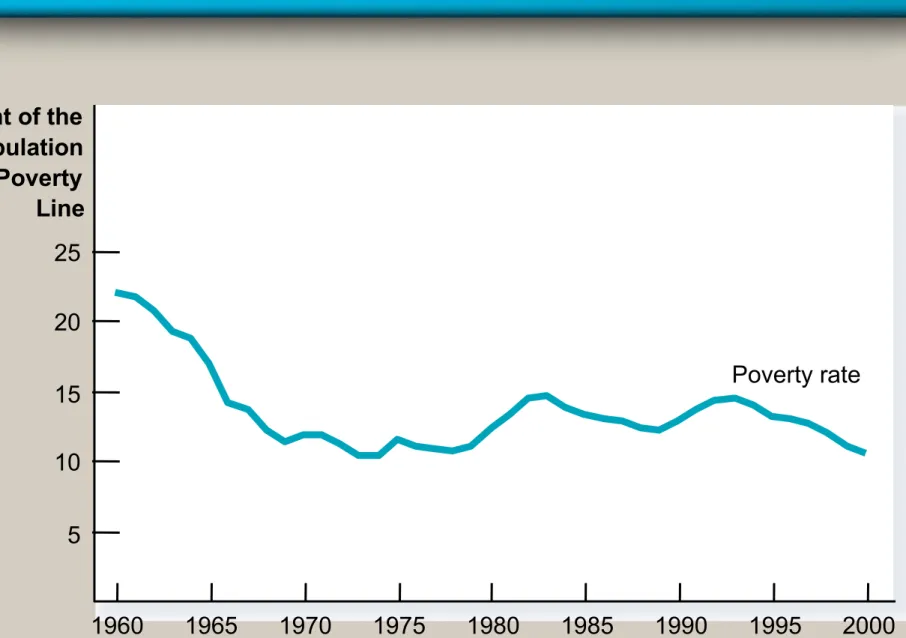
The Poverty Rate
• The poverty rate is the percentage of the
Problems in Measuring Inequality
• The Poverty Line
• The poverty line is an absolute level of income set by the federal government for each family size
Figure 1 The Poverty Rate
Copyright©2003 Southwestern/Thomson Learning
Percent of the Population below Poverty Line
Problems in Measuring Inequality
• The Poverty Line and Income Inequality
• As economic growth pushes the entire income distribution upward, more families are pushed
above the poverty line because the poverty line is an absolute rather than a relative standard.
• Despite continued economic growth in average income, the poverty rate has not declined.
• Although economic growth has raised the income of the typical family, the increase in inequality has
Table 4 Who Is Poor?
Problems in Measuring Inequality
• Three Facts About Poverty
• Poverty is correlated with race. • Poverty is correlated with age.
Copyright © 2004 South-Western
Problems in Measuring Inequality
• Data on income distribution and the poverty
rate give an incomplete picture of inequality in living standards because of the following:
• In-kind transfers • Life cycle
Problems in Measuring Inequality
• In-Kind Transfers
• Transfers to the poor given in the form of goods and
services rather than cash are called in-kind
transfers.
• Measurements of the distribution of income and the poverty rate are based on families’ money income. • The failure to include in-kind transfers as part of
Copyright © 2004 South-Western
Problems in Measuring Inequality
• The Economic Life Cycle
• The regular pattern of income variation over a
person’s life is called the life cycle.
• A young worker has a low income at the beginning of his or her career.
• Income rises as the worker gains maturity and experience.
• Income peaks at about age 50.
Problems in Measuring Inequality
• Transitory versus Permanent Income
• Incomes vary because of random and transitory forces.
• Acts of nature
• Temporary layoffs due to illness or economic conditions, etc.
• A family’s ability to buy goods and services depends largely on its permanent income, which is its normal, or average, income.
Copyright © 2004 South-Western
Economic Mobility
• The movement of people among income classes is called economic mobility.
Economic Mobility
• Movements up and down the income ladder can be due to:
• Good or bad luck.
• Hard work or laziness.
Copyright © 2004 South-Western
POLITICAL PHILOSOPHY OF
REDISTRIBUTING INCOME
• What should the government do about economic inequality?
• Economic analysis alone cannot give us the answer. • The question is a normative one facing
POLITICAL PHILOSOPHY OF
REDISTRIBUTING INCOME
• Three Political Philosophies
• Utilitarianism • Liberalism
Copyright © 2004 South-Western
Utilitarianism
• Utilitarianism is the political philosophy according to which the government should
choose policies to maximize the total utility of everyone in society.
Utilitarianism
• The utilitarian case for redistributing income is based on the assumption of diminishing
marginal utility.
• An extra dollar of income to a poor person
provides that person with more utility, or
Copyright © 2004 South-Western
Liberalism
• Liberalism is the political philosophy according to which the government should choose
policies deemed to be just, as evaluated by an impartial observer behind a “veil of ignorance.” • This view was originally developed by the
Liberalism
• Public policy should be based on the maximin criterion, which seeks to maximize the utility or well-being of the worst-off person in society.
• That is, rather than maximizing the sum of everyone’s utility, one should maximize the minimum utility.
Copyright © 2004 South-Western
Libertarianism
• Libertarianism is the political philosophy according to which the government should punish crimes and enforce voluntary
agreements, but should not redistribute income. • Libertarians argue that equality of opportunity
POLICIES TO REDUCE POVERTY
• Minimum-wage laws • Welfare
Copyright © 2004 South-Western
Minimum-Wage Laws
• Advocates view the minimum wage as a way of helping the working poor.
Minimum-Wage Laws
• The magnitude of the effects of the minimum wage depends on the elasticity of the demand
Copyright © 2004 South-Western
Minimum-Wage Laws
• Advocates argue that the demand for unskilled labor is relatively inelastic, so that a high
minimum wage depresses employment only slightly.
Welfare
• The government attempts to raise the living standards of the poor through the welfare system.
• Welfare is a broad term that encompasses
various government programs that supplement the incomes of the needy.
Copyright © 2004 South-Western
Negative Income Tax
• A negative income tax collects tax revenue
Negative Income Tax
• High-income families would pay a tax based on their incomes.
• Low-income families would receive a subsidy —a “negative tax.”
Copyright © 2004 South-Western
In-Kind Transfers
• In-kind transfers are transfers to the poor given in the form of goods and services rather than cash.
In-Kind Transfers
• Advocates of in-kind transfers argue that such transfers ensure that the poor get what they
most need.
Copyright © 2004 South-Western
Antipoverty Programs and Work Incentives
Antipoverty Programs and Work Incentives
• An antipoverty program can affect work incentives:
• A family needs $15,000 to maintain a reasonable standard of living.
• The government promises to guarantee every family a $15,000 income.
Copyright © 2004 South-Western
Antipoverty Programs and Work Incentives
• Workfare refers to a system that would require any person collecting benefits to accept a
Antipoverty Programs and Work Incentives
Copyright © 2004 South-Western
Summary
• Data on the distribution of income show wide disparity in our society.
• The richest fifth of the families earns about ten times as much as the poorest fifth.
Summary
• Political philosophers differ in their views about the role government should play in redistributing income.
Copyright © 2004 South-Western
Summary
• Liberals would determine the distribution of income as if we were behind a “veil of
ignorance” that prevented us from knowing our own stations in life.
• Libertarians would have the government
Summary
• Various policies aimed to help the poor include: minimum-wage laws, welfare, negative income taxes, and in-kind transfers.
• Although each of these policies helps some families escape poverty, they also have