Copyright © 2004 South-Western/Thomson Learning
2
2
Copyright © 2004 South-Western/Thomson Learning
Thinking Like an Economist
• Every field of study has its own terminology
• Mathematics
• integrals axioms vector spaces
• Psychology
• ego id cognitive dissonance
• Law
• promissory estoppel torts venues
• Economics
• supply opportunity cost elasticity consumer surplus demand comparative advantage
Copyright © 2004 South-Western/Thomson Learning
Thinking Like an Economist
• Economics trains you to. . . .
• Think in terms of alternatives.
• Evaluate the cost of individual and social choices. • Examine and understand how certain events and
Copyright © 2004 South-Western/Thomson Learning
THE ECONOMIST AS A
SCIENTIST
• The economic way of thinking . . .
Copyright © 2004 South-Western/Thomson Learning
The Scientific Method: Observation, Theory, and More Observation
• Uses abstract models to help explain how a complex, real world operates.
Copyright © 2004 South-Western/Thomson Learning
The Role of Assumptions
• Economists make assumptions in order to make the world easier to understand.
• The art in scientific thinking is deciding which assumptions to make.
Copyright © 2004 South-Western/Thomson Learning
Economic Models
• Economists use models to simplify reality in order to improve our understanding of the
world
• Two of the most basic economic models include:
• The Circular Flow Diagram
Copyright © 2004 South-Western/Thomson Learning
Our First Model: The Circular-Flow Diagram
• The circular-flow diagram is a visual model of the
Figure 1 The Circular Flow
Copyright © 2004 South-Western
Spending Goods and services bought Revenue Goods and services sold Labor, land, and capital Income
= Flow of inputs and outputs = Flow of dollars Factors of
production
Wages, rent, and profit FIRMS •Produce and sell
goods and services •Hire and use factors
of production
•Buy and consume goods and services •Own and sell factors
of production HOUSEHOLDS •Households sell •Firms buy MARKETS FOR
FACTORS OF PRODUCTION •Firms sell
•Households buy MARKETS
FOR
Copyright © 2004 South-Western/Thomson Learning
Our First Model: The Circular-Flow Diagram
• Firms
• Produce and sell goods and services • Hire and use factors of production
• Households
Copyright © 2004 South-Western/Thomson Learning
Our First Model: The Circular-Flow Diagram
• Markets for Goods and Services
• Firms sell
• Households buy
• Markets for Factors of Production
Copyright © 2004 South-Western/Thomson Learning
Our First Model: The Circular-Flow Diagram
• Factors of Production
Copyright © 2004 South-Western/Thomson Learning
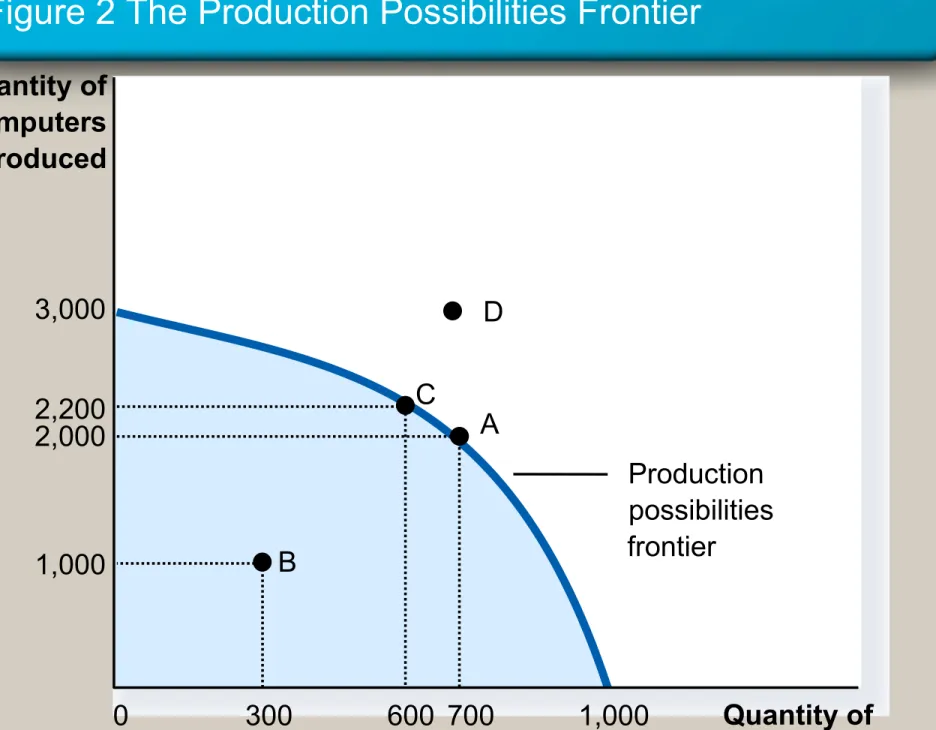
Our Second Model: The Production Possibilities Frontier
• The production possibilities frontier is a graph that
Figure 2 The Production Possibilities Frontier
Copyright©2003 Southwestern/Thomson Learning
Copyright © 2004 South-Western/Thomson Learning
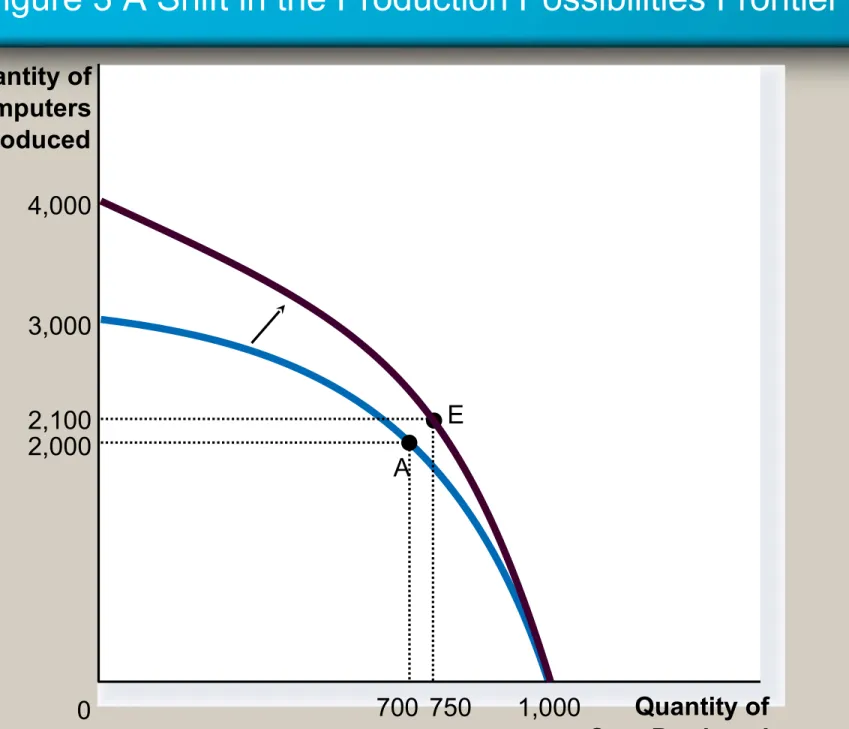
Our Second Model: The Production Possibilities Frontier
• Concepts Illustrated by the Production Possibilities Frontier
• Efficiency • Tradeoffs
Figure 3 A Shift in the Production Possibilities Frontier
Copyright © 2004 South-Western
Copyright © 2004 South-Western/Thomson Learning
Microeconomics and Macroeconomics
• Microeconomics focuses on the individual parts
of the economy.
• How households and firms make decisions and how they interact in specific markets
• Macroeconomics looks at the economy as a
whole.
Copyright © 2004 South-Western/Thomson Learning
THE ECONOMIST AS POLICY
ADVISOR
• When economists are trying to explain the world, they are scientists.
Copyright © 2004 South-Western/Thomson Learning
POSITIVE VERSUS NORMATIVE ANALYSIS
• Positive statements are statements that attempt to
describe the world as it is.
• Called descriptive analysis
• Normative statements are statements about how
the world should be.
Copyright © 2004 South-Western/Thomson Learning
• Positive or Normative Statements?
• An increase in the minimum wage will cause a decrease in employment among the least-skilled.
POSITIVE
• Higher federal budget deficits will cause interest rates to increase.
POSITIVE
?
?
POSITIVE VERSUS NORMATIVE
ANALYSIS
Copyright © 2004 South-Western/Thomson Learning
• Positive or Normative Statements?
• The income gains from a higher minimum wage are worth more than any slight reductions in
employment.
NORMATIVE
• State governments should be allowed to collect from tobacco companies the costs of treating smoking-related illnesses among the poor.
NORMATIVE
?
?
POSITIVE VERSUS NORMATIVE
ANALYSIS
Copyright © 2004 South-Western/Thomson Learning
Economists in Washington
• . . . serve as advisers in the policymaking
process of the three branches of government:
Copyright © 2004 South-Western/Thomson Learning
Economists in Washington
• Some government agencies that collect
economic data and make economic policy:
• Department of Commerce
• http://www.commerce.gov
• Bureau of Labor Statistics
• http://www.bls.gov
• Congressional Budget Office
• http://www.cbo.gov
• Federal Reserve Board
Copyright © 2004 South-Western/Thomson Learning
WHY ECONOMISTS DISAGREE
• They may disagree about the validity of alternative positive theories about how the world works.
Table 2 Ten Propositions about Which Most Economists Agree
Copyright © 2004 South-Western/Thomson Learning
Summary
• Economists try to address their subjects with a scientist’s objectivity.
• They make appropriate assumptions and build
simplified models in order to understand the world around them.
Copyright © 2004 South-Western/Thomson Learning
Summary
• Economics is divided into two subfields:
• Microeconomists study decisionmaking by households and firms in the marketplace.
Copyright © 2004 South-Western/Thomson Learning
Summary
• A positive statement is an assertion about how the world is.
• A normative statement is an assertion about how the world ought to be.
Copyright © 2004 South-Western/Thomson Learning
Summary
• Economists who advise policymakers offer
conflicting advice either because of differences in scientific judgments or because of
differences in values.
• At other times, economists are united in the