Blown to Bits
Your Life, Liberty,
and Happiness After
the Digital Explosion
Hal Abelson
Ken Ledeen
Harry Lewis
Upper Saddle River, NJ • Boston • Indianapolis • San Francisco New York • Toronto • Montreal • London • Munich • Paris • Madrid
Many of the designations used by manufacturers and sellers to distinguish their products are claimed as trademarks. Where those designations appear in this book, and the publisher was aware of a trademark claim, the designations have been printed with initial capital letters or in all capitals.
The authors and publisher have taken care in the preparation of this book, but make no expressed or implied warranty of any kind and assume no responsibility for errors or omissions. No liability is assumed for incidental or consequential damages in connection with or arising out of the use of the information or programs contained herein.
The publisher offers excellent discounts on this book when ordered in quantity for bulk purchases or special sales, which may include electronic versions and/or custom covers and content particular to your business, training goals, marketing focus, and branding interests. For more information, please contact:
U.S. Corporate and Government Sales (800) 382-3419
For sales outside the United States, please contact:
International Sales [email protected]
Visit us on the Web: www.informit.com/aw
Library of Congress Cataloging-in-Publication Data: Abelson, Harold.
Blown to bits : your life, liberty, and happiness after the digital explosion / Hal Abelson, Ken Ledeen, Harry Lewis.
p. cm.
ISBN 0-13-713559-9 (hardback : alk. paper) 1. Computers and civilization. 2. Information technology—Technological innovations. 3. Digital media. I. Ledeen, Ken, 1946- II. Lewis, Harry R. III. Title.
QA76.9.C66A245 2008 303.48’33—dc22
2008005910
Copyright © 2008 Hal Abelson, Ken Ledeen, and Harry Lewis
For information regarding permissions, write to:
Pearson Education, Inc. Rights and Contracts Department 501 Boylston Street, Suite 900 Boston, MA 02116
Fax (617) 671 3447
This work is licensed under the Creative Commons Attribution-Noncommercial-Share Alike 3.0 United States License. To view a copy of this license visit
ISBN-13: 978-0-13-713559-2 ISBN-10: 0-13-713559-9
Text printed in the United States on recycled paper at RR Donnelley in Crawfordsville, Indiana. Third printing December 2008
This Book Is Safari Enabled
The Safari®Enabled icon on the cover of your favorite technology book means the book is available through Safari Bookshelf. When you buy this book, you get free access to the online edition for 45 days.
Safari Bookshelf is an electronic reference library that lets you easily search thousands of technical books, find code samples, download chapters, and access technical information whenever and wherever you need it.
To gain 45-day Safari Enabled access to this book:
• Go to http://www.informit.com/onlineedition • Complete the brief registration form
• Enter the coupon code 9SD6-IQLD-ZDNI-AGEC-AG6L
If you have difficulty registering on Safari Bookshelf or accessing the online edition, please e-mail [email protected].
Editor in Chief
Mark Taub
Acquisitions Editor
Greg Doench
Development Editor
Michael Thurston
Managing Editor
Gina Kanouse
Senior Project Editor
Kristy Hart
Copy Editor
Water Crest Publishing, Inc.
Indexer
Erika Millen
Proofreader
Williams Woods Publishing Services
Publishing Coordinator
Michelle Housley
Interior Designer and Composition
Nonie Ratcliff
Cover Designer
CHAPTER 8
Bits in the Air
Old Metaphors, New Technologies,
and Free Speech
Censoring the President
On July 17, 2006, U.S. President George Bush and British Prime Minister Tony Blair were chatting at the G-8 summit in St. Petersburg, Russia. The event was a photo opportunity, but the two leaders did not realize that a microphone was on. They were discussing what the UN might do to quell the conflict between Israel and militant forces in Lebanon. “See the irony is,” said Bush, “what they need to do is get Syria to get Hezbollah to stop doing this shit and it’s over.”
The cable network CNN carried the clip in full and posted it on the Web, but most broadcast stations bleeped out the expletive. They were aware of the fines, as much as $325,000, that the Federal Communications Commission might impose for airing the word “shit.”
The FCC had long regulated speech over the public airways, but had raised its decency standards after the 2002 “Golden Globes” awards presentation. Singer Bono had won the “Best Original Song” award. In his acceptance speech, broadcast live on NBC, he said, “This is really, really, fucking bril-liant.” The FCC ruled that this remark was “patently offensive under contem-porary community standards for the broadcast medium.” It promised to fine and even pull the licenses of stations broadcasting such remarks.
In 2006, the Commission extended the principle from the F-word to the S-word. Nicole Richie, referring to a reality TV show on which she had done
some farm work, said to Paris Hilton, “Why do they even call it The Simple Life? Have you ever tried to get cow shit out of a Prada purse? It’s not so fucking simple.” The FCC’s ruling on Richie’s use of the excrement metaphor implied that Bush’s use would be “presumptively profane” in the eyes of the FCC.
A federal court reversed the FCC’s policy against such “fleeting” expletives—an expansion of indecency policies that had been in place for decades. Congress quickly introduced legislation to restore the FCC’s new and strict standard, and the whole matter was to be argued before the U.S. Supreme Court in the spring of 2008. The FCC had adopted its new standards after complaints about broadcast indecency rose from fewer than 50 to about 1.4 million in the period from 2000 to 2004. Congress may have thought that the new speech code reflected a public mandate.
Under the First Amendment, the government is generally not in the speech-restricting business. It can’t force its editorial judgments on news-papers, even to increase the range of information available to readers. The Supreme Court struck down as unconstitutional a Florida law assuring polit-ical candidates a simple “right to reply” to newspaper attacks on them.
Nonetheless, in 2006, an agency of the federal government was trying to keep words off television, using rules that “presumptively” covered even a candid conversation about war and peace between leaders of the free world. Dozens of newspapers printed Bush’s remark in full, and anyone with an Internet connection could hear the audio. In spite of the spike in indecency complaints to the FCC, Americans are generally opposed to having the gov-ernment nanny their television shows.
How Broadcasting Became Regulated
The FCC gained its authority over what is said on radio and TV broadcasts when there were fewer ways to distribute information. The public airways were scarce, went the theory, and the government had to make sure they were used in the public interest. As radio and television became universally acces-sible, a second rationale emerged for government regulation of broadcast speech. Because the broadcast media have “a uniquely pervasive presence in the lives of all Americans,” as the Supreme Court put it in 1978, the govern-ment had a special interest in protecting a defenseless public from objection-able radio and television content.
With minimal technology, anyone can sit at home or in Starbucks and choose from among billions of web pages and tens of millions of blogs. Shock jock Howard Stern left broadcast radio for satellite radio, where the FCC has no authority to regulate what he says.
More than 90% of American televi-sion viewers get their TV signal through similarly unregulated cable or satellite, not through broadcasts from rooftop antennas. RSS feeds supply up-to-date information to millions of on-the-go cell phone
users. Radio stations and television channels are today neither scarce nor uniquely pervasive.
For the government to protect children from all offensive information arriving through any communication medium, its authority would have to be expanded greatly and updated continuously. Indeed, federal legislation has been introduced to do exactly that—to extend FCC indecency regulations for broadcast media to satellite and cable television as well.
The explosion in communications raises another possibility, however. If almost anyone can now send information that many people can receive, per-haps the government’s interest in restricting transmissions should be less than what it once was, not greater. In the absence of scarcity, perhaps the govern-ment should have no more authority over what gets said on radio and TV than it does over what gets printed in newspapers. In that case, rather than expanding the FCC’s censorship authority, Congress should eliminate it entirely, just as the Supreme Court ended Florida’s regulation of newspaper content.
Parties who already have spots on the radio dial and the TV channel lineup respond that the spectrum—the public airwaves—should remain a limited resource, requiring government protection. No one is making any more radio spectrum, goes the theory, and it needs to be used in the public interest.
But look around you. There are still only a few stations on the AM and FM radio dials. But thousands, maybe tens of thousands, of radio communica-tions are passing through the air around you. Most Americans walk around with two-way radios in their pockets—devices we call cell phones—and most of the nation’s teenagers seem to be talking on them simultaneously. Radios and television sets could be much, much smarter than they now are and could make better use of the airwaves, just as cell phones do.
Engineering developments have vitiated the government’s override of the First Amendment on radio and television. The Constitution demands, under these changed circumstances, that the government stop its verbal policing.
As a scientific argument, the claim that the spectrum is necessar-ily scarce is now very weak. Yet that view is still forcefully advanced by the very industry that is being regulated. The incumbent license holders—existing broadcast stations and networks—have an incentive to protect their “turf” in the spectrum against any risk, real or imagined, that their signals might be corrupted. By deterring technological innova-tion, incumbents can limit competi-tion and avoid capital investments. These oddly intertwined strands—the government’s interest in artificial scarcity to justify speech regulation and the incumbents’ interest in artificial scarcity to limit competition and costs—today impair both cultural and technological creativity, to the detri-ment of society.
To understand the confluent forces that have created the world of today’s radio and television censorship, we have to go back to the inventors of the technology.
From Wireless Telegraph to Wireless Chaos
Red, orange, yellow, green, blue—the colors of the rainbow—are all different and yet are all the same. Any child with a crayon box knows that they are all different. They are the same because they are all the result of electromagnetic radiation striking our eyes. The radiation travels in waves that oscillate very quickly. The only physical difference between red and blue is that red waves oscillate around 450,000,000,000,000 times per second, and blue waves about 50% faster.
Because the spectrum of visible light is continuous, an infinity of colors exists between red and blue. Mixing light of different frequencies creates other colors—for example, half blue waves and half red creates a shade of pink known as magenta, which does not appear in the rainbow.
In the 1860s, British physicist James Clerk Maxwell realized that light con-sists of electromagnetic waves. His equations predicted that there might be waves of other frequencies—waves that people couldn’t sense. Indeed, such
SURVIVING ONWIRELESS
waves have been passing right through us from the beginning of time. They shower down invisibly from the sun and the stars, and they radiate when lightning strikes. No one suspected they existed until Maxwell’s equations said they should. Indeed, there should be a whole spectrum of invisible waves of different frequencies, all traveling at the same great speed as visible light.
In 1887, the radio era began with a demonstration by Henrich Hertz. He bent a wire into a circle, leaving a small gap between the two ends. When he set off a big electric spark a few feet away, a tiny spark jumped the gap of the almost-completely-circular wire. The big spark had set off a shower of unseen electromagnetic waves, which had traveled through space and caused electric current to flow in the other wire. The tiny spark was the current com-pleting the circuit. Hertz had created the first antenna, and had revealed the radio waves that struck it. The unit of frequency is named in his honor: One cycle per second is 1 hertz, or Hz for short. A kHz (kilohertz) is a thousand cycles per second, and a MHz (megahertz) is a million cycles per second. These are the units on the AM and FM radio dials.
Gugliemo Marconi was neither a mathematician nor a scientist. He was an inventive tinkerer. Only 13 years old at the time of Hertz’s experiment, Marconi spent the next decade developing, by trial and error, better ways of creating bursts of radio waves, and antennas for detecting them over greater distances.
In 1901, Marconi stood in Newfoundland and received a single Morse code letter transmitted from England. On the strength of this success, the Marconi Wireless Telegraph Company was soon enabling ships to communicate with each other and with the shore. When the Titanicleft on its fateful voyage in 1912, it was equipped with Marconi equipment. The main job of the ship’s radio operators was to relay personal messages to and from passengers, but they also received at least 20 warnings from other ships about the icebergs that lay ahead.
The words “Wireless Telegraph” in the name of Marconi’s company sug-gest the greatest limitation of early radio. The technology was conceived as a device for point-to-point communication. Radio solved the worst problem of telegraphy. No calamity, sabotage, or war could stop wireless transmissions by severing cables. But there was a compensating disadvantage: Anyone could listen in. The enormous power of broadcasting to reach thousands of people at once was at first seen as a liability. Who would pay to send a mes-sage to another person when anyone could hear it?
signals couldn’t be kept apart. The Titanicdisaster demonstrated the confu-sion that could result. The morning after the ship hit the iceberg, American newspapers reported excitedly that all passengers had been saved and the ship was being towed to shore. The mistake resulted from a radio operator’s garbled merger of two unrelated segments of Morse code. One ship inquired if “all Titanic passengers safe?” A completely different ship reported that it was “300 miles west of the Titanic and towing an oil tank to Halifax.” All the ships had radios and radio operators. But there were no rules or conventions about whether, how, or when to use them.
Listeners to Marconi’s early transmitters were easily confused because they had no way to “tune in” a particular communication. For all of Marconi’s genius in extending the range of transmission, he was using essentially Hertz’s method for generating radio waves: big sparks. The sparks splattered electromagnetic energy across the radio spectrum. The energy could be stopped and started to turn it into dots and dashes, but there was nothing else to control. One radio operator’s noise was like any other’s. When several transmitted simultaneously, chaos resulted.
The many colors of visible light look white if all blended together. A color filter lets through some frequencies of visible light but not others. If you look at the world through a red filter, everything is a lighter or darker shade of red, because only the red light comes through. What radio needed was something similar for the radio spectrum: a way to produce radio waves of a single fre-quency, or at least a narrow range of frequencies, and a receiver that could let through those frequencies and screen out the rest. Indeed, that technology already existed.
In 1907, Lee De Forest patented a key technology for the De Forest Radio Telephone Company—dedicated to sending voice and even music over the radio waves. When he broadcast Enrico Caruso from the Metropolitan Opera House on January 13, 1910, the singing reached ships at sea. Amateurs hud-dled over receivers in New York and New Jersey. The effect was sensational. Hundreds of amateur broadcasters sprang into action over the next few years, eagerly saying whatever they wanted, and playing whatever music they could, to anyone who happened to be listening.
But with no clear understanding about what frequencies to use, radio communication was a hit-or-miss affair. Even what the New York Times described as the “homeless song waves” of the Caruso broadcast clashed with
another station that, “despite all entreaties,” insisted on broadcasting at the identical 350kHz frequency. Some people could “catch the ecstasy” of Caruso’s voice, but others got only some annoying Morse code: “I took a beer just now.”
Radio Waves in Their Channels
The emerging radio industry could not grow under such conditions. Commer-cial interests complemented the concerns of the U.S. Navy about amateur interference with its ship communications. The Titanic disaster, although it owed little to the failures of radio, catalyzed government action. On May 12, 1912, William Alden Smith called for radio regulation on the floor of the U.S. Senate. “When the world weeps together over a common loss…,” proclaimed the Senator, “why should not the nations clear the sea of its conflicting idioms and wisely regulate this new
servant of humanity?”
The Radio Act of 1912 limited broadcasting to license holders. Radio licenses were to be “granted by the Secretary of Commerce and Labor upon application therefor.” In granting the license, the Secretary would stipulate the frequencies “authorized for use by the station for the prevention of interference and the hours for which the station is licensed for work.” The Act reserved for government use the choice fre-quencies between about 200 and 500kHz, which permitted the clear-est communications over long dis-tances. Amateurs were pushed off to “short wave” frequencies above 1500kHz, considered useless for technological reasons. The fre-quency 1000kHz was reserved for distress calls, and licensed stations were required to listen to it every 15 minutes (the one provision that
HIGH FREQUENCIES
might have helped the Titanic, since the radio operators of a nearby ship had gone off-duty and missed the Titanic’srescue pleas). The rest of the spectrum the Secretary could assign to commercial radio stations and private busi-nesses. Emphasizing the nature of radio as “wireless telegraphy,” the Act made it a crime for anyone hearing a radio message to divulge it to anyone except its intended recipient.
Much has changed since 1912. The uses of radio waves have become more varied, the allocation of spectrum blocks has changed, and the range of usable frequencies has grown. The current spectrum allocation picture has grown into a dense, disorganized quilt, the product of decades of Solomonic FCC judgments (see Figure 8.1). But still, the U.S. government stipulates what parts of the spectrum can be used for what purposes. It prevents users from interfering with each other and with government communications by demanding that they broadcast at limited power and only at their assigned frequencies. As long as there weren’t many radio stations, the implied
Source: www.ntia.doc.gov/osmhome/allochrt.pdf.
FIGURE8.1 Frequency allocation of the U.S. radio spectrum. The spectrum from
promise in the Act of 1912 that licenses would be granted “upon application therefor” caused no problems. With the gossip of the pesky amateurs pushed into remote radio territory, there was plenty of spectrum for commercial, mil-itary, and safety use.
Within a decade, that picture had changed dramatically. On November 2, 1920, a Detroit station broadcast the election of Warren Harding as President of the United States, relaying to its tiny radio audience the returns it was receiving by telegraph. Radio was no longer just point-to-point communica-tion. A year later, a New York station broadcast the World Series between the Giants and the Yankees, pitch by pitch. Sports broadcasting was born with a broadcaster drearily repeating the ball and strike information telephoned by a newspaper reporter at the ballpark.
Public understanding of the possibilities grew rapidly. The first five radio stations were licensed for broadcasting in 1921. Within a year, there were 670. The number of radio receivers jumped in a year from less than 50,000 to more than 600,000, perhaps a million. Stations using the same frequency in the same city divided up the hours of the day. As radio broadcasting became a profitable business, the growth could not go on forever.
On November 12, 1921, the New York City broadcast license of Intercity Radio Co. expired. Herbert Hoover, then the Secretary of Commerce, refused to renew it, on the grounds that there was no frequency on which Intercity could broadcast in the city’s airspace without interfering with government or other private stations. Intercity sued Hoover to have its license restored, and won. Hoover, said the court, could choose the frequency, but he had no dis-cretion to deny the license. As the congressional committee proposing the 1912 Radio Act had put it, the licensing system was “substantially the same as that in use for the documenting upward of 25,000 merchant vessels.” The implied metaphor was that Hoover should keep track of the stations like ships in the ocean. He could tell them what shipping lanes to use, but he couldn’t keep them out of the water.
The radio industry begged for order. Hoover convened a National Radio Conference in 1922 in an attempt to achieve consensus on new regulations before chaos set in. The spectrum was “a great national asset,” he said, and “it becomes of primary public interest to say who is to do the broadcasting, under what circumstances, and with what type of material.” “[T]he large mass of subscribers need protection as to the noises which fill their instruments,” and the airwaves need “a policeman” to detect “hogs that are endangering the traffic.”
because broadcast signals inevitably spread out, reducing the amount of usable spectrum. Persuasion and voluntary compliance helped Hoover limit interference. As stations became established, they found it advantageous to comply with Hoover’s prescriptions. Start-ups had a harder time breaking in. Hoover convinced representatives of a religious group that to warn of the coming apocalypse, they should buy time on existing stations rather than build one of their own. After all, their money would go farther that way—in six months, after the world had ended, they would have no further use for a transmitter. Hoover’s effectiveness made Congress complacent—the system was working well enough without laws.
But as the slicing got finer, the troubles got worse. WLW and WMH in Cincinnati broadcast on the same frequency in 1924 until Hoover brokered a deal for three stations to share two frequencies in rotating time slots. Finally, the system broke down. In 1925, Zenith Radio Corporation was granted a license to use 930kHz in Chicago, but only on Thursday nights, only from 10 p.m. to midnight, and only if a Denver station didn’t wish to broadcast then. Without permission, Zenith started broadcasting at 910kHz, a frequency that was more open because it had been ceded by treaty to Canada. Hoover fined Zenith; Zenith challenged Hoover’s authority to regulate frequencies, and won in court. The Secretary then got even worse news from the U.S. Attorney General: The 1912 Act, drafted before broadcasting was even a concept, was so ambiguous that it probably gave Hoover no authority to regulate anything about broadcast radio—frequency, power, or time of day.
Hoover threw up his hands. Anyone could start a station and choose a fre-quency—there were 600 applications pending—but in doing so, they were “proceeding entirely at their own risk.” The result was the “chaos in the air” that Hoover had predicted. It was worse than before the 1912 Act because so many more transmitters existed and they were so much more powerful. Stations popped up, jumped all over the frequency spectrum in search of open air, and turned up their transmission power to the maximum to drown out competing signals. Radio became virtually useless, especially in cities. Congress finally was forced to act.
The Spectrum Nationalized
The purpose of the Act was to maintain the control of the United States over all the channels of … radio transmission; and to provide for the use of such channels, but not the ownership thereof, by individuals, firms, or corporations, for limited periods of time, under licenses granted by Federal authority…. The public could use the spec-trum, under conditions stipulated by the government, but could not own it. A new authority, the Federal Radio Commission (FRC), made licensing decisions. The public had a qualified expectation that license requests would be granted: The licensing authority, if public convenience, interest, or necessity will be served thereby, … shall grant to any appli-cant therefor a station license…. The Act recognized that demand for licenses could exceed the supply of spectrum. In case of competition among applicants, the licensing
authority shall make such a distribution of licenses, bands of frequency…, periods of time for operation, and of power among the different States and communities as to give fair, efficient, and equitable radio service to each….
The language about “public convenience, interest, or necessity” echoes Hoover’s 1922 speech about a “national asset” and the “public interest.” It is also no accident that this law was drafted as the Teapot Dome Scandal was cresting. Oil reserves on federal land in Wyoming had been leased to Sinclair Oil in 1923 with the assistance of bribes paid to the Secretary of the Interior. It took several years for Congressional investigations and federal court cases to expose the wrongdoing; the Secretary was eventually imprisoned. By early 1927, the fair use of national resources in the public interest was a major con-cern in the United States.
With the passage of the Act of 1927, the radio spectrum became federal land. International treaties followed, to limit interference near national bor-ders. But within the U.S., just as Hoover had asked five years earlier, the fed-eral government took control over who would be allowed to broadcast, which radio waves they could use—and even what they could say.
THE “RADIOCOMMISSION” GROWS
In 1934, the FRC’s name was changed to the Federal Communi-cations Commission—the FCC— when telephone and telegraph regulation came under the Commission’s oversight. When a separate chunk of radio spectrum was allocated for television, the FCC assumed authority over video broadcasts as well.
The premises of the Radio Act of 1927 are still in force. The spectrum has been treated as a scarce national resource ever since, managed by the
Goat Glands and the First Amendment
The Radio Act of 1927 stipulated that the FRC could not abridge free speech over the radio. Nothing in this Act shall be understood or construed to give the licensing authority the power of censorship…, and no regulation or con-dition … shall interfere with the right of free speech by means of radio com-munications.Inevitably, a case would arise exposing the implicit conflict: On the one hand, the Commission had to use a public interest standard when granting and renewing licenses. On the other, it had to avoid censorship. The pivotal case was over the license for KFKB radio, the station of the Kansas goat-gland doctor, John Romulus Brinkley (see Figure 8.2). The wrath brought down on CBS in 2004 for showing a flash of Janet Jackson’s breast— and which the networks feared if they broadcast Saving Private Ryan on
New York Evening Journal, September 11, 1926. Microfilm courtesy of the Library of Congress.
FIGURE8.2 A planted newspaper article about “Dr.” Brinkley’s goat-gland clinic.
Veterans’ Day or President Bush muttering to Tony Blair—descends from the FCC’s action against this classic American charlatan.
Brinkley, born in 1885, became a “doctor” licensed to practice in Kansas by buying a degree from the Eclectic Medical University in Kansas City. He worked briefly as a medic for Swift & Co., the meatpackers. In 1917, he set up his medical practice in Milford, a tiny town about 70 miles west of Topeka. One day, a man came for advice about his failing virility, describing himself as a “flat tire.” Drawing on his memory of goat behavior from his days at the slaughterhouse, Brinkley said, “You wouldn’t have any trouble if you had a pair of those buck glands in you.” “Well, why don’t you put ‘em in?” the patient asked. Brinkley did the transplant in a back room, and a business was born. Soon he was performing 50 transplants a month, at $750 per surgery. In time, he discovered that promising sexual performance was even more lucrative than promising fertility.
As a young man, Brinkley had worked at a telegraph office, so he knew the promise of communication technology. In 1923, he opened Kansas’s first radio station, KFKB—“Kansas First, Kansas Best” radio, or sometimes “Kansas Folks Know Best.” The station broadcast a mixture of country music, funda-mentalist preaching, and medical advice from Dr. Brinkley himself. Listeners sent in their complaints, and the advice was almost always to buy some of Dr. Brinkley’s mail-order patent medicines. “Here’s one from Tillie,” went a typical segment. “She says she had an operation, had some trouble 10 years ago. I think the operation was unnecessary, and it isn’t very good sense to have an ovary removed with the expectation of motherhood resulting there-from. My advice to you is to use Women’s Tonic No. 50, 67, and 61. This com-bination will do for you what you desire if any comcom-bination will, after three months persistent use.”
KFKB had a massively powerful transmitter, heard halfway across the Atlantic. In a national poll, it was the most popular station in America—with four times as many votes as the runner-up. Brinkley was receiving 3,000 letters a day and was a sensation throughout the plains states. On a good day, 500 people might show up in Milford. But the American Medical Association—prompted by a competing local radio station—objected to his quackery. The FRC concluded that “public interest, convenience, or necessity” would not be served by renewing the license. Brinkley objected that the can-cellation was nothing less than censorship.
The court used the public land metaphor in justifying the FRC’s action. “[B]ecause the number of available broadcasting frequencies is limited,” wrote the court, “the commission is necessarily called upon to consider the character and quality of the service to be rendered…. Obviously, there is no room in the broadcast band for every business or school of thought.”
“Necessarily” and “obviously.” It is always wise to scrutinize arguments that proclaim loudly how self-evident they are. Judge Felix Frankfurter, in an opin-ion on a different case in 1943, restated the principle in a form that has often been quoted. “The plight into which radio fell prior to 1927 was attributable to certain basic facts about radio as a means of communication—its facilities are limited; they are not available to all who may wish to use them; the radio spectrum simply is not large enough to accommodate everybody. There is a fixed natural limitation upon the number of stations that can operate without interfering with one another.”
These were facts of the technology of the time. They were true, but they were contingent truths of engineering. They were never universal laws of physics, and are no longer limitations of technology. Because of engineering innovations over the past 20 years, there is no practically significant “natu-ral limitation” on the number of broadcast stations. Arguments from inevitable scarcity can no longer justify U.S. government denials of the use of the airwaves.
The vast regulatory infrastructure, built to rationalize use of the spectrum by much more limited radio technology, has adjusted slowly—as it almost inevitably must: Bureaucracies don’t move as quickly as technological inno-vators. The FCC tries to anticipate resource needs centrally and far in advance. But technology can cause abrupt changes in supply, and market forces can cause abrupt changes in demand. Central planning works no bet-ter for the FCC than it did for the Soviet Union.
sold out to commercial broadcasters. De facto, as one historian put it, “while talking in terms of the public interest, … the commission actually chose to further the ends of the commercial broadcasters.”
The Path to Spectrum Deregulation
When you push a button on your key fob and unlock your car doors, you are a radio broadcaster. The signal from the key fob uses a bit of the spectrum. The key fob signal obeys the same basic physical laws as WBZ’s radio broad-casts in Boston, which have been going on continuously since WBZ became the first Eastern commercial station in 1921. But the new radio broadcasts are different in two critical respects. There are hundreds of millions of them going on every day. And while WBZ’s broadcast power is 50,000 watts, a key fob’s is less than .0002 of a watt.
If the government still had to license every radio transmitter—as Congress authorized in the aftermath of the radio chaos of the 1920s—neither radio key fobs nor any of hundreds of other innovative uses of low-power radio could have come about. The law and the bureaucracy it created would have snuffed this part of the digital explosion.
Another development also lay behind the wireless explosion. Technology had to change so that the available spectrum could be used more efficiently. Digitalization and miniaturization changed the communications world. The story of cell phones and wireless Internet and many conveniences as yet unimagined is a knot of politics, technology, and law. You can’t understand the knot without understanding the strands, but in the future, the strands need not remain tied up in the same way as they are today.
From a Few Bullhorns to Millions of Whispers
Thirty years ago, there were no cell phones. A handful of business executives had mobile phones, but the devices were bulky and costly. Miniaturization helped change the mobile phone from the perk of a few corporate bigwigs into the birthright of every American teenager. But the main advance was in spectrum allocation—in rethinking the way the radio spectrum was used.
the company. The technology was the same as broadcast radio stations used, except that the mobile phone radios were two-way. The scarcity of spectrum, still cited today in limiting the number of broadcast channels, then limited the number of mobile phones. Hoover understood this way back in 1922. “Obviously,” he said, “if 10,000,000 telephone subscribers are crying through the air for their mates … the ether will be filled with frantic chaos, with no communication of any kind possible.”
Cellular technology exploits Moore’s Law. Phones have become faster, cheaper, and smaller. Because cell phone towers are only a mile or so apart, cell phones need only be powerful enough to send their signals less than a mile. Once received by an antenna, the signal is sent on to the cell phone company by “wireline”—i.e., by copper or fiber optic cables on poles or under-ground. There need be only enough radio spectrum to handle the calls within the “cell” surrounding a tower, since the same frequencies can be used simul-taneously to handle calls in other cells. A lot of fancy dancing has to be done to prevent a call from being dropped as an active phone is carried from cell to cell, but computers, including the little computers inside cell phones, are smart and fast enough to keep up with such rearrangements.
Cell phone technology illustrates an important change in the use of radio spectrum. Most radio communications are now over short distances. They are transmissions between cell phone towers and cell phones. Between wireless routers at Starbucks and the computers of coffee drinkers. Between cordless telephone handsets and their bases. Between highway toll booths and the transponders mounted on commuters’ windshields. Between key fobs with buttons and the cars they unlock. Between Wii remotes and Wii game machines. Between iPod transmitters plugged into cars’ cigarette lighters and the cars’ FM radios.
Even “satellite radio” transmissions often go from a nearby antenna to a customer’s receiver, not directly from a satellite orbiting in outer space. In urban areas, so many buildings lie between the receiver and the satellite that the radio companies have installed “repeaters”—antennas connected to each other by wireline. When you listen to XM or Sirius in your car driving around a city, the signal is probably coming to you from an antenna a few blocks away.
The radio spectrum is no longer mainly for long-range signaling. Spectrum policies were set when the major use of radio was for ship-to-shore transmissions, SOS sig-naling from great distances, and broadcast-ing over huge geographic areas. As the nation has become wired, most radio
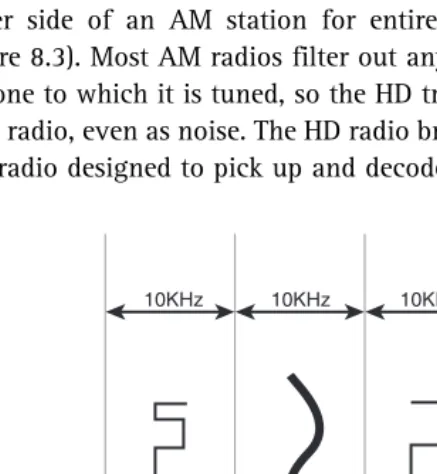
Low power digital HD radio signal High power analog AM radio signal
10KHz 10KHz 10KHz
Guard band Band allocated to station
Guard band
signals travel only a few feet or a few hundred feet. Under these changed con-ditions, the old rules for spectrum management don’t make sense.
Can We Just Divide the Property Differently?
Some innovations make better use of the spectrum without changing the fun-damental allocation picture shown in Figure 8.1. For example, HD radio squeezes an unrelated low-power digital transmission alongside the analog AM and FM radio channels. (“HD” is a trademark. It doesn’t stand for “high definition.”) On AM HD radio, the HD transmission uses the guard bands on either side of an AM station for entirely different broadcast content (see Figure 8.3). Most AM radios filter out any signal in the channels adjacent to the one to which it is tuned, so the HD transmission is inaudible on an ordi-nary radio, even as noise. The HD radio broadcast can be heard only on a spe-cial radio designed to pick up and decode the digital transmission.
HD radio is a clever invention, and by opening the spectrum to HD broad-casts, the FCC has been able to squeeze in more broadcast stations—at least for those willing to buy special radios. But it doesn’t challenge the fundamen-tal model that has been with us since the 1920s: Split up the spectrum and give a piece to each licensee.
Even parts of the spectrum that are “allocated” to licensees may be drasti-cally underused in practice. A 2002 Federal Communications Committee Report puts it this way: “… the shortage of spectrum is often a spectrum access problem. That is, the spectrum resource is available, but its use is compart-mented by traditional policies based on traditional technologies.” The com-mittee came to this conclusion in part by listening to the air waves in various frequency blocks to test how often nothing at all was being transmitted. Most of the time, even in the dense urban settings of San Diego, Atlanta, and Chicago, important spectrum bands were nearly 100% idle. The public would be better served if others could use the otherwise idle spectrum.
For about ten years, the FCC has experimented with “secondary spectrum marketing.” Someone wanting some spectrum for temporary use may be able to lease it from a party who has a right to use it, but is willing to give it up in exchange for a payment. A university radio station, for example, may need the capacity to broadcast at high power only on a few Saturday after-noons to cover major football games. Perhaps such a station could make a deal with a business station that doesn’t have a lot of use for its piece of the spectrum when the stock markets are closed. As another example, instead of reserving a band exclusively for emergency broadcasts, it could be made available to others, with the understanding—enforced by codes wired into the transmitters—that the frequency would be yielded on demand for public safety broadcasts.
As the example of eBay has shown, computerized auctions can result in very efficient distribution of goods. The use of particular pieces of the spec-trum—at particular times, and in particular geographic areas—can create effi-ciencies if licensees of under-utilized spectrum bands had an incentive to sell some of their time to other parties.
Sharing the Spectrum
In his 1943 opinion, Justice Frankfurter used an analogy that unintentionally pointed toward another way of thinking. Spectrum was inevitably scarce, he opined. “Regulation of radio was therefore as vital to its development as traf-fic control was to the development of the automobile.”
Just as the spectrum is said to be, the roadways are a national asset. They are controlled by federal, state, and local governments, which set rules for their use. You can’t drive too fast. Your vehicle can’t exceed height and weight limits, which may depend on the road.
But everyone shares the roads. There aren’t any special highways reserved for government vehicles. Trucking companies can’t get licenses to use partic-ular roads and keep out their competitors. Everybody shares the capacity of the roads to carry traffic.
The roads are what is known in law as a “commons” (a notion introduced in Chapter 6). The ocean is also a commons, a shared resource subject to international fishing agreements. In theory at least, the ocean need not be a commons. Fishing boats could have exclusive fishing rights in separate sec-tors of the ocean’s surface. If the regions were large enough, fishermen might be able to earn a good living under
these conditions. But such an alloca-tion of the resources of the ocean would be dreadfully inefficient for society as a whole. The oceans better satisfy human needs if they are treated as a commons and fishing boats move with the fish—under agreed limits about the intensity of fishing.
The spectrum can be shared rather than split up into pieces. There is a precedent in electronic communications. The Internet is a digital commons. Everyone’s packets get mixed with everyone else’s on the fiber optics and satellite links of the Internet backbone. The packets are coded. Which packet belongs to whom is sorted out at the ends. Anything confidential can be encrypted.
Something similar can be done with broadcasts—provided there is a basic rethinking of spectrum management. Two ideas are key: first, that using lots of bandwidth need not cause interference and can greatly increase transmis-sion capacity; and second, that putting computers into radio receivers can greatly improve the utilization of the spectrum.
The Most Beautiful Inventor in the World
Spread spectrum was discovered and forgotten several times and in several countries. Corporations (ITT, Sylvania, and Magnavox), universities (espe-cially MIT), and government laboratories doing classified research all shared in giving birth to this key component of modern telecommunications—and were often unaware of each other’s activities.
By far the most remarkable precedent for spread spectrum was a patented invention by Hollywood actress Hedy Lamarr—“the most beautiful woman in the world,” in the words of movie mogul Louis Mayer—and George Antheil, an avant-garde composer known as “the bad boy of music.”
Lamarr made a scandalous name for herself in Europe by appearing nude in 1933, at the age of 19, in a Czech movie, Ecstasy. She became the trophy wife of Fritz Mandl, an Austrian munitions maker whose clients included both Hitler and Mussolini. In 1937, she disguised herself as a maid and escaped Mandl’s house, fleeing first to Paris and then to London. There she met Mayer, who brought her to Hollywood. She became a star—and the iconic beauty of her screen generation (see Figure 8.4).
In 1940, Lamarr arranged to meet Antheil. Her upper torso could use some enhancement, she thought, and she hoped Antheil could give her some advice. Antheil was a self-styled expert on female endocrinology, and had written a series of articles for Esquire magazine with titles such as “The Glandbook for the Questing Male.” Antheil suggested glandular extracts. Their conversation then turned to other matters—specifically, to torpedo warfare.
A torpedo—just a bomb with a propeller—could sink a massive ship. Radio-controlled torpedoes had been developed by the end of World War I, but were far from foolproof. An effective countermeasure was to jam the signal con-trolling the torpedo by broadcasting loud radio noise at the frequency of the control signal. The torpedo would go haywire and likely miss its target. From observing Mandl’s business, Lamarr had learned about torpedoes and why it was hard to control them.
© Bettmann/CORBIS
FIGURE8.4 Hedy Lamarr, at about the age when she and George Antheil made their
spread spectrum discovery.
Antheil’s contribution was to control the frequency-hopping sequence by means of a player piano mechanism—with which he was familiar because he had scored his masterpiece, Ballet Mécanique, for synchronized player pianos. As he and Lamarr conceived the device (it was never built), the signal would therefore hop among 88 frequencies, like the 88 keys on a piano keyboard. The ship and the torpedo would have identical piano rolls—in effect, encrypt-ing the broadcast signal.
nothing with the invention at the time. Instead, Lamarr went to work selling war bonds. Calling herself “just a plain gold-digger for Uncle Sam,” she sold kisses, and once raised $4.5 million at a single lunch. The patent was ignored for more than a decade. Romuald Ireneus ’Scibor-Marchocki, who was an engineer for a Naval contractor in the mid-1950s, recalls being given a copy when he was put to work on a device for locating enemy submarines. He didn’t recognize the patentee because she had not used her stage name.
The story of Antheil and Lamarr, and the place of their invention in the history of spread spectrum, is told in Spread Spectrumby Rob Walters(Booksurge LLC, 2005).
U.S. Patent Office.
FIGURE8.5 Original spread spectrum patent by Hedy Lamarr (néeKiesler—Gene
Markey was her second husband, of six) and George Antheil. On the left, the beginning of the patent itself. On the right, a diagram of the player-piano mechanism included as an illustration in the patent.
Channel Capacity
Lamarr and Antheil had stumbled on a particular way of exploiting a broad fre-quency range—“spreading” signals across the spectrum. The theoretical founda-tion for spread spectrum was one of the remarkable mathematical results of Claude Shannon in the late 1940s. Although no digital telephones or radios existed at the time, Shannon derived many of the basic laws by which they would have to operate. The Shannon-Hartley Theorem predicted spread spec-trum in the same way that Maxwell’s equations predicted radio waves.
Shannon’s result (building on work by Ralph Hartley two decades earlier) implies that “interference” is not the right concept for thinking about how much information can be carried in the radio spectrum. Signals can overlap in fre-quency and yet be pulled apart perfectly by sufficiently sophisticated radio receivers.
Early engineers assumed that communication errors were inevitable. Send bits down a wire, or through space using radio waves, and some of them would probably arrive incorrectly, because of noise. You could make the channel more reliable by slowing the transmission, they supposed, in the same way that people talk more slowly when they want to be sure that oth-ers undoth-erstand them—but you could never guarantee that a communication was errorless.
Shannon showed that communication channels actually behave quite dif-ferently. Any communication channel has a certain channel capacity—a num-ber of bits per second that it can handle. If your Internet connection is advertised as having a bit rate of 3Mbit/sec (3 million bits per second), that number is the channel capacity of the particular connection between you and your Internet Service Provider (or should be—not all advertisements tell the truth). If the connection is over telephone wiring and you switch to a service that runs over fiber optic cables, the channel capacity should increase.
Power, Signal, Noise, and Bandwidth
The capacity of a radio channel depends on the frequencies at which mes-sages are transmitted and the amount of power used to transmit them. It’s helpful to think about these two factors separately.
A radio broadcast is never “at” a single frequency. It always uses a range orbandof frequencies to con-vey the actual sounds. The only sound that could be carried at a sin-gle, pure frequency would be an unvarying tone. The bandwidth of a broadcast is the size of the frequency band—that is, the difference between the top frequency and the bottom frequency of the band. Hoover, to use this language, allotted 10kHz of bandwidth for each AM station.
If you can transmit so many bits per second with a certain amount of bandwidth, you can transmit twice that many bits per second if you have twice as much bandwidth. The two trans-missions could simply go on side by side, not interacting with each other in any way. So, channel capacity is proportional to bandwidth.
The relation to signal power is more surprising. To use simple numbers for clarity, suppose you can transmit one bit, either 0 or 1, in one second. If you
BANDWIDTH
Because channel capacity depends on frequency bandwidth, the term “bandwidth” is used informally to mean “amount of information communicated per second.” But technically, bandwidth is a term about electromagnetic communica-tion, and even then is only one of the factors affecting the capacity to carry bits.
ERRORS ANDDELAYS
8W of power enables 8 signals to be
distinguished in the presence of the same background noise 1 Watt = minimum power
difference needed to distinguish 0 bit from 1 bit in the presence of background noise
TIME
1 W
7W 6W 5W 4W 3W 2W 1W 0W 1
1 0 0 1 0
111
111 111
011
001 011
010
001 001
000 101 100 110
could use more powerbut no more time or bandwidth, how many bits could you transmit?
One way a radio transmission might distinguish between 0and 1is for the signals representing these two values to have different signal powers. To con-tinue to oversimplify, assume that zero power represents 0, and a little more power, say 1 watt, represents 1. Then to distinguish a 1 from a 0, the radio receiver has to be sensitive enough to tell the difference between 1 watt and 0 watts. The uncontrollable noise—radio waves arriving from sunspots, for example—also must be weak enough that it does not distort a signal repre-senting 0so that it is mistaken for a signal representing 1.
Under these conditions, four times as much power would enable transmis-sion of two bits at once, still in one second. Power level 0 could represent 00; 1 watt, 01; 2 watts, 10; and 3 watts could represent 11. Successive power levels have to be separated by at least a watt to be sure that one signal is not confused with another. If the power levels were closer together, the unchanged noise might make them impossible to distinguish reliably. To transmit three bits at a time, you’d need eight times as much power, using levels 0 through 7 watts—that is, the amount of power needed increases expo-nentially with the number of bits to be transmitted at once (see Figure 8.6).
FIGURE8.6 Shannon-Hartley. Signal levels must be far enough apart to be
So the Shannon-Hartley result says that channel capacity depends on both bandwidth and signal power, but more bandwidth is exponentially more valu-able than more signal power. You’d have to get more than a thousand times more signal power to get the same increase in channel capacity as you could get from having just ten times more bandwidth (because 1024 = 210).
Bandwidth is precious indeed.
One Man’s Signal Is Another Man’s Noise
The consequences of the Shannon-Hartley result about the value of band-width are quite astonishing. If WBZ were transmitting digitally with its 50,000 watt transmitter, it could transmit the same amount of information (over shorter distances) using less power than a household light bulb—if it could get 100kHz of bandwidth rather than the 10kHz the FCC has allowed it.
Of course, no station could get exclusive use of 100kHz. Even giving each station 10kHz uses up the spectrum too quickly. The spectrum-spreading idea works only if the spectrum is regarded as a commons. And to see the consequences of many signals broadcasting in the same spectrum, one more crucial insight is needed.
The power level that affects the capacity of a radio channel is not actually the signal power, but the ratio of the signal power to the noise power—the so-called signal-to-noise ratio.In other words, you could transmit at the same bit rate with one watt of power as with ten—ifyou could also reduce the noise by a factor of ten. And “noise” includes other people’s signals. It really doesn’t matter whether the interference is coming from other human broad-casts or from distant stars. All the interfering broadbroad-casts can share the same spectrum band, to the extent they could coexist with the equivalent amount of noise.
A surprising consequence of Shannon-Hartley is that there is some channel capacity even if the noise (including other people’s sig-nals) is stronger than the signal. Think of a noisy party: You can pick out a conversation from the back-ground noise if you focus on a single voice, even if it is fainter than the rest of the noise. But the Shannon-Hartley result predicts even more: The channel can transmit bits flawlessly, if slowly, even if the noise is many times more powerful than the signal. And if you could get a lot of bandwidth, you could drastically reduce the signal power
without lowering the bit rate at all(see Figure 8.7). What would seem to be just noise to anyone listening casually on a particular frequency would actu-ally have a useful signal embedded within it.
The Shannon-Hartley Theorem is a mathematician’s delight—a tease that limits what is possible in theory and gives no advice about how to achieve it in practice. It is like Einstein’s E = mc2—which at once says nothing, and everything, about nuclear reactors and atomic bombs. Hedy Lamarr’s fre-quency hopping was one of the spread spectrum techniques that would even-tually be practical, but other ingenious inventions, named by odd acronyms, would emerge in the late twentieth century.
Two major obstacles stood between the Shannon-Hartley result and usable spread spectrum devices. The first was engineering: computers had to become fast, powerful, and cheap enough to process bits for transmission of high-quality audio and video to consumers. That wouldn’t happen until the 1980s. The other problem was regulatory. Here the problem was not mathematical or scientific. Bureaucracies change more slowly than the technologies they regulate.
FREQUENCY NOISE LEVEL P
O W E R
FIGURE8.7 The spread spectrum principle. The same bit rate can be achieved at much lower power by using more bandwidth, and the signal power can even be less than the noise.
Spectrum Deregulated
Michael Marcus is an improbable revolutionary. An MIT-trained electrical engineer, he spent three years as an Air Force officer during the Vietnam war, designing communications systems for underground nuclear test detection at a time when the ARPANET—the original, military-sponsored version of the Internet—was first in use. After finishing active duty, he went to work at a Pentagon think tank, exploring potential military uses of emerging commu-nications technologies.
In the summer of 1979, Marcus attended an Army electronic warfare work-shop. As was typical at Army events, attendees were seated alphabetically. Marcus’s neighbor was Steve Lukasik, the FCC’s chief scientist. Lukasik had been Director of ARPA during the development of the ARPANET and then an ARPANET visionary at Xerox. He came to the FCC, not generally considered a technologically adventurous agency, because Carter administration officials were toying with the idea that existing federal regulations might be stifling innovation. Lukasik asked Marcus what he thought could stimulate growth in radio communications. Marcus answered, among other things, “spread spectrum.” His engineering was sound, but not his politics. People would not like this idea.
The military’s uses of spread spectrum were little known to civilians, since the Army likes to keep its affairs secret. The FCC prohibited all civil use of spread spectrum, since it would require, in the model the Commission had used for decades, trespassing on spectrum bands of which incumbents had been guaranteed exclusive use. Using lots of bandwidth, even at low power levels, was simply not possible within FCC regulations. Lukasik invited Marcus to join the FCC, to champion the development of spread spectrum and other innovative technologies. That required changing the way the FCC had worked for years.
Shortly after the birth of the Federal Radio Commission, the U.S. plum-meted into the worst depression it had ever experienced. In the 1970s, the FCC was still living with the culture of the 1930s, when national economic poli-cies benevolently reined in free-market capitalism. As a general rule, innova-tors hate regulation, and incumbent stakeholders love it—when it protects their established interests. In the radio world, where spectrum is a limited, indispensable, government-controlled raw material, this dynamic can be powerfully stifling.
they will be granted use of spectrum, since investors won’t fund businesses reliant on resources the government controls and may decide not to provide.
Regulators test proposals to relax their rules by inviting public comment, and the parties they hear from most are the incumbents—who have the resources to send teams to lobby against change. Their complaints predict disaster if the rules are relaxed. In fact, their doomsday scenarios are often exaggerated in the hope the regulators will exclude competition. Eventually, the regulators lose sight of their ultimate responsibility, which is to the pub-lic good and not to the good of the incumbents. It is just easier to leave things alone. They can legitimately claim to be responding to what they are being told, however biased by the huge costs of travel and lobbying. Regulatory powers meant to prevent electromagnetic interference wind up preventing competition instead.
And then there is the revolving door. Most communications jobs are in the private sector. FCC employees know that their future lies in the commercial use of the spectrum. Hundreds of FCC staff and officials, including all eight past FCC chairmen, have gone to work for or represented the businesses they regulated. These movements from government to private employment violate no government ethics rules. But FCC officials can be faced with a choice between angering a large incumbent that is a potential employer, and disap-pointing a marginal start-up or a public interest non-profit. It is not surpris-ing that they remember that they will have to earn a livsurpris-ing after leavsurpris-ing the FCC.
In 1981, Marcus and his colleagues invited comment on a proposal to allow low-power transmission in broad frequency bands. The incumbents who were using those bands almost universally howled. The FCC beat a retreat and attempted, in order to break the regulatory logjam, to find fre-quency bands where there could be few complaints about possible interfer-ence with other uses. They hit on the idea of deregulating three “garbage bands,” so called because they were used only for “industrial, scientific, and medical” (ISM) purposes. Microwave ovens, for example, cook food by pum-meling it with 2.450GHz electromagnetic radiation. There should have been no complaints—microwave ovens were unaffected by “interference” from radio signals, and the telecommunications industry did not use these bands.
RCA and GE complained anyway about possible low-power interference, but their objections were determined to be exaggerated. This spectrum band was opened to experimentation in 1985, on the proviso that frequency hop-ping or a similar technique be used to limit interference.
months later, and by 1990, the company’s cell phone technology was in wide-spread use, using a wide-spread spectrum technique called CDMA. A few years later, Apple Computer and other manufacturers agreed with the FCC on stan-dards to use spread spectrum for radio local area networks—“wireless routers,” for which Apple’s trademarked device is called the Airport. In 1997, when the FCC approved the 802.11 standard and the spectrum bands were finally avail-able for use, the press barely noticed. Within three years, wireless network-ing was everywhere, and virtually all personal computers now come ready for WiFi.
For his efforts, Marcus was sent into internal exile within the FCC for seven years but emerged in the Clinton era and returned to spectrum policy work. He is now retired and working as a consultant in the private sector.
The success of WiFi has opened the door to discussion of more radical spectrum-spreading proposals. The most extreme is UWB—“ultra wide band” radio. UWB returns, in a sense, to Hertz’s sparks, splattering radiation all across the frequencies of the radio spectrum. There are two important differ-ences, however. First, UWB uses extremely low power—feasible because of the very large bandwidth. Power usage is so low that UWB will not interfere with any conventional radio receiver. And second, UWB pulses are extremely short and precisely timed, so that the time between pulses can symbolically encode a transmitted digital message. Even at extremely low power, which would limit the range of UWB transmissions to a few feet, UWB has the potential to carry vast amounts of information in short periods of time. Imagine connect-ing your high definition TV, cable box, and DVD player without cables. Imagine downloading your library of digital music from your living room audio system to your car while it is parked in your garage. Imagine wireless video phones that work better than wired audio phones. The possibilities are endless, if the process of regulatory relaxation continues.
What Does the Future Hold for Radio?
In the world of radio communications, as everywhere in the digital explosion, time has not stopped. In fact, digital communications have advanced less far than computer movie-making or voice recognition or weather prediction, because only in radio does the weight of federal regulation retard the explo-sive increase in computational power. The deregulation that is possible has only begun to happen.
Michael Marcus’s web site,
What If Radios Were Smart?
Spread spectrum is a way of making better use of the spectrum. Another dramatic possibility comes with the recognition that ordinary radios are extremely stupid by comparison
with what is computationally pos-sible today. If taken back in time, today’s radios could receive the broadcasts of 80 years ago, and the AM radios of 80 years ago would work as receivers of today’s broadcasts. To achieve such total
“backward compatibility,” a great deal of efficiency must be sacrificed. The reason for such backward compatibility is not that many 80-year-old radios are still in service. It’s that at any moment in time, the incumbents have a strong interest in retaining their market share, and therefore, in lobbying against efforts to make radios “smarter” so more stations can be accommo-dated.
If radios were intelligent and active, rather than dumb and pas-sive, vastly more information could be made available through the air-waves. Rather than broadcasting at high power so that signals could travel great distances to reach pas-sive receivers, low-power radios could pass signals on to each other. A request for a particular piece of information could be transmitted from radio to radio, and the informa-tion could be passed back. The radios could cooperate with each other to increase the information flux received by all of them. Or multiple weak transmitters could occasionally synchronize to produce a single
powerful beam for long-range communication.
Such “cooperation gains” are already being exploited in wireless sensor networking. Small, low-power, radio-equipped computers are equipped with sensors for temperature or seismic activity, for example. These devices can be scattered in remote areas with hostile environments, such as the rim of a
If radios were intelligent and active, rather than dumb and passive, vastly more information could be made available through the airwaves.
WHAT DOES“SMART” MEAN?
“Intelligent” or “smart” radio goes by various technical names. The two most commonly used terms are “software-defined radio” (SDR) and “cognitive radio.” Software-defined radio refers to radios capable of being reprogrammed to change characteristics usually implemented in hardware today (such as whether they recognize AM, FM, or some other form of modulation).
smoldering volcano, or the Antarctic nesting grounds of endangered pen-guins. At far lower cost and greater safety than human observers could achieve, the devices can exchange information with their neighbors and eventually pass on a summary to a single high-power transmitter.
There are vast opportunities to use “smart” radios to increase the number of broadcast information options—if the regulatory stranglehold on the indus-try can be loosened and the incentives for innovation increased.
Radios can become “smarter” in another respect. Even under the “narrow-band” model for spectrum allocation, where one signal occupies only a small range of frequencies, cheap computation can make a difference. The very notion that it is the government’s job to prevent “interference,” enshrined in legislation since the 1912 Radio Act, is now anachronistic.
Radio waves don’t really “interfere,” the way people in a crowd interfere with each other’s movements. The waves don’t bounce off each other; they pass right through each other. If two different waves pass through the antenna of a dumb old radio, neither signal can be heard clearly.
To see what might be possible in the future, ask a man and a woman to stand behind you, reading from different books at about the same voice level. If you don’t focus, you will hear an incoherent jumble. But if you concentrate on one of the voices, you can understand it and block out the other. If you shift your focus to the other voice, you can pick that one out. This is possi-ble because your brain performs sophisticated signal processing. It knows something about male and female voices. It knows the English language and tries to match the sounds it is hearing to a lexicon of word-sounds it expects English speakers to say. Radios could do the same thing—if not today, then soon, when computers become a bit more powerful.
But there is a chicken-and-egg cycle. No one will buy a “smart” radio unless there is something to listen to. No one can undertake a new form of broadcasting without raising some capital. No investor will put up money for a project that is dependent on uncertain deregulation decisions by the FCC. Dumb radios and inefficient spectrum use protect the incumbents from com-petition, so the incumbents lobby against deregulation.
Moreover, the incumbent telecommunications and entertainment indus-tries are among the leading contributors to congressional election campaigns. Members of Congress often pressure the FCC to go against the public interest and in favor of the interests of the existing stakeholders. This problem was apparent even in the 1930s, when an early history of radio regulation stated, “no quasi-judicial body was ever subject to so much congressional pressure as the Federal Radio Commission.” The pattern has not changed.
are inhibited by the quality of the technology and the market’s expected reaction to it—but not by the reactions of federal regulators. Overextended copyright protections have chilled creativity, as was dis-cussed in Chapter 6, but lawmakers are to blame for that problem, not unelected commissioners.
From cell phones to wireless routers to keychain auto locks, wire-less innovations are devoured by the public, when they can be brought to market at all. To foster innovation, the regulatory stranglehold needs to be broken throughout the wireless arena, including broadcast technologies. The regulations are now the source of the scarcity that is used to justify the regulations!
But Do We Want the Digital Explosion?
Technologies converge. In 1971, Anthony Oettinger foresaw the line blurring between computing and communications. He called the emerging single tech-nology “compunication.” Today’s computer users don’t even think about the fact that their data is stored thousands of miles away—until their Internet connection fails. Telephones were first connected using copper wires, and tel-evision stations first broadcast using electromagnetic waves, but today most telephone calls go through the air and most television signals go through wires.
Laws, regulations, and bureaucracies change much more slowly than the technologies they govern. The FCC still has separate “Wireless” and “Wire-line” bureaus. Special speech codes apply to “broadcast” radio and television, although “broadcasting” is an engineering anachronism.
The silo organization of the legal structures inhibits innovation in today’s layered technologies. Regulation of the content layer should not be driven by an outdated understanding of the engineering limits of the physical layer. Investments made in developing the physical layer should not enable the same companies to control the content layer. The public interest is in innovation and efficiency; it is not in the preservation of old technologies and revolving doors between regulators and the incumbents of the regulated industry.
TV, ENTERTAINMENT, AND CONGRESS
In the 2006 election campaigns, the TV, movie, and music industries contributed more than $12 million to the re-election campaigns of incumbents, more than the oil and gas industry. The three biggest con-tributors were Comcast Corp., Time Warner, and the National Cable and Telecommunications Association.