C
H
A
P
T
E
R
Elementary Particles
CHAPTER-OPENING QUESTIONS—Guess now!1.Physicists reserve the term “fundamental particle” for particles with a special property. What do you think that special property is?
(a) Particles that are massless.
(b) Particles that possess the minimum allowable electric charge.
(c) Particles that have no internal structure.
(d) Particles that produce no force on other objects.
2.The fundamental particles as we see them today, besides the long-sought-for Higgs boson, are
(a) atoms and electrons.
(b) protons, neutrons, and electrons.
(c) protons, neutrons, electrons, and photons.
(d) quarks, leptons, and gauge bosons (carriers of force).
(e) hadrons, leptons, and gauge bosons.
I
n the final two Chapters of this book we discuss two of the most exciting areas of contemporary physics: elementary particles in this Chapter, and cosmology and astrophysics in Chapter 33. These are subjects at the forefront of knowledge— elementary particles treats the smallest objects in the universe; cosmology treats the largest (and oldest) aspects of the universe. The reader who wants an under-standing of the great beauties of present-day science (and its limits) will want to read these Chapters. So will those who want to be good citizens, even if there isnot time to cover them in a physics course.
915
CONTENTS
32–1 High-Energy Particles and Accelerators
32–2 Beginnings of Elementary Particle Physics—Particle Exchange
32–3 Particles and Antiparticles 32–4 Particle Interactions and
Conservation Laws 32–5 Neutrinos
32–6 Particle Classification 32–7 Particle Stability and
Resonances
32–8 Strangeness? Charm? Towards a New Model 32–9 Quarks
32–10 The Standard Model: QCD and Electroweak Theory 32–11 Grand Unified Theories 32–12 Strings and Supersymmetry
32
This photo is a computer reconstruction of particles produced due to a 7 TeV proton–proton collision at the Large Hadron Collider (LHC). It is a candidate for having produced thelong-sought Higgs boson (plus other particles). The Higgs in this case could have decayed (very quickly ) into two Z bosons (which are carriers of the weak force):
We don’t see the tracks of the particles because (1) they are neutral and (2) they decay too quickly ( ), in this case:
The tracks of the 2 electrons and 2 positrons are shown as green lines. The Higgs is thought to play a fundamental role in the Standard Model of particle physics, importantly providing mass to fundamental particles.
The CMS detector of this photo uses a combination of the detector types discussed in Section 30–13. A magnetic field causes particles to move in curved paths so the momentum of each can be measured (Section 20–4). Tracks of particles with very large momentum, such as our electrons here, are barely curved.
In this Chapter we will study elementary particle physics from its beginnings until today, including antiparticles, neutrinos, quarks, the Standard Model, and theories that go beyond. We start with the great machines that accelerate particles so they can collide at high energies.
Z0 S e– + e±.
⬃10–24s
In this penultimate Chapter we discuss elementary particle physics, which represents the human endeavor to understand the basic building blocks of all matter, and the fundamental forces that govern their interactions.
Almost a century ago, by the 1930s, it was accepted that all atoms can be considered to be made up of neutrons, protons, and electrons. The basic constitu-ents of the universe were no longer considered to be atoms (as they had been for 2000 years) but rather the proton, neutron, and electron. Besides these three “elementary particles,” several others were also known: the positron (a positive electron), the neutrino, and the particle (or photon), for a total of six elementary particles.
By the 1950s and 1960s many new types of particles similar to the neutron and proton were discovered, as well as many “midsized” particles called mesons whose masses were mostly less than nucleon masses but more than the electron mass. (Other mesons, found later, have masses greater than nucleons.) Physicists felt that these particles could not all be fundamental, and must be made up of even smaller constituents (later confirmed by experiment), which were given the namequarks.
By the term fundamental particle, we mean a particle that is so simple, so basic, that it has no internal structure†(is not made up of smaller subunits)—see Chapter-Opening Question 1.
Today, the fundamental constituents of matter are considered to be quarks(they make up protons and neutrons as well as mesons) and leptons(a class that includes electrons, positrons, and neutrinos). There are also the “carriers of force” known as gauge bosons, including the photon, gluons, and W and Z bosons. In addition there is the elusive Higgsboson, predicted in the 1960s but whose first suggestions of experimental detection came only in 2011–2013. The theory that describes our present view is called the Standard Model. How we came to our present understanding of elementary particles is the subject of this Chapter.
One of the exciting developments of the last few years is an emerging synthesis between the study of elementary particles and astrophysics (Chapter 33). In fact, recent observations in astrophysics have led to the conclusion that the greater part of the mass–energy content of the universe is not ordinary matter but two mysterious and invisible forms known as “dark matter” and “dark energy” which cannot be explained by the Standard Model in its present form.
Indeed, we are now aware that the Standard Model is not sufficient. There are problems and important questions still unanswered, and we will mention some of them in this Chapter and how we hope to answer them.
32–1
High-Energy Particles and
Accelerators
In the late 1940s, after World War II, it was found that if the incoming particle in a nuclear reaction (Section 31–1) has sufficient energy, new types of particles can be produced. The earliest experiments used cosmic rays—particles that impinge on the Earth from space. In the laboratory, various types of particle accelerators have been constructed to accelerate protons or electrons to high energies so they can collide with other particles—often protons (the hydrogen nucleus). Heavy ions, up to lead (Pb), have also been accelerated. These high-energy acceleratorshave been used to probe more deeply into matter, to produce and study new particles, and to give us information about the basic forces and constituents of nature. The particles produced in high-energy collisions can be detected by a variety of spe-cial detectors, discussed in Section 30–13, including scintillation counters, bubble chambers, multiwire chambers, and semiconductors. The rate of production of
g
†Recall from Section 13–1 that the word “atom” comes from the Greek meaning “indivisible.” Atoms
any group of particles is quantified using the concept of cross section, Section 31–1. Because the projectile particles are at high energy, this field is sometimes called
high-energy physics.
Wavelength and Resolution
Particles accelerated to high energy can probe the interior of nuclei and nucleons or other particles they strike. An important factor is that faster-moving projectiles can reveal more detail. The wavelength of projectile particles is given by de Broglie’s wavelength formula (Eq. 27–8),
(32;1)
showing that the greater the momentum pof the bombarding particle, the shorter its wavelength. As discussed in Chapter 25 on optical instruments, resolution of details in images is limited by the wavelength: the shorter the wavelength, the finer the detail that can be obtained. This is one reason why particle accelerators of higher and higher energy have been built in recent years: to probe ever deeper into the structure of matter, to smaller and smaller size.
High resolution with electrons. What is the wavelength, and hence the expected resolution, for 1.3-GeV electrons?
APPROACH Because 1.3 GeV is much larger than the electron mass, we must be dealing with relativistic speeds. The momentum of the electrons is found from Eq. 26–9, and the wavelength is
SOLUTION Each electron has which is about
2500 times the rest energy of the electron Thus we can
ignore the term in Eq. 26–9, and we solve for p:
Therefore the de Broglie wavelength is
where Hence
or 0.96 fm. This resolution of about 1 fm is on the order of the size of nuclei (see Eq. 30–1).
NOTE The maximum possible resolution of this beam of electrons is far greater than for a light beam in a light microscope
EXERCISE A What is the wavelength of a proton with
A major reason today for building high-energy accelerators is that new par-ticles of greater mass can be produced at higher collision energies, transforming the kinetic energy of the colliding particles into massive particles by as we will discuss shortly. Now we look at particle accelerators.
Cyclotron
The cyclotron was developed in 1930 by E. O. Lawrence (1901–1958; Fig. 32–1) at the University of California, Berkeley. It uses a magnetic field to maintain charged ions—usually protons—in nearly circular paths. Although particle physi-cists no longer use simple cyclotrons, they are used in medicine for treating cancer, and their operating principles are useful for understanding modern accelerators.
E = mc2, ke = 1.00TeV?
(l L 500nm).
l = A6.63 * 10
–34JsBA3.0 * 108m兾sB
A1.3 * 109eVBA1.6 * 10–19J兾eVB = 0.96 * 10
–15m,
E = 1.3GeV.
l = ph = hcE,
p = BE2 - m2c4
c2 L B
E2 c2 =
E c. E2 = p2c2 + m2c4,
Amc2B2 Amc
2 = 0.51MeVB. ke = 1.3GeV = 1300MeV,
l = h兾p.
EXAMPLE 32;1 l = ph,
SECTION 32–1 High-Energy Particles and Accelerators
917
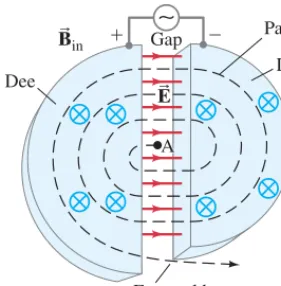
The protons move in a vacuum inside two D-shaped cavities, as shown in Fig. 32–2. Each time they pass into the gap between the “dees,” a voltage accelerates them (the electric force), increasing their speed and increasing the radius of curvature of their path in the magnetic field. After many revolutions, the protons acquire high kinetic energy and reach the outer edge of the cyclotron where they strike a target. The protons speed up only when they are in the gap betweenthe dees, and the voltage must be alternating. When protons are moving to the right across the gap in Fig. 32–2, the right dee must be electrically negative and the left one positive. A half-cycle later, the protons are moving to the left, so the left dee must be negative in order to accelerate them.
The frequency,f, of the applied voltage must be equal to the frequency of the circulating protons. When ions of charge qare circulating withinthe hollow dees, the net force Fon each ion is due to the magnetic field B, so where vis the speed of the ion at a given moment (Eq. 20–4). The magnetic force is perpen-dicular to both and , and does not speed up the ions but causes them to move in circles; the acceleration within the dees is centripetal and equals where r is the radius of the ion’s path at a given moment. We use Newton’s second law,
and find that
when the protons are within the dees (not the gap), so their (constant) speed at radiusris
The time required for a complete revolution is the period Tand is equal to
Hence the frequency of revolution fis
(32;2)
This is known as the cyclotron frequency.
Cyclotron. A small cyclotron of maximum radius accelerates protons in a 1.7 T magnetic field. Calculate (a) the frequency needed for the applied alternating voltage, and (b) the kinetic energy of protons when they leave the cyclotron.
APPROACH The frequency of the protons revolving within the dees (Eq. 32–2) must equal the frequency of the voltage applied across the gap if the protons are going to increase in speed.
SOLUTION (a)From Eq. 32–2,
which is in the radio-wave region of the EM spectrum (Fig. 22–8).
(b) The protons leave the cyclotron at From
(see above), we have so their kinetic energy is
NOTE The kinetic energy is much less than the rest energy of the proton (938 MeV), so relativity is not needed.
NOTE The magnitude of the voltage applied to the dees does not appear in the formula for ke, and so does not affect the final energy. But the higher this
= A1.6 * 10
–19CB2
(1.7T)2(0.25m)2
(2)A1.67 * 10–27kgB = 1.4 * 10
–12J = 8.7MeV.
ke = 1
2mv
2 = 1
2m
q2B2R2 m2 =
q2B2R2
2m
v = qBr兾m,
qvB = mv2兾r r = R = 0.25m.
= A1.6 * 10
–19CB(1.7T)
(6.28)A1.67 * 10–27kgB = 2.6 * 10
7Hz = 26MHz, f = qB
2pm
R = 0.25m
EXAMPLE 32;2 f = 1
T = qB
2pm.
T = distance
speed = 2pr
qBr兾m =
2pm
qB . v = qBrm .
qvB = mvr2 F = ma F = ma,
v2兾r, BB
v B
F = qvB,
FIGURE 32–2 Diagram of a cyclotron. The magnetic field, applied by a large electromagnet, points into the page. The protons start at A, the ion source. The red electric field lines shown are for the alternating electric field in the gap at a certain moment.
∼
⫺ ⫹
in Gap
Path
External beam Dee Dee
A
An important aspect of the cyclotron is that the frequency of the applied voltage, as given by Eq. 32–2, does not depend on the radius rof the particle’s path. Thus the frequency does not have to be changed as the protons or ions start from the source and are accelerated to paths of larger and larger radii. But this is only true at nonrelativistic energies. At higher speeds, the momentum (Eq. 26–4)
is so min Eq. 32–2 has to be replaced by and
the cyclotron frequency f(Eq. 32–2) depends on speed vbecause does. To keep the particles in sync, machines called synchrocyclotronsreduce the frequency in time to correspond to the increase of (in Eq. 32–2) as a packet of charged particles increases in speed more slowly at larger orbits.
Synchrotron
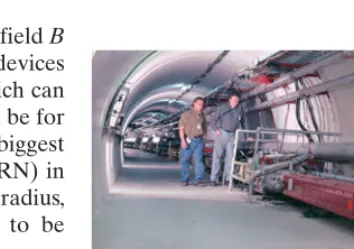
Another way to accelerate relativistic particles is to increase the magnetic field B in time so as to keep f(Eq. 32–2) constant as the particles speed up. Such devices are called synchrotrons; the particles move in a circle of fixed radius, which can be very large. The larger the radius, the greater the of the particles can be for a given magnetic field strength (see argument on previous page). The biggest synchrotron of all is at the European Center for Nuclear Research (CERN) in Geneva, Switzerland, the Large Hadron Collider (LHC). It is 4.3 km in radius, and 27 km in circumference, and accelerates protons to 4 TeV (soon to be 7 TeV).
The Tevatronaccelerator at Fermilab (Fermi National Accelerator Laboratory, near Chicago, Illinois, has a radius of 1.0 km.†The Tevatron accelerated protons
to about (hence its name, ). It was shut down
in 2011.
These large synchrotrons use a narrow ring of magnets (see Fig. 32–3) with each magnet placed at the same radius from the center of the circle. The magnets are interrupted by gaps where high voltage accelerates the particles to higher speeds. Another way to describe the acceleration is to say the particles “surf” on a traveling electromagnetic wave within radiofrequency (RF) cavities. (The par-ticles are first given considerable energy in smaller accelerators, “injectors,” before being injected into the large ring of the large synchrotron.)
One problem of any accelerator is that accelerating electric charges radiate electromagnetic energy (see Chapter 22). Since ions or electrons are accelerated in an accelerator, we can expect considerable energy to be lost by radiation. The effect increases with energy and is especially important in circular machines where centripetal acceleration is present, such as synchrotrons, and hence is called
synchrotron radiation. Synchrotron radiation can be useful, however. Intense beams of photons ( rays) are sometimes needed, and they are often obtained from an electron synchrotron. Strong sources of such photons are referred to as
light sources.
g
1TeV = 1012eV
1000GeV = 1TeV
ke gm
g gm
p = gmv = mv兾11 - v2兾c2,
SECTION 32–1 High-Energy Particles and Accelerators
919
†Robert Wilson, who helped design the Tevatron, and founded the field of proton therapy
(Section 31–6), expressed his views on accelerators and national security in this exchange with Senator John Pastore during testimony before a Congressional Committee in 1969:
Pastore: “Is there anything connected with the hopes of this accelerator [the Tevatron] that in any way involves the security of the country?”
Robert Wilson: “No sir, I don’t believe so.”
Pastore: “Nothing at all?”
Wilson: “Nothing at all. ”
Pastore: “It has no value in that respect?”
Wilson: “It has only to do with the respect with which we regard one another, the dignity of men, our love of culture. It has to do with are we good painters, good sculptors, great poets? I mean all the things we really venerate in our country and are patriotic about it has nothing to do directly with defending our country except to make it worth defending.”
p p
p
Linear Accelerators
In a linear accelerator(linac), electrons or ions are accelerated along a straight-line path, Fig. 32–4, passing through a series of tubular conductors. Voltage applied to the tubes is alternating so that when electrons (say) reach a gap, the tube in front of them is positive and the one they just left is negative. At low speeds, the particles cover less distance in the same amount of time, so the tubes are shorter at first. Electrons, with their small mass, get close to the speed of light quickly, and the tubes are nearly equal in length. Linear accelerators are particularly impor-tant for accelerating electrons to avoid loss of energy due to synchrotron radiation. The largest electron linear accelerator has been at Stanford University (Stanford Linear Accelerator Center, or SLAC), about 3 km (2 mi) long, accelerating electrons to 50 GeV. Linacs accelerating protons are used as injectors into circular machines to provide initial kinetic energy. Many hospitals have 10-MeV electron linacs that strike a metal foil to produce ray photons to irradiate tumors.g
v L c,
FIGURE 32–4 Diagram of a simple linear accelerator.
∼
Source
+
+ – + –
Colliding Beams
High-energy physics experiments were once done by aiming a beam of particles from an accelerator at a stationary target. But to obtain the maximum possible collision energy from a given accelerator, two beams of particles are now acceler-ated to very high energy and are steered so that they collide head-on. One way to accomplish such colliding beamswith a single accelerator is through the use of
storage rings, in which oppositely circulating beams can be repeatedly brought into collision with one another at particular points. For example, in the experiments that provided strong evidence for the top quark (Section 32–9 and Fig. 32–15), the Fermilab Tevatron accelerated protons and antiprotons each to 900 GeV, so that the combined energy of head-on collisions was 1.8 TeV.
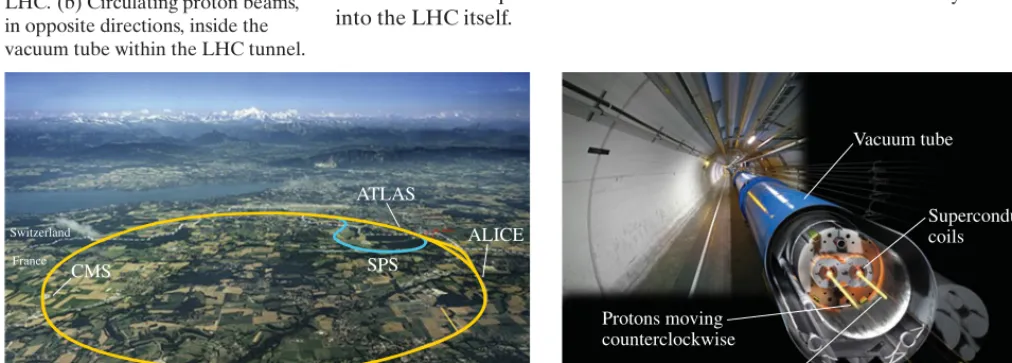
The largest collider is the Large Hadron Collider (LHC) at CERN, with a circumference of 26.7 km (Fig. 32–5). The two colliding beams are designed to each carry 7-TeV protons for a total interaction energy of 14 TeV. For the experiments in 2011 and 2012 the total interaction energy was 7 TeV and 8 TeV. The protons for each of the beams, moving in opposite directions, are accelerated in several stages. The penultimate is SPS (Super Proton Synchrotron), seen in Fig. 32–5a which accelerates protons from 28 GeV to the 450 GeV at which they are injected into the LHC itself.
FIGURE 32–5 (a) The large circle represents the position of the tunnel, about 100 m below the ground at CERN (near Geneva) on the French–Swiss border, which houses the LHC. The smaller circle shows the position of the Super Proton Synchrotron used for accelerating protons prior to injection into the LHC. (b) Circulating proton beams, in opposite directions, inside the vacuum tube within the LHC tunnel.
(a) (b)
ALICE
Superconducting coils
Protons moving counterclockwise
Protons moving clockwise
Vacuum tube
ATLAS
CMS
Switzerland
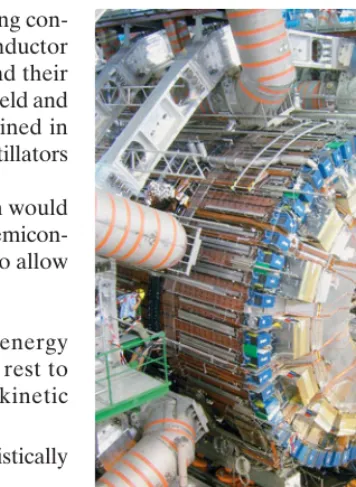
Figure 32–6 shows part of one of the detectors (ATLAS) as it was being con-structed at the LHC. The detectors within ATLAS include silicon semiconductor detectors with huge numbers of pixels used to track particle paths and find their point of interaction, and to measure their radius of curvature in a magnetic field and thus determine their momentum (Section 20–4). Their energy is determined in “calorimeters” utilizing plastic, liquid, or dense metal compound crystal scintillators (Section 30–13).
In the planning stage is the International Linear Collider (ILC) which would have colliding beams of and at around 0.3 to 1 TeV. It would utilize semicon-ductor detectors using CMOS (Section 25–1) with embedded transistors to allow fast readout.
Protons at relativistic speeds. Determine the energy required to accelerate a proton in a high-energy accelerator (a) from rest to
and (b) from to (c) What is the kinetic
energy achieved by the proton in each case?
APPROACH We use the work-energy principle, which is still valid relativistically as mentioned in Section 26–9:
SOLUTION The kinetic energy of a proton of mass mis given by Eq. 26–5,
where the relativistic factor is
The work-energy theorem becomes
where and are for the initial and final speeds, .
(a) For and for
For a proton, so the work (or energy) needed to accelerate it
from rest to is
(b) To go from to we need
So the work needed to accelerate a proton from 0.900cto 0.999cis
which is 15 times as much.
(c) The kinetic energy reached by the proton in (a) is just equal to the work done
on it, The final kinetic energy of the proton in (b), moving at
is
NOTE This result makes sense because, starting from rest, we did work
on it.
W = 1.21GeV + 18.9GeV = 20.1GeV
ke = (g3 - 1)mc2 = (21.4)(938MeV) = 20.1GeV. v3 = 0.999c,
ke = 1.21GeV.
= (22.4 - 2.29)(938MeV) = 18.9GeV,
W = ¢ke = (g3 - g2)mc2 g3 =
1
31 - (0.999)2 = 22.4. v3 = 0.999c, v2 = 0.900c
= (2.29 - 1.00)(938MeV) = 1.21GeV.
W = ¢ke = (g2 - g1)mc2 v2 = 0.900c
mc2 = 938MeV,
g2 = 1
31 - (0.900)2 = 2.29. v2 = 0.900c v = v1 = 0, g1 = 1;
v1 = 0, v2 = 0.900c g2
g1
W = ¢ke = (g2 - 1)mc2 - (g1 - 1)mc2 = (g2 - g1)mc2
g = 1
31 - v2兾c2
.
g ke = (g - 1)mc2,
W = ¢ke.
v = 0.999c.
v = 0.900c
v = 0.900c,
EXAMPLE 32;3
e± e–
SECTION 32–1 High-Energy Particles and Accelerators
921
32–2
Beginnings of Elementary
Particle Physics—Particle Exchange
The accepted model for elementary particles today views quarksandleptonsas the fundamental constituents of ordinary matter. To understand our present-day view of elementary particles, it is necessary to understand the ideas leading up to its formulation.Elementary particle physics might be said to have begun in 1935 when the Japanese physicist Hideki Yukawa (1907–1981) predicted the existence of a new particle that would in some way mediate the strong nuclear force. To understand Yukawa’s idea, we first consider the electromagnetic force. When we first dis-cussed electricity, we saw that the electric force acts over a distance, without contact. To better perceive how a force can act over a distance, we used the idea of a field. The force that one charged particle exerts on a second can be said to be due to the electric field set up by the first. Similarly, the magnetic field can be said to carry the magnetic force. Later (Chapter 22), we saw that electromagnetic (EM) fields can travel through space as waves. Finally, in Chapter 27, we saw that electromagnetic radiation (light) can be considered as either a wave or as a collection of particles called photons. Because of this wave–particle duality, it is possible to imagine that the electromagnetic force between charged particles is due to
(1) the EM field set up by one charged particle and felt by the other, or
(2) an exchange of photons ( particles) between them.
It is (2) that we want to concentrate on here, and a crude analogy for how an exchange of particles could give rise to a force is suggested in Fig. 32–7. In part (a), two children start throwing heavy pillows at each other; each throw and each catch results in the child being pushed backward by the impulse. This is the equiv-alent of a repulsive force. On the other hand, if the two children exchange pillows by grabbing them out of the other person’s hand, they will be pulled toward each other, as when an attractive force acts.
For the electromagnetic force, it is photons exchanged between two charged particles that give rise to the force between them. A simple diagram describ-ing this photon exchange is shown in Fig. 32–8. Such a diagram, called a
Feynman diagramafter its inventor, the American physicist Richard Feynman (1918–1988), is based on the theory of quantum electrodynamics(QED).
g
FIGURE 32–7 Forces equivalent to particle exchange. (a) Repulsive force (children on roller skates throwing pillows at each other). (b) Attractive force (children grabbing pillows from each other’s hands).
(a)Repulsive force (children throwing pillows)
(b)Attractive force (children grabbing pillows from each other’s hands)
FIGURE 32–8 Feynman diagram showing a photon acting as the carrier of the electromagnetic force between two electrons. This is sort of an xvs. graph, with increasing upward. Starting at the bottom, two electrons approach each other. As they get close, momentum and energy get transferred from one to the other, carried by a photon (or more than one), and the two electrons bounce apart.
t t
e⫺
Photon
e⫺
e⫺ e⫺
T
ime
Position
Figure 32–8 represents the simplest case in QED, in which a single photon is exchanged. One of the charged particles emits the photon and recoils somewhat as a result; and the second particle absorbs the photon. In such a collision or
interaction, energy and momentum are transferred from one charged particle to
By analogy with photon exchange that mediates the electromagnetic force, Yukawa argued that there ought to be a particle that mediates the strong nuclear force—the force that holds nucleons together in the nucleus. Yukawa called this predicted particle a meson(meaning “medium mass”). Figure 32–9 is a Feynman diagram showing the original model of meson exchange: a meson carrying the strong force between a neutron and a proton.
A rough estimate of the mass of the meson can be made as follows. Suppose the proton on the left in Fig. 32–9 is at rest. For it to emit a meson would require energy (to make the meson’s mass) which, coming from nowhere, would violate conservation of energy. But the uncertainty principle allows nonconservation
of energy by an amount if it occurs only for a time given by
We set equal to the energy needed to create the mass m of the meson: Conservation of energy is violated only as long as the meson exists, which is the time required for the meson to pass from one nucleon to the other, where it is absorbed and disappears. If we assume the meson travels at relativistic speed, close to the speed of light c, then need be at most about where dis the maximum distance that can separate the interacting nucleons. Thus we can write
or
(32;3)
The range of the strong nuclear force (the maximum distance away it can be felt) is small—not much more than the size of a nucleon or small nucleus (see
Eq. 30–1)—so let us take Then from Eq. 32–3,
The mass of the predicted meson, roughly is about 250 times the
electron mass of
EXERCISE B What effect does an increase in the mass of the virtual exchange particle have on the range of the force it mediates? (a) Decreases it; (b) increases it; (c) has no appreciable effect; (d) decreases the range for charged particles and increases the range for neutral particles.
Note that since the electromagnetic force has infinite range, Eq. 32–3 with tells us that the exchanged particle for the electromagnetic force, the photon, will have zero mass, which it does.
The particle predicted by Yukawa was discovered in cosmic rays by C. F. Powell and G. Occhialini in 1947, and is called the “ ” or pi meson, or simply the
pion. It comes in three charge states: or 0, where
The and have mass of and the a mass of all
close to Yukawa’s prediction. All three interact strongly with matter. Reactions observed in the laboratory, using a particle accelerator, include
(32;4)
The incident proton from the accelerator must have sufficient energy to produce the additional mass of the free pion.
Yukawa’s theory of pion exchange as carrier of the strong force has been superseded by quantum chromodynamicsin which protons, neutrons, and other strongly interacting particles are made up of basic entities called quarks, and the basic carriers of the strong force are gluons, as we shall discuss shortly. But the basic idea of the earlier theory, that forces can be understood as the exchange of particles, remains valid.
p + p S p + n + p±. p + p S p + p + p0,
135.0MeV兾c2, p0
139.6MeV兾c2 p–
p± e = 1.6 * 10
–19C.
±e, –e,
p d = q
0.51MeV兾c2.
130MeV兾c2, mc2 L hc
2pd =
A6.6*10–34JsBA3.0*108m兾sB
(6.28)A1.5*10–15mB L 2.1*10
–11J = 130MeV.
d L 1.5 * 10–15m. mc2 L hc
2pd.
mc2¢d
c≤ L 2hp
¢E¢t L h
2p
¢t = d兾c,
¢t
¢t
¢E = mc2. ¢
E
(¢E)(¢t) L h兾2p.
¢t
¢E
SECTION 32–2
923
FIGURE 32–9 Early model showing meson exchange when a proton and neutron interact via the strong nuclear force. (Today, as we shall see shortly, we view the strong force as carried by gluons between quarks.)
p
Meson
n
There are four known types of force—or interactions—in nature. The electromagnetic force is carried by the photon, the strong force by gluons. What about the other two: the weak force and gravity? These too are believed to be mediated by particles. The particles that transmit the weak force are referred to
as the and and were detected in 1983 (Fig. 32–10). The quantum
(or carrier) of the gravitational force has been named the graviton, but its existence has not been detected and it may not be detectable.
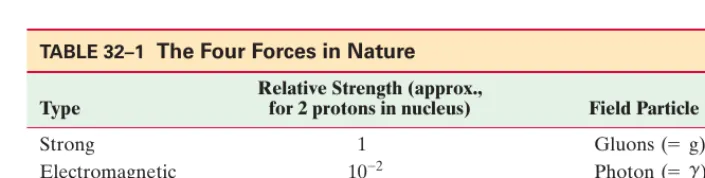
A comparison of the four forces is given in Table 32–1, where they are listed according to their (approximate) relative strengths. Although gravity may be the most obvious force in daily life (because of the huge mass of the Earth), on a nuclear scale gravity is by far the weakest of the four forces and its effect at the particle level can nearly always be ignored.
Z0,
W±, W–,
TABLE 32–1 The Four Forces in Nature
Relative Strength (approx.,
Type for 2 protons in nucleus) Field Particle
Strong 1 Gluons ( )
Electromagnetic Photon ( )
Weak and
Gravitational 10–38 Graviton (?) Z0 W& 10–6
= g
10–2
= g FIGURE 32–10 (a) Computer reconstruction of a Z-particle decay into an electron
and a positron whose tracks are shown in white, which took place in the UA1 detector at CERN. (b) Photo of the UA1 detector at CERN as it was being built. 1980s.
AZ0 S e± + e–B
(a) (b)
32–3
Particles and Antiparticles
The positron, as we discussed in Sections 27–6 (pair production) and 30–5 ( decay), is basically a positive electron. That is, many of its properties are the same as for the electron, such as mass, but it has the opposite electric charge Other quantum numbers that we will discuss shortly are also reversed. The positron is said to be the antiparticleto the electron.
The positron was first detected as a curved path in a cloud chamber in a magnetic field by Carl Anderson in 1932. It was predicted that other particles also would have antiparticles. It was decades before another type was found.
(±e).
Finally, in 1955 the antiparticle to the proton, the antiproton which carries a negative charge (Fig. 32–11), was discovered at the University of California, Berkeley, by Emilio Segrè (1905–1989, Fig. 32–12) and Owen Chamberlain (1920–2006). A bar, such as over the p, is used to indicate the antiparticle Soon after, the antineutron was found. All particles have antiparticles. But a few, like the photon, the and the Higgs, do not have distinct antiparticles—we say that they are their own antiparticles.
Antiparticles are produced in nuclear reactions when there is sufficient energy available to produce the required mass, and they do not live very long in the presence of matter. For example, a positron is stable when by itself but rarely survives for long; as soon as it encounters an electron, the two annihilate each other. The energy of their vanished mass, plus any kinetic energy they possessed, is usually converted into the energy of two rays. Annihilation also occurs for all other particle–antiparticle pairs.
Antimatter is a term referring to material that would be made up of “antiatoms” in which antiprotons and antineutrons would form the nucleus around which positrons (antielectrons) would move. The term is also used for antiparticles in general. If there were pockets of antimatter in the universe, a huge explosion would occur if it should encounter normal matter. It is believed that antimatter was prevalent in the very early universe (Section 33–7).
Negative Sea of Electrons; Vacuum State
The original idea for antiparticles came from a relativistic wave equation devel-oped in 1928 by the Englishman P. A. M. Dirac (1902–1984). Recall that, as we saw in Chapter 26, the total energy Eof a particle with mass mand momentum p
and zero potential energy is given by Eq. 26–9, Thus
Dirac applied his new equation and found that it included solutions with both and signs. He could not ignore the solution with the negative sign, which we might have thought unphysical. If those negative energy states are real, then we would expect normal free electrons to drop down into those states, emitting
– ±
E = &3p2c2 + m2c4
.
E2 = p2c2 + m2c4
.
*
g p0,(n)
(o).
(o),
SECTION 32–3 Particles and Antiparticles
925
(not seen)
p
p
p
p
p
L
£
p
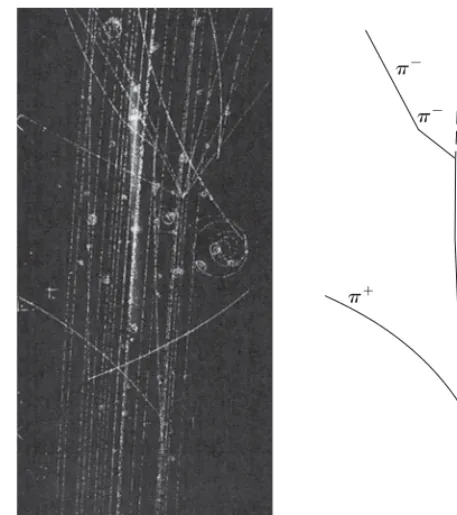
FIGURE 32–11 Liquid-hydrogen bubble-chamber photograph of an antiproton colliding with a proton at rest, producing a Xi—anti-Xi pair that subsequently decay into other particles. The drawing indicates the assignment of particles to each track, which is based on how or if that particle decays, and on mass values estimated from measurement of momentum (curvature of track in magnetic field) and energy (thickness of track, for example). Neutral particle paths are shown by dashed lines since neutral particles rarely ionize atoms, around which bubbles form, and hence leave no tracks. 1950s.
Ao + p S – + ±B (o)
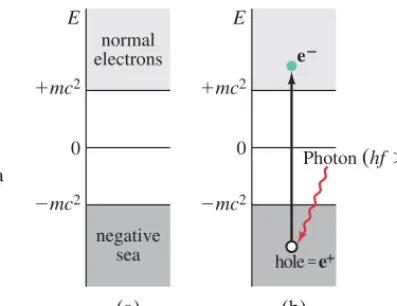
photons—never experimentally seen. To deal with this difficulty, Dirac postu-lated that all those negative energy states are normally occupied. That is, what we thought was the vacuumis instead a vast sea of electrons in negative energy states (Fig. 32–13a). These electrons are not normally observable. But if a photon strikes one of these negative energy electrons, that electron can be knocked up to a normal energy state as shown in Fig. 32–13b. Note in Fig. 32–13
that there are no energy states between and (because
cannot be negative in the equation ). The photon that
knocks an from the negative sea up to a normal state (Fig. 32–13b) must have an energy greater than What is left behind is a hole (as in semiconductors, Sections 29–7 and 29–8) with positive charge. We call that “hole” a positron, and it can move around as a free particle with positive energy. Thus Fig. 32–13b represents (Section 27–6)pair production:
The vast sea of electrons with negative energy in Fig. 32–13 is the vacuum (or
vacuum state). According to quantum mechanics, the vacuum is not empty, but contains electrons and other particles as well. The uncertainty principle allows a particle to jump briefly up to a normal energy, thus creating a particle;antiparticle
pair. It is possible that they could be the source of the recently discovered dark energythat fills the universe (Chapter 33). We still have a lot to learn.
32–4
Particle Interactions and
Conservation Laws
One of the important uses of high-energy accelerators and colliders is to study the interactions of elementary particles with each other. As a means of ordering this subnuclear world, the conservation laws are indispensable. The laws of conservation of energy, of momentum, of angular momentum, and of electric charge are found to hold precisely in all particle interactions.
A study of particle interactions has revealed a number of new conservation laws which (just like the old ones) are ordering principles: they help to explain why some reactions occur and others do not. For example, the following reaction has never been observed:
even though charge, energy, and so on, are conserved ( means the reaction does not occur). To understand why such a reaction does not occur, physicists hypothesized a new conservation law, the conservation of baryon number. (Baryon number is a generalization of nucleon number, which we saw earlier is conserved in nuclear reactions and decays.) All nucleons are defined to have baryon number and all antinucleons (antiprotons, antineutrons) have All other types of particles, such as photons, mesons, and electrons and
B = –1.
B = ±1,
S
p + p + o
S
p + n
g S e–e±. 2mc2.
e
-E = &1p2c2 + m2c4
p2 E = ±mc
2 E = –mc2
AE 7 mc2B FIGURE 32–13 (a) Possible energy states for an electron. Note the vast sea of fully occupied electron states at
(b) An electron in the negative sea is hit by a photon and knocks it up to a normal positive energy state. The positive “hole” left behind acts like a positive electron—it is a positron.
AE 7 2mc2B
E 6 –mc2.
(a) (b)
E E
mc2
eⴚ
Photon(hf 2mc2)
mc2 0
mc2
mc2 0
holeeⴙ negative
other leptons, have The reaction shown at the start of this paragraph does not conserve baryon number since the left side has
and the right has On the other hand, the
following reaction does conserve Band doesoccur if the incoming proton has sufficient energy:
As indicated, on both sides of this equation. From these and other
reactions, the conservation of baryon number has been established as a basic principle of physics.
Also useful are conservation laws for the three lepton numbers, associated with weak interactions including decays. In ordinary decay, an electron or posi-tron is emitted along with a neutrino or antineutrino. In another type of decay, a particle known as a “ ” or muon, can be emitted instead of an electron. The muon (discovered in 1937) seems to be much like an electron, except its
mass is 207 times larger The neutrino that accompanies an
emitted electron is found to be different from the neutrino that accompanies an emitted muon. Each of these neutrinos has an antiparticle: and In ordinary decay we have, for example,
but not To explain why these do not occur, the concept of
electron lepton number, was invented. If the electron and the electron
neutrino are assigned and and are assigned
whereas all other particles have then all observed decays conserve
For example, in initially and afterward
Decays that do not conserve even though they would obey the other conservation laws, are not observed to occur.
In a decay involving muons, such as
a second quantum number,muon lepton number is conserved. The and
are assigned and their antiparticles and have whereas
all other particles have too is conserved in interactions and decays. Similar assignments can be made for the tau lepton number, associated with the lepton (discovered in 1976 with mass more than 3000 times the electron mass) and its neutrino,
Antiparticles have not only opposite electric charge from their particles, but
also opposite B, and For example, a neutron has an
antineutron has (and all the L’s are zero).
Lepton number in muon decay. Which of the following decay schemes is possible for muon decay: (a)
(b) (c) All of these particles have
RESPONSE A has and This is the initial state for all
decays given, and the final state must also have In (a), the
final state has and would not be
conserved and indeed this decay is not observed to occur. The final state of
(b) has and so both and
are conserved. This is in fact the most common decay mode of the Lastly,
(c) does not occur because is not conserved, nor
isLm.
Le (= ±2 in the final state)
m–. Le
Lm Le = ±1 - 1 + 0 = 0,
Lm = 0 + 0 + 1 = ±1
Le = ±1 - 1 = 0; Lm Lm = 0 + 0 = 0,
Lm = ±1, Le = 0. Le = 0.
Lm = ±1 m–
Lt = 0.
m– S e– + n e? m– S e– + R
e + nm;
m– S e– + R e; CONCEPTUAL EXAMPLE 32;4
B = –1
B = ±1,
Lt. Le, Lm,
nt.
t Lt,
Lm = 0. Lm
Lm = –1, Rm
m± Lm = ±1,
nm m–
ALmB, p± S m± + nm,
Le, Le = 0 + (±1) + (–1) = 0.
Le = 0,
n S p + e– + Re,
Le. Le = 0,
Le = –1, Re
e±
Le = ±1, AneB
Ae–B
Le,
p + e– + Rm.
S
n
n S p + e– + Re
b Re Rm.
AnmB AneB A106MeV兾c2B.
m
b B = ±2
B = ±1 + 1 = ±1 + 1 - 1 + 1. p + p S p + p + o + p,
B = (±1) + (±1) + (–1) = ±1.
B = (±1) + (±1) = ±2,
B = 0.
SECTION 32–4 Particle Interactions and Conservation Laws
927
C A U T I O N
Energy and momentum are conserved. In addition to the “number” conservation laws which help explain the decay schemes of particles, we can also apply the laws of conservation of energy and momentum. The decay of a particle at rest with mass (Table 32–2 in Section 32–6) can
yield a proton and a neutral pion,
Determine the kinetic energies of the proton and .
APPROACH We find the energy release from the change in mass as we did for nuclear processes (Eq. 30–2 or 31–2a). Then we apply conservation of energy and momentum, using relativistic formulas as the energies are large.
SOLUTION The energy released, , is the change in mass
Next we apply conservation of momentum: the initial particle is at rest, so the
and p have opposite momentum but are equal in magnitude: We square
this equation, which becomes, using Eq. 26–9 ( ),
Solving for
We substitute Eq. 26–6a, for both the and the p:
Next (after cancelling as shown) we substitute
After cancelling as shown, we solve for
which gives Then
32–5
Neutrinos
We first met neutrinos with regard to decay in Section 30–5. The study of neutrinos is a “hot” subject today. Experiments are being carried out in deep underground laboratories, sometimes in deep mine shafts. The thick layer of earth above is meant to filter out all other “background” particles, leaving mainly the very weakly interacting neutrinos to arrive at the detectors.
Some very important results have come to the fore in recent years. First there was the solar neutrino problem. The energy output of the Sun is believed to be due to the nuclear fusion reactions discussed in Chapter 31, Eqs. 31–6 and 31–7. The neutrinos emitted in these reactions are all (accompanied by ). But the rate at which arrive at Earth was measured starting in the late 1960s to be much less than expected based on the power output of the Sun. It was then pro-posed that, on the long trip between Sun and Earth, might turn into or Subsequent experiments, definitive only in 2001, confirmed this hypothesis. Thus
the three neutrinos, can change into one another in certain
cir-cumstances, a phenomenon called neutrino flavor oscillation†. (Each of the three neutrino types is called, whimsically, a different “flavor.”) This result suggests that the lepton numbers and are not perfectly conserved. But the sum,
is believed to be always conserved.
Le + Lm + Lt,
Lt Le,Lm, ne,nm,nt,
nt.
nm ne
ne
e±
ne b
kep = 116MeV - 97MeV = 19MeV.
kep0 = 97MeV. kep0 =
Q2+2Qm pc2
2mp0c2+2Q+2mpc2
= (116MeV)
2+2(116MeV)(938MeV)
2(135MeV)+2(116MeV)+2(938MeV)
kep0: ke2
p0 + 2kep0mp0c2 = Q 2
- 2Qkep0 + ke2p0 + 2Qmpc2 - 2kep0mpc2. kep = Q - kep0:
ke2
p0 + 2kep0mp0c2 + m2p0c4 = ke2p + 2kepmpc2 + m2pc4 - m2pc4 + m2p0c4.
Akep0 + mp0c2B 2
= Akep + mpc2B2
- m2
pc4 + m2p0c4 p0
E = ke + mc2, E2
p0 = E2p - m2pc4 + m2p0c4. E2
p0: E2
p0 - m2p0c4 = E2p - m2pc4.
p2c2 = E2 - m2c4 p2
p0 = p2p,
pp0 = pp.
p0 ©±
Q = Cm©± - Amp + mp0BDc2 = C1189 - (938 + 135)D MeV = 116MeV. c2: *
Q = kep + kep0
AE = mc2B p0
©± S p + p0
.
= 135MeV兾c2): (mp0
p0 (mp = 938MeV兾c2)
1189MeV兾c2 ©±
EXAMPLE 32;5
†Neutrino oscillations had first been proposed in 1957 by Bruno Pontecorvo. He also proposed that
The second exceptional result has long been speculated on: are neutrinos massless as originally thought, or do they have a nonzero mass? Rough upper limits on the masses have been made. Today astrophysical experiments show that the sum of all three neutrino masses combined is less than about But can all the masses be zero? Not if there are the flavor oscillations discussed above. It seems that at most, one type could have zero mass, and it is likely that at least one neutrino type has a mass of at least
As a result of neutrino oscillations, the three types of neutrino may not be exactly what we thought they were (e, ). If not, the three basic neutrinos, called 1, 2, and 3, are combinations of and
Another outstanding question is whether or not neutrinos are in the category calledMajorana particles,†meaning they would be their own antiparticles, like and Higgs. If so, a lot of other questions (and answers) would appear.
Neutrino Mass Estimate from a Supernova
The explosion of a supernova in the outer parts of our Galaxy in 1987 (Section 33–2) released lots of neutrinos and offered an opportunity to estimate electron neutrino mass. If neutrinos do have mass, then their speed would be less thanc, and neutrinos of different energy would take different times to travel the 170,000 light-years from the supernova to Earth. To get an idea of how such a measurement could be done, suppose two neutrinos from “SN1987A” were emitted at the same time and were actually detected on Earth (via the reaction
) 10 seconds apart, with measured kinetic energies of about 20 MeV and 10 MeV. From other laboratory measurements we expect the neutrino mass to be less than 100 eV; and since our neutrinos have kinetic energy of 20 MeV
and 10 MeV, we can make the approximation so that E(the total
energy) is essentially equal to the kinetic energy. We use Eq. 26–6b, which tells us
We solve this for v, the velocity of a neutrino with energy E:
where we have used the binomial expansion and we
ignore higher-order terms since The time for a neutrino to travel
a distance is
where again we used the binomial expansion The
difference in arrival times for our two neutrinos of energies and
is
We solve this for and set
This calculation, with its optimistic assumptions, estimates the mass of the neu-trino to be But there would be experimental uncertainties, and even worse there is the unwarranted assumption that the two neutrinos were emitted at the same time.
22eV兾c2.
= 22 * 10–6MeV = 22eV. mnc2 = B
2cAt2 - t1B d
E12E22 E12 - E22
R 1 2
t2 - t1 = 10s:
mnc2
t2 - t1 =
d c
mn2c4
2 ¢ 1
E22
- 1
E12 ≤.
E2 = 10MeV
E1 = 20MeV C(1 - x)–1 = 1 + x + pD.
t = dv = d
c¢1 - mn
2c4
2E2 ≤
L dc ¢1 + mn
2c4
2E2 ≤,
d (= 170,000ly)
t mn2c4 V E2.
(1 - x)12 = 1 - 12x + p, v = c¢1 - mn
2c4
E2 ≤ 1 2
= c¢1 - mn
2c4
2E2 + p≤,
E = mnc 2
31 - v2兾c2
.
mnc2 V E, Re + p S n + e±
*
g, p0,
nt.
ne,nm, m, t 0.04eV兾c2.
0.14eV兾c2.
SECTION 32–5 Neutrinos
929
†The brilliant young physicist Ettore Majorana (1906–1938) disappeared from a ship under
Theoretical models of supernova explosions suggest that the neutrinos are emitted in a burst that lasts from a second or two up to perhaps 10 s. If we assume the neutrinos are not emitted simultaneously but rather at any time over a 10-s interval, then that 10-s difference in arrival times could be due to a 10-s differ-ence in their emission time. In this case the data would be consistent with zero neutrino mass, and it put an approximate upper limitof
The actual detection of these neutrinos was brilliant—it was a rare event that allowed us to detect something other than EM radiation from beyond the solar system, and was an exceptional confirmation of theory. In the experiments, the most sensitive detector consisted of several thousand tons of water in an under-ground chamber. It detected 11 events in 12 seconds, probably via the reaction There was not a clear correlation between energy and time of arrival. Nonetheless, a careful analysis of that experiment set a rough upper limit
on the electron antineutrino mass of about The more recent results
mentioned above are much more definitive—they provide evidence that mass is much smaller, and that it is not zero—but precise neutrino masses still elude us.
32–6
Particle Classification
In the decades after the discovery of the meson in the late 1940s, hundreds of other subnuclear particles were discovered. One way to categorize the particles is according to their interactions, since not all particles interact via all four of the forces known in nature (though all interact via gravity). Table 32–2 (next page) lists some of the more common particles classified in this way along with many of their properties. At the top of Table 32–2 are the so-called “fundamental” particles which we believe have no internal structure. Below them are some of the “composite” particles which are made up of quarks, according to the Standard Model.
The fundamental particles include the gauge bosons (so-named after the theory that describes them,gauge theory), which include the gluons, the photon, and the W and Z particles; these are the particles that mediate (or “carry”) the strong, electromagnetic, and weak interactions, respectively.
Also fundamental are the leptons, which are particles that do not interact via the strong force but do interact via the weak nuclear force. Leptons that carry electric charge also interact via the electromagnetic force. The leptons include the electron, the muon, and the tau, and three types of neutrino: the electron
neu-trino the muon neutrino and the tau neutrino Each lepton has an
antiparticle. Finally, the recently detected Higgs boson is also considered to be fundamental, with no internal structure.
The second category of particle in Table 32–2 is the hadrons, which are
compositeparticles (made up of quarks as we will discuss shortly). Hadrons are particles that interact via the strong nuclear force and are said to be strongly interacting particles. They also interact via the other forces, but the strong force predominates at short distances. The hadrons include the proton, neutron, pion, and many other particles. They are divided into two subgroups:baryons, which are particles that have baryon number (or in the case of their antiparticles) and, as we shall see, are each made up of three quarks; and mesons, which have baryon number and are made up of a quark and an antiquark.
Only a few of the hundreds of hadrons (a veritable “zoo”) are included in Table 32–2. Notice that the baryons and all decay to lighter-mass baryons, and eventually to a proton or neutron. All these processes conserve baryon number. Since there is no particle lighter than the proton with
if baryon number is strictly conserved, the proton itself cannot decay and is stable. (But see Section 32–11.) Note that Table 32–2 gives the mean life of each particle (as is done in particle physics), not the half-life . Recall that
they differ by a factor 0.693: , Eq. 30–7. The term
lifetimein particle physics means the mean life
The baryon and lepton numbers as well as strangeness S
(Section 32–8), as given in Table 32–2 are for particles; their antiparticles have AB, Le,Lm,LtB,
t (= mean lifetime).
t = T1
2
兾
ln 2 = T 1 2兾
0.693(T1 2)
(t) B = ±1,
¶, ©, ,
= 0,
–1
±1
AntB.
AnmB,
AneB,
p
4eV兾c2. Re + p S n + e±.
Baryon decay. Show that the decay modes of the baryon given in Table 32–2 do not violate the conservation laws we have studied up to now: energy, charge, baryon number, lepton numbers.
APPROACH Table 32–2 shows two possible decay modes, (a)
(b) All the particles have lepton numbers equal to zero.
SOLUTION (a) Energy: for the change in mass-energy is
so energy can be conserved with the resulting particles having kinetic energy.
Charge: so charge is conserved.
Baryon number: so baryon number is conserved.
(b) Energy: for the mass-energy change is
This reaction releases 110.2 MeV of energy as kinetic energy of the products.
Charge: so charge is conserved.
Baryon number: ±1 = ±1 + 0, so baryon number is conserved.
±e = 0 + e,
= 1189.4MeV - 939.6MeV - 139.6MeV = ±110.2MeV.
¢(Mc2) = m
©c2 - mnc2 - mp±c2
©± S n + p±,
±1 = ±1 + 0,
±e = ±e + 0,
= 1189.4MeV - 938.3MeV - 135.0MeV = ±116.1MeV,
¢(Mc2) = m
©c2 - mpc2 - mp0c2
©± S p + p0
©± S n+p±. ©
± S p + p0,
©± EXAMPLE 32;6
SECTION 32–6
931
TABLE 32–2 Particles (selected)†
Forces Particle Anti- Mass B Le LM LT S Mean life
Category involved name Symbol particle Spin [antiparticles have opposite sign] (s) Principal Decay Modes
Fundamental
Gauge bosons str Gluons g Self 1 0 0 0 0 0 0 Stable
(force em Photon Self 1 0 0 0 0 0 0 Stable
carriers)
w, em W 1 0 0 0 0 0 hadrons
w Z Self 1 0 0 0 0 0 hadrons
Higgs boson w, str Higgs Self 0 0 0 0 0 0
Leptons w, em‡ Electron 0.511 0 0 0 0 Stable
Neutrino (e) ‡ 0 0 0 0 Stable
Muon 105.7 0 0 0 0
Neutrino ‡ 0 0 0 0 Stable
Tau 1777 0 0 0 0 hadrons
Neutrino ‡ 0 0 0 0 Stable
Quarks w, em, str (see Table 32–3)
Hadrons(composite), selected
Mesons str, em, w Pion 0 139.6 0 0 0 0 0
(quark– Self 0 135.0 0 0 0 0 0
antiquark)
Kaon 0 493.7 0 0 0 0
0 497.6 0 0 0 0
0 497.6 0 0 0 0
Eta Self 0 547.9 0 0 0 0 0
Rho Self 1 775 0 0 0 0 0
1 775 0 0 0 0 0
and others
Baryons str, em, w Proton p 938.3 0 0 0 0 Stable
(3 quarks) Neutron n 939.6 0 0 0 0 882
Lambda 1115.7 0 0 0
Sigma 1189.4 0 0 0
1192.6 0 0 0
1197.4 0 0 0
Xi 1314.9 0 0 0
1321.7 0 0 0
Omega 1672.5 0 0 0
and others
†See also Table 32–4 for particles with charm and bottom.Sin this Table stands for “strangeness” (see Section 32–8). More detail online at: pdg.lbl.gov.
‡Neutrinos partake only in the weak interaction. Experimental upper limits on neutrino masses are given in parentheses, as obtained mainly from the WMAP
survey (Chapter 33). Detection of neutrino oscillations suggests that at least one type of neutrino has a nonzero mass greater than0.04eV兾c2.
0p–, ¶0K–, –p0 0.82* 10–10
–3 ±1 3 2 ± – ¶
0p– 1.64* 10–10 –2 ±1 1 2 ± – ¶
0p0 2.90* 10–10 –2 ±1 1 2 0 0
np– 1.48* 10–10 –1 ±1 1 2 ©± ©– ¶ 0g 7.4* 10–20 –1 ±1 1 2 ©0 ©0
pp0, np± 0.80* 10–10
–1 ±1 1 2 ©– ©±
pp–, np0 2.63* 10–10
–1 ±1 1 2 ¶0 ¶0
pe–Re ±1 1 2 n ± 1 1 2 o
p±p0 4.4* 10–24 r–
r± p
±p–, 2p0 4.4* 10–24
r0
2g, 3p0, p±p–p0 5.1* 10–19
h0
3p (
n)
m,
p&mp (
n) e, p&ep 5.12* 10–8 ±1
KL0 KL0
p±p–, 2p0 0.895* 10–10
±1 KS0
KS0
m±n
m,p±p0 1.24* 10–8
±1 K–
K±
2g 0.85* 10–16 p0
m±n
m
2.60* 10–8 p–
p±
±1 0(60.14eV兾c2)
1 2
Rt
nt
(t) m ±nt
–R
mnt, e–Rent, 2.91* 10–13
±1 1
2 t±
t- ±
1 0(60.14eV兾c2)
1 2
Rm
nm (m)
e–Renm 2.20* 10–6
±1 1
2 m±
m– ±
1 0(60.14eV兾c2) 1 2 Re ne ± 1 1 2 e± e–
bb, Z0Z0, W±W–, gg,tt,gg 1.6* 10–22
125* 103 H0
e±e–, m±m–, t±t–, 3* 10–25
91.19 *103 Z0
ene,mnm,tnt, 3* 10–25
80.385 *103 W–
W± g
32–7
Particle Stability and Resonances
Many particles listed in Table 32–2 are unstable. The lifetime of an unstable par-ticle depends on which force is most active in causing the decay. When a stronger force influences a decay, that decay occurs more quickly. Decays caused by the weak force typically have lifetimes of or longer (W and Z decay directly and more quickly). Decays via the electromagnetic force have much shorterlifetimes, typically about to and normally involve a (photon).
Most of the unstable particles included in Table 32–2 decay either via the weak or the electromagnetic interaction.
Many particles have been found that decay via the strong interaction, with very short lifetimes, typically about Their lifetimes are so short they do not travel far enough to be detected before decaying. The existence of such short-lived particles is inferred from their decay products. Consider the first such particle discovered (by Fermi), using a beam of particles with varying amounts of energy directed through a hydrogen target (protons). The number of interactions ( scattered) plotted versus the pion’s kinetic energy is shown in Fig. 32–14. The large number of interactions around 200 MeV led Fermi to conclude that the and proton combined momentarily to form a short-lived particle before coming apart again, or at least that they resonated together for a short time. Indeed, the large peak in Fig. 32–14 resembles a resonance curve (see Figs. 11–18 and 21–46), and this new “particle”—now called the —is referred to as a resonance. Hundreds of other resonances have been found, and are regarded as excited states of lighter mass particles such as a nucleon.
¢ p±
p±
p±
10–23s.
g
10–19s, 10–16
10–13s
FIGURE 32–14 Number of particles scattered elastically by a proton target as a function of the incident
kinetic energy. The resonance shape represents the formation of a short-lived particle, the which has a charge in this case of ±2eA¢±±B.
¢,
p±
p±
200 0
Number of interactions
Kinetic energy ofp⫹(MeV) 400 600 800
p⫹⫹p p⫹⫹p
Width
⌬
The widthof a resonance—in Fig. 32–14 the full width of the peak at half the maximum is on the order of 100 MeV—is an interesting application of the uncertainty principle. If a particle lives only then its mass (i.e., its rest energy) will be uncertain by an amount
which is what is observed. Actually, the lifetimes of for such resonances are inferred by the reverse process: from the measured width being
32–8
Strangeness? Charm?
Towards a New Model
In the early 1950s, the newly found particles K, and were found to behave rather strangely in two ways. First, they were always produced in pairs. For example, the reaction
occurred with high probability, but the similar reaction was
never observed to occur even though it did not violate any known conservation law. The second feature of these strange particles, as they came to be called, was that
K0 + n S
p– + p p– + p S K0 + ¶0
© ¶,
L 100MeV.
L 10–23s
¢E L h
2p¢t L
A6.6 * 10–34JsB
(6)A10–23sB L 10
–11J L 100MeV,
10–23s,
but did not decay at a fast rate characteristic of the strong interaction (even though they decayed into strongly interacting particles).
To explain these observations, a new quantum number, strangeness, and a new conservation law,conservation of strangeness, were introduced. By assigning the strangeness numbers (S) indicated in Table 32–2, the production of strange particles in pairs was explained. Antiparticles were assigned opposite strange-ness from their particles. For example, in the reaction
the initial state has strangeness and the final state has
so strangeness is conserved. But for the
initial state has and the final state has so strangeness
would not be conserved; and this reaction is not observed.
To explain the decay of strange particles, it is assumed that strangeness is conserved in the strong interaction but is not conserved in the weak interaction. Thus, strange particles were forbidden by strangeness conservation to decay to nonstrange particles of lower mass via the strong interaction, but could decay by means of the weak interaction at the observed longer lifetimes of to
The conservation of strangeness was the first example of a partially conserved
quantity. In this case, the quantity strangeness is conserved by strong interactions but not by weak.
Guess the missing particle. Using the conservation laws for particle interactions, determine the possibilities for the missing particle in the reaction
in addition to mentioned above.
RESPONSE We write equations for the conserved numbers in this reaction, with B, S, and Q as unknowns whose determination will reveal what the possible particle might be:
The unknown product particle would have to have these characteristics:
In addition to a neutral sigma particle, is also consistent with these numbers.
In the next Section we will discuss another partially conserved quantity which was given the name charm. The discovery in 1974 of a particle with charm helped solidify a new theory involving quarks, which we now discuss.
32–9
Quarks
One difference between leptons and hadrons is that the hadrons interact via the strong interaction, whereas the leptons do not. There is an even more
fundamen-tal difference. The six leptons are considered to be truly
fundamental particles because they do not show any internal structure, and have no measurable size. (Attempts to determine the size of leptons have put an upper limit of about ) On the other hand, there are hundreds of hadrons, and experiments indicate they do have an internal structure. When an electron collides with another electron, it scatters off as per Coulomb’s law. But electrons scattering off a proton reveal a more complex pattern, implying internal parts within the proton (= quarks).
10–18m.
Ae–, m–, t–, ne,nm,ntB
©0
,
¶0
,
B = ±1
Le = 0
Q = 0
S = –1. Strangeness:
0 + 0 = 1 + S.
Charge:
–1 + 1 = 0 + Q Lepton number:
0 + 0 = 0 + Le Baryon number:
0 + 1 = 0 + B
Le,
K0 + ¶0
p– + p S K0 + ? CONCEPTUAL EXAMPLE 32;7
10–8s. 10–10
S = ±1 + 0 = ±1,
S = 0
K0 + n, S
p– + p S = ±1 - 1 = 0,
S = 0 + 0 = 0,
p– + p S K0 + ¶0,
SECTION 32–9 Quarks
933
C A U T I O N
In 1963, M. Gell-Mann and G. Zweig proposed that none of the hadrons, not even the proton and neutron, are truly fundamental, but instead are made up of combinations of three more fundamental pointlike entities called (somewhat whimsically)quarks.†Today, the quark theory is well-accepted, and quarks are considered truly fundamental particles, like leptons. The three quarks originally proposed were named up, down, and strange, with abbreviations u, d, s. The theory today has six quarks, just as there are six leptons—based on a presumed symmetryin nature. The other three quarks are called charm,bottom, and top(c, b, t). The names apply also to new properties of each quark (quantum numbers c,b, ) that distinguish these new quarks from the 3 original quarks (see Table 32–3). These properties (like strangeness) are conserved in strong, but not weak, interactions. Figure 32–15 shows one of the events that provided evidence for the top quark.
All quarks have spin and an electric charge of either or (that is, a fraction of the previously thought smallest charge e). Antiquarks have opposite sign of electric charge Q, baryon number B, strangeness S, charm c, bottom b, and top . Other properties of quarks are shown in Table 32t –3.
–1 3e
±2 3e 1
2
t
†Gell-Mann chose the word from a phrase in James Joyce’s Finnegans Wake.
TABLE 32–3 Properties of Quarks (Antiquarks have opposite sign Q, B, S, c, b, t)
Quarks
Mass Charge Baryon Number Strangeness Charm Bottom Top
Name Symbol Q B S c b t
Up u 2.3 0 0 0 0
Down d 4.8 0 0 0 0
Strange s 95 0 0 0
Charm c 1275 0 0 0
Bottom b 4180 0 0 0
Top† t 173,500 0 0 0
†The top quark, with its extremely short lifetime of 5*10–25 s, does not live long enough to form hadrons.
±1
1 3 ±2
3e
–1
1 3 –1
3e
±1
1 3 ±2
3e
–1
1 3 –1
3e
1 3 –1
3e
1 3 ±2
3e
(MeV兾c2)
FIGURE 32–15 This computer-generated reconstruction of a proton–antiproton colli