Fuzzy Controller Based Unequal
Clustering Algorithm with Fault Tolerance
https://doi.org/10.3991/ijoe.v13i12.7263
Chuhang Wang
Changchun Normal University, Changchun, China
Huangshui Hu!!"
Changchun University of Technology, Changchun, China
Abstract—In order to solve the hot spots problem in equal wireless sensor networks, a distributed Fuzzy controller based Unequal Clustering algorithm with Fault Tolerance (FUCFT) is proposed. Fuzzy controller in FUCFT uses the residual energy, node centrality, node degree and distance to base station as in-put variables and outin-puts chance and size based on the IF-THEN rules, so as to make the optimal nodes be elected as cluster heads with appropriate cluster size. Moreover, TDMA scheme is adopted to transmit data among the clusters and tolerate the faults for the cluster heads and member nodes. Reclustering on de-mand is used to reduce the energy dissipation of the consecutive clustering in rounds. The simulation results indicate that FUCFT ensures load balance among clusters, and reduces the energy consumption as well as improves the network lifetime compared with its counterparts.
Keywords—wireless sensor networks, unequal clustering, fuzzy logic, fault tolerance, load balance
1
Introduction
perfor-Usually, equal clustering mechanism is used to form the clusters with relatively equal size, which means that each cluster includes nearly equal number of nodes to ensure that CHs are distributed evenly over the network and each cluster has almost the same coverage area [8,9]. However, there is a major problem for this type of clus-tering that the traffic load is not evenly distributed among all the nodes because the nodes in the vicinity of the BS have to relay more data than farther ones, then the energy of them is dropped in a faster rate, which is typically known as the hot spot [3]. To solve this problem, unequal clustering is provided to balance the load, which makes the closer cluster to the BS be smaller in size[4,10,11]. It is obvious that the smaller the number of cluster members, the less the rate of intra-cluster energy con-sumption. Thus, such CHs could save more energy for relaying the data received from farther clusters. Moreover, most of the existing methods maintain the created clusters by reclustering in rounds, which increase the energy dissipation of the network due to the overhead of consecutive clustering. So the on demand reclustering methods have provided to deal with this problem [8], which triggers the reclustering process when a certain parameter such as residual energy becomes less than the predefined threshold so as to save the energy consumed by the continuous clustering phases. In this case of reclustering, the nodes cannot collect data. Moreover, the CHs and CMs with failure arise if not predicted. Then the CMs keep sending their data to the failed CHs and undoubtedly the data will be lost. So fault-tolerant clustering approaches have inves-tigated to solve this problem, in these approaches backup CHs (BCHs) [13-15] are used to take over the responsibility once the defined CHs notice their eligibilities of being CHs are at a certain level or disordered.
This paper proposes an unequal clustering algorithm FUCFT with fault tolerance ability based on fuzzy logic principle. FUCFT elects an optimal node as CH based on its residual energy, node centrality, distance to BS, and assigns maximum limit of number of members for the CH, Moreover, fault-tolerance mechanism is adopted to maintain the clusters when their CHs or CMs are at a certain level or disordered due to temporary or permanent faults. Reclustering on demand is performed in order to reduce the energy dissipation due to the overhead of consecutive cluster formation phases. Because of the restriction in number of members and the cluster maintaining mechanism for a CH, even load, energy reduction and fault tolerance are achieved while the hot spot problem is solved in FUCFT.
2
Related Works
ener-gy at a faster rate, and thus the network cannot be implemented in large scales. More importantly, electing CHs randomly and not considering their energy lead to distrib-ute CHs unevenly and elect the nodes with low energy as CHs. In order to improve the performance of LEACH, several further studies are presented in [6-8]. By taking the node degree and node centrality into account, EADC-FL [8] overcomes the short-coming of unevenly distributed cluster head as enjoyed by LEACH. And the residual energy is used as the primary parameter to elect the candidate cluster heads so as to make the sensor nodes with the higher energy have more chance to be elected as the candidate CHs. Subsequently, each node calculates the value of its cost using fuzzy logic with inputs of node degree and node centrality. Thus, the candidate CH whose cost is the least will be elected as the final CH and finally clusters in equal size are constructed to make the energy consumption of cluster members balanced. Moreover, a routing tree is created for inter-cluster communication as in [9] in order to balance the energy consumption among the CHs. However, communication in multi-hop fash-ion among CHs inevitably makes the CHs in the vicinity of the BS take more data relay tasks and lose more energy compared to the father ones, which causes hot spot problem [3].
CH based on its residual energy, node degree and distance to BS by a fuzzy output variable ‘size’ in order to balance the energy consumption. Moreover, DUCF uses the second fuzzy output variable ‘chance’ with the same inputs as ‘size’ for electing the CHs so as to make the node have higher ‘chance’ value than its neighbors elect itself as CH. Also, the CHs will check its ‘size’ for acceptance of new members when re-ceiving a joining message. If the number of member nodes is more than its ‘size’ value, the CH send a message which indicates no space for the new member node. And this new member node will send another joining message for the next nearest CH apart from the previous one and this process continues till it joins a CH node. In the worst case, when a non-CH node cannot join any CH, it gets elected itself as CH. Afterwards, a TDMA mechanism is adopted to communicate among CH and its member nodes. Furthermore, a multi-hop data transmission scheme is used to reduce energy consumption in CHs. Though these related works show improvement than one another, less attention on fault tolerance of the nodes is paid to improve the reliability and extend the lifetime of the network.
3
System model
FUCFT can balance the energy consumption among the clusters by forming appro-priate sized clusters, and tolerate the failure of the CHs and CMs by TMDA mecha-nism, moreover, the overhead is significantly reduced by reclustering on-demand, so the overall network lifetime is increased. In this section, the system model is de-scribed in detail including the network, energy and fuzzy controller models.
3.1 Network model
In order to simplify the network, the assumptions on the network properties are made as follows:
• N nodes
S={s ,s ,...,s }
1 2 n are distributed in a square field, and each nodes
ihas aunique identity.
• Nodes are stationary after deployment with limited energy.
• Nodes are homogenous in terms of initial energy, processing power, memory, transmission and reception capabilities.
• The distance between nodes can be estimated by using received signal strength indicator (RSSI) which is a common measurement technique to find distance in WSN and has negligible impact on the system.
• During the very first time of deployment, distance to BS, distance to neighbors and number of neighbors will be computed at each node by Hello message interactions.
3.2 Energy model
The energy dissipated by transmitting
l
-bit message to the distance d is given by: 20 4
0
,
,
elec fs txelec mp
l E
d
if d d
E
l E
d
if d d
!
!
" #
+
#
<
$
= %
#
+
#
&
$'
(1)where
E
elecis transmitter energy to run the transmitter or receiver circuitry and!
fs!
mp are energy dissipation values to run the amplifier for close and far distanceswith the threshold
d
0=
!
fs/
!
mp respectively. Energy consumed in receivingl
-bit message is calculated as follows:rx elec
E
=
l E
!
(2)Moreover, energy consumption due to data aggregation with
l
-bit is represented in Eq. (3).DA pDb
E
=
l E
!
(3)3.3 Fuzzy controller model
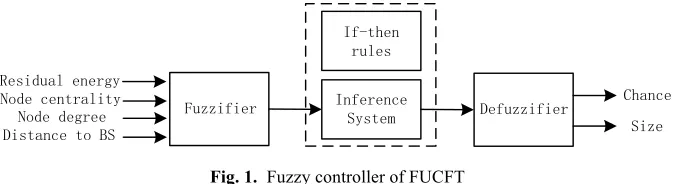
Fuzzy logic is a efficient method used to solve various problems in WSNs with lots of uncertainties, which is based on human decision-making behavior and experience [3,12]. Generally, fuzzy clustering algorithms merge different clustering parameters for CH election. As shown in Fig.1, a Mamdani fuzzy controller [3,8,12] is used, which consists four elements: fuzzifier, inference engine, rule base and defuzzifier. Fuzzifier converts the crisp input data into appropriate fuzzy linguistic variable, rule base contains a set of fuzzy rules describing the dynamic behavior of the controller, and inference engine is used to form inferences and make decisions based on the rules, defuzzifier converts the fuzzy output of inference engine into crisp values.
Fig. 1. Fuzzy controller of FUCFT
The input parameters of the fuzzy controller are ‘residual energy’, ‘node centrali-ty’, ‘node degree’ and ‘distance to BS’.
• Residual energy: the remaining energy of a node, which is needed to perform the activities such as data collection, aggregation and aggregated data transmission. • Node centrality: the value shows how central the node is among its neighbors
proportional to the network dimension, which can be calculated from the Eq. (4).
2
( , ) /
_
j Ni iarea
d i j N
Node centrality
S
!
=
"
(4)Where
N
i is the number of neighbors of nodei
, andS
area is the size of the sensing field area.• Node degree: the number of neighbors within the communication radius of a node, which could reduce the intra cluster distance for a cluster.
• Distance to BS: the distance between node
i
and the BS, which is used to make the clusters in different sizes so as to avoid the hot spot problem.Furthermore, FUCFT has two output variables which are also called ‘chance’ and ‘size’ like in DUCF [3].
• Chance: the value shows the ability for a node to be selected as CH, which is based on residual energy, node centrality and distance to BS.
• Size: the maximum number of CMs can be assigned for a particular CH, which is based on residual energy, node degree and distance to BS.
Next, the membership function for the inputs and outputs are given according to the experimental findings in [3,10] and also from our own experimental results. Low, medium, high is the fuzzy linguistic variable for ‘residual energy’, close, adequate, far for ‘node centrality’, big, medium, little for ‘node degree’, distant, reachable, nearby for ‘distance to BS’. Low, high, close, far, big, little, distant and nearby follows trape-zoidal membership function, whereas the others have a triangular membership func-tion. In addition, the output ‘chance’ has nine linguistic variables and they are very low, low, rather low, low medium, medium, high medium, rather high, high, very high. The output ‘size’ has very small, small, rather small, medium, rather large, large, very large as its seven linguistic variables. The membership function for the inputs and outputs is depicted in Fig.2.
(a) Membership function for residual energy (b) Membership function for node centrality
(c) Membership function for node degree (d) Membership function for distance to BS
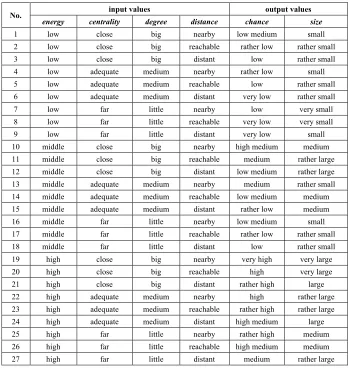
Based on the membership functions, the crisp input values are fuzzified to appro-priate linguistic variable by the inference engine of the fuzzy controller. Then, the fuzzified variables are processed through the if-then rule base which consists of 27 rules, these rules are based on the mentioned above combination of different linguistic variables. The if-then rules are specified in Table 1.
Table 1. Fuzzy if-then rules
No. input values output values
energy centrality degree distance chance size
1 low close big nearby low medium small
2 low close big reachable rather low rather small
3 low close big distant low rather small
4 low adequate medium nearby rather low small 5 low adequate medium reachable low rather small 6 low adequate medium distant very low rather small
7 low far little nearby low very small
8 low far little reachable very low very small
9 low far little distant very low small
10 middle close big nearby high medium medium 11 middle close big reachable medium rather large 12 middle close big distant low medium rather large 13 middle adequate medium nearby medium rather small 14 middle adequate medium reachable low medium medium 15 middle adequate medium distant rather low medium 16 middle far little nearby low medium small 17 middle far little reachable rather low rather small 18 middle far little distant low rather small 19 high close big nearby very high very large 20 high close big reachable high very large 21 high close big distant rather high large 22 high adequate medium nearby high rather large 23 high adequate medium reachable rather high rather large 24 high adequate medium distant high medium large 25 high far little nearby rather high medium 26 high far little reachable high medium medium 27 high far little distant medium rather large
4
FUCFT
FUCFT adopts distributed fuzzy controller to calculate the ‘chance’ and ‘size’ of each node so as to make the optimal nodes elected as CHs and appropriate cluster size assigned. FUCFT works in two different phases: cluster formation phase and cluster maintenance phase.
4.1 Cluster formation phase
Initially, each node calculates its ‘chance’ and ‘size’ by the fuzzy controller. Then each node broadcasts a beacon message Msg_Candidate to its neighbors, and the
Msg_Candidate message contains the node ID and ‘chance’ value. The node with higher ‘chance’ value than its neighbors elects itself as CH and sends an Msg_Head
message within its communication radius. At the same time, each CH lists its neigh-bors based on the ‘chance’ value from high to low. Of course, a node may receive more than one Msg_Head message. In such case, it will choose to join the nearby CH by sending Msg_Join message. Once receiving the Msg_Join message, the CH checks its ‘size’ for acceptance of new members. If the current number of member nodes is less than ‘size’, a new member is allowed to join with it by sending back an
Msg_Success message. Otherwise it sends back an Msg_Failure message which indi-cates no space for the new member node. When a node receives an Msg_Failure mes-sage, it sends again an Msg_Join message for the next nearest CH apart from the previous one and this process continues till it join a CH node. In the worst case, if a node can’t join any CH within its communication radius, it will elect itself as CH. When the cluster is finished, the CH updates its list by removing the non-CMs and broadcasts Msg_list message to its member nodes. The pseudo code of cluster for-mation is illustrated in Fig. 3.
Cluster formation
1.
n
=number of nodes,m
= number of CHs,ListH
= list of CHs,ListM
=list of Members;2.
n
=N
,m
=0,S
i=the ith node in the network,Si state iniState
.
=
; 3. for i=1 to n do4.
ListH
i=!
,ListM
i=
!
;5.
S .Er
i =ResidualEnergy,S .Dn
i =NodeDegree,S .Cn
i =NodeCentrality,S .BSn
i=DistanceToBS;
6. Chance,Size = FuzzyCtr(s .Er,s .Dn,S .Cn,si i i i.BSn);
7. sends and receives Msg_Candidate message to and from neighbors 8. Msg_Candidate = MSG_TYPE ,ID ,Chance[ 1 i i];
9. lists neighbors based on the ‘chance’ value according to the received messag-es;
12. for i=1 to n do
13. if (s .Chance > s .Chance si j ,! "j Ni)
14. sends Msg_Head message Msg Head_ =[MSG TYPE ID_ 2, j];
15.
s state chState
i.
=
m
+=1;16. else if ( receives a Msg_Head message from node
s
j)17. Adds an item to
ListH
j={...,s
j} ordered by the distance betweens
jands
i; 18. sends Msg_Join message to the nearestCH
x19. Msg_Join = MSG_TYPE ,ID ,CH_ID[ 3 i x]; 20. updates
ListH
j={...,s
j} by removings
x; 21. else if (receives a Msg_Join message from Sj) 22. if (ListM
i<
s size
i.
)23. sends a Msg_Sucess message to
s
j Msg Success_ =[MSG TYPE ID ID_ 4, i, j];24. adds an item to ListMi
ListM
i={...,
S
j}; 25. else26. sends a Msg_Failure to
s
j Msg Failure_ =[MSG TYPE ID ID_ 5, i, j];27. end if;
28. else if (receives Msg_Sucess message from
s
j) 29.s state cmState
i.
=
;s .CH = s
i j;ListH
i=!
; 30. else if (receives Msg_failure fromS
j)31. if (
ListH
i! "
)32.
S
x= the first item inListH
i, removesS
x fromListH
i; 33. sends Msg_Join message toS
x;34. else
35. announce itself as CH; 36.
s state chState
i.
=
; 37. end if;38. end if; 39. end for; 40. for i=1 to m do
41. updates ListBackupi by removing the items which are not existing in
ListM
i ;42. broadcasts ListBackupi to its CMs; 43. end for;
4.2 Cluster maintenance phase
After the clusters are created, each CH allocates a TDMA schedule for its CMs. Each CM is awake only during the assigned timeslot to transmit its sensed data. The CH aggregates the received redundant data packets into a single packet and sends it to BS in multi-hop fashion. At this stage, CHs and CMs inevitably face to energy deple-tion, physical damage and other inference which would make them disordered [16]. Once CHs fail, the entire area of their interest will be unmonitored, so the CMs are required to be noticed quickly to prevent data losing in the cluster. Moreover, disor-dered CMs also affect the eligibility of the next elected CH, which should be removed by their CH from the list of cluster members
ListM
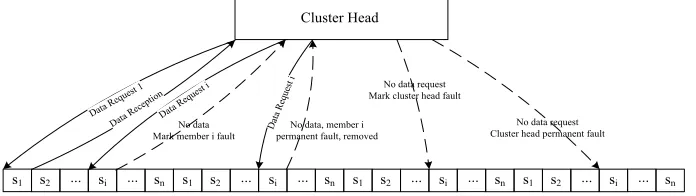
. Fig.4 shows the process of fault tolerance.Fig. 4. Data collection and fault tolerance
Seen from Fig.4, the CMs send their sensed data attached with newly chance val-ues upon receiving a data reqval-uest message at the allotted timeslot. Once the CH can’t receive data packet at the end of the frame, it checks whether there is an error mark, and if the error mark has existed, the CH realizes that it is a permanent failure and remove the CM from its list of cluster member. Otherwise, it will mark an error for the CM. Moreover, the error mark is moved by the CH when it receives a data packet with another request so as to tolerate the temporary fault. Similarly, when a CM can’t receive data request, it will wait for the next frame to receive the request as it might be a temporary failure. In case of not receiving the request in the second frame, it will be required to replace its CH. To replace the CH, the CM needs to check its received latest and updated BCHs’ list which is periodically sent by its CH. Then it sends an Msg_Join message to the first available BCH and wait for the acknowledge message. However, there is a possibility that the BCH might be disordered. In the case of not receiving the acknowledge message from the BCH, the CM sends another Msg_Join message to the second available BCH until it joins to a CH.
Furthermore, reclustering on demand rather than in rounds is used to reduce the overhead of the algorithm and extend the network lifetime. Whenever the ‘chance’ value of a CH is less than the average ‘chance’ value of its CMs’, the CH will set a prespecified bit in the data packet, which is prepared to be transmitted to the BS. Once the BS receives this data packet, it will inform the network to perform cluster formation. On-demand reclustering results in significant reduction of overhead by the
Cluster Head
s1 s2 ... si ... sn s1 s2 ... si ... sn s1 s2 ... si ... sn s1 s2 ... si ... sn
Data R eception Data Request 1 Data R
equest i
No data
Mark member i fault Data Request iNo data, member i permanent fault, removed
No data request Mark cluster head fault
work decreases and the network lifetime extends. The pseudo code of on-demand reclustering is given in Fig.5.
Reclustering on-demand
1.
m
= number of CHs,ListM
=list of Members; 2. for i=1 to m do3. calculates average ‘chance’ 1
.
i
ListM
j j
i s size AverChance
ListM =
=
!
4. if (
s chance < AverChance
i.
i)5. sets a predefined bit in the data packet to inform BS; 6. end if;
7. end for;
8. if (BS receives a data packet with predefined bit=True) 9. broadcasts Msg_Reclustering message in the network; 10. end if;
Fig. 5. Pseudo code of on-demand reclustering
5
Simulation results
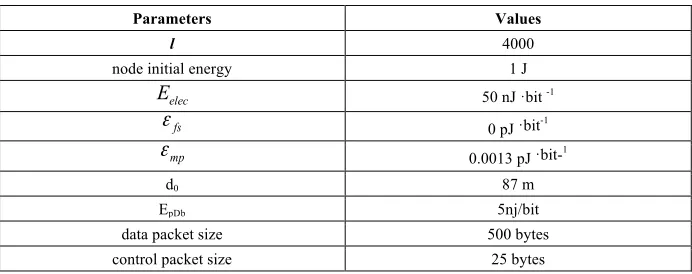
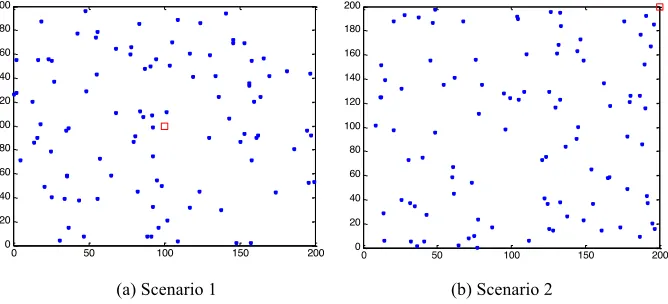
In this section, simulations are conducted to evaluate the performance of the pro-posed algorithm FUCFT compared with DUCF [3], LEACH [5] and EADC-FL [8]. In the simulations, 100 nodes are deployed randomly in a square field of area
200m!200m. FUCFT, DUCF, LEACH and EADC-FL have been tested in different scenarios. In Scenario 1: BS node’s location is(50,50), which is in the middle of region of interest; Scenario 2: BS node’s location is(200,200), which is at the corner of region of interest. The scenarios are shown respectively in Fig.6. The rectangle red box in Fig.6 represents BS and blue spots represents sensor nodes. The initial energy of each node is 1J. Every simulation result is the average of 50 independent experi-ments, and the parameters of the simulations are listed in Table 2.
Table 2. Simulation parameters
Parameters Values
l 4000
node initial energy 1 J
elec
E 50 nJ !bit -1
fs
!
0 pJ !bit-1mp
!
0.0013 pJ !bit-1d0 87 m
EpDb 5nj/bit
data packet size 500 bytes
(a) Scenario 1 (b) Scenario 2 Fig. 6. Network topology in two scenarios
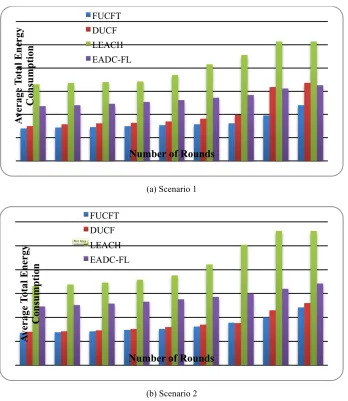
Firstly, the average energy consumption is measured by using the four algorithms in two Scenarios 1, 2 respectively, and the results are depicted in Fig.7. The results show that LEACH consumes more energy than the other algorithms because its CHs are elected randomly and communicate with BS directly. EADC-FL comes next, which can obtain a better distribution of CH number than LEACH because it consid-ers the node density, node centrality and node energy in selection of CHs as well as communicates with BS in multi-hop fashion. However, it still lags behind DUCF and FUCFT, because DUCF and FUCFT assigns a proper number of member nodes to a CH based on its capacity so as to form unequal clusters. Moreover, FUCFT considers residual energy and node centrality to obtain the optimal ‘size’ and ‘chance’ respec-tively, which reduces the intra-cluster communication compared to DUCF. Thus, the proposed algorithm FUCFT achieves the best energy efficiency.
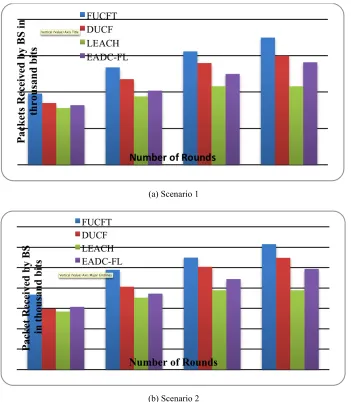
Secondly, the number of useful messages over the time is performed to evaluate the communication efficiency. The results are given in Fig.8. LEACH shows worst performance than others because it does not restrict the number of members in a clus-ter which will reduce the number of data message from individual nodes to BS. The same problem continues in EADC-FL which don’t take care about the numbers of nodes in a cluster though it forms adaptive clusters based on node density, node cen-trality and node energy as factors in determining the CH chance of a node. DUCF gives better results than LEACH and EADC-FL since it restricts the number of mem-bers through the second fuzzy output variable ‘size’. Furthermore, FUCFT tolerates the CH and CM failure to avoid data packets losing between CMs and CH so as to significantly improve the communication efficiency of the network.
0 50 100 150 200
0 20 40 60 80 100 120 140 160 180 200
0 50 100 150 200
(a) Scenario 1
(b) Scenario 2
(a) Scenario 1
(b) Scenario 2
Fig. 8. Number of packets received by the base station
clustering formation phases. Therefore, as time goes on, EADC-FL obtains more survival nodes than LEACH and DUCF due to its on demand reclustering scheme. What is more, FUCFT forms unequal clusters with optimal size, especially, replaces the failed CHs and removes the failed CMs. Thus, the network lifetime is extended.
Fig. 9. Comparison of survival nodes
6
Conclusion
A new unequal clustering algorithm with fault tolerance FUCFT is proposed for WSNs using fuzzy controller to decrease the traffic as well as extend the network lifetime. FUCFT considers the residual energy, node centrality and distance to BS as parameters inputted into the fuzzy controller to evaluate the ‘chance’ of the candidate CHs, a node with the maximum ‘chance’ will be elected as CH and the rest of the nodes as BCHs. Thus, the CMs can ensure that there is always a BCH for their CHs so as to replace the failed CH with an appropriate BCH using a TDMA scheme. Moreover, FUCFT forms the clusters with restricted numbers by considering residual energy, distance to BS and node degree so as to balance the energy consumption among the nodes. Reclustering on demand is used to reduce the energy dissipation of the consecutive clustering in rounds. The simulation results show that FUCFT outper-forms other clustering algorithms, it can improve the energy consumption and lifetime of the network by forming optimal clusters and tolerating the failure of CHs and CMs, which makes it be suitable for many real time applications.
7
References
[2]Afsar M M, Tayarani M H(2014). Clustering in sensor networks: a literature survey. Jour-nal of Network and Computer Applications.46: 198-226. https://doi.org/10.1016/j. jnca.2014.09.005
[3]Baranidharan B, Santhi B(2016). DUCF: Distributed load balancing Unequal Clustering in wireless sensor networks using Fuzzy approach. Applied Soft Computing. 40: 495-506.
https://doi.org/10.1016/j.asoc.2015.11.044
[4]Sariga A, Pothula S(2017). A survey on unequal clustering protocols in wireless sensor networks networks. Journal of King Saud University-Computer and Information Sciences, 29(4): 428-448. https://doi.org/10.1016/j.jksuci.2017.03.006
[5]Heinzelman W R, Chandrakasan A, Balakrishnam H. Energy-efficient communication protocol for wireless microsensor networks. Proceedings of the 33rd Annual Hawaii Inter-national Conference on System Sciences. Piscataway, NJ: IEEE, 2000: 3005-3014.
https://doi.org/10.1109/TWC.2002.804190
[6]Lee J S, Cheng W L(2012). Fuzzy-logic-based clustering approach for wireless sensor networks using energy predication. IEEE Sensors Journal. 11(9):2891–2897.
https://doi.org/10.1109/JSEN.2012.2204737
[7]Attea B A, Khalil E A(2011). A new evolutionary based routing protocol for clustered het-erogeneous wireless sensor networks. Applied Soft Computing. 12(7):1950–1957.
https://doi.org/10.1016/j.asoc.2011.04.007
[8]Nooshin N, Zurina M H, Shamala S, Mohamad A M(2015). An Energy aware distributed clustering algorithm using fuzzy logic for wireless sensor networks with non-uniform node distribution. Wireless Pers Commun. 84:395-419. https://doi.org/10.1007/s11277-015-2614-9
[9]Yu J, Qi Y, Wang G, Gu X(2012). A cluster-based routing protocol for wireless sensor networks with nonuniform node distribution. International Journal of Electronics and Communications. 66(1):54-61. https://doi.org/10.1016/j.aeue.2011.05.002
[10]Ying L, Huang Q, Weiquan L(2013). Load-balanced clustering algorithm with distributed self-organization for wireless sensor networks. IEEE Sensors Journal. 13(5): 1498-1506.
https://doi.org/10.1109/JSEN.2012.2227704
[11]Bagci H, Yazici A(2013). An energy aware fuzzy approach to unequal clustering in wire-less sensor networks. Applied Soft Computing. 13(4): 1741-1749. https://doi.org/10.1016/ j.asoc.2012.12.029
[12]Mirjana M, Valdimir V, Vladimir M(2014). Fuzzy Logic and Wireless Sensor Networks-A Survey. Journal of Intelligent & Fuzzy Systems. 27(2): 877-890. https://doi.org/ 10.3233/IFS-131046
[13]Logambigai R, Kannan A(2016). Fuzzy logic based unequal clustering for wireless sensor networks. Wireless Network. (22): 945-957.https://doi.org/10.1007/s11276-015-1013-1
https://doi.org/10.1007/s11276-015-1013-1
[14]Zadi D, Ahawajy J, Ghanavati S(2013). A new energy efficient cluster-head and backup selection scheme in WSN. In Proc IEEE 14th Int. Conf. Inf. Reuse Integr(IRI), Aug.2013, 408-415.https://doi.org/10.1109/IRI.2013.6642500
[15]Farnaz P, Mansour E(2016). Fuzzy logic method for enhancement fault-tolerant of cluster head in wireless sensor networks clustering. TEM Journal. 5(3): 268-276.
https://doi.org/10.18421/TEM53-03
[16]Davood I, Jemal A, Sara G(2015). An alternative clustering scheme in WSN. IEEE Sen-sors Journal. 15(7): 4148-4155. https://doi.org/10.1109/JSEN.2015.2411598
1469-8
Authors
Wang Chuhang received master degree from Jilin University in 2005. She is cur-rently an associate professor in College of Computer Science and Technology, Changchun Normal University. Her main research interests are wireless sensor net-works and real-time embedded systems. (e-mail: [email protected])
Hu Huangshui received master and doctor degree from Jilin University in 2005 and 2012 respectively. He is currently an associate professor in College of Computer Science and Engineering, Changchun University of Technology. His main research interests are wireless sensor networks, multifunction vehicle bus networks. (e-mail: [email protected]