A Self-organizing Wireless Sensor Networks Based on
Quantum Ant Colony Evolutionary Algorithm
https://doi.org/10.3991/ijoe.v13i07.7284
Lin-lin Wang*
Zhongshan Torch Polytechnic, Zhongshan, China
Chengliang Wang
ChongQing University, Chongqing, China
Abstract—Aiming at the coverage problem of self-organizing wireless
sen-sor networks, a target coverage method for wireless sensen-sor networks based on Quantum Ant Colony Evolutionary Algorithm (QACEA) is put forward. This method introduces quantum state vector into the coding of ant colony algo-rithm, and realizes the dynamic adjustment of ant colony through quantum rota-tion port. The simularota-tion results show that the quantum ant colony evolurota-tionary algorithm proposed in this paper can effectively improve the target coverage of wireless sensor networks, and has obvious advantages compared with the other two methods in detecting the number of targets and the convergence speed. Based on the above findings, it is concluded that the algorithm proposed plays an essential role in the improvement of target coverage and it can be widely used in the similar fields, which has great and significant practical value.
Keywords—self-organizing wireless sensor, quantum ant colony evolutionary
algorithm, target coverage
1
Introduction
With the development of embedded computing technology, the wireless sensor network combining sensor technology, computer network technology and distributed formula signal processing technology has become a new research hotspot. In these studies, a class of self-organizing wireless sensor networks with self-organizing abil-ity has received more and more attention.
presented a coverage method based on the Simulated Annealing (SA), which can avoid premature convergence and evolution stagnation by adjusting the temperature value adaptively. X. Wang et al. proposed a coverage method based on the Particle Swarm Optimization (PSO), which discretizes the continuous particle position param-eters to optimize and obtain the effective solution of the target coverage problem. However, the discretization process leads to the poor accuracy of PSO algorithm and slow convergence in later stage of evolution. Based on the above model, the target coverage method for wireless sensor networks based on QACEA (Quantum Ant Col-ony Evolutionary Algorithm) is proposed to introduce the quantum state vector into the ACO coding, and the quantum rotation port is used to realize the dynamic adjust-ment of the ant colony, which verify that a better response can be made for the prob-lem.
2
Review
In the target location, navigation and intelligent monitoring and other applications, each monitored target needs to be perceived by a number of sensor nodes. Due to sensor data processing and perceptual constraints, it is common for each sensor node to be aware of only a limited number of targets within its own monitoring range. As-suming that there are M monitored objects and N sensor nodes in the wireless sensor network, then the overlay relationship between the sensor nodes and the targets in the wireless sensor network can be expressed by the following formula:
{ }
0
1
1 2 1 1 1 1 2 1 1 1 2 1 2 2 2 1 2 1 1 1 2 1 1 1
,
c
c
c
c
c
c
c
c
c
c
c
c
c
c
c
c
c
c
C
m,n M,N M,N M, M, ,N M ,N M , M , M m,n ,N ,N-, , ,N ,N-, ,!
"
"
"
"
"
"
"
#
$
%
%
%
%
%
%
%
&
'
=
( ( ( ( ( (!
!
"
"
!
!
(1) In the overlay relationship matrix C shown in Equation 1, Cm,n represents an over-lay relationship between the n-th sensor node and the m-th monitored object. Cm,n=1 indicates that the m-th monitored target is in the coverage area of the n-th sensor node, and Cm,n=0 indicates that the m-th monitored target is outside the coverage area of the n-th sensor node.{ }
,0
1,
, 1 , 2 , 1 , , 1 1 , 1 2 , 1 1 , 1 , , 2 1 -, 2 2 , 2 1 , 2 , 1 1 -, 1 2 , 1 1 , 1
!
"
"
"
"
"
"
"
#
$
%
%
%
%
%
%
%
&
'
=
( ( ( ( ( ( n m N M N M M M N M N M M M n m N N N Ns
s
s
s
s
s
s
s
s
s
s
s
s
s
s
s
s
s
S
!
!
"
"
!
!
(2) In the monitoring relation matrix S, sm,n=1 indicates that the m-th monitored target is monitored by the n-th sensor node, and sm,n=0 indicates that the m-th monitored target is in the coverage area of the n-th sensor node, but not monitored, or the m-th monitored object is outside the coverage of the n-th sensor node. When each sensor node can monitor a maximum of targets in the coverage area, the constraints can be as shown in Equation 3.!
==
"
M
m mn
3
Quantum Ant Colony Evolutionary Algorithm
Quantum ant colony evolutionary algorithm is a new algorithm combining tum evolutionary algorithm and ant colony algorithm. Based on the concepts of quan-tum bit and quanquan-tum superposition state in quanquan-tum computation, quanquan-tum ant colony evolution algorithm can greatly enhance the traversal and convergence rate when the scale of the problem is large. Quantum ant colony evolutionary algorithm will use a set of quantum bits’ probability amplitude and a set of binary numbers to represent each ant of the ant colony.
In the quantum ant colony evolutionary algorithm, each ant can search several points in the solution space in parallel, which improves the search efficiency and increases the probability of obtaining the global optimal solution. By means of quan-tum bit coding, each representative quanquan-tum in an ant is the probability amplitude of the particle coordinate in the wave function. Each ant in the quantum ant colony evo-lutionary algorithm can complete the update of the two optimal solutions by the up-date of the quantum rotation and path optimization in the iterative process, that is, realize the quantum search mechanism in the evolution process. In the process of searching, the quantum ant colony evolutionary algorithm firstly carries out the en-coding and quantum bit measurement, and calculates the fitness value of the meas-urement result. Then each ant in the ant colony completes the movement of the ant and updates the pheromone according to the visibility and the pheromone intensity, and calculates the fitness value of each moving route, and then, finds out the individ-uals with the greatest fitness in all the binary individindivid-uals generated by the qubit meas-urement and ant movement. With the iterative operation of the algorithm, the phero-mone will gradually accumulate to the path of the global optimal solution, so as to achieve the convergence state of the algorithm. The simulation results show that the quantum ant colony evolutionary algorithm has good searching ability and strong robustness, and can effectively avoid the phenomenon of evolutionary stagnation and premature convergence.
4
Methods
Quantum ant colony evolutionary algorithm is an improved ant colony algorithm which combines quantum computing theory with ant colony algorithm. It combines the high efficiency of quantum computation and the robustness of ant colony algo-rithm. The main steps of the quantum ant colony evolutionary algorithm are: ant col-ony quantum encoding, initial ant colcol-ony generation, qubit state measurement, ant movement and pheromone update, ant colony quantum rotation port update, ant posi-tion non-door mutaposi-tion and so on.
4.1 Ant colony quantum coding
converge slowly and become stagnant. In the quantum ant colony evolutionary algo-rithm, the ants are encoded based on a set of qubits and a set of binary numbers to represent the implementation, the state of each qubit is shown in 5:
1
0
!
"
#
=
+
(5)In the formula, and are the probability amplitude of the corresponding
state of the quantum bit. The
2
!
represents the probability that the quantum state isobserved as
0
state, the2
!
represents the probability that the quantum state isobserved as
1
state. The corresponding normalization conditions can be shown as in 6:1
2 2=
+
!
"
(6)In wireless sensor network target coverage, it is necessary to encode the coverage and monitoring relationship of the sensor and the target node respectively, as shown in Equation 1 and Equation 2. When the m-th monitored target is out of the coverage of the n-th sensor node, the sensor can’t monitor the target in the coverage relation matrix C and the monitoring relation matrix S, that is, when Cm,n=0, there must be
Sm,n=0, that is, the bit need not be encoded. The encoding process can be as shown in Equation 7, encoding only the bytes in the matrix S with the underlined position:
!
!
!
!
"
#
$
$
$
$
%
&
=
!
!
!
!
"
#
$
$
$
$
%
&
=
0
0
0
0
0
0
0
1
0
0
1
0
1
0
0
0
1
0
0
0
0
0
1
1
0
1
1
0
1
0
0
1
S
C
(7)The code length of ants is equal to the number of elements in matrix c. According to the code length, a set of qubit matrix A carried by ants can be expressed as the following: L L
A
!
"
!
"
!
"
!
!
2 2 1 1=
(8)4.2 Generation of initial quantum bits
In the initial ant colony, the probabilistic amplitude of the corresponding states of all the qubits on each ant in the ant colony is generated by a Logistic mixture map as shown in Equation 9.
k
k
x
x
x
k+1=
µ
k(
1
!
k),
=
0
,
,1
2
,
!
,
(9)When µ = 4, the Logistic map is in a turbid state. Given a random number between (0 ,1), the Logistic map generates K chaotic variables. In the process of initialization,
! = cos (2"xk) and # = sin (2"yk) in the matrix A, the probabilistic amplitude of the qubits carried by the initial ant will be uniformly distributed in the solution space.
4.3 Quantum bit state measurement
In order to obtain the iteration-best ant in the current ant colony, it is necessary to measure the state of each ant's qubit in the iteration process of the quantum ant colony evolutionary algorithm to obtain the corresponding target coverage program and fit-ness. The measurement of the quantum state at position 1 is shown in Equation 10:
!"
!
#
$
%
>
=
22
]
1,
0
[
,1
]
1,
0
[
,
0
z
t t t
random
random
&
&
(10) In the formula (10), Z=(z1z…zl) is the binary resolving formula corre-sponding to the ant after the state measurement, and random [0,1] is the random num-ber between [0,1]. After the measurement of the quantum state, the ant will be trans-formed into the determined binary sequence string, that is, obtaining the correspond-ing target coverage scheme.
4.4 Evaluation of ants' fitness
4.5 The movement of ants and the updating of pheromones
In the quantum ant colony evolutionary algorithm, we can generate the ant binary route by the pheromone strength and visibility to update the current optimal solution. The movement rule and transition probability of ants can be shown in Equation 11:
)
(
)
(
)
(
)
(
)
(
)
(
)
(
00
t
t
t
t
t
t
t
p
ij ij i i ij ijij ! µ ! µ
µ !
"
#
"
#
"
#
+
=
(11)In equation 11, t represents the number of iterations of the algorithm, and the num-ber of steps that the ant has traveled.
j
!
{
0
1,
}
respectively indicate the two possible positions of the ants at step i. Assuming that the current position of the ant corre-sponds to the m-th row and n-th column of the monitoring relation matrix S, then the visibility parameter setting of the position 1 selected in the next step in the t-th cyclic process is as follows:!
!
"
!
!
#
$
%
<
&
'
(
)
*
+
+
,
,
,
= = =E
s
E
s
s
t
ni mi n
i mi n
i mi l n m 1 , 1 , 1 , ,
0
1
)
(
(12)Equation 12 shows that when the number of the sensors monitoring the target is close to the required number E, the visibility will be higher, and the additional sensors are not required to monitor the target, then the visibility is set to zero.
At the initial stage, the pheromone intensity of all paths is set as the upper limit
]
!
[!
min max of the pheromone on the path. After every ant in each ant colony com-pletes the circulation, only the pheromone on the best path of the current ant is updat-ed, the update rule of the trajectory is shown in Equation 13:best ij
ij
t
"!
t
!
!
(
+
1
)
=
(
)
+
#
(13)4.6 Quantum rotation port update of ant position
When all the ants in the ant colony are moving, the quantum rotation of each ant bit must be updated according to the optimal solution in the previous iteration. The updating process is shown in Equation 14:
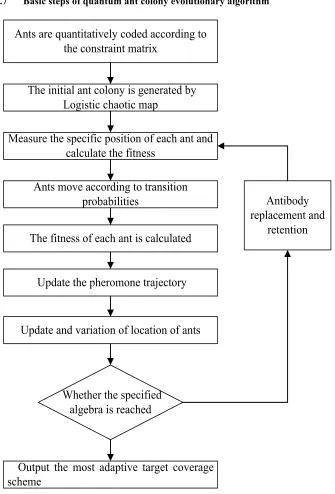
4.7 Basic steps of quantum ant colony evolutionary algorithm
Ants are quantitatively coded according to
the constraint matrix
The initial ant colony is generated by
Logistic chaotic map
Measure the specific position of each ant and
calculate the fitness
Ants move according to transition
probabilities
The fitness of each ant is calculated
Update the pheromone trajectory
Update and variation of location of ants
Output the most adaptive target coverage
scheme
Whether the specified
algebra is reached
Antibody
replacement and
retention
Fig. 1. Basic step of the wireless sensor network target coverage based on the quantum ant
5
Results
In the algorithm simulation, the monitoring range is 600x600m, the number of monitored targets is 200, and the monitored targets and the sensor nodes are all ran-domly distributed. Each monitored target needs at least three sensor nodes to monitor, and each sensor node can simultaneously perceive five targets within the coverage. In the quantum ant colony evolutionary algorithm, the number of ants in the ant colony is fixed at 40, the pheromone trajectory intensity takes the parameter $ = 2, the visibil-ity parameter takes µ = 2, and the pheromone volatilization coefficient takes # = 0.9. In the genetic algorithm, the number of chromosomes in the population is 40, the computation time is 9, the crossover probability is 7, and the mutation probability is 0.5. In the simulated annealing algorithm, the initial temperature is set at 300 degrees, and the annealing temperature coefficient is set at 85. The iteration times of all three algorithms are 100 times.
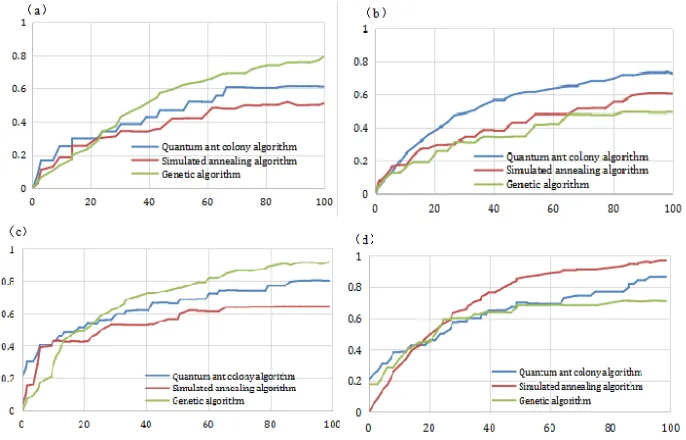
When the sensor nodes are 150, Figure 2 shows the target coverage of the target coverage method based on the quantum ant colony evolutionary algorithm, genetic algorithm and simulated annealing algorithm respectively during the target coverage of the wireless sensor network.
Target coverage is defined as the percentage of the total number of successfully de-tected targets in the monitoring range. In order to determine the performance of the algorithm under different sensor conditions, the sensed radii of the sensors are set at 50 m, 60 m, 70 m and 80 m respectively in the four subgraphs.
(a) Perceptual radius is 50 m (b) Sensing radius is 60 m (C) Sensing radius is 70 m (d) Sensing radius is 80 m
It can be seen from the simulation results that the target coverage rate of the target coverage method based on the simulated annealing algorithm increases slowly with the increase of the number of the iteration algorithm, and tends to stagnate in the later period of the algorithm. The coverage rate of target coverage method based on genetic algorithm is relatively stable, but it is difficult to introduce new genes when the muta-tion probability is low because of using a fixed encoding formula, and it is easy to fall into premature convergence. When the mutation probability is high, there will be a large degree of volatility, and the target coverage is difficult to be improved. Quantum ant colony evolutionary algorithm uses the encode formula based on quantum bit, the state vector of quantum is introduced into the coding of ant colony algorithm, which avoid premature convergence and evolution stagnation caused by deterministic state. It can be seen from the figure that the target coverage of the quantum ant colony evo-lutionary algorithm is increased by 10 percentage points and 20 percentage points respectively compared with the genetic algorithm and the simulated annealing algo-rithm under different radius conditions.
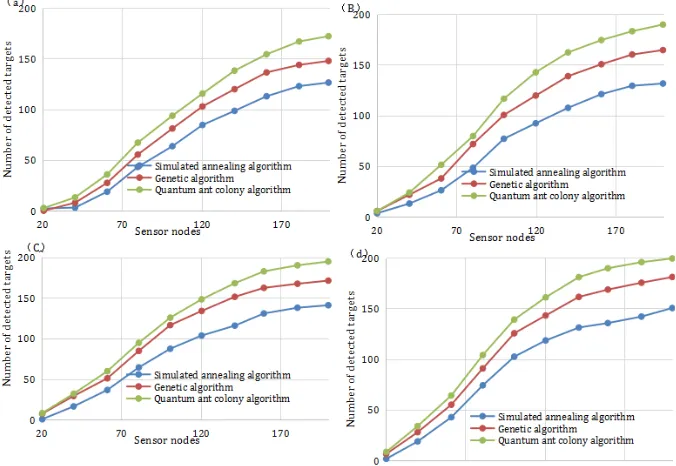
(a) Perceptual radius is 50 m (b) Sensing radius is 60 m (C) Sensing radius is 70 m (d) Sensing radius is 80 m
Fig. 3. Successful detection of the number of targets with its changes of iteration number
algo-rithm contains multiple individuals within the population, the number of successful detection targets is more than simulated annealing algorithm.
Quantum ant colony evolutionary algorithm (quantum ant colony algorithm) is op-timized by quantum evolution and pheromone-based ant routing search. Compared with the former two algorithms, the search range is enlarged. At the same time, the quantum ant colony evolution algorithm will undergo the process of updating the optimal solution twice in each iteration, and can detect more targets more efficiently. It can be seen from the figure that, as the number of sensor nodes increases, the in-crement of the number of targets successfully detected of the quantum ant colony evolutionary algorithm increases compared with the other two algorithms, mainly because the complexity of the problem increases exponentially with the increase of the number of sensors. The traditional genetic algorithm and simulated annealing algorithm are easy to fall into premature convergence. The quantum ant colony evolu-tionary algorithm has the coding formula of the quantum bit probability amplitude. Each quantum bit can be expressed as a superposition of several quantum states, and has the parallelism compared with the genetic algorithm and simulated annealing algorithm. At the same time, the search driven by the quantum rotation port can trans-form the global search into the local search so that the equalization of rough search and fine search can be improved to avoid the stagnation of evolution and improve the convergence rate of the algorithm, that is, with the increase of the number of the sen-sor nodes, the performance advantage of the quantum ant colony evolutionary algo-rithm is more obvious compared with the other two algoalgo-rithms.
6
Conclusion
7
References
[1]Dezun D., Xiangke L., Kebin L., et al. (2012). Distributed Coverage in Wireless Ad Hoc and Sensor Networks by Topological Graph Approaches. IEEE Transactions on Comput-ers, 61(10): 1417-1428. https://doi.org/10.1109/TC.2011.149
[2]Yourim Y., Yong-Hyuk K. (2013). An Efficient Genetic Algorithm for Maximum Cover-age Deployment in Wireless Sensor Networks. IEEE Transactions on Cybernetics, 43: 1473-1483. https://doi.org/10.1109/TCYB.2013.2250955
[3]Akbarzadeh, V., Gagne, C., Parizeau, M., et al. (2013). Probabilistic Sensing Model for Sensor Placement Optimization Based on Line-of-Sight Coverage. IEEE Transactions on Instrumentation and Measurement, 62(2): 293-303. https://doi.org/10.1109/TIM.2012.2214 952
[4]Biradar, R. V., Sawant, S. R., Mudholkar, R. R., & Patil, V. C. (2011). Multihop routing in self-organizing wireless sensor networks. International Journal of Computer Science Issues (IJCSI), 8(1): 155-164.
[5]Liu, M., Zhang, F., Ma, Y., Pota, H. R., & Shen, W. (2016). Evacuation path optimization based on quantum ant colony algorithm. Advanced Engineering Informatics, 30(3): 259-267. https://doi.org/10.1016/j.aei.2016.04.005
[6]Dong, H., Yang, X., Teng, X., & Sha, Y. (2016, June). A diversity reserved quantum parti-cle swarm optimization algorithm for MMKP. In Computer and Information Science (ICIS), 2016 IEEE/ACIS 15th International Conference on (pp. 1-7). IEEE.
[7]Sukhanov, A. V., Prokof’ev, I. V., & Ivanov, A. V. (2016). A universal digital platform for the construction of self-organizing wireless sensor networks for industrial safety and eco-logical monitoring systems. Russian microelectronics, 45(2): 137-141.
https://doi.org/10.1134/S1063739716020098
[8]Desai, S. S., & Nene, M. J. (2016, May). DANES—Distributed algorithm for node energy-management for self-organizing wireless sensor networks. In Recent Trends in Electronics, Information & Communication Technology (RTEICT), IEEE International Conference on (pp. 1296-1301). IEEE.
8
Authors
Lin-lin Wang (corresponding author) is with Zhongshan Torch Polytechnic, Zhongshan, 528436, China ([email protected]).
Chengliang Wang is with the School of Software Engineering ChongQing Uni-versity, Chongqing 400030, China.