Application and Design of Patient Temperature
Acquisition System Based on Wireless Sensor Network
https://doi.org/10.3991/ijoe.v13i05.7046
Huijie Ding
The Open University of Guangdong, Guangdong, China [email protected]
Abstract—The purpose of this study is to achieve large-scale real-time ac-quisition and monitoring of the patient’s body temperature, for noticing abnor-mal phenomenon of temperature in time. In the ward, arrange ZigBee wireless temperature monitoring network, realize the ward patients temperature meas-urement and gathering of temperature related clinical data, achieve the tempera-ture monitoring network through the serial RS232 and PC communication, and PC receives, displays, and processes the data through the serial port. The results showed that the system can also realize the acquisition, transmission and moni-toring of a plurality of temperature signals, and send out the alarm in abnormal temperature. As a result, the system can be widely used in clinical measure-ment, suitable for popularization in large hospital with a large number of pa-tients.
Keywords—ZigBee; temperature monitoring network; body temperature
1
Introduction
This research, based on the ZigBee wireless sensor network technology with low power consumption, takes the system CC2530 chip on the chip as the core, and DS18B20 as the temperature sensor, and designs and implements real-time monitor-ing system of clinical patient’s temperature based on ZigBee. The system can meet the large-scale real-time monitoring for patients without frequent contact; in addition, the system also has low power consumption, miniaturization, strong expansibility and so on characteristics.
2
State of the art
At present, the hospital ward monitoring system mostly transfers to the monitoring center through the cable, so it needs for wiring, walling or ceiling wiring cumbersome work, and the mobility is not strong. In particular, the patient's body temperature needs manual measurement.
In recent years, due to people's pursuit of intelligence, wireless sensor networks are developing rapidly. Wireless sensor network is a new technology that combines the technologies in many fields. Wireless sensor network consists of many wireless sen-sor nodes, and each sensen-sor node in the case of electricity, can obtain the relevant data in the wireless network. The data acquisition module is different that it can realize the acquisition of different data parameters. With the increasing integration of hardware and mature of technology, sensor node volume decreased gradually and the cost is reduced, so the construction cost of wireless sensor network is decreased. Compared with the traditional networks, wireless sensor networks have large-scale, self-organizing, dynamic reconfigurable information system, data centric and so on fea-tures, so wireless sensor network technology has been extended to all areas, including medical and health care field [3].
The application value of wireless sensor network is embodied in: (1) mobility. Be-cause there are no cable restrictions, users can work in different places, and network users can access to real-time information resources anywhere. (2) no need for wiring. The installation is easy, and it can greatly shorten the construction time. (3) flexible networking. Wireless sensor networks can consist of a variety of topologies, and it is easy to expand from a small number of users to peer to peer network infrastructure [4].
At present, there are 5 popular wireless network technology standards: ZigBee, Wi-Fi, Bluetooth, Ultra Wide Band, and NFC [5].
ZigBee is a new wireless network technology with short distance, low rate, low power consumption and high communication efficiency. It is based on the IEEE 802.15.4, mutually coordinating in the thousands of tiny sensors to realize the com-munication between each other. These sensors require only a small amount of energy to relay the data from one sensor to another via radio waves, creating conditions for the ubiquitous network.
wire-less sensor network technology based on the patient temperature acquisition system. In the system, we use a small size and low power consumption of the chip, so as to achieve the sensor node miniaturization and long working hours. Business service platform software uses a four-tier architecture, and reserve the interface of different sensor nodes and different applications. The system can not only be applied to the hospital, but also can be applied to the patient's health care. The system has reserved the interface which is connected with the hospital system. It can be easily embedded in the system platform of the hospital.
3
Methods
3.1 System overall structure design
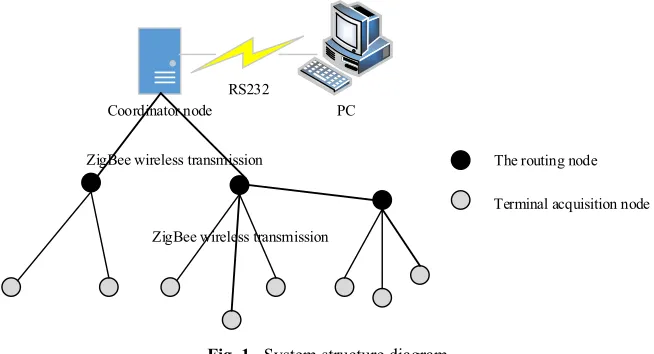
Body temperature measurement is one of the basic nursing works in hospital, which needs to consume a lot of manpower and material resources. Wireless tempera-ture monitoring system of this paper is to use the terminal acquisition node worn by the tester, to measure body temperature data. Wireless temperature monitoring system consists of a coordinator data aggregation uploading and command sending node, routing data and relay node, and terminal acquisition node.
The system takes the ward for the monitoring unit. Set wireless temperature moni-toring network based on ZigBee technology in each ward building, and clinical pa-tients use mobile temperature terminal node for the measurement of body tempera-ture. Body temperature data makes instructions and data transmission and gathering through the ZigBee network, and finally accesses to the computer of the nursing sta-tion on each floor through the serial of the coordinator. Then, temperature data will be displayed in the computer accessed to, which is convenient for nursing staff observa-tion, analysis, and processing temperature data. At the same time, set the threshold temperature, if the temperature of terminal nodes wearer's body temperature is higher or lower than the temperature threshold value, it will send an alarm signal, for timely detection of disease. According to the characteristics of the temperature monitoring system, the design of this paper adheres to the principle of miniaturization and modu-larization, the temperature information collection node must be able to work inde-pendently, and keep the system stable when there are new nodes joining or exiting the network. At the same time, it is necessary to reduce the power consumption for the long-term working of the terminal node, which is mainly realized by making the ter-minal node regularly in the working and sleeping state.
PC Coordinator node RS232
ZigBee wireless transmission
ZigBee wireless transmission The routing node
Terminal acquisition node
Fig. 1. System structure diagram
ZigBee based temperature monitoring system network nodes are divided into three kinds: the terminal acquisition node, the router node and the coordinator. Because the data in the system for the transmission process is the temperature data from the coor-dinator to the terminal acquisition node sending commands data and that from the terminal acquisition node to the coordinator, it will be helped by the intermediate relay of the routing nodes, and there is no need for mutual communication among nodes. In this way, we consider the selection of tree network topology as the network structure of the system.
3.2 System hardware design
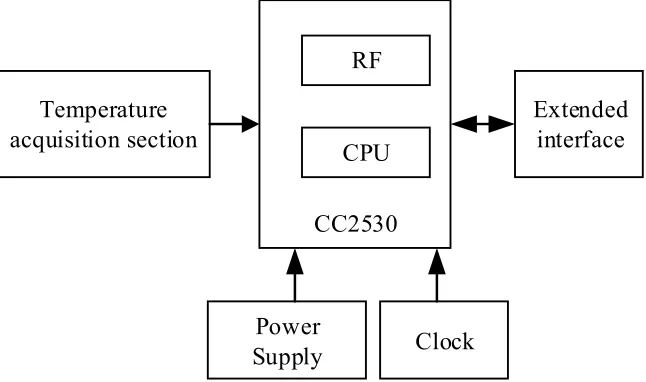
There are 3 kinds of network nodes in the temperature monitoring system based on ZigBee: the terminal acquisition node, the routing node and the coordinator node. A network is composed of 1 coordination device, a plurality of routing nodes and a plurality of terminal acquisition nodes. These 3 kinds of nodes are the basic equip-ment to compose of the wireless sensor network. There is no difference in the hard-ware of the 3 types of nodes, and its functional properties are determined by the soft-ware compilation. 3 types of nodes of the system use CC2530 chip of TI Company as the core chip. CC2530 chip is a real SoC, 2.4G frequency. It can realize wireless communication and data processing with the circuit composed of a CC2530 chip and a few peripheral electronic components.
digital temperature signal, and transfer to CPU with the "bus line" serial, at the same time transmit CRC check code, having strong ability of anti-interference correction. The utility model has the advantages of small volume, and the utility model can meet the requirements of the portable temperature measurement in the clinic [6]. The volt-age is applicable to a wide range (3.0V~5.5V), the external power supply can be used, and the parasitic power supply can also be used, so the DS18B20 can make the sys-tem simpler. In order to ensure the accuracy of sys-temperature measurement, sys-temperature measurement can be carried out under the armpit, and the sensor can be fixed in the part of patients with rich blood flow. The design circuit of this part is shown in figure 3.
CC2530
RF
CPU
Temperature
acquisition section
Extended
interface
Power
Supply
Clock
Fig. 2. Terminal acquisition node diagram
CC2530
P0_6
DS18B20
VDD
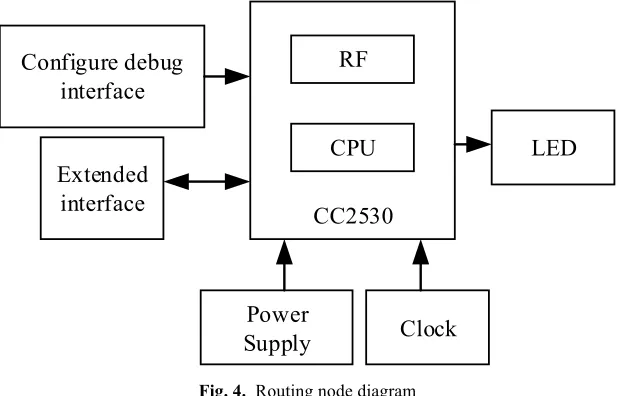
The data transmission network is composed of the routing node and the coordinator node, which is mainly responsible for receiving the data packets sent by the acquisi-tion node and make routing of the data packets, and transmit to the coordinator [7]. Routing node does not need to communicate with the PC machine, and the hardware part does not contain the serial part. The routing node block diagram is shown in figure 4.
CC2530
RF
CPU
Configure debug
interface
Extended
interface
Power
Supply
Clock
LED
Fig. 4. Routing node diagram
The main function of the coordinator node is to launch the ZigBee wireless net-work, and receive the data sent by terminal acquisition node and routing node. It real-izes the data aggregation and PC serial communication in the system, comparatively simple in the hardware structure. The coordinator node diagram is shown in figure 5.
CC2530 RF
CPU Configure debug
interface
Extended interface
Power
Supply Clock
LED UART machinePC
3.3 System software design
The software development environment of this system is IAR Embedded Work-bench. IAR EW developed by IAR System is a powerful integrated development environment software, well received by the industry. As a software development platform, it can meet the needs of different users, and in allusion to different chip architectures, it has also developed corresponding different versions. This paper in-troduces the software design of coordinator node and terminal node in details.
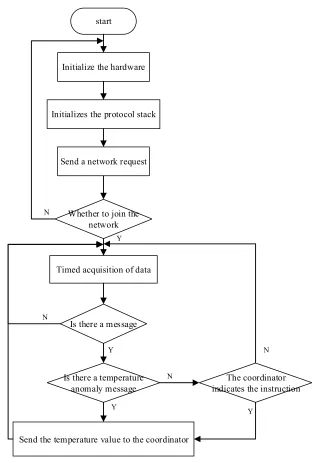
In this system, the coordinator is responsible for the establishment of the network, data aggregation and serial communication with the host computer. The design uses non-beacon mode network, and the network channel uses the default configuration values in the f8wConfig.cfg file. After the coordinator is powered on, it does not re-quire a network scan channel. When the coordinator constructs a network, it selects a random PANID, and after obtaining PANID, the new network starts running. After the coordinator constructs a network, it sends beacon frames to the nearby ZigBee device node by way of broadcasting in the network, and then enters the state of wire-less monitoring [8]. After powering on of routing node and terminal acquisition node, it will firstly send a beacon request for searching network, and then receive the re-sponse from a coordinator, to send network request. After receiving allowance answer of a coordinator, it can join the network. At the same time, the coordinator takes it as the child node, to join its neighbor table, and assign a 16-bit full network unique short network address. The coordinator, after constructing the network, has been in the listening state, whether the nodes join and leave, whether it receives instruction in-formation sent from the serial port, whether it receives the temperature data infor-mation uploaded by the terminal acquisition node or routing relay node, and it makes the appropriate treatment according to the information types.
start
Initialize the hardware
Initializes the protocol stack
Send a network request
Whether to join the network
Timed acquisition of data
Is there a message
Is there a temperature anomaly message
Send the temperature value to the coordinator
The coordinator indicates the instruction
N
Y
N
Y
Y Y
N
N
Fig. 6. Working flow chart of terminal acquisition node
4
Experiment
4.1 Experiment process
In the ZigBee wireless sensor network communication function test, the tools needed to be used are the hardware device CC2531 USB Dongle, or CC Debuger (simulation download) connected to the CC2530-EB development board. The soft-ware tool is Texas Instruments Packet Sniffer, IEEE802.15.4/ZigBee protocol type, then it can capture ZigBee wireless data packet in the environment, and understand the working conditions of ZigBee network through the analysis of the data packet. In the upper computer, input acquisition commands and observe the host computer inter-face.
In the test of the system function, simultaneous test of the timing acquisition and traditional thermometer is used. When the temperature is normal, there is no feedback in the system; when the temperature exceeds the preset limit, the red light on the ter-minal acquisition module is flashing, and uploading the data of body temperature. When testing the timing acquisition, the time interval can be adjusted smaller, and similarly, use the method of simultaneous test of the traditional thermometer.
Instruction mode specific test methods are as follows:
The 3 terminal acquisition nodes are placed on the wrist of the 3 subjects, and then 3 subjects are arranged in two rooms. The coordinator is placed in the room with the resettlement of 2 subjects, and the routing node is placed in the room with the reset-tlement of q subject, so as to ensure the packet transmission. The normal body tem-perature range is set at 36 degrees C ~37 C, to test body temtem-perature every ten minutes.
4.2 Experimental results and discussion
The test results of the communication function of the ZigBee wireless sensor net-work show that the receiving interface on the computer can display the temperature data uploaded by the terminal node, which indicates that the system operates normal-ly, and has a good communication function.
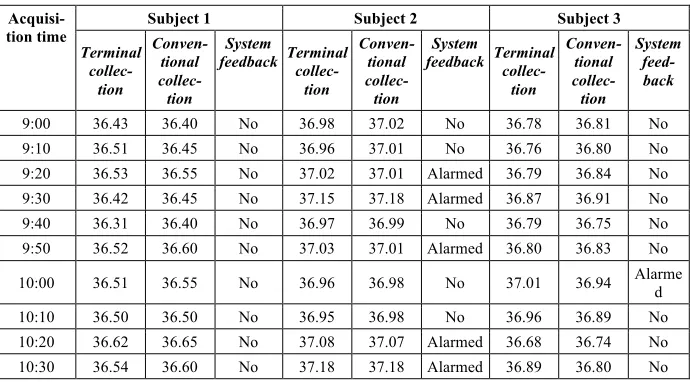
Table 1. System function test results
Acquisi-tion time Subject 1 Subject 2 Subject 3
Terminal collec-tion Conven-tional collec-tion System
feedback Terminal collec-tion Conven-tional collec-tion System
feedback Terminal collec-tion Conven-tional collec-tion System feed-back
9:00 36.43 36.40 No 36.98 37.02 No 36.78 36.81 No 9:10 36.51 36.45 No 36.96 37.01 No 36.76 36.80 No 9:20 36.53 36.55 No 37.02 37.01 Alarmed 36.79 36.84 No 9:30 36.42 36.45 No 37.15 37.18 Alarmed 36.87 36.91 No 9:40 36.31 36.40 No 36.97 36.99 No 36.79 36.75 No 9:50 36.52 36.60 No 37.03 37.01 Alarmed 36.80 36.83 No 10:00 36.51 36.55 No 36.96 36.98 No 37.01 36.94 Alarmed 10:10 36.50 36.50 No 36.95 36.98 No 36.96 36.89 No 10:20 36.62 36.65 No 37.08 37.07 Alarmed 36.68 36.74 No 10:30 36.54 36.60 No 37.18 37.18 Alarmed 36.89 36.80 No
As can be seen from table 1, the system sends out an alarm when the collected temperature exceeds the preset range.
The designed patient's body temperature acquisition system based on ZigBee wire-less network is small, and has low energy consumption, easy for patients to wear, and the accuracy of temperature acquisition is high, suitable for being promoted in large-scale hospitals with a large number of patients.
5
Conclusion
In this paper, the temperature monitoring system based on ZigBee technology is in-troduced from the aspects of system hardware and software implementation, and the terminal acquisition node is optimized in terms of miniaturization and low power consumption. The experimental results show that the system can meet the needs of measurement accuracy, and make real-time monitoring of patients in a large scale, which can be widely applied in clinical physiological signal measurement.
6
References
[1] Chang, K., Lee, J., Jun, C. H., & Chung, H. (2016). Acquisition of a series of temperature-varied sample spectra to induce characteristic structural changes of components and selec-tion of target-descriptive variables among them for multivariate analysis to improve accu-racy. Applied Spectroscopy Reviews, 51(7-9), 718-734. https://doi.org/10.1080/0570 4928.2016.1167069
Charac-teristics: A Population-Based Study. infection control & hospital epidemiology, 37(08), 946-953. https://doi.org/10.1017/ice.2016.89
[3] Kalpakis, K., Dasgupta, K., & Namjoshi, P. (2014). Efficient algorithms for maximum lifetime data gathering and aggregation in wireless sensor networks. Computer Networks, 42(6), 697-716. https://doi.org/10.1016/S1389-1286(03)00212-3
[4] Shirazi, S. S. (2015). Energy Efficient Hierarchical Cluster-Based Routing for Wireless Sensor Networks. International Conference of Advanced Computer Science & Information Technology (pp.61-69). https://doi.org/10.5121/csit.2015.51207
[5] Song, J. L., Cheng, W. L., Xu, Z. M., Yuan, S., & Liu, M. H. (2016). Study on PID tem-perature control performance of a novel PTC material with room temtem-perature Curie point. International Journal of Heat and Mass Transfer, 95, 1038-1046. https://doi.org/10.1016/ j.ijheatmasstransfer.2015.12.057
[6] Thomson, M. C., Mason, S. J., Phindela, T., & Connor, S. J. (2016). Use of rainfall and sea surface temperature monitoring for malaria early warning system in botswana. American Journal of Tropical Medicine & Hygiene, 73(1), 214-221.
[7] Wang, B., Wang, X., Chen, X., Hou, L., Xie, W., & Pan, M. (2016). Acquisition of opti-mal operating temperature for epitaxial Si: P blocked-impurity-band detector based on temperature-dependent characteristics investigation. Optical and Quantum Electronics, 48(2), 1-8.
[8] Watson, J., Kavanagh, S., & Nugent, S. (2016). High Precision Analog Multiplexers Ena-ble Multi-Channel Data Acquisition in High Temperature Environments. Additional Pa-pers and Presentations, 2016(HiTEC), 000035-000039.
7
Author
Huijie Ding is with the College of Information & Engineering of The Open Uni-versity of Guangdong, Guangdong, China ([email protected]).