Iranian journal of educational Sociology
(Interdisciplinary Journal of Education)Available online at: http://www.iase-idje.ir/ Volume 1, Number 10, December 2018
The study of the effectiveness of teaching philosophy in the
form of a loop and exploring the working memory of blind students
Zeynab Hashemzadeh1, Hayedeh Saberi 2, Shahrbanoo Aali3
1. Graduate Doctorate of Educational Psychology, Department of Psychology, Rudehen Branch, Islamic Azad University, Rudehen, Iran.
2. Assistant Professor of Psychology, Rudehen Branch, Islamic Azad University, Rudehen, Iran 3. Assistant Professor of Ferdowsi University of Mashhad
Article history:
Received date: 10 April 2018 Review date: 23 May 2018 Accepted date:11 July 2018
Abstract
Introduction: The main goal of the philosophy education program is to create intellectual challenges for students, which plays an important role in the ability of cognitive skills. Methodology: The present study was conducted to examine the effectiveness of teaching philosophy in the form of a curriculum on the working memory of elementary school students in Mashhad in the academic year 1391-1396. Twenty-eight female and female students were voluntarily selected and randomly divided into two groups: control and Experiments were conducted. Then all the participants responded to the Wechsler memory test. The research method was experimental and pre-test and post-test design with control group. Then, the classroom method was used in a circle method with the help of the stories of Sharp Lepman and Robert Fisher. Seven training sessions were conducted for the experimental group and the control group was performed on the waiting list They were. After completing the training sessions again, "all participants responded to the Wechsler memory test. To test the hypotheses, the covariance analysis method was used. Findings: The results showed a significant difference in the working memory of the experimental group. Therefore, it seems that training with Slow-hole technique can have a positive effect on the blindness of blind children. Conclusion: The workload of the motor-driven motor is in many complex cognitive activities requiring hard-coded controlled processing. Encourages the use of high-level cognitive skills in students, and this can be done Depending on the workload, it is related to work memory.
Keywords:
working memory, philosophy for children, blind, students
Please cite this article as: Hashemzadeh. Z,Saberi H, Aali SH. (2018). The study of the effectiveness of teaching philosophy in the form of a loop and exploring the working memory of blind students, Iranian journal of educational Sociology. 1(10),
171-180.
Corresponding Author Email: [email protected]
1. Introduction
A systematic study of class discourse has begun since 1960 in the United Kingdom, when studies have focused on the fact that teachers talk more than students in the classroom and questions that are not freely asked by students (Alexander, 2004). Further studies have warned that teacher-centered discussions often provide students with a summary of responses, answer questions are often questioned, teacher lectures are not enough to challenge students themselves, and questions in the classroom of Students are not in need of high cognitive levels, experiencing independent discussions and problem solving for students at the lowest level. The human cognitive system has evolved as a tool for dealing with the Bajarian overflow of information. For example, we only understand a fraction of the electromagnetic spectrum or sound waves. Our momentary awareness of the content is very limited. This is a feature of mind and minds. Cognitive psychologists want to discover these limitations in humans. One of the first reasons for this short-term memory limitation is mentioned. Short-term memory is limited in time and the duration of data retention (Graska, 2016).
Today, the concept of short-term memory has been replaced with working memory, the work memory was first introduced in 1960 by Miller, Galandre and Preibaram, and then developed by Bally and Hitach in 1974. The working memory is a multidimensional and active system for storing and processing information. Initially, the working memory model included a monitoring control center and two-unit storage systems: Phonological Circuit, Visual Space Circuit. The visual sighting system maintains spatial visual information and functions the phonological circuit of the storage and processing of verbal components. These two sub-systems operate under the control of the central system (Badlie and Hitach, 1974). The central executive system is predicted as a control structure in relation to the ability to pay attention, the responsibility for manipulating data in working memory and controlling the two other systems. Another part called the event tank was later added to this model, which plays a role in the call of information from long-term memory (Bedli 2000). Studies conducted confirm the phonological role of speech in the understanding, production and processing of speech and language (Ansor et al., 2011).
In recent years, I have been keen on developing the thinking skills and raising the level of reasoning and intellectual creativity in the world education system. One of these programs, which has been reviewed and reviewed, is the Philosophy for Children program. The program seeks to make students philosophical thinking using philosophical thinking and be able to reasonably and logically analyze and address issues with a comprehensive approach. Learning children requires a rich environment and they usually learn through all their senses. What they see, what they hear, what they are touching, what they are seeing provides all the experiences for better learning. Now, the question arises: If a child does not have one of these senses, is his learning inevitable? Is not there a way to teach him? Therefore, the main aim of the present research is to examine the effectiveness of teaching philosophy in a loop way and to explore the working memory of blind students. According to the studies, the author of the research, which directly examines the effectiveness of teaching philosophy on working memory, has not been carried out, and in the field of teaching philosophy and work memory, there has been a separate research on the blind, some of which are: Germic (2011) It is important that the curriculum for the teaching of philosophy in the form of a circle can be applied to the blind according to their particular circumstances, and the learning of thinking skills for blind children is important. Research results (2014) show that the application of teaching philosophy to Blind children have a lot to do with creativity and discernment than ordinary children They are effective. Research has shown that philosophy education in the form of a circle is ineffective in questioning and attitudes toward creativity, critical thinking, research skills and creative thinking, and judgment of blind students (Akrami et al. 1394, Talei, 2012).
Javadi and Soheili (2014) in an article on the comparative study of mental and memory imaging in blind and sighted children. The results of their research showed a common pattern for the more effective behavior
and reaction of blind children in the environment, and showed that the values of logical memory, verbal association and mental control of blind children showed higher performance. Major Manghesh and Abdollahi studied the mental imagery and visual memory in children. The results showed that children are more attentive to visual symptoms, and children transmit information from short-term memory to long-term memory using vision ciphers. Have better performance than sighted children. Also, there was no significant difference between the two groups in the forward scale. Pourali et al. (2011) studied the different dimensions of verbal working memory in three groups of blind, low and normal students. The results showed that the blind had higher mean scores than the other groups in different dimensions of working memory. In spite of the number of cultivars, the difference was statistically significant between the cultivars directly and the cultivars. Also, the results of this study showed that the low- Digitization of the cultivars has a higher ability than direct visually impaired students. Narimani and Bashardost (2007) investigated the comparison of some of the memory components of blind and visually impaired students. The results showed that blind subjects experienced logical memory, mental control, and word association better performance than the visual group, there were no differences between the two groups for forward and reverse repeat tests. The present research responds to the question of whether learning the philosophy in a circle can affect the working memory of blind and middle school students?
2. Methodology
This quasi-experimental study was conducted with a pretest-posttest with a control group. Statistical population, sample and method of sampling: The statistical population of the study is all blind and blind boys and girls in Mashhad city in the academic year of 1995-96. The sample consisted of 24 blind students, all of whom were studying at grades three to six. Considering that the experimental work requires the participation of the participants for intervention, in the first stage, the sample was voluntarily taken and at the next stage, each sample member was randomly assigned to the experimental group and the control group. First, the Wechsler memory test of the child's version at the stage A pre-test was conducted in the form of interviews and verbally. Subsequently, 7 sessions of philosophical education were conducted in a circular manner. The duration of each session was 30 to 45. Then, in the post-test, again, the Wechsler memory test was performed on the two groups. Wechsler Memory Test: The Wechsler Memory Test, which is used as an objective measure for memory evaluation, results in ten years of practical, simple, and immediate memory research, and provides information for distinguishing between functional and functional memory impairments.
Advantages of using this scale, which last for an average of 15 minutes, are standardized at the satisfaction level. 2. Pay attention to the memory difference of the various types. 3. The memory gain (MQ) that it obtains is partially comparable to that of the subject. With this test, you can generally learn and remember the immediate focus of 4-focus and attention to orientation and long-term memory. The Memory Scale and Kessler (Form A) include 7 sub-tests: awareness of everyday and personal issues, awareness of time and place (orientation), mental control, logical memory, repetition of reciprocal and inverse counts, visual memory, and learning of associations. Be Credibility: Based on the internal consistency of all 11 age groups: total score (0.96), verbal scale (94%) and non-verbal scale (0.90). Based on the validity of the review: general scale (0.95) The verbal scale (0.93) and the non-verbal scale (0.90) of this revelation were within a month. In a 2-year interval proved to be more reliable. Measurement error was for general scale (3.19), verbal scale (3.60) and verbal scale (4.66). The highest error was for memory counts and the least error for word treasures. The validity of the revised version of the children's (WISC-R) test correlation with the fourth revision of Stanford Binet (0.78), Pupil's academic achievement (0.71) has been reported. Cronbach's alpha for the whole test and each exam Were 0.86, 0.72, 0.80, and 0.81, respectively. Intervention method: The method of implementation of this program was first performed by the test and
control group under Wechsler's memory test, and then applied the program to the loop and Kaveh Bardiehdard was further measured by a Wechsler memory test. In this study, the Kwu-style training was organized in seven 45-minute sessions and for two and a half months in joint sessions with girls and boys.
Table1.Outline in training sessions
Intervention program meeting
introduction and familiarization with students and introductory explanations regarding the next session as well as pre-test implementation
First
presents a number of challenging questions second
story of goodness in evil and evil in good. The discussion of questions with questions like what a sign in the story shows that young farmer loves horses?
Third
story of Freedom argued with questions like: Why did Tel declare the bow to his hat? fourth
story of a mischief discusses questions such as: Where do you detect someone bad? fifth
story relates the discussion with questions such as: If two things are connected, does that mean they need to be connected?
sixth
Summarize and Continue Loop and Explore and Run Post Test Seventh
3. Findings
Participants' demographic information was as follows: In the two experimental groups of 12, 4 were boys and 2 were Deckhoor, in two control groups, 4 were male and 2 were female. Also, the mean age of the adherents in the experimental and control groups was 10.83 and 10.42, respectively. Also, in the experimental group, in the experimental group, 4 were in the third grade, 2 in the fourth, 4 in the fifth and the second in the sixth, and in the control group, 4 in the third, 3 in the fourth, 3 in the fifth and 2 in the sixth attendance
Table2. Mean, standard deviation and Shapiro-Wilk index of memory components (personal awareness, orientation,
mental control, logical memory, numerical memory, associations) in two groups in two stages: pre-test and post-test Memory Statistic index
time pretest posttest Pe rsona l aw ar ene ss Experimental group M 50 / 3 00 / 5 S 90 / 0 85 / 0 S_W 62 / 0 ( sig ) ( (sig 81 / 0 Control group M 66 / 3 08 / 3 S 15 / 1 24 / 1
Shapiro & vilkes Sig) ) 85 / 0 ( NS ) 93 / 0 D ir ection Experimental group M 25 / 3 50 / 4 S 86 / 0 67 / 0
Shapiro & vilkes ( NS ) 88 / 0 ( sig ) 73 / 0 Control group M 91 / 3 75 / 3 S 90 / 0 96 / 0
Shapiro & vilkes ( NS ) 86 / 0 ( NS ) 89 / 0 Me nt al con trol Experimental group M 16 / 5 25 / 7 S 52 / 1 21 / 1
Shapiro & vilkes ( NS ) 95 / 0 ( NS ) 94 / 0 Control group M 08 / 5 91 / 4 S 37 / 1 44 / 1
Shapiro & vilkes ( NS ) 92 / 0 ( NS ) 92 / 0 Log ica l m em or y Experimental group M 91 / 9 41 / 11 S 42 / 4 96 / 3
Shapiro & vilkes ( NS ) 88 / 0 ( NS ) 93 / 0 Control group M 66 / 8 25 / 9
S 11 / 3 86 / 2
Shapiro & vilkes ( NS ) 94 / 0 ( NS ) 90 / 0 num er al m em or y Experimental group M 50 / 10 00 / 11 S 19 / 2 17 / 2
Shapiro & vilkes Sig) ) 71 / 0 (sig) 85 / 0 Control group M 16 / 9 00 / 9 S 64 / 1 70 / 1
Shapiro & vilkes ( NS ) 94 / 0 ( NS ) 89 / 0 associa tio ns Experimental group M 75 / 17 45 / 18 S 94 / 1 72 / 1
Shapiro & vilkes ( NS ) 89 / 0 ( NS ) 94 / 0 Control group M 79 / 15 75 / 15 S 28 / 2 56 / 2
Shapiro & vilkes ( NS ) 95 / 0 ( NS ) 92 / 0 Me m or y (tot al scor e) Experimental group M 08 / 50 62 / 57 S 94 / 5 60 / 5
Shapiro & vilkes ( NS ) 94 / 0 ( NS ) 95 / 0 Control group M 29 / 46 75 / 45 S 91 / 4 22 / 6
Shapiro & vilkes ( NS ) 93 / 0 ( NS ) 87 / 0
As seen in Table 2, the pre-test scores of personal knowledge for the experimental group (p = 0.001, F = 0.62) and control group (p = 0.04, F = 0.85), pre-test scores Numerical memory for the experimental group (p = 0.001, F = 0.71), post-test scores, personal awareness for the experimental group (p = 0.01, F = 0.81), post-test orientation scores for the experimental group P = 0.002, p = 0.73) and numerical memory post-test scores for the experimental group (p = 0.04, F = 0.85) are far from normal distribution. However, the deviation from the normal distribution is not so severe and therefore it can be expected that this deviation from the normal distribution of the results of the research will not be affected. In Table 1, the assumption is that the normal distribution of data for each of the memory components in each of the groups is evaluated. In this section, the assumption of the independence of the pre-test variables from the group membership variable and the equality of the variance of the variables of the pre-test variables in the experimental group and the control group were investigated. Multivariate covariance analysis requires testing the independence of dependent variables (memory components) in the pre-test stage from the independent variable of the group. Multivariate analysis of variance (MANOVA) was used for this purpose. Before applying the analysis of variance, the homogeneity assumption of the covariance matrices of the variables observed by the "M. Box was evaluated and it was found that the observed covariance matrices were statistically homogeneous in groups (F = 0.77, F = 0.77, M Box's = 25.23). On the other hand, the result of Bartlett's twist test with a degree of freedom of 20, at a significant level of 0.001 was 64.32. This result shows that there is an acceptable level of correlation between dependent variables and so MANOVA is a suitable method for comparing memory components in two groups of research. After assuring the assumptions, pre-test data were analyzed using multivariate analysis of variance and the results of the analysis showed that F value was not significant at the level of 0.05 (Wilcoxle lambda = 0.64, 2 = 0.35, 0.05) / 0 <P, 55/1 = (17 and 6) F). Based on this analysis, it has been concluded that the memory components in the pre-test stage are not significantly different between the two test and control groups and the assumption of the independent variance of the pre-test from the group membership variable is among the data of the present study. B) Test of variance of variance of pre-test variables in the group. To test the equality of error variances, the pre-test scores of memory components were used in the test and control groups. Table 2 shows the results of the Loon test.
Table 3. Levine test on the equality of error variances
As can be seen in the table above, the variance of memory component errors including personal awareness, navigation, mental control, logical memory, numerical memory and associations in the two groups do not differ significantly. Therefore, the assumption of the equality of error variances in the two groups is established between the pre-test data. C) Homogeneity test of pre-test and post-test regression line in two groups. The following shows the results of the homogeneity test of the pre-test and post-test regression line slope in the test and control group.
Table 4. Comparison of regression line slope between pre and post variables of memory components in experimental and
control groups
significance F
mean square error Average squared variable 58 / 0 59 / 0 50 / 1 89 / 0 Personal awareness 44 / 0 97 / 0 73 / 0 71 / 0 To navigation 56 / 0 65 / 0 53 / 1 99 / 0 Mental control 12 / 0 19 / 3 63 / 7 40 / 24 Logical memory 69 / 0 38 / 0 73 / 2 06 / 1 Numerical memory 52 / 0 74 / 0 83 / 5 32 / 4 Associations
As shown in the table 4, the line difference between the pre-test and the post-test in the experimental and control group is not significant for any of the memory components. The hypothesis affects the teaching of philosophy in a slow-moving way and explores the philosophy of the loop and examines memory (personal awareness, navigation, mental control, logical memory, numerical memory, and association of blind students).
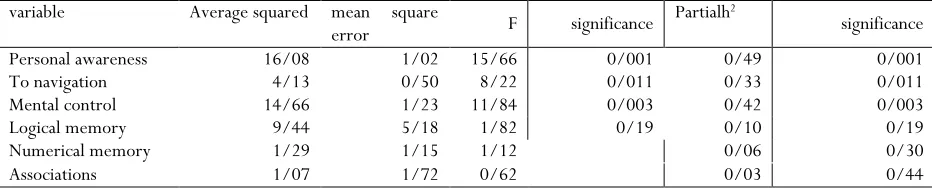
To test this hypothesis, covariance analysis was performed. An analysis of the homogeneity assumption of variance of covariance by the "M. Box "showed that the observed covariance matrices of the dependent variables were not the same between the two experimental and control groups (P = 0.05, F = 0.93, Box's M = 28). On the other hand, the result of the Bartlett Sprite test with a degree of freedom was 20 at a significant level of 0.05-0.22. This result shows that there is an acceptable level of correlation between dependent variables. Therefore, MANCOVA is a suitable method for comparing independent variable effects in this study. Due to the insignificance of the "M. Box ", among the four statistics (Pillow, Wilkes Lambda, Hutchling and Root), the Wilkes Lambda statistic was selected to report the F value. The results of multivariate analysis of covariance using Wilkes Lambdaan analysis showed that the linear combination of dependent variables (personal awareness, navigation, mental control, logical memory, numerical memory and associations) was significantly different in the control and control group (p> 0.05) P, 43/3 = (11 and 6) F, 34/0 = Wilkes Lambda, 65/0 = 2partialh). This means that the implementation of an independent variable at least in one of the levels of the dependent variable causes a significant difference in the experimental and control groups. For this reason, one-way covariance analysis was used to understand the effect of the independent variable on each level of the dependent variable. Table 4 shows the results of one-dimensional covariance analysis in comparison of memory components in test and control groups.
Sig F 1 df 2 df Variables 14 / 0 31 / 2 1 22 Personal awareness 86 / 0 03 / 0 1 22 To navigation 77 / 0 08 / 0 1 22 Mental control 09 / 0 05 / 3 Logical memory 34 / 0 93 / 0 1 22 Numerical memory 65 / 0 21 / 0 1 22 Associations
Table 5. One-way covariance analysis in comparison of memory components in experimental and control groups significance Partialh2
significance F
mean square error Average squared variable 001 / 0 49 / 0 001 / 0 66 / 15 02 / 1 08 / 16 Personal awareness 011 / 0 33 / 0 011 / 0 22 / 8 50 / 0 13 / 4 To navigation 003 / 0 42 / 0 003 / 0 84 / 11 23 / 1 66 / 14 Mental control 19 / 0 10 / 0 19 / 0 82 / 1 18 / 5 44 / 9 Logical memory 30 / 0 06 / 0 12 / 1 15 / 1 29 / 1 Numerical memory 44 / 0 03 / 0 62 / 0 72 / 1 07 / 1 Associations
Based on the results of the table 5, the research hypothesis has been tested as follows: Based on the results of the above table, the implementation of the independent variable caused the personal knowledge component (P <0.001, 15.66 = (16 and 1) F), orientation (P <0.05, F = 22.28) and mental control (P
<0.01, F = 11.14 = F). It should be noted that Table 4 shows the Eta squared (2η) for each variable. The
quotient of ETA means that a few percent of the variance of the variable dependent on the implementation of the independent variable is explained. For example, the oddity of the component of personal awareness is 0.49, which means that approximately 49 percent of the variance of personal awareness is explained by the implementation of an independent variable. Further, considering that the group variable had a level in its present research, therefore, for evaluating the differences, a benfroni post hoc test was used. It should be noted that due to the insignificant value of F for the logic memory component, numerical memory and association, It was concluded that the implementation of independent variables did not result in a significant change in these components from memory. For this reason, these components have not been studied in Ben Fronian's table.
Table 6. Benfrown test results in assessing the difference between moderated modulus of memory components
Variable / group Test group - control group
Personal awareness SE =0/51 ،∆x =̄ -2/03 001 / 0 = p
To navigation SE =0/36 ،∆x =̄ -1/03 011 / 0 = p
Mental control SE =0/56 ،∆x =̄ -1/94 003 / 0 = p
Table 6 shows the results of Bonferroni post hoc test in comparing the difference between moderated averages of memory components in both experimental and control groups. As can be seen, the difference
between the adjusted meanings in the self-awareness component (p <0.001 and SE = 0.05 = 0.03 = Δxδ),
orientation (p <0.05 and 0.36) = SE, 03 / 1- = Δx̄) and mental control (p <0.01 and SE = 0.56, 94 / 1-
= Δxδ) are significant. Since previously the results of single-variable covariance analysis showed that some
of the memory components (logical memory, numerical memory, and associations) were not affected by the implementation of the independent variable, so in the second hypothesis test it was concluded that the implementation of the independent variable (Philosophical education in the style of loop), compared with the control group, has improved the component of personal awareness, orientation and mental control at a meaningful level.
4. Conclusion
. The purpose of the present study was to investigate the effectiveness of teaching philosophy in a slow-moving circle and to explore the memory of blind students. Based on the results of statistical analysis, there were significant differences between the control group and the control group in the three components of personal awareness, orientation, and mental control, namely, teaching philosophy in a loop manner and
increasing the scores of the three components in the experimental group. The review of the researches has shown that the success of the philosophy program for children in improving the reasoning skills (Talei, 1391), (World, 2007); research skills (Talei, 2012), (Jafari, 2012), critical thinking skills (Talei, 2012) (Tabataba'i and Mousavi, 2011), creative thinking skills (Talei, 1391), (Naderi et al., 2012), (Attar, 2011), the growth of moral judgment (Marashi et al., 2010), (Khazami, 2009) and skills Self-awareness, self-confidence, emotional control and conflict resolution (Ramadanpour, 2008). The power of reasoning, power, judgment, self-confidence, emotional control (Naji, 2008, A, and B). But according to the studies, the author of the study, which specifically studies the effect of teaching philosophy in a circle way, does not find the memory of the blind.
The Philosophy for Children program is a generalized approach to dialogue, and conversation is also used as a teaching tool for Socrates. In a slow cycle, students listen with special attention (respect) to speech, add to each other's thoughts, question each other in order to provide reasons for other unconfirmed and indissoluble ideas. They help each other. To extract the results and materials of the said material, as well as to identify and clarify each other's assumptions. A loop stretches out and tries to continue until it reaches the conclusion, not as much as the boundary line of curriculum.
The work memory refers to the hypothetical cognitive system that is responsible for access to information in the process of cognitive processing. Working memory is considered to be the mental stimulus used in many of the complex cognitive activities requiring controlled cognitive processing (Broadway, Redokoanal, 2010). Evolutionary psychologists recognize the language and behavior of subject relations as derivatives of working memory. Reading and listening to lectures is not just an understanding of the flow of separate words, but of understanding the meaning between them. The ability of working memory to play an important role in language understanding (Justco Carpenter, 1980). However, work memory capacity is often considered as a constant attribute, many studies have recently suggested that it can be improved with proper training (Klingberg 2010). In 2010, Klingberg examined studies on working memory training, and said that the training was effective between 30% and 40%. In addition, Kleinberg (2010) reviewed neuropsychiatric imaging data on working memory training, which indicated that activity in the prefrontal cortex has increased (the work memory center), and in this area communication has been strengthened, and the relationship between The prefrontal cortex has also been strengthened. However, some scholars question this optimistic view of improving work memory (Unhumans, 2010). Congenital blind children are likely to show a unique profile when verbal auditory skills are adapted to abnormal growth, this alignment probably clarifies the memory components and, on the other hand, how sensory inputs affect the memory process It specifies. The verbal memory skills have not been fully addressed in the blind population. When a person is deprived of a sense of humor, he will use his best endeavors to find a way to compensate for his lack. In this context, other senses are strengthened and they try to compensate for the lack of other senses. For example, blind children try to compensate for their lack of sense of sight by using their auditory senses (Akrami et al., 1394). The research results of Narimani and Bashardost (2007) show that the motivation to compensate for visual impairment is counterbalanced by mental creativity and student endeavors.
Efforts have been made to transform the educational methods of the blind in the present era, including those made by the researcher Nilsson on the blind. Nielson believes that past active learning methods that only guided and guided children through getting their hands or just listened to the reins. In many cases it has failed and not only has not led to the growth of the child, but has also become a barrier to growth and a factor of growth retardation (Nilsson, 2005). Nilsson's approach to learning the active philosophy, he believes, if the blind child He has the opportunity to explore, test, and think. He can learn basic skills. Therefore, the Philosophy of Children program is effective in raising the awareness of blind children and enriching cognitive and executive actions and their memory. In summary, the results of Narimani and Bashardost (2007) have shown that blind people are more capable of being compared with those of the sight in tasks that require listening, attention and concentration, and the need for more acquiring skills. Since the
philosophy training program has been able to make a dramatic change in the attitude of ordinary children, the potential of this program can also be used to boost the talents of the blind. The implementation of the Philosophy Program for Special and Extreme Children has no obstacles and can not be ruled out (Bernie Feer, 2011). It also seeks out how to engage in unbiased thinking, rationality, critical thinking, creative thinking, attention, and democracy. has it. The existence of such a community in this program is important for blind children (Lipman, 2007). The application of the philosophy-style curriculum enhances the power of thought, cognitive and metacognitive skills, mental imagery, enhancement of audiological sense, and the improvement of critical and creative thinking in blind students (Pring and Tadic, 2010). Little research has been done in the field of teaching philosophy to blind children, and more research is needed with practical results regarding the use of this method in schools and blind rehabilitation centers and the familiarity of educators with this method. In addition, the study of the philosophy of philosophy can be considered in the context of the study circle in relation to other exceptional children.
References
Akrami L, Qamarani A, Agarel p. (2015). Investigating the Effectiveness of Learning Philosophy in a Circle Method and Investigating Questionnaires and Attitudes toward Creativity in the Students of the Blind. Cognitive Sciences Quarterly. Alexander R. (2004). Towards dialogic teaching. Cambridge, England: Dialogos.
Amy u, Faramarz Gharmaleki A. (2005). Comparison of Lippmann and Bernie Beer Styles in Children's Philosophy. Religious thought and motivation (Vol. 2, pp. 47e90). New York: Academic Press.
Attar Sh. (2011). The Effect of Teaching Philosophy on Children on Problem Solving Skills and Creativity of Third-Year Students of Hamedan Middle School in the academic year of 2010-2011. Master's Thesis, Faculty of Humanities, Payame Noor University of Tehran.
Baddeley A D. (2000). The episodic buffer: A new component of working memory? Baddeley A D, Hitch G J. (1974). Working memory. In The psychology of learning. Brenifier O. (2011). P4C blind Children', alcofrib@club-internet.
Broadway J M, Redick T S, Engle R W. (2010). Working memory capacity: Self-control capacity and training. Nature Reviews Neuroscience, 17(7), 438e449.
Constantinidis C, Klingberg T. (2016). The neuroscience of working memory control in society, mind, and brain (pp. 163e173). Oxford University Press.
Garemic m. (2011). P4c for blind children. Prof. [email protected].
Global c. (2007). Investigating the Impact of the Philosophy Education Program on Children's Growth in Students' Ethical Implications. Quarterly Journal Studies Program, 2 (7: 3-9).
Great Mannish A, Abdullahi M. (2011). Study of the Effectiveness of Visual Memory Function and Verbal Memory in Students. Journal of Psychology.
Grisham JR, Henry J D, Williams A D, Bailey Ph E. (2010). Socimotional deficit associated with obsessive-compulsive symptomatology. Psychiatry Research, 175, P: 256-259.
Gruszka A, orzechowski J. (2016). Meta- analysis of the research impact of Baddeley's multicomponent working memory model and Cowan's embedded processes model working memory: A bibliometric maping approach. Polish Psychological Bulletin, 47(1), 1e11.
Hajji Seyyed Javadi N, And soheilie c. (2015). Comparative study of mental imaging and memory in children. International Conference, 27-2.
Khazami p. (2009). Investigating the Effect of Philosophy Education by Research Method on the Growth of Ethical Judgment of Primary School Students in Ahvaz City. Master's thesis, Faculty of Education and Psychology, Shahid Chamran University of Ahvaz
Hayhoe s. (2014). Does philosophy disable? The epistemological model of disability, and the influence of the process of knowledge construction and people with impairments, school of childhood studies and education times, Canterbury thirst church university / centre of the philosophy of natural & social science, Landen school of ecumenical & political science, UK. Jafari Z. (2012). The Effect of Teaching Philosophy on Children on the Development of the Students' Spirituality in Preschool
Children. Master of Science in Education and Psychology Faculty of Alzahra University.
Marashi M, Safaei Moghadam M,Khazami p. (2000). Investigating the Effect of the Implementation of the Philosophy Education Program for Children in a Socio-Methodological Approach to the Students of the Early Childhood Seminary of Ahwaz. Thinking and Child, Institute of Humanities and Cultural Studies, 1 (1): 83- 102.
Mashhadi AS (2012). The theory of mind A new approach to evolutionary psychology. New Developments in Cognitive Science, Vol. 5, No. 3, 71-82.
Naderi A, Taklinia A, Shariatmadari AS, Saif Naraghi M. (2012). The Effect of Implementation of Philosophy Program for Children on Creativity Development in First Grade Secondary School Students in District 14 of Tehran. Thinking and child, Institute of Humanities and Cultural Studies, 3 (1): 91-117.
Naji Q. (2008 A). Philanthropic for children and adolescents. Tehran: Institute of Humanities and Cultural Studies.
Naji Q. (2008: B). A look at new ways to enhance research and research capability. At the Conference on Development and Technology in Iran, Mr. Golshani, M. Tehran, Iran: Institute of Humanities and Cultural Studies.
Narimani M, Bashardost S. (2007). Comparing some of the components of working memory in some blind students New York: Holt.
Nielsen L. (2005). Nielson's active learning philosophy for children Who are blind, WWW.National db.org. Owen, A. M., Hampshire, A., Grahn, J. A., Stenton, R., Dajani, S., Burns, A. S., et al.
Pourali Z, Saif Naraghi, M., Kazemi, F. (1390). A Study on Comparison of Working Memory in Female and Male Students of Nibina, Deir Bina, and Bin of Mashhad in 2011. Master of Science, Allameh Tabatabaei University.
Pring,Tadic (2010). Are language and social communication intact in children with congenital visual imparment school at age.J child Psychol psychiatry, 51 (6), 696-705.
Ramezanpour, Shiva (2008). The effect of socio-educational method of teaching philosophy on the elementary school children on the development of their citizenship skills. Master's Degree in Philosophy of Education, University of Tehran.Sciences, 14(7), 317e324.
Tabatabai, z and Mousavi, M. (2011). The Impact of the Philosophy Program for Children on Questioning and Critical Thinking of Students in the Third to the Fifth Elementary Schools. Alavi Elementary School, Varamin City, Scientific-Specialty Thinking and Childhood, (3): 73-90.
Talei, S. (2012). The Effect of Teaching Philosophy on Children on the Development of Basic Skills. Graduate Course, Faculty of Psychology and Educational Sciences, Islamic Azad University, Tehran Branch. Trends in Cognitive Sciences, 4(11), 417e423. Unsworth N, Spillers G J, Brewer G A. (2011). Variation in verbal fluency: A latent variable analysis of clustering, switching, and
overall performance. The Quartile Journal of experimental Psychology, 64(3),447.