Corresponding author: Allameh Tabataba‟i University, Tehran, Iran Email address: zia_ [email protected]
L2 Teachers’ Explicit and Implicit Corrective Feedback and Its Linguistic Focus
Servat Shirkhani, Zia Tajeddin*
Ph.D. Candidate of TEFL, Department of English, Science and Research Branch, Islamic Azad University, Tehran
Allameh Tabataba’i University
Abstract
Various studies have confirmed the influential role of corrective feedback (CF) in the development of different linguistic skills and components. However, little, if any, research has been conducted on comparing types of linguistic errors treated by teachers through CF. To bridge this gap, this study sought to investigate the linguistic errors addressed and the types of CF provided by teachers. To this end, the classes of 40 teachers teaching at the intermediate level were audio-recorded for two successive sessions. The detailed analysis of around 128 hours of classroom interactions showed that explicit correction was the most frequent CF type, accounting for 48.5 percent of all CF types provided, and recast was the second most frequently used CF type, constituting 29.5 percent of all CF types. All the other CF types (i.e. request for clarification, confirmation check, repetition, metalinguistic feedback, elicitation, and multiple feedback) constituted 22 percent of the CF. Repetition was the least frequently used CF type, amounting to 0.66 percent of the CF given by teachers. As to the linguistic focus of CF, pronunciation errors were found to be the mostly noticed target for teachers‟ CF, constituting 47 percent of all errors addressed, while vocabulary was the least frequently addressed linguistic target, accounting for 17.5 percent of all errors. The study suggests that teachers prefer explicit corrective strategies over implicit ones and that they provide CF mainly to correct pronunciations errors. The study suggests that there is a need for change in the types of CF teachers use and the relative attention they assign to different linguistic error types they treat through CF.
Keywords: Corrective feedback; Explicit correction; Implicit correction; Linguistic feedback; Recast; Types of feedback
Article Information:
Received: 10August 2015 Revised: 17 December 2015 Accepted: 2 January 2016
1. Introduction
Corrective feedback (CF) has been defined as any response to learner utterances containing error (Ellis, 2006) which is intended to correct the learner‟s erroneous utterance. CF has been the focus of a variety of second language acquisition (SLA) studies. However, most of these studies have centered on the influence of CF on language development (e.g. Carroll & Swain, 1993; Lyster, 2004; Trahey & White, 1993) or have compared the impacts of different CF strategies on language learning (e.g. Ammar & Spada, 2006; Ellis, Loewen, & Erlam, 2006; Lyster, 2004; Sheen, 2007; Yang & Lyster, 2010). Although a number of studies (Ellis, Basturkmen, & Loewen 2001; Lyster & Mori 2006; Lyster & Ranta 1997; Sheen, 2004) have focused on the distribution of CF types in English as a foreign language (EFL) language teaching classrooms, these studies have been based on short-term observations. The average number of hours examined in 12 studies cited by Lyster, Saito, and Sato (2013) was 16.5 hours. Furthermore, there is a paucity of research in relation to the types of errors addressed by teachers. However, studying the targets of CF can have implications for language teaching because CF targets can influence the feedback uptake and indicate teachers‟ preferences or ability for correcting certain types of errors. Therefore, the present study aimed to explore the way EFL teachers treat various linguistic error types in their classes at the intermediate level. It focused on the types of CF and the CF targets in a large corpus consisting of 128 hours of class recordings.
2. Review of the Related Literature
2.1. Types and targets of corrective feedback
CF has been referred to as one of the most powerful factors influencing learners‟ achievement (Hattie & Timperely, 2007). Long (1996) and White (1990) stress the importance of CF, also referred to as negative evidence, asserting that positive evidence is not sufficient for L2 acquisition. In addition, the use of CF in language teaching has a strong foundation in a number of SLA theories, including Swain‟s (1985, 1995) Output Hypothesis, Schmidt‟s (1990, 1995) Noticing Hypothesis, Long‟s (1983, 1996) Interaction Hypothesis, and connectionist models of language learning (N. Ellis, 2006). CF can address various aspects of language. It has been
discussed as an important issue leading to the development of different linguistic components. CF has proved effective in improving learners‟ writing skill (Ellis, 1999; Ellis, 2006; Yaakub, 2005, as cited in Al Harrasi, 2007), vocabulary (Ellis, 2006), grammar (Long, 1983), and comprehension (Ellis, 2006; Hyland, 1998; Reid, 1993).
CF can be written or oral. As Ellis (2009) mentions, written CF has been usually classified as direct, indirect, and metalinguistic CF, while oral CF can be provided through a variety of strategies. Lyster and Ranta (1997) identified six different types of oral CF: request for clarification, recast, repetition, metalinguistic feedback, elicitation, and explicit correction. Request for clarification elicits a reformulation of the preceding utterance by indicating to students that their utterance has either been misunderstood by the teacher or is ill-formed in some way (Spada & Fröhlich, 1995, as cited in Ellis, 2008). Recast involves the teacher‟s rephrasing of the student‟s utterance by changing one or more components without changing the central meaning (Ellis, 2008). Repetition refers to the teacher‟s repetition of the student‟s erroneous utterance highlighting the error mostly through intonation. Metalinguistic feedback contains comments, information, or questions related to the form of the student‟s utterance, without explicitly providing the correct form. Metalinguistic comments generally indicate that there is an error somewhere but, through these comments, the teacher attempts to elicit the information from the student. Elicitation, according to Lyster and Ranta (1997), refers to the techniques that teachers use to directly elicit the correct form from the student. Explicit correction refers to the explicit provision of the correct form. While providing the correct form, the teacher clearly indicates that the student has made an error. In addition to the preceding feedback types, in their analysis, Lyster and Ranta (1997) identified a seventh category called multiple feedback, which referred to combinations of more than one type of CF in one teacher turn.
Ranta and Lyster (2007) classified the six CF types identified by Lyster and Ranta (1997) into two broad CF categories: reformulations and prompts. Reformulations refer to the CF types that supply learners with correct
reformulations of their errors. They thus include recasts and explicit correction. Prompts include all other CF types that push learners to repair their own errors, that is elicitation, metalinguistic feedback, request for clarification, and repetition. In fact, reformulations and prompts are other terms for input-providing and output-prompting CF. Besides this classification, CF types have been categorized into explicit and implicit strategies. Ellis (2009) has presented a taxonomy of CF types, an adaptation of which is provided in Table 1.
Table 1
Taxonomy of CF strategies (Adapted from Ellis, 2009)
Explicit Implicit
Input-providing explicit correction confirmation check recast
Output-prompting metalinguistic feedback elicitation
request for clarification repetition
2.2. Research on corrective feedback
Little research has investigated the proportions of CF and/or the targets of CF. The most comprehensive study in this regard is the meta-analysis by Brown (2014), who studied proportions of CF types given by teachers and the linguistic targets of the CF. Findings showed that recast was the most frequent CF strategy, accounting for 57 percent of all CF, while prompts constituted 30 percent of all CF types. Moreover, the results indicated that grammar errors received the highest percentage of CF (43%). In another study, Panova and Lyster (2002) examined the proportions of CF types as well as the amount of learner uptake. They found recasts and translation (which are implicit types of input-providing CF) as the most frequently used CF types.
A number of other studies on CF have investigated the features of CF. Sheen (2006) studied the relationship between the features of recasts and learner uptake. She found significant relationships between uptake and features such as length of recasts (short vs. long), the linguistic focus (pronunciation vs. grammar), and the type of change (substitution vs. addition). Associations were further found between
repair and features of recasts like mode (declarative vs. interrogative), the use of reduction (partial recasts), and the number of changes (one vs. multiple).
Some other studies have investigated the role of context in determining the frequency and distribution of CF or its effectiveness. Van Lier (1988), for instance, showed that the type of CF is a reflection of the nature of the context created jointly by the teacher and the learners in the classroom. Moreover, Sheen (2004) studied the variation in patterns of CF and learner uptake in communicative classrooms across four instructional settings (i.e. Canada immersion, Canada ESL, New Zealand ESL, and Korea EFL). She found significant differences in the types of CF used in different contexts. Lyster and Mori (2006) examined the amount of uptake in two contexts: French immersion in Canada and Japanese immersion in Japan. They showed that the amount of uptake following recasts differs noticeably across instructional settings. Llinares and Lyster (2014) studied the role of context in defining the frequency and distribution of different types of CF (i.e. recasts, prompts, and explicit correction) and learner uptake. The results showed no significant influence of context on the proportion of the three types of CF provided by teachers, but they revealed differences in rates of repair after recasts, prompts, and explicit correction. In his meta-analysis, Brown (2014) referred to a number of contextual and methodological factors, including learners‟ proficiency level, teachers‟ experience, and second/foreign language instructional contexts, which may impact the teachers‟ choice of CF strategies in different teaching contexts. Further differences in amounts of uptake across settings have been reported by Lyster (1998) and Oliver and Mackey (2003).
Whereas a large number of studies have been carried out in relation to CF, most of them have been concerned with either the necessity of CF in developing some aspects of language (e.g. Trahey & White, 1993) or the effectiveness of CF in language classrooms (e.g. Carroll & Swain, 1993; Li, 2010; Lyster, 2004) or have focused on examining the effects of either implicit versus explicit CF (e.g. Ellis, Loewen, & Erlam, 2006; Sheen, 2007) or input-providing versus output-prompting CF (e.g. Ammar & Spada, 2006; Lyster, 2004; Yang & Lyster, 2010). A few
studies have investigated the CF strategies used by teachers (e.g. Lyster & Ranta, 1997) and the relationship between certain types of CF and learner uptake (Esmaeili & Behnam, 2014; Lyster & Mori, 2006). However, the review of studies on CF suggests that little research has explored types of errors mostly addressed by teachers (e.g. Brown, 2014). This study, thus, sought to fill the gap through investigating patterns of CF provided by EFL teachers. It focused on the linguistic errors addressed by teachers and the type of CF provided. In line with the purpose of the study, two questions were posed:
1. What types of CF are used by Iranian EFL teachers teaching in language institutes?
2. What linguistic aspects are addressed as the targets of CF used by Iranian EFL teachers teaching in language institutes?
3. Method 3.1. Participants
Teachers from four language institutes agreed to participate in the study. On the whole, 45 teachers teaching English as a foreign language at the intermediate level in these four institutes were selected as participants of this study. The classes of the selected teachers were then audio-recorded for two sessions. During the recording process, five of the teachers were removed from the pool of participants because they felt uncomfortable with being recorded. As a result, 40 teachers constituted the main participants of the study. The 40 teachers‟age ranges were between 19 to 35 years old with the mean of 26 and their teaching experience varied from 1 to 10 years with a mean of 4 years. Thirty-two of the participants were female and eight were male. Twenty teachers were English majors (11 with a B.A. degree and 9 with an M.A. degree) and 20 were non-English majors with B.A. and M.A. degrees.
3.2. Data analysis
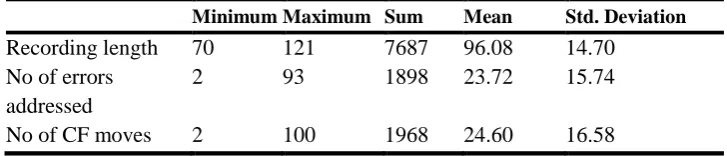
As noted earlier, based on agreements on the part of the teachers and institute directors, two sessions of 40 teachers‟ classes were audio-recorded. The class lengths ranged from 70 minutes to 121 minutes and the average class duration was
around 96 minutes. The whole database comprised 128.12 hours (i.e. 7,687 minutes) of class recordings (see Table 2). When the classes were recorded, a detailed description of CF moves in the audio-recorded materials for each teacher was prepared. In providing the description, the CF moves taken by the teachers were located first and then for each of those cases, the types of error being corrected and the type of CF given were determined.
The collected data were analyzed for the frequency of linguistic aspects being corrected and types of CF. In categorizing data, the three linguistic aspects identified by Lyster and Ranta (1997) as the probable targets of CF were considered as the three foci of CF. The linguistic aspects included grammar, vocabulary, and pronunciation. Moreover, eight categories were defined for CF types: request for clarification, confirmation check, recast, repetition, metalinguistic feedback, elicitation, explicit correction, and multiple feedback. Descriptive statistics for types of CF and types of errors were calculated for the first and the second research questions, respectively.
4.Results
To answer the research questions of the study, an overall 128.12 hours (i.e. 7,687 minutes) of class sessions were recorded. During this time, 1,898 errors were addressed by the participating teachers. The number of errors in each session ranged from 2 to 93 and the average was estimated as 24 errors in each session. For the most part, each error received one type of CF. Nonetheless, there were cases in which the teacher provided more than one type of CF for the errors, with each CF type in one distinct move. So, on the whole, 1,968 CF moves were provided by the teachers (see Table 2).
Table 2
Descriptive statistics for recording length and number of errors and CFs
Minimum Maximum Sum Mean Std. Deviation
Recording length 70 121 7687 96.08 14.70
No of errors addressed
2 93 1898 23.72 15.74
No of CF moves 2 100 1968 24.60 16.58
4.1. Types of corrective feedback
The purpose of the first research question was to explore the types of CF used by EFL teachers teaching in language institutes. To this end, descriptive statistics for the types of CF were calculated. As shown in Table 3, the most frequently used CF type was explicit correction, which was used 953 times (i.e. 48.5% of all CF types provided). In fact, the mean of using explicit correction was around 12 times in each session. The second most frequently used CF type was recast, which occurred 580 times (constituting 29.5% of all CF types). The teachers used it about 7 times in each session. All the other CF types, thus, constituted about 22 percent of the CF given by the teachers, and each of them was used less than 2 times on average in each session. The least frequent CF was repetition, constituting 0.66 percent of all the CF and occurring once in almost every six sessions on average (the frequency in each session was 0.16).
Table 3
Descriptive Statistics for Types of CF N Minimu
m
Maxim um
Su m
Perce nt
Mea n
Std. Deviation Request for
clarification 80 0 3 40 2.03 .50 .84 Confirmation
check 80 0 4 39 1.98 .49 .89
Recast 80 0 25 580 29.47 7.2
5 6.54
Repetition 80 0 4 13 .66 .16 .59
Metalinguistic 80 0 11 121 6.14 1.5 1 2.33
Elicitation 80 0 15 141 7.16 1.7
6 2.88 Explicit
correction 80 0 62 953 48.42
11.
91 10.56
Multiple feedback 80 0 15 81 4.12 1.0 1 2.06
No of CF moves 2 100 196
8
100 24. 60
16.58
Figure 1 presents the types of CF.
Figure 1. Types of CF
To see whether the frequencies of CF types were significantly different from their expected frequencies, a chi-square goodness-of-fit test was run. As Table 4 shows, explicit correction, recast, and repetition were the three CF strategies with the greatest differences in their observed and expected frequencies. Based on the table, explicit correction and recast occurred noticeably more than expected, while repetition was employed much less than expected. The result of the chi-square test (Table 5) indicated significant differences between the observed and expected frequencies for types of CF, X2(7, n= 1968) = 3271.8, p = .000.
Table 4
Observed and expected frequencies for types of CF Observed N Expected N Residual Request for
clarification 40 246.0 -206.0
Confirmation check 39 246.0 -207.0
Recast 580 246.0 334.0
Repetition 13 246.0 -233.0
Metalinguistic
feedback 121 246.0 -125.0
Elicitation 141 246.0 -105.0
Explicit correction 953 246.0 707.0
Multiple feedback 81 246.0 -165.0
Total 1968
Table 5
Chi-square test for types of CF CF
Chi-Square 3271.764a
df 7
Asymp. Sig. .000
a. 0 cells (0.0%) have expected frequencies less than 5. The minimum expected cell frequency is 246.0.
To clarify the nature of each CF type, samples of the CF types taken from the data of this study are presented in Table 6.
Table 6 Examples of CF types
CF Type Example
Request for clarification
Student They should pay attention to natural.
Teacher Pay attention to what? Confirmation check Student I think it’s very quite.
Teacher Is it quiet?
Recast Student Nowadays people can call their children and know /nаս/ about them
Teacher They can call their children and know /nǝս/ about them.
Repetition Student They want to cut people.
Teacher To cut people?!
Metalinguistic feedback
Student It may be fun, perfect, wonderful, boring, shy,
Teacher Shy for place?
Elicitation Student In the past, people had to do … make, make some fire.
Teacher People …?
Student Had to made fire.
Teacher Had to …?
Student Make.
CF Type Example
Explicit correction Student He listens and gives some advices.
Teacher Not advices, some advice.
Multiple feedback Student Yes, he does.
Teacher Yes …? … Yes, she does.
More than one CF type
Student They received me an email.
Teacher No, YOU received an email.
Student I received?! They received.
Teacher They sent you. YOU received.
4.2. The focus of CF
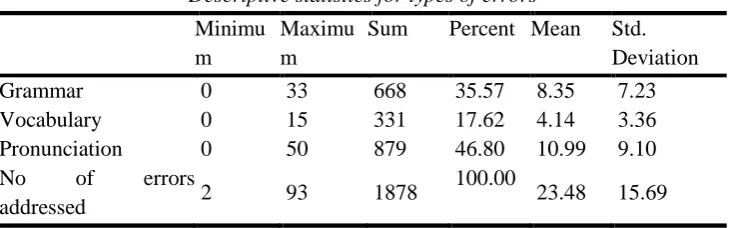
The second research question addressed aspects of the language which were the targets of CF used by EFL teachers. To answer this question, the descriptive analysis of data for highlighting the linguistic focus of the errors was addressed. At first, all the CFs given were identified, as described in the previous section. Next, the focus of errors addressed by these CFs was specified. A small number of errors addressed by the teachers (1%) dealt with the appropriateness of the language use. These errors were considered as pragmatic errors and were not included in data analysis. All the other errors focused on the linguistic accuracy of the language used by learners and were taken as linguistic errors. As pointed out earlier, the linguistic aspects which encompassed CF by the teacher were categorized into grammar, vocabulary, and pronunciation based on the three components of oral language on which any corrective act may focus. These are the categories used in Lyster and Ranta‟s (1997) seminal study. Analysis of the related data indicated that
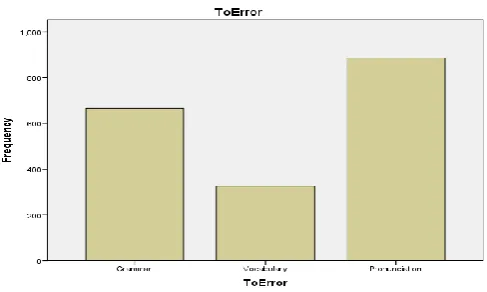
pronunciation received the most and vocabulary the least amount of attention (see Table 7). As manifested in Table 5, 46.80 percent of the noticed errors were related to pronunciation, 17.62 percent to vocabulary, and 35.57 percent to grammar. Regarding the mean of the errors addressed in each session, on average, around 23 errors were addressed in each session, out of which nearly 11 were pronunciation, about 8 were grammar, and about 4 were vocabulary. Comparison of the three figures related to the three foci of CF shows that pronunciations errors receiving CF were 1.3 times as frequent as errors of grammar and 2.7 times as frequent as errors of vocabulary.
Table 7
Descriptive statistics for types of errors Minimu
m
Maximu m
Sum Percent Mean Std. Deviation
Grammar 0 33 668 35.57 8.35 7.23
Vocabulary 0 15 331 17.62 4.14 3.36
Pronunciation 0 50 879 46.80 10.99 9.10
No of errors
addressed 2 93 1878
100.00
23.48 15.69
A clear picture of the relative attention given to the three linguistic aspects is presented in Figure 2.
Figure 2. Types of errors
In order to examine the significance of the differences between the frequencies of the types of errors and their expected frequencies, a chi-square goodness-of-fit test was run. As shown in Table 8, the frequencies for vocabulary and pronunciation were noticeably different from their expected frequencies while the number of grammatical errors receiving CF was close the expected frequency for this error type. Based on the table, errors of pronunciation were treated more than expected, while errors of vocabulary were addressed greatly less than expected. According to the result of the chi-square test (Table 9), there were significant differences between the observed and expected frequencies for types of errors being treated through CF, X2(2, n= 1878) = 244.1, p = .000.
Table 8
Observed and expected frequencies for types of errors Observed N Expected N Residual
Grammar 668 626.0 42.0
Vocabulary 331 626.0 -295.0
Pronunciation 879 626.0 253.0
Total 1878
Table 9
Chi-square test for types of error Linguistic Errors
Chi-Square 244.086a
df 2
Asymp. Sig. .000
a. 0 cells (0.0%) have expected frequencies less than 5. The minimum expected cell frequency is 626.0.
To add to the clarity of the issue, samples of linguistic error types taken from the data of this study are presented in Table 10.
Table 10 Examples of error types
Error Type Example
Grammar Student It has modern TV. Teacher It has a modern TV.
Student Yes, it has a modern TV and there’s a dining table there.
Vocabulary Student He worked as a paint of the house. Teacher Painter
Student Yes
Pronunciation It is smaller than an ocean/ ˈəʊʃiæn/. /ˈəʊʃən/, it’s /ˈəʊʃən/, /ˈəʊʃən/
5. Discussion
The focus of this study was on the patterns of CF in intermediate EFL classrooms. It examined the linguistic errors addressed by the teacher and the focus of CF provided.
As for the types of CF the teachers used, the results showed that explicit correction was the most frequently used CF strategy and that recast was the second most preferred strategy. Based on Ranta and Lyster‟s (2007) classification of the CF types into reformulations and prompts, it can be seen that reformulation is the category receiving the higher frequency (about 78%) in the two categories. In other words, teachers mostly use CF types that supply learners with correct reformulations of their errors. Only about 22 percent of CFs were prompts, which push learners to repair their own errors. Interestingly, the results are in line with those reported by Panova and Lyster (2002). Comparing reformulation strategies with prompts, Panova and Lyster came up with 79 percent for reformulation strategies and 21 percent for prompts.
Regarding the comparison of explicit correction and recast, the results of the present study showed a great difference between the frequency with which explicit correction and recast were used: explicit correction was used more than 1.5 times as much as recast was used. This can be regarded as a positive point since, as Llinares and Lyster (2014) reported, many CF-related studies have found that in classroom contexts, explicit CF is more effective than implicit CF. Nonetheless, the result of this part is in opposition with a number of research findings (e.g. Esmaeili & Behnam, 2014; Lyster & Mori, 2006; Lyster & Ranta, 1997; Seedhouse, 1997). Lyster and Ranta‟s (1997) examination of the CF strategies used by teachers in French immersion classrooms in Canada showed that recast was the most frequent CF type teachers used. Moreover, Seedhouse (1997) reported that teachers generally used mitigated, indirect forms of correction such as recasts more than more direct forms of explicit correction. According to Lyster and Mori (2006), relevant research emphasizes recast as the most frequent CF type in various classroom settings. They reported that, in immersion classrooms, prompts are the
second most frequent CF type, while explicit correction is relatively infrequent. Like the three above studies, the examination of CF types in language classrooms by Esmaeili and Behnam (2014) confirmed the preference for recast in treating learners‟ errors. With regard to repetition as the least frequently occurring CF type, the result contradicts Seedhouse‟s (1997) conclusion that teachers prefer indirect correction strategies over more direct strategies. Furthermore, the finding indicates the teachers‟ tendency to provide the correct forms rather than trying to elicit them from the learners.
The discrepancies between the results of this study and others can be attributed to factors like the instructional context. A few studies (e.g. Seedhouse, 2004; van Lier, 1988) have investigated CF types across contexts and reported considerable variation in the ways teachers respond to learners‟ errors. Seedhouse (2004) argued that the type of repair depends on the focus of the instruction which may be on either fluency or accuracy. Sheen (2004) studied the CF types in four teaching contexts and reported significant differences in the types of CF used in the four contexts. Contradictory results regarding the influence of context were reported by Llinares and Lyster (2014). The results of their comparison of patterns of CF and uptake across contexts indicated that recasts, prompts, and explicit correction were used in similar proportions, with recast being the most frequent CF type and explicit correction being the least frequent type.
With regard to the linguistic focus of CF, it was found that the highest proportion of CF turns addressed pronunciation errors and the least CF was given in response to vocabulary errors. Pronunciation errors constituted around 47 percent of all errors addressed by the teachers. They were being corrected around 1.3 times more than grammatical errors and 2.7 times more than vocabulary. Only few studies have compared the proportions of error types treated through CF. A further problem is that even these few studies have not used the same categorizations of errors. For instance, Kubota (1991) compared teachers‟ attention to local and global errors. Apparently, except Brown (2014), no researcher has compared the linguistic aspects as the focus of CF. The result of this study runs counter to Brown‟s (2014) finding that grammar accounts for a great percentage of all errors receiving CF. The result further contrasts the finding by Ellis,
Basturkmen, and Loewen (2001). In their analysis of 12 hours of adult English as a second language (ESL) task-based lessons, consisting of 448 focus-on-form episodes, they found that a noticeably large percentage of focus-on-form episodes addressed vocabulary in comparison with grammar and pronunciation. Thus, the results lend support to the findings (e.g. by Llinares & Lyster, 2014; Seedhouse, 2004; Sheen, 2004; Van Lier, 1988) that there is considerable variation across instructional context in the ways teachers respond to the learners‟ errors. There may be a difference in the proportion of errors occurring in EFL and ESL contexts and the treated errors may be proportionate to the errors made in each context.
As mentioned above, the study revealed that a large proportion of CFs (around 47%) were focused on pronunciation errors, while only about 17.5 percent of all CFs focused on vocabulary. However, at this point, there is no cogent account for the great difference between the frequencies of the two linguistic aspects. This difference can be related to the goal of language teaching in the instructional setting, that is, language institutes. The priority in these contexts is the development of oral fluency, which may make teachers give more weight to pronunciation errors than to other error types. Other possible accounts are the particular concerns that the teachers have for pronunciation errors, more saliency of pronunciation errors, or the higher occurrence of this error type in EFL classes.
In sum, the findings of the present study corroborate the findings by Panova and Lyster (2002) that reformulation strategies are used considerably more than prompts. The results, however, challenge the experimentally supported view that recasts constitute the most frequently used CF strategy in classroom settings. Regarding the focus of CF, the study revealed that a large proportion of CF focuses on pronunciation while vocabulary is the least addressed linguistic aspect of CF. However, the results of this study are not fully consistent with other similar studies. In fact, as Sheen and Ellis (2011) maintained, the inconsistency in teachers‟ handling of errors is due to the complexity of CF. Additionally, some experimental studies have revealed that variations exist in the distribution and frequency of CF types across instructional settings (e.g. Lyster & Mori, 2006; Sheen, 2004).
6. Conclusion
This study pursued two purposes. First, it compared the frequency of various types of CF. In this regard, the findings contradict the widely supported view (e.g. by Esmaeili & Behnam, 2014; Lyster & Mori, 2006; Lyster & Ranta, 1997; Seedhouse, 1997) in the literature in that recast is the most frequent CF strategy as in this study, the occurrence of explicit correction was significantly higher than recast and other CF strategies. Nonetheless, the findings of this part are in conformity with the results of the study by Panova and Lyster (2002), which showed that in treating EFL learners‟ errors, reformulation strategies occur noticeably more than prompts. This finding suggests that teachers should be given more awareness on the need to help learners assume responsibility for correcting their own errors. The findings further suggest that teachers may need to act more flexibly in using various CF strategies. Lyster, Saito, and Sato (2013) recommended that teachers choose CF types according to factors such as linguistic targets, learners‟ level, and the classroom orientation. Thus, as Ellis (2012) argued, looking for the most effective CF type might be a mistake and “the single „best‟ strategy may be a chimera” (p. 263).
The second concern of the study was to examine the types of linguistic error treated by the teachers. The study revealed that a large proportion of CFs (around 47%) focus on pronunciation errors, while only about 17.5 percent of all CFs address vocabulary. Due to the scarcity of studies focusing on the linguistic targets of CF, interpretation of the teachers‟ CF behavior in this regard is not easy. The result of this part, however, implies the need for further studies looking for the why of teachers‟ differential attention to one over the other linguistic aspects of language. Like the choice of CF strategies, making choices on the type of errors to correct demands teachers‟ attention to the particular instructional context which involves learner characteristics and instructional objectives.
Specifically related to the Iranian EFL context, the results imply that language teachers should provide learners with more output-prompting CF strategies. The first reason is that in the EFL context, learners do not have sufficient opportunities that push them toward production; therefore, teachers can provide such opportunities through making their learners aware of their errors but leaving the
task of correction to the learners themselves. The second reason is that, as the results of this study show, the teachers‟ provision of input-providing strategies is not proportionate to all the CF strategies. However, as Lyster and Ranta (1997) suggested, teachers should not rely only on one corrective strategy but provide learners with a wide range of CF types they have access to.
A number of limitations in this study should be noted. First, this study did not include true randomization of participants due to accessibility problems as some teachers were not willing to have their teaching sessions recorded. Second, individual differences among language teachers were not considered although they may influence the teachers‟ feedback behavior in the classroom. Third, the data of the study were in the audio format only; therefore, they did not provide the researchers with information about the teachers‟ use of paralinguistic feedback while this strategy can be part of some teachers‟ CF behavior. Moreover, this study examined the corrective behavior of EFL teachers teaching at intermediate levels. Thus, it would be worthwhile to study teachers‟ handling of errors in elementary and advanced levels and examine the likely variation of CF patterns in relation to course levels. Finally, considering the existence of variations in the distribution and frequency of CF types across instructional settings, it would be important to study the role of setting, foreign language versus second language, in the distribution and effectiveness of CF types.
7. References
Al-Harassi, S. (2007). An analysis of the nature of oral corrective feedback types (in particular recasts) used by Omani teachers in Cycle One and Cycle Two English basic education classroom, and their effects on learners' immediate response. Unpublished MA thesis, University of Stirling, UK.
Ammar, A., & Spada, N. (2006). One size fits all? Recasts, prompts, and L2 learning. Studies in Second Language Acquisition, 28(4), 543-574.
Brown, D. (2014). The type and linguistic foci of oral corrective feedback in the L2 classroom: A meta-analysis. Language Teaching Research. Retrieved
January 2016, from http://booksc.org/s/?q=The+type+and+linguistic+foci+of+oral+corrective+f eedback+in+the+L2+classroom%3A+A+meta-analysis&t=0
Carroll, S., & Swain, M. (1993). Explicit and implicit negative feedback: An empirical study of the learning of linguistic generalizations. Studies in Second Language Acquisition, 15(3), 357-386.
Ellis, N. C. (2006). Cognitive perspectives on SLA: The Associative-Cognitive CREED. AILA Review, 19(1), 100-121.
Ellis, R. (1999). Second language acquisition. New York: Oxford University Press. Ellis, R. (2006). Researching the effects of form-focused instruction on L2
acquisition. In K. Bardovi-Harlig & Z. Dornyei (Eds.), Themes in SLA Research (AILA Review 19, pp. 18-41). Amsterdam: John Benjamins. Ellis, R. (2008). The study of second language acquisition. Oxford: Oxford
University Press.
Ellis, R. (2009). Corrective feedback and teacher development. L2 Journal, 1(1), 3-18.
Ellis, R. (2012). Language teaching research and language pedagogy. Oxford: Wiley Blackwell.
Ellis, R., Basturkmen, H., & Loewen, S. (2001). Preemptive focus on form in the ESL classroom. TESOL Quarterly, 35(3), 407-432.
Ellis, R., Loewen, S., & Erlam, R. (2006). Implicit and explicit corrective feedback and the acquisition of L2 grammar. Studies in Second Language Acquisition, 28(2), 339-368.
Esmaeili, F., & Behnam, B. (2014). A study of corrective feedback and learner's uptake in classroom interactions. International Journal of Applied Linguistics & English Literature, 3(4), Retrieved January 2016, from http://www.journals.aiac.org.au/index.php/IJALEL/article/view/1165/1172 Hattie, J., & Timperley, H. (2007). The power of feedback. Review of Educational
Research, 77(1), 81-112.
Hyland, F. (1998). The impact of teacher written feedback on individual writers. Journal of Second Language Writing, 7(3), 255-286.
Kubota. M. (1991). Corrective feedback by experienced Japanese EFL teachers. Institute for Research in Language Teaching Bulletin, 5, 1-25.
Li, S. (2010). The effectiveness of corrective feedback in SLA: A meta-analysis. Language Learning, 60(2), 309-365.
Llinares, A., & Lyster, R. (2014). The influence of context on patterns of corrective feedback and learner uptake: A comparison of CLIL and immersion classrooms. The Language Learning Journal, 42(2), 181-194.
Long, M. (1983). Native speaker/non-native speaker conversation and the negotiation of comprehensible input. Applied Linguistics, 4(2), 126-141. Long, M. (1996). The role of linguistic environment in second language
acquisition. In W. C. Ritchie & B. K. Bahtia (Eds.), Handbook of second language acquisition (pp. 413-468). New York: Academic Press.
Lyster, R. (1998). Negotiation of form, recasts, and explicit correction in relation to error types and learner repair in immersion classrooms. Language Learning, 48(2), 183-218.
Lyster, R. (2004). Differential effects of prompts and recasts in form-focused instruction. Studies in Second Language Acquisition, 26(3), 399-432. Lyster, R., & Mori, H. (2006). Interactional feedback and instructional
counterbalance. Studies in Second Language Acquisition, 28(2), 269-300. Lyster, R., & Ranta, L. (1997). Corrective feedback and learner uptake:
Negotiation of form in communicative classrooms. Studies in Second Language Acquisition, 19(1), 37-66.
Lyster, R., Saito, K., & Sato, M (2013). Oral corrective feedback in second language classrooms. Language Teaching, 46(1), 1-40.
Oliver, R., & Mackey, A. (2003). Interactional context and feedback in child ESL classrooms. Modern Language Journal, 87(4), 519-533.
Panova, I., & Lyster, R. (2002). Patterns of corrective feedback and uptake in an adult ESL classroom. TESOL Quarterly, 36(4), 573-595.
Ranta, L., & Lyster, R. (2007). A cognitive approach to improving immersion students‟ oral language abilities: The Awareness–Practice–Feedback
sequence. In R. DeKeyser (Ed.), Practice in a second language: Perspectives from applied linguistics and cognitive psychology (pp. 141-160). Cambridge: Cambridge University Press.
Reid, J.M. (1993). Teaching ESL writing. New York: Prentice Hall Regents. Schmidt, R. (1990). The role of consciousness in second language learning.
Applied Linguistics, 11(2), 129-158.
Schmidt, R. W. (1995). Consciousness and foreign language learning: A tutorial in the role of attention and awareness in learning. In R. W. Schmidt (Ed.), Attention and awareness in foreign language learning (pp. 1-63). Honolulu: University of Hawai‟i Press.
Seedhouse, P. (1997). The case of the missing “no‟‟: The relationship between pedagogy and interaction. Language Learning, 47(3), 547-583.
Seedhouse, P. (2004). The Interactional Architecture of the Language Classroom: A Conversation Analysis Perspective. Malden: Blackwell.
Sheen, Y. (2004). Corrective feedback and learner uptake in communicative classrooms across instructional settings. Language Teaching Research, 8(3), 263-300.
Sheen, Y. (2006). Exploring the relationship between characteristics of recasts and learner uptake. Language Teaching Research, 10(4), 361-392.
Sheen, Y. (2007). The effect of focused written corrective feedback and language aptitude on ESL learners‟ acquisition of articles. TESOL Quarterly, 41(2), 255-283.
Sheen, Y., & Ellis, R. (2011). Corrective feedback in language teaching. In E. Hinkel (Ed.), Handbook of research in second language teaching and learning (Volume II, pp. 593-610). New York: Routledge.
Swain, M. (1985). Communicative competence: Some roles of comprehensible input and comprehensible output in its development. In S. Gass & C. Madden (Eds.), Input in second language acquisition (pp. 235-255). Rowley, Mass.: Newbury House.
Swain, M. (1995). Three functions of output in second language learning. In G. Cook & B. Seidlhofer (Eds.), Principles and practice in the study of
language: Studies in honor of H. G. Widdowson (pp. 125-144). Oxford: Oxford University Press.
Trahey, M., & White, L. (1993). Positive evidence and preemption in the second language classroom. Studies in Second Language Acquisition, 15(2), 181-204.
Van Lier, L. (1988). The classroom and the language learner. London: Longman. White, L. (1990). Implications of learnability theories for second language learning
and teaching. In M. A. K. Halliday, J. Gibbons, & H. Nicholas (Eds.), Learning, keeping and using language (pp. 271-286). Amsterdam: John Benjamins.
Yang, Y., & Lyster, R. (2010). Effects of form-focused practice and feedback on Chinese EFL learners‟ acquisition of regular and irregular past tense forms. Studies in Second Language Acquisition, 32(2), 235-263.
Notes on Contributors:
Servat Shirkhani is currently a Ph.D. candidate at Islamic Azad University, Science and Research Branch, Tehran, and a faculty member at Islamic Azad University, Khorram Abad Branch, Khorram Abad. Her areas of interest include pragmatics, language assessment, teacher education, and technology enhanced language instruction.
Zia Tajeddin is Professor of Applied Linguistics at Allameh Tabataba‟i University, Iran. He is the editor-in-chief of Issues in Language Teaching and the founder of Iranian Interlanguage Pragmatics SIG. His research interests include interlanguage pragmatic instruction and assessment, (classroom) discourse analysis, (im)politeness, sociocultural theory, teacher and learner identity and cognition, and ELF/EIL.