DEMOGRAPHIC RESEARCH
VOLUME 30, ARTICLE 10, PAGES 313
332
PUBLISHED 29 JANUARY 2014
http://www.demographic-research.org/Volumes/Vol30/10/ DOI: 10.4054/DemRes.2013.30.10
Research Article
Heterogeneity’s ruses: How hidden variation
affects population trajectories of age-dependent
fecundity in
Drosophila melanogaster
Aziz A. Khazaeli
James W. Curtsinger
© 2014 Aziz A. Khazaeli & James W. Curtsinger.
This open-access work is published under the terms of the Creative Commons Attribution NonCommercial License 2.0 Germany, which permits use, reproduction & distribution in any medium for non-commercial purposes, provided the original author(s) and source are given credit.
1 Introduction 314 1.1 The argument for late-life fecundity plateaus 314
1.2 Counterarguments 315
1.3 Nature of experimental material 315
2 Materials and methods 316
2.1 Wild stocks 316
2.2 Inbred lines 316
2.3 Data analysis and simulation 317
3 Results 317
3.1 Fecundity trajectories 318
3.2 Relative age 325
3.3 Simulation of reproductive senescence 326
3.4 Mixture trajectories 328
3.5 Correlations between survival and reproduction 328
4 Discussion 328
4.1 Conclusions apply to a broad range of Drosophila populations 328 4.2 Positive correlations between life span and reproduction 329 4.3 Importance of observations on individuals 329
Heterogeneity’s ruses:
How hidden variation affects population trajectories of
age-dependent fecundity in
Drosophila melanogaster
Aziz A. Khazaeli1
James W. Curtsinger2
Abstract
BACKGROUND
Progress in understanding senescence requires information about age-dependent changes in individual organisms. However, for experimental systems such as Drosophila melanogaster we usually do not know whether population trajectories are an accurate guide to patterns of individual aging, or are artifacts of population heterogeneity.
OBJECTIVE
In experimental cohorts of D. melanogaster, population trajectories of age-specific fecundity typically plateau in old age. Here we ask whether fecundity plateaus can be explained by hidden heterogeneity in reproductive life spans (RLS).
METHODS
Using published and original data from five experimental populations, we examined fecundity trajectories in subpopulations stratified by RLS, and in total populations with age expressed relative to RLS for each individual fly. We also executed computer simulations of reproductive senescence in which individuals vary in RLS, and show linear decline in fecundity with increasing age.
RESULTS
In subgroups of flies with similar RLS, the senescent decline of fecundity is generally linear. Population trajectories in which age is expressed relative to individual RLS also exhibit linear or slightly accelerated decline. Simulations demonstrate that observed levels of variation in RLS are sufficient to produce plateaus in the mixture trajectories that are very much like those observed in experiments, even though fecundity declines linearly in individuals.
1 College of Biology, University of Minnesota, St. Paul, MN 55108. E-Mail: [email protected]. 2
CONCLUSIONS
Late-life fecundity plateaus in D. melanogaster are artifacts of population heterogeneity in RLS. This conclusion applies to both inbred and outbred populations, and both “wild” and lab-adapted stocks. For reproductive senescence in this model system, population trajectories are not an accurate guide to individual senescence.
1. Introduction
One goal of biodemography is to understand the forces that shape trajectories of survival and reproduction in laboratory populations of experimental organisms. Here we examine original and published life history data from five populations of the fruit fly Drosophila melanogaster. Our objective is to determine whether population trajectories of age-specific fecundity, which plateau late in life, accurately reflect the pattern of reproductive senescence in individual flies, or whether plateaus are artifacts of population heterogeneity.
Examples of population fecundity trajectories are shown in Figure 1. The reproductive chronology starts when females mate, store sperm, and begin laying eggs, one or two days after emergence from the puparium. Flies typically reach peak daily fecundity within the first two weeks of adult life, and then exhibit declining fecundity in old age. At some point in mid- to late-life, the decline moderates and population trajectories inflect upward, producing fecundity plateaus. The plateaus could reflect real biological change in individuals, or they could be an example of heterogeneity’s ruses (Vaupel and Yashin 1985). The alternative explanations are analogous to discussions surrounding mortality plateaus, which are well documented in this species (Curtsinger et al. 1992; Vaupel et al. 1998, Khazaeli, Pletcher, and Curtsinger 1998; Wachter 1999; Drapeau et al. 2000; Service 2000; Curtsinger, Gavrilov, and Gavrilova 2006).
1.1 The argument for late-life fecundity plateaus
reproduction (Rauser et al. 2005a). Subsequent research has led to speculations about the cessation of aging, immortality, and the evolution of life history characteristics that are special to late life (Rose, Rauser, and Mueller 2005; Mueller, Rauser, and Rose 2011).
1.2 Counterarguments
Other analyses are not consistent with the hypothesis that late-life fecundity reaches a plateau. Novoseltsev et al. (2004) analyzed individual fecundity records in D. melanogaster and in Medflies and found evidence for three stages: maturation, followed by a period of high, relatively constant fecundity in the prime of life, and then a long period of senescent decline with no clear break point marking a late-life plateau. Klepsatel et al. (2013a) studied lifetime survival and reproduction in recently collected stocks of D. melanogaster and suggested a four-stage model: maturation to a peak, followed by linear and then exponential decline, and then a post-ovipository period. The specific model that best fit the data was not consistent with late-life fecundity plateaus.
Curtsinger (2013) reanalyzed the data of Rauser et al. (2005a) and found that late-life inflections in the population fecundity trajectories can be explained by a type of population heterogeneity that had not previously been investigated. The argument consisted of three parts. First, in subgroups stratified by reproductive life span (RLS), which is defined for each individual fly as the duration from emergence until the age when the last egg is laid, the decline of fecundity was generally linear with age. Second, pooling data from subgroups with different RLS produced upward inflections in the mixture trajectory. Third, a simulation of the dynamics of reproductive senescence that assumed linear decline of fecundity in individual flies and realistic levels of variation in RLS produced population trajectories that were very similar to those observed in experiments, including the late-life upward inflections. Together the observations establish that late-life fecundity plateaus can be attributed to population heterogeneity in RLS, at least for the data of Rauser et al. (2005a).
1.3 Nature of experimental material
stocks. The analysis of heterogeneity in RLS described above has so far been considered only in outbred, lab-adapted populations.
Here we extend the analysis of heterogeneity in RLS to five additional populations of D. melanogaster with different histories and genetic compositions. These include two inbred populations that differ substantially in average life spans, and three genetically heterogeneous populations studied by Klepsatel et al. (2013a) that have been in laboratory culture for only a few generations. The outbred populations have much greater lifetime fecundity than the inbred populations, and a much steeper fecundity decline in old age. We show that over this wide range of genetic compositions and life history phenotypes, the decline in egg-laying is generally linear or slightly faster, provided that we take account of variation in RLS. Further, we show by simulation that observed levels of variation in RLS are sufficient to explain non-linearities in all five population trajectories.
2. Materials and methods
Analysis of heterogeneity in RLS requires data on the survival and reproduction of individual flies. We employ two sources: recently published data on wild stocks, and new original data on inbred populations.
2.1 Wild stocks
Laboratory populations of D. melanogaster descended from recent collections in Zambia (ZAM), Austria (AUS), and South Africa (SA) were studied by Klepsatel et al. (2013a). The populations have not been maintained in laboratory culture long enough to adapt to laboratory conditions, and are therefore referred to as “wild”. Data consist of complete records of daily egg-laying and survival of individual female flies, as well as additional information about the hatchability of eggs and counts of ovarioles. Archived raw data are published (Klepsatel et al. 2013b), and are also deposited at Dryad: doi:10.5061/dryad.3q332. A total of 486 female flies were studied, and approximately 846,000 eggs were counted.
2.2 Inbred lines
Previous studies employed mass culture techniques. For this investigation, we chose two lines for collection of life history data on individual females. Inbred RI7 is derived from stocks that were artificially selected for long life, and thus has an above-average adult life span, while inbred S9 is derived from an unselected control, and exhibits a more typical life span (Curtsinger and Khazaeli 2002). Stocks were maintained on agar-yeast-cornmeal medium at 24° C under constant illumination and 60-70% relative humidity in a walk-in incubator in the Minnesota laboratory. Experimental cohorts were reared in half-pint bottles under controlled density (100 larvae/bottle). Adult flies of both sexes emerging within a single 24 hour period were collected under light CO2
anesthesia and then housed in 8-dram shell vials with fresh medium while recovering. Individual female flies were placed in 8-dram shell vials with two males. Survival and egg counts were determined daily, starting on day 2 and continuing until the death of each fly. Dead males were replaced as needed to ensure adequate supplies of sperm. Flies were transferred to fresh vials every day. A total of 333 flies produced approximately 214,000 eggs. Raw data for the inbred lines are reported in Supplemental File 1.
2.3 Data analysis and simulation
For statistical analysis we used Systat version 10.2 (Systat Software Inc., Richmond, CA.). Smoothing employs the LOESS algorithm. The coefficient of determination for smoothed curves was calculated using the method of Jacoby (2000). Systat was also used for simulations of reproductive senescence. Command codes for the simulation are given in Supplemental File 2.
3. Results
Table 1: Life history phenotypes in five experimental populations of D. melanogaster. RLS is reproductive life span
Population Females Life span (SD) RLS (SD) Lifetime
Fecundity (SD)
Peak Fecundity
(day)
RI7 192 49.3 (15.0) 42.2 (15.0) 703 (337) 26.4 (12)
S9 143 33.5 (9.5) 30.0 (9.0) 553 (202) 32.3 (8)
ZAM 169 35.0 (12.7) 25.6 (12.1) 1328 (597) 84.3 (7)
SA 134 37.4 (10.2) 29.1 (11.3) 1764 (640) 99.9 (5)
AUS 183 38.0 (8.9) 31.2 (9.9) 2109 (575) 108.3 (3)
3.1 Fecundity trajectories
Population trajectories of average fecundity reached peak levels before day 20, and then declined toward zero in the senescent phase (Figure 1a). To facilitate comparison of populations, standardized fecundity rates were computed by dividing average daily rates by the peak daily rate in each population. Standardized trajectories (Figure 1b) inflect upward between days 20 and 55, depending on the population. The relatively high mid-life fecundity exhibited by RI7 around day 25 reflects age-specific adaptation to artificial selection for late age of reproduction (Khazaeli and Curtsinger 2010).
Figure 1: Trajectories of fecundity in two inbred and three wild outbred populations of D. melanogaster females maintained in single-fly culture
(a) Average daily fecundity per female reaches a peak in early life and then begins to decline to zero.
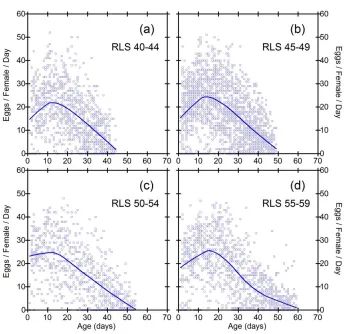
Figure 2: Daily fecundities as a function of age in subgroups of inbred line RI7. Each data point represents the fecundity of one fly on one day
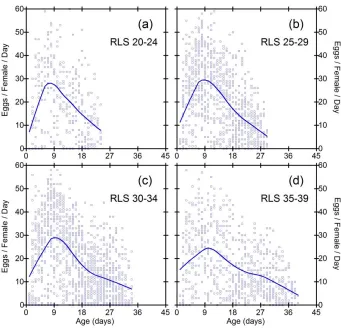
Figure 3: Daily fecundities as a function of age in subgroups of inbred line S9. Each data point represents the fecundity of one fly on one day
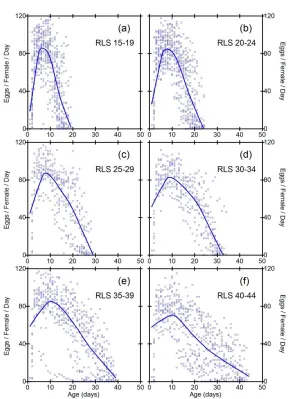
Figure 4: Daily fecundities as a function of age in subgroups of the ZAM wild population. Each data point represents the fecundity of one fly on one day
Figure 5: Daily fecundities as a function of age in subgroups of the SA wild population
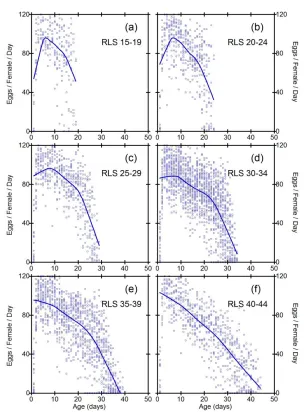
Figure 6: Daily fecundities as a function of age in subgroups of the AUS wild population
3.2 Relative age
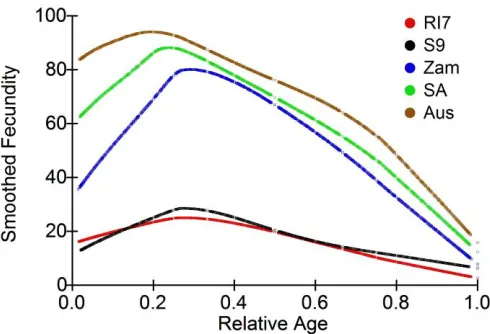
While the general pattern in Figures 2-6 suggests linear decline in subgroups, limitations of this conclusion are that sample size criteria and data binning are somewhat arbitrary, and the method does not make full use of all the available data. It is desirable to employ a method of data analysis that accounts for heterogeneity in RLS, and also uses all the available information. One solution is to standardize the time variable for each fly, such that age is measured as percent of individual RLS. Smoothed trajectories of fecundity as a function of relative ages, shown in Figure 7, suggest linear decline of fecundity. Coefficients of determination for the smoothed curves calculated by the method of Jacoby (2000) range from 0.30 (S9) to 0.46 (SA).
Figure 7: Smoothed fecundities as a function of relative age in five experimental populations of D. melanogaster
For each female fly relative age was calculated as chronological age in days divided by individual RLS. The data comprise complete survival and reproductive records of 821 female flies that produced over one million eggs. R2
ranges from 0.30 (S9) to 0.46 (SA).
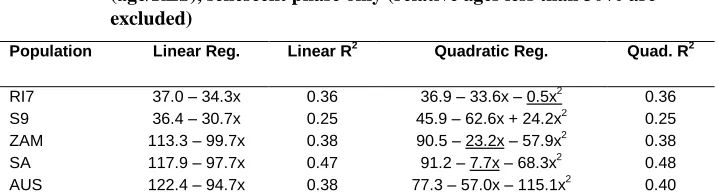
quadratic term has zero or negligible effect on R2. Further, for all three wild populations, the quadratic term is statistically significant and negative, indicating downward inflections that are inconsistent with plateaus. The only statistically significant, positive quadratic term is for inbred S9, and in that case the quadratic regression offers no improvement over the linear model, judging from R2.
Table 2: Linear and quadratic regressions of daily fecundity on relative age (age/RLS), senescent phase only (relative ages less than 30% are excluded)
Population Linear Reg. Linear R2 Quadratic Reg. Quad. R2
RI7 37.0 – 34.3x 0.36 36.9 – 33.6x – 0.5x2 0.36
S9 36.4 – 30.7x 0.25 45.9 – 62.6x + 24.2x2
0.25
ZAM 113.3 – 99.7x 0.38 90.5 – 23.2x – 57.9x2 0.38
SA 117.9 – 97.7x 0.47 91.2 – 7.7x – 68.3x2
0.48
AUS 122.4 – 94.7x 0.38 77.3 – 57.0x – 115.1x2 0.40
Underlined regression terms are not significant (P>0.05). For all other terms P<0.001.
3.3 Simulation of reproductive senescence
Following the methods of Curtsinger (2013), we simulated reproductive senescence using four input parameters estimated for each population: mean RLS, standard deviation of RLS, observed day of peak average fecundity, and average level of fecundity at the peak. For each simulation, a value of RLS was assigned to each of 1000 flies by randomly sampling a normal distribution with the observed mean and standard deviation. Integer-valued individual daily fecundities were then calculated by assuming linear decline from the level and age at the peak, to zero the day after the end of the individual’s RLS. This produces “fan diagrams” in which individual trajectories radiate to zero at different ages from a common point at the peak. The normality assumption is valid for RI7, S9, SA, and AUS populations (Kolmogorov-Smirnov test, all P > 0.09, two-tailed), but normality is rejected for the ZAM data, which are skewed right (K-S, P < 0.01). Square-root transformation removes the non-normality (K-S, P = 0.35). For this population, the simulation employed normal sampling to determine the square-root of RLS.
the population trajectory, and that observed levels of variation in RLS are sufficient to account for the observations.
Figure 8: Observed (dots) and simulated (lines) age-dependent fecundities for five experimental populations of D. melanogaster
For each population inputs were mean and standard deviation of RLS, age of peak average fecundity, and level of fecundity at the peak. While individual fecundities are assumed to decline linearly after the peak, the population trajectories are non-linear and closely resemble observed values (R2
3.4 Mixture trajectories
Curtsinger (2013) showed by numerical example that mixing groups of flies with different RLS produces non-linearities in the mixture trajectory. This occurs because fecundity trajectories for the pooled cohorts initially lie between that of the RLS groups separately, but as flies with briefer RLS approach the end of their reproductive lives, the mixture curve moderates its decline and bends upward, toward the level of flies with longer RLS. This is analogous to the production of late-life mortality plateaus from mixing groups with different log-linear mortalities.
3.5 Correlations between survival and reproduction
There is an underlying positive correlation between survival and reproduction in these data. Note that in Figures 2-6, peak fecundity levels are approximately equal for all the RLS subgroups within each population. Since fecundities decline linearly from a common peak, this means that some subgroups in each population lived longer and produced more eggs per female per day than other subgroups in the same population. The graphical impression of positive correlations is confirmed by the product-moment correlation coefficients between lifetime fecundity and RLS, which are positive and statistically significant in each population, ranging from 0.51 for inbred S9 to 0.85 for wild SA (all P< 0.001, Bonferroni corrected).
4. Discussion
Late-life plateaus in population trajectories of age-specific fecundity in Drosophila melanogaster are a ruse of heterogeneity: the population trajectories do not reflect the predominately linear age-related changes in subgroups defined by RLS. When population trajectories are corrected for relative age, late-life fecundity plateaus disappear.
4.1 Conclusions apply to a broad range of Drosophila populations
linearly, or slightly more rapidly in the case of the wild populations, in old age. Second, observed levels of variation in RLS are sufficient to produce plateaus in the mixture trajectories even when individual trajectories are strictly linear. These conclusions are entirely consistent with the results of Curtsinger (2013), and bring the total number of populations analyzed from this perspective to eight. The populations examined include both inbred and outbred populations, and both lab-adapted and wild stocks. The results are also consistent with the analysis of Klepsatel et al. (2013a), who used a different approach to reject the hypothesis of fecundity plateaus in their wild stocks.
4.2 Positive correlations between life span and reproduction
A secondary but very interesting conclusion shared by Rauser et al. (2005a), Curtsinger (2013), Klepsatel et al. (2013a), and the present study is the lack of evidence for trade-offs between survival and reproduction. In all eight populations, the life history data are best characterized by positive correlations between survival and fecundity. Simply put, the evidence suggests that there are weak flies and strong flies; the latter live longer and produce more eggs. This conclusion applies both to phenotypic correlations obtained from genetically heterogeneous populations, and to genetic correlations estimated from inbred lines. For recent discussions of life history trade-offs see Flatt (2011), Cunff, Baudisch, and Pakdanan (2013), and Khazaeli and Curtsinger (2013).
4.3 Importance of observations on individuals
References
Carey, J.R. (2003). Longevity: the biology and demography of life span. Princeton, N.J.: Princeton University Press.
Cunff, Y., Baudisch, A., and Pakdaman, K. (2013). How evolving heterogeneity distributions of resource allocation strategies shape mortality patterns. PLoS Comput Biol. 9(1): e1002825.doi:10.1371/journal.pcbi.1002825.
Curtsinger, J.W. (2013). Late-life fecundity plateaus in Drosophila melanogaster can be explained by variation in reproductive life spans. Exp. Gerontol. 48:13381342.
doi:10.1016/j.exger.2013.08.016.
Curtsinger, J.W., Fukui, H., Townsend, D., and Vaupel, J.W. (1992). Demography of genotypes: Failure of the limited life-span paradigm in Drosophila melanogaster. Science 258(5081):461463. doi:10.1126/science.1411541.
Curtsinger, J.W., Gavrilova, N.S., and Gavrilov, L.A. (2006). Biodemography of aging and age-specific mortality in Drosophila melanogaster. In: Masoro, E. and Austad, S. (eds.). Handbook of the Biology of Aging Amsterdam: Elsevier Academic Press: 267281
Curtsinger, J.W. and Khazaeli, A.A. (2002). Lifespan, QTLs, age-specificity, and pleiotropy in Drosophila. Mechanisms of Ageing and Development. 123(2-3): 8193. doi:10.1016/S0047-6374(01)00345-1.
Drapeau, M.D., Gass, E.K., Simison, M.D., Mueller, L.D., and Rose, M.R. (2000). Testing the heterogeneity theory of late-life mortality plateaus by using cohorts of Drosophila melanogaster. Experimental Gerontology. 35(1): 71–84.
doi:10.1016/S0531-5565(99)00082-0.
Flatt, T. (2011). Survival costs of reproduction in Drosophila. Exp. Gerontol. 46: 369375. doi:10.1016/j.exger.2010.10.008.
Jacoby, W.G. (2000). Loess: a nonparametric graphical tool for depicting relationships between variables. Electoral Studies 19: 577613. doi:10.1016/S0261-3794(99)00028-1.
Khazaeli, A.A. and Curtsinger, J.W. (2013). Pleiotropy and life history evolution in Drosophila melanogaster: Uncoupling life span and early fecundity. The Journals of Gerontology Series A: Biological Sciences and Medical Sciences. 68(5): 546553. doi:10.1093/gerona/gls226.
Khazaeli, A.A., Pletcher, S.D., and Curtsinger, J.W. (1998). The fractionation experiment: reducing heterogeneity to investigate age-specific mortality in Drosophila. Mech. Ageing Dev. 105:301317. doi:10.1016/S0047-6374 (98)00102-X.
Klepsatel, P., Galikova, M., De Maio, N., Ricci, S., Schlotterer, C., and Flatt. T. (2013a). Reproductive and post-reproductive life history of wild-caught Drosophila melanogaster under laboratory conditions. Journal of Evolutionary Biology.26(7):1508-1520. doi:10.1111/jeb.12155.
Klepsatel, P., Galikova, M., De Maio, N., Ricci, S., Schlotterer, C., and Flatt. T. (2013b). Data from Reproductive and post-reproductive life history of wild-caught Drosophila melanogaster under laboratory conditions. Dryad Digital Repository. doi:10.5061/dryad.3q332.
Mueller, L.D., Rauser, C.L., and Rose, M.R. (2011). Does Aging Stop? Oxford University Press, USA. doi:10.1093/acprof:oso/9780199754229.001.0001.
Novoseltsev, V.N., Arking, R., Carey, J.R., Novoseltseva, J.A., and Yashin, A.I. (2004). How and individual fecundity pattern looks in Drosophila and Medflies. Annals of the New York Academy of Sciences. 1019(1): 577580. doi:10.1196/ annals.1297.108.
Rauser, C.L., Abdel-Aal, Y., Shieh, J.A., Suen, C.W., Mueller, L.D., and Rose, M.R. (2005a). Lifelong heterogeneity in fecundity is insufficient to explain late-life fecundity plateaus in Drosophila melanogaster. Exp. Gerontol. 40: 660670.
doi:10.1016/j.exger.2005.06.006.
Rauser, C.L., Hong, J.S., Cung, M.B., Pham, K.M., Mueller, L.D., and Rose, M.R. (2005b). Testing whether male age or high nutrition causes the cessation of reproductive aging in female Drosophila melanogaster populations. Rejuv. Res. 8: 86–95. doi:10.1089/rej.2005.8.86.
Rauser, C.L., Mueller, L.D., and Rose, M.R. (2003). Aging, fertility, and immortality. Exp. Gerontol. 38: 2733. doi:10.1016/S0531-5565(02)00148-1.
Rose, M.R., Rauser, C.L., and Mueller, L.D. (2005). Late life: A new frontier for physiology. Physiol. Biochem. Zool. 78: 869878. doi:10.1086/498179.
Service, P.M. (2000). Heterogeneity in individual mortality risk and its importance for evolutionary studies of senescence. Am. Nat. 156: 113. doi:10.1086/303371.
Vaupel, J.W. and Carey, J.R. (1993). Compositional interpretations of Medfly mortality. Science 260:16661557. doi:10.1126/science.8503016.
Vaupel, J.W., Carey, J.R., Christiansen, K., Johnson, T.E., Yashin, A.I., Holm, N.V., Iachine, A., Khazaeli, A.A., Liedo, P., Longo, V.D., Yi, Z.Y., Manton, K.G., and Curtsinger, J.W. (1998). Biodemographic trajectories of longevity. Science 280:855860. doi:10.1126/science.280.5365.855.
Vaupel, J.W. and Yashin, A.I. (1985). Heterogeneity’s Ruses: Some surprising effects of selection on population dynamics. Am. Stat. 39: 176185. doi:10.2307/ 2683925.