An Adaptive-Robust Control Approach for Trajectory
Tracking of two 5 DOF Cooperating Robot Manipulators
Moving a Rigid Payload
M. Azadii and M. Eghtesadii
i M. Azadi is PhD. Student of Dept. of Mechanical Engineering, Shiraz University, IRAN (e-mail: [email protected]) ii M. Eghtesad is Associate Professor of Dept. of Mechanical Engineering, Shiraz University, IRAN (e-mail: [email protected])
ABSTRACT
In this paper, a dual system consisting of two 5 DOF (RRRRR) robot manipulators is considered as a cooperative robotic system used to manipulate a rigid payload on a desired trajectory between two desired initial and end positions/orientations. The forward and inverse kinematic problems are first solved for the dual arm system. Then, dynamics of the system and the relations between forces/moments acting on the object by the robots, using different Jacobian matrices, are derived. The proposed control method is a position control approach; therefore, it does not need the complexity of measurement of forces and moments at the contact points. Simulation results are provided to illustrate the performance of the control algorithm. The robustness of the proposed control scheme is verified in the presence of disturbance and uncertainty.
KEYWORDS
Cooperative Robots –Adaptive-Robust Control Scheme –5 DOF robot manipulators– Trajectory Tracking
1. INTRODUCTION
The robotic systems consisting of multiple robots have more capacity than the single robot for the tasks such as handling heavy materials and assembly. Many researchers have studied the coordinated control of multiple robot arms actively. When multiple robots grasp one object, the robotics system forms a closed chain mechanism that is extremely nonlinear and coupled.
Some control approaches specify the object motion with regard to the independent robot arm actions, and transform object trajectory into the individual robot end-effector trajectory. In addition to these approaches, Hayati [1] extended the Raibert and Craig’s [2] position and force control scheme to multiple coordinated robot arms. Khatib [3] developed a control scheme for nonredundant robotic arms based on the dynamic model in the operational space. Nakamura et al. [4] proposed a method to control the resultant force and the internal force, where the resultant force is the force vector contributing directly to the motion of the object and the internal force represents the part of the force vector which does not affect the motion. Hsu [5] developed a coordinated control law for a multi-robot system performing part-mating tasks. This control law includes motion and internal force control and a load distribution method.
impedance control for a contact task involving multiple robots handling a common heavy object. Uncertainties associated with the payload as well as dynamic characteristics of the robots were also considered. Kawasaki and Ito [12], [13] presented two adaptive coordinated control methods for multiple robot arms grasping a common object firmly. In their controllers, dynamic parameters of both object and robot arms are estimated online. The desired motions of the robot arms are generated by an estimated object reference model. The control methods need measurement of only positions and velocities of the object and robot arms while measurement of forces and moments at contact points are not required. Uzmay, Burkan and Sarikaya [14] opened another study on application of adaptive and robust control methods to a cooperative manipulation system, which was developed for handling an object by two-link planar robot manipulators. Adaptive control algorithm ensures a parameter adaptation law satisfying the stability conditions of uncertain systems. In designing robust control structure, contact and friction constraints for grasp and bearing conditions are considered as the uncertainties that determine the available values of control parameters. Also, Damaren [15] studied an adaptive control scheme for two flexible robot manipulators.
When the parameters of the system are unknown we may use adaptive or robust control schemes. One of the attractive features of the adaptive controllers is that the control implementation does not require a priori
knowledge of unknown constant or slowly varying system parameters. In a robotic system some of the parameters such as payload mass or friction coefficients are difficult to compute or measure; therefore, using adaptive control schemes represents an important step toward high-speed/precision robotic applications [16]. Two disadvantages of adaptive controllers are: 1) large amount of online calculation is required (especially for higher DOF robots) and 2) they lack adequate robustness to additive bounded disturbances [16].
Two of the attractive features of the robust controllers are 1) on-line computation is kept to minimum and 2) they enjoy inherent robustness to additive bounded disturbances [16]. One of the disadvantages of the robust control approaches is that these controllers require a priori known bounds on the uncertainty. In general, calculation of bounds on uncertainty can be quite a tedious process since this calculation involves finding the maximum values for the inertia and friction related constants for all links of each robot manipulator. Another disadvantage of the robust control approaches is that even in the absence of additive bounded disturbances, asymptotic stability of the tracking error cannot be guaranteed; while in general, it would be desirable to obtain at least a “theoretical” asymptotic stability result for the tracking error [16].
In this paper, an adaptive-robust control scheme has been used that can be though of as combining the best qualities of the adaptive controllers and the robust controllers. This control approach has the advantages of: 1) reduced on-line calculations (compared to the adaptive control methods), 2) robustness to additive bounded disturbances, 3) no need to a priori knowledge of system uncertainty, 4) simplicity of the control commands and 5) asymptotic tracking error performance.
In this paper, in section 2, the equations for kinematics and dynamics of a dual-arm system while manipulating a common rigid payload, which is grasped clamped-clamped are obtained. The presented dynamic model for the system, section 3, is based on Lagrange's formulation. In addition, the kinematic constraints are introduced in the model. As the main point, in section 4, application of an adaptive-robust control scheme is proposed for tracking the desired paths for two manipulator end-effectors in the presence of disturbance and uncertainties. The simulation results and conclusions are presented in sections 5 and 6, respectively.
2. KINEMATICS [10,17]
Consider a rigid body manipulated by two robots. To mathematically describe the motion of the object, a non-inertial coordinate frame O-xyz is attached to the object whose origin, O, is located at the mass center of the object (see Fig. 1). The object motion is represented by the motion of the coordinate frame O-xyz with respect to the inertial frame b-XYZ.
We may define:
[
T]
Ti T i
i P
x = θ (1)
as the position/orientation of the ith robot, (i=1,2) end effector. The position Pi is a 3×1vector and if we utilize
the “clamped-clamped” model for grasp conditions, then the position of the mass center of the rigid body can be determined by:
i b
i P R r
P= 0+0 (θ)0 (2)
whereP0 is the position vector of object center of
mass, and 0Rb(θ)denotes the rotation matrix of the body frame both relative to inertial frame; 0ri denotes the
position vector of end-effector i in the body frame. The orientation vector θi(3×1) of the ith end-effector is given by:
i
i θ θ
θ = +0 (3)
where oθi is an orientation vector corresponding to the initial configuration of the end effector i and θ denotes the orientation of the object frame (O-xyz) with respect to
the inertial frame (b-XYZ). By defining
[
T T]
TP
⎥ ⎥ ⎦ ⎤ ⎢ ⎢ ⎣ ⎡ + = i i b
i x R r
x θ θ 0 0 0
0 ( ) i=1, 2
(4).
Differentiating (4) leads to
⎥ ⎥ ⎦ ⎤ ⎢ ⎢ ⎣ ⎡ + ⎥ ⎦ ⎤ ⎢ ⎣ ⎡ = 0 ) ( 0 0
0 b i
i P R r
x θ
θ
& & &
& i=1, 2 (5).
Equation (5) can be rewritten in the following form:
0 0 ( )x
R
x&i= i θ & i=1,2 (6)
where ⎥ ⎥ ⎦ ⎤ ⎢ ⎢ ⎣ ⎡ = × × × 3 3 3 3 0 3 3 0 0 ) , ( ) ( I r A I
R i i
i
θ
θ (7)
in which I3×3 and 03×3 are 3×3 identity and zero matrices, respectively, and
i b i
i r d Rdt r
A(θ,0 )θ&= 0 (θ)0 i=1, 2 (8)
Let qi be the vector of joint displacements and )
( i A q
J i be the Jacobian matrix of robot i; the joint space velocity vector is related to the object velocity vector by:
0 0
1R x
J
q&i= A−i i& i=1,2 (9)
Defining x=
[
q1T qT2 xT0]
T as the combined coordinate vector, we obtain the following equation:0 ) (x x=
J & (10)
where J(x) is the Jacobian matrix of the whole system, expressed by ⎥ ⎥ ⎦ ⎤ ⎢ ⎢ ⎣ ⎡ − − = × × ) ( ) ( 0 ) ( 0 ) ( ) ( 2 2 1 1 0 2 6 0 6 1 θ θ R q J R q J x J A n n
A (11)
where n is the degrees of freedom of a single robot. The relation between joint space acceleration and the acceleration of the object can be obtained by differentiating (9) with respect to time as:
0 0 1 0 0 1 0 0
1R x J R x J R x
J
q&&i=&A−i i& + A−i &i& + A−i i&& i=1,2 (12)
3. DYNAMICS [16-18]
A. Dynamics of Manipulators
By using Lagrange’s formulation, the dynamic equations of the ith robot motion may be obtained in terms of the joint coordinates:
i T A i i i i i i i i i
i q q C q q q G q J F
M i + = + + ( , ) ( ) τ )
( && & & (13)
whereMi(qi)denotes the robot inertia matrix,
) , ( i i
i q q
C & denotes the matrix of Coriolis and centrifugal effects, Gi(qi)is the vector of gravitational terms and
τ
i is the vector of generalized joint torques/forces. The termi
Fdenotes the force/moment vector exerted on end-effector i by the payload measured at the origin of the end-effector frame and expressed in the base frame of the
ith robot. Equation (13) can aslo be rewritten in the form of ) )( ( 1 i i i i
i M q
q&& = − τ −τ′ (14)
where τ ′i denotes the torque contribution depending on joint positions and velocities:
i T A i i i i i i
i′=C(q ,q&)q& +G (q)+J iF
τ (15).
B. Object Dynamics
Kinetic energy of the object is ω ωTIw
P P m E K T 2 1 2 1
. = &* &*+ (16)
where m is the object mass, P&*is the linear velocity of object the center of mass, ω is the angular velocity of the object, and Iwrepresents the object inertia tensor relative to its center of mass when expressed in the inertial frame. Potential energy of object is
o
mgz
U= (17)
where g is gravitational acceleration andzois z coordinate of object center of mass in the inertial frame. Then, the Lagrangian of the object is:
o w
T
TP I mgz
P m U T
L= − = + ω ω− 2
1 2
1 &* &* (18).
The power provided by the external forces/torques must be equal to the provided power by the generalized forces in the mass center of object for a nondissipative system, so:
0 2 2 1
1V F V F V
FT − T = T
− (19)
whereFidenotes the forces and moments exerted by the object on robot i measured at the origin of the ith end-effector frame and expressed in the inertial frame;
0 2 1,V ,V
V are velocity vectors of end effectors 1, 2 and object, respectively.
Substituting (6) in (19), we obtain:
0 0 2 0 2 2 1 0 1 1 )
( F T R F T R x FTTfrox
fr T fr
T − & = &
− (20)
where for RPY angles
i fr
T
is the n×n identity matrix, [18]. Solving (20) for F, we obtain:∑
−
=
= − 2
1 0
)
(
i i T i fr T i T ofr
R
T
F
T
F
(21).Substituting (18) and (21) in the Lagrange’s formulation, we can obtain the dynamics of object in the inertial frame as follows [10, 17]:
2 2 1 1 0 0 0 0
0) ( , )
(x x B x x x g G F G F
Ho && + o & & + o =− w − w
(22) Where
o
o o fr
w T fr o
o x T M T
H ( )= (23)
and ⎥ ⎦ ⎤ ⎢ ⎣ ⎡ × = × × × w o w I O O I m M 3 3 3 3 3
3 (24).
T
o mgO
g =[00 1×3] (25)
with T i fr T i T o fr
w
T
R
T
G
1=
− 0 i=1,2 (26)where o and i refer to object and ith robot, respectively.
C. Dynamic Model of the Cooperative System
When the vectors F1 and F2 are calculated from (13) and substituted into (22), we have:
] ) ( ) , ( ) ( [ . ] ) ( ) , ( ) ( [ . ) , ( ) ( 2 2 2 2 2 2 2 2 2 2 0 1 1 1 1 1 1 1 1 1 1 0 0 0 0 0 0 2 2 1 1 τ τ − + + − − + + − = + + − − q G q q q C q q M J R q G q q q C q q M J R g x x x B x x H T A T T A T o o o & & && & & && & &
&& (27)
Substituting (9) and (12) in (27), the following equation will be obtained.
] .[ ] [ . ] . [ . ] [ 2 0 1 0 2 0 1 0 0 0 1 2 0 0 1 1 0 0 1 2 0 0 1 1 0 0 0 1 2 0 0 1 1 0 2 2 1 1 2 2 1 1 2 2 2 2 1 1 1 1 2 2 2 2 1 1 1 1 2 2 2 2 1 1 1 1 τ τ T A T T A T T A T T A T o A T A T A T A T A T A T A T A T o A T A T A T A T o J R J R G J R G J R g x R J M J R R J M J R R J C J R R J C J R B x R J M J R R J M J R H − − − − • − − • − − − − − − − − − − + = + + + + + + + + + + & && (28).
Define the following matrices:
2 0 1 2 2 2 2 0 1 0 1 1 1 1 1
0 J M J R R J M J R
R H
M= o+ T A−T A− + T A−T A−
• − − • − − − − − − + + + + = 2 2 2 2 1 1 1 1 2 2 2 2 1 1 1 1 0 1 2 0 0 1 1 0 0 1 2 0 0 1 1 0
.R J M J R R J M J R R J C J R R J C J R B C A T A T A T A T A T A T A T A T o (29) (30) 2 2 2 0 1 1 1
0 J G R J G
R g G T A T T A T
o+ − + −
= (31)
2 2 2 0 1 1 1
0 τ τ
τ T
A T T A
TJ R J
R − + −
= (32)
Therefore, (28) can be rewritten in the following form. τ
= +
+Cx G
x
M &&0 &0 (33)
The vector
τ
is composed of two vectors τ1 and τ2:[
]
⎥ ⎦ ⎤ ⎢ ⎣ ⎡ = ⎥ ⎦ ⎤ ⎢ ⎣ ⎡ = 2 1 2 1 2 1 τ τ τ ττ W W W (34)
Where
2 , 1
0 =
=R J− i
Wi Ti AiT (35) Taking pseudo inverse of W, the vectors τ1 and τ2 can be
obtained as:
[
τ1T τT2]
T =W+τ (36)In equation (36), the 6×1vector, τ , is obtained from two vectors, τ1 and τ2, with 2n parameters, so we may consider some simplified or regular optimization process for calculation of the vectorτ .
D. Properties of the Dynamic Matrix Equation
SinceM1,M2andHoare positive definite and
considering the properties of Jacobian matrices JAiand
i
R0 , we can show that M is a positive definite matrix.
Taking time derivative of (29) and using (30), the following equation can be obtained:
2 2 2 2 1 1 1 1 0 1 2 2 0 0 1 1 1 0 ) 2 ( . ) 2 ( ) 2 ( 2 R J C M J R R J C M J R B H C M A T A T A T A T o o − − − − − + + − + − = − & & & & (37)
Since the matrices, M&1−2C1, M&2−2C2 and o
o B
H& −2 are skew-symmetric, M& −2C is also
skew-symmetric. In addition, it can be shown that M is upper and lower bounded.
M
m M k
k ≤ ≤ (38)
where km (kM<∞) denotes the strictly positive minimum (maximum) eigenvalue of Mfor all configurations x0.
Also, from the robots and object properties, it can be shown that the dynamic matrix equation (33), is linear in dynamic parameters [16-18]:
ρ Y G x C x
M &&0+ &0+ = (39)
where
[
RTJATY RT JATY Yo]
Y = 01 −1 1 02 −2 2 (40)
and ρ is the vector of parameters of the system and is equal to:
[
T]
To T
T ρ ρ
ρ
ρ= 1 2 (41)
where ρ1,ρ2 and ρ0 are the vectors of dynamic parameters
of the robots 1 and 2 and the object.
Since theCi,Gi,Boand go matrices are upper bounded, it is obvious that C and Gmatrices are also upper bounded: 2 ~ o c x k
C ≤ and G ≤kg (42)
for some positive constants kc and kg.
4. CONTROLLER DESIGN
A fundamental task in robotic applications is to transfer objects either on a desired path or from one point to another point. The control problem for manipulators is inherently nonlinear because the dynamics of a robot is highly nonlinear. This means that a nonlinear control theory must be used in order to control a manipulator motion. In this section we describe the proposed control algorithm for trajectory tracking of two cooperative robot manipulators to move a rigid payload.
A. Adaptive-Robust Controller Design
mechanism to estimate the bounds (not the uncertainty or disturbances) [16]. We use the latter in this paper.
A.1 Robust Controller Design
Let us begin with a robust approach for mechanical arm dynamics, equation (39), and then put forward an adaptive law for bounds estimation.
Robust passivity based control law for the system of Eq. (2), has been suggested as follows [18]:
0
ˆ ˆ
ˆ C G K u
M + + − D +
= ς ς σ
τ && & (43)
whereMˆ , Cˆ , Gˆ have the same forms as M, C andG, respectively, but with estimated parameters, KD is a constant positive definite matrix, and
0 0 ~x
x d Λ
ς&= & − (44)
0 0
0 ~x ~x
x ς Λ
σ=& −&=& + (45)
where Λ is a constant positive definite matrix,x0d is the
desired trajectory and x~0 =x0−x0d is the vector of
position tracking error.
Equations (39) and (43) give:
0
~ ˆ
ˆ C K w u
Mσ&+ σ+ Dσ= + (46)
where
) ˆ ( ) ˆ ( ) ˆ ( ~
~ Y M M C C G G
w= ρ = − ς&&+ − ς&+ − (47)
and ρ ρ
ρ~= ˆ− (48)
in which ρˆ and ρ are the vectors of estimated and exact base dynamic parameters of the system, respectively. It has been shown that the Lyapunov function,V=12σTMσ, has negative semi-definite time derivative if u0 is chosen as [18]:
σ ε
η )
( 2
0 =−
u (49)
Also, u0 can be considered as [16]: σ
σ η ε
η ( ))
( 2
0 =− +
u (50)
when εis a vector of real positive valued functions and η
≤
w~ (51)
where, from the properties of section 3.D, η can be written as [18]:
2 0 3 0 2 0 1
0 α ~x α ~x& α ~x&
α
η = + + + (52)
or [16]:
θ δ δ δ δ
δ δ η
S e
e e e
T = =
+ + =
] ][
1 [
. 2 0 1 2
2 2 1
0 (53)
where e=[~xo ~x&o], and (when only revolute joints are used) the constant bounds αi’s and δi’s depend on KD, Λ, desired trajectory, Mˆ , Cˆ and Gˆ and can be a priori
calculated in a complicated and lengthy process [18].
A.2 Modification of the Robust Controller Design by Adaptation of the Parameters
In order to include an adaptive mechanism in a system, first, there should be recognized some uncertain parameters to be estimated on-line. These parameters, in our case, could be eitherρˆ , estimated base dynamic parameters of the system, orθˆ , the vector of estimation of the constant bounds of θ. To estimate a fewer number of unknowns, one may choose the vector of uncertain bounds, θˆ . But, a difficulty arises when choosing θˆ and notρˆ . This difficulty takes place since the terms ρˆ are not estimated anymore and, therefore, cannot be used in equation (43). To deal with this problem and to make the controller (torque) commands simpler, one may modify the controller law of equation (43) as:
0
u KD + −
= σ
τ (54).
Equations (39) and (54) give:
0 0
0
. Y u w u
u G C M K
C
M D
+ ′ = + −
= + − − − = + +
ρ ς ς σ σ
σ& && & (55).
where w', like w~ , is bounded because of the system
properties of section 3.D as: η
≤ ′
w (56).
Note that, because of the properties of the system dynamics, the current forms of equations (52) or (53) do not need to be changed, although the constant bounds do not have their previous values. These bounds can be updated by the following well-known adaptation mechanism [16]:
σ γ θ
θ&ˆ=~&=−ST (57)
where γ is a positive definite matrix, θ~=θˆ−θ, andηˆ and η~=ηˆ−η can be defined as:
θ η θ
ηˆ=Sˆ , ~=S~ (58).
B. The Stability Analysis
The following Lyapunov function can be used for the stability analysis of the system:
ε θ
γ θ σ
σ ~ 1~ ε 1
2 1 2
1 + − + −
= M K
V T T (59)
where Kε is a positive definite matrix.
Tacking time derivative of equation (64) leads to: ε θ γ θ σ σ σ
σ & & & ε &
&=1 2 M + M +~ −1~+k−1
V T T T i (60).
Substituting the control law (54) in dynamic matrix equation of the robotic system leads to:
0
u w K C
Mσ&=− σ− Dσ+ − (61).
σ σ
ε σ σ θ σ σ
ε 1 2 ( 2 )
.
) ' ( ~
1 M C
k
u w S
K V
T o T D
T
− +
+ − + −
− =
− & &
& (62)
where the last term in equation (62) is equal to zero because of skew symmetry property of M& −2C. By considering equations (53) and (56), we can show that:
ε σ
σ θ σ θ σ
σ ε &
&≤− K −S~ +S − u +k−1
V T D T o (63).
By assuming ε&=−Kεε , to make sure ε will have a stable and convergent behavior, and substituting equations (50) and (58) into equation (63), this equation is rewritten as:
ε σ θ
θ σ σ σ θ ε σ σ
+ −
+ − −
≤
ˆ ) ˆ (
ˆ 2
S S S
K
V& T D T (64)
or,
ε σ θ
θ σ σ θ ε σ σ
+ −
+ − −
≤
ˆ ) ˆ (
ˆ 2 2
S S S
K
V& T D
(65).
By simplifying the above equation, we will have:
ε σ θ
σ θ ε ε σ σ
+ + − −
≤
ˆ ˆ
S S K
V& T D
(66).
As the summation of the last two terms in equation (66) is less than zero the following inequality is obtained:
σ σTKD
V&<− (67)
Therefore, one may write:
( )
2min σ
λ KD
V&≤− (68)
where λ is the smallest eigenvalue of matrixKD. This
implies that:
∫ ≥ ∞
− ∞
0 min ()
) ( ) 0
( V t dt
V λ σ (69).
Since V& is negative semi-definite, it can be stated that
V is a non-increasing function and, therefore, it is upper bounded by V(0), then:
∫ <∞
∞
0
min (σ) σ
λ r d or ∞∫ <∞
0 2
) (t dt
σ (70)
which shows σ∈Ln2. To establish a stability result for the position tracking error, ~x0, one, by using Eq. (45), may
write the transfer function relationship between the tracking error and the filtered tracking error, σ, as:
(
)
. ( )) ( ). ( ) (
~ 1
0 s G s s sI s
x = σ = +Λ− σ (71) where s is the Laplace variable. Since G(s) is a strictly proper, asymptotically stable transfer function and
∞
∈L2
σ , one may conclude that, [16-18]:
0 x 0
t→∞ =
~
lim (72).
Therefore, the position tracking error, ~x0, and also the
velocity tracking error, ~x&0, converge asymptotically to zero.
As it is seen for this control scheme, equations (45), (53) and (54), there is only need to measure positions and velocities and we don’t need to measure the force and torque reactions and also the joints and object accelerations. This makes the controller a simple and efficient one.
5. SIMULATION
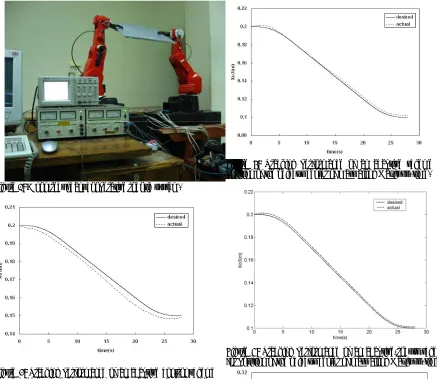
Since we have two similar robot manipulators in our lab each with 5 DOF, see figures 2 and 3, the simulation is performed on the system consisting of a rigid object grasped firmly by these two robots. Kinematic and dynamic parameters of the RRRRR robot manipulators are given in Tables (1), (2), respectively. The object is a rigid plate with the following specifications:
) ( 25 . 0 ), ( 1 . 0 ), ( 16 .
0 m w m m kg
lp= p= p= , where lp,wp
and mpare length, width and mass of the plate, respectively.
The vectors for positions/orientations of the end effectors relative to the center of mass of the rigid object in the inertial frame are:
[
]
Tr1 0.08 0 0
0 = − , r
[
0.08 0 0]
T 20 =
[
0 0 /2]
T1
0θ = −π ,
[
0 0 /2]
T2
0θ = π
The base frame of robot 2 is located at
[
]
Torigin
P 2 = 0.5 0 0 meters apart from the base frame of robot 1 (the inertial frame). Then, the rotation matrices of robots 1 and 2 with respect to the inertial frame are:
⎥ ⎥ ⎥
⎦ ⎤
⎢ ⎢ ⎢
⎣ ⎡
− − = = ×
1 0 0
0 1 0
0 0 1
, 2
1 3 3 b
w b
wR I R .
A similar input disturbance equal to 0.1sin(πt/T)τ has been added to the elements of
τ
(where T is the total time andτ
is the vector of input torques).The desired path is designed from the initial position/orientation of the rigid object center of mass,
T oinitial
X =[0.12 0 0.2 0.15 0 0] to its final position/orientation,
T ofinal
X =[0.15 0 0.1 0.3 0.1 0] .
Because the Jacobian matrices are not square for 5 DOF robots, the dynamic equations of motion for two 5 DOF arms are more complicated than those of two 6 DOF robotic arms. Also, because of the grasp constraints, the object can move on 4 DOF trajectories. To have a 4 DOF trajectory, as an example, the motion in y direction and the rotation about z axis are limited and both variables remain constant, and therefore, they will not be shown in the figures.
[16-18], which is, in many aspects, comparable to the adaptive-robust controller is chosen. Figs. 4 to 11 illustrate the Cartesian position in X and Z coordinates and the orientation in terms of RPY angles, Φ andθ, about X
and Y axes, for the rigid plate when an adaptive and an adaptive-robust control scheme are applied to the system and their corresponding desired values in the inertial frame. From these figures, it is obvious that the adaptive-robust control scheme has adaptive-robustness against disturbances. Also, it performs better and needs update of a fewer number of parameters, which makes it more efficient and faster, in compare to its adaptive counterpart.
6. CONCLUSION
The kinematics and combined dynamics of a dual arm system consisting of two RRRRR robots and a rigid plate in operational space have been developed. Furthermore, an adaptive-robust control method was proposed for trajectory tracking of the rigid plate and consequently the robots. The proposed controller does not need to measure the force and torque reactions at contact points between end-effectors and rigid body and also there is neither body nor joint acceleration measuring requirement.
In order to show the validity of the proposed control method, a numerical simulation was performed and its results are presented for trajectory tracking of the cooperating robotic system.
The adaptive-robust control has the advantages of both adaptive and robust control schemes, among its merits are the simplicity of this controller and its robustness against disturbances.
7. TABLES AND FIGURES
TABLE 1
DENAVIT-HARTENBERG KINEMATIC PARAMETERS OF THE ROBOTS
Join t
θi
[rad] di [mm] [mm] ai [rad] αi
1 θ1 125 0 -π/2
2 θ2 0 200 0
3 θ3 0 200 0
4 θ4 0 0 -π/2
5 θ5 148 0 0
TABLE 2
DYNAMIC PARAMETERS OF THE ROBOTS
Moments of inertia (kg.m²) Lin
k No.
Mass
(kg) Ixx Iyy Izz
1 1.9 1.05 0.722 0.707
2 1.6 0.27 4.4 4.349
3 1.3 0.035 0.619 0.614
4 0.6 0.0397 0.0417 0.008
5 0.45 0.228 0.222 0.022
Figure 1: Non-inertial coordinate frame O-xyz and inertial frame
b-XYZ.
Figure 3: A non-redundant cooperative robotic system.
Figure 4: Tracking performance of an adaptive control scheme for position of the object’s center of mass along X axis vs. time.
Figure 5: Tracking performance of an adaptive-robust control scheme for position of the object’s center of mass along X axis vs. time.
Figure 6: Tracking performance of an adaptive scheme for position of the object’s center of mass along Z axis vs. time.
Figure 7: Tracking performance of an adaptive-robust scheme for position of the object’s center of mass along Z axis vs. time.
Figure 9: Tracking performance of an adaptive-robust scheme for orientation of the object about X axis vs. time.
Figure 10: Tracking performance of an adaptive scheme for orientation of the object about Y axis vs. time.
Figure 11: Tracking performance of an adaptive-robust scheme for orientation of the object about Y axis vs. time.
8. REFERENCES
[1] S. Hayati, "Hybrid position-force control of multi arm cooperating robots", Proc. IEEE International conference on robotics and automation, pp. 82-89, 1986.
[2] M. H. Raibert, and J. J. Craig, "Hybrid position force control of manipulators", ASME Journal of dynamic system measurement, and control, vol. 108, No. 3, pp.126-133, 1981.
[3] O. Khatib, “Object manipulation in a multi-effector robot system”, Robotics Research: the Fourth International Symposium, pp. 137-144, 1988.
[4] Y. Nakamura, K. Nagai and T. Yoshikawa, “Dynamic and stability in coordination of multiple robotic mechanism”, International Journal of Robotics Research, Vol. 8, No. 2, pp. 44-61, 1989. [5] P. Hsu, “Control of multi-manipulator systems – trajectory
tracking, load distribution, internal force control, and decentralized architecture”, Proc. IEEE Int. Conference on Robotics and Automation, pp. 1234-1239, 1989.
[6] M. Uchiyama and P. Dauchez, “A symmetric hybrid position/force control scheme for the coordination of two robots”, Proc. IEEE International Conference on Robotics and Automation, Vol. 1, pp. 350-356, 1988.
[7] K. Kreutz and A. Lokshin, “Load balancing and closed chain multiple arm control”, Proc. American Control Conference, pp. 2148-2155, 1988.
[8] M. Itoh, T. Murakami and K. Ohnisni, “Decentralized control of cooperative manipulators based on virtual force transmission algorithm”, Proceedings of 1999 IEEE conference, pp. 874–889, USA: Kohala Coast-Island of Havai, 1999.
[9] J. F. Liu, “Robust control of planar dual-arm cooperative manipulators”, Robotics and Computer-Integrated Manufacturing, Vol. 16. No 2-3, pp. 109-120, 2000.
[10] M. Azadi, M. Eghtesad and B. Gharesifard, “Inverse dynamics control of two 5 DOF cooperating robot manipulators”, ASME, Proceedings of IDETC/CIE, No. 85634, 2005.
[11] A. Nagchaudhuri and D. P. Garg, “Adaptive control strategies for coordination and control of multiple robots”, Proc. of ASME International Mechanical Engineering Congress and Exposition, IMECE2001/DSC-24615, 2001.
[12] H. Kawasaki, T. Shimizu and S. Ito, “Adaptive coordinated control of multiple robot arms”, IFAC 2000, 2000.
[13] H. Kawasaki, S. Ito and R. B. Ramli, “Adaptive decentralized coordinated control of multiple robot arms”, Preprints of the 7th
IFAC Symposium on Robot Control, pp. 461-466, 2003.
[14] I. Uzmay, R. Burkan and H. Sarikaya, “Application of robust and adaptive control techniques to cooperative manipulation”, Control Engineering Practice 12, pp. 139-148, 2004.
[15] C. J. Damaren, “An adaptive controller for two cooperating flexible manipulators”, Journal of Robotic Systems, Vol. 20, 1, pp. 15-21, Jan. 2003.
[16] F. S. Lewis, C. T. Abdallah and D. M. Dawson, “Control of robot manipulators”, Macmillan Company, 2nd Edition, 2004.
[17] M. Azadi, “Dynamics and control of cooperating manipulator robots”, MS.c. Thesis, Department of Mechanical Engineering, Shiraz University, Sep. 2005.