University of New Orleans University of New Orleans
ScholarWorks@UNO
ScholarWorks@UNO
University of New Orleans Theses and
Dissertations Dissertations and Theses
Spring 5-18-2012
Evoking Luck
Evoking Luck
Kianna R. Simmons University of New Orleans
Follow this and additional works at: https://scholarworks.uno.edu/td
Part of the Sociology Commons
Recommended Citation Recommended Citation
Simmons, Kianna R., "Evoking Luck" (2012). University of New Orleans Theses and Dissertations. 1482.
https://scholarworks.uno.edu/td/1482
This Thesis is protected by copyright and/or related rights. It has been brought to you by ScholarWorks@UNO with permission from the rights-holder(s). You are free to use this Thesis in any way that is permitted by the copyright and related rights legislation that applies to your use. For other uses you need to obtain permission from the rights-holder(s) directly, unless additional rights are indicated by a Creative Commons license in the record and/or on the work itself.
Evoking Luck
A Thesis
Submitted to the Graduate Faculty of the University of New Orleans
in partial fulfillment of the requirements for the degree of
Master of Arts in Sociology
by
Kianna Simmons
BS University of Louisiana, 2009
Table of Contents
List of Tables ... iv
Abstract ... v
Introduction ... 1
Literature Review ... 4
History of Gambling ... 4
Government... 5
Why People Gamble ... 6
Theory ... 10
Play Theory ... 12
The Illusion of Control ... 12
Research Design & Methodology ... 14
Research Design ... 14
Researcher’s Role ... 15
Methodology ... 17
Ethics ... 21
Findings ... 21
Analysis ... 21
Slot Machines ... 24
Themes and Codes ... 27
Luck Rituals as a verbal language ... 28
Yelling ... 28
Luck rituals as physical contact with machine ... 30
Touching ... 30
Button Rituals ... 31
Ticket Rituals... 32
Multi-Gaming ... 33
Luck rituals as non- verbal language ... 35
Not Working... 36
Gesturing ... 37
Lucky Charm ... 37
Discussion ... 38
Conclusion ... 43
References ... 47
List of Tables
Abstract
Gambling is a universal activity, although not a recently studied behavior in Sociological literature. This study uses symbolic interaction, play, and illusion of control theories to examine luck rituals at casino slots. Gamblers were observed through covert participant observations over a seven-month observation period in The casino, and yielded 388 observations. Analysis of the gamblers demonstrated the fact that luck rituals do exist and are used at the slot machines in a casino setting. Luck rituals are associated with participants’ belief in their ability to control the uncontrollable. The illusion of control provides a framework through which the results are discussed. Illusions of control are particularly likely to occur in situations with a high amount of uncertainty. This study showed that more women and African Americans participate in luck rituals than men.
Introduction
Gambling is widespread and crosses all demographic groups inside and outside
of the United States. The British Gambling Prevalence Survey (BGPS) (2010) says that
73% of the British population (35.5 million) adults ages 16 and up participated in some
form of gambling. Gambling by most definitions is the risking of something of value on
the unknown outcome of some future event. Dictionary.com (2012) specifically defines
gambling as: 1) play at any game of chance for money or other stakes; or 2) stake or
risk money, or anything of value, on the outcome of something involving chance.
It is assumed that risk taking is something that occurs in many individuals’ daily
lives. Risk taking can be done through making any decision: for example, small risks
like whether to follow or exceed the speed limit or larger risks such as paying the rent or
buying a television. In the United States there are many venues in which individuals can
partake in the activity of gambling. Individuals can go to a football or basketball game
and bet on the outcome. Individuals can place these bets informally with friends or
formally with a bookmaker. Furthermore, many assume that people go to a casino to
gamble with a belief in the chance to increase one’s wealth, though a casino does offer
other activities. Once in the casino, bettors cannot do any side bets; strictly formal
betting occurs only at the tables and the slots.
Gambling is a phenomenon in which people believe that they can get something
for nothing. The entire objective is for the better to win or to break even (no money lost
games such as craps, roulette, slot machines, and card games (i.e. black jack or poker).
In casinos, many individuals use the activity of gambling to divert from their reality, as
“gambling is an escape from the routine and boredom of much of modern industrial life”
(Bloch 1951: 217). Gamblers take a chance and risk their money in order to leave with
more than they came in with. Some argue that”taking a chance’ destroys routine and
hence is pleasurable” (Bloch 1951: 217). Research shows that gamblers attempt to
control the chaotic world around them and reduce the risk of losing money.
This study seeks to examine the rituals gamblers do to evoke luck. In gambling,
luck is sought and employed for the purpose of having control over future outcomes,
and is done regardless of whether it is rational or not. I specifically look at the behaviors
individuals use to maintain luck, which I refer to as luck rituals. I define luck rituals at a
slot machine as repetitive acts done by patrons before or during the time the reels spin
in order to evoke luck. More specifically, I think the luck rituals that participants use are
in order to complete the fantasy of casino gambling and to maintain control.
For this study, I will examine how luck rituals are used in regards to playing slot
machines, also known as the “slots.” Slots are chosen because they are a true game of
chance that is to say that the slots involve no one else but the person and the game.
Regardless of the individual playing the game, the slots give the same odds. The game
requires no skills or prior knowledge in order to play, and with the slots, individuals have
the least control over the game and its outcomes.
The study of luck rituals can give insight on a topic that has not been abundantly
psychologists, and were framed as a form of pathology. Studies on how individuals
evoke luck are particularly scarce in the field of Sociology. John Rosecrance, an
American sociologist, looked at the habits of bettors on horse racing. Most of the current
literature, to my knowledge, is based on the behavior of gambling as an addiction.
Historically, gambling was recreation for many and had widespread participation.
Throughout the years gambling has been stigmatized, deconstructed and embedded
into society. Though gambling has become more accepted in society and more people
now gamble, there is still a lack of literature on non-pathological gamblers’ behaviors.
Researchers have mainly dwelled on the gambling behaviors of those that are
considered pathological.
Gambling cuts across all classes, racial and ethnic lines, and in many cases a
greater proportion of society are gamblers than are non-gamblers (Frey 1984).
Gambling is a persistent and institutionalized form of behavior and gambling studies
could be helpful from a public policy standpoint (Frey 1984). The studies of
non-pathological gamblers could be advantageous since most gamblers are not addicted to
gambling. Basing a majority of the studies on pathological gamblers leaves a vast
majority of the gambling population out of the larger discourse on gambling. Though
other disciplines have explored gambling behavior, there have been no definitive
conclusions made about it.
This study takes a different perspective on gambling behavior. It assumes that
individual’s actions while gambling are used to assert control on the outside world, with
the outside world being the world outside of the fantasy or reality. Drawing on an
complete their fantasy and seeks to explore the ways they feel that they are able to
maintain some sense of control within an uncertain and uncontrollable situation-i.e. slot
machines. Luck rituals allow an illusion of control. This study is significant because I
believe these behaviors are important primarily because of the popularity of gambling
around the world and across social groups, and also because of the amount of time,
energy, and resources that people and cities put into it.
Literature Review
History of Gambling
Historically, people gambled for the “possessions of their dead, the possessions
of their living friends and relatives, to settle legal disputes, establish rights to various
resources, and on the outcome of athletic contest and other competitive events”
(Aasved 2003: 3). Gambling began in American society as a form of recreation and then
later became stigmatized and looked down upon, as society often assumed that
individuals who gambled were addicted to gambling. The gambler was “condemned
largely for his failure to perform the normal productive functions ordinarily expected of
him, rather than because of the nature of gambling itself” (Bloch 1951: 1). Bloch (1951)
framed gambling as a social ill and thought that it interfered with normal assumption of
responsibility, which organized society compels. “Gambling addiction occurred when the
individual consistently and continuously neglected his important primary duties and
obligations to his family, employer, and community for the sake of gambling” (Bloch
1951: 219). Frey cited Bloch as stating that others saw gambling as dysfunctional
individual’s normal capacity of work” (Bloch 1951, as quoted in Frey 1984 110-111).
This caused an individual to go against law and order and commit crimes in order to
accomplish his purpose. Embezzlement was a common crime committed by gamblers
(Bloch 1951). Bloch (1951) thought that gambling had characteristics that were similar
to those of organized crime (Bloch 1951; Schelling 1967).
Government
It is also important to note the larger social implications of gambling and casinos.
Gambling is not only used by the participants but it is also used by the government.
Studies have shown that “gambling is increasingly being recognized by national and
local governments throughout the United States and the world as an effective means of
generating revenues” (Aasved 2003: 3). Specifically, lotteries have become one of the
biggest money makers run by the government. Marx stated that “the sanctioning of
gambling by the political and economic structures represents an effort by elites to
manipulate and exploit the masses of a society” (Frey 1984:112). Likewise, Cosgrave
and Klassen argued that “the government seeks to regulate gambling as part of their
own (governing) activities, and in doing so attempt to define and regulate the actions of
citizens” (2001: 4).
Gambling has many dimensions and has much variety. It varies not only in the
ways one can participate, but also in who participates and in the locations where the
actual behavior can occur. Cosgrave and Klassen noted, “the legalization of a variety of
forms of gambling has contributed, at least tacitly, to the social acceptance of gambling
has become a routine aspect of everyday life” (2001: 3).Gambling locations can be legal
venues, such as casinos, internet and racetracks, as well as illegal venues such as
homes and school properties. The individuals that participate in this behavior can also
vary in terms of demographic characteristics, such as race, sex, socioeconomic status,
religion and ethnicity.
Why People Gamble
Smith and Preston (1984) investigated the motives individuals had for gambling
and found that the predominant motive was for play and leisure. Kusyszyn (1976)
claimed that gambling satisfied the needs of the participants for recreation and play.
“Kusyszyn viewed play as providing people with wish fulfillment, conflict reduction, and
escape from reality such as daily routine and the world of work and change from a
passive to active life (Smith and Preston 1984: 326). Allport stated that the motive to
gamble, once it had achieved a “functional autonomy” of its own, may dominate other
primary considerations of the personality (Allport 1937; Bloch 1951 219).
The play and leisure aspect of gambling is something that is primarily enjoyed by
the middle and upper classes. Unlike the middle class, the poor were often motivated by
monetary gain when deciding to make a gambling trip (Smith and Preston 1984). Those
with higher education levels were more likely to gamble with the motive of play or
leisure. Conversely, those with lower educational attainment were more likely to gamble
with the motive of winning money.
Gambling can be seen as a form of play for adults. According to Huizinga (1955)
an activity is play if it is fully absorbing, includes elements of uncertainty, involves a
Kusyszyn argues that gambling can be a release from reality and can transport the self
into a play world, which is a fantasy world where the gambler is suspended until jarred
back into reality by the finish of the last race or the disappearance of their money
(Kusyszyn 1984). “In these worlds, individuals can abandon the superego
(consciousness) and act on pure id (pleasure principle) instincts” (Kusyszyn 1984: 135).
In the “play world” money can lose its market value (i.e. $20 equals a pair of pants);
according to Kusyszyn (1984) casinos use plastic chips to encourage the devaluation of
money in order to encourage the loss of money’s market value.
Gambling meets all aspects associated with Huizinga’s (1955) definition of play.
Namely, “gambling can be fully absorbing because players can go into a trance-like
state pulling the arm (lever) of the one armed bandit (slot machine) for hours at a time
until they are completely fatigued” (Kusyszyn 1984: 140). Gambling includes elements
of uncertainty- this is demonstrated by merely looking at the definition of the word.
Risking things without the knowledge of the future outcome most certainly creates a
sense of uncertainty.
Huizinga’s (1955) primary characteristic of play is that it must exist outside of
ordinary life. Gambling’s ability to always have a place (i.e. race track, casino, bingo
hall, or card rooms) for it to occur coincides with this notion. Gambling as play gives
individuals the chance to achieve a sense of freedom through absolute autonomy via
their ability to choose the way they want to gamble. The sense of illusion and
exaggeration heightens the gamblers’ hope of winning. Both the aspect of autonomy
and sense of illusion can be seen in the gamblers’ “belief in control and how that control
Some gamblers think that they can affect their environment by doing things such as
blowing on dice and rooting for their horses. These activities probably represent their
belief in the ability to have control of an uncertain situation.
Gambling allows an individual to have a sense of agency in a generally uncertain
and uncontrollable aspect of life. “Gamblers exhibit a freedom of choice in that,
independent of their own free will, they can choose the game they most desire”
(Kusyszyn 1984: 136-137). The illegalities of gambling allow participants to see it as
action. Action is found “whenever the individual knowingly takes consequential chances
perceived as avoidable” (Goffman 1967; Frey 1984: 113). Additionally, “by keeping
gambling illegal and segregated and by expressing moral distaste for its existence,
prevailing ethical and economic values are reinforced” (Frey 1984: 110). Action
activities are consequential and fateful because something of value can be won or lost
on the outcome and by committing something of value, players indicate their
seriousness. As such, “gambling thus presents an opportunity display or an extrinsic
desire to demonstrate self composition to the outside world” (Goffman 1967).
Society causes individuals to have contradictory pursuits for living their lives.
Frey argued that “on the one hand, there have been cultural demands for routine,
controlled orderliness, and predictability. On the other hand, there is the pressure to
experiment, to take a chance, to be entrepreneurial” (1984: 109). The strong pressures
from society to conform and routinize one’s life make it hard to engage in the latter of
the two pursuits. “Gambling permits one to protest against budgetary restraints and
rationality while permitting thrill seeking, competitive aggression, and problem solving”
society. This can be achieved in a socially acceptable, not completely illegal (depending
on the time period) manner. Gambling opportunities and venues have multiplied,
making gambling an increasingly accessible, socially acceptable and popular activity
(Griffiths 1989; Desai et al. 2005; Chiu and Storm 2009).
Although it is not one of the main motives individuals attribute to their gambling,
the belief in luck is something that affects a vast amount of participants. Due to the
uncertainty in the act of gambling, many participants draw on luck, perhaps irrationally,
to reclaim or regain control. Researchers have contended that a belief in good luck may
be adaptive and that positive illusions surrounding luck can lead to feelings of
confidence, control and optimism (Darke and Freedman 1997; Chiu and Storm 2009).
Rudski (2004) also examined optimism and control, although his study looking at
optimism and control incorporated the illusion of control and the use of superstitions.
George McCall (1963) spoke of the lottery and stated that throughout relevant
literature the playing of the lottery is considered wasteful. For example, sociological
writings surrounding issues of lotteries and gambling often framed these issues as
social problems. McCall also stated that participation in this behavior required a belief in
luck, spiritualism, and dream interpretation, all of which were disproportionately
associated with black and lower income cultures due to their lack of access to actual
resources (McCall 1963; Frey 1984). Frey (1984) refuted the idea and stated that
individuals in the middle class and non-blacks played the numbers more than the lower
class and blacks. For Frey, the belief in luck along with monetary gain was often
When participants get a win they attribute it to luck, rather than attributing it to
some external factor, which is more likely when the outcome is a loss. Scholars have
noted that “people frequently underestimate the likelihood of experiencing negative
events and overestimate the likelihood of experiencing positive events- an effect which
generally increases with perceived controllability” (McKenna 1993; Rudski 2004, 312).
Luck is considered to be an irrational, erroneous thought. Thus, pathological gamblers
and occasional gamblers have irrational and erroneous thoughts. Gaboury and
Ladouceur (1989) had participants verbalize their thoughts as they gambled. The results
showed that 70% of gamblers’ perceptions while gambling were irrational (Ladouceur
2004). Many individuals showed a sense of rationality when they understood that the
game was based on luck but then had altered perceptions when they were in the act of
gambling. We see that ”adequate beliefs reflect the idea that the results of the game are
determined by chance, while erroneous beliefs involve the idea of prediction and control
over the outcome of the game” (Ladouceur 2004:556).
The research in this area is severely lacking and most of it is somewhat
segmented and fractured. Further, the majority of the literature is older, with few studies
being from the twenty-first century. While there are a limited number of sociological
studies that examine gambling as a non-pathological behavior, most studies have been
done by psychologists and physicians who primarily focus on pathological gamblers and
how to help them with their addiction. These gamblers are believed to be the typical
gambler, though statistics show that a majority of gamblers are more recreational.
The symbolic interactionist approach draws meaning and significance to the game play
behaviors and illusion of control. Symbolic Interactionism looks at human interaction
and communication at both the micro and macro level. This perspective can be utilized
not only to examine the act of gambling, but can also take the actual gamblers and the
physical games into context (Evans and Hance 1998). Symbolic Interactionism can be
used to frame the argument that “gambling cannot exist without a social system in which
to gamble” (Evans and Hance 1998: 413). Goffman’s theories can show that while
gambling, individuals pretend to be something they are not because the individuals
around them do not have to know them or their true identities (1967). Individuals also
pretend to have more money by losing what they have and acting as if it does not affect
them because they have the money to risk (Goffman 1967; Evans and Hance 1998).
Pretending actually helps the individuals, because to them “the nature of play is much
less important than the appearance of play” (Frey 1984:113).
Previous work from the symbolic interactionist perspective has shown that
gambling falls under at least four types of play: 1) chance (alea), also known as pure
chance; 2) competition (agon), with games that involve skill; 3) mimicry role playing
situations; and 4) vertigo (ilinx) which are mood altering experiences (Evans and Hance
1998; Young 2010; Aasvad 2010). Gambling can encompass all four aspects of play
and can cause gamblers to go into a “different world.” In this alternate world of
gambling, participants “are no longer aware of fatigue and are scarcely conscious of
what is going on around them” (Evans and Hance 1998:413). Through this lack of
awareness, individuals can lose their sense of rationality and begin to develop
perceived control of an uncontrollable situation. While gambling, the participants start to
“erroneously believe in winning and losing streaks and in false probabilities rather than
in purely random occurrence of events” (Aasvad 2010:104). These aspects of play have
also been explored in the theory of play; which comes out of the symbolic interaction
paradigm.
Play Theory
Play theory states that gamblers do not participate in the phenomenon of
gambling for monetary gain, but solely for the entertainment. Aasvad (2010) looks at
play as something that is essential to human needs, much like the needs for sex and
food (Aasvad 2010). He also states that play was one of the main catalysts for the
evolution of ancient societies (Aasvad 2010). Play is seen as something that is not
serious and is separated from the main parts of the participants’ mundane life. Huizinga
(1955) believes that this separation is necessary in order for an activity to be truly
deemed as play. Play is also seen as something that can absorb the individuals that
participate in it (Kusyszyn 1984: Aasvad 2010). This absorption into the world of play
can produce a euphoric feeling for the individuals, and also result in a relief of tension
that may otherwise be unattainable in the participants’ ordinary lives (Huizinga 1955;
Aasvad 2010). This euphoric feeling can cause individuals to have the illusion that they
have an ability to change outcomes, in particular the outcomes of their gambling
endeavor.
The Illusion of Control
Langer (1975) defines illusion of control theory as “an expectancy of a personal
Hageman 2010). More simply defined, illusion of control is the mistaken belief that one
can influence outcomes in situations where one actually has no control (Rudski 2004).
Langer (1975) did several experiments on the illusion of control, namely, one
experiment involving lottery tickets. She allowed some of the participants to choose their
tickets and others were given tickets. Each group was later given an opportunity to
switch their tickets for others with a more favorable outcome. Individuals that chose their
tickets were less likely to exchange (Langer 1975; Thompson 1999). Illusion of control
can be common even if the event is something that is based on pure chance.
In these pure chance situations individuals can still overestimate their degree of
control. Illusion of control is based on both situational factors and personal-based
factors (Thompson 1999). Situational factors include personal involvement (individual as
active agent), familiarity (working with familiar circumstances or tools), foreknowledge of
the desired outcome (knowing the outcome you want to receive) and success at the
task (receiving successful outcomes). Personal based factors include the presence of
depression or a feeling of wanting to be in control (Thompson 1999). Individuals have a
tendency to confuse situations of chance with situations that involve skill. These
different situations can be misconstrued by conflating characteristics involved with
skill-based activities (e.g. familiarity, choice, involvement) (Thompson 1999).
Thompson et al. (1998) stated that Langer’s (1975) theory was not a complete
explanation (of what?) so they attempted to create a more thorough definition using the
concept of control heuristic. Control heuristic can be defined as a short cut or simple
rule and was created to look at the degree of influence over an outcome (Thompson
actions and the desired outcome could change the participants’ perspectives
(Thompson 1999; Hageman 2010). The theory of the illusion of control is criticized for
broadly describing the characteristics for the behavior; however Langer’s theory was
also criticized for the emphasis on skill-related cues as the predominant reason for the
illusions.
This project draws on the theory of the illusion of control to look at the
phenomenon of gambling. This theory is especially fitting in regards to what
characteristics these participants exhibit in their behaviors. The theory demonstrates
why gamblers continue to gamble, even with unfavorable outcomes, and why gambling
is an activity that crosses all demographics. The theory also sheds light on why
gamblers behave the way that they do when gambling. This theory shows that
individuals will do different things to help gain a sense of control, and this theory was
paramount in helping me explore the rituals gamblers used to evoke luck and a sense of
control.
Research Design & Methodology
Research Design
This study is aimed at learning and understanding a particular cultural
phenomena, gambling, to speak to the greater system of meanings in our culture
related to luck and chance. As such, I employed an ethnographic research design. This
design allows the researcher to “explore and understand the meaning individuals or
This research occurs in the natural setting of a public casino. Within the casino,
is where the researcher records the participant behavior. Ethnographies use the natural
settings for in-depth observations over a period of time. This design elucidates patterns
in-group behavior that may not be otherwise recognized.
This paper examines the broad culture-sharing behavior of individuals and
groups through an ethnographic inquiry into luck rituals evident in casino gambling. As
previously stated, an ethnography is a qualitative strategy of inquiry where “researchers
study an intact cultural group in a natural setting over a prolonged period of time by
collecting primarily observational and interview data”(Creswell 2009: 232). Further, “the
intent of ethnographic research is to obtain a holistic picture of the subject of study with
emphasis on portraying the everyday experiences of individuals observing and
interviewing them and relevant others” (Fraenkel and Wallen 1990; Miller 1992).
Ethnography has both observational and narrative aspects and does not focus on the
experimental aspects that are normally associated with quantitative research.
Ethnographies can be used to acquire points of view that are often over looked in other
types of research.
Researcher’s Role
My perception of gambling is shaped by my personal experiences with gambling.
I have worked in a casino since February of 2011, first as a security officer and now as
a slot attendant. In both positions I have been able to interact with guests as they game.
In the past two years I have seen many different things happen in the casino. Presently,
working as a slot attendant, I am constantly in contact with participants playing slot
are doing. Walking on the floor for eight to ten hours allows me to hear the patrons’
conversations about a variety of topics, including their reasons for performing different
rituals. The participants often help each other “learn the ropes” when it comes to tactics
they can take to enhance their ability to win. I have also talked and interacted with other
employees who have been in the industry for many years. These interactions have
taught me things about various phenomena that occur in the casino along with its
culture, all of which has enhanced my knowledge of the slot machines and the gambling
industry itself. These interactions and placement within the casino has allowed me to
gain an in depth knowledge of the slot machines and importantly, the site itself. While
working in this setting I was in graduate school gaining a sociological perspective and
critical eye. My academic work, along with my placement in casino culture has given me
the opportunity to critically explore gambling culture and luck rituals. This critical eye
helped me notice certain patterns that were occurring that others might seem
commonplace.
Because I am involved in the gambling process as an employee, my own
perceptions may be tainted. While this may appear as bias, I believe it can also be a
strength as I have a strong understanding of this particular casino culture and its
participants. I did record the exact behavior that was witnessed. Then these
observations are categorized using a detailed coding analysis. Further, I only recorded
behavior I believed to be reasonably explained from within the casino or gambling
culture. In many cases, behaviors may have ambiguous or unclear. These cases were
My own world view, which is a “basic set of beliefs that guide my actions” (Guba
1990: 70) reflects a social constructivist perspective. This view “holds assumptions that
individuals seek understanding of the world in which they live and work” (Creswell 2009:
8).
Methodology
Qualitative observations describe a research methodology in which “the
researcher takes field notes on the behavior and activities of individuals at the research
sites and records observation” (Creswell 2009). Observations can show things the way
they are rather than as an exemplified phenomenon. Knowledge for the layman can be
expanded because observations are easy to read and understand when described
using rich description.
Data for this study were collected through hours of observations over a 7 month
period, and then narrowed to fit the scope of my focus. Covert observations were done
to obtain the information needed for this study. These observations were conducted at a
land based casino in an urban area. I conducted my observations as a covert observer,
meaning that I did not participate in the actions or behaviors. Rather, I solely observed
the behaviors as they occurred. From a methodological standpoint, this observation
process had benefits and drawbacks. The main benefit was that I did not interrupt the
natural setting in which the behaviors occurred. Hatch (2002) describes the qualitative
strengths of a documented observation as providing an understanding of “the cultures,
setting or social phenomenon being studied from the perspectives of the participants”
(72). In contrast, Janesick (2004) stresses the importance of an interpretation as
hunches, ethical concerns and issues, and a serious description of the researcher’s role
in the entire history of the project” (156). The individuals did not know they were being
observed and therefore did not have the chance to change or hide any aspect of their
behavior. Since the group under observation was not aware they were being
researched, the problem of an observer effect was avoided (Livesey 1995). One
problem associated with only observing the participants was that I did not get their exact
perspectives or feedback of the situation, which could provide insight into why
individuals participated in the different luck rituals. The participants’ feedback could also
show whether or not the participants engaged in the behaviors consciously.
Overall I separated out 170 individual observations of luck rituals during a
seven-month observation period. Data collection began in May 2011 and ended December
2011. The data were obtained on as many weekend shifts as possible. One potential
limitation to this project is that the data were obtained on mostly night and early morning
weekend shifts. However, in my interactions with other employees and in this space, I
would argue are still applicable to other days and times.
The observations were conducted for approximately one hour on my eight to ten
hour shifts. The observation was done on as many shifts as possible; usually about
three to four shifts per week. These shifts were usually during the mid-evening to early
morning (7pm to 3am or 8pm to 4am).
Initially, I observed and recorded the events I saw going on in the casino with no
particular aim. Through these initial observations, it occurred to me that the players
unique behaviors. It was with that set of observations that I narrowed the scope of this
project down to those behaviors that showed patrons interacting directly with the
machines in some fashion. The individuals observed were subsequently selected based
on their participation in these aforementioned behaviors. I observed an individual
participating in the behavior at least five times before I recorded it as a ritual. I observed
the behavior five times to make sure that the action was not a one-time event. I also
heard the conversations that the patrons were having with one another and these
conversations shed light on the things I saw while confirming my notions about the
actions that were occurring. I also had informal conversations with other employees that
reinforced the things I was hearing in the patrons’ conversations.
To record these observations I used a small composition notebook so that I could
immediately record what I was observing. I carried the notebook with me on the floor as
I worked. It was located in the pouch I wear as part of my work uniform. With each
observation, I tried to record the participants’ perceived race, perceived sex and their
attire. Later, I expanded on the jottings of the observations to detailed field notes.
After expanding on the notes, I began the coding process categorizing all of the
observations and using open coding. According to Babbie (2004), “coding is the key
process in the analysis of qualitative research data” (376). I used an inductive coding
system, categorizing the data by similarities in the behavior. What emerged were the
following ten codes: yelling, talking, touching, ticket rituals, button rituals, multi-gaming,
After the initial coding, these categorizations were organized by similarities of
behavior. This process led to the development of the themes: evoking luck as physical
contact with the machine, evoking luck as verbal language and evoking luck as
non-verbal language.
I checked my code definitions to ensure that they were correct and conveyed
exactly what I needed them to. I also checked my field notes before I transferred them
from my notebook and then double checked after they were transferred. This study is
not generalizable, it is exploratory. It may be transformative in that it identifies issues
that may be applicable to any urban casino.
The validity of my findings (Creswell 2009) are insured in several different ways.
These strategies include: rich description of data, long term and repeated observations,
and peer examination. I used a rich description of the data by giving a full and accurate
description of the setting so that the reader would feel as if s/he was truly there. I
performed long term and repeated observations, which were done for approximately 8-9
months at the same site. I have used peer examination by having a fellow Sociology
graduate student or faculty member examine my work.
I also acknowledge the limitations of this study. Namely, the lack of conversation
with the guest brings in a problem of not knowing exactly why the gambling rituals are
done. I can only speculate from the 2 years of working in the casino about the behaviors
during my specified research period, and can not directly speak to the motivations of the
participants. The days and times of the observations can also be a problem. There is
could have potentially yielded a specific sample of demographic characteristics of the
participants. The lack of literature in this field of study also brings up as I had little to
work from academically in planning my research and informing my various questions
and areas of focus. As such, this work is largely exploratory. Specifically, much of the
information provided is from my personal lengthy observations and personal
experiences rather published academic work. However, I also believe that a scholarly
exploration of this culture and these rituals is one of my primary contributions with this
project.
Ethics
The names of the participants are not included in this project to ensure
anonymity. Other identifying characteristics were also changed. All needs and rights of
the individuals observed were completely respected and I did not violate these
individuals in any way. There was be no photographic images of the individuals nor will
any audio be used. I only recorded my observations in my notebook.
Findings
Analysis
Walking up to the casino from Main Street, the waving palm trees welcome you
to the property. As one nears the imposing edifice, the shine and sparkle of the
strategically placed lights grow more inviting. Walking up the stairs one gets an
obscured view of the inside of the casino. Then the intimidating gold trimmed doors
open widely to a small enclosure, which leads to the second set of doors. These doors
checking identifications. Music is playing over the sound system. Upon entering the
casino, the smell of grilling hamburgers and freshly cooked French fries enters one’s
nose. The sweet smell of caramel lattes can also be recognized. There is an abundance
of smells. This can vary from the scents that other patrons are wearing, the different
restaurants, cigarette smoke, and hint of the cleaning chemicals used by the casino
staff. Throughout the casino there are different restaurants that range from high-end
steak and Asian cuisine to the lesser priced burgers and Panini’s. In the casino, every
sense is engaged and every need is satisfied.
As one walks under the twinkling stars on the night’s sky painted ceiling, several
high definition televisions are on display, along with hundreds of two-foot machines
sitting on three-foot stands. Progressing into the casino the flashing lights of decorated
slot machines and the mechanical beeps grow more intense with each passing step.
Walking through this sea of alluring refrigerator-sized slot machines, an array of faces in
all different stages of emotions becomes blatantly visible. They range from ecstatic to
sadly depressed. One can also hear the non-simultaneous sounds of the slot machines.
The noises heard can vary from sounds of ringing bells for wins or recognizable music
playing from various bonus rounds. Noise, is the perfect word for all the sounds
combined. Nothing is in sync and all the sounds are loud, confused, and most definitely
can be disturbing to one’s thoughts…until individuals become numb to the noise, as
most workers and regulars do.
After passing the two large sections of 100’s of slot machines, one can see
players huddled around tables playing blackjack and three-card poker. Going toward the
happily cheering or talking (because of the money won), to sulking and occasionally
weeping because all their money is gone. The pungent stench of loss mixing in with the
funk of stale alcohol and burnt cigarettes can overwhelm one’s senses. The cacophony
of noises one can hear, all at once, walking through this large casino can also send one
into sensory overload. Coming into a large casino can leave one with mixed emotions.
This experience can leave one hyper-stimulated and wanting more, and for others it can
leave a sense of fear and confusion.
The casino’s large facility is constructed in way that is conducive to play and
leisure. It allows individuals to participate in an activity that provides them with
amusement and allows them to get away from the demands of their everyday life. The
casino has five different entrances. The entrances are located at each major street that
intersects the property. Once inside individuals are engaged through all of their senses.
Visually, players will see thousands of slot machines. The price to play these slot
machines ranges from one cent to $500. Patrons will see large displays, such as two life
size displays, a pirate ship and one of city landscapes. Patrons hear lots of different
sounds including background house music and the slot machines’ themselves with bells
and whistles sounding off. Some of the machines even talk to you. Depending on the
section, different types of music can be heard. The music from the slot machine
bonuses can also be heard throughout the entire casino.
The casino is designed in such a way as to keep patrons distracted and disorient
them from time and the real world. The only way one can see outside to be near one of
these entrance/exit doors. Other than these doors, The casino has no windows
outside and as a result this throws off the gamers’ perception of time. The fact that there
are no clocks in the casino helps with the misinterpretation of time. Many employees do
not wear watches, which makes it hard for the patrons to identify the time of day.
Individuals will come in and stay for hours without even realizing what time it is or how
much time has passed. The casino has strategically placed machines near every
entrance/exit doors, restrooms, and restaurants. When a patron wants to leave they are
drawn back in for “just one more spin.”
There are many different perspectives on risk when it comes to gambling at the
casino. A large portion of the patrons that come in play slots rather than the table
games. Slot machines are one of the top revenue makers in this casino. One reason for
this may be that slot machines are not complicated games. If patrons get confused, they
can simply look on the machine for the help sections or ask a slot attendant to explain
the game. The machines’ help sections show the game’s pay line and what constitutes
a win. Like Blackjack, slot machines are a popular form of gambling. They may be
considered more entertaining than the table games because the slot machines, unlike
the table games, light up, have bright colors, play music and allow for free money to be
won in bonus rounds. Further, patrons that enjoy card games played at the tables can
also play them electronically.
Slot Machines
This study focused specifically on the slot machines. These games require no
skill, preparation, ability, or knowledge. The games place all people on the same level
because slots are made to be completely random. This ultimately gives the individual
an illusion that they may control this uncontrollable system. With this illusion they may
do things they feel will encourage a change in their overall outcome.
There are two primary types of machines, old-fashioned reel slots, also known as
one arm bandits, and the electronic machines. The electronic machines consist of
electronic slots and video poker. The old fashioned slots often have three to six wheels
that spin. Each wheel has images printed on them. To win on these slot games players
must match the images from the left most reel to the right in order to receive the
designated rewards. The reels can be spun by either pulling the lever on the right of the
machine or pushing the bet or spin button on the front of the machine. These machines
merely make noises when matches are made; they do nothing extra like the electronic
slots.
The electronic slots have touch screens which makes the game more interactive
for the players. These slots, like the old-fashioned ones, have several spinning reels.
The difference is that these spin digitally rather than having physical spinning reels. Due
to these games being controlled by computers the players are more involved in the
games they play. The electronic slots also allow the patrons to place bets at a quicker
pace than when playing old-fashioned slots. These games give players the chance to
participate in bonus rounds during play. Bonus rounds allow the players to win free
money. This is considered free money because patrons can win free spins, uncover
money in matching games, or choose from given options in which they wager no
money. During the bonus rounds players may hear different kinds of music or voices
The other form of electronic games is video poker. The poker slots are
simulations of various poker games. These games often come equipped with touch
screens. The poker games are often multi-game machines and consist of different types
of poker games and different types of keno (which is similar to the lottery concept of
choosing numbers). Individuals can bet using the touch screen or the buttons on the
front of the machine. Players can choose the cards they want to keep by pressing the
hold buttons and discard the rest using the deal button.
Slot games give the player variety in their betting amounts. There is variety due
to the pay lines a game has. Even with one pay line a player has the option to choose
how many credits s/he wants to bet per spin. The slots, whether old-fashioned or
electronic, can have multiple pay lines though many of the old-fashioned games only
have one pay line. The slot machines with one pay line give players’ only one way to
win. The images have to be on the pay line or it is not a win. The winnings are often
distributed in coins. That is why these machines are associated with the clinging of
coins. Through the new technology the machines have moved away from distributing
the winnings in the form of coins. The new way to pay is through the “Ticket in, Ticket
out” system. Individuals cashing out now receive a digital ticket that can either be turned
back into cash or put in another machine and turned into credits. Though the one-arm
bandits are not the most alluring games for beginners, these are usually the slots
suggested to casino novices. They are the least complicated to comprehend and will not
leave the player wondering why his/her money is disappearing. The slot machines with
multiple pay lines give players more ways to win. With multiple pay lines, players have
more lines with a smaller bet or bet less lines and more money. The more the player
bets the better chance they have to trigger a bonus round. Multiple pay lines can
ultimately yield more money, though it may cost more to accrue this money.
The individuals I observed were patrons at the slot machines. The participants in
the slot area varied on all demographic aspects though all individuals were males or
females aged twenty-one and over. This was deduced through the checks of
identification, by security, at each entrance. These individuals appeared to hold different
socioeconomic statuses, which was indicated through the clothing worn and the amount
one spent. The participants were observed while gambling in the casino at one of the
many slot machines. They were observed as they used different strategies to evoke
luck as they played. The setting was within the thirteen slot areas in the casino. These
areas contain only slot machines with the table games being on the outskirts.
Themes and Codes
I defined luck rituals as a repetitive act done by patrons after a “good” play or
while reels spun in order to evoke luck. Patrons participated in these behaviors to
complete their illusion of control. This illusion caused players to have faith in their own
abilities to alter the randomness of the game. These codes were considered rituals
because they were reoccurring, which I realized in my observations. The rituals were
not normal behaviors associated with the gaming process, like putting money in a
games or placing a bet, because they were not necessary for the game to be played.
These actions were extra and did not contribute to the outcome, which as we know was
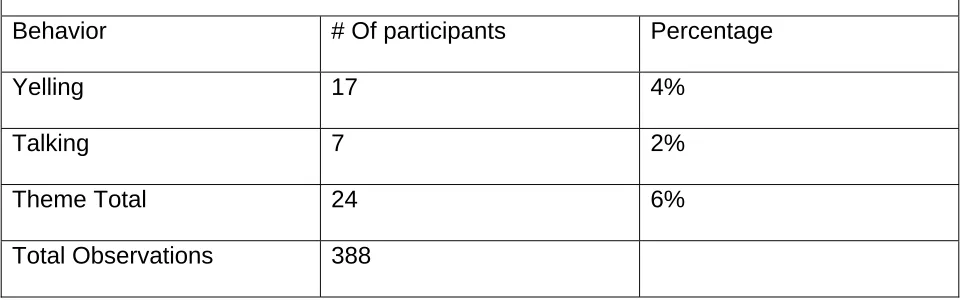
Table 1
Evoking Luck as Verbal Language
Behavior # Of participants Percentage
Yelling 17 4%
Talking 7 2%
Theme Total 24 6%
Total Observations 388
Luck Rituals as a verbal language
One of the predominant forms of luck ritual I observed was verbal language
spoken to the machine. I observed and subsequently coded “yelling” and “talking”
directly to the machine. The code “yelling” refers to the patrons that were talking in a
louder tone. “Talking” refers to a patron that was speaking in a regular tone of voice.
Yelling and talking were verbal attempts to evoke luck and change the outcome of the
spinning reels. These codes occurred after a bet was placed and the reels began to
spin. These codes were used to ask for certain outcomes to occur. Neither of these
codes was needed for the slot machines to perform properly. These were not done by
all patrons that gambled, but they were evident in 6% of all participants observed.
Yelling
Several players referred to characters of certain slot games by name. One
Caucasian woman who was casually dressed in a t-shirt and slacks talked to the Wizard
wizard, Where ya at wizard.” She was obviously not talking to an actual wizard or king
of the forest. She was referring to characters in the game. Having these characters
show up meant she won in the bonus round and the machine awarded more money to
the player. Another woman playing at the Wizard of Oz machine yelled, “go wizard go!”
Her yelling was encouragement for the wizard that controlled the bonus round. The
patrons asked for things needed to make matches and win money. An example of this
occurred when a Hispanic man dressed in business casual clothing yelled “come on” at
the machine when the image he wanted was directly above the pay line. Yelling is a
different action than talking because of the volume the individual uses. For the most part
patrons yelled things directly to the machine but some patrons just talked to the
machine. It appeared that the talking ritual was mainly performed by African American
woman and men. An African American woman’s bonus round ended and she began
talking to the game after she did not win anything in the bonus round.
Yelling seemed to be popular mostly among Caucasian women. The previous
chart shows a difference in the amount of yelling females did compared to men. Women
yelled more often than men. Yelling occurred twenty-four different times among the luck
behaviors.
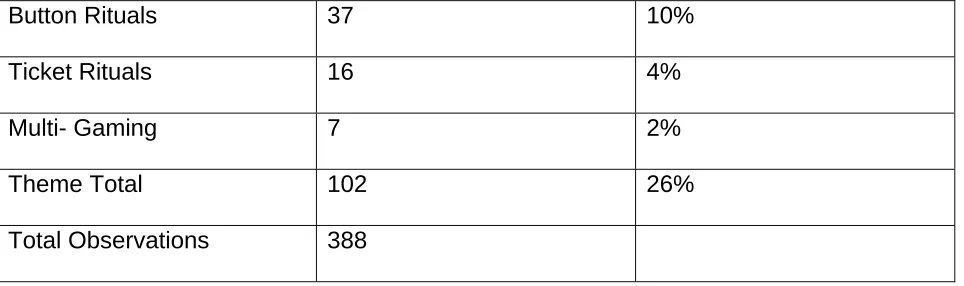
Table 2
Evoking Luck as Physical Contact with Machine
Behavior # Of participants Percentage
Table 2 continued
Luck rituals as physical contact with machine
Physically interacting with the machine is the next relevant theme I will discuss.
The codes that emerged were: touching, button ritual, ticket ritual, and multi-gaming.
These were physical things done directly to the machine in order to evoke luck and alter
the outcome of the spinning reels. These actions were in engaged in by 26% of all the
participants I observed. Two of the top three behaviors are in this theme. This theme
stood out as the one that most participants engaged in.
Touching
Touching is the primary code within this theme. I consider it to be the primary
code because both women and men participated in this activity the most. Touching is a
physical interaction with the machine’s monitor. The code “touching” encompassed not
only when a patron was touching but also rubbing, hitting and tapping on a machine’s
monitor. This occurred after a bet was placed and the reels began to spin. As the reels
spun the patron interacted with the reels through the monitor. The activity that the
patrons engaged in the most was knocking on the monitor. For example, an African
Button Rituals 37 10%
Ticket Rituals 16 4%
Multi- Gaming 7 2%
Theme Total 102 26%
American woman who was professionally dressed in a business suit was knocking on
the screen as the reels spun. I observed that knocking was popular with African
American and Caucasian women while African American men used a more aggressive
tactic. The men appeared to beat or hit the machine’s monitor. A comfortably dressed
African American man in sweat pants and a hoodie was hitting the machine with an
open hand as the reels spun. Another African American man beat the monitor before
each spin. These actions did not disturb the outcomes that were already in motion. I
observed these actions being done after several different bets.
Predominantly, African American women engaged in touching, though Caucasian
women did as well but to a lesser extent. Both African American and Caucasian women
knocked on the monitors. The theme chart above shows that women made physical
contact with the monitor more than men. Touching occurred 42 times within 102 theme
behaviors observed.
Button Rituals
I define “button ritual” as the code for hitting the spin or bet buttons on the
machine as the reels spun. In this code I included the action of pulling the lever. This is
because the pulling of the lever is equivalent to the pressing of the spin button. They
both cause the designated bet to occur. The bet or spin button was pressed multiple
times in a row; once the patron placed their initial bet, the reels begin to spin. The
patron also continued to hit the spin or bet button from the time the reels began to spin
until the reels finished spinning. For example, an Asian woman dressed in a blouse and
slacks was tapping the spin button from the beginning of the reels spinning to the time
not mean anything. The extra taps did not cause the reels to stop nor to slow down. The
outcome of the spin would be the same whether the button was pressed once or
continuously throughout the play. The players had different variations on the button
rituals. For example, the patrons tapped, hit and pressed the button. Players also
alternated between the bet and spin button after making their bet. A Caucasian male
dressed in a button down shirt and jeans alternated between the spin and bet button
each spin.
My observations showed that button rituals predominately occurred with
Caucasian women. The Caucasian women I observed participated in button rituals in
the form of tapping. The females I observed hit the spin button more than the males did.
When the males did participate they predominately tapped the spin button. Men were
the only ones that alternated between the bet and spin button.
Ticket Rituals
“Ticket ritual” is a code for cashing out a ticket and putting the ticket or cash back
in the same machine. This was often done after what the player considered a win or a
“taxable.” A taxable was winning 1200 dollars or more, which is an amount that has to
be taxed by the state. Often after a patron wins a taxable they assumed that the
machine would not hit again and consequently, they would leave to play another
machine. Working at The casino I often experienced patrons asking me if games have
hit while I was there or if I knew the last time a game had hit. A casually dressed
Caucasian woman cashed out her money and her ticket jammed and after an attendant
fixed it she put her ticket right back into the same game and began to play again.
the same game. An African American woman wearing a t-shirt and jeans took her
money out of the game after winning some money and then told her nicely dressed
friend (who was in a blouse and jeans), “that’s how you win but you can’t put your
money back in, I mean you can just cash out” and then she put a five dollar bill back into
the machine. The players tried to change the outcome of their next spin by “tricking” the
machine. The trick was cashing out but never leaving and this was believed to make the
machine think a new player had come to play. The process of cashing out the ticket and
replaying it at the same machine did not change the outcome of the slot machines. The
outcome was random and would occur whether or not it was the same patron or a new
one.
During my observations I overheard the patrons rationalizing this behavior. The
patrons said that taking the ticket out makes the game believe that there is a new patron
playing and may give them a better chance of hitting. The code “ticket ritual” appeared
to mostly be done by Caucasian females with African American females very close
behind in numbers. Women participated in this behavior more than men. I observed one
Caucasian man participating in the ticket ritual behavior; however this does not mean
that more men do not participate in this behavior on an everyday basis.
Multi-Gaming
I used the code “multi-gaming” for patrons who played multiple games at one
time. The patron put their money in multiple games and played them simultaneously.
For example, an African American woman wearing a dress played two games but had
money in three. Some of the individuals directed their attention to one of the games as
simultaneously was only watching one of the game’s reels spin. Playing multiple games
did not alter any of the game’s randomness. The only thing that occurred in this
situation was that the patron added in the random systems of the other games.
Regardless of the number of machines with money in them, they all independently have
their own random system.
During my observations I heard patrons say that this was done to increase their
chances of hitting. This was an attempt to optimize the chance of winning big money.
My observations showed that women did this behavior and this was mostly done by
Caucasian women and African American women. I did not observe a man participating
in this behavior, which is not to say that this situation does not occur, but I did not see it
during my observation period.
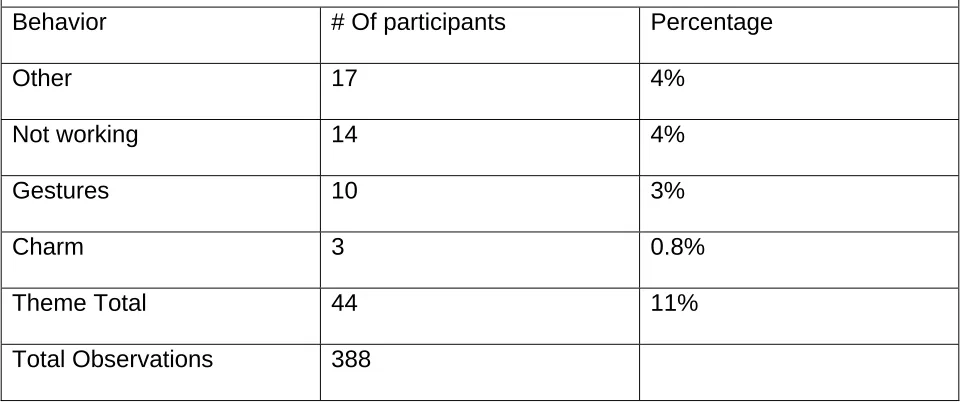
Table 3
Evoking Luck as Non Verbal
Behavior # Of participants Percentage
Other 17 4%
Not working 14 4%
Gestures 10 3%
Charm 3 0.8%
Theme Total 44 11%
Luck rituals as non- verbal language
In this theme I included the codes not working, gestures, other, and charms. I
referred to this theme as non-verbal because the patrons were not speaking. It was
separate from the physical interaction theme because the patrons were not physically
interacting with the machine they were playing. These codes were mainly based on my
perceptions and the body language of the participants.
Other
Other is a code that I used for the patrons’ use of other individuals during their
gaming process. Often times, while the patron was partaking in the gaming process and
went into the bonus round, rather than trying their own luck they enlisted the help of
others. For example, a Caucasian woman who was casually dressed in a t-shirt and
jeans got another woman, who appeared to be with her, to play her bonus round
because she said that she had not been lucky lately. An African American woman who
was nicely dressed in a blouse and some jeans went into the bonus round, which had a
matching game, and she also had another woman make her choices for her. The
players also used others to determine what they should do in situations dealing with the
machines they were playing. A Caucasian man and a Caucasian woman asked an
African American woman for advice on what they should do after they won some
money. They asked her whether or not they should continue to play the game or if they
should cash their money out. Using someone else’s judgment was thought to be able to
change the outcome of what might be chosen in the bonus round. However, it did not
change the true outcome of the bonus round because if the patron was randomly
chosen to win in the bonus round, they would win the bonus round. I have seen a player
come out with nothing. This behavior showed up mainly with Caucasian men and
women and African American women. Women enlisted the help of others more than the
men did and my observations showed that the Caucasian women did this most often.
Not Working
I describe the code of “not working” as the situation when a patron found a
machine that they saw was not working and then decided to play it. During my
observations I overheard patrons saying that when the machine did not work there was
a better chance of hitting. Some believed that the game would malfunction and they
would win. Some items that indicated the machines may need maintenance were: when
call attendant appeared across the monitor, the light over the bill validator (cash
acceptor) was not lit up, the machine showed that a ticket was jammed, or lights were
blinking at the top of the machine. For instance, A Caucasian man dressed in a button
down shirt and jeans was playing at a game that tilted, and after he got it fixed he
continued to play. He continued to play at this machine even though it tilted four times
during the duration of his play. An African American woman called for help on a
machine that would not accept her coupon, though there was an identical game right
next to it. There was an African American man wearing a button down shirt and jeans
who asked an attendant to open his machine because he did not like the light that was
blinking at the top of his machine. These minor problems could be fixed. To my
knowledge these problems did not cause the games to malfunction and pay out big
money. These problems pertained to the printer and the bill validator being jammed or
these problems did not cause the game to reset like some of the patrons may have
believe.
I observed 14 individuals migrating to machines that were not working. The
women appeared to do this more than the men did. I observed this among all the
women except for the Middle Eastern women. The Middle Eastern and Asian men were
the only males that I did not see participating in this behavior.
Gesturing
I defined gesturing as things that were done in front of the monitor but without
saying anything or making any physical contact with the machine. Gestures were done
after the bet was placed and the reels began to spin. The gestures could be things like
fist shaking and finger flicking. For instance, an African American man dressed in a
jacket and jeans shook his fist in the air as his reels were spinning. Another African
American man dressed in a button down shirt and khakis shook a fist with one finger out
in front of the monitor as the reels spun. These actions were merely gestures. They
were used to express the wants the patrons had, which was the want for the reels to do
something in their favor.
Women mostly did gestures and Caucasian and Hispanic women were the ones
that participated in the behavior the most. I observed that African American and
Hispanic men were the only men that participated in this behavior.
Lucky Charm
“Lucky charm” is a code for an object a patron used to evoke luck. The charm
could be big or small and the patron held the charm or even rubbed it. A Middle Eastern
at a time. There was a Caucasian man dressed in business casual clothing that was
rubbing a cross necklace that he was wearing, before and after each item he picked in
the bonus round. A female, who was with him, also participated in the behavior. When it
was her turn to choose in the bonus round she rubbed his necklace as well. The charms
were used for each spin and they were used to attempt to influence the outcomes of the
slot machines played.
The lucky charm code mainly appeared to be predominant with males. This
behavior occurred 3 times out of the 44 behavior occurrences in the non-verbal theme.
Two of the occurrences were done by men. This may seem small but those that did
participate in the behavior made sure not to miss incorporating their charm in their
gaming process, which is something that I found to be particularly noteworthy.
Discussion
If superstition is defined as “an irrational belief that an object, action, or
circumstance not logically related to a course of events influences its outcome,” (The
American Heritage® Dictionary of the English Language 2000) it coincides with the acts
I referred to as luck ritual. This shows that my notion is not completely new. Though it is
a different perspective from the articles I found which focused on horse races, flashing
lights and lottery tickets rather than casino slot machines, I applied it to luck rituals at
casino slot machines. I did not find articles linking luck rituals to slot machines.
Researchers note that “if there is a universal truth about superstition, it is that
superstitious behavior emerges as a result of uncertainty- to circumstances that are