in the population sciences published by the Max Planck Institute for Demographic Research Konrad-Zuse Str. 1, D-18057 Rostock · GERMANY www.demographic-research.org
DEMOGRAPHIC RESEARCH
VOLUME 18, ARTICLE 1, PAGES 1-26
PUBLISHED 29 FEBRUARY 2008
http://www.demographic-research.org/Volumes/Vol18/1/ DOI: 10.4054/DemRes.2008.18.1
Research Article
Gender equity and fertility intentions in Italy
and the Netherlands
Melinda Mills
Letizia Mencarini
Maria Letizia Tanturri
Katia Begall
© 2008 Mills et al.
1 Introduction 2
2 Previous research and theoretical framework 3 2.1 Classic approaches to explain low fertility 3 2.2 A gendered approach to explain low fertility 4 2.3 Gender systems and low fertility 7
3 Data and methods 11
3.1 Data 11
3.2 Variables used in the analysis and statistical methods 12
4 Results 16
5 Discussion 18
6 Acknowledgements 20
Gender equity and fertility intentions in Italy and the Netherlands
Melinda Mills1
Letizia Mencarini2
Maria Letizia Tanturri3
Katia Begall4
Abstract
Fertility levels have fallen drastically in most industrialized countries. Diverse theoretical and empirical frameworks have had difficulty explaining these unprecedented low levels of fertility. More recently, however, attention has turned from classic explanations, such as women’s increased labour market participation, to gender equity as the essential link to understand this phenomenon. Increases in women’s labour market participation did not prompt a rise in men’s domestic duties, often referred to as women’s ‘dual burden’ or ‘second shift’. Beyond the household, institutions and policies within countries facilitate or constrain the combination of women’s employment with fertility. This paper provides an empirical test of gender equity theory by examining whether the unequal division of household labour leads to lower fertility intentions of women within different institutional contexts. Italy constitutes a case of low gender equity, low female labour market participation and the lowest-low fertility. The Netherlands has moderate to high gender equity, high part-time female labour market participation and comparatively higher fertility. Using data from the 2003 Italian Multipurpose Survey – Family and Social Actors and the Dutch sample from the 2004/5 European Social Survey, a series of logistic regression models test this theory. A central finding is that an unequal division of household labour only significantly impacts women’s fertility intentions when they already bear a heavy load (more work hours, children), a finding that is particularly salient for working women in Italy.
1 ICS/Department of Sociology, University of Groningen, Netherlands.
E-mail: [email protected].
2 Department of Statistics and Applied Mathematics, University of Turin, Italy.
E-mail: [email protected].
3 Department of Applied Statistics and Economics “L.Lenti”, University of Pavia, Italy.
E-mail: [email protected].
1. Introduction
Fertility levels have fallen well below replacement level in many industrialized countries, prompting some to argue that we are now experiencing a fertility crisis (Caldwell & Schindlmayr, 2003). International organizations such as the United Nations (2000) have suggested that if these levels persist, countries would have to seek other options, such as massive migration to counter population decline. This decline in fertility has become an increasing concern, particularly in southern European countries where fertility levels have fallen well below the replacement rate for a longer period (Chenais, 1996). These unprecedented levels of low fertility have serious long-term consequences, including aging populations, a decline in the active working population and smaller overall populations (Teitelbaum & Winter, 1985).
A large body of research has focussed on potential reasons and underlying theories to explain low fertility, ranging from economic motives and opportunity costs of having children, to economic uncertainty and shifts in ideology and investments in children. More recently, however, gender equity has been posited as an essential link in understanding the low fertility phenomenon (McDonald 2000a; Cooke 2003). The changing position of women, including women’s increased participation in education and the labour force and the availability of reliable forms of contraception, has been seen as vital to interpret decreases in fertility (Rindfuss et al., 1996). Women’s increased participation in education and the labour market, however, provides only a partial explanation.
Hank, 2000). When they do attempt this, they take on not only the role of paid worker, but also remain the largest contributor to housework and caring tasks.
This paper provides an empirical test of gender equity theory by exploring whether the unequal division of household labour has an impact on the fertility intentions of women in the diverse institutional settings of Italy and the Netherlands. Italy constitutes a case of low gender equity, low female labour market participation and the lowest-low fertility. The Netherlands has moderate to high gender equity, high part-time female labour market participation and comparatively higher fertility. This study therefore attempts to identify whether a link exists between asymmetrical gender division of household labour and low fertility. We assume that women make fertility decisions not only based on current participation in paid and unpaid labour, but with future expectations of how their lives would develop with (additional) children. Our central hypothesis is that for women who engage in the majority of domestic labour, childbearing is seen to exacerbate an already heavy and unbalanced division of household labour. This in turn encourages women to limit their fertility intentions. We anticipate that this effect will be particularly strong for women already balancing the multiple roles of mother and paid worker, and for those in institutional contexts with weak support for combining work and parenthood.
This paper first sketches previous theories and research on this topic in order to draw hypotheses and come to a deeper understanding of the process that links the unequal division of household labour with low fertility. Within this section, we also highlight the relevant institutional and behavioural differences between Italy and the Netherlands. This is followed by a description of the data and methods used in this study and presentation of the main results. We conclude with a reflection on our findings and pay particular attention to future policy directives in this area.
2. Previous research and theoretical framework
2.1. Classic approaches to explain low fertility
Additional factors also include shifts in ideology and the investments in children, often referred to in relation to the second demographic transition (Lesthaeghe & van de Kaa, 1986; van de Kaa, 1987; Lesthaeghe, 1995).
Economic theories have explained low fertility to be triggered by women’s increased economic independence (Becker, 1981), mainly through improved education and higher labour-force participation. This in turn reduces the gains from marriage based on the interdependence of the traditional gender division of labour in the family, and increases the relative cost of childbearing (via women’s foregone earnings while they care for the children at home or reduce their work hours). Although gender is a major explanatory factor in these classic theories, feminist scholars have argued that overlapping gender-roles may, in fact, strengthen family relationships, whereas role-specialization makes the family vulnerable whenever the abilities of one or both partners to provide their particular contribution (earnings or care) diminish (Oppenheimer, 1994). Moreover, high female employment rates can be combined with relatively high fertility when policies and home-sphere gender relations facilitate the combination of paid work and parenthood (Bernhardt, 1993; Brewster & Rindfuss, 2000).
An added criticism is that women’s labour market participation and fertility intentions cannot be understood by examining only current behaviour. Rather, we need to also anticipate decision-making based on future expected outcomes. It is not merely participation in paid labour that sways women’s fertility decisions, but the amount of work that they engage in at home in their ‘second shift’ (Hochschild, 1989). In other words, women who are already participating in the labour market, and doing a large share of domestic work, may be deterred from having children due to the expectation that it will damage their future labour market or individual development prospects. In many countries, having children can seriously compromise women’s job opportunities. This situation can in itself drive some women to reduce the number of children they have or even forego parenthood altogether (Matthews, 1999; Scisci & Vinci, 2002; Mencarini & Tanturri, 2006; Tanturri & Mencarini, 2008).
2.2 A gendered approach to explain low fertility
Sweden; Miller Torr & Short 2004 on US; Cooke, 2003 on Italy and Spain; Mencarini & Tanturri 2004, on Italian urban contexts). Existing results provide overwhelming evidence that the time-squeeze for working mothers is indeed real. In contexts where childcare services or other support such as part-time or flexible hours for working mothers are not available, the behaviour of fathers is fundamental. In fact, the participation of fathers in household duties appears to increase both the intentions and likelihood for the couple to have more children.
Fertility theory has therefore also embraced gender equity as a possible explanation of lowest-low fertility in Southern Mediterranean countries (Ongaro, 2002). McDonald (2000b) suggests that very low fertility may be the result of a hiatus that has developed in some developed countries between “high levels of gender equity in individual-oriented social institutions and sustained gender inequity in family-oriented social institutions”. If in recent decades women have been given the same opportunities as men in education, and to some extent, in the labour market, this has not occurred within the family. The shift to a more gendered approach also entails moving from not only a study of the individual but also household and institutional determinants.
Over two decades ago, Folbre (1983: 267) argued that ignoring power relations within the household was a “fatal error of omission” in fertility theory. One such proxy of power is the level of education, which in turn influences the bargaining power of women in the household. We anticipate that women who have higher levels of education will be more empowered in their decision-making both in relation to household labour and fertility. This is not only attributed to higher levels of human capital and the ability to assert their power, but also the fact that education allows them to question traditional roles (McDonald, 2006). Furthermore, various studies have demonstrated that couples with higher education have a more even division of household labour compared to those with lower levels of education (Gershuny & Robinson, 1988; Mencarini & Tanturri, 2004). Others have argued that the highly educated (often working) women have higher opportunity costs or ‘more to lose’ if they have children (e.g., Becker, 1981). However, we foresee an opposite effect with the following hypothesis. Due to a more even division of household labour, higher economic assets and the ability to break traditional roles, highly educated women will
have higher fertility intentions compared to those with lower education. This effect is
Although there is a higher percentage of childlessness among the highly educated and their births are often postponed, there is growing evidence that these individuals not only have high fertility intentions, but also possess the resources to turn intentions into behaviour.
Although the level of education provides a useful measure, the actual division of housework within the household is a more direct measure of power and equity. This has also been the central focus of previous studies on this topic. Miller Torr and Short (2004) found that the relationship between gender equity – as indicated by division of housework – and fertility is U-shaped in the US. They found that in dual-earner couples, both ‘modern couples’ (where women do less than 54% of housework) and ‘traditional couples’ (where women do more than 84% of housework) were more likely to have second birth. Using Eurobarometer data for 15 European countries, Alonso (2004) also found a significant positive correlation between fertility levels and the ideal distribution of childcare tasks and the actual distribution of housework tasks. In the same study, however, no correlation was found between fertility and the actual share of childcare tasks.
Tazi-Preve et al. (2004) shows a depressive effect of the unequal distribution of household labour on fertility intentions in Austria. This concurs with the work of Olah (2003), who found that in both and Sweden and Hungary, a more equal gender division in household tasks accelerates the transition to the second child, noting that specific policies in Sweden supported this transition. Using European Community Household Survey data for Italy and Spain, Cooke (2003) also concludes that a substantial involvement of fathers in care activities with the first child facilitates the transition to the second child among young couples. Finally, using data from a survey conducted in five urban areas (Udine, Padua, Florence, Pesaro and Messina), Mencarini and Tanturri (2004) found a higher likelihood of having a second child among working women if the father increased his involvement in housework after a first birth, and if the mother did not reduce her working hours after the first child. Based on these findings, we therefore hypothesize the following relationship between the household division of labour and fertility intentions. Women who engage in a large share of household labour (>75%) will have lower fertility intentions than those who engage in a low share of household labour (<75%).
second shift is what tends to cause the most strain on women. The reconciliation of roles within and outside the family is more difficult for a working mother than for a father, and often the strategies adopted are completely different. Men typically increase the time devoted to paid work and women decrease their working time or even exit the labour market (Anxo et al., 2007, Mencarini & Tanturri, 2004, Lo Conte and Prati, 2003). For reasons such as these, previous studies (Cooke, 2003; Mencarini & Tanturri, 2004) have shown that the gender symmetric role-set of parents increases their likelihood to have one more child in Italy. To capture this ‘dual burden’ effect and in an extension of the previous hypothesis we therefore expect that: Women who engage in a
large share of household labour (>75%)and: a) work a high number of hours in paid
employment (>30 hours/week) and/or,b) alreadyhave one or more children – will have
lower fertility intentions.
2.3 Gender systems and low fertility
Gender equity is not only relevant within the household, but also at the institutional and national level. Mason and Oppenheim (1997) defines these larger gender systems as socially constructed expectations for men and women that “prescribe a division of labour and responsibilities between women and men and grant different rights and obligations to them” (1997: 158). The level of gender development and institutions that support women and men to combine work and care differ greatly per country. Cultural norms surrounding working mothers, availability, affordability and use of childcare and the division of labour form a central part of these gender systems. More tangible institutions and related policies relevant for this topic include: tax systems and regulations, employment regulations and specifically in relation to flexible or part-time work, level and acceptability of working women and mothers, contraceptive availability and acceptance, childcare legislation, affordability and availability. We focus on several of these aspects that are particularly relevant when comparing the Dutch and Italian case.
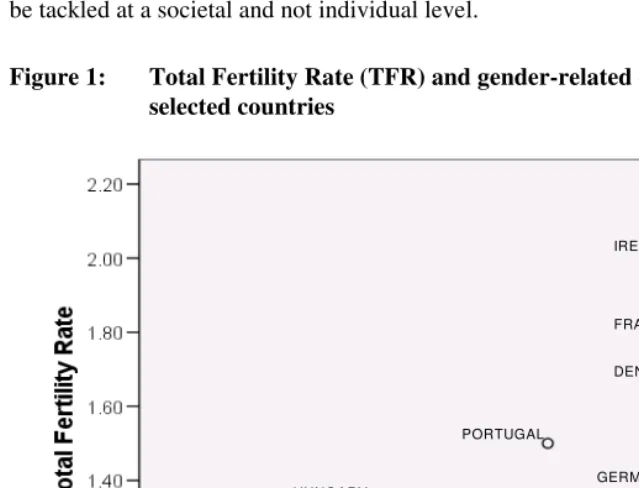
regimes (e.g., Mills & Blossfeld, 2005). Figure 1 shows evident clustering of post-socialist countries, which have both low fertility and low levels of gender equity (which is also likely related to the GDI’s focus on life expectancy and standard of living). This is followed by the southern, more family-oriented regimes, which include Greece, Portugal, Italy and Spain. The conservative or corporatist regimes such as Germany and Switzerland consist of another general group. The social-democratic regimes, including the Scandinavian countries, France and the Netherlands, make up the next group. This is in line with the work of Fuwa (2004), who demonstrated that macro-level gender inequality limited the effects of individual-level variables (e.g., education, resources) on the division of housework. Undertaking an analysis of 22 countries, Fuwa (2004) demonstrated that women in less egalitarian countries benefited less from their individual-level assets, concluding that reduction of inequality in the household should be tackled at a societal and not individual level.
Figure 1: Total Fertility Rate (TFR) and gender-related development index for selected countries
Source: TFR, United Nations http://www.un.org/esa/population/publications/worldfertility/Selected_Indicators.xls GDI, Human Development Report (2003), Table 22, Gender-related development Index
Note: Dates of TFR vary between 2000 and 2001, GDI is 2001
USA
IRELAND
NORW AY FRANCE
NETHERLANDS
AUSTRALIA DENMARK
SW EDEN CANADA UK
PORTUGAL
GERMANY SW ITZERLAND
AUSTRIA
SPAIN
ITALY
GREECE
SLOVENIA
CZECH REPUBLIC POLAND HUNGARY
ESTONIA
Another relevant institutional consideration is the level of female labour market participation and more specifically, the level of mothers who are employed in the labour market. Figure 2 shows the employment rates in 2003 of women (in percentages) by the presence of children for the Netherlands and Italy in comparison with the OECD average (OECD, 2006). A striking difference is the levels of labour market participation between the two countries. In the Netherlands, almost 80 percent of women without children are employed, followed by around 75 percent of mothers with one child working, which falls just below 70 percent for those with two or more children. Dutch women’s employment is concentrated in part-time jobs, interspersed with exits from the labor market during childbearing and rearing periods (van der Lippe & van Dijk, 2002). Italy is in stark contrast to other OECD countries and the Netherlands, with just over 57 percent of women without children in the labour market, which drops to below 55 percent when they have their first child and more sharply to 45 percent in the presence of 2 or more children.
Figure 2: Employment rates of women (in %) by presence of children, OECD average, the Netherlands and Italy, 2003
Source: Society at a Glance: OECD Social Indicators 2006 Edition, figure produced by authors.
0 10 20 30 40 50 60 70 80 90
All women Women with no children One child Two or more children
e
m
p
lo
y
m
e
n
t
ra
te
s
%
To understand these different contexts, we can turn to nation-specific contextual explanations. Dalla Zuanna (2001) provides a rich description of how the family-oriented Italian model penetrates all areas of institutional and social life, relating this to low fertility. Dalla Zuanna argues that endemic familialism generates a strong preference for having a low number of children as a strategy to assure more privileges and opportunity to each child. This strategy also presents large obstacles to leave the parental home, which can be linked indirectly to low fertility. Yet in Italy it is not only postponement of life events, he argues, but a failure to marry and have children, which in turn increases the number of childless women. Del Boca (2002 and Del Boca & Vuri 2007) attribute the low labour market participation rates and low fertility of women in Italy to the Italian institutional structure and specifically the rigid labour market system and weakness of the publicly funded childcare system. These constraints operate to both discourage the labour market participation of women and greatly increase their costs of having children.
Bettio and Villa (1998) contend that the threat of high unemployment rates (particularly for women) in Italy make it virtually impossible for women to risk taking career breaks to have children, due to extreme difficulties to re-enter the labour market. Resistance by unions to part-time work in Italy coupled by regulations, which make it more expensive to hire two part-time workers than one full-time worker, reflects some of this rigidity (Del Boca 2002). Although childcare services in Italy are highly subsidized, the main problem is the scarcity of public childcare for children under three years old and the extreme rigidity in the number of hours that services for both pre-school and pre-school children are available. Others (Kreyenfeld & Hank, 2000) have highlighted the disparity between affordability and actual availability of childcare as a central issue in other European countries as well. Childcare services are generally more compatible with part-time employment, which is relatively rare in Italy. Another clear difference between the two countries is the use of childcare facilities. In Italy, only a minority of children under the age of 3 are in public childcare (6% according to the OECD Family Database), but between the ages of 3 and 6, most are in public care (71%). Whereas, in other European countries, such as the Netherlands and Sweden, around 1/3 of children under the age of 3 are in public childcare (CRRU, 2004).
in these part-time work patterns in the Netherlands (De Graaf & Vermeulen, 1997). Van Wel & Knijn (2006) maintain that the part-time labour market participation of Dutch mothers is primarily caused by cultural factors and not economic or institutional constraints. They contend that a ‘culture of care’ dominates, as does the one-and-a-half earner model where the man works full-time and the woman part-time. This model is particularly dominant among those with lower education. For those with higher education, the tendency is for both partners to attempt to work part-time, although this is only achieved within a very limited group. Based on these institutional and cultural differences, we anticipate that women in Italy will face higher institutional and family
constraints than in the Netherlands, which will in turn limit their fertility intentions. As
outlined in the previous hypothesis, we expect that these constraints will be particularly poignant for Italian working women who engage in both substantial paid labour combined with a heavy load of household duties.
3. Data and methods
3.1 Data
Two different data sources were used for this analysis, using identical sample restrictions. Due to the fact that the research question concerns the share of household labour, respondents who are not co-residing with their partners are excluded from the analysis. Couples who are both cohabiting or married are included in the analyses. The age in both samples has also been restricted to between 20 and 40 years old. This is due to the fact that women older than 40 are unlikely to have further fertility intentions (which was the case in both samples).
of the sample, resulting in too few cases. The ESS was used for the Dutch sample due to the fact that contemporary (and publicly available) Dutch data sources, such as the Netherlands Kinship Panel Study, do not have comparative information about the amount/share of household labour.
3.2 Variables used in the analysis and statistical methods
The dependent variable of fertility intentions was measured by a question that appeared in both surveys about the intentions to have a child within the next 3 years. The categories of definitely not and probably not were classified as no, with probably and definitely yes categorized as yes.
The highest level of education for both the respondent and their partner is
represented by three comparative categories. Lower secondary represents those who have not completed primary school to those who have completed this level or the first stage of basic education. Upper secondary education refers to those who have completed lower secondary school or technical training. The highest level of post-secondary or tertiary education group includes those who completed lower post-secondary school theoretical training up to the highest level of tertiary education (i.e., PhD).
Working hours were classified as the total number of hours per week according to
Finally, we also included age of the respondent, and number of children in the household in the model. To facilitate interpretation and comparison between different groups of respondents, all items except for age and hours of household labour have been recoded into categorical variables (see Table 1 for descriptive statistics of all items used).
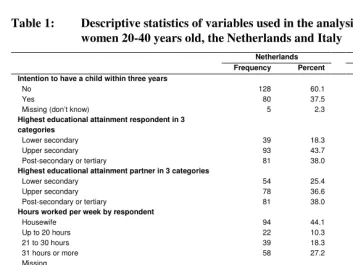
Table 1: Descriptive statistics of variables used in the analysis, women 20-40 years old, the Netherlands and Italy
Netherlands Italy
Frequency Percent Frequency Percent Intention to have a child within three years
No 128 60.1 1979 57.2
Yes 80 37.5 1393 40.3
Missing (don’t know) 5 2.3 86 2.5
Highest educational attainment respondent in 3 categories
Lower secondary 39 18.3 1483 42.9
Upper secondary 93 43.7 1614 46.7
Post-secondary or tertiary 81 38.0 361 10.4
Highest educational attainment partner in 3 categories
Lower secondary 54 25.4 1738 50.3
Upper secondary 78 36.6 1409 40.7
Post-secondary or tertiary 81 38.0 311 9.0
Hours worked per week by respondent
Housewife 94 44.1 1487 43.0
Up to 20 hours 22 10.3 366 10.6
21 to 30 hours 39 18.3 395 11.4
31 hours or more 58 27.2 1210 35.0
Missing
Respondents’ share of household labour
<75% 86 40.4 1018 29.5
>75% 127 59.6 2380 68.8
Missing (refused) 60 1.7
Number of children living in household
No children 56 26.3 744 21.5
1 child 57 26.8 1116 32.3
2 or more children 100 46.9 1598 46.2
Total 213 100.0 3458 100.0
A series of logistic regression models examine the fertility intentions of women in both countries. The first model examines the impact of key variables including: education of respondent and partner, age, weekly hours paid labour by respondent, number of children, hours of unpaid household labour and the share of the household work by the respondent. The second model then includes the two interaction effects of share of household work by: a) number of children and, b) hours of paid employment. Model 3 includes the full model (with interaction effects) for working women only. As Table 1 illustrates, 43 percent of women in the Italian sample report zero work hours, roughly the same as in the Netherlands (44%).
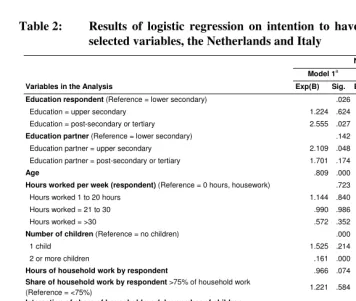
Table 2: Results of logistic regression on intention to have another child by selected variables, the Netherlands and Italy
Netherlands
Model 1a Model 2b Model 3c Variables in the Analysis Exp(B) Sig. Exp(B) Sig. Exp(B) Sig.
Education respondent (Reference = lower secondary) .026 .047 .575 Education = upper secondary 1.224 .624 1.102 .021 .837 .840 Education = post-secondary or tertiary 2.555 .027 2.273 .060 1.528 .642
Education partner (Reference = lower secondary) .142 .046 .015 Education partner = upper secondary 2.109 .048 2.686 .014 4.174 .056 Education partner = post-secondary or tertiary 1.701 .174 2.210 .056 9.591 .004
Age .809 .000 .801 .000 .784 .000
Hours worked per week (respondent) (Reference = 0 hours, housework) .723 .878 .075 Hours worked 1 to 20 hours 1.144 .840 .742 .798
Hours worked = 21 to 30 .990 .986 .406 .435 2.245 .683 Hours worked = >30 .572 .352 .841 .834 36.932 .047
Number of children (Reference = no children) .000 .000 .045 1 child 1.525 .214 2.339 .015 86.712 .016 2 or more children .161 .000 .223 .000 2.518 .517
Hours of household work by respondent .966 .074 .969 .113 1.318 .030
Share of household work by respondent >75% of household work
(Reference = <75%) 1.221 .584 10.930 .011 1.787 .345
Interaction of share of household work by number of children
(Reference = <75% of housework, no children) .093 .040 >75% of household, 1 child .194 .042 .720 .012 >75% of household, 2 or more children .212 .065 .802 .047
Interaction of share of household work by hours worked
(Ref. = <75% of housework, 0 – 20 hours work) .033 .020 >75% of household, 21 to 30 hours work .700 .741 .921 .488 >75% of household, >30 hours work .123 .016 .707 .009
Constant 2259.239 .000 275.746 .000 25.382 .247
-2 LL 183.368 171.001 105.198
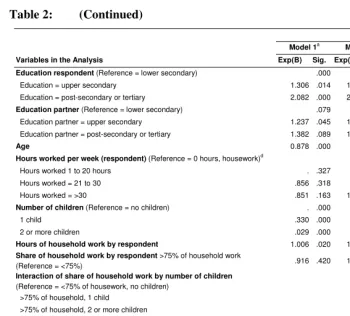
Table 2: (Continued)
Italy
Model 1a Model 2b Model 3c Variables in the Analysis Exp(B) Sig. Exp(B) Sig. Exp(B) Sig.
Education respondent (Reference = lower secondary) .000 .000 .000 Education = upper secondary 1.306 .014 1.314 .012 1.631 .001 Education = post-secondary or tertiary 2.082 .000 2.082 .000 2.599 .000
Education partner (Reference = lower secondary) .079 .077 .045 Education partner = upper secondary 1.237 .045 1.239 .045 1.406 .016 Education partner = post-secondary or tertiary 1.382 .089 1.389 .086 1.446 .127
Age 0.878 .000 .878 .000 .871 .000
Hours worked per week (respondent) (Reference = 0 hours, housework)d
Hours worked 1 to 20 hours . .327 .927 .665 Hours worked = 21 to 30 .856 .318 .962 .886 1.169 .644 Hours worked = >30 .851 .163 1.050 .801 1.280 .377
Number of children (Reference = no children) . .000 .000 .000
1 child .330 .000 .341 .000 .341 .000
2 or more children .029 .000 .030 .000 .027 .000
Hours of household work by respondent 1.006 .020 1.006 .028 1.000 .004
Share of household work by respondent >75% of household work
(Reference = <75%) .916 .420 1.138 .636 1.651 .021
Interaction of share of household work by number of children
(Reference = <75% of housework, no children) .969 .029 >75% of household, 1 child .948 .834 0.656 .016 >75% of household, 2 or more children .932 .816 0.588 .117
Interaction of share of household work by hours worked
(Ref. = <75% of housework, 0 – 20 hours work) .406 .043 >75% of household, 21 to 30 hours work .868 .664 .822 .644 >75% of household, >30 hours work .729 .181 .646 .122
Constant 200.712 .000 171.549 .000 143.233 .000
-2 LL 2927.351 2925.533 1591.933
3340 3340 1869
Source: Netherlands, European Social Survey (ESS), Wave 2, 2004/5; Italy, Italian Multipurpose Survey – Family and Social Actors, 2003
Note: Reference group for intention to have another child is no.
a Model 1: base b Model 2: with interactions c
Model 3: with interactions, only working women
4. Results
The first descriptive results within Table 1 provide clear evidence of similarities as well as differences between these countries. From these preliminary descriptive statistics, a first general conclusion is that the distribution of those who intend to have a child within the next three years is virtually the same in both countries. There is only a slightly higher intention expressed by Italian women (40.3) in comparison to their Dutch counterparts (35.6).
The most obvious difference is that Dutch women have higher education in comparison to their Italian counterparts, while 38 percent of Dutch women finished post-secondary or tertiary education, this accounts for only 10 percent of the Italian sample. A striking similarity in light of the educational differences is the fact that differences in the labour market participation of women in the Netherlands and Italy are relatively small. About 44 percent of women in both countries reports to be full-time housewives, Dutch women work more often part-time, 28 percent work 21-30 hours per week compared to 11 percent of Italian women. This high level of housewives in the Netherlands does not entirely reflect OECD and national estimates and therefore may be more of a selection effect in the collection of the ESS data.
A remarkable similarity is the share of household labour that women engage in within the household. Italy has a pronounced unequal division of household labour, with about 70 percent of women engaging in more than 75 percent of the household duties, while in the Dutch sample 60 percent of women report doing more than 75 percent of household duties. Conversely, around 40 percent of Dutch women do less than 75 percent of the housework, compared to 30 percent of Italian women.
Table 2 provides the estimate of the logistic regression analyses by country, starting with the base model and continuing with the full model that includes the interaction effects for all women (model 2) and working women only (model 3).
Our second hypothesis predicted that women who engage in a large share of
household labour (>75%) would have lower fertility intentions. In the first model, we
see no significant difference between the two groups of women, providing no clear evidence that an asymmetrical division of labour inhibits fertility intentions. However, role conflicts appear to dampen fertility intentions, as was predicted in our third hypothesis. Here we see that the result becomes significant when we enter the interaction effects. In this hypothesis we argued that it was not only a larger share of
household labour (>75%), but also working in a high number of hours in paid
employment (>30 hours/week) and/or, already having one or more children that would
lower fertility intentions. Both of these sub-hypotheses are supported, demonstrating the role conflict within the second shift. Compared to childless women who engage in less housework, mothers (with either one or two or more children) engaging in more than 75 percent of the housework have significantly lower fertility intentions. A similar finding also holds in relation to work hours. Compared to those with a lower share of housework and limited work hours (0-20/week), combining 75 percent of household tasks with higher work hours – particularly more than 30 hours a week – results in reduced fertility intentions for women. This is significant and particularly holds for Dutch women working more than 30 hours a week. Previous research (e.g., European Commission, 2005, p.42; Mills & Täht, 2007) has demonstrated that it is structurally and normatively difficult for Dutch mothers to deviate from working part-time. The school system in the Netherlands, for instance, largely fosters a need for one parent to work part-time, constraining the full-time dual-earner model. This occurs in the form of structural and cultural norms, such as: generally two to three free afternoons per week for elementary school age children, the cultural norm that children return home each lunch hour, reticence to put children in daycare, and the structural lack of after-school care. Other control variables, such as age and number of children operate in the expected manner.
5. Discussion
The goal of this paper was to provide an empirical test of gender equity theory by examining whether the unequal division of household labour leads to lower fertility intentions of women in the divergent institutional contexts of Italy and the Netherlands. A theoretical review demonstrated the need for a more gendered approach to the explanation of low fertility. An unequal division of labour within the household was positioned as a central link in understanding women’s reduced fertility intentions. Contexts such as Italy are characterised by an extreme absence of institutions to reconcile work and parenthood for women such as a scarcity of public or subsidized childcare services and a ‘male-breadwinner’ model which reinforces a highly unequal division of household labour. The Netherlands shows slightly more institutional support via childcare availability and work-family reconciliation measures, such as the widely accepted norm of female part-time labour. Yet, these ‘one-and-a-half-earner’ households are still characterized by a highly unequal division of household labour, which may be related to engrained traditional values (de Graaff & Vermeulen, 1997).
The empirical evidence does not provide clear support to directly link the asymmetrical division of household labour with lower fertility intentions. Rather, the story seems to rest on role conflicts. We did find that an asymmetrical division of household labour prompt women, and especially working women or mothers, to adjust their fertility intentions. This in turn means the reduction of, or even, forgone fertility. Those with higher education (and partners with higher education levels) showed higher fertility intentions, which we relate to a stronger bargaining power of women and the tendency of more highly educated couples to equally divide housework or possibly to outsource it.
In future studies, we would like to divide household labour from child and family care activities, which remained a problem. Another extension would be to examine not only fertility intentions, but also behaviour such as the transition to second child. Finally, fertility intentions were discussed and analyzed only in relation to women’s and not couples’ intentions. It is obvious that women do not make fertility decisions in a vacuum. An interesting future study would be to examine differences in the fertility intentions of men, women and joint couple decisions.
duties (e.g., Drobnič, Blossfeld & Rohwer, 1999), we question whether these types of
goals are realistic. It may be more promising for women to ‘outsource’ household and childcare duties than to anticipate an equal distribution of household labour. Conversely, although not always a popular opinion in some circles, it also essential to consider the already large burden placed on the ‘male-breadwinner,’ particularly in these family-based societies. A reduction in men’s paid workload and a more even distribution of paid labour between partners could also allow men to participate more fully in the household.
Another clear difference between these two countries was the higher employment of Dutch women and mothers, which is largely attributed to the opportunity for Dutch women to combine part-time work with parenthood. This type of employment appears to result in more possibilities to have children and, for the society, ultimately reach higher total fertility levels. This is in opposition to the ‘either / or’ possibility of parenthood versus employment in Italy, which operates largely as a deterrent for women to embark into parenthood or have further children. The underlying reasons for these differences are partially attributed to institutions, such as the lack of childcare in Italy, cultural acceptance of working mothers and availability of more flexible part-time jobs. It is also coupled with a persistent unequal division of household labour in both countries, which make it difficult for women, and couples, to break out of this position.
But is the introduction of more flexible employment measures, such as more possibilities for part-time work, a realistic solution for Italy? A gradual and non-radical solution such as this could be a more pragmatic strategy to counter low fertility in the Italian case. This fits with McDonald’s (2000b: 433) assertion that “social norms may allow women’s increased control over their own fertility within what is, in most respects, a male-dominated family system so long as their increased independence does not threaten the prevailing family system”. In this sense, the Dutch model means that women are permitted and encouraged to marginally enter the labour market and remain virtually full-time mothers and housewives, which in turn does not threaten the male-breadwinner family model (Mills & Täht, 2007).
for women means that Dutch mothers often hold a ‘triple burden’ by engaging in the multiple roles of paid worker, primary household worker and primary carer for children. By taking a longer-term life course perspective, we also see that part-time work means the development of substantially different employment careers and incomes, that often progress at a significantly lower level than their male counterparts, even years after children have left the home (Hofmeister, Blossfeld & Mills, 2006). In the event of divorce or widowhood, these women are at a higher risk of falling into poverty. Regardless of this problem, it is clear that gender equity both within and outside of the family is central factor in understanding low fertility.
6. Acknowledgements
References
Alonso, F.G. (2004): The uneven distribution of family responsibilities between women and men, and its link with low fertility: some evidence for European Union countries from Eurobarometer data. Papers de demografia, Nº. 253, Universidad de la Rioja, Spain.
Anxo. D., L. Flood, L. Mencarini, A. Pailhé, A. Solaz, and M.L. Tanturri (2007): Time Allocation between Work and Family Over the Life-Cycle: A Comparative Gender Analysis of Italy, France, Sweden and the United States. IZA Discussion
Paper, No. 3193 (November), Available at SSRN:
http://ssrn.com/abstract=1049381.
Becker, G.S. (1981). A Treatise on the Family. Cambridge, MA: Harvard University Press.
Becker, P.E. and P. Moen, (1999): Scaling Back: Dual-earner couples’ work-family strategies, Journal of Marriage and the Family, 61(4): 995-1007.
Bernhardt, E.M. (1993): “Fertility and employment”, European Sociological Review, 9 (1): 25-42.
Bettio, F. and P. Villa (1998): A Mediterranean Perspective on the Break-down of the Relationship between Participation and Fertility, Cambridge Journal of
Economics, 22 (2): 137-171.
Blossfeld, H.-P. and C. Hakim, (1997): Between Equalization and Marginalization:
Women Working Part-time in Europe and the United States. New York: Oxford
University Press.
Brewster, K.L. and R.R. Rindfuss (2000): “Fertility and women’s employment in industrialized nations.” Annual Review of Sociology, 26: 271-296.
Caldwell, J. and T. Schindlmayr, (2003): “Explanations of the fertility crisis in modern societies: A search for commonalities,” Population Studies, 57(3): 241-263.
Chesnais, J.-C. 1996. “Fertility, family and social policy in contemporary Western Europe,” Population and Development Review, 22(4): 729-739.
Cooke, L. P. (2003): The South revisited: The division of labor and family outcomes in
Italy and Spain, IRISS Working Paper Series, no. 2003-12. CEPS/Instead,
CRRU (2004): Quality in early learning and child care services: Papers from the
European Commission Childcare Network, Childcare Resource and Research
Unit, Toronto, Canada.
Dalla Zuanna, G. (2001): “The banquet of Aeolus. A Familistic Interpretation of Italy's. Lowest-Low Fertility” Demographic Research, 4(5), 1-29.
Davis, K. 1937. “Reproductive institutions and the pressure for population,” Sociological Review, 29 (July): 289-306, reprinted in (1997) Population and
Development Review, 23 (3): 611-624.
De Graaf, P. and H. Vermeulen (1997): “Female Labour-Market Participation in the Netherlands: Developments in the Relationships between Family Cycles and Employment,” pp. 191-209, In: Blossfeld, H.-P. and C. Hakim (Eds.) Between equalization and marginalization: Women working part-time in Europe and the
United States of America, New York: Oxford University Press.
Del Boca, D. (2002): The effect of child care and part time opportunities on participation and fertility decisions in Italy, Journal of Population Economics, 15(3): 1432-1475.
Del Boca, D. and D. Vuri, (2007): The mismatch between employment and child care in Italy: the impact of rationing, Journal of Population Economics, 20 (4): 805-832.
Drobnič, S., H.-P., Blossfeld, and G. Rohwer, (1999): Dynamics of women’s
employment patterns over the family life course: A comparison of the United States and Germany, Journal of Marriage and the Family, 61(1): 133-146.
Esping-Andersen, G. (1990): The Three Worlds of Welfare Capitalism. Cambridge: Polity Press.
European Commission (2005): Reconciliation of work and private life: A comparative
review of thirty European countries, Luxembourg.
Folbre, N. (1983): Of patriarchy born: The political economy of fertility decisions,
Feminist Studies, 9(2): 261-284.
Fuwa, M. (2004): “Macro-Level Gender Inequality and the Division of Household Labor in 22 Countries,” American Sociological Review, 69(6): 751-767.
Hochschild, A.R. with A. Machung. (1989): The second shift. Working parents and the
revolution at home. Viking: New York.
Hofmeister, H., H.-P. Blossfeld and M. Mills (2006): “Globalization, uncertainty and women’s mid-career life courses: a theoretical framework,” pp. 3-31, In: H.-P. Blossfeld and H. Hofmeister (Eds.) Globalization, Uncertainty and Women’s
Careers: An International Comparison. Cheltenham, UK/Northampton, USA:
Edward Elgar.
Kohler, H.P., F.C. Billari and J.A. Ortega, 2002. “The emergence of the lowest-low fertility in Europe during the 1990s,” Population Development Review, 28 (4): 641-80.
Kravdal, O. (2007): “Effects of Current Education on Second- and Third-Brith Rates amoung Norwegian women and men born in 1964,” Demographic Research, 17(9): 211-46.
Kreyenfeld, M. and Hank, K. (2000): “Does the availability of child care influence the employment of mothers? Findings from western Germany,” Journal Population
Research and Policy Review, 19(4): 317-337.
Lesthaeghe, R. (1995): “The Second Demographic Transition in Western Countries: An Interpretation,” pp. 17-62, In: K.O. Mason and A.-M. Jensen (Eds.) Gender and
Family Change in Industrialized Countries. New York: Oxford University Press.
Lesthaeghe, R. and D.J. van de Kaa, (1986): Twee demografische transities? (Two Demographic Transitions?)., pp. 9-24, In: D.J. van de Kaa and R. Lesthaeghe (Eds), Bevolking: groei en krimp. Deventer: Van Loghum Slaterus.
Lo Conte, M. and S. Prati. (2003): “Maternità e partecipazione femminile al mercato del lavoro. Un’analisi della situazione professionale delle neo-madri” paper presented at Workshop Cnel-Istat on Motherhood and female participation to
job market, between constraints and re-conciliation strategies, Rome (December
2)
Mason, K. and K. Oppenheim. (1997): Gender and Demographic Change: What do we know? In: G.W. Jones et al. (eds.), The Continuing Demographic Transition. Oxford: Clarendon Press, pp. 158-182.
Matthews, B.J. (1999): The Gender System and Fertility: An Exploration of the Hidden Links, Canadian Studies in Population, 26(1): 21-38.
McDonald, P. (2000a): “Gender equality, social institutions and the future of fertility,”
McDonald, P. (2000b): “Gender equity in theories of fertility transition,” Population
and Development Review, 26(3): 427-439.
McDonald, P. (2006): Low Fertility and the State: The Efficacy of Policy, Population
and Development Review, 32(3): 485-510.
Mencarini, L. and M.L. Tanturri (2004): “Time use, family role-set and childbearing among Italian working women.”, Genus 60:111-137.
Mencarini, L. and M.L. Tanturri (2006): “High Fertility or Childlessness: Micro-Level Determinants of Reproductive Behaviour in Italy”, Population, 61 (4): 389-416.
Miller Torr, B. M. and S. E. Short. (2004): "Second births and the second shift: A research note on gender equity and fertility." Population and Development
Review 30 (1):109-130.
Mills, M. and H.-P. Blossfeld (2005): Globalization, Uncertainty and the Early Life Course: A Theoretical Framework, pp. 1-24, In: H.-P. Blossfeld, E. Klijzing, M. Mills and K. Kurz (Eds.) Globalization, Uncertainty and Youth in Society. London/New York: Routledge Advances in Sociology Series.
Mills, M. and K. Täht (2007): “The impact of non-standard work times on partnership quality and stability: Quantitative and qualitative findings from the Netherlands,” Paper presented at the Population Association of America Meeting, New York, USA, March 29-31, 2007.
Mills, M., H.-P. Blossfeld and E. Klijzing (2005): “Becoming an Adult in Uncertain Times: A 14-Country Comparison of the Losers of Globalization,” pp. 393-411, In: H.-P. Blossfeld, E. Klijzing, M. Mills and K. Kurz (Eds.) Globalization,
Uncertainty and Youth in Society. London/New York: Routledge Advances in
Sociology Series.
Morgan, S. P., Taylor, M.G. (2006): Low fertility at the turn of the Twenty-First Century, Annual Review of Sociology, 32: 375-99.
OECD (2006): OECD Factbook 2006: Economic, Environmental and Social Statistics. Geneva: OECD.
Olah L.Sz. (2003): Gendering fertility: Second births in Sweden and Hungary,
Population Research and Policy Review, 22 (2), pp. 171-200.
Ongaro F. (2002): La bassa fecondità in Italia tra fattori esplicativi e implicazioni
socio-economiche: conseguenze per la ricerca, paper presented at XLI
Oppenheimer, V.K. (1994): Women’s rising employment and the future of the family in industrial societies” Population and Development Review, 20 (2): 293- 342.
Plantenga, J. (1996): For Women Only? The Rise of Part-time Work in the Netherlands,
Social Politics, 3(1): 57-71.
Portegijs, W., B. Hermans, V. Laltha (2006): Emancipatiemonitor 2006: veranderingen in de leefsitutatie en levensloop. Den Haag: Sociaal en Cultureel Planbureau/Centraal Bureau voor de Statistiek.
Rindfuss, R.R., K.L. Brewster and A.L. Kavee (1996): “Women, work and children: Behavioural and attitudinal change in the United States,” Population and
Development Review, 22(3): 457-482.
Rubery, J., S. Horrell, and B. Burchell (1994). “Part-time Work and Gender Inequality in the Labour Market,” In: A. MacEwen Scott (ed.) Gender Segregation and
Social Change: Men and Women in Changing Labour Markets. New York:
Oxford University Press.
Scisci A. and M. Vinci (2002): Differenze di genere, famiglia e lavoro, Carocci, Roma.
Tanturri M.L. and L. Mencarini (2008), “Childless or childfree? An insight into voluntary childlessness in Italy”, Population Development Review, vol.34, n.1.
Tazi-Preve, I., D. Bichlbauer, A. Goujon (2004): Gender Trouble and Its Impact on Fertility Intentions, Yearbook of Population Research in Finland, n. 40, pp.5-24.
Teitelbaum, M.S. and J.M. Winter (1985): The Fear of Population Decline. Orlando, FL: Academic.
United Nations (2000): Replacement Migration: Is it a Solution to Declining and Aging
Populations? ESA/P/WP.160. New York: United Nations.
van de Kaa, D.J. (1987): “Europe’s Second Demographic Transition,” Population
Bulletin, 42(1): 1-59.
van de Kaa, D.J. (1996): “Anchored Narratives: The Story and Findings of Half a Century of Research into the Determinants of Fertility,” Population Studies, 50(3): 389-432.
van der Lippe, T., and L. van Dijk, (2002): “Comparative Research on Women’s Employment,” Annual Review of Sociology 28, 221-241.
van Wel, F. and T. Knijn (2006): Transitional Phase or a New Balance? Working and Caring by Mothers With Young Children in the Netherlands, Journal of Family