April 2013, Volume 2 Number 2, 3-14
The effect of outgroup status and perspective-taking on
empathy and outgroup helping
Mashuri, Ali
Department of Psychology, University of Brawijaya, Indonesia ([email protected])
Hasanah, Nur
Department of Psychology, University of Brawijaya, Indonesia ([email protected])
Rahmawati, Intan
Department of Psychology, University of Brawijaya, Indonesia ([email protected])
Received: 2 July 2012 Revised: 2 August 2012 Accepted: 3 August 2012 Available Online: 3 August 2012 DOI: 10.5861/ijrsp.2012.149
ISSN: 2243-7681 Online ISSN: 2243-769X
OPEN ACCESS
Abstract
An important part of our daily lives is characterized with helping interactions, which not only
take place in interpersonal context but also in intergroup context. Helping interactions in
intergroup context typically occur in which people belonging to certain social category
(ingroup) are willing to help others belonging to different social category (outgroup).This
research aims to examine, firstly, how outgroup helping and empathy are affected by outgroup
status and perspective-taking. Secondly, this research is to test the role of empathy in
mediating the effect of outgroup status and perspective-taking on outgroup helping. The
results are in line with all hypotheses specified in demonstrating that both lower outgroup
status than higher outgroup status and strong perspective-taking than weak perspective-taking
elicited higher degree of empathy and outgroup helping. We also predicted and found that
empathy mediated the effect of outgroup status and perspective-taking on outgroup helping.
Theoretical and practical implications of these research findings are discussed.
Mashuri, A., Hasanah, N., & Rahmawati, I.
The effect of outgroup status and perspective-taking on empathy and outgroup helping
1. Introduction
Nowadays, the act of helping occurs across the border, socially or geographically. For example when a tsunami stroke on some areas of Southeast Asia, international aids (donation, construction materials, food, volunteerism, and many others) flew rapidly from people around the globe (van Leeuwen, 2007). In this present study, natural disaster assumed to afflict a neighboring country constitutes a background for the investigation of how people are willing to help and emphatic toward the victims of the disaster. We tested the idea in this study that the willingness and the empathy could be explained in light of the victims’ group status (intergroup factor) and perspective-taking (interpersonal factor).
A growing body of evidence from previous studies has verified that the degree of help people give to outgroup as opposed to ingroup is not clearly different (Saucier, Miller, & Doucert, 2005). However, there is a substantial difference regarding the reasons why people are willing to provide help to outgroup than to ingroup (Stürmer, Snyder, & Kropp, 2006). Ingroup helping prevalently stems from pro-social motives such as the belief of sharing a common fate or identity (Gaertner & Dovidio, 2000; Gaertner, Dovidio, Anastasio, Bachman, & Rust, 1993) or emphatic concern (Batson, 1994), whereas outgroup helping is normally energized by strategic motives which meet vested interests of ingroup members such as exerting power, restoring the significance of a threatened group identity, or creating a positive impression (Levine & Cassidy, 2009; Nadler, 2002; Nadler & Halabi, 2006; van Leeuwen & Tauber, 2009). The researchers argued in this study that outgroup helping can also be motivated by a prosocial motive of empathic concern. We argued that this empathy motivated-outgroup helping could be activated in the condition in which the outgroup as the help recipient is portrayed as having lower status than ingroup and in the condition in which ingroup as the helper is encouraged to have strong perspective-taking.
2. Literature review
2.1 Outgroup helping and empathy
Outgroup helping occurs when differences in group memberships or different social, ethnic, or cultural backgrounds between helpers and recipients are salient (Nadler, 2002). It is more prominently the wealthy helping the poor and the developed countries providing aid to the developing countries. Outgroup helping therefore undoubtedly signifies a medium in which more fortunate people redistribute their wealth, give their expertise, and express their caring to provide the needy others with the best solution (van Leeuwen, 2007; van Leeuwen & Tauber, 2009). Previous studies have demonstrated the beneficial role of empathy as a social emotion in promoting positive attitudes and pro-social behaviors toward other. Here, the other not only refers to a single person but also members of group. There are abundant conceptual definitions of empathy. In this study, we focus on the definition of empathy created by de Vignemont and Singer (2006). The two authors contend that empathy has three properties. The first is that empathy is an affective state; the second is that empathy emerges on the basis of imagination and observation of others’ affective state; and the third is that empathy is the recognition of others’ condition as the source of one’s affective state.
The effect of outgroup status and perspective-taking on empathy and outgroup helping
Ortiz, 2007). Under certain situations, however, empathy toward outgroup members is also feasible. For instance, group members encouraged to empathize with a single member of outgroup have proved to show greater caring and pro-sociality to that member. Provided that the single member is considered to be prototypical or representative to the entire outgroup, the heightened caring can be extended to positive behavioral proclivities which are aimed at helping (Batson, Chang, & Rowland, 2002). People are also willing to pro-socially help outgroup when they share a common bond, a sense of “we-ness” rather than “them versus us”, with that outgroup (Levine, Prosser, & Evans, & Reicher, 2005).
One of this research purposes is to examine the notion that empathy motivated- outgroup helping can be expanded to group level. Furthermore, we seek to affirm that empathy motivated- outgroup helping can be generated from the nature of group membership through social categorization process. Two categorization processes that have been examined to elicit empathy-motivated outgroup helping are ‘ingroup norm’ created by Tarrant, Dazeley, and Cottom (2009) and ‘levels of identity categorization’ invented by Dovidio, Gaertner, Shnabel, Saguy, and Johnson (2010). Inspired by these studies, we set out to examine another social categorization process termed “outgroup status” to investigate the dynamics of group-based relationship between empathy and helping behavior toward outgroup. The rationalizations of this idea are primarily hinged on Social Identity Theory.
2.2 Outgroup status, empathy, and outgroup helping
Social Identity Theory (Tajfel & Turner, 1979) posits that the need to secure a positive social identity urges differential emotional reactions to ingroup and outgroup member. In support of this assumption, Gordjin, Wigboldus, and Yzerbyt (2001) found that when the victims of negative intergroup behavior were classified as outgroup members rather than ingroup members, emotion of anger was less likely to be experienced. Emotion of empathy for harmed outgroup members was weakened when ingroup members perceived that the harm could be justified (Miron & Branscombe, 2008). Sometimes people instead experience pleasure rather than empathy with misery or any negative events that suffer members of outgroup. This phenomenon is called intergroup schadenfreude (Leach, Spears, Branscombe, & Doosje, 2003).
Some researchers have found the moderating effect of social categorization on the relationship between empathy and outgroup helping. Sturmer and colleagues for example (Sturmer, Snyder, Knopp, & Stern, 2006; Sturmer, Snyder, & Omoto, 2005) successfully identified that empathy indeed urge outgroup helping to the extent that the outgroup is perceived to be similar to the ingroup. This finding ascertains the notion that the significant effect of empathy on outgroup helping relies on the degree of perceived commonality between the ingroup and outgroup. Nevertheless, Sturmer and colleagues did not observe significant effect of perceived similarity or commonality on outgroup empathy.
In a stark contrast to the study by Sturmer and colleagues, other researchers have instead confirmed direct effect of social categorization on outgroup empathy. Tarrant et al. (2009) for example found that ingroup norm has a direct, significant effect on outgroup empathy. Participants in their study who were led to believe that empathy toward others is their ingroup norm showed greater willingness to provide helping to outgroup than those who were led to believe that objectivity or detachment toward others is their ingroup norm. Furthermore they also revealed that the empathy significantly mediates the relationship between characteristics of ingroup norm (empathic versus objective or detached) and outgroup helping.
Mashuri, A., Hasanah, N., & Rahmawati, I.
2.3 Perspective-taking, empathy, and outgroup helping
Perspective-taking is observing and imagining others’ feeling and thought to activate empathy (van Lange, 2008). Some researchers conceive that perspective-taking is categorized into three multi-dimensional constructs: perceptual, cognitive, and affective (e.g., Underwood & Moore, 1982). Using the multidimensional construct, Oswald (1996) found that affective perspective taking is significantly more effective than cognitive perspective taking to arouse empathy as well as to boost willingness to provide altruistic helping. Nevertheless, by paying no special attention to the multidimensional approach, some researchers have verified that strong perspective taking (by encouraging participants to imagine other persons’ feeling about the misery they have) compared to weak perspective taking (by persuading participants to remain objective and detached toward other persons’ feeling about the misery they have) is more powerful to elicit empathy (e.g., Coke, Batson, & Mc Davis, 1978; van Lange, 2008). This strong perspective-taking then motivates people to provide helping. Stated another way, strong perspective taking exerts effect on helping through empathy or empathy mediates the relationship between strong perspective taking and helping behavior (e.g., Coke et al., 1978; Batson, Early, & Salvarini, 1997).
Extended to intergroup context, Batson et al. (1997) found that inducing perspective-taking for a young woman in AIDS (Experiment 1) and a homeless man (Experiment 2) improved participants’ attitude toward people with AIDS and the homeless. However, they also found that perspective-taking does not have a significant direct effect on the attitudes. Rather, empathy mediated the direct effect of perspective taking on attitude toward stigmatized outgroup in general. To follow up these findings, Batson et al. (2002) sought to find whether or not empathy not only improves the attitudes but also heightens the act of helping toward stigmatized outgroup. The results of their study were indeed in line with this hypothesis in showing that participants, after being induced with strong perspective taking to a fictitious drug addict and dealer named Jared, were willing to allocate funds to the agency to help people with hard drug addictions in general. In this study, Batson et al. (2002) also confirmed the significant effect of empathy on attitude as the previous study and the role of meditational effect of empathy on the relationship between perspective taking and the act of helping.
2.4 The current study
This study is intended to integrate the role of outgroup status and perspective-taking in explaining empathy and outgroup helping. More particularly, this study tried to verify that outgroup status as a social categorization has a significant impact in shaping empathy. This argumentation is based on Intergroup Emotion Theory (Mackie, Devos, & Smith, 2000) holding that process of social categorization motivates people to experience situational, group-based emotions they consider as having been impactful to their ingroup. From this perspective, people experience group-based emotions (such as anger, pride, and anxiety, and also empathy) especially after they consider and perceive themselves as members of socially significant groups. These emotions are strongly implicative for intergroup attitude and behavior.
Whereas its link to empathy is still relatively unexplored, outgroup status has been proven through several studies to stir up outgroup helping. Participants as members of a high status group were willing to provide helping to outgroup members especially when the outgroup did not threaten their superior status. Under the presence of a potentially material challenge from the outgroup, nevertheless the support to provide helping to members of the outgroup attenuated (Jackson & Esses, 2000). Cunningham and Platow (2007) also uncovered that under unstable, high material ingroup condition, participants more favored to provide helping for their own group members instead of outgroup members. However, when the high material ingroup condition was stable, participants did not discriminate their support to provide helping for ingroup members and outgroup members.
The effect of outgroup status and perspective-taking on empathy and outgroup helping
compared to weak perspective-taking would elicit higher degree of empathy (Hypothesis 1b). Third, the researchers predicted that lower outgroup status more than higher outgroup status would trigger higher degree of outgroup helping (Hypothesis 2a). Fourth, the researchers predicted that strong perspective-taking compared to weak perspective-taking would generate higher degree of outgroup helping (Hypothesis 2b). Fifth, the researchers set up our first mediation hypothesis predicting that empathy would mediate the effect of outgroup status on outgroup helping (Hypothesis 3a). Sixth, the researchers predicted that empathy would mediate the effect of perspective-taking on outgroup helping (Hypothesis 3b).
3. Methodology
3.1 Participants and design
One hundred-and-seventy seven students (38 men, 130 women; 9 participants did not specify their gender; Mage = 19.24, SDage = 1.058) from the Department of Psychology, University of Brawijaya, participated on a voluntary basis. The researchers implemented a 2 (Outgroup Status: lower vs. higher) by 2 (Perspective-Taking: strong vs. weak) between subjects experimental design. Participants were randomly assigned to one of the four combined conditions: lower outgroup status and strong perspective-taking (n = 47), lower outgroup status and weak perspective-taking (n = 42), higher outgroup status and strong perspective-taking (n = 45), and higher outgroup status and weak perspective-taking (n =43).
3.2 Procedure and materials
All variables in this study were assessed on 5-point scales on which participants were asked to indicate their agreement with a statement (1 = not at all; 5 = very much). Scales were created by averaging the items. Experiment in this study was conducted on the basis of completion of a questionnaire that was divided into three parts. In each of the first and second parts there was a text ostensibly published at a credible national newspaper in Indonesia. This text was to manipulate the first independent variable (i.e., outgroup status), which was modified from the study by Cunningham and Platow (2007). In essence, the text reported currently relative economic status of Indonesian people compared to Vietnamese people. In the lower outgroup status condition, the text reads as follows:
“Based on the most currently academic survey, the average household income for Indonesian people is approximately 500.000 IDR (Indonesian Rupiah). This average income is significantly higher than the average household income of Vietnamese people which approximates 50.000 IDR. This gap of the average household income for Indonesian and Vietnamese has been stable for the past one decade. Indonesian thus is richer than Vietnamese and it is predicted that this trend will remain the same for the incoming decades.”
In the higher outgroup status condition, the text read as follows:
“Based on the most currently academic survey, the average household income for Indonesian people is approximately 50.000 IDR (Indonesian Rupiah). This average income is significantly less than the average household income of Vietnamese people which approximates 500.000 IDR. This gap of the average household income for Indonesian and Vietnamese has been stable for the past one decade. Vietnamese is thus richer than Indonesian and it is predicted that this trend will remain the same for the incoming decades.”
Mashuri, A., Hasanah, N., & Rahmawati, I.
result.” Instructions in the weak perspective-taking condition read as follows: “…While you are reading the text, try to take an objective perspective toward what is described. Please try not to get caught up in how the others feel; just remain objective and detached.” Immediately following the instructions was a text modified from the study by Levine and Thompson (2004). The text reported a massive, tragic flood tragedy that fictitiously had just afflicted central province in Vietnam, and it reads as follows:
“Vietnam: Mirinae tropical storms caused flash floods in several provinces in central Vietnam. The floods last month wiped out several and left over 2,000 people dead many thousands more injured and homeless. The hardest hit was of course the poor. Many of who lived unsafe hillsides and riverbanks because the land was cheap. In such places, local officials frequently ignore building regulations in return for bribes or votes. Now, after the disaster, the government’s response is similarly negligent. The inactivity and general malaise of both regional and national branches has added to the death toll and the misery that the citizens of Vietnam must endure. The living mourns those lost in this tragedy whilst struggling to regain their lives. The lack of medical assistance, food supplies, and temporary housing with adequate sanitation presents a grave threat to these Vietnamese people. Diseases, such typhoid and cholera, spread rampantly now in these conditions. The government remains slow to act and still fails to provide the organization and assistance that is crucial at this time. Calls for international help have gone out.”
After reading the two articles, participants then were asked to indicate to what extent they agreed with a single item (“The comparative survey about the Indonesian and Vietnamese peoples’ average income in the first article was realistic and credible”). This item was to assess the credibility of the first article. Then to measure the credibility of the second article, a single item (“The article about flash floods which strikes down Vietnam is realistic and credible”) was given to participants. Participants were also exposed with a single item (According to the first article, the Vietnamese are poorer than the Indonesians”) to assess their comprehension about the first article. This item was accompanied with a single item (“In answering the next questions, I was instructed to do my best to feel and understand other peoples’ misery) to assess whether or not the content of the second article was understood properly by the participants.
In the next part of the questionnaire, participants were asked to answer some items to measure empathy invented by Batson et al. (1997). In this scale, participants were provided with a series of 6 emotion labels (sympathy, soft-heartedness, warmth, compassion, tenderness, and moving; α = .83; M = 3.428; SD = .634) and were asked to indicate to what extent they experience each emotion after reading the text or transcript about the flood tragedy in Vietnam. Participants then were asked to answer some items adapted from the study by Levine and Thompson (2004). These items was to measure outgroup helping [10 items, e.g., “I support the plan of Indonesian government to provide financial support for Vietnamese government to recover its people misery from the flood; “I support the plan of Indonesian government to give financial aid to Non Governmental Organizations (NGOs) in Vietnam that aim to assist the Vietnamese people to recover from the flood”; α = .84; M = 3.728; SD = .588]. On the last part of the questionnaire, participants were asked to indicate their age and gender. Upon finishing, participants were thanked and debriefed.
4. Results
4.1 Manipulation checks
The effect of outgroup status and perspective-taking on empathy and outgroup helping
p= .000, confirming that the second article was also highly credible. Participants’ belief in a statement that the Vietnamese was poorer than the Indonesian in the lower outgroup status condition (M = 3.71, SD = .968) was significantly higher than in the higher outgroup status condition (M = 2.45, SD =.993), t(175) = 8.503, p = .000. This result proved that participants properly understood the content of the first article. In the strong perspective-taking condition, participants’ belief in a statement that they were instructed to try at their best to feel and comprehend others’ misery (M = 4.05, SD = .999) was significantly higher than in the weak perspective-taking (M = 3.47, SD = 1.296), t(175) = 3.371, p = .001. As such, the second article about perspective-taking instructions was indeed properly understood by the participants.
4.2 Preliminary analyses
The demographic variables of gender (coded 1 for men and 0 for women) and age were found to have no significant effect on empathy and outgroup helping—for the effect of gender on empathy, t(175) = -1.263, p= .208, for the effect of gender on outgroup helping, t(175) = .767, p = .444., for the effect of age on empathy, β = -.135, p = .078, and for the effect of age on outgroup helping, β = -.147, p = .051. As a consequence, we did not need to include and control gender and age in the next analyses.
4.3 Empathy and outgroup helping
A univariate General Linear Model (GLM) was used to analyze separately the effect of outgroup status (coded 1 for lower outgroup status and 0 for higher outgroup status) and perspective-taking (coded 1 for strong perspective-taking and 0 for weak perspective-taking) on empathy and outgroup helping. In support of Hypothesis 1a, empathy toward lower status outgroup (M = 3.405, SD = .713) was significantly greater than empathy toward higher status outgroup (M = 3.129, SD =.664), F(1, 173) = 7.003, p = .009. Strong perspective-taking elicited higher degree of empathy (M = 3.370, SD = .70) compared to weak perspective-taking (M = 3.157, SD = .689), F(175) = 4.081, p = .043. This result was in line with Hypothesis 1b.
The researchers also found that the degree of outgroup helping addressed to lower status outgroup (M = 4.028, SD = .574) was significantly higher than outgroup helping addressed to higher status outgroup (M = 3.680, SD = .574), F(1, 173) = 17.302, p = .000. This finding was in accordance with Hypothesis 2a. Supporting Hypothesis 2b, the researchers found that strong perspective-taking generated outgroup helping (M = 3.957, SD = .533) which was significantly higher than weak perspective-taking (M = 3.745, SD = .647), F(1, 173) = 5.969, p = .016.
4.4 Mediation analyses
Following Baron and Kenny’s procedure (1986), the researchers examined the role of empathy in mediating the effect of outgroup status and perspective-taking on outgroup helping. As in Figure 1, the effect of empathy on outgroup helping, while controlling for the effect of outgroup status, was significant. This analysis however lowered the effect of outgroup status on outgroup helping, from B = .348, p = .000 to B = .252, p = .002. A Sobel z-test revealed that empathy significantly mediated the effect of outgroup status on outgroup helping, z = 2.462, p = .007 (one-tailed). This result thus is in line with Hypothesis 3a.
Mashuri, A., Hasanah, N., & Rahmawati, I.
Figure 1. The role of Empathy in mediating the effect of Outgroup Status on outgroup helping
Note: B is an unstandardized regression coefficient. The path form Empathy to outgroup helping is the effect of Empathy on outgroup helping while controlling for Outgroup Status. The number in parenthesis is the effect of Outgroup Status on outgroup helping while controlling for empathy. ** p < .01, *** p < .001
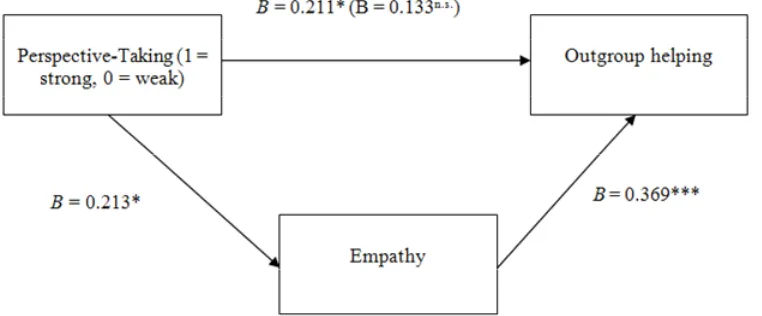
Figure 2. The role of Empathy in mediating the effect of Perspective-Taking on outgroup helping
Note: B is an unstandardized regression coefficient. The path form Empathy to outgroup helping is the effect of Empathy on outgroup helping while controlling for Perspective-Taking. The number in parenthesis is the effect of Perspective-Taking on outgroup helping while controlling for Empathy. * p < .05, *** p < .001, n.s. = not significant
5. Discussions
The researchers present a study in which they investigated, firstly, how empathy and outgroup helping was affected by outgroup status and perspective-taking. Secondly, we examined how the effect of outgroup status and perspective taking on outgroup helping was mediated by empathy. The results in this study were in line with all hypotheses specified in demonstrating that empathy and outgroup helping was significantly higher in the lower outgroup status than higher outgroup status and in the strong perspective-taking than weak perspective-taking. Empathy also turned out to significantly mediate the effect of outgroups status and perspective taking on outgroup helping.
The effect of outgroup status and perspective-taking on empathy and outgroup helping
(Canadian White-People) were willing to provide empowerment help to immigrants in Canada only when the immigrants were described as having lower group status than the Canadians.
This study is the first to identify that social categorization of outgroup status proved to be impactful on empathy, in which lower status outgroups stirred up deeper empathy than higher status outgroup. This finding basically confirms the truism of Social Identity Theory of group based-emotion (Iyer & Leach, 2008; Yzerbyt, Dumont, Mathieu, Gordijn, & Wigboldus, Gordijn, 2003). In terms of this theory, emotion appraisals toward a certain group are strongly influenced by two factors: situational context of ingroup and outgroup relations and situational context of outgroup. By exploring the second factor, this study manipulated situational context of outgroup status (higher or lower) and pioneered the finding that this situational context has a significant effect on empathy as one of emotion appraisals.
This study successfully verified the role of perspective-taking and empathy in determining outgroup helping. The practical implication of this finding is related to the importance of identifying the ways to elevate perspective-taking and empathy more particularly in the context of intergroup relations. One way which has empirically proved to enhance perspective-taking and empathy toward outgroup is intergroup contact (Pettigrew & Tropp, 2008). Intergroup contact in the context of cross-country relationship could be actualized by, for example, enhancing cooperation among countries through student exchange or cross-cultural exhibition.
Follow-up studies could address a number of issues. Subsequent study could draw more closely on how outgroup status has an effect on help type. As discussed previously, (e.g., Cunningham & Platow, 2007; Jackson & Esses, 2000; Halabi, et al., 2008), people tend to be willing to help higher status group only when the type of help is dependency, but not empowerment. Since intergroup helping in this study is a more general helping, next study needs to differentiate empowerment help and dependency help. Secondly, next study could investigate the effect of outgroup status and perspective-taking on empathy and outgroup helping in the context of peace or conflict. The characteristic of outgroup in this study (i.e., the Vietnamese) is generally neutral in the sense that Indonesia and Vietnam has never had history of bilateral conflict. In contrast, relationship between Indonesia and Malaysia for instance is so often characterized with tension especially regarding issue of geographical border and immigrant workers. As found by Nadler and Halabi (2006), outgroup helping in the conflict situation is more energized by strategic motives such as desire to exert power and dominance than pro-social motive.
6. Conclusions
This study supported the notion that the act of helping to members of group having different nationality (outgroup helping) could be generated by empathic concern. At intergroup level, this empathy motivated-outgroup helping is more prominent when the status of the out group as the help recipient is lower than that of the ingroup as help providers. At interpersonal level, empathic concern motivates outgroup helping primarily in strong perspective-taking than in weak perspective-taking. All of these findings imply the feasibility of empathy motivated-outgroup helping under a specific intergroup context (lower versus higher out-group’s status) and in a specific interpersonal context (strong versus weak perspective-taking).
7. Acknowledgements
This research was funded by Educational Development Fund (Dana Pengembangan Pendidikan) sponsored by the Faculty of Social and Political Science, University of Brawijaya
8. References:
Baron, R. M., & Kenny, D. A. (1986). The moderator-mediator variable distinction in social psychological research: Conceptual, strategic and statistical considerations. Journal of Personality and Social Psychology, 51, 1173-1182. <http://dx.doi.org/10.1037/0022-3514.51.6.1173>
Mashuri, A., Hasanah, N., & Rahmawati, I.
psychology (pp. 333-381). Boston: McGraw-Hill.
Batson, C. D., & Ahmad, N. (2001). Empathy-induced altruism in a prisoner dilemma II: What if the target of empathy has defected? European Journal of Social Psychology, 31, 25-36.
<http://dx.doi.org/10.1002/ejsp.26>
Batson, C. D., Chang, J., Orr, R., & Rowland, J. (2002). Empathy, attitudes, and action: Can feeling for a member of a stigmatized group motivate one to help the group? Personality and Social Psychology Bulletin, 28, 1656-1666. <http://dx.doi.org/10.1177/014616702237647>
Batson, C. D., Early, S., & Salvarini, G. (1997). Perspective taking: Imagining how another feels versus imagining how you would feel. Personality & Social Personality Bulletin, 23,
751-758. ,http://dx.doi.org/10.1177/0146167297237008>
Batson, C. D., Eklund, J. H., Chermok, V. L., Hoyt, J. L., Ortiz, B. G. (2007). An additional antecedent of empathic concern: Valuing the welfare of the person in need. Journal of Personality and Social Psychology, 93, 65-74. <http://dx.doi.org/10.1037/0022-3514.93.1.65>
Cialdini, R. B., Brown, S. L., Lewis, B. P., Luce, C., & Neuberg, S. L. (1997). Reinterpreting the
empathy-altruism relationship: When one into one equals oneness. Journal of Personality and Social Psychology, 73, 481-494. <http://dx.doi.org/10.1037/0022-3514.73.3.481>
Coke, J. S., Batson, C. D., & McDavis, K. (1978). Empathic mediation of helping: a two-stage model. Journal of Personality and Social Psychology, 36(7), 752-766. <http://dx.doi.org/10.1037/0022-3514.36.7.752>
Cunningham, E., & Platow, M. J. (2007). On helping lower-status outgroups: The nature of the help and the stability of the intergroup status hierarchy. Asian Journal of Social Psychology, 10, 258-264. <http://dx.doi.org/10.1111/j.1467-839X.2007.00234.x>
de Vignemont, F., & Singer, T. (2006). The empathic brain: How, when and why? Trends in Cognitive Sciences, 10(10), 435-41. <http://dx.doi.org/10.1016/j.tics.2006.08.008>
Dovidio, J. F., Gaertner, S. L., Shnabel, N., Saguy, T., & Johnson, J. (2010). Recategorization and prosocial behavior: Common ingroup identity and a dual identity. In S. Sturmer & M. Snyder (Eds.), The psychology of prosocial behavior: Group process, intergroup relations, and helping. UK: Wiley. Gaertner, S. L., & Dovidio, J. F. (2000).Reducing intergroup bias: The common ingroup identity model.
Philadelphia: Psychology Press.
Gaertner, S. L., Dovidio, J. F., Anastasio, P. A., Bachman, B. A., & Rust, M. C. (1993). The common ingroup identity model: Recategorization and the reduction of intergroup bias. In W. Stroebe & M. Hewstone (Eds.), European review of social psychology (Vol. 4, pp. 1-26). London: Psychology Press.
Gordijn, E. H., Wigboldus, D., & Yzerbyt, V. (2001). Emotional consequences of categorizing victims of negative outgroup behavior as ingroup or outgroup. Group Processes and Intergroup Relations, 4, 317-326. <http://dx.doi.org/10.1177/1368430201004004002.
Halabi, S., Dovidio, J. F., & Nadler, A. (2008). When and how do high status group members offer help: Effects of social dominance orientation and status threat. Political Psychology, 29(6), 841-858.
<http://dx.doi.org/10.1111/j.1467-9221.2008.00669.x>
Iyer, A., & Leach, C. W. (2008). Emotion in inter-group relations. European Review of Social Psychology, 19, 86-125. <http://dx.doi.org/10.1080/10463280802079738>
Jackson, L. M., & Esses, V. M. (2000). Effects of perceived economic competition on people's willingness to help empower immigrants. Group Processes and Intergroup Relations, 3(4), 419-435.
<http://dx.doi.org/10.1177/1368430200003004006>
Leach, C. W., Spears, R., Branscombe, N., & Doosje, B. (2003). Malicious pleasure: Schadenfreude at the suffering of another group. Journal of Personality and Social Psychology, 84, 932–943.
<http://dx.doi.org/10.1037/0022-3514.84.5.932>
Levine, M., & Cassidy, C. (2009). Groups, identities, and bystander behavior: How group process can be used to promote helping. In S. Sturmer & M. Snyder (Eds.), The psychology of pro-social behavior: Group processes, intergroup relations, and helping (pp. 209 – 222). UK: Wiley.
<http://dx.doi.org/10.1002/9781444307948.ch11>
The effect of outgroup status and perspective-taking on empathy and outgroup helping
after natural disasters. Journal of Social Psychology, 144(3), 229-246. <http://dx.doi.org/10.3200/SOCP.144.3.229-245>
Levine, M., Prosser, A., Evans, D., & Reicher, S. (2005). Identity and emergency intervention: How social group membership and inclusiveness of group boundaries shapes helping behavior. Personality and Social Psychology Bulletin, 31, 443-453. <http://dx.doi.org/10.1177/0146167204271651>
Mackie, D. M., Devos, T., & Smith, E. R. (2000). Intergroup emotions: Explaining offensive action tendencies in an intergroup context. Journal of Personality and Social Psychology, 79, 602-616.
<http://dx.doi.org/10.1037/0022-3514.79.4.602>
Maner, J. K., Luce, C. L., Neuberg, S. L., Cialdini, R. B., Brown, S., Sagarin, B. J. (2002). The effects of perspective taking on helping: Still no evidence for altruism. Personality and Social Psychology Bulletin, 28, 1601-1610. <http://dx.doi.org/10.1177/014616702237586>
Miron, A. M., & Branscombe, N. R. (2008). Social categorization, standards of justice, and collective guilt. In A. Nadler, T. E. Malloy, & J. D. Fisher (Eds.), The social psychology of intergroup reconciliation (pp. 77-96). New York: Oxford University Press.
<http://dx.doi.org/10.1093/acprof:oso/9780195300314.003.0005>
Nadler, A. (2002). Inter-group helping relations as power relations: Helping relations as affirming or challenging inter-group hierarchy. Journal of Social Issues, 58, 487-503.
<http://dx.doi.org/10.1111/1540-4560.00272>
Nadler, A., & Halabi, S. (2006). Intergroup helping as status relations: maintaining or challenging social dominance between groups through helping. Journal of Social Issues, 58, 487-502.
<http://dx.doi.org/10.1111/1540-4560.00272>
Oswald, P. A. (1996). The effects of cognitive and affective perspective taking on empathic concern and altruistic helping. The Journal of Social Psychology, 136(5), 613-623.
<http://dx.doi.org/10.1080/00224545.1996.9714045>
Pettigrew, T. F., & Tropp, L. R. (2008). How does intergroup contact reduce prejudice? Meta-analytic tests of three mediators. European Journal of Social Psychology, 38, 922-934.
<http://dx.doi.org/10.1002/ejsp.504>
Stürmer, S., Snyder, M, & Omoto, A. M. (2005). Prosocial emotions and helping: The moderating role of group membership. Journal of Personality and Social Psychology, 88, 532-46.
<http://dx.doi.org/10.1037/0022-3514.88.3.532>
Stürmer, S., Snyder, M., Kropp, A., & Siem, B. (2006), Empathy-motivated helping: The moderating role of group membership. Personality and Social Psychology Bulletin, 32, 943 - 956.
<http://dx.doi.org/10.1177/0146167206287363>
Tajfel, H., & Turner, J. (1979). An integrative theory of intergroup conflict. In: W. G. Austin & S. Worchel (Eds.), The social psychology of intergroup relations (pp. 94-109). Monterey, CA: Brooks-Cole.
Tarrant, M., Dazeley, S., & Cottom, T. (2009). Social categorization and empathy for outgroup members. British Journal of Social Psychology, 40(7), 1635-1656.
Underwood, B., & Moore, B. (1982). Perspective taking and altruism. Psychological Bulletin, 91, 143-173. <http://dx.doi.org/10.1037/0033-2909.91.1.143>
van Lange, P. A. M. (2008). Does empathy triggers only altruistic motivation: How about selflessness and justice? Emotion, 8, 766-774. <http://dx.doi.org/10.1037/a0013967>
van Leeuwen, E. (2007). Restoring identity through outgroup helping: Beliefs about international aids in response to the December 2004 Tsunami. European Journal of Social Psychology, 37(4), 661-671. <http://dx.doi.org/10.1002/ejsp.389>
van Leeuwen, E., & Täuber, S. (2009). The strategic side of outgroup helping. In S. Sturmer & M. Snyder (Eds.), The psychology of pro-social behavior: Group processes, intergroup relations, and helping (pp.
81–102). UK: Wiley. <http://dx.doi.org/10.1002/9781444307948.ch4>
Yzerbyt, V. Y., Dumont, M., Wigboldus, D., & Gordijn, E. H. (2003). I feel for us: The impact of categorization and identification on emotions and action tendencies. British Journal of Social Psychology, 42, 533-549.