٭
Corresponding Author, Email: [email protected]
Failure Process Modeling with Censored Data in
Accelerated Life Tests
N. Ramezanianpour
1*
, M.Seyyed-Esfahani
1and T.H.Hejazi
2 1- Department of Industrial Engineering, Amirkabir University of Technology, Tehran, Iran 2- Department of Industrial & Material Engineering, Sadjad University of Technology, Mashhad, IranABSTRACT
Manufacturers need to evaluate the reliability of their products in order to increase the customer
satisfaction. Proper analysis of reliability also requires an effective study of the failure process of a product,
especially its failure time. So, the Failure Process Modeling (FPM) plays a key role in the reliability analysis
of the system that has been less focused on. This paper introduces a framework defining an approach for the
failure process modeling with censored data in Constant Stress Accelerated Life Tests (CSALTs). For the
first time, various types of censoring schemes are considered in this study. Usually, in data analysis, it is
impossible to get closed form of estimates of the unknown parameter due to complex and nonlinear
likelihood equations. As a new approach, a mathematical programming problem is formed and the Maximum
Likelihood Estimation (MLE) of parameters is obtained to maximize the likelihood function. A case study in
red Light- Emitting Diode (LED) lamps is also presented. The MLE of parameters is obtained using genetic
algorithm (GA). Furthermore, the Fisher information matrix is obtained for constructing the asymptotic
variances and the approximate confidence intervals of estimates of the parameters.
KEWORDS
1. INTRODUCTION
Reliability is one of the most important qualitative characteristics of the complex products. It measures the level of efficiency of systems. In recent years, many manufacturers have used reliability as an essential factor for improving the quality of their products and aimed at reducing the failures of costly components as a strategic policy, since inadequate reliability results in poor economic performance and extra costs for both the manufacturer and the customer. So, manufacturers need to evaluate the reliability of their products in order to increase the customer satisfaction. In order to improve the reliability of products, quantitative methods should be used to predict and analyze various aspects of reliability. Proper analysis of reliability also requires an effective study of the failure process of a product, especially its failure time. So the failure process modeling plays a key role in reliability analysis of the systems. Different frameworks have been suggested for the investigation of the FPM of systems in the literature; for example, see [1-4].
Lifetime experiments are performed on products to obtain their failure times. One of the important issues in reliability analysis is how to collect the lifetime data of the products in a limited time, as the mean time to failure of products might be very high under the normal operating conditions. So, in reliability and lifetime measurement experiments, test units are usually exposed to stress levels higher than normal operating conditions, leading to a shorter lifetime and accelerated damage. As a result, lifetime data required to determine unknown parameters is are obtained faster than the normal operating conditions [5].Consequently, components are affected by different types of stresses such as temperature, voltage, vibration, pressure, load, and humidity, which directly affect their lifetime. This type of testing is known as Accelerated Life Test (ALT). For the first time, Chernoff [6] and Bessler et al. [7] introduced the concept of accelerated life testing in 1962. Data obtained from these experiments are used to estimate the lifetime parameters such as Mean Time To Failure (MTTF) and reliability in normal operating conditions.
In general, ALTs can be classified into three categories: constant stress accelerated life test, Step Stress Accelerated Life Test (SSALT), and Continuously Increasing Stress Accelerated Life Test (CISALT). The basis for this classification is the time dependency of the stress variables. CSALT is the most common method. In this method, the stress applied to the units is time-independent and each unit runs at a constant stress level
until the test is terminated [8]. This method has been studied extensively by several authors. Bai and Chung [9] proposed CSALT models based on the Weibull lifetime distributions. Kolarik and Teng[10] designed and performed a CSALT on direct current motors. It involved on/off cycling vs. continuous operation under multiple stresses. They considered the voltage, load, and operation mode as the stress factors. The two-parameter Weibull distribution with a constant shape parameter was used for the failure data analysis. Fan and Yu [11] discussed the reliability analysis of the CSALTs when a parameter in the generalized Gamma lifetime distribution is linear in the stress level. Zhang et al. [12] predicted the life of White Organic Light Emitting Display (OLED) using CSALTs. Guan et al. [13] studied the optimal CSALTs with complete sample for the generalized Exponential distribution.
Usually in data analysis, it is impossible to get closed form of estimates of the unknown parameter due to the complex and nonlinear likelihood equations. In this paper, as a new approach, a mathematical programming problem was formed and the maximum likelihood estimation of parameters is obtained to maximize the likelihood function using optimization tools.
In order to be effective, reliability data set should contain both failure times and censored times. Therefore, lifetime data could be separated into two categories: complete or censored. Complete data means the failure time of each test unit is observed or known. Censoring is one of the most common ways in reliability analysis that plays an important role in FPM. This method is applied when some of the units in the sample do not fail during the test, or the exact failure times of all units are not known. In general, censoring is done based on the time of failures, their number, or a combination of both. There are different types of censoring schemes: left censoring, right censoring, interval censoring, random censoring, Type-I and Type-II censoring, Type-I and Type-II hybrid censoring, and progressive censoring [14].
constant shape parameter was also used to analyze the failure data. Three scenarios were considered in the tests: (a) only the temperature effect, (b) temperature and voltage, and (c) all three stress variables. Zhou et al. [17] considered the geometric process implementation of the CSALT model based on the progressive Type-I hybrid censored data.
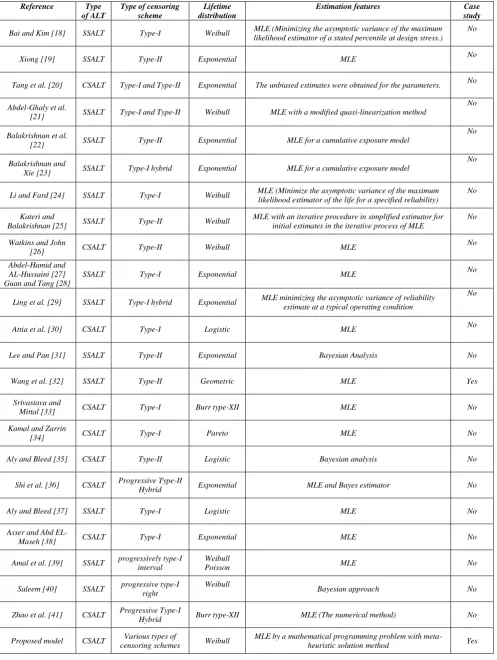
In previous studies, up to three types of censoring schemes which have been investigated; however, various types of censoring schemes have been considered in this study. A summary of the literature review based on type of ALT, type of censoring scheme, lifetime distribution, estimation method, and case study is presented in Table 1.
A correct definition of the model describing the failure process is a very important issue that has been less focused on.This paper presents a framework defining an approach for FPM with the censored data in CSALTs. For the first time, various types of censoring schemes have been considered in this study. As a new approach, mathematical programming tools were used for getting the maximum likelihood estimation of the unknown parameters with mathematical solving approach in data analysis phase. As a case study, the framework was used for the reliability analysis of red light-emitting diode lamps. This paper has been organized as follows: Description of FPM framework discusses the framework for the FPM. Case study presents a case study describing the reliability analysis of the red LED lamps. Finally, the conclusion outlines the conclusions and further research.
2.DESCRIPTION OF FAILURE PROCESS MODELING
FRAMEWORK
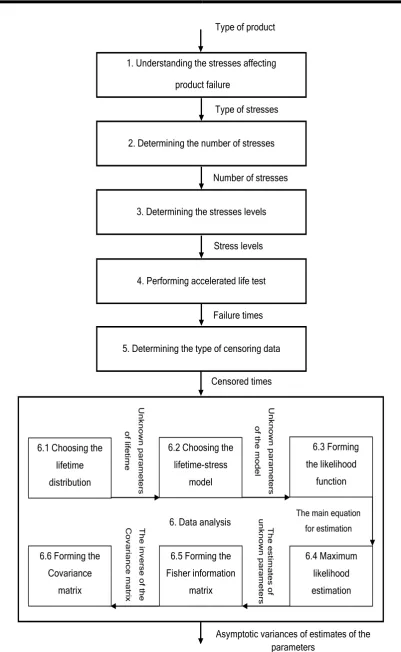
This section provides a framework defining an approach for FPM with censored data in CSALTs from initial data collection to reliability parameter estimation. The aim of framework is to estimate the reliability under the normal operating conditions, which is achieved by FPM and analysis of failure data from accelerated stress conditions. In other words, reliability characteristics can be obtained in normal operating conditions using lifetime-stress model. Figure 1 presents the framework. Each phase of the framework will be described in the following.
A. Understanding The Stresses Affecting Product Failure
In order to investigate the failure process of any product, it is necessary to study the factors that directly affect its lifetime. In other words, if ALT is considered to accelerate the failure process of product, the type of stresses used in the test must also be specified. Any factor that directly reduces the lifetime of the product and its
variations are measurable could be used. These factors are often introduced by manufacturers. For example, in electrical system, factors such as temperature, voltage or electric current, and power fluctuations can reduce lifetime.
B. Determining The Number Of Stresses
Among the stresses that affect the lifetime of any product, one or more types of stresses can be considered to accelerate the failure process in ALT. The number of stresses is determined based on the type of product and the test conditions. Usually one type of stress is used in experiments when the lifetime of product is not too long. Also focusing on one type of stress makes performing the test easier compared to when two or more types of stress are used. Two or more types of stress can be used if the lifetime of product is long, which makes the experiment become more complex.
C. Determining The Stress Levels
Depending on the number of considered stresses, it is necessary to determine the levels of each stress variable, since in CSALT; the product could be exposed to several levels of one type of stress. The first level of stress is chosen to be a little more than the stress level in normal operating conditions, so that it decreases the lifetime of product. The next levels further reduce the lifetime of the product. The last level is chosen so that the product does not fail immediately.
D. Performing Accelerated Life Test
After determining the stresses and their levels, a certain number of products are selected as a sample for each level, and the test is then performed accordingly for a certain period or up to when a number of failures occur. The Observed failure times are recorded during the test.
F. Data Analysis
After collecting the required data, statistical analysis of them begins. Statistical analysis consists of six steps which will be explained in the following.
Step 1.Choosing the lifetime distribution
When performing the reliability analysis, a distribution must be chosen to model the data. The more closely the distribution fits the data, the more likely the reliability statistics will accurately describe the performance of the product. The major distributions used in reliability analysis are: Exponential, Normal, Log-normal, Gamma, and Weibull. Using goodness of fit tests such as the Kolmogorov-Smirnov test and Anderson-Darling, the best distribution that fits the failure data is selected.
Step 2.Choosing the lifetime-stress model
Due to the changes in the shape or scale parameter of lifetime distribution in terms of the stress, a proper relationship between lifetime and stress is selected. Usually, when the stress level increases, less time is needed to reach the failure point, and when the stress level is reduced, the lifetime will increase. Different models are presented that describe the relationship between lifetime and stress, such as Arrhenius model [5], Eyring model, Inverse power law model, Log-Linear model and Proportional Hazards (Cox) model [42].
Step 3.Forming the likelihood function
The likelihood function is formed based on the type of sample observations (complete or censored) which is a function of the population parameters and observed samples. Here, the observations are known whereas the population parameters are unknown. Lifetime-stress relationship is also considered in the function. In general, suppose a random sample of size n is put into test, and
𝐗𝟏, 𝐗𝟐, … , 𝐗𝐧 is the set of random failure times. Denote O as the set containing the indices which the failure times are observed; R as the set containing the indices which the failure times are right censored; L as the set containing the indices which the failure times are left censored; and I as the set containing the indices which the failure times are interval censored with the only knowledge that the real failure time 𝐱𝐢 is in the interval [𝐔𝐢, 𝐕𝐢]. Then the likelihood (L) based on this sample is
L (xi, θ) =∏i𝜖𝑂f(xi; θ)∏ [1 − F(xi𝜖𝑅 i; θ)]
∏ F(xi; θ) i𝜖𝐿
∏[F(Vi; θ) − F(Ui; θ)] i𝜖𝐼
(1)
where 𝛉 is an unknown parameter, i=1,2,…,n, and
𝐟(𝐱𝐢; 𝛉) and 𝐅(𝐱𝐢; 𝛉) are probability density function
(PDF) and cumulative distribution function (CDF), respectively. Likelihood for other type of censoring can be constructed from following the same rationale.
Step 4.Maximum Likelihood Estimation
The method is based on the unknown population parameters. By optimizing the likelihood function based on parameters, the ones that are most consistent with the observed samples will be determined. In other words, the idea behind the maximum likelihood parameter estimation is to determine the parameter values that maximize the likelihood (or, equivalently, the log likelihood). In the case of censored data, other estimation methods such as least square method are less precise. Therefore, using MLE method in this case is considered to be more robust and results in estimators with good statistical properties. Usually, explicit expressions cannot be obtained through directly solving the likelihood equations. Instead, the numerical methods such as Newton-Raphson method or powerful tools in the analysis of incomplete data such as the Expectation–Maximization (EM) algorithm can be used. Fisher information matrix and consequently asymptotically variances of estimates are obtained directly from the numerical methods. The EM algorithm possesses several advantageous properties, such as stable convergence, compared to the Newton– Raphson method. So as a new approach, mathematical programming tools were used for estimating the maximum likelihood estimates of unknown parameters with mathematical solving approach. The general form of mathematical programming problem is
Max L (2)
s.t
C1> 0 (3)
C2< 0 (4)
.
t = 0 400 Time
40
424 450
Three failures
Eight failures Three
failure times are
interval censored
Two failure times are
TABLE 1. COMPARISON OF PROPOSED MODEL WITH PRIOR MODELS.
Reference Type
of ALT
Type of censoring scheme
Lifetime distribution
Estimation features Case
study
Bai and Kim [18] SSALT Type-I Weibull MLE (Minimizing the asymptotic variance of the maximum likelihood estimator of a stated percentile at design stress.)
No
Xiong [19] SSALT Type-II Exponential MLE No
Tang et al. [20] CSALT Type-I and Type-II Exponential The unbiased estimates were obtained for the parameters. No
Abdel-Ghaly et al.
[21] SSALT Type-I and Type-II Weibull MLE with a modified quasi-linearization method
No
Balakrishnan et al.
[22] SSALT Type-II Exponential MLE for a cumulative exposure model
No
Balakrishnan and
Xie [23] SSALT Type-I hybrid Exponential MLE for a cumulative exposure model
No
Li and Fard [24] SSALT Type-I Weibull MLE (Minimize the asymptotic variance of the maximum likelihood estimator of the life for a specified reliability)
No
Kateri and
Balakrishnan [25] SSALT Type-II Weibull
MLE with an iterative procedure in simplified estimator for initial estimates in the iterative process of MLE
No
Watkins and John
[26] CSALT Type-II Weibull MLE
No
Abdel-Hamid and AL-Hussaini [27] Guan and Tang [28]
SSALT Type-I Exponential MLE No
Ling et al. [29] SSALT Type-I hybrid Exponential MLE minimizing the asymptotic variance of reliability estimate at a typical operating condition
No
Attia et al. [30] CSALT Type-I Logistic MLE No
Lee and Pan [31] SSALT Type-II Exponential Bayesian Analysis No
Wang et al. [32] SSALT Type-II Geometric MLE Yes
Srivastava and
Mittal [33] CSALT Type-I Burr type-XII MLE No
Kamal and Zarrin
[34] CSALT Type-I Pareto MLE No
Aly and Bleed [35] CSALT Type-II Logistic Bayesian analysis No
Shi et al. [36] CSALT Progressive Type-II
Hybrid Exponential MLE and Bayes estimator No
Aly and Bleed [37] SSALT Type-I Logistic MLE No
Asser and Abd
EL-Maseh [38] CSALT Type-I Exponential MLE No
Amal et al. [39] SSALT progressively type-I interval
Weibull
Poisson MLE No
Saleem [40] SSALT progressive type-I right
Weibull
Bayesian approach No
Zhao et al. [41] CSALT Progressive Type-I
Hybrid Burr type-XII MLE (The numerical method) No
Proposed model CSALT Various types of
censoring schemes Weibull
MLE by a mathematical programming problem with
6. Data analysis
Unk
n
o
wn
p
a
ra
m
e
te
rs
of
life
tim
e
Unk
n
o
wn
p
a
ra
m
e
te
rs
of
th
e
m
o
d
e
l
Th
e
e
s
tim
a
te
s
o
f
u
n
k
n
o
wn
p
a
ra
m
e
te
rs
Th
e
in
v
e
rs
e
o
f t
h
e
Cov
a
ria
n
c
e
m
a
tri
x
6.1 Choosing the lifetime distribution
6.2 Choosing the lifetime-stress
model
6.3 Forming the likelihood
function
6.4 Maximum likelihood estimation 6.5 Forming the
Fisher information matrix 6.6 Forming the
Covariance matrix
The main equation for estimation
Asymptotic variances of estimates of the parameters
Stress levels
Failure times
Censored times
5. Determining the type of censoring data
1. Understanding the stresses affecting
product failure
Type of stresses
Number of stresses Type of product
2. Determining the number of stresses
3. Determining the stresses levels
4. Performing accelerated life test
As can be seen in (2), the objective of the mathematical programming problem was to obtain the maximum likelihood estimates of the unknown parameters which was derived by maximizing the likelihood function. The constraint (3) shows that the parameters of lifetime distribution should be positive. The constraint (4) indicates an inverse relationship between the lifetime and stress. The MLE of unknown parameters was obtained to maximize the likelihood function using optimization tools
Step 5.Forming the Fisher information matrix
The Fisher information matrix is a key tool in parameter estimation. It is a measure of the information content of the data relevant to the parameters being estimated. It is a symmetric matrix, the elements of which are the negative second partial and mixed partial derivations of of unknown parameters. Denoteθ1, θ2, … , θ𝑛as the set of unknown parameters, then the Fisher information matrix is [5]
(5)
F =
[
− ∂2lnL ∂θ12
− ∂2lnL ∂θ1∂θ2 …
− ∂2lnL ∂θ1∂θn − ∂2lnL
∂θ2∂θ1
− ∂2lnL
∂θ22 …
− ∂2lnL ∂θ2∂θn
. . . . . . . . . . . .
− ∂2lnL ∂θn∂θ1
− ∂2lnL ∂θn∂θ2 …
− ∂2lnL ∂θn2 ]
Step 6.Calculating the Covariance matrix
Covariance matrix is a symmetric matrix that shows the covariance between the variables. In general, estimation of Covariance matrix is asymptotic equals to the inverse of the Fisher information matrix and is given by [5]
(6)
Σ̂= F−1
=
[
var(θ̂)1 cov(θ̂, θ1 ̂ ) … cov(θ2 ̂, θ1 ̂)n
cov(θ̂, θ2 ̂ )1 var(θ̂)2 … cov(θ̂, θ2 ̂)n
. . . .
. . . .
. . . .
cov(θ̂, θn ̂ ) cov(θ1 ̂, θn ̂ ) …2 var(θ̂) ]n
The variances all appear on the main diagonal of Covariance matrix. In other words, the purpose of calculating the Fisher information matrix is to obtain the asymptotic variance of the maximum likelihood estimates of the unknown parameters, the result of which is the confident intervals of the estimated parameters.
3.CASE STUDY
The object of this case study is the application of the framework in red LED lamps. An LED is a semiconductor light source. LEDs are used as indicator lamps in many devices and are increasingly used for other lighting applications such as aviation lighting, digital microscopes, automotive lighting, advertising, general lighting, and traffic signals. LEDs can have a relatively long useful life.
The six phases of framework from initial data collection to reliability parameter estimation will be described in the following.
A. Understanding The Stresses Affecting Led Lamps Failure
The definition of useful life is often given as the hours of operation during in which the LED’s output light has been decreased to 70% of initial output. The selection of 70% is based on vision research indicating that in general lighting applications, the typical human eye does not detect the decrease in light until it exceeds 30%. Optical and electrical parameters are critical in LED lamps. The input electric current and temperature cause stress in the LED crystalline structure. Also other factors such as power fluctuations, humidity, on and off frequency, and isolation affect the failure of LED lamps.
B. Determining The Number Of Stresses
Among the stresses mentioned in the previous phase, electric current, temperature, and humidity can be used because their levels could be increased. In this study, only electric current was investigated as the stress variable since a fixed electric current at a specified level is easier than fixing temperature or humidity at a specified level. By using the same experimental conditions, the effect of temperature and humidity was ignored.
C. Determining The Stress Levels
The stress level in the normal operating condition is five milliampere (mA). The stress levels of 20, 30 and 40 mA were selected. These stress levels were selected as follows: the first level (20 mA) was slightly greater than the level in the normal operating condition, and it resulted in reduction of the lifetime of the lamp. The second level (30 mA) reduced the lifetime of the lamp more quickly. The third level (40 mA) had the most effect in reduction of the lifetime of the lamp. Higher electrical current causes very fast failure and even melting of the lamp.
D. Performing Accelerated Life Test
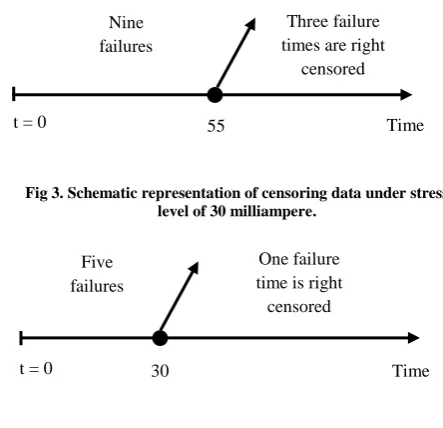
E. Determining The Type Of Censoring Data For stress level of 20 mA, the test was continued for 400 hours and failure times were recorded. For the period of 400 to 424 hours, no observation was performed. Then from 424 hours to 450 hours, observation was carried on and failure times were recorded. For stress level of 30 mA, the test was continued for 55 hours and failure times were recorded. For stress level of 40 mA, the test was continued for 30 hours and failure times were recorded. The type of censoring data used is represented as in Figures 2 to 4.
Fig 3. Schematic representation of censoring data under stress level of 30 milliampere.
Fig 4. Schematic representation of censoring data under stress level of 40 milliampere.
So for stress level of 20 mA, the failure times of three lamps were interval censored while the failure times of two lamps were right censored. For stress level of 30 mA, the failure times of three lamps were right censored. For stress level of 40 mA, the failure time of one lamp was right censored. The observed failure times in three stress levels are listed in Table 2.
F. Data Analysis
Step 1.Choosing the lifetime distribution
The two-parameter Weibull distribution is widely used in reliability evaluation and analysis of lifetime data. Let us assume the lifetime random variable T follows the Weibull distribution with the shape and scale parameters of β and α , respectively. So the CDF and PDF of T are
(7)
FT(t; α, β) = 1 − e−( t α)β
and
fT(t; α, β) = βtβ−1
αβ e−( t
α)β (8)
where
t > 0 , α > 0 , β > 0 .
TABLE 2.THE OBSERVED FAILURE TIMES IN THREE STRESS
LEVELS.
Stress levels (mA) Failure times
20 211 288 399 428 429 430 432 444 446 449 450
30 27 39 39 44 45 48 48 50 53 40 10 17 21 24 29
Step 2.Choosing the lifetime-stress model
In order to determine the best relationship between stress and Weibull distribution parameters, the parameters in each of the stress levels were estimated using Minitab software. These values are shown in Table 3.
TABLE 3.PARAMETERS OF WEIBULL DISTRIBUTION AT
DIFFERENT STRESS LEVELS.
Stress levels(mA) α β
20 426.542 9.018 30 46.562 7.922 40 22.474 3.649 Considering the Linear relationship, Ln(power) relationship, Inverse power law relationship, and Arrhenius relationship between stress values and each of the parameters, the coefficient of determination (R2) were calculated as reported in Table 4.
The Arrhenius relationship between the scale parameter and stress and the linear relationship between the shape parameter and stress were selected, because compared to the other relationships, their coefficients of determination are closer to one.
TABLE 4. 𝐑𝟐VALUES REGARDING THE RELATIONSHIP
BETWEEN THE PARAMETERS AND STRESS.
Relationships α β
Linear 0.794 0.896 Ln(power) 0.867 0.828 Inverse power law 0.966 0.780 Arrhenius 0.991 0.699
Therefore, the lifetime-stress models were obtained as follows:
(9)
β = A1+ B1S
(10)
α = A2 e B2
S
where A1, B1, A2and B2 are unknown parameters and S is the stress level.
Nine failures
t = 0 Time
Three failure times are right
censored
55
Five failures
30
t = 0 Time
Step 3.Forming the likelihood function
For forming the likelihood function, it is necessary to define a notation that is shown in Table 5.
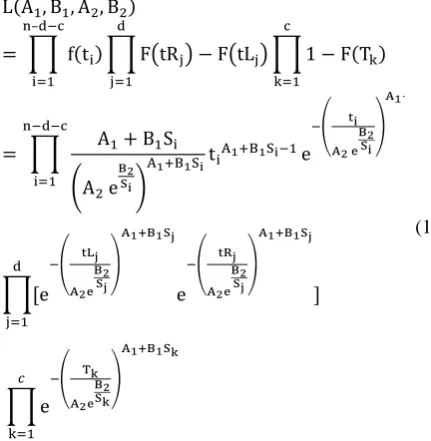
Based on the interval and right censored data from Weibull distribution, the likelihood function under CSALT is given by:
L(A1, B1, A2, B2)
= ∏ f(ti) n–d−c
i=1
∏ F(tRj) − F(tLj) d
j=1
∏ 1 − F(Tk) c
k=1
= ∏ A1+ B1Si (A2 e
B2 Si)
A1+B1Siti
A1+B1Si−1 n−d−c i=1 e −( ti A2 e B2 Si ) A1+B1Si ∏[e − ( tLj A2e B2 Sj) A1+B1Sj e − ( tRj A2e B2 Sj) A1+B1Sj d j=1 ] ∏ e −( Tk A2e B2 Sk ) A1+B1Sk 𝑐 k=1 (11)
TABLE 5.LIST OF NOTATIONS.
Notation Definition
ti Observed failure time of unit i
Si The stress applied to unit i at time ti
Sj The stress applied to unit j upon failure
Sk The stress applied to unit k upon failure
tLj
The lower bound of the time interval in which unit j fails
tRj The upper bound of the time interval in which unit j fails
Tk The lower bound of the time interval in which unit k fails
n Sample size
(total number of test units in CSALT) d The number of units that fail in the time interval [tLj, tRj]
(interval censored observations) c The number of units that fail in the time interval [Tk, +∞]
(right censored observations)
n-d-c The number of units for which the exact failure times are observed
(complete observations)
Using ln L to denote the natural logarithm of
L(A1, B1, A2, B2), then we have
Step 4.Maximum Likelihood Estimation
In this case study, the estimation of parameters was considered under CSALT with interval censored and right censored data assuming two-parameter Weibull lifetime distribution. After equating the first partial derivatives of ln L with respect to A1, B1, A2 and B2 to zero and substituting the numerical values in the equations, it was observed that due to complex and nonlinear equations, getting closed form of estimates of the unknown parameter was not possible. So, as a new approach, mathematical programming tools were used for estimating these parameters with the mathematical solving approach.
(12)
lnL(A1, B1, A2, B2)
= ∑ ln(A1+ B1Si) n−d−c
i=1
+ (A1+ B1Si− 1) ln(ti)
− tiA1+B1Si(A2e B2
Si)−A1−B1Si− (A1
+ B1Si) (ln(A2) +
B2
Si)
+ ∑ ln (e−tLjA1+B1Sj(A2e B2
Sj)−A1−B1Sj d
j=1
− e−tRjA1+B1Sj(A2e B2
Sj)−A1−B1Sj
)
+ ∑ −TkA1+B1Sk (A2e B2
Sk)−A1−B1Sk c
k=1
)
The mathematical programming problem is
(
13
)
Max ln L(A1, B1, A2, B2)
s. t
(14)
(15)
(16)
(17)
A1+ 40B1 ≥ 0
A2≥ 0
B1≤ 0
B2≥ 0
Considering this case as a minimization problem, since the logarithm of likelihood function was not convex, the optimization toolbox of Matlab software was unable to find the global optimum solution. Due to the nonlinear programming problem, meta-heuristic algorithms could be used to solve the problem. Among the meta-heuristic algorithms, GA has accuracy and requires less time in solving problems. Likewise, this algorithm has more capability and is easier to model. Therefore, based on the predictability and convergence of genetic algorithm, GA toolbox was used to solve the problem.
GA became popular through the work of Holland in the early 1970s, particularly his book “Adaptation in Natural and Artificial Systems” [43]. GA is a search heuristic that mimics the process of natural selection and is routinely used to generate useful solutions to optimization and search problems.
The evolution usually starts from a population of randomly generated individuals, and is an iterative process, with the population in each iteration called a generation. In each generation, the fitness of every individual in the population is evaluated; the fitness is usually the value of the objective function in the optimization problem being solved. The more fit individuals are stochastically selected from the current population, and each individual's genome is modified (recombined and possibly randomly mutated) to form a new generation. The new generation of candidate solutions is then used in the next iteration of the algorithm. Commonly, the algorithm is terminated when either a maximum number of generations has been produced, or a satisfactory fitness level has been reached for the population.
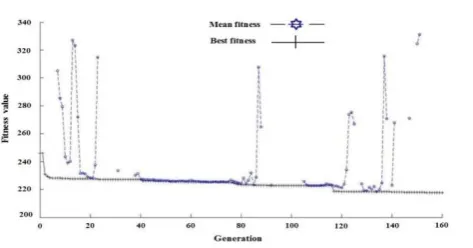
After 160 iterations, the GA is converged to the optimum solution as follows:
(18)
(19)
(20)
(21)
(22)
Â1= 0.183
B̂1= -0.001
Â2= 16.105
B̂2= 5.067 ln L = 219.289
The convergence graph of GA is shown in Figure 5.
Fig 5. The convergence graph of genetic algorithm.
Step 5.Forming the Fisher information matrix
In order to form the Fisher information matrix, the second order partial and mixed partial derivations of the log likelihood function were calculated with respect to A1,
B1, A2 and B2 . By substituting the numerical values consisting of the MLE of parameters, stress levels, the observed failure times and censored times, the Fisher information matrix was obtained as follows:
F=
(23)
[
−𝛛𝟐𝐥𝐧𝐋(𝐀𝟏, 𝐁𝟏, 𝐀𝟐, 𝐁𝟐)
𝛛𝐀𝟏𝟐
−𝛛𝟐𝐥𝐧𝐋(𝐀 𝟏, 𝐁𝟏, 𝐀𝟐, 𝐁𝟐)
𝛛𝐀𝟏𝛛𝐁𝟏
−𝛛𝟐𝐥𝐧𝐋(𝐀 𝟏, 𝐁𝟏, 𝐀𝟐, 𝐁𝟐)
𝛛𝐀𝟏𝛛𝐀𝟐
−𝛛𝟐𝐥𝐧𝐋(𝐀 𝟏, 𝐁𝟏, 𝐀𝟐, 𝐁𝟐)
𝛛𝐀𝟏𝛛𝐁𝟐
−𝛛𝟐𝐥𝐧𝐋(𝐀 𝟏, 𝐁𝟏, 𝐀𝟐, 𝐁𝟐)
𝛛𝐁𝟏𝛛𝐀𝟏
−𝛛𝟐𝐥𝐧𝐋(𝐀 𝟏, 𝐁𝟏, 𝐀𝟐, 𝐁𝟐)
𝛛𝐁𝟏𝟐
−𝛛𝟐𝐥𝐧𝐋(𝐀 𝟏, 𝐁𝟏, 𝐀𝟐, 𝐁𝟐)
𝛛𝐁𝟏𝛛𝐀𝟐
−𝛛𝟐𝐥𝐧𝐋(𝐀 𝟏, 𝐁𝟏, 𝐀𝟐, 𝐁𝟐)
𝛛𝐁𝟏𝛛𝐁𝟐
−𝛛𝟐𝐥𝐧𝐋(𝐀 𝟏, 𝐁𝟏, 𝐀𝟐, 𝐁𝟐)
𝛛𝐀𝟐𝛛𝐀𝟏
−𝛛𝟐𝐥𝐧𝐋(𝐀 𝟏, 𝐁𝟏, 𝐀𝟐, 𝐁𝟐)
𝛛𝐀𝟐𝛛𝐁𝟏
−𝛛𝟐𝐥𝐧𝐋(𝐀 𝟏, 𝐁𝟏, 𝐀𝟐, 𝐁𝟐)
𝛛𝐀𝟐𝟐
−𝛛𝟐𝐥𝐧𝐋(𝐀 𝟏, 𝐁𝟏, 𝐀𝟐, 𝐁𝟐)
𝛛𝐀𝟐𝛛𝐁𝟐
−𝛛𝟐𝐥𝐧𝐋(𝐀 𝟏, 𝐁𝟏, 𝐀𝟐, 𝐁𝟐)
𝛛𝐁𝟐𝛛𝐀𝟏
−𝛛𝟐𝐥𝐧𝐋(𝐀 𝟏, 𝐁𝟏, 𝐀𝟐, 𝐁𝟐)
𝛛𝐁𝟐𝛛𝐁𝟏
−𝛛𝟐𝐥𝐧𝐋(𝐀 𝟏, 𝐁𝟏, 𝐀𝟐, 𝐁𝟐)
𝛛𝐁𝟐𝛛𝐀𝟐
−𝛛𝟐𝐥𝐧𝐋(𝐀 𝟏, 𝐁𝟏, 𝐀𝟐, 𝐁𝟐)
𝛛𝐁𝟐𝟐 ]
=
[
1397.874 36822.168 −2.006 −1.476
36822.168 1051471.328 −45.730 −32.314
−2.006 −45.730 0.0153 0.003
−1.476 −32.314 0.003 0.002
]
Step 6.Forming the Covariance matrix
The asymptotic Covariance matrix Σ̂ of the maximum likelihood estimates Â1, B̂1 , Â2 and B̂2was
obtained by inverting the Fisher information matrix F for the large sample size. So the Covariance matrix was obtained as follows
Σ̂= F−1=
[
var( Â1) cov( Â1, B̂1 ) cov( Â1, Â2) cov( Â1, B̂2)
cov( B̂1 , Â1) var( B̂1) cov( B̂1, Â2) cov( B̂1 , B̂2)
cov( Â2, Â1) cov( Â2, B̂1 ) var( Â2) cov( Â2, B̂2)
cov( B̂2, Â1) cov( B̂2, B̂1) cov( B̂2, Â2) var( B̂2) ]
=
(24)
[
0.1533 −0.0040 −0.9008 46.4559 −0.0040 0.0001 0.0235 −1.1799 −0.9008 0.0235 95.2362 −395.9830 46.4559 −1.1799 −395.9830 15104.7969
]
The approximate (1-α) 100% confidence intervals for
A1, B1, A2 and B2 are given by [44]
A
̂1± Zα 2⁄ √var(Â1 ), B̂1± Zα 2⁄ √var( B̂1 ),
B̂2 ± Zα 2⁄ √var( B̂2) (25) where Zα 2⁄ is the 100(1- α 2⁄ ) percentile of a standard normal variate. The 95% confidence intervals A1, B1, A2 and B2 are presented in Table6.
TABLE 6. THE 95% CONFIDENCE INTERVALS OF
PARAMETERS.
Parameters 95% lower limit 95% upper limit
A
̂1= 0.183 -0.583 0.949 B̂1= -0.001 -0.0206 0.0186 A
̂2= 16.105 -3.0224 35.2324 B̂2= 5.067 -235.8199 245.9539
According to the estimates obtained for the parameters
A1, B1, A2 and B2, the shape and scale parameters of the Weibull distribution in stress level of 5 mA (normal operating conditions) can be obtained from equations (9) and (10) as follows:
(26)
β̂ = 0.178
(27)
α̂ = 44.3685
Reliability function of two-parameter Weibull distribution (which has been plotted in Figure 6) for a specified period of time t can be directly derived by using the estimated parameters from equations (26) and (27) as follows:
(28)
R(t) = e−(44.3685t )0.178
Fig. 6. Reliability function at different service times in normal operating condition.
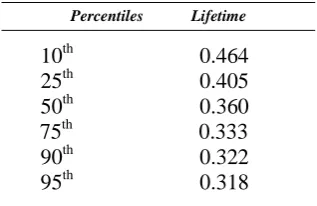
The main percentiles of lifetime distribution were calculated according to the reliability function as shown in Table 7.
TABLE 7.PERCENTILES OF LIFETIME DISTRIBUTION.
Percentiles Lifetime
10
th0.464
25
th0.405
50
th0.360
75
th0.333
90
th0.322
95
th0.318
4.CONCLUSION
In this paper, we have presented a framework defining a new approach for FPM with censored data in CSALTs. The FPM plays a key role in the reliability analysis of systems. Therefore, a correct definition of the model describing the failure process is a very important issue that has been less focused on. In addition, in the previous studies, up to three types of censoring schemes have been investigated, whereas the various types of censoring schemes have been considered for the first time in this study.
A case study was developed in red LED lamps. CSALT with three stress levels under interval censored and right censored data was applied. After forming the likelihood function, it was observed that the maximum likelihood estimates could not be obtained in the closed form. Numerical methods such as Newton-Raphson method can be used to compute them. The Newton-Raphson method is a direct approach for estimating the relevant parameters in a likelihood function, which uses the observed information matrix. When censoring is used, the observed information matrix shows more variability, especially when the sample size is small. In this paper, as a new approach, mathematical programming with a mathematical solving approach was proposed and used as a tool to compute the maximum likelihood estimates. The maximum likelihood estimates of unknown parameters were obtained using GA. The Results obtained for the Covariance matrix show that some asymptotic variances of estimates of the parameters were great. In general, the estimates obtained from the censored data have less accuracy compared to the complete data. In other words, the greater the amount of censored data, the less the convergence of estimates of the parameters to the true value is, and thus, the asymptotic variance increases. The precision of estimation will be improved by increasing the sample size.
data, there should be a balance between test time, sample size and results performance of statistical inference of test.
Finally, as a future work, in order to increase the precision of estimation, optimization criteria such as minimization of asymptotic variance of estimates of the reliability parameters can be considered and the optimum model can be designed accordingly. The optimal design of CSALTs can be studied to specify the optimal sample size and censoring times. Additionally, using powerful tools in the analysis of censored data such as the Expectation– Maximization algorithm is proposed for estimating the parameters.
REFRENCES
[1] Ascher, H. and Feingold, H. “Repairable systems reliability: Modeling, inference, misconceptions and their causes,” 1th ed., Marcel Dekker, New York, 1984.
[2] Vaurio, J.K. “Identification of process and distribution characteristics by testing monotonic and non-monotonic trends in failure intensities and hazard rates,” Reliability Engineering and System Safety, vol. 64, no.3, pp. 345–357, 1999.
[3] Louit, D.M.,Pascual, R. and Jardine, A.K.S. “A practical procedure for the selection of time-to-failure models based on the assessment of trends in maintenance data,” Reliability Engineering and System Safety, vol. 94, no. 10, pp.1618-1628, 2009.
[4] Regattieri, A.,Manzini, R. and Battini, D. “Estimating reliability characteristics in the presence of censored data: A case study in a light commercial vehicle manufacturing system,” Reliability Engineering and System Safety, vol. 95, pp.1093–1102, 2010.
[5] Nelson WB. Accelerated Testing: Statistical Models, Test Plans, and Data Analyses, John Wiley & Sons, New York, 1990.
[6] Chernoff, H. “Optimal accelerated life designs for estimation,” Technometrics, vol. 4, no. 3, pp. 381– 408, 1962.
[7] Bessler, S.,Chernoff, H. and Marshall, A.W. “An optimal sequential accelerated life test,” Technometrics, vol. 4, no. 3, pp. 367–379, 1962.
[8] Chenhua L. “Optimal step-stress plans for accelerated life testing considering reliability/life prediction,” PhD Thesis, Department of Mechanical and Industrial Engineering, Northeastern University, USA, 2009.
[9] Bai, D. and Chung, S. “An accelerated life test model with the inverse power law,” Reliability
Engineering and System Safety, vol. 24, no. 3, pp. 223-230, 1989.
[10] Teng, N.H. and Kolarik, W.J. “On/off cycling under multiple stresses,” IEEE Trans. Reliability, vol. 38, no. 4, pp. 494–498, 1989.
[11] Fan, T.H. and Yu, C.H.“Statistical inference on constant stress accelerated life tests under generalized Gamma lifetime distributions,” Quality and Reliability Engineering International, vol. 29, no. 5, pp. 631-638, 2013.
[12] Zhang, J., Liu, C., Cheng, G.,Chen, X., Wu, J., Zhu, Q. and Zhang, L. “Constant-stress accelerated life test of white organic light-emitting diode based on least square method under Weibull distribution,” Journal of Information Display, vol. 15, no. 2, PP. 71-75, 2014.
[13] Guan, Q., Tang, Y., Fu, J. and Xu, A. “Optimal multiple constant-stress accelerated life tests for generalized Exponential distribution,” Communications in Statistics - Simulation and Computation, vol. 43, no. 8, PP.1852-1865, 2014.
[14] Nelson WB. Applied Life Data Analysis, John Wiley & Sons, New York (1982).
[15] Yang, G.B. “Optimum constant-stress accelerated life test plans,” IEEE Trans. Reliability, vol. 43, no. 4, PP. 575–581, 1994.
[16] Mettas, A. “Modeling and analysis for multiple stress-type accelerated life data,” in Proceedings of Annual Reliability and Maintainability Symposium, Los Angeles, CA, pp. 138–143, 2000.
[17] Zhou, K., Shi, Y. and Sun, T. “Reliability analysis for accelerated life-test with progressive hybrid censored data using geometric process,” Journal of Physical Sciences, vol. 16, PP.133-143, 2012.
[18] Bai, D. and Kim, M. “Optimum simple step-stress accelerated life tests for Weibull distribution and type-I censoring,” Naval Res. Logist, vol. 40, no. 2, PP. 193–210, 1993.
[19] Xiong, C. “Inference on a simple step-stress model with type-II censored Exponential data,” IEEE Trans. Reliability, vol. 47, no. 2, PP. 142–146, 1998.
[20] Tang, L.C., Goh, T.N., Sun, Y.S. and Ong, H.L. “Planning accelerated life tests for censored two-parameter Exponential distributions,” Nav Res Logistic, vol. 46, no. 2, PP. 169–186, 1999.
[22] Balakrishnan, N., Kundu, D., Tony Ng, H.K. and Kannan, N.“Point and interval estimation for a simple step-stress model with type-II censoring,” J. Qual. Technol, vol. 39, no. 1, pp. 35–47, 2007.
[23] Balakrishnan, N. and Xie, Q. “Exact inference for a simple step-stress model with type-I hybrid censored data from the Exponential distribution,” J. Statist. Plann. Inference, vol. 137, no. 11, PP. 3268–3290, 2007.
[24] Li, C. and Fard, N. “Optimum bivariate step-stress accelerated life test for censored data,” IEEE Trans. Reliability, vol. 56, no. 1, PP. 77–84, 2007.
[25] Kateri, M. and Balakrishnan, N. “Inference for a simple step-stress model with type-II censoring, and Weibull distributed lifetimes,” IEEE Trans. Reliability, vol. 57, no. 4, PP. 616-626, 2008.
[26] Watkins, A. and John, A. “On constant stress accelerated life tests terminated by type II censoring at one of the stress levels,” Journal of statistical Planning and Inference, vol. 138, no. 3, PP. 768-786, 2008.
[27] Abdel-Hamid, A. and AL-Hussaini, E. “Estimation in step-stress accelerated life tests for the exponentiated Exponential distribution with type-I censoring,” Computational Statistics & Data Analysis, vol. 53, no. 4, PP. 1328-1338, 2009.
[28] Guan, v. and Tang, Y. “Optimal step-stress test under type-I censoring for multivariate Exponential distribution,” Journal of Statistical Planning and Inference, vol. 142, no. 7, PP. 1908-1923, 2012.
[29] Ling, L., Xu, W. and Li, M. “Optimal bivariate step-stress accelerated life test for type-I hybrid censored data,” Journal of Statistical Computation and Simulation, vol. 81, no. 9, PP. 1175–1186, 2010.
[30] Attia, A.F.,Aly, H.M. and Bleed, S.O. “Estimating and planning accelerated life test using constant stress for generalized Logistic distribution under type-I censoring,” ISRN Applied Mathematics; 203618, 15 pages, 2011.
[31] Lee, J. and Pan, R. “Bayesian analysis of step-stress accelerated life test with Exponential distribution,” Quality and Reliability Engineering International, vol. 28, no.3, PP. 353-361, 2012.
[32] Wang, R.,Xu, X., Pan, R. and Sha, N. “On parameter inference for step-stress accelerated life test with Geometric distribution,” Communications in Statistics - Theory and Methods, vol. 41, no. 10, pp.1796-1812, 2012.
[33] Srivastava, P.W. and Mittal, N. “Optimum multi-objective modified constant-stress accelerated life test plan for the Burr type-XII distribution with type-I censoring, ” Proceedings of the Institution of
Mechanical Engineers, Part O: Journal of Risk and Reliability, vol. 227, no. 2, PP. 132-143, 2013.
[34] Kamal, M. andZarrin, S. “Design of accelerated life testing using geometric process for Pareto distribution withtype-I censoring,” Journal of global research in mathematical archives, vol. 1, no. 8, PP. 59-66, 2013.
[35] Aly, H.M. and Bleed, S.O. “Bayesian estimation for the generalized Logistic distribution type-II censored accelerated life testing,” Int. J. Contemp. Math. Sciences, vol. 8, no. 20, PP. 969 – 986, 2013.
[36] Shi, Y.M., Jin, L., Wei, C. and Yue, H.B. “Constant-stress accelerated life test with competing risks under progressive type-II hybrid censoring,” Advanced Materials Research, vol. 712 – 715, pp. 2080-2083, 2013.
[37] Aly, H.M. and Bleed, S.O. “Estimating and planning step stress accelerated life test for generalized Logistic distribution under type-I censoring,” International Journal of Applied Mathematics & Statistical Sciences, vol. 2, no. 2, pp. 1-16, 2013.
[38] Asser, S. and Abd EL-Maseh, M.“Estimation of the parameters of the bivariate generalized Exponential distribution using accelerated life testing with censoring data,” International Journal of Advanced Statistics and Probability, vol. 2, no. 2, pp. 77-83, 2014.
[39] Amal, S.H., Assar, S.M. and Shelbaia, A. “Optimum inspection times of step stress accelerated life tests with progressively type-I interval censored,” Australian Journal of Basic and Applied Sciences, vol. 8, no. 17, pp. 282-292, 2014.
[40] Saleem, Z.A. “Effect of progressive type-I right censoring on Bayesian statistical inference of simple step-stress acceleration life testing plan under Weibull life distribution,” International Journal of Mechanical, Aerospace, Industrial and Mechatronics Engineering, vol. 8, no. 2, pp. 325-329 , 2014.
[41] Zhao, J., Shi, Y. and Yan, W. “Inference for constant-stress accelerated life test with type-I progressively hybrid censored data from Burr-XII distribution,” Journal of Systems Engineering and Electronics, vol. 25, no. 2, pp. 340-348, 2014.
[42] Cox, D.R. “Regression models andlife tables,” Springer-Verlag, New York, pp. 527-541, 1992.