Iranian journal of educational Sociology
(Interdisciplinary Journal of Education)Available online at: http://www.iase-idje.ir/ Volume 1, Number 10, December 2018
Designing an Optimal Model for the Educational System in
University of Applied Science and Technology
Negar Sadria 1, Hossein Abbasian 2* , Hasan Reza Zin Abadi2 , Mohammad Reza Behrangi2
1.Ph.D. Student of Educational Management at Kharazmi University 2.Faculty Member of Kharazmi University.
Article history:
Received date: 13 April 2018 Review date: 28 May 2018 Accepted date:12 July 2018 Printed on line: 25 December 2018
Abstract
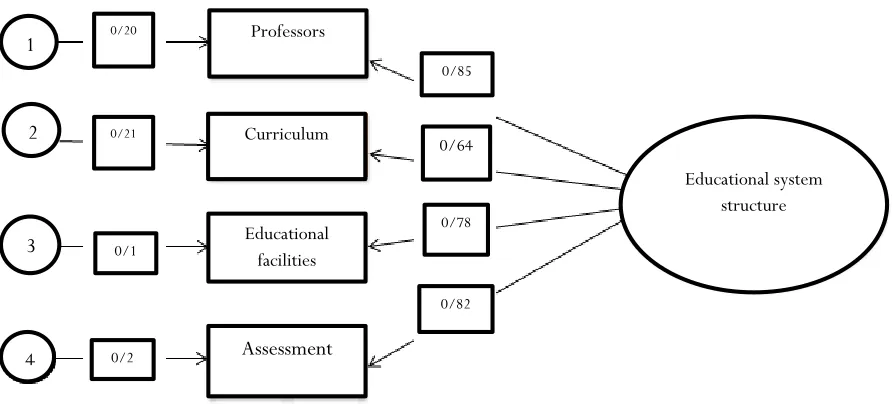
Purpose: The purpose of this study was to design a suitable model for the educational system in University of Applied Science and Technology. Methodology: This research was a qualitative-quantitative research. In the qualitative section of the research, the main components of the model for the educational system of this university have been identified by interviewing the experts. In the quantitative section, the components identified from the qualitative section, were validated. For sampling in the qualitative section of the study, using a snowball sampling method, 10 experts from the university with the theoretical saturation, were selected as sample and for validation of the model, according to the size of the statistical population of the research in the quantitative section, using the Cochran formula, 266 rectors, assistants and professors of the centers were selected by stratified sampling method. Findings: Data analysis was performed by confirmatory-factor analysis test. The results of the test showed that the structure of the educational system of the university was assessed in four indices of professors with 9 items, the curriculum with 9 items, the educational facilities with 10 items, and the assessment with 7 items and their factor loads are 0.85, 0.64, 0/78, and 0/82 respectively. Discussion: A suitable model for the educational system of the University of Applied Science and Technology was designed with 4 indices of the university professors, university curriculum, university educational facilities and university assessment system.
Keywords:
Designing the Model, Educational System, University of Applied Science and Technology
Please cite this article as: Sadria N, Abbasian H, Zin Abadi H R, Behrangi M R. (2018). Designing an Optimal Model for the Educational System in University of Applied Science and Technology, Iranian journal of educational Sociology. 1(10), 39-49.
*Corresponding Author: [email protected]
1. Introduction
Today, the role of education in increasing the efficiency, productivity and economic development of countries is becoming increasingly important because in the current world, the factories, land, tools and machines are not the capital, but the wealth lies in the human resources (Bats, 2002). In fact, education is an essential component and the first step to achieve an increase in the efficiency and sustainability of the societies (Gangdag and Rambaldi, 2014).
On the other hand, the thought generation to face the domestic and global issues more than ever reveals the importance of educating human resources of societies as the potential capital; somehow that the attention to the intellectual capital of each country is one of the undeniable priorities of the country, particularly in
the field of education (Sharif and Shabgoo Monsef, 2011). The developed society is a society with the
advanced knowledge, capable of generating science and technology, relying on a greater contribution of human resources and social capital (Daria et al., 2016).
One of the most important training organizations in today's societies is the universities, which their most important achievement is knowledge, reiterated inventions and specialized graduated students. Professors, students, staff, organizational processes and communication networks are among the valuable assets of universities, all of which are among the intellectual capital of societies (Ghezel et al., 2013).
As the higher education is today recognized as a service industry, the universities need to pay attention to the expectations of their community and environment in order to gain a higher position and maintain competitive advantage (Bonhooni, 2016).
Higher education in universities, with respect to the environment of the communities, is mainly divided into two types of targeting. The first category is the education that emphasizes the scientific fundamentals of the majors and lead the students to designing, planning, researching and innovating skills; the second category of education, while paying enough attention to the scientific foundations, more focus on acquiring skills in the professions, implementing the project and the use of facilities and, in other words, skill-based education (Binaghi, Rezvani, 2009).
In the last years, the governments and large organizations have focused on the training of human resources, in particular, on the skill-based education, and the governments, families and individuals focus increasingly on the skill-based education. Because it is generally believed that this kind of education is a useful commodity and service that individuals benefit from it (Keff, 2010). Also, with the specialization of occupations and the combination of knowledge and technology, it seemed that basically mastering the job and performing it optimally was not possible without knowledge of the scientific foundations of that profession. Therefore, the skill-based and applied sciences trainings have been opened their way on the educational systems. (Moghanizadeh, 2009).
University of Applied Science and Technology has the following objectives and aims to work in the following areas:
Explaining the position of the applied scientific system in the educational structure of the country and its rapid and sustainable development, Active participation in helping the rapid achievement of the social, economic, and cultural sectors of the country to the global standards, Increasing the share of applied-scientific graduated students in the activities of the economic, social and cultural sectors of the country, To increase the efficiency and effectiveness of higher education in the country through the provision of the
applied scientific education, Setting up the specialized academic higher education institutions for different economic, social and cultural sectors of the country, taking into account the potentials and relative
advantages of each region (Borzouie, 2014). Based on this, University of Applied Science and Technology
needs to have a new look at the university's educational system and model design of the educational system to achieve its goals. (Borzouie, 2014)
2. literature Review
The process of training in universities and educational organizations cannot be formed by effort and error; the education needs a plan (Nowroozi and Razavi, 2011). The design of the educational model has been defined in many ways over the years, and many of the definitions mentioned in this section emphasize the process. An example of these definitions is the definition from Smith and Reagan (2005). They have a very broad definition of educational design; however, the educational design in their view is a systematic and logical process of applying the principles of learning and teaching for programs, educational materials, activities, information resources and evaluation. In another definition, Pissourièche (2006), considers the instructional design as science, art, and how to create educational or training programs, although this definition is very general. In another definition, the instructional design is defined as the predictive process of methods based on objectives in specific circumstances. The educational design model of the work plan or predetermined design is the activities that the education designer follows to achieve the desired results (Fardanesh, 2011).
Sadeghzadeh (2008), in a research entitled "pathology of the management of the educational system and its impact on the current status of the educational system", considers the factors of lack of innovation and creativity, lack of participation, lack of strategic planning, lack of educational evaluation, the lack of new ideas, the overcoming of individual activities on the collective ones, the lack of strategic planning and the lack of awareness of the implemented programs utility (lack of evaluation) as fault to the educational system of the country. Ijtihadi and Davoudi (2008), in a research entitled as "Pathology Of The Structure Of The Higher Education System In Implementing The Five-Year Plans For The Development Of Higher Education In Order To Provide Appropriate Strategies" have stated that the main obstacles and pitfalls of the structure of the higher education system in the implementation of its developmental plans, come from its functional structure. These barriers include the structural mismatches with program features, structural mismatches with the program implementation environment, and structural mismatches with the objectives of the programs. Coopaie Haji et al. (2014), conducted a research entitled "Designing the Optimal Model of Distance Education Management in Higher Education System with Emphasis on the Environmental Factor and Modern Technologies". The research findings indicated that the main components of distance education management with emphasis on the environmental factor and the factor of modern technologies as the dimensions and concept of distance education management are introduced. The environmental factor has a significant role in the management of distance education and higher education managers should pay more attention to the environmental factors and new technologies than the other factors to achieve the effectiveness and efficiency.
Mercer (2015), in a research entitled "The Most Important Challenges for Higher Education in the UK", has investigated 150 university centers. The results indicated that the curriculum and learning processes
were the main challenges of the higher education in the sample. Digan and Salma Golis (2012), in a study at the University of Ouldagh: The creation of an appropriate environment for students to study and encourage the top students, the use of educational aids, and attention to the practical part of the courses to enhance the students' skills and educational facilities updates at the university. Gaskillback (2003), categorized the problems of this university in five categories: 1. Expansion: Preparedness to increase the number of students and increase the competition among the educational institutions, 2. Differences and variances: meeting the need for flexibility in education and various educational fields, 3. Coping: nature of educational life, research and education, 4. quality assurance and 5. Readiness to change the financial conditions and the need for guaranteed resources.
One of the main issues and challenges of the applied-science education in University of Applied Science and Technology is the incomplete understanding of the effectiveness of these educations and direct them. Any changes to the use of applied academic education in universities require an in-depth analysis of the factors affecting this type of education and in general, an efficient model for the educational system of University of Applied Science and Technology. The findings show that the factors such as the appropriateness of educational and training programs, educational and research facilities, financial resources, goals, teaching-learning process, teaching quality, student satisfaction, research and scientific works can affect the effectiveness of the educational system (Tankai and Zafar, 2010).
In summary, the problem of this research can be summarized as follows: inefficiency of existing methods in teaching the students and the necessity of applying new methods and technologies with appropriate educational model, lack of a practical educational model for students' use, the existing pattern for the necessary elements for the promotion of applied science education. It should be provided a model that is suitable for University of Applied Science and Technology and can be the guide to solve the university's problems and achieve its goals. Therefore, the present study was aimed at designing an appropriate model for the educational system of University of Applied Science and Technology.
3. Methodology
This research is kind of mixed research; both qualitative and quantitative method have been used for data collection. In the qualitative section of the research, for collecting qualitative data, the main and the secondary indices of the educational system model were identified using the interview with the experts of the University of Applied Science and Technology. In the quantitative section of the research, the identified indices in the qualitative section were included in a questionnaire and validated.
The statistical population of the research in the qualitative section included the experts, deputies, heads of centers, and all professors in the field of education in the University of Applied Science and Technology in Qazvin province. For sampling of this population, using a snowball sampling method, 10 ones were selected as the sample for reaching the experts' theoretical saturation. In the quantitative part, considering that the field of research was in the field of the University of Applied Science and Technology, the statistical population included the university rector, the staff, heads of centers and deputies of applied science centers and professors of the University of Applied Science and Technology in Qazvin province (904 ones). In the quantitative section, according to the Cochran sampling formula, 266 people should be selected as the sample. Therefore, using the randomized sampling method, firstly, the applied scientific centers of Qazvin
province were divided into different classes and then from each class, the head of the educational center was selected and among the professors of the centers the required number were randomly selected. The number of people in the community and the research sample are presented in table
Number of professor in each The data collection tool was semi-structured in the qualitative part of interview, which the questions was designed with a deep study of research literature review and resources related to research. In the quantitative section, the data gathering tool was a researcher-made questionnaire developed based on the experts' opinion. Therefore, it has a formal and content validity. To determine the reliability of the questionnaire, Cronbach's alpha coefficient was also used based on several options for measuring the scale. The reliability coefficient of the questionnaire for the professors' indices, curriculum, educational facilities and evaluation were 0/754, 0/811, 0/734, 0/774 and 0/763 for the total questionnaire, respectively. Considering that the reliability of the questionnaire is higher than 70%, it can be concluded that the research questionnaire has a good reliability. To analyze the data in the validation phase, confirmatory-factor analysis method was used using SPSS and AMOS software.
4. Findings
The main indices of the educational system of the University of Applied Science and Technology along with their sub items are: Professors' index with 9 items, curriculum index with 9 items, index of facilities and educational activities with 10 items and assessment index with 7 items. After identifying the indices and items of the educational system of the University of Applied Science and Technology, in order to validate them, these indices and items are available to 266 university heads, administrative staff, deputies and professors of the University of Applied Science and Technology as the pundits of the university that the results are as follows:
Firstly, in order to check the normality of the indices, in many statistical tests, including the parametric tests, it was assumed that the data distribution was normalized and the distribution of data in a population or at the level of samples selected from the population would follow the normal distribution. Therefore, the analyst needs to know how to analyze these variables before analyzing the statistical analysis of the variables. With the Kolmogorov-Smirnov test.
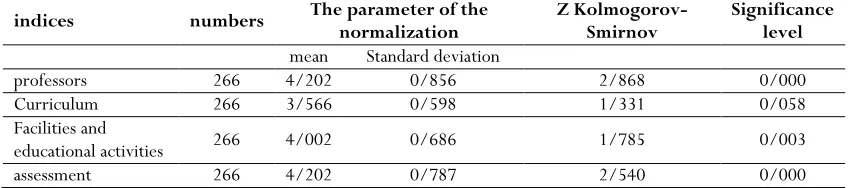
Table 1. Results of the Kolmogorov-Smirnov test to determine the normalization
indices numbers The parameter of the normalization Z Kolmogorov-Smirnov Significance level
mean Standard deviation
professors 266 4/202 0/856 2/868 0/000
Curriculum 266 3/566 0/598 1/331 0/058
Facilities and
educational activities 266 4/002 0/686 1/785 0/003
assessment 266 4/202 0/787 2/540 0/000
According to the results of table 1, considering that the significance level of the test error for the professors' indices, facilities and educational activities and the assessment at the confidence level of 0/95 is less than 0/05, it can be said that the variables of research are not at the normal levels, but due to the high
level of error, the curriculum index is 0/05, at the normal level. In such cases, statisticians are using self-assessment methodology to examine the model.
Fig. 1. Estimation of the educational system model of the University of Applied Science and Technology with standard coefficients
According to figure 1, it is seen that the significance level of all questions is less than 0/01 and also the factor loads of the courses are high and it is concluded that the model for the structure of the educational
system of the University of Applied Science and Technology without deleting the indices is verified.
Normality of All Indices |---
|* 28/473
|* 38/970
|* 49/467
|*** 59/964
|******* 70/460
|*********** 80/957
|***************** 91/454
|******************** 101/951 N = 800
|***************** 112/448 Mean = 92/502
|************ 122/945 S. e. = 0/858
|******** 133/442
|**** 143/938
|** 154/435
|* 164/932
|* 175/429
|---
Fig. 2. Normality of data with Monte Carlo self-regulation method for the structural model of research
As it is seen in figure 2, the model is normalized by self-regulation and the problem of the normalization of data is eliminated. To determine the model, two conditions are required: rating condition and rank
1
2
3
4
0/21
0/1 8
0/2 6
0/85
0/64
0/78
0/82 Professors
Curriculum
Educational facilities
Assessment
Educational system structure
0/20
condition. This model has the rating condition, since the degree of freedom of the model should be positive that according to the output of table 2, it is 20. Also, the number 10 is the number of non-existent variance-covariance matrix elements of the observed variables; and the number 8 is the number of free parameters defined in the model. The degree of freedom is the difference between two values that are estimated to be 2. Based on the positive degree of freedom obtained, the developed model is over- identified and there is information needed to estimate the parameters.
Table 2. Exploring identified and over- identified Models
statistics value
The number of non-existent elements of the variance-covariance matrix of the observed variables 10
The number of free parameters defined in the model 8
Degree of freedom (8-10) 2
Another hypothesis of the confirmatory-factor analysis is to have the rank condition. This model also has the rank condition because performing computational operations in matrix algebra is more feasible for estimating the parameters and reproducing the variance-covariance matrix of the observed variables (the significance level below 0/05).
Model fitting and modification indices to confirm confirmatory factor analysis for this model according to table 3; because the CMIN / DF is significantly greater than 0.05. Therefore, the above model has the adequate fitting. The more complex the model, the greater the probability of better fitting the data to the model, so that in a saturated model, fitting of the model will be complete. Given the sensitivity of the chi-square to the sample size, with increasing sample size, the probability of rejection of the zero hypothesis is
generally increased, since even a slight difference between two matrices S and Σ will be statistically
significant. Therefore, the other indices should be considered.
Table 3. Evaluation of the CMIN / DF index for the estimated model
Model NPAR CMIN DF P CMIN/DF
Developed model 8 95/108 2 0.000 47/554 Extraction model 10 0/000 0
Independent model 4 570/443 6 0.000 95/074
If the CFI, NFI, and IFI indices are greater than 90%, they indicate optimal fitting, and if they are greater than 80%, they indicate proper fitting of the model. Therefore, , the model has a favorable fit.
According to table 4, economical fitting indices have been higher than 50%, indicating that the model is economic.
Table 4. Indices of the economical fitting
Model PRATIO PNFI PCFI
Developed model 0/533 0/578 0/578
Extraction model 0/000 0/000 0/000
Independent model 1/000 0/000 0/000
Also, if the RMSEA indices are smaller than 0.05, they refer to the optimal fitting of the model, and if they are smaller than 0.08, it indicates the optimal fitting of the model (Alsopoulos and Kaliuszidis, 2004). According to table 5, the model has the positive fitting. Considering the fitting indices mentioned, in general, it can be said that the developed model has the well-fitting index.
Table 5. RMSEAindex for model fitting verification
Model RMSEA LO 90 HI 90 PCLOSE
Developed model 0/019 0/050 0/073 0/000 Extraction model 0/596 0/555 0/638 0/000
5. Discussion
As stated, the purpose of this study was to design a suitable model for the educational system of the University of Applied Science and Technology. Following the findings of the research, we will discuss and interpret the findings of the research:
According to the results of the analysis of the professor's index and according to the information obtained, it is concluded that the examined items can be considered as the damages of the educational system structure of the University of Applied Science and Technology in the professors' index. Also, the confirmatory analysis of the items of professors' index showed that all items of professors' index were approved. Lack of problem-searching and problem-solving capacities in different educational and research positions at the university by the professors, lack of attention to the integration of creativity and innovation components as a main element in the courses of the professors' retraining, inadequate professors' attention to all the training processes, lack of proper system for attracting elite or professional experts as professor, mismatches, content of training courses with the needs of professors, the traditional thinking in the design of training courses, lack of unitary policy to attract the professors, lack of testing and methods for the professors' skills assessment, shortage of full-time professors (faculty members) are considered as items approved by the factor analysis for the professors' index. Findings of this index can be consistent with the findings of the research done by Mohaddesi et al. (2011) indicating that to the professors, the field of teaching method and to the students, the ability to establish a friendly relationship with the students and counseling are the most important effective areas in the success of teaching. Torkzadeh et al. (2015), also concluded that the quality of classroom management was influenced by the systemic view of professors into the classroom and how it is managed. It follows that the adoption of any rational, natural or open system approaches, which determines the mode of thinking and practice of classroom management, leads to the emergence of conceptual approaches and the development of different mental and operational structures for the classroom, its activities and content.
According to the results of the analysis of the curriculum index and according to the information obtained, it is concluded that the studied items can be considered as damages to the structure of the educational system of the University of Applied Science and Technology in the curriculum index. A confirmation analysis of the items of the professors' indices also showed that all items in the curriculum are approved. Therefore, it is concluded that paying attention to the skill dimension in the curriculum, the lack of attention to the content of the curriculum in the sub-group of management and social services, the length of the approval process of the curriculum developed according to the jobs' analysis, the lack of attention to the development of the content of single-module courses, lack of attention to the content of the course through communication with the owners of the industry, the lack of a change in the curriculum for the development of productive employment with a proactive approach to sanctions and resilience economy, and the lack of attention to the
diversity and the presentation of specific scientific courses for the solution of human resources problems in the countries of the region are the verified elements of the factor analysis for the curriculum index.
Confirmatory analysis of the indices of facilities and educational activities showed that the lack of appropriate physical workshop and laboratory spaces in the most centers, lack of attention to educational standards in most centers, lack of training facilities in centers, lack of facilities in the private centers of the University of Applied Science and Technology, lack of efficient management to use existing facilities in the region, lack of enforcement of professional competence law, lack of interaction with the industry to exploit the capabilities of workshops and industry laboratories in providing the practical lessons, lack of attention to the development of new technology-based laboratories and workshops, the lack of attention to subsidiaries and their equipping for diplomatic ties, the low utilization of the indices and standards available in the field of skill training of the international organizations are as the validated items of factor analysis for the index of facilities and educational activities. The findings of this study can be compared with Woolfit's (2015) findings based on the use of video and teaching aids in facilitating the teaching-learning process for student. Also, the findings of this research can be compared with the results of the findings of the research done by Oosta et al. (2015) and Bordbar (2015), indicating that the factors of fitness of the curriculum, educational facilities and facilities, financial resources, goals, teaching-learning process, research, quality of teaching, student satisfaction, produced scientific works and graduates are the main factors influencing the efficiency of education.
The confirmatory analysis of the evaluation indices showed that the items of some professors with the correct way of evaluating the practical units, eliminating the comprehensive exam at the end of the course, the lack of integrated tests on general and common skills, lack of attention to holding skill assessment tests in centers (functional-skill), little attention to the creativity and innovation of the students and their evaluation, the low familiarity of the professors with the proper design of the end-of-the-course questions and the lack of attention to research and the presentation of the seminar by the student in the evaluation of the students are as the items verified of the factor analysis for the evaluation index.
In order to present the appropriate model of the educational system of the University of Applied Science and Technology, according to the findings of the research, it was considered that the significance level of all indices is less than 0.01 and also the factor loads of the courses are at a high level and it is concluded that the model is approved for the structure of the educational system of the University of Applied Science and Technology without the removal of indices. Also, fitness indices indicated that the model had the necessary utility as the structure of the educational system of the University of Applied Science and Technology. Findings of this research are consistent with the findings of the research done by Bordbar (2015) indicating that the most important educational damage in three dimensions of teaching, communication and evaluation are important. Tasdighi (2011), in his research concluded that Iran's educational system faces a lot of damage in 1404; it needs to change the structure, programs, goals and methods as an inevitable necessity.
Mehr Alizadeh et al. (2013), in his research, described the scientific challenge and critique, challenges to higher education, the managerial and political challenge of higher education, the challenge of weakness of monitoring and evaluation, the challenge of elite participation, the challenge of the lack of transnational institutionalization for the higher education Iran, as the faults of the educational system of Iran. The results are also consistent with the results of the research done by Karimi et al. (2013), based on a fault in the design of education curriculum. On the other hand, Mercer's findings (2015), showed that the curriculum and
teaching-learning processes were the main challenges of higher education and can be compared with the findings of this study. Digane et al. (2012), also find that there is a challenge to create an appropriate environment for students to study and encourage top students, the use of educational aids and pay attention to the practical part of the course to increase the students' skills and update the educational facilities at the university which can be considered in the line with research findings.
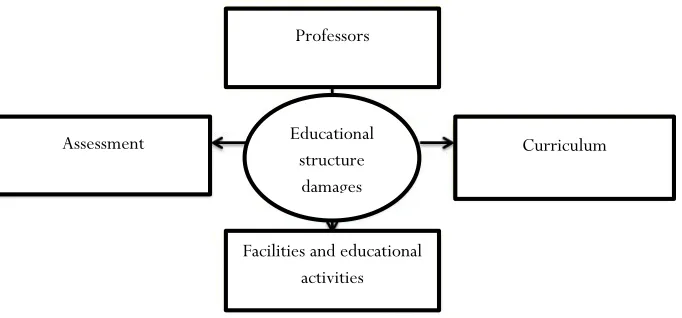
In general, the results of the research indicate that there is a damage in the dimensions of professors, curriculum, facilities and educational activities and evaluation. Regarding the fact that the present study was related to the pathology of the University of Applied Science and Technology, a three-dimensional theory of pathology is used to study the research. According to the classification of factors in this method, the verified model can be as follows.
Fig. 3. Classification of the Faults' Causes in the University of Applied Science and Technology
Assessment Curriculum
Professors
Facilities and educational activities Educational
structure damages
References
Boon hui T. (2016). “Evaluation of Service Quality of Private Higher Education Using Service Improvement Matrix”. Social and Behavioral Sciences. 224(15): 132-140.
Dariah A R, et al. (2016). “A new approach for sustainable development goals in Islamic perspective”, procedia- social and behavioral sciences. 219: 159-166.
Fardanesh H. (2011). “Theoretical Foundations of Educational Technology”. Tehran: Publications of the Organization for the Study and Compilation of Academic Books (SAMT)
Ganegodage K R, Rambaldi A N. (2014). “The Impact of Education Investment on Sri Lanka Economic Growth”. Economics of Education Review. 30: 1491-1502.
Koopaie Haji S, Najafi Hezar Jaribi H, Sarmadi M R, Farajollah M. (2014). “Designing an Optimal Model for Remote Education Management in the Higher Education System with Emphasis on Environmental Factors and New Technologies” Two Quarterly Journal of Educational Planning, Vol. 4, No. 7. pp: 163-178
Noroozi D, Razavi Seyyed A. (2011). “Educational Design Basics”. Publications Organization for the Study and Compilation of Academic Books (SAMT), Tehran.
Piscurich G M. (2006). “Rapid instructional design”. United State American: Pfeiffer 12 (1).
Smith M K, Ragan. (2005). “the behaviorist orientation to learning”. Retrieved from http://wwwinfed. Org/biblio/learning-behaviourist.htm, ganuary30.